Tag Archives: Arfa Khanum

Muslim Mirror Releases List of 100 Most Influential Indian Muslims 2025; Young Faces Gain Prominence

INDIA :

Muslim Mirror’s 100 Most Influential Muslims of 2025

New Delhi: 

Muslim Mirror has released its much-anticipated annual list of the “100 Most Influential Indian Muslims of 2025,” spotlighting individuals who have made significant contributions to India’s public life across a wide spectrum of fields including politics, culture, education, business, media, religion, sports, and social service. Now in its second edition, the list aims to document influence not merely as power or popularity, but as sustained impact, leadership, and the ability to shape public discourse.

A defining feature of the 2025 edition is the growing prominence of younger achievers, signalling a visible generational shift within Indian Muslim leadership. Alongside established national figures, the list includes emerging voices who have built influence through grassroots activism, professional excellence, digital platforms, legal advocacy, education, and community engagement. Editors associated with the project said this was a deliberate attempt to recognise new centres of influence beyond traditional hierarchies.

The list reflects the diversity and plural character of Indian Muslim society, cutting across geography, ideology, profession, and language. From seasoned politicians and religious scholars to artists, entrepreneurs, academics, and social reformers, the compilation offers a broad snapshot of leadership trends at a time when issues of representation, constitutional values, and social justice remain central to national debate.

Representation Across Sectors

The 2025 list features several eminent academicians and intellectuals who have shaped higher education, policy discourse, and social research. Among them are Abul Qasim Nomani, Ameerullah Khan, Furqan Qamar, Shahid Jamil, and Ubaid-ur-Rahman, recognised for their contributions to education, public policy, and academic leadership.

In the business and entrepreneurship category, the list includes influential names such as Azad Moopan, Azim Hashim Premji, Farah Malik, Irfan Razack, M. P. Ahammed, Mecca Rafiq Ahmed, Meraj Manal, Syed Mohamed Beary, P. Mohammed Ali, Shahnaz Hussain, Tausif Ahmad Mirza, Yusuff Ali, and Ziaullah Sharif. Their inclusion underlines the growing economic footprint of Indian Muslim entrepreneurs, both domestically and globally, spanning sectors from retail and healthcare to infrastructure and consumer goods.

Community leadership remains a strong pillar of the list, with figures such as Arshad Madani, Mahmood Madani, Malik Motasim Khan, Mehmood Pracha, Syedna Mufaddal Saifuddin, Navaid Hamid, Pirzada Md Abbas Siddiqui, Qasim Rasool Ilyas, Sadatullah Husaini, Umer Ahmed Ilyasi, and Yusuf Mohamed Abrahani recognised for their roles in religious guidance, legal advocacy, social mobilisation, and institutional leadership.

Culture, Media, and Public Discourse

In arts and entertainment, globally recognised names such as A. R. Rahman, Aamir Khan, Mammootty, Munawar Faruqui, and Shah Rukh Khan continue to command immense cultural influence, shaping narratives that extend well beyond cinema and music into social consciousness.

The list also acknowledges the growing importance of media and journalism in shaping opinion and challenging dominant narratives. Journalists and commentators such as Arfa Khanam, Irfan Meraj, and Seema Mustafa are recognised for their consistent engagement with issues of democracy, minority rights, and constitutional values.

Religious and Intellectual Scholarship

A significant section of the list is devoted to Islamic scholars and religious thinkers, reflecting their continued influence on moral leadership and intellectual discourse. Names such as A. P. Aboobacker Musliyar, Qasim Nomani, Prof. Akhtarul Wase, Asghar Ali Imam Mahdi Salafi, Asjad Raza Khan, Ibraheem Khaleel Al-Bukhari, Javed Jamil, Khalid Saifullah Rahmani, Khaleelur Rahman Sajjad Nomani, Qamaruzzaman Azmi, Rashid Shaz, Shakir Ali Noori, Shamail Nadvi, and Yasoob Abbas find place for their scholarly work, writings, and public engagement.

Politics and Governance

The political category features leaders cutting across party lines and regions, including Asaduddin Owaisi, Ghulam Nabi Azad, Hamid Ansari, Mehbooba Mufti, Omar Abdullah, Salman Khurshid, Najeeb Jung, Syed Naseer Hussain, Engineer Rashid, Akhtarul Iman, Iqra Hasan, Zameer Ahmed Khan, Rakibul Hasan, K. Rahman Khan, Kadir Mohideen, Mohibullah Nadvi, Md Shafi, Agha Mahadi, Asim Waqar, and Sadiq Ali Shihab Thangal. Their inclusion reflects influence exercised through electoral politics, governance, diplomacy, and legislative advocacy.

Changemakers and Social Reformers

One of the most dynamic sections of the 2025 list is that of changemakers and social reformers, featuring individuals such as Safeena Husain, Shahabuddin Yaqoob Quraishi, Syeda Hameed, Zameer Uddin Shah, Mahbubul Hoque, Sabahat S. Azim, Mehmood Pracha, Faiz Syed, and Zahir Ishaq Kazi, among others. Many of these figures have earned recognition through long-term grassroots work rather than formal authority.

International Booker Prize 2025 winner Banu Mushtaq for Heart Lamp, along with renowned poet Wasim Barelvi, has been placed in the category of Literary Figures.

In sports, iconic names Sania Mirza and Irfan Pathan continue to inspire younger generations through excellence and public engagement beyond the playing field.

Beyond Rankings

The editors emphasised that the list does not claim to be exhaustive, nor does it measure influence solely through fame, wealth, or official position. Instead, it seeks to capture real-world impact, moral authority, intellectual contribution, and the ability to shape conversations within and outside the community.

The annual list has increasingly become a reference point for understanding evolving leadership patterns among Indian Muslims. By foregrounding both established figures and rising talents, the 2025 edition reflects continuity as well as change, underscoring how Indian Muslims continue to contribute meaningfully to India’s democratic, cultural, and social field.

source: http://www.muslimmirror.com / Muslim Mirror / Home> Indian Muslim / by Muslim Mirror / January 15th, 2026

Chameli Devi Jain Award for Outstanding Woman Journalist awarded to Arfa Khanum Sherwani and Rohini Mohan

Bulandshahr, UTTAR PRADESH / NEW DELHI :

Arfa Khanum Sherwani works as senior editor with ‘The Wire’ while Rohini Mohan is a Bengaluru-based independent journalist

Arfa Khanum (left) and Rohini Mohan

Arfa Khanum (left) and Rohini Mohan

The Chameli Devi Jain Award for an Outstanding Woman Journalist was awarded jointly this year to Arfa Khanum Sherwani, senior editor, The Wire and Rohini Mohan, a Bengaluru-based independent journalist. Rukmini S., an independent data-journalist from Chennai, received an Honourable Mention.

The annual award, which recognises social concern, dedication, courage and compassion, received over 40 entries from all over India representing the print, broadcast and online media. While most entries were in English, a substantial proportion was also in Hindi, Malayalam, Odia and Telugu.

A three-member jury, comprising of Zoya Hasan, political scientist and Professor Emerita, Centre of Political Studies, Jawaharlal Nehru University; Sreenivasan Jain, Managing Editor, NDTV and Manoj Mitta, senior editor and author, felt that Arfa Khanum Sherwani excelled in reporting from conflict situations in Kashmir and Uttar Pradesh. Through her online videos in Hindi, including field reports and studio discussions, she displayed exceptional courage and empathy in giving a voice to people on the margins and holding authorities to account.

The jury observed that Rohini Mohan’s reportage on the NRC exercise in Assam set a new benchmark for investigative journalism. In the highest tradition of watchdog journalism, the meticulous research on the ground, her humane engagement with affected people, and analysis of the arbitrary conduct of the institutions involved yielded findings that proved to be far-reaching.

Rukmini S. the jury said, deserved special recognition for pushing the boundaries of data journalism in India.

The presentation of the award, scheduled for Saturday, which was to be followed by the BG Verghese Memorial Lecture by Madan Lokur, former justice of the Supreme Court, was postponed due to the coronavirus threat.

The Media Foundation instituted the Chameli Devi Jain Award for an Outstanding Woman Journalist in 1980, named after Chameli Devi Jain, a legendary freedom fighter and community reformer who went to jail for her beliefs. The first award was given in 1982 and nearly 40 years later it continues to recognise some of the best known and respected names in Indian journalism.

The Media Foundation was started in in 1979 with the aim of upholding freedom of speech, expression and information and to encourage freedom in society and enhance the quality of life through the media and process of communication. Its founding members were media luminaries including B.G. Verghese, L.C. Jain, Prabash Joshi. N.S. Jaganathan and Ajit Bhattachrjea. Currently, Mr Harish Khare, former editor, The Hindu and The Tribune is chairperson of the Foundation.

source: http://www.nationalheraldindia.com / National Herald / Home> India / by National Herald Web Desk / March 14th, 2020

The Wire’s Arfa Khanum Sherwani and Faiyaz Ahmad Wajeeh Win Red Ink Awards 2019

NEW DELHI :

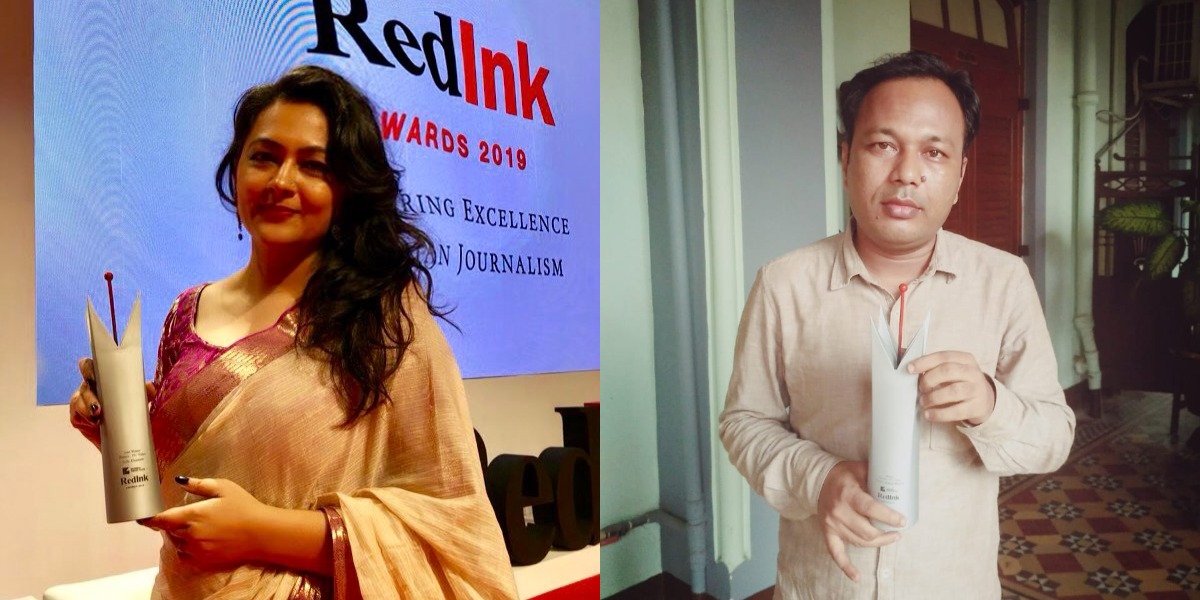
The Wire's Arfa Khanum Sherwani and Faiyaz Ahmad Wajeeh. Photo: The Wire
The Wire’s Arfa Khanum Sherwani and Faiyaz Ahmad Wajeeh. Photo: The Wire

While Sherwani won in the Politics (TV) category for her interview with Sri Sri Ravi Shankar, Wajeeh was declared winner of the Arts (TV) category for his story on a bookstore.

New Delhi:

The Wire‘s Arfa Khanum Sherwani and Faiyaz Ahmad Wajeeh bagged the prestigious Red Ink Awards on Friday. While Sherwani won in the Politics (TV) category for her interview with Sri Sri Ravi Shankar of The Art of Living foundation, Wajeeh was declared winner of the Arts (TV) category for his video on a bookstore that brought together Urdu’s literary greats.

Sherwani’s interview with Ravi Shankar was on his comments on the Ayodhya land dispute case in March 2018, when he said if the Ram mandir issue is not resolved “we will have a Syria in India”. While Sherwani pressed him on the issue, the interview was ended abruptly by members of his team. The video was produced by Akhil Kumar, while the camera was handled by Moniza Hafizee and editing by Asad Ali.

Wajeeh’s story was on 88-year old Shahid Ali Khan’s lifelong passion for Urdu literature. His journey with Maktaba Jamia, a publishing house and bookstore, took him from Delhi to Mumbai in 1957, where he befriended renowned Urdu writers and poets like Sahir Ludhianvi, Jan Nisar Akhtar, Meena Kumari and Jagan Nath Azad. He now runs the Nai Kitab publishing house in Delhi.

The video was produced by Hina Fathima, who also handled the camera. The video was narrated by Yasmeen Rashidi, while the poetry was translated by Meenakshi Tewari.

Apart from the two winners, The Wire‘s Kabir Agarwal, Jahnavi Sen and Ishita Mishra also received special mentions for their stories. Agarwal’s four-part series on Swach Bharat and its implementation in Uttar Pradesh received a special mention in the Health and Wellness category. Read the four parts here .

Jahnavi Sen’s story on the failure of the government to recognise and rehabilitate manual scavengers received a special mention in the Human Rights category. Ishita Mishra’s story on the BJP’s efforts to monitor the stories published in the media also received a special mention, in the Politics category.

The Red Ink Awards for Excellence in Journalism are announced annually by the Mumbai Press Club and recognise meritorious work in TV, print and digital formats. Awards are presented in various categories such as politics, crime, health and wellness, business, environment, human rights, photography, science and innovation, entertainment and lifestyle, and sports as well as a category called ‘Mumbai Star Reporter’. It is the only awards instituted by a professional body.

The Journalist of the Year Award went to former Tribune journalist Rachna Khaira for her expose on the functioning of the Unique Identification Authority of Indian (UIDAI) and its Aadhaar data cache. Lifetime achievement awards were given to former Maharashtra Times journalist Dinu Ranadiv and Mumbai Mirror‘s former photo editor Sebastian D’Souza.

source: http://www.thewire.in / The Wire / Home> Media / by The Wire Staff / June 29th, 2019

Delhi Youth Welfare Association and American Federation of Muslims of Indian Origin felicitate meritorous students

NEW DELHI :

DYWAwadsMPOs15jan2019

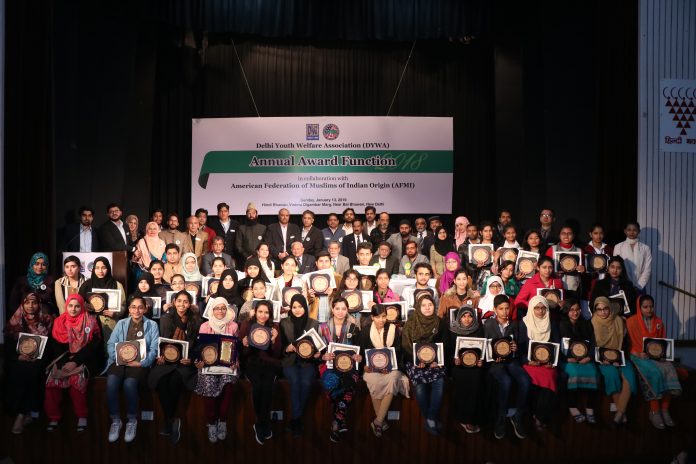
Delhi Youth Welfare Association (DYWA) in collaboration with American Federation of Muslims of Indian Origin (AFMI), organized the DYWA Annual Award Celebration on 13thJanuary 2019 at Hindi Bhawan, Rouse Avenue, New Delhi.

96 students from 15 schools were felicitated with a shields, certificates and cash prizes. Five special awards were also given. Maulana Azad Education Foundation (best government organisation), Society for Promotion of Education (best non-government organization), Shehnaz (best student, class XII), Nikhat Urooj and Iffat Zareen (best students, Urdu Language/Literature in class XII) and Rabea Girls’ Public School (the school with highest number of individual awards in class X & XII).

This was the 28th edition of annual awards.

Various educationists, social activists and political leaders such as Arfa Khanum (Senior Journalist, The Wire), Dr. A.S. Nakadar (Founder Trustee and Former President AFMI), Dr. Aslam Abdullah (Editor, Muslim Observer and Director Islamic Society of Nevada) attended the convention as guests.

Siraj Hussain, former vice chancellor, Jamia Hamdard University, was the chief guest at the event. He shared a few tips on how to become civil servants. “Befriend as many books as you can. And choose best universities to pursue higher education,” he said.

Dr. Nakadar encouraged students to identify their latent talents. “Stop comparing yourself with others. It will make you better person and best among the people,” he said.

Arfa Khanum shared her journey from a small town in Uttar Pradesh to charting a successful career in journalism. “Being in Delhi is a privileged which many of you may have overlooked. You must make use the resources available to you to the optimum. You are the future of India and you would decide what this nation wants,” she said.

Aslam Abdullah underlined the perils of patriarchy. “We ought to treat at par with men. That is a perquisite for us to bring about any change,” he said.

DYWA is a well-known organization of old Delhi and has been working in the field of education for the last 28 years and AFMI (American Federation of Muslims of Indian origin) is a philanthropic charity formed by American Muslims of Indian Origin in the year 1989.

source: http://www.twocircles.net / TwoCircles.net / Home> Education> India News> Indian Muslim> Lead Story / by TCN News / January 15th, 2019

News channels in India are in adolescent phase: Arfa Khanum

UTTAR PRADESH / NEW DELHI :

ArfaKhanumMPOs30sept2016

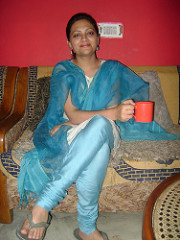
Television journalism is one of the most glamorous jobs of new India. Arfa Khanum Sherwani as principal correspondent and news anchor for NDTV India holds one of those glamorous jobs. Her home in New Delhi is an example of simplicity. She used to be in front of her camera, but this time she was the subject of the interview. I asked her about television journalism in India which is barely a decade old.

While Ms. Sherwani is very optimistic about the future of news channels in India, she is also brutally honest in accepting the mistakes made by electronic journalists.

Arfa, originally from UP, is a Chemistry graduate. She did a one year course in journalism from Aligarh Muslim University (AMU) and joined The Pioneer. From there she moved to The Asian Age. Realizing that she is more comfortable in a visual medium, she found herself as a TV reporter and news anchor.

Arfa has won accolades and criticism for her courageous and investigative reporting on Sachar Committee Report, Batla House encounter, and a special on the performance of the Ministry of Minority Affairs.

“News channels in India are in adolescent phase,” Arfa argues and that’s why they seem to be moving from one experiment to another, still trying to find a firm footing. She is critical of the abuse of the term ‘breaking news’ and over reliance on TRP, the rating system used by the Indian TV channels.

Arfa does not hesitate in calling the news dished out by TV channels as ‘infotainment.’ She calls for higher standard and believes that viewers are ready to watch quality journalism if given the opportunity.

She is passionate about the media and believes that she has so much to learn and excited about the opportunity to learn something new every day. She wants to be known as a serious journalist who is a face of authenticity who raises people’s issues and concerns and becomes their voice.

A sign of good journalist, she always keeps a notebook to record her thoughts and a book to keep herself informed of the issues.

Watch Arfa’s report on performance of the Ministry of Minority Affairs

source: http://www.twocircles.net / TwoCircles.net / Home> Articles / by Kashif-ul-Huda, TwoCirlces.net / June 16th, 2009