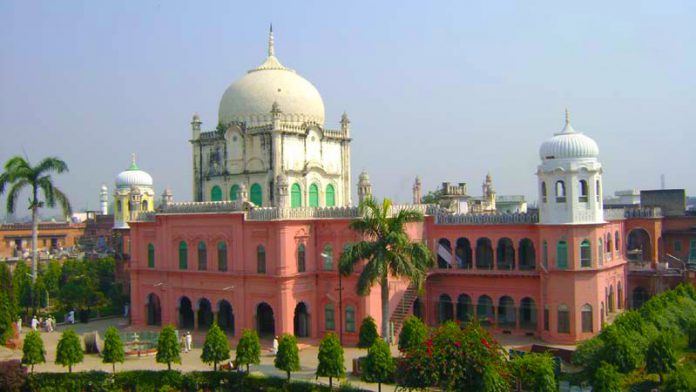
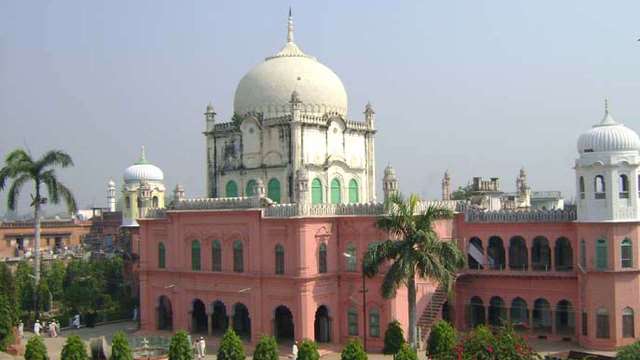
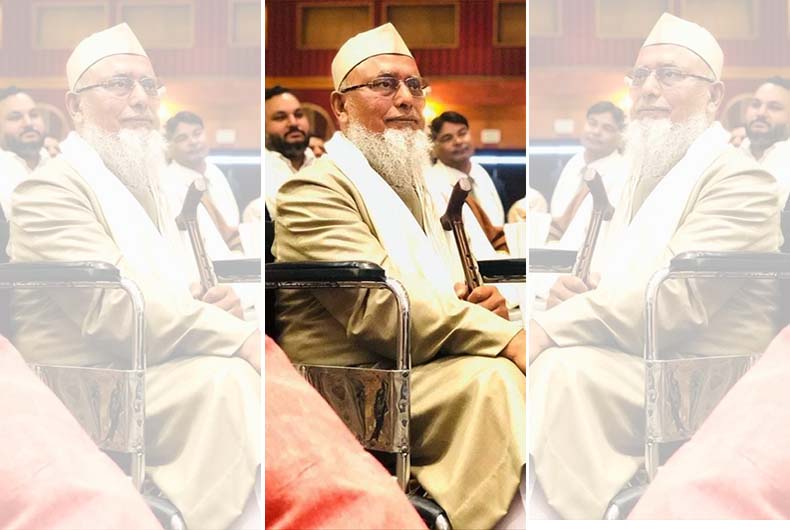
Tag Archives: Darul Uloom Deoband

Maulana Mohammad Ismail Sambhali: Scholar, Freedom Fighter and Politician

Sambhal (Moradabad District) , UTTAR PRADESH :

One of the oldest places in Uttar Pradesh is Sambhal in District Moradabad, has a long list of people in its history who confronted with British and posed great resistance with their historic acts of gallantry. Abdul Qaiyyum, Lala Prem Pal, Qari Abdul Haq, Maqsood Turki, Chaudhary Riyasat Ali, Lala Chandulal, Lala Roop Kishor, Maulvi Noorul Hasan, Sheikh Abdul Raheem, Chetan Swaroop, Radhey Lal Poddar, Munshi Moinuddin, Ml. Sultan Ahmad,Maulvi Abdul Waheed are prominent among such people.

The exact date of birth of Maulana Ismail Sambhli is not known however, he might have taken birth in 1899 at Mohallah Deepa Sarai. He belonged to the Sarwar Waley family of Turk community. His father, Munshi Kifayatullah was considered among the educated people of the area and was famous with the nickname ‘Munshiji’. His grandfather’s name was Sarwar Husain who was a native to village Mundha in J. P. Nagar. Later he shifted to Sambhal. His family surname, Sarwar Waley was due to his grandfather’s name.

He received primary education at Madrasatul Mohammadia, Deepa Sarai and was admitted to class VI to continue further education in English against his mother’s wish. She wanted him to get Arabic education and finally her will prevailed. Meanwhile, his father passed away and he was sent to his elder brother at Bahawalpur where he had the honour to receive education from Maulana Farooq Ahmad, Sheikhul Hadees and Head, Jamia Usmania.

Maulana Farooq Ahmad was the disciple of Shaikhul Hind Maulana Mahmoodul Hasan and relative of Maulana Mansoor Ansari who was put on exile on the pretext of abetting and participating in the freedom movement. He was extremely unhappy with British and a staunch supporter of freedom struggle. It was his company that helped instill a sense of nationalism in the heart of Maulana Ismail Sambhli and inspired him to participate in the freedom struggle.

After completing education at Bahawalpur, Maulana Ismail Sambhli returned back to his native place, Sambhal and continued with his education at Madrasa Sirajul Uloom. In the meantime the barbaric incident of Jalianwala Bagh took place that put the whole of India on fire. A protest strike was observed in Sambhal as well and a mass gathering of all communities was organized at the gardens of Gul Chhatar. Maulana Ismail Sambhli delivered a very inspiring lecture at the mass convention. Maulana was the youngest among all orators yet his oration impressed the public most and thus his national and political life began. Maulana gained popularity as Raees-ul Muqarrareen (master orator).

When the British defeated Turkey, the resulting loss and the sense of defeat made the Muslims furious. On November 22, 1919 the Khilafat Committee was founded and the Jamiatul Ulema-e-Hind took birth in Delhi. The Khilafat Movement was pronounced through out the country. Just months after the sad demise of Sheikhul Hind Maulana Mahmoodul Hasan, Maulana Ismail Sambhli took admission in Darul Uloom Deoband where his nationalist ideas and concepts received firmness. He started partaking in the nationalist activities with much vigour and zeal and despite him being a student he was arrested on February 22, 1921 for his radical ideas and inflammatory speeches. After two – three days his case was heard at Moradabad Jail and he was sentenced to two years’ rigorous imprisonment. Then the political detainees were generally subject to extreme brutalities. Maulana and his companions borne all types of atrocities. They were put under penal servitude, were imprisoned in small cages and were compelled to sleep handcuffed. Precisely, they were put to all types of brutalities but did not tender apology. Finally, he was released after the term of his punishment was over. Back to home he concentrated on completing his education. After completing courses at Darul Uloom Deoband he joined Jamia Qasmia Madrasa Shahi, Moradabad as a teacher in later 1924. The country’s condition had changed by the time, Khilafat had come to an end, there were communal disturbances through out the country and Congress had suspended its Civil Disobedience Movement. Mahatma Gandhi was imprisoned for six years. People were feeling let down but Maulana Sambhali kept moving ahead with full confidence.

In 1930 when Congress proclaimed for complete freedom. On March 13 Mahatma Gandhi commenced his famous Dandi march in violation of the laws of salt. A Civil Disobedience Movement was also commenced.

The Britishers put the nationalist people to extreme brutalities. They were mercilessly beaten, shot by guns and imprisoned. The Jamiatul Ulema sense the need of the hour and vowed to support Congress in its Civil Disobedience Movement. It established a Daira-e-Harabia (Circle of War). Mufti Kifayatullah, Maulana Ahmad Saeed, Maulana Husain Ahmad and Maulana Mubarak Husain Sambhli were arrested one by one. Maulana Mohammad Ismail Sambhli was the seventh in this order to be arrested and was sentenced to six months’ rigorous imprisonment.

When the time came for Provincial Assembly elections, the Muslim League Parliamentary Board came to existence. On behalf of Maulana Ahmad Saeed, Nazim of Jamiatul Ulema Mohammad Ali Jinnah was given the right to nominate members to the parliamentary board. Mr. Jinnah nominated 22 members from 56 out of which 20 were of Jamiatul Ulema and two of Ahrar. The Provincial Boards were under the control of Central Board. Maulana Ismail Sambhli was admitted to UP Board. He was also declared candidate from Sambhal of Moradabad and Tehsil Bilari constituencies. Those days the land lords, nawabs, kings and English title holders enjoyed great immunity and British supported people were considered prominent in the society. The nationalists participated in the election to defeat the pro-British candidates.

In 1939, the war in Europe started and the Indian government without taking the members in confidence sent the Indian army to war. The Congress opposed the move and boycotted the Assembly. It convened its session at Ramgarh on March 20-21, 1940 under the president ship of Maulana Abul Kalam Azad. The Civil Disobedience Movement was pronounced in the session and finally in the last of 1940 the non-violent civil disobedience movement commenced. A programme was chalked out for individual speeches. Maulana Ismail Sambhli was arrested in Moradabad during the movement and was sentenced for nine months’ imprisonment. In August 1942, Congress gave the famous ‘Leave India’ slogan. Mahatma Gandhi was arrested and sent to Sabarmati Jail. There were arrests every where in the country. Maulana Ismail Sambhli was again arrested in Sambhal and was put under house arrest at Moradabad Jail for indefinite period. Later he was released after one year.

In 1946, when elections were declared, the tussle between Congress and Muslim League was at its peak. Maulana Sambhli was elected, remained MLA till 1952.

Maulana Ismail Sambhli did not participate in the 1952 elections and stationed at Delhi as the Nazim-e-Ala of Jamiatul Ulema. He served Jamiat for four years and remained busy in social and political affairs. In 1957 he resigned from Jamiat and returned to Sambhal.

In 1962, he was appointed as Sheikhul Hadees at Madrasa Imdadia, Moradabad and served there for about three years.. In 1974, he shunned the idea of service and returned back to Sambhal and engaged himself in the literary work only to complete the half hatched books. “Maqalat-e-Tasawwuf”, “Akhbarul Tanzeel” (the Quranic prophesies) and “Taquleed-e-Aimma” are some important books authored by him.

Meanwhile he went to Mawana, Meerut and taught Quran’s translation for eight months. In his last age, he spent a few Ramadhan months in Bombay delivering lectures on the translation and analysis of Quran every night after Taraweeh. He fell sick in the last Ramadhan of his life yet, and after returning to Sambhal he breathed his last on 23rd November 1975 after one and half months’ prolonged illness. (deoband.net)

source: http://www.milligazette.com / The Milli Gazette / Home> News> Family & Kids / by Mohammad Najeeb Qasmi / May 22nd, 2016
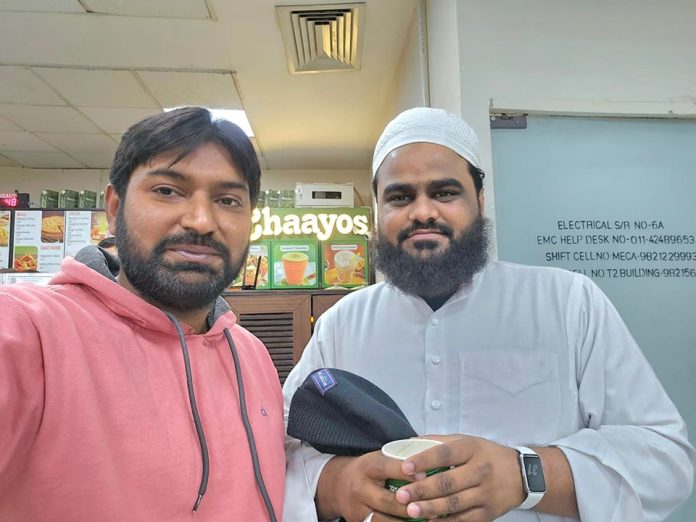
Madrasa 2.0: Moulana Mehdi Hasan and the Dream of IIAD

Deoband, UTTAR PRADESH / DELHI :

It was a hot, restless afternoon in New Delhi – the kind where the sun presses down with such fury that even the breeze seems to hide. The air was thick with chants, placards, and purpose. Students from across the capital’s universities had gathered in protest – a voice of defiance against the rising wave of mob lynchings sweeping through India, backed by extremist ideologies. Amid the sea of young faces, I noticed a small group that stood out. They were not university students in jeans and t-shirts, but madrasa students in simple white kurtas and skullcaps, holding banners of peace and justice.

They had come all the way from Deoband, a quiet town that has long been a lighthouse of Islamic learning, to stand shoulder to shoulder with victims’ families. Among them was a young scholar whose calm presence carried a certain gravity: Moulana Mehdi Hasan Aini Qasmi.

Our meeting was brief, just a few words exchanged, a handshake perhaps, but something about him stayed with me. I didn’t know then that this quiet madrasa graduate would one day become the face of a remarkable educational revolution in India.

The Seeds of Brotherhood

Two years later, in 2018, the Students Islamic Organisation of India (SIO) held its grand All India Conference in New Delhi, themed “Reclaiming Dignity | Designing the Future.” Among the audience of fiery youth and intellectuals, Mehdi Hasan was invited as a representative of madrasa students – being the President of the Abna-e-Madaris (Old Boys’ Association of Deoband).

When he spoke, his words carried the depth of tradition and the urgency of modern times. After the session, we found ourselves in a long conversation about faith, education, and the future of Muslim youth. That day, a brotherhood was born – one that would travel far beyond Delhi’s conference halls.

Soon, he invited me to Deoband. What began as a visit turned into a revelation. We walked through the majestic gates of Darul Uloom Deoband, met students immersed in their studies, and discussed the evolving role of Islamic education in a rapidly changing India. It was there I saw the spark – Mehdi’s vision was clear: to bridge the gap between traditional Islamic scholarship and the demands of modern society.

From Streets to Seminars

Between 2019 and 2020, our journey turned into a mission. Together, we travelled across India – from the quiet corners of Tripura to the bustling lanes of Telangana – addressing crowds, organising awareness drives, and speaking against hate, Islamophobia, and discrimination.

Then came the storm – COVID-19. India went silent. The streets emptied. Institutions shut their doors. But we refused to stop. Our activism simply changed form. While the world was locked down, we were reaching out – distributing relief, helping stranded students, and connecting youth through virtual spaces.

One late-night discussion during those months became the turning point.

“If people have time,” I said thoughtfully, “why can’t we bring madrasa education online? Why can’t we empower teachers who have no income now? Why can’t we teach our youth skills to survive?”

That one why became a revolution.

Over the next two years, the spark spread like wildfire. Under Mehdi’s leadership, IIAD organised over ten national workshops across India, reaching thousands of students from Aurangabad to Delhi. These workshops covered topics far beyond theology – from Education to Entrepreneurship and Islamic Thought to Social Leadership.

One such event, the Aurangabad Education Expo, became a milestone in connecting madrasa students with mainstream educational opportunities. Through these sessions, IIAD began to carve a new narrative for Islamic learning – one that embraced progress without compromising on principles.

The Birth of an Idea

Our first online programme, “Education to Entrepreneurship,” was meant to be a small initiative – a bridge between learning and livelihood. But the response was beyond imagination. Hundreds of madrasa students and teachers joined from every corner of India.

We realised we had touched a nerve – there was a hunger for knowledge, a thirst for relevance. In 2022, we organised an offline workshop in Bidar at Shaheen Group of Institutions for madrasa students. To our surprise, several attendees were already running small businesses – many of whom had attended our first online sessions back in 2020.

One night, Moulana Mehdi and I sat in deep conversation till Fajr. The sky turned from ink to gold as we reached a decision that would change everything: to start a full-fledged online institute for Islamic education and leadership and the name finalised was “India Islamic Academy Deoband” and now it is a brand in Madaris Circles.

But Mehdi had already taken the first step. Before our official launch, he had begun teaching small groups online – offering a Basic Islamic Foundation Course (3 months) and an Advanced Islamic Studies Course (6 months). Within weeks, the response exploded. Students from across India – and even abroad – joined.

And then, in 2021, the dream took shape.

Multi-Dimensional Mehdi

Many madrasa teachers benefited from IIAD’s programmes and became self-sustained, empowered to teach and earn through digital platforms. Watching this transformation unfold, I became deeply impressed by Moulana Mehdi Hasan’s multifaceted personality.

As a student, he had marched with his friends in protests; later, he organised them. As a social activist, he raised his voice fearlessly and even faced police cases. Through his advocacy work within Muslim organisations, he united madrasa youth under a shared purpose – to stand up for justice, particularly during the anti-CAA movement, where he became a leading voice representing madrasa student unions.

During the pandemic, the COVID-19 crisis his alumni group at Darul Uloom Deoband established a help-desk that handled thousands of calls, distributed oxygen cylinders and fought misinformation – reinforcing his role as a frontline community leader, he turned compassion into action as a social worker, extending relief to the needy.

As a writer and journalist, he penned articles and books that shaped public discourse in Urdu media. And as an entrepreneur, he became the very example he urged others to follow – transforming his vision for empowering madrasa students into a thriving digital institution.

The Rise of IIAD – India Islamic Academy Deoband

The official launch of India Islamic Academy Deoband (IIAD) was not just the founding of an institution; it was the dawn of a new era. For the first time, a madrasa-based initiative had embraced technology to take classical Islamic education to every home.

The story of IIAD began in 2017, when a vision was realised – to bridge authentic Islamic scholarship with modern accessibility. What started as a modest initiative soon blossomed into a movement that redefined faith-based learning for the digital era.

By 2019, IIAD proudly celebrated the first wave of scholars graduating from its inaugural Aalim programme, ready to serve their communities with knowledge and integrity. The academy’s turning point came in 2021, when it launched its Global Digital Campus – a state-of-the-art online learning platform that connected students and scholars across continents.

And by 2024, that vision had grown into a vibrant global community – a growing Ummah of over 5,000 students from diverse countries, all united by the pursuit of knowledge and purpose.

The journey of IIAD stands as a testament to how faith, when paired with foresight and innovation, can transform education and empower generations.

What began with few offline and online courses soon expanded into a vast ecosystem. Today, IIAD offers 15 specialised courses – blending Islamic scholarship with modern subjects like media, leadership, and entrepreneurship. The courses are taught in Urdu and English.

From the official website, one can see how IIAD evolved with a clear mission – to empower the next generation of Muslim scholars, entrepreneurs, and thought leaders. The vision was simple yet revolutionary: “To make Islamic learning accessible, practical, and globally relevant.”

But Mehdi’s ambition didn’t stop there.

The Expanding Vision

He founded the Abna-e-Madaris Educational Trust, a platform that supports social and educational initiatives across India. Through it, he organised relief programmes, training sessions, and mentorship circles for youth.

He also launched Deoband Dastak, an online Urdu news portal that amplifies the voices of the unheard and highlights stories of reform within the madrasa ecosystem. His pen became his sword – through articles, opinions, and books – shaping discourse and reclaiming narratives.

Now, as IIAD moves forward, the academy is preparing to launch a course on Artificial Intelligence for Madrasa Students and a Crash Course on Entrepreneurship, opening doors that were once unimaginable in traditional settings.

To further strengthen academic and intellectual pursuits, Moulana Mehdi established another pioneering platform – the Deoband Educational and Research Foundation (DERF). The foundation aims to promote rigorous scholarship, interfaith dialogue, and academic research rooted in Islamic tradition while engaging contemporary challenges. Through DERF, Mehdi envisions nurturing a new generation of Muslim researchers who can think critically, write powerfully, and contribute meaningfully to global discourse.

A Bridge Between Two Worlds

What makes Moulana Mehdi Hasan Aini Qasmi truly remarkable is not merely what he built – but what he bridged.

For centuries, madrasa and modern education were seen as parallel lines – never meeting. But through his courage, vision, and relentless work, Mehdi made them intersect. He became the bridge, connecting heritage with progress, theology with technology, tradition with transformation.

From joining protests as a young activist to leading educational innovation as an entrepreneur, his journey is not just a personal success story; it is a blueprint for a generation.

Today, when I see students from humble madrasa backgrounds speaking about startups, media literacy, and AI ethics, I see his reflection in every one of them.

He has proven that change doesn’t always come from power or privilege. Sometimes, it begins with a simple idea shared between two friends – on a sleepless night – under a sky just beginning to brighten.

Humanitarian Impact

Beyond education and activism, Mehdi Hasan’s compassion flows into the heart of social service. Through his initiatives and trusts, hundreds of struggling families found hope. 300 families had their kitchens lit through ration kits during Ramadan-ul-Mubarak; 100 families were gifted festive joy on Eid al-Fitr; and 50 Imams and Mu’azzins were honoured with Eid gifts. During Eid al-Adha, 200 households were provided Qurbani meat and essentials, while 15 destitute women received full maternity care with dignity.

Each month, 15 orphaned madrasa students are sponsored, 50 talented youth receive scholarships, and teachers of five Makatib-e-Qurani are paid regular salaries, ensuring that the flame of knowledge never dims.

Even during disasters, his team reached out, sending 100 blankets and supplies to flood victims in Punjab, a testament to his unshakeable belief that service to humanity is service to faith.

And that, perhaps, is the story of Moulana Mehdi Hasan Aini Qasmi – a madrasa graduate who dreamed beyond walls, taught beyond classrooms, and built bridges where there were once only divides.

source: http://www.radiancenews.com / Radiance News / Home> Entrepreneurship> Features> Focus / by Syed Azharuddin / October 23rd, 2025

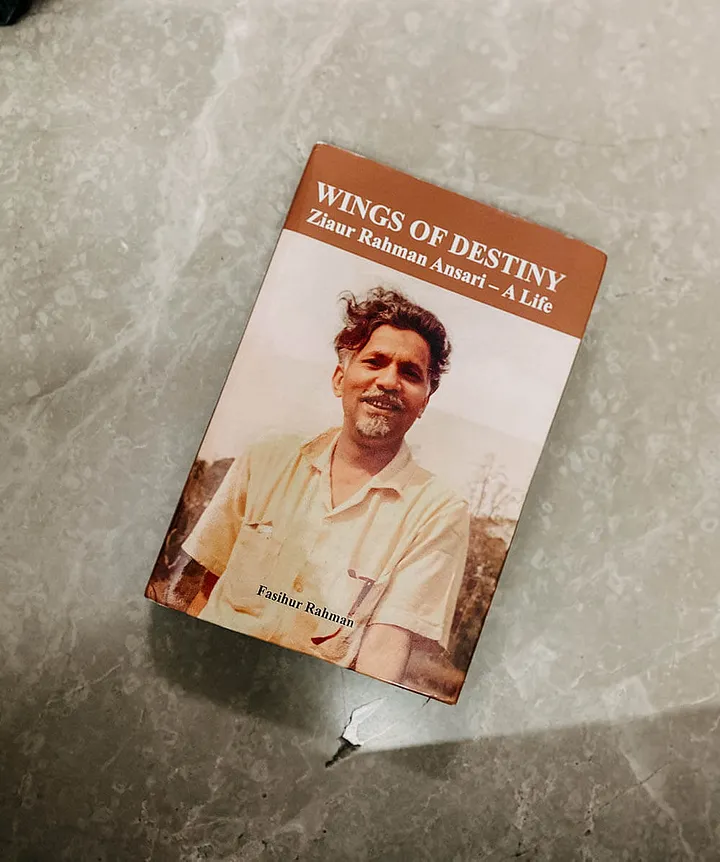
Book Review of ‘Wings of Destiny — Ziaur Rahman Ansari — A life’ by Fasihur Rahman

UTTAR PRADESH / NEW DELHI :

Ziaur Ansari was a prominent political figure, having served as the Union minister in the council of 2 Prime ministers Indira and Rajiv Gandhi. Wings of Destiny written by his son Fasihur Rahman is an ode to his entire political career spanning more than three decades and highlights the stalwart’s remarkable, inspirational life as well as clears the air around the controversies surrounding him.

When the truth stands coy in a corner, visible and yet under the pretence of being unknown and unacknowledged, you know that something somewhere is unfair.

Indeed, many times in life, there comes a threshold where one needs to understand and realize that truth which is the most supreme of all, can be an eye opener, as well as a beautiful and also a terrible thing, many a time. Terrible because there may be more to the situation than what meets the eye.

Yes, we all know and have read about the countless hardships that all of us underwent during the Indian freedom struggle. But, surely not all has come to light as far as the involvement of all parties, be it left or right is concerned. Yes, Muslims too were an integral part of the struggle towards Independence, their contribution being extremely indispensable. A prominent figure among them is Ziaur Rahman Ansari who served as Union minister from 1973 to 1977 and from 1980 to 1989 during the council of two Prime Ministers -Indira Gandhi and Rajiv Gandhi, this book which is written by his nephew Fasihur Rahman is a memoir cum biographical sketch of Ziaur Ansari’s life.

Ziaur Ansari was primarily in the spotlight in the year 1985, when he participated in a debate on a private Member Bill related to the SC judgement on the Shah Bano case, which to date remains one of the most debated issues in India as well as abroad. Having been often misquoted, misinterpreted and improperly perceived, Fasihur has taken it upon himself to finally take the opportunity to tell the world the true story behind Ziaur’s life.

The book which began with giving an ancestral account of Ansari primarily spoke about his father Habibur Rahman Ansari’s invaluable contribution to the freedom movement. What followed was the journey through Ziaur Rahman’s pursuit of politics which was turbulent and spanned a period of almost three decades, showing how he contested 9 elections.

Ziaur, not only being a man of strong ethics and politics, nevertheless was a man with a passion for fine arts, poetry, literature and music too. Ziaur was also inspired by Abul Kalam Azad’s legacy which was one of the cores of Rahman’s life. The hardships suffered by the Ulamas aka the religious scholars after the Mutiny of 1857 have also been explored by Fasihur here highlighting the true role of Darul Uloom Deoband in the Indian freedom struggle. I, for once, was amazed by this one since like mentioned earlier, I realized that many religious scholars, many freedom fighters have remained unsung, unacknowledged in their role in the struggle against the British rule for reasons which were, are and perhaps will always be something we shall never be able to comprehend fully. Racism, unfortunately, in the most erred way possible, nevertheless, Fasihur has brought forth a lot of undeciphered and unknown details forward.

Have you ever known or read about the famous Shah Bano case and the subsequent judgement of 1985? Well, the book explores the same in its entirety giving us Ziaur’s intervention in the Parliamentary debate on the SC judgement.

Ziaur Rahman was the president for a tenure of almost three decades at the All India Momin conference. The book provides a complete walk through the evolution, historical significance, mandate, and contribution of the conference in the complete socio-economic upliftment of the Muslim artisans. It also highlights their contribution to the freedom movement in India.

The last two years of Ziaur’s life were traumatic as Amyotrophic Lateral Sclerosis, an incurable neurological disorder, marked them. Characterized by loss of speech this is one of the most painful possible diseases and indeed Ziaur’s pain and anguish must have been sheer agony.

Lagate ho jigar pe teer par hum kuch nahi kehte. Zabaan hote hue ye bezabaani dekhte jao…

This Urdu couplet which was used by Ziaur himself to express the trauma of the condition he was reduced to was something that shook me personally, making me fathom and realize the kind of inability and pain the disease might have led him to. It was heartbreaking to read the complete scenario, especially since Fasihur has revealed how even being the prominent voice he had been, Ziaur was unable to speed track the path to going abroad and procuring the treatment which would have cured him.

A brilliantly written book, this one is a memoir you surely should not miss. Fasihur Rahman is impeccable in detail, immaculate in expression, not shying away from portraying facts as well as refraining from giving any kind of a judgmental tonality to any of the data he has provided. A crisp narration, this one will give you a lot of detail especially as it delves into pre as well as post-independence happenings and thus will be of interest as well as use to readers and historians too alike.

source: http://www.booxoul.medium.com / Medium.com / Home> Booxoul / December 14th, 2022

Reflections on a Mission: A Visit to Vision International Academy, Phulat

Kodangallur, KERALA / Fulat(Phulat)Village (Muzaffarnagar District), UTTAR PRADESH :

Recently, I had the opportunity to visit Vision International Academy (VIA), situated in the village of Fullat in Muzaffarnagar district, Uttar Pradesh. It was a journey I had long awaited. Spending time with the children there—even briefly—was a moving experience. Before me sat over 300 Huffaz—young children who had committed the Qur’an to memory. But the academy is not merely a Hifz institution. As the name “Vision” suggests, it embodies a deeper insight into human potential, blending spiritual excellence with academic brilliance.

Mammooty Anjukunnu

That evening, while returning to Darul Uloom Deoband, I received a call from Babukka. He sounded emotional. He had called to express his joy—not just about my visit to Vision or meeting the students—but about something much greater. Because what I had visited was not just another educational center. It was a mission. A dream. And behind it stood the journey of a visionary man.

Let me tell you that story.

A man from Kodungallur, Kerala—Ameer Ahmad Babu Manappat—never imagined that his life would take a turn into the field of Islamic education. A former student of Aligarh Muslim University, he was first struck by the concept of Hifz during a visit to Delhi. Intrigued, he began exploring madrasas in SaharanpurDeoband, and surrounding areas of North India. He wanted to understand the intellectual capacity of Huffaz. People had told him these children possessed extraordinary memory and brilliance.

However, while interacting with them, he found something amiss. These bright children, despite having memorized the entire Qur’an, were often unaware of the world outside. And he, in turn, was a stranger to theirs. This encounter exposed a painful reality: two different worlds existed—and there was a vast, unbridged distance between them.

In North India, the term “madrasa” is broad and includes Hifz centers, Arabic colleges, and basic religious schools. Many children are enrolled in such madrasas without access to formal education. They might learn basic arithmetic or science, but there’s little focus on academic rigor or integration. Most teachers remain confined to their own disciplines. The idea of combining Qur’anic and modern education barely exists.

Ameer Babu, grandson of Kerala’s renowned Muslim reformer Manappat Kunhahammad Haji, felt a growing sense of responsibility. He believed that Huffaz—gifted with sharpened intellect and memory—deserved access to high-quality general education. Their potential, he thought, could be channeled for the upliftment of society and the community.

He spent months researching and, with experts, developed an innovative bridge course—an academic fast-track that compresses eight years of schooling into one. After two more years, students would be ready for the 10th-grade public examination.

Many doubted his vision. He met numerous religious scholars and explained the idea, but most dismissed it. “We already teach school subjects,” they would say. “What more do you want?”

In reality, over 35,000 Huffaz graduate annually from madrasas in Uttar Pradesh alone. Yet less than 10% of them appear for the 10th-grade board exams. Most do not pursue further education. Many end up in manual labor, small trades, or low-income jobs.

Still, Ameer Babu did not abandon his mission.

His journey brought him to Fullat, near the UP-Delhi border, home to a vast madrasa campus named Jamia Shah Waliullah, founded by Maulana Kaleem Siddiqui, a renowned scholar and spiritual leader. The madrasa is located in the birthplace of Imam Shah Waliullah Dehlawi, one of the greatest Islamic scholars in Indian history.

When Ameer Babu shared his vision with the people there, he was told, “Let Hazrat come, he will help you.” Soon, Hazrat arrived—dressed in white, with a radiant smile and graceful demeanor. It was Maulana Kaleem Siddiqui himself.

After listening carefully, Maulana asked Ameer Babu:

“Ameer Saab, what do you want?

Land?
Buildings?
Some support?”

Then he stood up, led him to a nearby three-acre plot of land adjacent to the madrasa, and asked: “Is this enough?”

That was the beginning.

In August 2017, Ameer Babu admitted 76 Huffaz in the first batch. The results were astounding. These students, with their incredible memory skills, were able to learn up to 1,500 words a week. They completed an entire year’s academic syllabus in just 13 to 18 days, using innovative learning techniques. Simultaneously, their Qur’anic memorization was maintained through a dedicated revision system (daura).

Under the Open School system, the first batch achieved a 92% pass rate in the 10th-grade board exams. Encouraged, they transitioned to the more rigorous UP State Board—and the pass rate rose to 96%. Then, Vision shifted to the CBSE curriculum, and the first batch passed with a 100% success rate.

Classes were expanded to include Plus One and Plus Two, with both Science and Humanities streams. Today, more than 300 Huffaz are enrolled at VIA.

Among its graduates:

  • 2 are now in medical colleges
  • 7 in engineering colleges
  • 8 in law schools
  • Over 50 in various Arts & Science colleges

Vision’s students now come from across seven Indian states. They are fluent in English, academically competitive, and grounded in Qur’anic values.

Last year, during Ramadan, 235 VIA students led Taraweeh prayers as Imams in 17 Indian states, including Kerala—showcasing both their spiritual and intellectual discipline.

Some of these students have now joined the SAFI Institute in Kerala, where Ameer Babu serves as Vice Chairman—an ongoing experiment in integrated education. His goal is to nurture a generation of confident, competent Muslim youth who carry the Qur’an in their hearts and knowledge in their minds.

During my visit, Babukka shared with me his dream—to build 100 such institutions across India for Huffaz. I responded with a story.

In 1992Balbir Singh, a leader in the mob that demolished the Babri Masjid, returned to his village a hero. But his father rejected him. His wife left. Disgraced and broken, he eventually arrived at Maulana Kaleem Siddiqui’s khanqah in Fullat. There, he broke down and wept. He embraced Islam and became known as Mohammad Aamir.

Following Maulana’s advice, Aamir joined Tablighi Jamaat for four months. Later, he told Maulana:

“Hazrat, I was one of those who demolished Babri Masjid. I must build 100 mosques to atone.”

Before his death in 2021, Mohammad Aamir fulfilled that dream.

Now, from the same khanqahAmeer Babu has set out on his own mission—to build 100 schools for Huffaz.

When Maulana Kaleem Siddiqui’s dawah efforts began shaking the status quo, the authorities arrested him under fabricated charges. That is a different story altogether.

But Ameer Babu carries on, undeterred.

He serves— the Qur’an, and those who carry it within.

source: http://www.muslimmirror.com / Muslim Mirror / Home> Education> Positive Story / by Mammooty Anjukunnu / June 07th, 2025

Khalid Saifullah Rahmani re-elected president of the AIMPLB

Darbhanga, BIHAR / Hyderabad, TELANGANA :

Maulana Khalid Saifullah Rahmani as

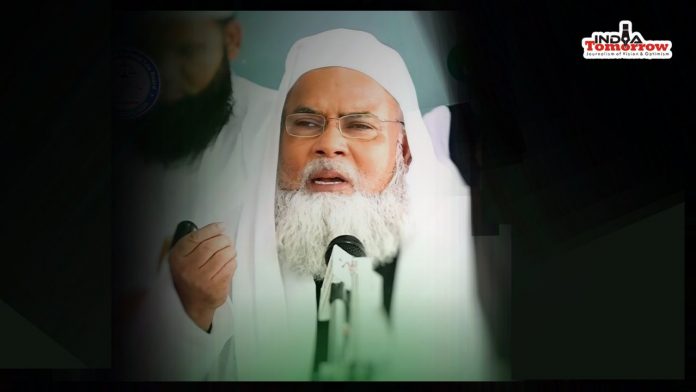
Maulana Khalid Saifullah Rahmani was re-elected president of the All India Muslim Personal Law Board (AIMPLB) today evening in the two-day 29th session of the Board which began today in the campus of Darul Uloom Sabeel-ur-Rashad Arabic College, the largest religious seminary of Karnataka.

Rahmani, a prominent Islamic scholar and leader, has held the presidency of the AIMPLB for several years and is known for his work in advocating for the protection of Muslim traditions and religious practices in the country. His re-election reflects the broad support he enjoys within the board and the larger Muslim community in India, which looks to the AIMPLB for guidance on issues related to marriage, inheritance, and religious freedom.

Along with Maulana Khalid Saifullah Rahmani’s re-election 40-member executive committee of AIMPLB were also elected. Now, the Maulana in consultation with the executive members will pick his team of office-bearers.

Maulana Rahmani is a close relative of Maulana Mujahid ul Islam Qasmi, the third president of the AIMPLB.

Born in November 1956, Maulana Rahmani received his primary education at home and studied at Madrasa Qasimul Uloom Hussainia for two years. He graduated from Jamia Rahmani in Munger and studied “Dawra-e-Hadith” again at Darul Uloom Deoband, and graduated from there. He later specialised in Islamic law and jurisprudence at Imarat Sharia, Patna.

Maulana Fazlur Rahim Mujaddidi was born on 22nd June 1957. He is the son and successor of the renowned scholar and educationist Maulana Shah Mohammad Abdur Rahim Mujaddidi and the successor of another Maulana Shah Hidayat Ali Mujaddidi.

He is an author and jurist He has authored books including The Islamic Jurisprudence: Introduction and Codification and Kitāb-ul-Fatāwa. While he is from the Deobandi School, he is respected by those from other schools as well, given his vast knowledge of various disciplines of Islamic education. He is also the general secretary of Islamic Fiqh Academy of India. (With Agencies Inputs)

source: http://www.muslimmirror.com / Muslim Mirror / Home> Indian Muslim> Religion / by Muslim Mirror Desk / November 24th, 2024

The Last Calligrapher of Old Delhi Preserves a Dying Art

DELHI:

Mohammad Ghalib is the sole remaining practitioner of the centuries-old craft in the city’s historic Mughal-era bazaar.

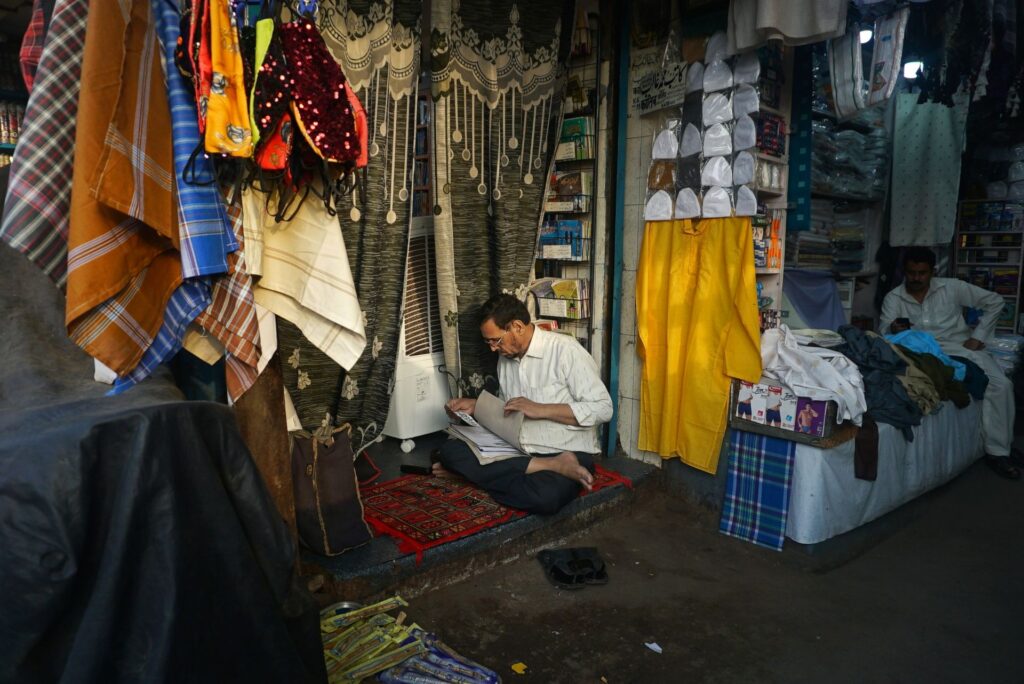
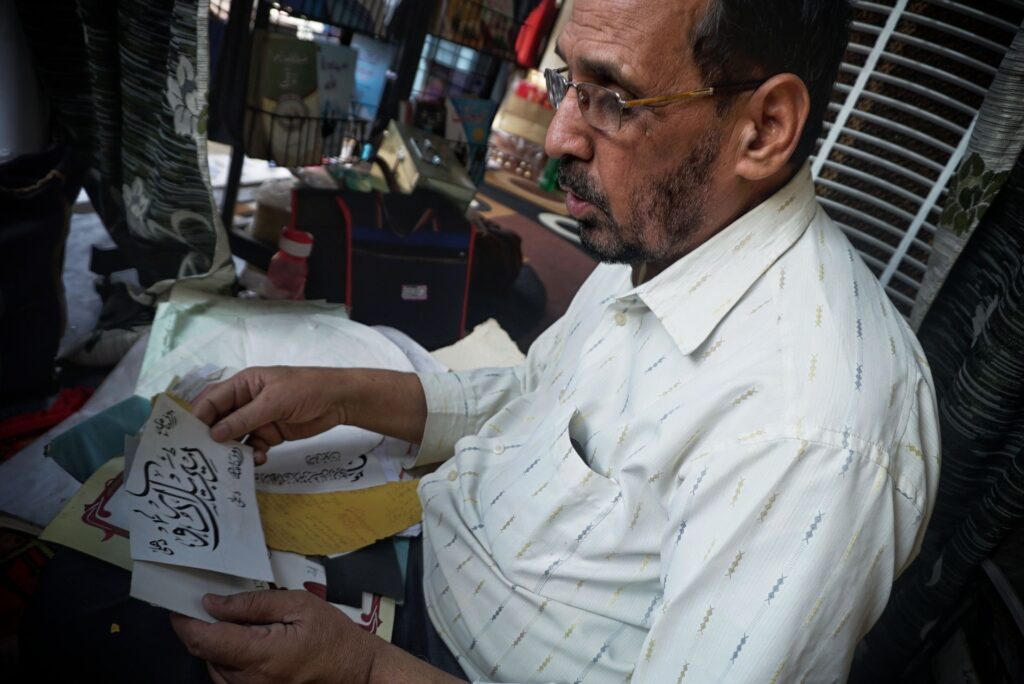
Mohammad Ghalib sits in his small makeshift workspace in the corner of a book shop in Old Delhi’s Urdu Bazaar. (Darash Dawood)

Mohammad Ghalib sits in the corner space of a book shop, barely a couple of square yards large, that was offered to him by a late friend years ago, as he couldn’t afford it on his own. He is the only “katib,” or calligrapher, left in the celebrated Urdu Bazaar of Old Delhi, witnessing his art form dying before his eyes.

On the wall outside the shop hangs a small, barely noticeable, handwritten nameplate in Urdu, Hindu and English, which reads “Katib Mohammad Ghalib,” desperately seeking attention. Amid large flex boards in the busy market, which was once a literary haven for Urdu connoisseurs, the nameplate itself becomes a telling tale of Ghalib’s bygone profession.

After setting everything up inside his shop, Ghalib hangs his small nameplate on the wall to grab the attention of customers. (Darash Dawood)

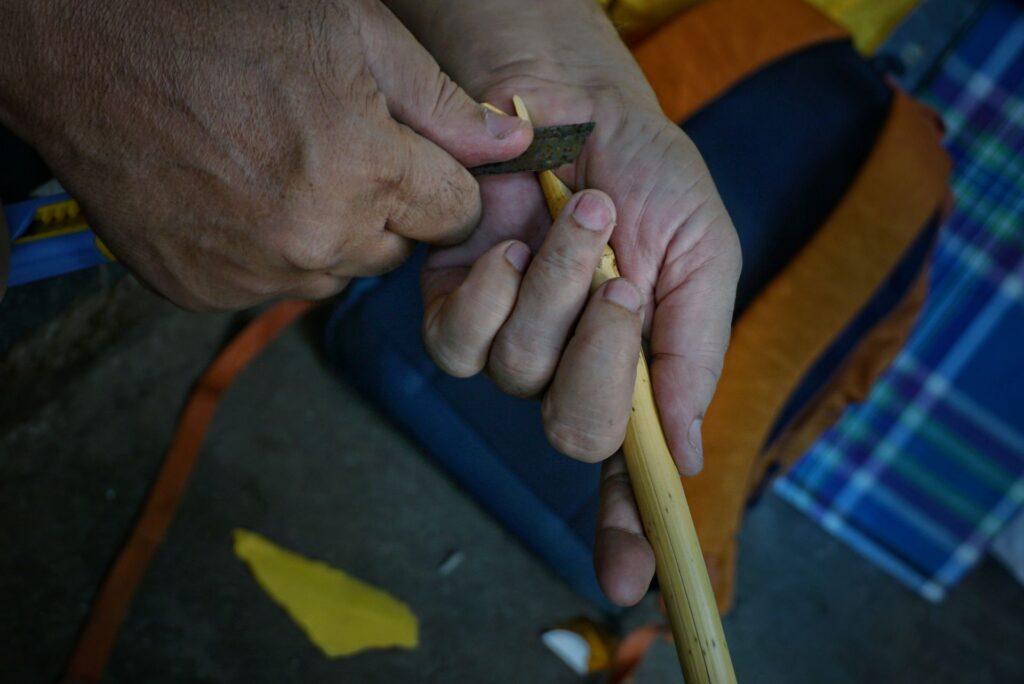
A couple of decades ago, about a dozen calligraphers would make this printing and books market come alive with their sharp bamboo pens, creating an aura of ornamental penmanship with their dexterity and delicate strokes. Holding their breaths tight, they would peck the nib of their bamboo pens in the ink and create unique styles and typographies for invitation cards, posters and logos.

Today, most of them are now dead, while many of the remaining few have retired from the profession, as it became obsolete due to technological advancement and digitization. Ghalib, however, still sets up his small workstation every day and lives in nostalgia.

“Kitabat,” or calligraphy, is a centuries-old art form in the Indian subcontinent, which attained its peak during the Mughal era. It was used to write the “farmaan” (official decrees) of the royal courts, as well as manuscripts, books, journals, newspapers, postcards and lineages.

“In earlier times, katibs were hired for Munshigiri [a position held by officials to maintain accounts] and were placed in royal courts,” says Ghalib. “It was the most respectable job. I am proud of the fact that even kings used to learn the art of kitabat and nawabs [governors in the Mughal era] used to keep at least one katib in their court for writing books, biographies or about their kingdom.” He adds that, “It is known as ‘shahi fun,’ or the royal profession.”

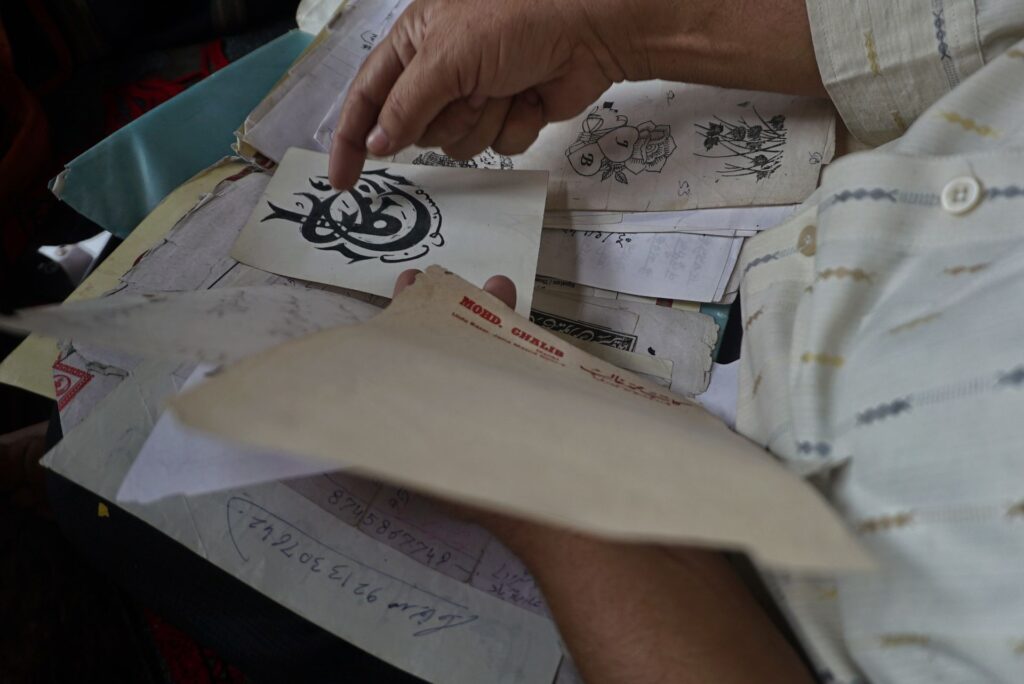
Ghalib leafs through his archival work, which dates back to the 1990s. (Darash Dawood)

“If any needy person came to the door of a katib and he had nothing to spare, the katib would write a word, any word, and tell the person to take it to Red Fort [the primary residence of Mughal emperors from the 17th century onward]. When he showed it to even a doorman, he would recognize that some katib had sent him and [would] fulfill all his needs,” explains Ghalib. After a breath, with an expression as if giving his final verdict about the buried brilliance, Ghalib adds, “Even Aurangzeb was a katib. And Dara Shikoh. Such was the value of a katib.” (Aurangzeb was the sixth Mughal emperor; Dara Shikoh was his elder brother and heir apparent whom he defeated, eventually arranging his execution for the throne.)

In kitabat, he says, one needs to be very dedicated. “A person gets lost in this work. It demands your full attention. Even a small movement of the hand can cost greatly. You have to hold your breath in order to write precisely. You can’t talk much when you begin writing; distraction is unforgivable.”

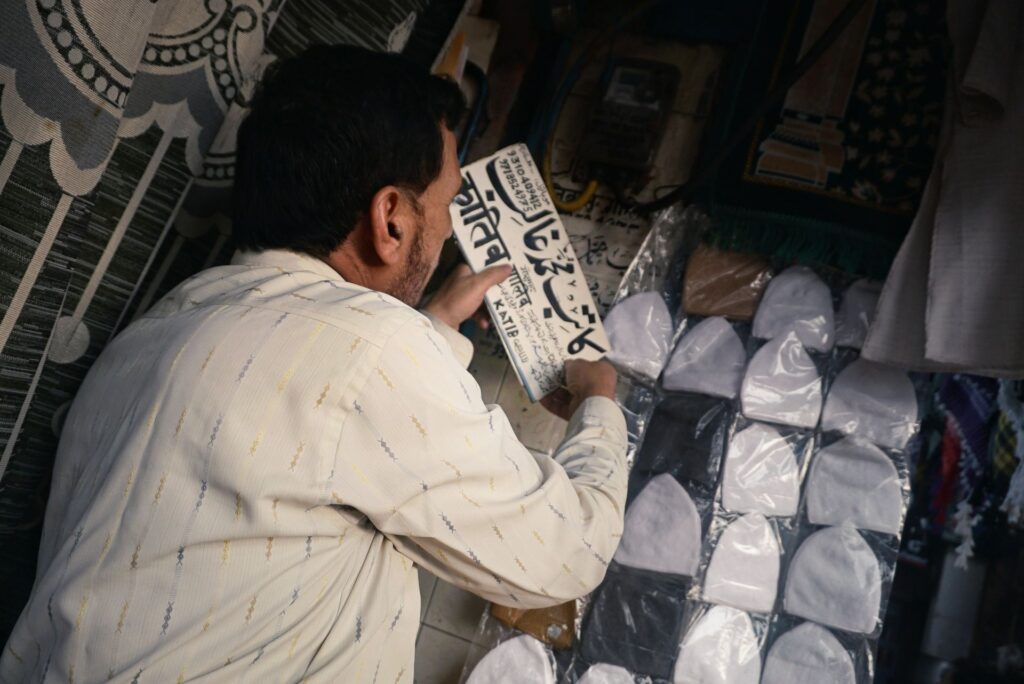
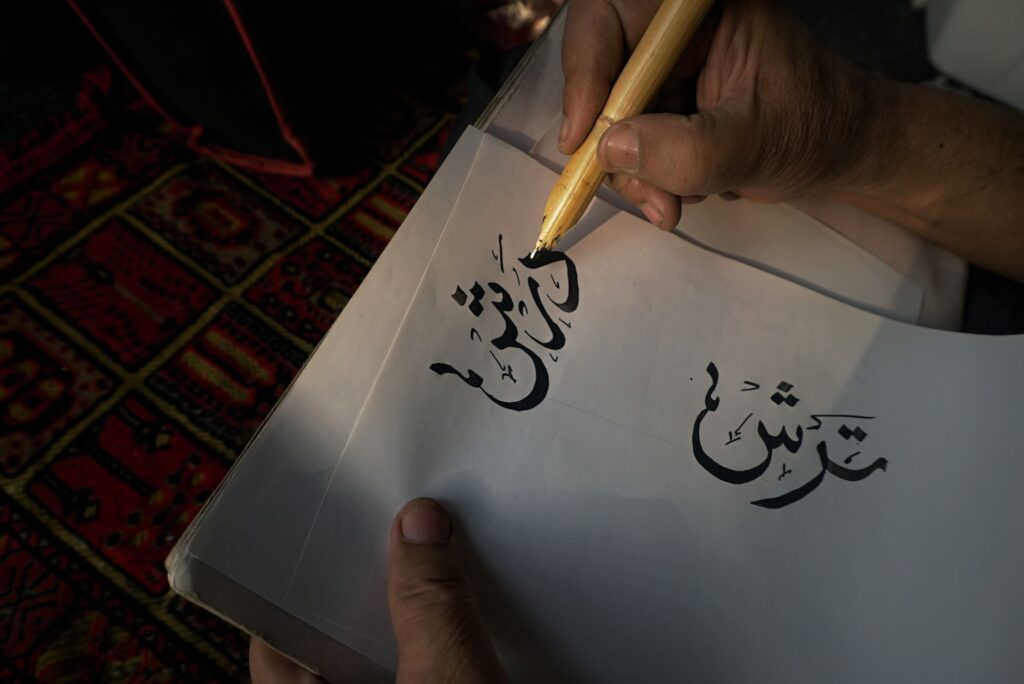
Ghalib demonstrates the art of calligraphy by writing out a name. (Darash Dawood)

The Urdu Bazaar in Old Delhi, where most katibs were stationed, also dates to the Mughal era. The very word Urdu, which means “camp” in Turkish, refers to the army camps in the area. Facing the eastern gate of the Jama Masjid, a large field that lay adjacent to the grand mosque was called Urdu Maidan, or army’s field. The two markets on each side of the grand mosque’s gate were known as Urdu Bazaar. “The army would fetch their essentials from these markets. The supplies of army disposals, including jackets and boots, would be available in this market till [the] late 1970s,” Sohail Hashmi, a Delhi-based writer and historian, tells New Lines.

Toward the end of the Mughal empire, books and printing shops emerged in this market, where one could find the best Urdu books, including translations of the Quran, the Vedas and Ramayana. Poets, writers, readers and publishers would throng the bazaar to discuss the latest Urdu literature while sitting on benches outside the bookstores. Inside their shops, there would be a dedicated corner for the katibs.

The rise of kitabat in the bazaar can also be traced to the lifetime of the famous court poet of Urdu and Persian, Mirza Ghalib, whose mansion in the neighborhood has been designated a heritage site by the Archaeological Survey of India. “Mirza Ghalib would come to this market to get his new work proofread, calligraphed by katibs and compiled as a diwan [collection],” Hashmi says.

The bazaar, along with the city of Delhi, first took a hit during the Rebellion of 1857 — the first major uprising against the British. Mirza Ghalib was heavily dismayed and lamented its destruction: “Urdu bazar ko koyi nahi janta tha to kahan thi Urdu / Bakhuda! Dehli na to shahar tha, na chavni, na qila, na bazaar.” (“When no one knew Urdu Bazaar, then where was Urdu? By God! Delhi was no longer a city, nor cantonment, fort or bazaar.”) The second major blow came during the Partition in 1947, when several Urdu poets and writers migrated to the new state of Pakistan. Over time, the market that had once bustled with book shops, printing presses and katibs became home to eateries serving Mughlai delicacies.

Almost two centuries after the 1857 rebellion, Mohammad Ghalib shares a similar pain. At 60, he is also ailing from many diseases: diabetes, heart disease and hypocalcemia.

He studied kitabat, introductory Arabic and Persian, and qirat (recitation) at Darul Uloom Deoband, the renowned seminary in India, from 1979 to 1983. His calligraphy teacher Munshi Imtiyaz was the son of Munshi Ishtiyaq, one of the most prominent katibs and teachers of Arabic in India in the 20th century. Later, Ghalib migrated to Delhi from the north Indian city of Saharanpur to work as a calligrapher. He has been in the Urdu Bazaar for four decades.

Since then, Ghalib has calligraphed academic books for the National Council of Education Research and Training, a government organization that prepares school curricula. He has also written by hand three volumes of “Tareekh E Arabi Adab” (History of Arabic Literature), authored by Dr. Abdul Haleem Nadvi, known for his contributions to Arabic studies in India. Ghalib has also worked for the National Council for Promotion of Urdu Language. Nowadays, however, he frequently returns home without any work for days and sometimes weeks. “Now all work is done by computers and I am mostly jobless,” he laments.

Once upon a time, calligraphers like Ghalib would be among the busiest professionals in the market, working day in and day out completing their assignments. “There used to be so much work. We would work even on holidays. We would receive assignments to write books on multiple genres, including academic books,” Ghalib says. Professional katibs with expertise in the craft are known as Har Fan Maula, which translates to “jack of all trades,” a tag given to calligraphers who are experts in writing many languages and scripts.

Reminiscing on the days when the calligraphy market was booming, Ghalib recalled the time he made a letterhead of his name. (Darash Dawood)

The craft is traditionally practiced with a “qalam,” a pen made from dry bamboo, which is used to write several scripts of Urdu and Arabic calligraphy including Thuluth, Nastaleeq, Kufic, Naksh and Diwani. “Contemporary calligraphy has taken the shape of an aesthetic art with colors and other decorative elements. They write Arabic in different ways, in colorful ways,” he explains. “People now write with brushes while we practice with wood pens. If you ask them to do some fine work or write a newspaper, they won’t be able to do it.”

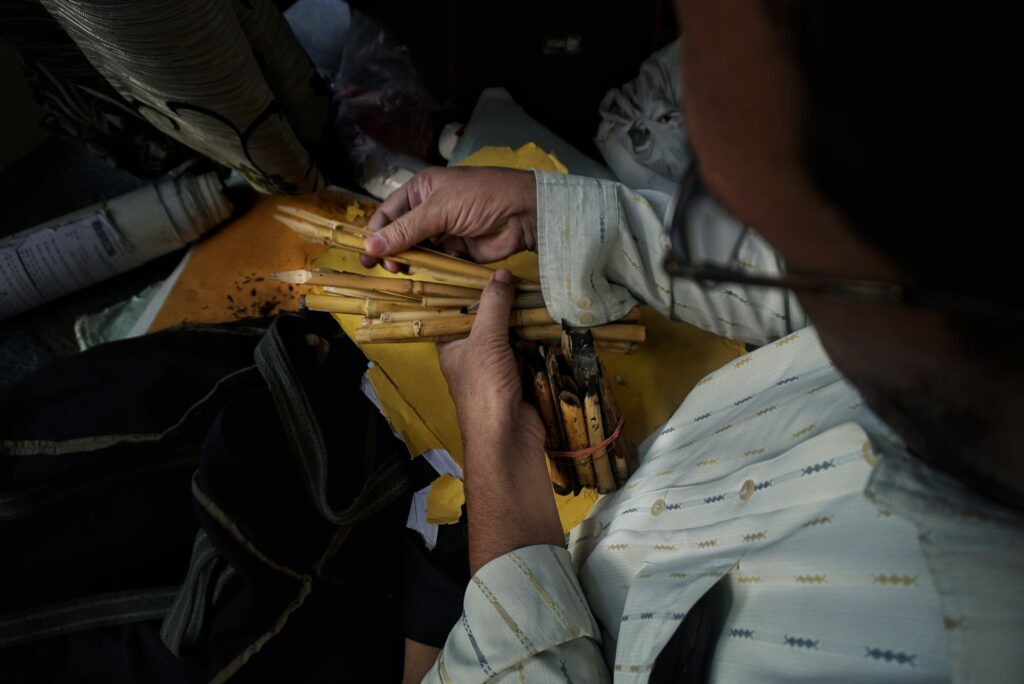
Ghalib holds a selection of his wooden pens, recalling that the finest he ever used were manufactured in Iran. (Darash Dawood)

For Ghalib, kitabat means everything. Despite the challenges, he speaks of it with a high sense of honor, in euphoria. “It is dearer to me, more than my own life,” he says. “I have earned a lot of things because of this profession. Because of this profession, I met a number of educated people.”

He traces the decline of kitabat to almost two decades ago. “I witnessed the sharp decline when most of the books were typed on computers 15 to 20 years ago,” he says. He acknowledges that technology gets work done quickly. It would take a month for Ghalib to write a book of about 500 pages, which typists could complete within a week.

“I will tell you one thing,” Ghalib continues. “I, too, would have left it [calligraphy] a long time ago. I am not boasting. I am Har Fan Maula — I write in Urdu, Persian, Hindi, Arabic and English. Sometimes, they would call me to the courts to write their papers. Last time, a few people from Medina, Saudi Arabia, sent 15 property papers in Arabic through someone. I do every kind of work. I write posters, receipts, etc.,” Ghalib says. His recent assignments have been limited to receipt writing for Islamic seminaries in Kashmir during Ramadan, designing calligraphic logos and layouts for wedding cards.

Ghalib sharpens his bamboo pens meticulously. (Darash Dawood)

The only institution that still uses this dying craft in India is The Musalman, an Urdu newspaper published, or rather handwritten, in the city of Chennai, capital of Tamil Nadu, a state in south India, 1,400 miles from Ghalib’s workspace. Published since 1927, The Musalman is a daily, four-page paper, currently run by Syed Arifullah, the youngest son of its former editor, Syed Fazlullah.

The craft has also taken a hit due to language politics in South Asia. Prior to India’s Partition, Hindustani, a vernacular of the country’s northern regions, especially Delhi and its surrounding area, bifurcated into Hindi and Urdu. After Partition, Pakistan adopted Urdu as its official language, which further complicated the language politics, yet a 2011 census showed that India still had over 50 million Urdu speakers. Over time, however, the language has come to be taught only in madrassas, which is why Muslims in India have come to be seen as its sole proprietors. Even young Muslims in India don’t engage with the language as much anymore. “People actually don’t read Urdu now … writing in Urdu is a little costly,” Ghalib says.“They print in Urdu, only if someone insists. Otherwise, they say who knows Urdu now?”

Ghalib too has fallen victim to this unfounded language divide of late. “Here [India], even if I upload a video on Facebook, they call me Pakistani. The condition here is such that you can’t even write anything in favor of uplifting the Urdu language. Hindus in India think that Urdu is the language of Muslims. Many people call me ‘Pakistani Khatat’ on my Facebook,” Ghalib laments. (Khatat is another word for katib.)

Four decades later, Ghalib is now dealing with his poor eyesight. His hands shiver while holding the pen. He takes long gasps before making each stroke on the paper. He is too withered to do any intricate work requiring precision. His teeth have fallen out due to disease and medicine. “I can’t eat properly, can’t even hold a cup of tea easily. My work suffers,” he says in a tone of exasperation.

Even on the days when Ghalib returns home without any work, he still holds out hope that “enthusiastic people” will eventually visit his little corner. “Sometimes, when I don’t have work for a week, I do not let this art die at home,” he says. “I return to my shop and then it is like Allah sends work one day that compensates all those days.”

source: http://www.newlinesmag.com / New Lines Magazine / Home> Reportage India / by Ubaid Majeed & Darash Dawood / February 09th, 2023

AIMPLB Poll: Maulana Rahmani Elected President, Maulana Mujaddidi as Secretary-General

NEW DELHI :

New Delhi:

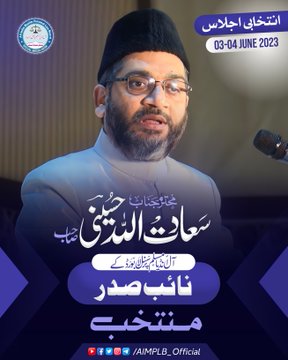
A top Islamic scholar – Maulana Khalid Saifullah Rahmani – was elected fifth president of the All India Muslim Personal Law Board (AIMPLB), with Jamaat-e-Islami Hind president Syed Sadatullah Husaini and Gulbarga-based Maulana Khusro Hussaini as vice-presidents.

Maulana Khalid Saifullah replaced Maulana Rabey Hasani Nadawi who passed away in April this year.

Image
Image

Maulana Fadl al-Rahim Mujaddidi has been elected as the General Secretary. He will be supported by secretaries – Maulana Umrain Mahfouz Rahmani, Maulana Syed Bilal Hussaini Sahib, Maulana Yasin Ali Usmani Sahib, and Maulana Ahmed Faisal Rahmani.

The board elections took place in the town of Mhow near Indore during the board’s executive committee meeting on June 3 and 4.

Maulana Khalid Saifullah was elected unanimously. There are 251 members of the board, including 51 executive members.

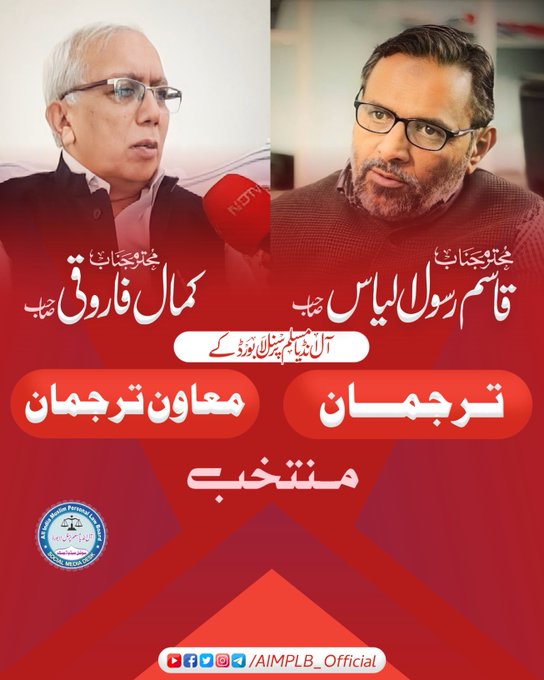
Welfare Party of India (WPI) president Dr. Syed Qasim Rasool Ilyas  has been elected as the spokesperson and Kamal Farooqui, a practicing chartered accountant and former chairman of Delhi Minorities Commission, has been elected as deputy spokesperson.

Image

Maulana Khalid Saifullah Rahmani was elected through consensus. A proposal was mooted by Hazrat Maulana Muhammad Sufyan Qasmi Sahib of Darul Uloom, Deoband, and subsequently supported by Maulana Shahid Hosni and Maulana Syed Mahmood Madani. All members unanimously voted for Moulana Rahmani.

After Wali Rahmani’s death, Moulana Khalid Rahmani was appointed as the interim general secretary of the All India Muslim Personal Law Board. He is also a member of the Legal Council of the All India Muslim Personal Law Board and serves as the general secretary of the Islamic Fiqh Academy in New Delhi.

He regularly contributes as a columnist for the Friday edition of Munsif and holds the position of editor for the Islamic juristic quarterly journal – Behs-o-Nazar – which was originally founded by Mujahidul Islam Qasmi.

Born in 1956 in Darbhanga district in Bihar, he has a rich educational background in Islamic studies and is renowned for his insightful teachings on various aspects of Sharia law. He began his education at home and then spent two years at Madrasa Qasimul Uloom Hussainia. He pursued further studies at Jamia Rahmani in Munger, where he earned his degree.

He was enrolled in the Dawra-e-Hadith program at Darul Uloom Deoband where he focused on the study of Hadith within the Dars-e-Nizami curriculum. He successfully completed his studies and graduated from Darul Uloom Deoband in the year 1395 AH (according to the Islamic calendar) or 1975 as per Gregorian calendar. Later, he specialized in Islamic law and jurisprudence at Amarat-e-Sharia in Patna.

He has been a student of Anzar Shah Kashmiri, Mahmud Hasan Gangohi, and Muhammad Salim Qasmi, and also benefited from the guidance of his uncle Mujahidul Islam Qasmi.

Established in 1973, AIMPLB serves as an authoritative body responsible for interpreting and implementing Muslim personal law in India. It comprises distinguished scholars, jurists, and community leaders who work collectively to uphold and protect the rights of Muslims in matters pertaining to marriage, divorce, inheritance, and other aspects of personal and family law.

source: http://www.indiatomorrow.net / India Tomorrow / Home> Breaking News / by admin india tomorrow / June 06th, 2023

Role of Darul Uloom, Deoband in India’s Freedom Struggle

Deoband, UTTAR PRADESH :

When the English imprisoned Abu Zafar Sirajuddin Muhammad Bahadur Shah Zafar (1775-1862), the last Indian Moghul Emperor, in the Jail of Rangoon in 1857, instead of Indian Flag, Union Jack started hoisting at Dehli’s Red Fort and Queen Victoria became the full-fledged ruler of India without any obstacle, at that time, many country patriots came into field united to fight against the British rule.

Maulana Muhammad Qasmi Nanautavi (1832-1879) was one of them too.

In 1857, one Fatwa for Jihad against the English was issued.

The Fatwa carried the signature of 34 prominent Ulama. One among them was Maulana Nanautavi himself. As other elders had participated in the Jihad of Shamli in 1857, Maulana Nanautavi also had participated personally with his colleagues. Briefly in the battle of Shamli, Nanautavi and his colleagues got defeated to British forces.

He was a far sighted scholar. He comprehended that the British has not only occupied India and would attack the Indian culture, but even the faith of Indians would be at risk. Therefore, while on the one hand, he started fighting against the English, he began debating with clergyman on the other. But to that time, the freedom wasn’t destined for India, so he didn’t succeed in the mission.

In this situation, intending to free India from the British rule, in the company of some friends, Maulana Nanautavi adopted another policy to establish a Madrasa on 21st May, 1866 (a famous learning centre of Indian Subcontinent, Darul Uloom, Deoband) beneath a pomegranate tree in Chattah Masjid of Deoband. So that the trained products of the Madrasa would sacrifice themselves to preserve the country and Islam both in British India. Alhamdulillah, Nanautavi succeeded in his mission and a good number of Darul Uloom’s product gave sacrifices for the sake of Indian freedom and Islam.

The noted Islamic scholar Maulana Manazir Ahsan Gilani (1892-1956) quoted in his book, “Ihaatae Darul Uloom Men Beete Huwe Din” (The Days Passed in the Campus of Darul Uloom) from his teacher and the first graduate of the seminary, Shaikhul Hind Mahmood Hasan Deobandi (1851-1920) saying:“Did my teacher (Maulana Muhammad Qasim Nanautavi) establish this seminary only for the teaching and learning? The seminary was established before me, as far as my knowledge goes, my teacher established this one in 1866 to compensate the defeat of 1857 from the British. I have chosen the same mission for which it was established before me.”

Very few people know the fact: “In the meeting of Jamiat Ulama-e-Hind at Kolkata in 1926, the participants included graduates of Darul Uloom, Deoband and they supported the group which called for complete independence of India from the British rule.

Indian National Congress was to declare complete independence as its goal three years later, in its session at Lahore.” (Wikipedia, Darul Uloom Deoband)The famous freedom fighter, Frontier Gandhi, Khan Abdu Ghaffar Khan (1890-1988), who visited Darul Uloom, during his visit to India in 1969, had said, “I have had relation with Darul Uloom since the time, Shaikhul Hind Maulana Mahmood Hasan, was alive. Sitting here, we used to make plans for the independence movement, as to how we might drive away the English from this country and how we could make India free the yoke of slavery of the British Raj. This institution has made great efforts for the freedom of this country.” (Wikipedia, Darul Uloom Deoband)Due to the great interest in India’s freedom struggle, Shaikhul Hind became an icon of Indian independence movement. Though he was a teacher of Darul Uloom, but made much effort to start an armed revolution against British rule from the both inside and outside India.

He started a programme to train volunteers and his students in the seminary from India and abroad for that goal. The most eminent among those who joined the movement were his students: Maulana Ubaidullah Sindhi (1872-1944), Maulana Husain Ahmad Madani (1879-1957), Maulana Muhammad Mian Mansoor Ansari etc.Shaikhul Hind sent Maulana Sindhi to Kabul and Ansari to the North-West Frontier Province to mobilize the popular support and recruit volunteers. And he with Maulana Husain Ahmad Madani travelled to Hijaz (KSA) to secure Turkish support. Getting the Turkish governor, Ghalib Pasha’s signature on a declaration of Jihad against the British, he planned to return to India via Baghdad and Bluchistan to start the rebellion.When Shaikhul Hind planned to return, the Silken Letter Movement was captured by Punjab CID.

Due to this movement, Shaikhul Hind was arrested in Hijaz. He was imprisoned in Malta, where he was tortured mercilessly, for more than three years.

Here it seems necessary to mention that what was the Silken Letter Movement. Shaikhul Hind wanted an armed revolution against the British rule, as I mentioned. So, he needed arms and ammunition. He and his colleagues, therefore, travelled to different countries to seek support from the anti-British countries; such as Afghanistan, Turkey and Russia. During the visiting different countries, letter exchanged between Shaikhul Hind and his colleagues, containing the outlines of the plan to recruit the volunteers for army and to establish a national government were written on silk piece of cloth. That is why the movement was known as the Silken Letter Movement/Tahreeke Reshmi Rumal (in Urdu)/Silk Letter Conspiracy (according to British government).When he returned to India, after release, was conferred upon by the title of Shaikhul Hind, leading leader of India.

Now he issued a Fatwa making it a duty of all Indian Muslims to support and participate with Mahatma Gandhi (1869-1948) and the Indian National Congress, who had prescribed a policy of non-cooperation and mass civil disobedience through non-violence.

He died on November 30, 1920 wishing to get martyrdom for India’s freedom.

Though Shaikhul Hind was no more, but he left a good number of students, who followed the footprint of their elders and worked tirelessly for the freedom of India.

Maulana Ubaidullah Sindhi (1872-1944), a 1891’s graduate of Darul Uloom, was also among them. He was the most active and prominent member of India’s freedom movement. He was among those leaders of Darul Uloom who left India, following the commandment of Shaikhul Hind, during World War 1, to get support of the anti-British central powers for an armed revolution against British rule.

Maulana Sindhi reached Kabul to rally the Afghan Amir Habibullah Khan.

After a period of time, he offered his support to Raja Mahendra Praratab’s plans for revolution in India with German support. He joined the Provisional Government of India formed in Kabul on 1st December, 1915. In this government, he was nominated the Minister for India. It was declared a revolutionary government in exile, which was supposed to take the charge of independent India, if the British government has been overthrown according to the plan. But unfortunately, in 1919, the provisional government was dissolved under the diplomatic pressure to Afghanistan.

He stayed in Afghanistan for 7-year nearly.

Then visiting Soviet Russia,he reached Turkey, where he issued the charter for the independence of India from Istanbul.

He left Turkey for Hijaz and remained there until 1929. He journeyed from a country to country for the sake of India’s independence. He died on 22nd August, 1944, at Deenpur in Pakistan.

Shikhul Islam Maulana Husain Ahmad Madani (1879-1957) was also one of the Shaikhul-Hind’s students and graduate and latter Professor of Hadith at Darul Uloom, Deoband.

Though he had been not convicted, but he accompanied Shaikhul Hind to Malta voluntarily, to take care of him. He stayed in Malta three years upto the release of Shaikhul Hind. Returning to India, he actively became involved in the freedom struggle. He had been imprisoned several times by the British authority for his participation in the freedom movement. It was he who dared to issue a Fatwa in the meeting of Indian National Congress at Karachi that working as British army and police is Haraam. After this Fatwa, he was rewarded two years rigorous imprisonment. He never stepped down from the freedom struggle movement, until India got freedom.

At the time of independence, the Muslim League and the Indian National Congress were at logger heads on partition of united India. On that occasion, Madani opposed the partition thoroughly. He journeyed the different provinces of India along with Maulana Abul Kalam Azad (1888-1958) and Mahatama Gandhi to assure the people safety and security and tried his level best to stop them to migrate from India to Pakistan. Many people targeted him, but he never conformed to the opinion of the partition.

After the independence, he was served a ministry, but he refused and restricted himself under the four walls of Darul Uloom and Jamiat Ulama-e-Hind for teaching and social works.

Like Madani and Sindhi, there were hundreds of Darul Uloom’s graduates, who actively took part in the freedom struggle of India. To mention the works of those patriots, the volumes and volumes are required.

It’s sorrowful matter that historians of modern India ignored completely the role played and efforts made by Darul Uloom for India’s freedom struggle. Today, most of the people aren’t aware of this historical institution. Some people know that Darul Uloom is a conservative seminary that produces merely Maulanas or a factory that only issues Fatwaas. And some say that Darul Uloom is “a Station of Terrorism” and “it produces terrorists”. This one is a famous opinion among Hindu fundamentalists, while the fact is otherwise as I stated in the essay.

It’s a bird’s eye view of the role of Darul Uloom, Deoband in India’s freedom struggle.

One who is interested on the topic, should go through the book, “Taarikhe Darul Uloom” (History of Darul Uloom).

May Allah accept the works of the seminary!

source: http://www.millattimes.com / Millat Times / Home> Special Column / by Khursheed Alam Dawood Qasmi , Email: qasmikhursheed@yahoo.co.in / August 15th, 2022

Qasim Nanautawi : The Scholar who awakened Muslims through education

UTTAR PRADESH :

Darul Uloom Deoband

He is truly a forgotten warrior of the freedom movement. Few know about him and fewer are familiar with his name but delve into the pages of history and you realise that he deserves a better place.

He participated in the Indian Rebellion of 1857 in the Battle of Shamli between the British and the anti-colonialist ulema. The scholars were ultimately defeated at that battle.

He was Mohammad Qasim Nanautawi.

Nanautawi was born in 1832 into the Siddiqui family of Nanauta, a town near Saharanpur in Uttar Pradesh.

He was schooled at Nanauta, where he memorised the Quran and learned calligraphy.

At the age of nine, Nanautawi moved to Deoband where he studied at the madrasa of Karamat Hussain. The teacher at this madrasa was Mehtab Ali, the uncle of Mahmud Hasan Deobandi.

On the instruction of Mehtab Ali, Nanautawi completed the primary books of Arabic grammar and syntax.

Thereafter, his mother sent him to Saharanpur, where his maternal grandfather Wajihuddin Wakil, who was a poet of Urdu and Persian, lived.

Wakil enrolled his grandson in the Persian class of Muhammad Nawaz Saharanpuri, under whom, Nanautawi, then aged twelve, completed Persian studies.

In 1844, Nanautawi joined the Delhi College. Although was enrolled in the college, he would take private classes at his teachers’ home, instead of the college.

Nanautawi stayed in Delhi for around five or six years and graduated, at the age of 17.

After the completion of his education, Nanautawi became the editor of the press at Matbah-e-Ahmadi.

During this period, he wrote a scholium on the last few portions of Sahihul Bukhari.

Before the establishment of Darul Uloom Deoband, he taught for some time at the Chhatta Masjid. His lectures were delivered at the printing press. His teaching produced a group of accomplished Ulama, the example of which had not been seen since Shah Abdul Ghani’s time.

In 1860, he performed Haj and, on his return, he accepted a profession of collating books at Matbah-e-Mujtaba in Meerut. Nanautavi remained attached to this press until 1868.

In May 1876, a Fair for God-Consciousness was held at Chandapur village, near Shahjahanpur.

Christians, Hindus, and Muslims were invited through posters to attend and prove the truthfulness of their respective religions.

All prominent Ulama delivered speeches at the fair. Nanautawi repudiated the Doctrine of the Trinity, speaking in support of the Islamic conception of God.

Christians did not reply to the objections raised by the followers of Islam, while the Muslims replied to the Christians word by word and won.

Mohammad Qasim Nanautawi established the Darul Uloom Deoband in 1866 with the financial help and funding of the Muslim states within India and the rich individuals of the Muslim Indian community.

He conformed to the Sharia and worked to motivate other people to do so. It was through his work that a prominent madrasa was established in Deoband and a mosque was built in 1868. Through his efforts, Islamic schools were established at various other locations as well.

His greatest achievement was the revival of an educational movement for the renaissance of religious sciences in India and the creation of guiding principles for the madaris (schools).

Under his attention and supervision, madaris were established in several areas.

Under Muhammad Qasim Nanautvi’s guidance, these religious schools, at least in the beginning, remained distant from politics and devoted their services to providing only religious education to Muslim children.

Nanautawi died on 15 April 1880 at the age of 47. His grave is to the north of the Darul-Uloom.

Since Qasim Nanautawi is buried there, the place is known as Qabrastan-e-Qasimi, where countless Deobandi scholars, students, and others are buried.

Significantly, the elders of Deoband took more and more part in the struggle for the independence of the country.

After the establishment of Darul-Uloom, the period of participation in national politics began.

Darul-Uloom, Deoband, was a centre of revolution and political, training. It nurtured such a body of such a body of self-sacrificing soldiers of Islam and sympathisers of the community who themselves wept in the grief of the community and also made others weep; who themselves tossed about restlessly for the restitution of the Muslims’ dignity and caused others also to toss about.

They shattered the Muslims’ intellectual stagnation, they broke up the spell of the British imperialism, and, grappling with the contemporary tyrannical powers, dispelled fear and anxiety from the minds of the country.

They also kindled the candle of freedom in the political wilderness.

It is a historical fact that the political awakening in the beginning of the twentieth century was indebted to Deoband and some other revolutionary movements in the country, and the revolutionary freedom-lovers who rose up there were the products of the grace from the spring of thought of Deoband.

Then, after the establishment of Pakistan, the Indian leaders of Deoband guided the Indian Muslims in utterly adverse circumstances and helped keep up their spirits high. — IANS

source: http://www.muslimmirror.com / Muslim Mirror / Home / by Amita Verma / July 31st, 2022

Sheikh Noor Alam Khalil Amini: Chief Editor of Arabic Monthly Al-Daie

Deoband, UTTAR PRADESH :

Sheikh Amini started his services as the Chief Editor of Al-Daie and the teacher of Arabic literature at Darul Uloom Deoband from 15th Shawwal 1402 AH (6th August 1982).

Sheikh Waheeduz-Zaman Kairanavi (1930-1995) was one of the few exemplary teachers of Arabic language and literature whom the 20th century witnessed in India. During his long teaching services at Darul Uloom Deoband, not only he trained his students how to speak and write eloquent Arabic language but he also trained them how to live an ideal life in the society as a good human being. He educated them in the way that wherever they went, they became the cause to enhance the glory and reputation for him and for their seat of learning, i.e. Darul Uloom Deoband.

Waheeduz-Zaman Kairanavi always encouraged his students and wished to see them at the peak of success. Whenever an opportunity of exposure and publicity came to him, he always pushed his students forward to let them prove their mettles.

In 1982, when there was a vacancy for Chief Editorship of Arabic Islamic fortnightly Magazine, Al-Daie, published from Darul Uloom Deoband, he preferred one of his capable and qualified students, Sheikh Noor Alam Khalil Amini (1952-2021), then the teacher of Darul Uloom Nadwatul Ulama, Lucknow to take this important responsibility. Later, the scholars of Arabic language and literature witnessed how ideal this choice was!

“Early days as Editor”

Sheikh Amini started his services as the Chief Editor of Al-Daie and the teacher of Arabic literature at Darul Uloom Deoband from 15th Shawwal 1402 AH (6th August 1982). As the Chief Editor, he published the first issue of the magazine on 7th Muharram 1403 – 25th October 1982 and went on to work tirelessly for 40 years (1403-1442 AH) as Chief Editor of the magazine. His standard Islamic, academic, literal and thoughtful write-ups for Al-Daie, in a well-expressed and eloquent Arabic language, enhanced the beauty of the magazine.

Moreover, collecting the standard and thoughtful articles by Arab writers and the excellent publication of Al-Daie in accordance with his amazing fervor, the magazine took no time to reach the peak of its success. Not only the Indian sub-continent scholars, but also the Arab scholars, poets and the men of letters welcomed the magazine with open arms.

Thus, the magazine played a key role, as a mouthpiece of Darul Uloom Deoband, in introducing Deobandi thought (Which is strictly following the path of Ahlus-Sunnah Wa-Al-Jamah) and presenting the institution’s academic activities in the Arab world.

“Columns on important subjects”

Sheikh Amini had fixed several columns in Al-Daie such as Kalimatul-Muharrir, Kalimatul-Adad, Al-Fikr Al-Islami, Dirasaat-Islamiyyah, Ilaa-Rahmatillah, Mahalliyat, Anba’aul-Jamiah, Ishraqah etc.

Besides these columns, there were also some other columns like Isdaratun-Hadithah, Al-Adabul-Islami, Al-Aalamul-Islami etc. in Al-Daie, if articles on such topics were included for publication.

Sheikh Amini used to write for the columns like Kalimatul-Muharrir, Kalimatu-lAdad, Al-Fikr Al-Islami, Ilaa-Rahmatillah, Isdaratun-Hadithah and Ishraqah in an eloquent Arabic language in the light of reliable references and accurate statistics. For the Kalimatul-Muharrir, it was his practice to write a brief article on current issues related to India or the Muslim world containing one or two pages sometimes. At the end of the article, there used to be written [Al-Tahreer] in the brackets. Next to it, the time and date were noted to let the readers know at what time and date the article was written. It was his practice to write the time and date at the end of his any write-up.

For the second column: Kalimatul-Adad, mostly he wrote a detailed article on social, political or Islamic burning issue. The article sometimes was on virtues of the month of Ramadan and fasting -Sawm, greatness of the migration of the prophet Muhammad (SAWS), need and importance of prayer etc. Article of this column sometimes revealed the cunningness of America and its illegitimate child, Israel.

He also used to show up the positive and negative aspects of the steps taken by the leaders of the Muslim and Arab world. He never hesitated to express his opinion about the stand and the decisions of the Indian government on any grave issue. The article would consist of 5/6 pages and sometimes even more pages than that. The Urdu translation of some of the articles written for this column is now part of his Urdu book “Kiya Islam Paspa Ho Raha Hai?

“Al-Fikrul-Islami”

He had great love for the scholars of Deobandi school of thought as they were true flag bearers of Islam. It was his mission to introduce their academic works and prominent services for Islam in Arab world. For this purpose, he translated Urdu books of those prominent scholars and published on the pages of Al-Daie in parts under the column of Al-Fikrul-Islami. This series continued for many years.

In this way, he translated dozens of books into Arabic language. The books are published from Darul Uloom Deoband and its Sheikhul Hind Academy. For few years, he had stopped writing for the aforesaid column. For this column, Abu Aaidh Al-Qasmi Al-Mubarakpuri (the patronymic of the famous Islamic scholar and teacher of Darul Uloom Deoband, Sheikh Muhammad Arif Jameel Qasmi Mubarakpuri, who is Assistant Editor of Al-Daie too) is translating “Tafseere Usmani” nowadays. This is a great and well-known Quranic commentary (Tafseer book) of Allamah Shabbir Ahmad Usmani (May Allah grant him Jannah!). As of Shaban 1442, the translation of the first 4 parts has been published under this column.

“Obituaries”

Sheikh Amini also wrote hundreds of articles for the column, “Ilaa-Rahmatillah”. Under this column, he wrote on famous scholars, thinkers, preachers, poets, men of letters and social and political personalities who had passed away in the near past from the Indian sub-continent as well as Arab world. In this article, he used to write the account of the deceased’s life, his services and the scholarly works etc. Like his other articles, the article of this column also had distinctive method as well as uniqueness and singularity of expression. The article would encompass all the features of the life of the diseased. The article used to be very lengthy. Sometimes, it was like a short biography of the diseased. He wrote on almost three hundred personalities as of March 2010.

Some articles written for the said columns were translated into Urdu language by the author and by some of his students and got them published in various Urdu magazines and newspapers. The readers liked them very much. They showed their desire that these Urdu articles should be compiled in the form of a book. Considering the sentiments of the readers, the author published the collection of 37 articles namely “Pase Marg Zindah” in 932 pages in May 2010. Of the same series, another collection of 24 articles namely “Raftagane Naa-Raftah” is soon to be published.

“Book Reviews”

Under the column of “Isdaratun-Hadithah”, he used to write a review on newly published books. His review too was very inclusive, comprehensive and lengthy. In this column, he used to elaborate the value of the reviewing book, its publication, introduction of author and his works in detail. As an example, the review of “Tohfatul-Alma’aee Commentary of Sunan Al-Tirmidhi” of Mufti Sa’eed Ahmad Palanpuri (Rahimahullah) can be read. This review is published with Tohfatul-Alma’aee, at the end of the 8th volume of the book.

The column: “Ishraqah” was on the last page of the magazine. Its remainder part used to be published on the last pages just back to the last one. For this column, Sheikh Amini used to write a well-grounded and demonstrative article, be on academic, religious, social or political topic, in the light of his thought, knowledge, experiences and observations or some situations and incidents influencing him. It was decorated with applicable idioms, appropriate synonyms, and beautiful similes. This article used to be the sample and model of an eloquent Arabic literature. It was highly valued and appreciated not only by the Indian readers of Al-Daie, but also by Arab scholars. It is pleasing that the hundreds of articles written for this column have been compiled and published this year namely: “Min Wahyil-Khaatir” in five huge volumes. It consists of 2600 pages as a whole. It was published just few weeks before the sad demise of Sheikh Amini. It is a precious and valuable gift for those who have interest in Arabic language and literature to read.

It is appropriate to record here that before the publication of Al-Daie, Darul Uloom published a quarterly magazine namely “Dawatul-Haq” as its mouthpiece, under the editorship of Sheikh Waheeduz-Zaman Kairanavi. After abolishing its publication, “Al-Daie”, a fortnightly magazine, was launched. Its first issue was published on 11th Rajab 1396 (10th July 1976), under the editorship of Sheikh Mufti Badrul Hasan Qasmi (ex-teacher of Darul Uloom Deoband and currently resident in Kuwait). Following his resignation, Sheikh Amini was appointed as its Chief Editor and the teacher of Arabic literature at Darul Uloom Deoband as stated above. Previously Al-Daie was published as a fortnightly magazine; but the governing body of Darul Uloom decided to convert it into monthly. Then from Safar-Rabiul Awwal 1414 AH (August 1993), it is regularly published as a monthly magazine.

May Allah accept the efforts of Sheikh Amini and grant him His choicest place in Jannah! Aameen!

[The writer, Khursheed Alam Dawood Qasmi, works at Moon Rays Trust School in Zambia, Africa. Sheikh Noor Alam Khalil Amini died on May 3, 2021 in Deoband.]

source: http://www.ummid.com / Ummid.com / Home> Life & Style / by Khursheed Alam Dawood Qasmi / June 11th, 2021