Tag Archives: Dr Javed Jamil

Muslim Mirror Releases List of 100 Most Influential Indian Muslims 2025; Young Faces Gain Prominence

INDIA :

Muslim Mirror’s 100 Most Influential Muslims of 2025

New Delhi: 

Muslim Mirror has released its much-anticipated annual list of the “100 Most Influential Indian Muslims of 2025,” spotlighting individuals who have made significant contributions to India’s public life across a wide spectrum of fields including politics, culture, education, business, media, religion, sports, and social service. Now in its second edition, the list aims to document influence not merely as power or popularity, but as sustained impact, leadership, and the ability to shape public discourse.

A defining feature of the 2025 edition is the growing prominence of younger achievers, signalling a visible generational shift within Indian Muslim leadership. Alongside established national figures, the list includes emerging voices who have built influence through grassroots activism, professional excellence, digital platforms, legal advocacy, education, and community engagement. Editors associated with the project said this was a deliberate attempt to recognise new centres of influence beyond traditional hierarchies.

The list reflects the diversity and plural character of Indian Muslim society, cutting across geography, ideology, profession, and language. From seasoned politicians and religious scholars to artists, entrepreneurs, academics, and social reformers, the compilation offers a broad snapshot of leadership trends at a time when issues of representation, constitutional values, and social justice remain central to national debate.

Representation Across Sectors

The 2025 list features several eminent academicians and intellectuals who have shaped higher education, policy discourse, and social research. Among them are Abul Qasim Nomani, Ameerullah Khan, Furqan Qamar, Shahid Jamil, and Ubaid-ur-Rahman, recognised for their contributions to education, public policy, and academic leadership.

In the business and entrepreneurship category, the list includes influential names such as Azad Moopan, Azim Hashim Premji, Farah Malik, Irfan Razack, M. P. Ahammed, Mecca Rafiq Ahmed, Meraj Manal, Syed Mohamed Beary, P. Mohammed Ali, Shahnaz Hussain, Tausif Ahmad Mirza, Yusuff Ali, and Ziaullah Sharif. Their inclusion underlines the growing economic footprint of Indian Muslim entrepreneurs, both domestically and globally, spanning sectors from retail and healthcare to infrastructure and consumer goods.

Community leadership remains a strong pillar of the list, with figures such as Arshad Madani, Mahmood Madani, Malik Motasim Khan, Mehmood Pracha, Syedna Mufaddal Saifuddin, Navaid Hamid, Pirzada Md Abbas Siddiqui, Qasim Rasool Ilyas, Sadatullah Husaini, Umer Ahmed Ilyasi, and Yusuf Mohamed Abrahani recognised for their roles in religious guidance, legal advocacy, social mobilisation, and institutional leadership.

Culture, Media, and Public Discourse

In arts and entertainment, globally recognised names such as A. R. Rahman, Aamir Khan, Mammootty, Munawar Faruqui, and Shah Rukh Khan continue to command immense cultural influence, shaping narratives that extend well beyond cinema and music into social consciousness.

The list also acknowledges the growing importance of media and journalism in shaping opinion and challenging dominant narratives. Journalists and commentators such as Arfa Khanam, Irfan Meraj, and Seema Mustafa are recognised for their consistent engagement with issues of democracy, minority rights, and constitutional values.

Religious and Intellectual Scholarship

A significant section of the list is devoted to Islamic scholars and religious thinkers, reflecting their continued influence on moral leadership and intellectual discourse. Names such as A. P. Aboobacker Musliyar, Qasim Nomani, Prof. Akhtarul Wase, Asghar Ali Imam Mahdi Salafi, Asjad Raza Khan, Ibraheem Khaleel Al-Bukhari, Javed Jamil, Khalid Saifullah Rahmani, Khaleelur Rahman Sajjad Nomani, Qamaruzzaman Azmi, Rashid Shaz, Shakir Ali Noori, Shamail Nadvi, and Yasoob Abbas find place for their scholarly work, writings, and public engagement.

Politics and Governance

The political category features leaders cutting across party lines and regions, including Asaduddin Owaisi, Ghulam Nabi Azad, Hamid Ansari, Mehbooba Mufti, Omar Abdullah, Salman Khurshid, Najeeb Jung, Syed Naseer Hussain, Engineer Rashid, Akhtarul Iman, Iqra Hasan, Zameer Ahmed Khan, Rakibul Hasan, K. Rahman Khan, Kadir Mohideen, Mohibullah Nadvi, Md Shafi, Agha Mahadi, Asim Waqar, and Sadiq Ali Shihab Thangal. Their inclusion reflects influence exercised through electoral politics, governance, diplomacy, and legislative advocacy.

Changemakers and Social Reformers

One of the most dynamic sections of the 2025 list is that of changemakers and social reformers, featuring individuals such as Safeena Husain, Shahabuddin Yaqoob Quraishi, Syeda Hameed, Zameer Uddin Shah, Mahbubul Hoque, Sabahat S. Azim, Mehmood Pracha, Faiz Syed, and Zahir Ishaq Kazi, among others. Many of these figures have earned recognition through long-term grassroots work rather than formal authority.

International Booker Prize 2025 winner Banu Mushtaq for Heart Lamp, along with renowned poet Wasim Barelvi, has been placed in the category of Literary Figures.

In sports, iconic names Sania Mirza and Irfan Pathan continue to inspire younger generations through excellence and public engagement beyond the playing field.

Beyond Rankings

The editors emphasised that the list does not claim to be exhaustive, nor does it measure influence solely through fame, wealth, or official position. Instead, it seeks to capture real-world impact, moral authority, intellectual contribution, and the ability to shape conversations within and outside the community.

The annual list has increasingly become a reference point for understanding evolving leadership patterns among Indian Muslims. By foregrounding both established figures and rising talents, the 2025 edition reflects continuity as well as change, underscoring how Indian Muslims continue to contribute meaningfully to India’s democratic, cultural, and social field.

source: http://www.muslimmirror.com / Muslim Mirror / Home> Indian Muslim / by Muslim Mirror / January 15th, 2026
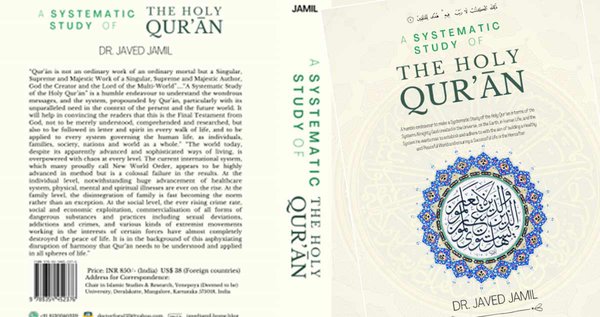
New Book Offers Unique Insight into Verses of the Holy Quran

Mangaluru, KARNATAKA :

Review of Dr. Javed Jamil’s book “A Systematic Study of the Holy Qur’ān”

Dr. Javed Jamil has already earned wide acclaim for his innovative and holistic approach on the world affairs and for his concept of Applied Islamics, which implies examining the scientific theories, international ideologies and developments in the light of Islamic principles and presenting Islamic Paradigms/Models/Definitions/Concepts/Programmes in different areas of knowledge in Natural Sciences, Social Sciences as well as Health Sciences. His books like “Muslims Most Civilised, Yet Not Enough?”, “Muslim Vision of Secular India: Destination and Roadmap”, “Justice Imprisoned”, “Economics First or Health First?” have brought a new approach based on the facts and figures, which have not only highlighted the failure of the modern systems in creating a healthy and peaceful world but have also successfully countered the propaganda by Western and other forces against Islam. His latest book, “A Systematic Study of the Holy Qur’ān” may well become his most applauded work in coming times because of, (using the title of the Foreword by Former Vice Chancellor of University of Hyderabad, Padamshri Prof. E Hasnain,) its “Unique Insight into the Wondrous Verses of the Holy Qur’ān”. It will be worthwhile here to quote a passage from the Foreword:

“What attracted my attention at the very outset was the caption on the cover of the book. The book describes Qur’ān as “a humble endeavour to make a Systematic Study of the Holy Qur’an in terms of the Systems Almighty God created in the Universe, on the Earth, in Human Life, and the System He wants man to establish and adhere to with the aim of building a Healthy and Peaceful World and ensuring a Successful Life in the Hereafter”. This is a categorical confirmation of the fact that, in Qur’ān there are a very large number of verses, which describe the Creation and Functioning of the Universe as a whole and the Functioning of the Earth, including its flora and fauna. There is absolutely no doubt that, if human beings have to establish on earth the kind of harmonious functioning existing in the universe, they have no option but to follow God’s injunctions in full. The particles of the universe, the stars, the planets and all other celestial bodies follow the Laws of Nature created by God with unimaginable precision. If God gave us human beings certain flexibility, we should endeavour to work only within the boundaries prescribed by Qur’ān. Moreover. the system that God has directed through His Final Book and Final Prophet (SAW) needs to be established not only in the lives of the people, but in the world as a whole, including the legal, social, political and administrative levels.

By just viewing the list of contents of the book, one can have an idea of the holistic nature of the work. It has five major parts: Iman (Realization with Commitment), Philosophy, Constitution, Systems and History of Confrontation between the Right and Wrong. The chapter on Iman covers Qur’ānic view of God/Allah with His Creation and Governing of the universe , the role of Prophets, especially the Last Prophet Muhammad (PBUH), the Books of God, Hereafter, Executive Angels and Predestination. Part 2 on Philosophy covers Philosophical issues related to Qur’ānic position of Monotheism, life, different religions, human nature, etc. Chapter 3 on Constitution covers Fundamental Rights, Fundamental Duties and Fundamental Prohibitions, Civil and Criminal Laws. Part 4 on Systems of Governance include Social, Political, Economic, Moral, Spiritual and Health Protective Systems and the Part 5 on History of Confrontation between the Right and Wrong compiles the stories of Prophets from Adam (AS) to Muhammad (SAW).

The book presents Islam as a Holistic System for Health, Security and Peace for mankind in this world as well as Hereafter, and effectively counters modern ideologies based on the supremacy of Economics. His arguments are highly convincing, as they are accompanied with facts and figures. He argues that while the modern constitutional systems are two-dimensional based on Fundamental Rights and Duties, while ignoring prohibitions altogether, Qur’ānic system of governance is Three-Dimensional with equal emphasis on Rights, Duties and Prohibitions. He lambastes the concept of Freedom of Choice, which is being used by the market forces to exploit the human susceptibilities at the huge cost of life and peace, resulting in tens of millions of deaths due to Alcohol, Sexual corruptions (including Homosexuality, Promiscuity and Prostitution), Gambling, Suicides, Pork, etc.

In each chapter, first a well thought and crafted article is presented followed by the compilation of the Qur’ānic verses related to that subject. The verses are followed by notes wherever necessary, providing huge information. In the first chapter on “The Supreme Being”, the components of the universe and their functioning in accordance with God’s designs are presented, and a full-blown picture of the physical State (Mulk) of universe created and governed by Head of State, Almighty God/Allah, through a unique system of the Laws of Nature (Umoor) has been developed. The arguments in Theoretical Physics about the universe being created without God have also been countered in a unique manner. The author has translated “Samaawaat” as “Cosmic Tiers” and has shown their positioning in terms of the structure of the universe. For example, Sky of the earth (atmosphere, clouds, protective roof) is the First Cosmic Tier, Solar System (Samaa-al dunyaa) the Second, Galaxy (Milky Way being ours) the Third, Cluster and Supercluster being the next in order and so on. Terms like Najam, Kawaakib, Shihab-at-Thaqib, Najm-ath-thaqib, Tariq, Samaa- dhaatil burooj, dhaatil-raj’a etc have been explained. The author notes that further researches will more specifically point out the exact positioning of these Samaawaat. When the terms Sajda, Tasbeeh, Hamd etc, are used in relation to the physical components of the universe, their existence being only physical, these terms also indicate their different physical movements like rotation on their own axis or around other objects in compliance of the Laws of Nature created and implemented by God, the Lord of the Universe. Human Sajdahs, Tasbehs and Hamd of course have physical, biological, mental, spiritual and social dimensions as well.

But the author clarifies that instead of studying Qur’ān in the light of Sciences, modern sciences and ideologies have to be studied in the light of Qur’ānic positions. Sciences can be in an evolving phase but Qur’ān is the Word of God, with absolute facts. It is another matter, due to our immense paucity of knowledge about the facts of the vast universe; more often than not we cannot fully understand their meaning.

In the chapter on different systems, he has presented alternative Islamic paradigms/models of Economic, Political, Social, Moral, Spiritual and Health protective systems of Islam, with critical review of the modern systems prevalent at the international level. He argues that the primary aim of Islamic Prohibitions and Permissions is to ensure highest standards of physical, mental, social, spiritual health and family peace and crimeless society, free of all forms of exploitation. Following these injunctions with total commitment to God, Last Prophet and Last Testament Quran will also ensure a Blissful life in Paradise after death.

The chapter on History becomes doubly interesting, as it also uses the excerpts from Torah, Evangel (Injil) and Psalms (Zabur) to explain in detail the lives and achievements of the Prophets/Ambassadors of God.

The book has used many terms, which are different from the traditional ones, but they add to the advanced understanding of the Holy Qur’an in exploring the functioning of the universe, life on earth and human existence. The basic argument according to the author which comes out from the study of Qur’an is that if the unimaginably vast universe is functioning with impeccable harmony for billions of years, it is because each and every particle and area of the universe is following with utmost precision the Laws of Nature, Biological and other laws created by God, and if the mankind has to have a peaceful and harmonious existence, they have no option but to follow the Laws sent through His Ambassadors by God, Qur’an being the Final Constitution for all times to come till the Doomsday.

The cover is attractive and the printing of the book is of good quality. Over-all, it is a must-read book for all Muslims, especially the students, scholars and analysts, and has the potential to revolutionise the future studies of Qur’an and Islam, with their application in every field of the human existence – individual and collective, internal and external. It will be worthwhile to conclude this review by quoting a few paragraphs from the book:

“The world today, despite its apparently advanced and sophisticated ways of living, is overpowered with chaos at every level. The current international system, which many proudly call New World Order, appears to be highly advanced in method but is a colossal failure in the results. At the individual level, notwithstanding huge advancement of healthcare system, physical, mental and spiritual illnesses are ever on the rise. At the family level, the disintegration of family is fast becoming the norm rather than an exception. At the social level, the ever rising crime rate, social and economic exploitation, commercialisation of all forms of dangerous substances and practices including sexual deviations, addictions and crimes, and various kinds of extremist movements working in the interests of certain forces have almost completely destroyed the peace of life. It is in the background of this asphyxiating disruption of harmony that Qur’ān needs to be understood and applied in all spheres of life.”

“True Version of Anthropic Principle says that (1) It is God Who created the universe ultimately leading to the creation of man; (2) God controlled the whole process of creation; (3) the creation of man was not an unintended coincidence but an intended act of God; (4) the purpose of man is not simply describing the beauty of the universe, but to attain the Realization that this harmonious universe has been created, and is being governed by God; and (5) man has to submit to the System of existence perfected through His Ambassadors and Testaments, and govern the Earth in accordance with the Divine commands.”

“In short, the message of Qur’ān, the Final Document of Peace, is unequivocal. Anything good, healthy and desirable in terms of health, peace and tranquillity, has to be promoted, and anything unhealthy and undesirable has to be discouraged. Both, short term and long terms benefits are allowed; but if short term benefits seriously endanger the long term benefits, long term benefits have to be preferred. All possible means within the ambit of Islam are to be availed for achieving the goal. The goal, however, cannot be achieved with perfection, unless there is unity of mankind; and mankind cannot unite unless it submits to One God, imitates One Prophet, follows One Book and faces One Direction. This is the real meaning of Wahdat (Unity), which is central to all the Islamic systems of affairs. Wahdat of God means, in effect, the Wahdat of mankind.” “Islam’s agenda, as shown by the Quran and Prophet (SAW), is to establish Natural and Just Word Order. The agenda of the present world is to establish and sustain New World Order. It has led to the development of a strange kind of world, which appears to be paradise from outside, but as one enters it, one finds nothing but hell. We are living in a world where, thanks to the designs of merchants, immorality reigns. The globe of New World Order is therefore rapidly developing into nothing but a fireball of chaos.It is in the backdrop of this universal disharmony that Islam, in its final form established by the Last Prophet (SAW), has to play its role. We have to challenge New World Order and establish Natural Just World Order, in accordance with the principles laid down by the Book of God and the life of the Prophet (SAW).”

Price: INR 850/- Outside India: US$ 38, for copies WhatsApp on: +918130340339, Email: doctorforu123#yahoo.com

source: http://www.milligazette.com / The Milli Gazette / Home> News> Books / by J Ali / March 24th, 2021