Tag Archives: Indian Muslims

‘The Greatest Telugu Stories Ever Told’ provide an insight into Telugu short fiction realm

TELANGANA / ANDHRA PRADESH :
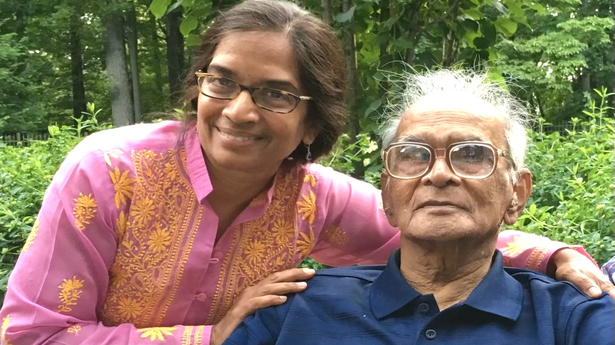
Anthologist and translator Dasu Krishnamoorty’s ebook ‘The Greatest Telugu Stories Ever Told’ gives a tapestry of Telugu experiences for readers.

The Greatest Telugu Stories Ever Told (Aleph Book Company) provides us a glimpse into the huge Telugu literary realm. Spanning virtually a century of literary works by a number of the most interesting writers of short tales, the gathering mirrors the Telugu-speaking individuals’s perspective of the world.

Co-authored by anthologist and translator Dasu Krishnamoorty along with his daughter Tamraparni Dasu, the anthology incorporates works of 21 writers, proper from Chalam and Kanuparthi Varalakshmamma to Vempalli Gangadhar and Vempalle Shareef.

The anthology

Influence on society

Elaborating on the factors in choosing the tales, the writers say they seemed for brokers of change. “Vempalle Shariff’s ‘Curtain’, for example, is a diatribe against the norms that keep Muslim women behind a curtain of patriarchy and prevent them from participating in the wider society. Sometimes, the story is so compelling in its cathartic message that it requires no other reason than its merit to be included.

‘Mother’s Debt’ (Mohammed Khadeer Babu) and ‘Predators’ (Syed Saleem) both highlight the wretched lives of those compelled to live in poverty at the edges of society,” says 93-year-old Krishnamoorty, connecting with us from New Jersey.

On selecting works of writers like Kanuparthi, Illindala Saraswati Devi, Achanta Sarada Devi and Chalam — who wrote about social inequity — Krishnamoorty says the brand new technology of writers continues to push that battle ahead in new instructions and develop into energetic devices of social change, as evidenced by Boya Jangiah, Jajula Gowri and others. “Writers alone cannot cause a change but are certainly a big part of the process,” he says.

 On being requested if some writers are both overrated or underrated, Tamraparni responds, “All the writers in the anthology, and many more that could not be included, deserve their reputation and accolades. The younger ones are perhaps underrated simply because the world doesn’t know of them yet. We hope that our anthology helps them gain the recognition they deserve.”

Diverse works

The anthology consists of works by six Muslims, 5 ladies and 5 Dalits. Krishnamoorthy says their goal was to provide a platform for the varied assortment of expertise significantly in underrepresented communities. “Telugu Muslims have always been a beacon of literary excellence. Only they can write with such passion and knowledge about their lived experience that comes through with such heart-wrenching intensity in ‘Adieu, Ba’ and ‘A Mother’s Debt’,” he provides.

Speaking of the challenges in translating, Tamraparni says, “Translation is inherently tricky; matching the idiom of the original with an equivalent one in English, rather than a literal translation; finding the equivalent of unique words, for example a word like ‘ thaayilam’ (a special treat, typically sweet, for a child) in Dada Hayat’s ‘The Truant’; retaining the voice of the original writer intact; avoiding the temptation to editorialise or tamp down unorthodox content as in Chalam’s ‘Madiga Girl’; how to preserve the musicality of the original language, as in ‘Molakala Punnami’.”

Describing working together with her father as a excessive octane expertise, Tamraparni says story choice was a degree of rivalry. “Some of the differences were generational, and some were temperamental. We agreed on most stories but there were four or five that needed energetic debate,” she provides.

Support system

Krishnamoorty had moved to the US to dwell along with his daughter’s household after he misplaced his spouse and there, he discovered translation a solution to keep engaged to tide over the powerful interval. “He brought an amazing level of intensity and enthusiasm to it even though he was almost 80 at that time,” says Tamraparni who alongside together with her father, launched a literary non-profit organisation, IndiaWrites Publishers, to assist the interpretation of up to date Indian short fiction into English. Together additionally they revealed a month-to-month on-line literary journal, Literary Voices of India, for a number of years. And 15 years later, the father-daughter duo revealed their second anthology The Greatest Telugu Stories Ever Told.


”I’m grateful that translation has given me such a stimulating and rewarding expertise to share with my father,” says Tamraparni. 

Source hyperlink

source: http://www.dksnewsonline.com / DKS News / Home> Entertainment> Art / by devanandsingh9199 / April 08th, 2022
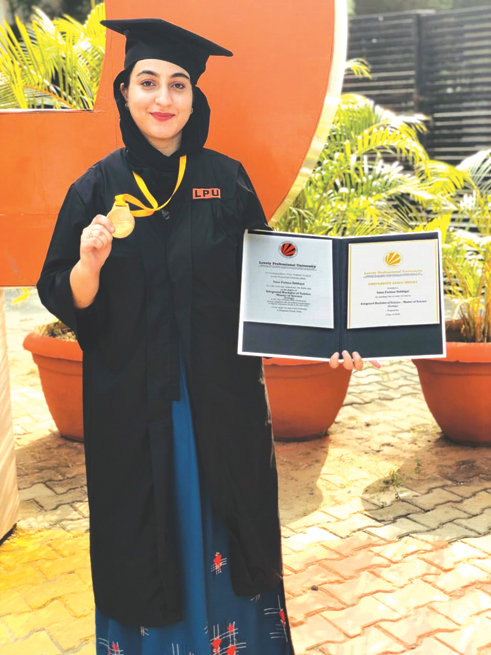

Kishtwar girl awarded gold medal in Integrated Zoology

Kishtwar, JAMMU & KASHMIR :

Kishtwar ::

Once again showing her excellence in the field of education, Kishtwar girl identified as Sana Fatima Siddiqui Daughter of Syed Ajaz Ahmed Resident of Bunastan Kishtwar was awarded University Gold Medal for standing First in Order of Merit in Integrated BSc- MSc Zoology program, Class of 2019 at 10th Annual Convocation Ceremony of Lovely Professional University by Mr. Michael Ashwin Satyandre Adhin, Hon’ble Vice-President of Suriname (South American Country).

The convocation was recently held at Ludhiana.


Speaking to Early Times, Sana attributed her success to her parents, siblings, friends and family members added that without support from parents and family it is not possible for girls to get her admissions in universities which are far away from home.
She said that she will continue her hardwork to bring lure for her parents and Kishtwar District in future as well.

She also thanked her teachers who guided her from time to time through out her life.

source: http://www.earlytimes.in / Early Times / Home> News Details / by Early Times Report / September 10th, 2019

IPL 2022: SRH pacer Umran Malik enthrals fans with another 150-kmph thunderbolt

Jammu City, JAMMU & KASHMIR :

The young pace sensation from Jammu and Kashmir had sent down a 153-kmph delivery in the second leg of the IPL played in United Arab Emirates.

Sunrisers Hyderabad pacer Umran Malik. Credit: SunRisers Hyderabad/Twitter

Pune :

Umran Malik, the young pace sensation from Jammu and Kashmir, has done it again.

The 22-year-old Sunrisers Hyderabad pacer on Tuesday set the internet on fire by sending a 150-kmph delivery in the first over of his team’s IPL 2022 match against Rajasthan Royals at the Maharashtra Cricket Association Stadium, here.

And this is not the first time that the express pacer has clocked the 150-kmph on the speed gun in the IPL.

In the second leg of the IPL played in United Arab Emirates (UAE), Malik sent down a 153-kmph thunderbolt, the fastest delivery in IPL history, and had both his skipper Kane Williamson and the then India captain Virat Kohli gushing over the new speed demon of Indian cricket.

After seeing his ability to bowl with lightning speed, SRH gambled and retained him as their third player ahead of the IPL 2022 mega auction.

On Tuesday, that gamble seems to have paid as Malik was their best bowler against Rajasthan Royals, taking two wickets in his four overs spell giving away 39 runs.

Every time he jumps on the popping crease, he outdoes his pace. With his express pace, Malik got the wickets of Jos Buttler and Devdutt Padikkal.

The instant stardom, that he achieved in UAE last year and enhanced on Tuesday, is just a byproduct of his confidence that made him believe that he could make it to the India team at a very young age.

When he was 18, he wrote in his bio on his social media handle, “India Soon”. The pacer, whose father Abdul Rashid is a fruit-seller in Shaheedi Chowk in Jammu, was confident enough to predict that one day he will make it to the national side.  His dedication and perseverance paved the way into his state’s Under-19 squad.

A good performance in the Syed Mushtaq Ali Trophy T20 competition helped him make it to the Sunrisers Hyderabad team as a net bowler.

Malik was roped in as a short-term Covid-19 replacement for T Natarajan, who had tested positive for Covid virus ahead of Hyderabad’s encounter against Delhi Capitals on September 22, 2021. After that, Malik’s fortunes completely changed.

Malik, who was part of the Hyderabad contingent as a net bowler, has played eight T20 and one List A match for Jammu Kashmir and has picked a total of four wickets.

Hailing from a modest family in Jammu’s Gujjar Nagar, Malik began playing at a young age. His family has always supported his passion with his father, his mother and two older sisters always there for him.

In the game against Royal Challengers Bangalore in the 2021 IPL, Malik went a step further by bowling the second-fastest delivery of IPL — a 152.95kph thunderbolt that stunned everyone.

At the post-match presentation, RCB’s then skipper Virat Kohli spoke in support of the youngster, “Whenever you see talent like this, you are going to have your eyes on them and make sure you maximise their potential.” “I really felt proud on seeing such a big player talking about me,” Malik had said after the match.


His exploits resulted in him being asked to be part of the Indian senior team’s net bowlers for the T20 World Cup in the UAE last year.

By clocking 150-kmph again on Tuesday, Malik has proved that his exploits last year were not a flash in the pan. He has it in him to consistently hit the 150-mark on the speed gun.

Now he has to build on this brilliant start to fulfill his dream of making it to the Indian team.

–IANS

source: http://www.tribuneindia.com / The Tribune / Home> Sports / by IANS / Pune, March 29th, 2022

Andhra Pradesh CM announces ₹5 lakh for powerlifting champion Sadia Almas

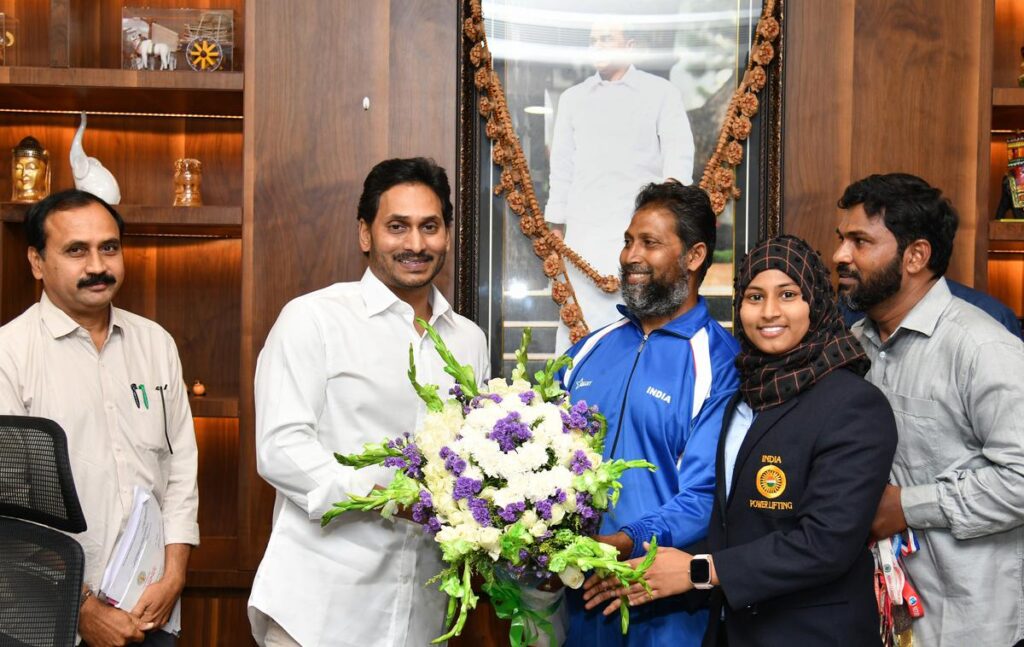
Powerlifting champion Sk. Sadia Almas presenting a bouquet to Chief Minister Y.S. Jagan Mohan Reddy at Tadepalli on Tuesday.

Proposal for setting up a powerlifting academy at Mangalagiri approved

Chief Minister Y.S. Jagan Mohan Reddy has announced a final assistance of ₹5 lakh on behalf of the Andhra Pradesh government for international powerlifting champion Shaik Sadia Almas.

Ms. Sadia, along with her father Samdhani, met Mr. Jagan Mohan Reddy at his chamber in the Assembly . She won three gold medals and a bronze medal at the Asian Powerlifting Championships held at Istanbul in Turkey in December 2021.

Mr. Jagan Mohan Reddy appreciated Ms. Sadia and approved the proposal of establishing a powerlifting academy in her hometown of Mangalagiri. He said that the government would make all efforts to encourage athletes in the State.

Sports Minister M. Srinivasa Rao, Mangalagiri MLA Alla Ramakrishna Reddy, Special Chief Secretary Rajat Bhargava and others were present on the occasion.

source: http://www.thehindu.com / The Hindu / Home> News> National> Andhra Pradesh / by Tharun Boda / Vijayawada – March 22nd, 2022

Farman Ali, the last of the great chefs

Lucknow, U.P. / NEW DELHI / Bengaluru, KARNATAKA:

At Falak in Bengaluru, a custodian of the old Urdu-speaking culture and culinary traditions brings storytelling to the table

While the lights of Dubai-esque skyscrapers speak of a new Bangalore and its ambition, the salubrious weather on the terrace is a testament to an old city — pleasant and genteel, never mind traffic, chaos or climate change!

This convergence of the old and the new is a theme, as I sit down to a meal at Falak, the new restaurant at Leela Bhartiya City. The meal is to flow like a quintessential 19th century Lucknowi dastaan (story), hyperbolic and stylised, to mimic the oral storytelling tradition, dastaan-e-goi.

In my bookcase, I have a copy of Tilism-i-Hoshruba, the truly first Indo-Islamic romance epic, an extension of the dastans of Amir Hamza, of the Persian tradition, albeit in translation. When it was first published, in a serialised form, between 1881-93, by the iconic Naval Kishore Press in Lucknow, it marked an important moment for the Urdu-speaking-and listening audience of northern India, long familiar with the Persian romance tradition — with fantasy, adventure and the implausible built in. But I turn to Hamza, to also dive into the inherent syncreticism on the pages, as the mores of a Persian world collide and merge with those of local Braj Bhasha-speaking cultures of the Indo-Gangetic plain.

Finding nuanced Avadhi in Bengaluru

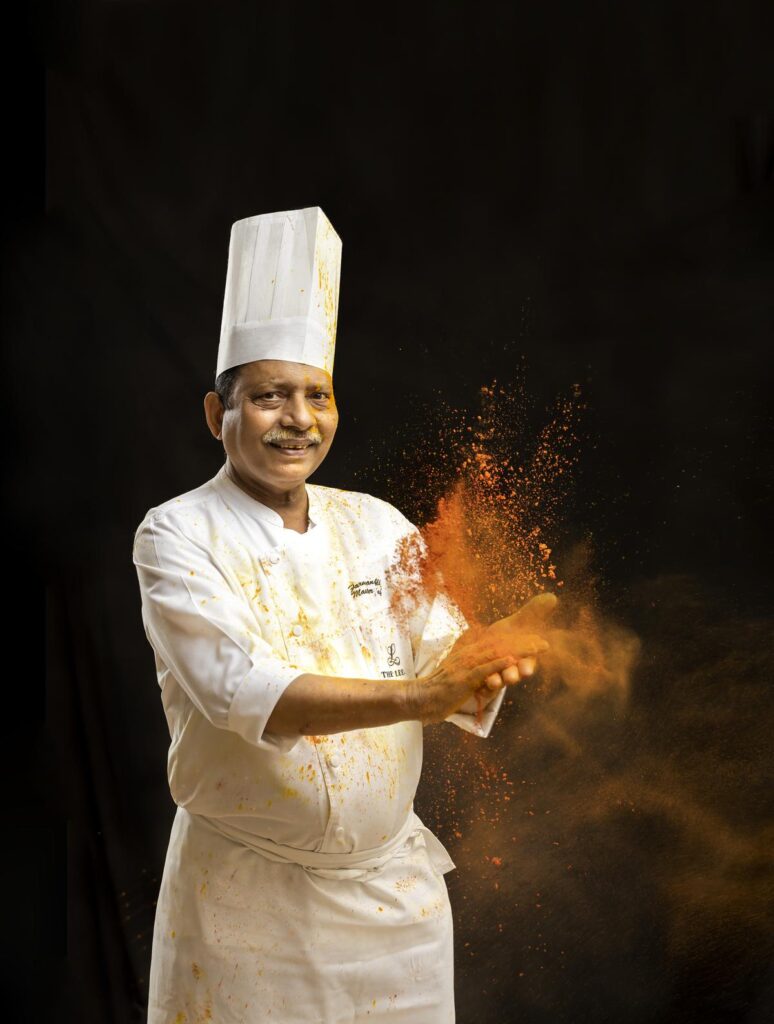
It’s a surprise to find a restaurant referencing this art form, to present Lucknowi (as also other Mughalai) dishes. Used to so much pastiche when it comes to Avadhi, the detailing in the menu is also unexpected. The food that arrives confirms that this perhaps is one of the most nuanced Avadhi/Mughalai restaurant opening in recent times — here in Bengaluru, rather implausibly, rather than Delhi, Mumbai or even London! Everything falls into place, however, when Farman Ali, all of 70, a chef who cooks behind the fiery range and sigri himself, and presides over the kitchens of Falak, makes his appearance.

When he hears about of my own Lucknowi antecedents, Ali abandons the idea of narrating food lore. With an extreme politeness that marks old Nawabi etiquette, he asks me, “ Ab aap ko kya dastan sunaye? [what possible tales can I tell you?].” And bursts into poetry, instead!

The rest of the evening goes by with the chef dropping verses from Daag or Ghalib or the other few who made 19th century Delhi one of the most literary cities in the world, even if we have forgotten that genre of poetry of lament created almost exactly at the time as Shelley, Wordsworth and the Romantics.

pix

Parts of an ancient story

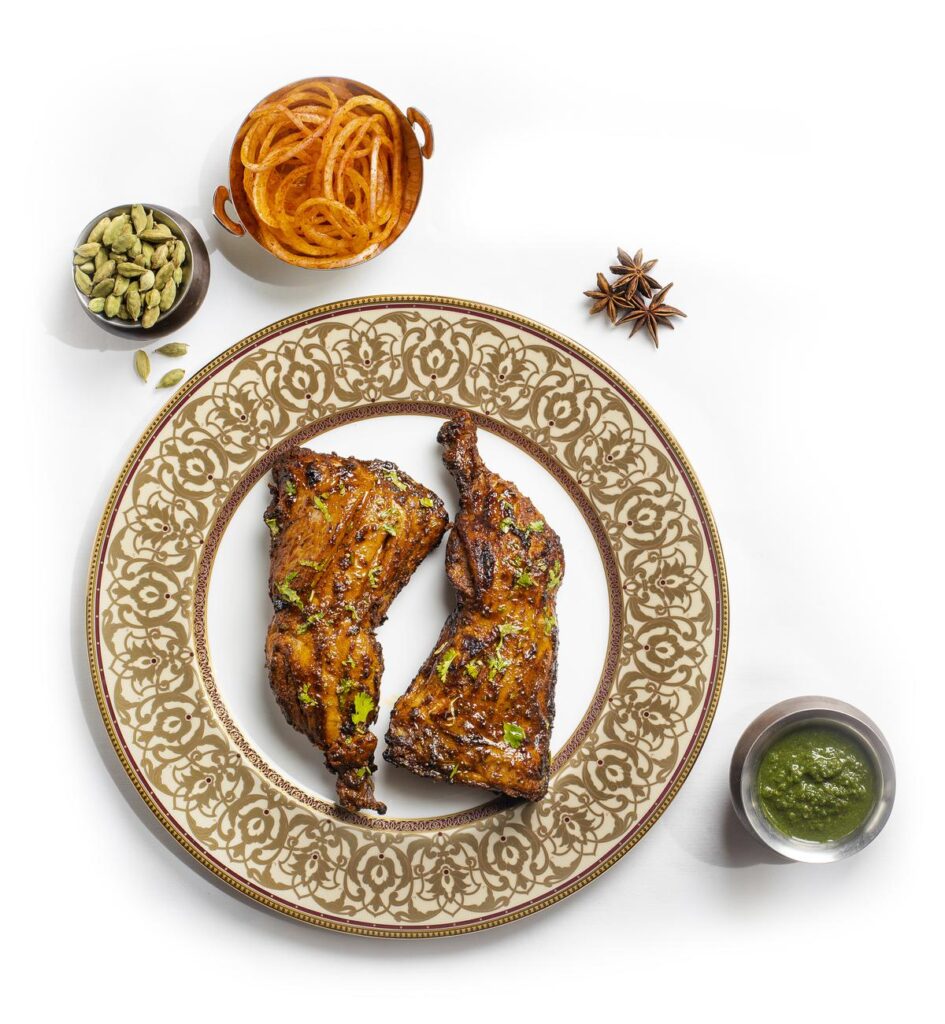
For Ali, I realise, this is not performance — though it is quite in sync with modern chefs expected to be performative as they spend time building brands ‘front of the house’. Instead, this is a way of life, a culture that has all but completely faded. As the meal progresses — the nihari (pepper-laced stew of old Delhi’s spice market, concocted, according to lore, to ward off cold and flu thought to emanate from the Yamuna canal in Chandni Chowk) being replaced by the qorma ( nihari evolved into the subtle Avadhi qorma, catering to aristocrats who thought it ill-mannered to be smelling of spices after a meal) being replaced by the ‘ balai’ka tukda for dessert (not dubbed ‘ shahi’ royal bread pudding here; balai being the correct term for clotted cream) — we talk not food but art.

One of the dishes served at Falak | Photo Credit: Special arrangement

“After 1857, so many artisans and poets fled Delhi for the Deccan,” says Ali. “Culture spreads like this.” He is right, of course. But the ghazal or qasidas aside, it’s also the biryani that has diffused. Farman Ali’s is the old Delhi/Lucknowi style (he grew up in old Delhi and still has a house there) where rice is cooked in stock, and the ‘ pulao’ is not the layered and overtly spiced dish that its Hyderabadi cousin is. Old ‘Nakhlauwallas’ — such as yours truly — contend there was no Avadhi biryani at all, before the restaurants took over, just many fanciful and well-documented pulaos such as the ‘ moti’ (pearls) or the ‘cuckoo’, served with fried onions and thin yoghurt, no chutney or gravy.

The man behind Jamavar

Ali worked in restaurants in Delhi and Dubai before being handpicked by The Leela’s Capt CP Krishnan Nair to create the food of Jamavar nationally, to cook and serve pan-Indian food. Based in Bengaluru, he curiously escaped much national attention, retiring just before the pandemic, but was called back by the owners of Bhartiya City, foodies themselves, to cook food closer to his roots.

If cuisine is an expression of a culture, at a particular point in history, its custodians and storytellers are as important as the taste of dishes.

In India, at this moment in time, it is perhaps important to look back on the custodians of the old Urdu-speaking cultures and their culinary expressions. What kind of a society produced these stylised dishes? Farman Ali, in many ways, is the last of the great chefs, many of whom were feted much more and earlier in their careers than him — such as Imtiaz Qureshi of ITC Hotels (and his family, such as son-in-law Ghulam Qureshi of Dumpukht), and chef Ghulam Rasool of Taj Hotels.

source: http://www.thehindu.com / The Hindu / Home> Life & Style> Food / by Anoothi Vishal / March 19th, 2022

The story of the Indian hockey great who died too young

BRITISH INDIA :

SM Jaffar was one of India’s finest hockey players in an era when the country reached near invincibility in the sport.

In the warm southern California summer of 1932, a group of young and colourfully-dressed athletes caught the attention of the residents of the Olympic host city. Angeleños, as the residents of Los Angeles were called at that time, had been expecting to see exotic looking foreigners, but even so, it would have been hard for many of them to not take a second look at turbaned Sikhs, Muslims and Hindus from faraway India.

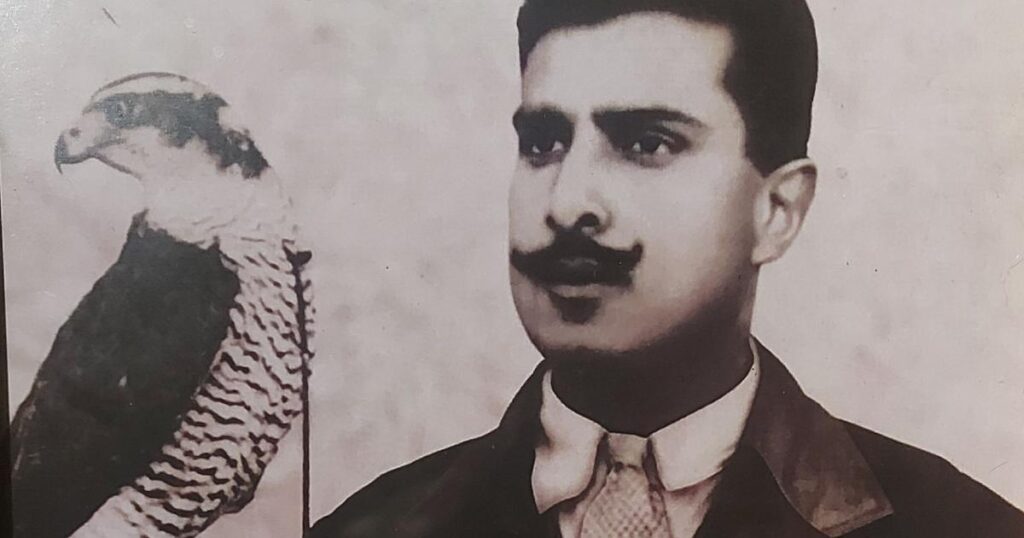
Accounts from diaries from the 1930s suggest that one 20-year-old with his trademark moustache and turban caught the attention of both athletes and fans. This hockey player from Shergarh, in what was then the Montgomery district of western Punjab, was one of the rising stars of the Indian hockey team: Sayed Mohammed Jaffar Shah (SM Jaffar), who played the left-out (forward) position.

Like his teammates, who undertook the 42-day journey by ship from Colombo to California, SM Jaffar could have easily been distracted by the attractions that Hollywood offered, but his focus on the hockey was unwavering. “This charming athlete from India, this sheikh from the deserts of Montgomery, this man who carried with him something of an atmosphere of vast extensive plains and cornfields and open air wherever he went, attracted many admirers,” writer Syed Ahmed Shah, better known as Patras Bokhari, wrote in an essay in the 1930s. “But this stranger with a manly moustache had the modesty of a village virgin that was both fascinating and forbidding.” SM Jaffar was Bokhari’s student at the Government College in Lahore.

Jaffar had a reputation of being a disciplinarian to the core. He even eschewed coffee, as his only attempt at drinking the beverage resulted in the loss of an entire night of sleep. “Myriads were the temptations in the way of a young man so far away from his mother and his father and his friends and dear ones at home,” Jaffar was quoted as saying by Bokhari.

The hockey player, who was a hawking and hunting enthusiast and a regular patron of Amritsar’s hawk sellers, chose to spend his free time in Los Angeles visiting the zoo and the city’s lion farm.

It was a foregone conclusion that the Indian team, which won the gold medal in the 1928 Amsterdam Olympics, would crush the only two opponents – the Unites States and Japan. Like the ongoing Tokyo Olympics, which have lost their sheen because of the global pandemic, the Los Angeles games had reduced participation on account of the Great Depression. Only 37 nations participated in the 1932 Olympics, compared to 46 in Amsterdam four years earlier. The Indian team, divided by groupism between Anglo-Indians and others (the captaincy went to Lal Shah Bokhari), beat the United States 24-1 and Japan 11-1 to win the gold.

“I have had the privilege of seeing many cuttings from American newspapers and I can say without the least fear of contradiction that no other player was more popular, more skilful and more highly praised than Jaffar, with perhaps the solitary exception of Dhyan Chand,” Syed Zulfiqar Ali Shah, who was Jaffar’s teacher at Lahore’s Aitchison College, wrote in 1937.

Shah, who would later become the principal of the prestigious Lahore institution, added, “…and what was true at Los Angeles, was equally true at the time of the Olympic Games in Berlin.”

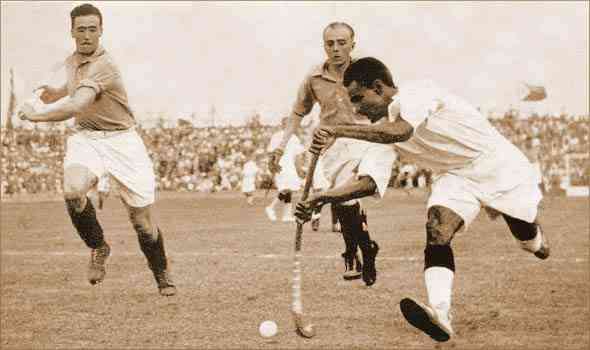
Dhyan Chand runs away with the ball in an Olympic contest. Credit: Wikimedia Commons [Public Domain]

Road To Berlin

After returning to Lahore, Jaffar immersed himself in his studies. He completed his degree and was appointed Extra Assistant Commissioner of Lahore and even took the Indian Police Competitive Examination. His hockey career also continued to flourish. By 1936, he was the captain of the Punjab hockey team at the inter-provincial hockey tournament in Calcutta.

The tournament, won by host Bengal, was used as a selection criterion for the 1936 Berlin Olympics. In a country which had several strong hockey sides such as Bengal, Bombay, Bhopal and Manavdar, just two players from Punjab were selected – Jaffar and Gurcharan Singh. Despite a request from the hockey authorities, the Indian Army initially refused to grant superstar Ali Iqtidar Shah Dara leave to play for the national side.

When it was time to select the captain of the Indian team, there were three candidates: Dhyan Chand, Jaffar and Manavdar’s MN Masood. “The IHF [Indian Hockey Federation] met at Delhi sometime in April to select the captain and officials of the tour,” Dhyan Chand wrote in his 1952 autobiography. “For the office of the captain, three names were put up – Jaffar, MN Masood and myself. Jaffar subsequently withdrew in my favour.”

It is widely accepted that the 1936 Indian team was the greatest to ever take the field in the history of the sport. Two-time defending champions, they were the favourites to win the gold, but the German side was a formidable opponent.

______

indianhistorypics

@IndiaHistorypic

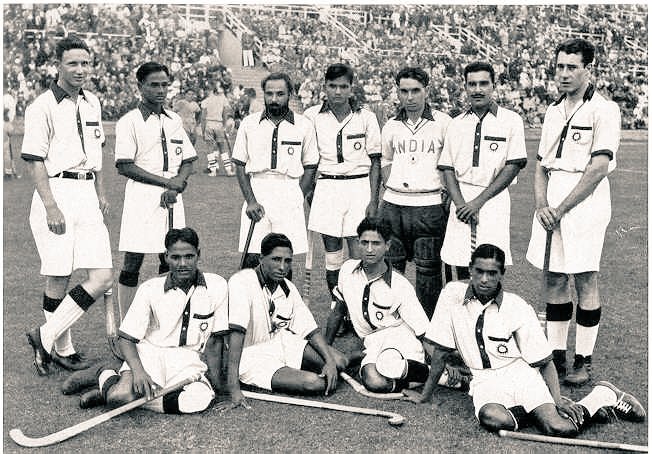
1936 :: Indian Hockey Team That Won Gold Medal In Berlin Olympics .

In Final, India Defeated Germany 8-1

In Tournament India Scored 38 Goals , Dhyan Chand Scored 13 Goals and His Younger Brother Roop Singh Scored 9 Goals

9:49 PM – Aug 1, 2021

_______

Panic seized the Indian team when they lost a warm-up game to the Germans by a score of 4 to 1. Dhyan Chand and Jaffar requested the army to release Dara for the tournament, and the legend was flown in to Germany a day before the semi-final. Till that point, India had little trouble in the tournament, easily defeating Japan, Hungary and the United States. The champions then crushed France 10-0 in the semis.

The final between India and Germany was witnessed by 40,000 spectators , most of them cheering for the home side.

India had some supporters in the stand too, including members of the Baroda and Bhopal royal families as well as some Indians who lived on the continent. The clinical performance of the Indian team, which won 8-1, threw the theory of Aryan Supremacy to the bottom of the Spree River that runs through the centre of Berlin. In a match where Dhyan Chand scored three goals, Dara added two and Jaffar contributed to the tally with a solitary goal. India could have easily scored more, but Dhyan Chand decided to give the “rough” Germans a “lesson in ball control” and the Indian team toyed with their opponents, moving the ball around endlessly.

“During the tour, he was a very great asset to the team, both on and off the field, and was highly praised by the German press,” Syed Zulfiqar Ali Shah wrote about Jaffar. “…He was Dhyan Chand’s right hand man and extremely useful in maintaining the morale of the team.”

The Olympic gold in hockey would stay in the subcontinent until 1972, with India winning gold in 1948, 1952, 1956 and 1964 and Pakistan doing so in 1960 and 1968.

A Tragic End

Unlike Olympic legends, Dhyan Chand and Ali Dara, SM Jaffar, who was at the peak of his athletic abilities in the mid-1930s, would not live to see the departure of the British from the subcontinent.

On the morning of March 21, 1937, Jaffar, an avid hunting enthusiast, went on a duck shoot with his friends on the banks of the Ravi River, near Lahore. The Olympian waded into the river to retrieve a duck that his dog was unable to get. Unknown to the party, the duck fell near a whirlpool in waist-deep water. Jaffar was sucked in, and his boots got caught in the reeds in the water. Despite being a skilled swimmer, he could not set himself free. The two-time Olympic gold medallist drowned in front of his friends in the Ravi. He was 25.

“It is too painful for me to recall here the incident of his most tragic death, which has deprived us of a brilliant ‘Old Boy’ of whom we were all unreservedly proud; no institution will mourn the death of Jaffar more than Aitchison College, of whose products he was the finest example,” Syed Zulfiqar Ali Shah wrote.

SM Jaffar is remembered as an all-time hockey great in Pakistan. As a tribute to his contribution to hockey, Aitchison College constructed a hockey pavilion in 1939. The Ali Institute of Education in Lahore organises an annual hockey tournament in his name. In India, however, his name is known only among the diehard hockey fans of a much older and dying generation. Perhaps a celebration of the legacy of such common heroes of the subcontinent would act as a catalyst for better relations between the South Asian countries?

Ajay Kamalakaran is a writer and independent journalist, based in Mumbai. He is a Kalpalata Fellow for History & Heritage Writings for 2021.

source: http://www.scroll.in / Scroll.in / Home> Remembering History / by Ajay Kamalakaran / August 06th, 2021

Prem Nazir award for Aleppey Ashraf

KERALA :

Besides Aleppey Ashraf, eight people from different fields will also be honoured on the occasion

Noted script writer and filmmaker Aleppey Ashraf has been selected for the Prem Nazir Award for the year 2022 instituted by the Prem Nazir Samskarika Vedi on the occasion of the 33rd death anniversary of the actor.

The award will be presented at an event to be held at Kozhikode Town Hall on Tuesday at 5 p.m., which will be inaugurated by noted writer K.P. Ramanunni. Former MLA Purushan Kadalundi will be the guest of honour on the occasion.

Assistant Director R. Thankaraj will deliver the Prem Nazir commemoration lecture.

Besides Mr. Ashraf, eight people from different fields will also be honoured on the occasion.

As part of the event, a karaoke music competition will be held at the venue from 11 a.m. onwards.

Those interested in taking part in the competition may contact 8891922573 or 9778009088 to register.

There will also be a musical programme after the award ceremony, chairman of the Vedi P.T. Azad said.

source: http://www.thehindu.com / The Hindu / Home> News> Cities> Kozhikode / by Staff Reporter / Kozhikode – January 11th, 2022

IIS kids set new world records

Doha, QATAR :

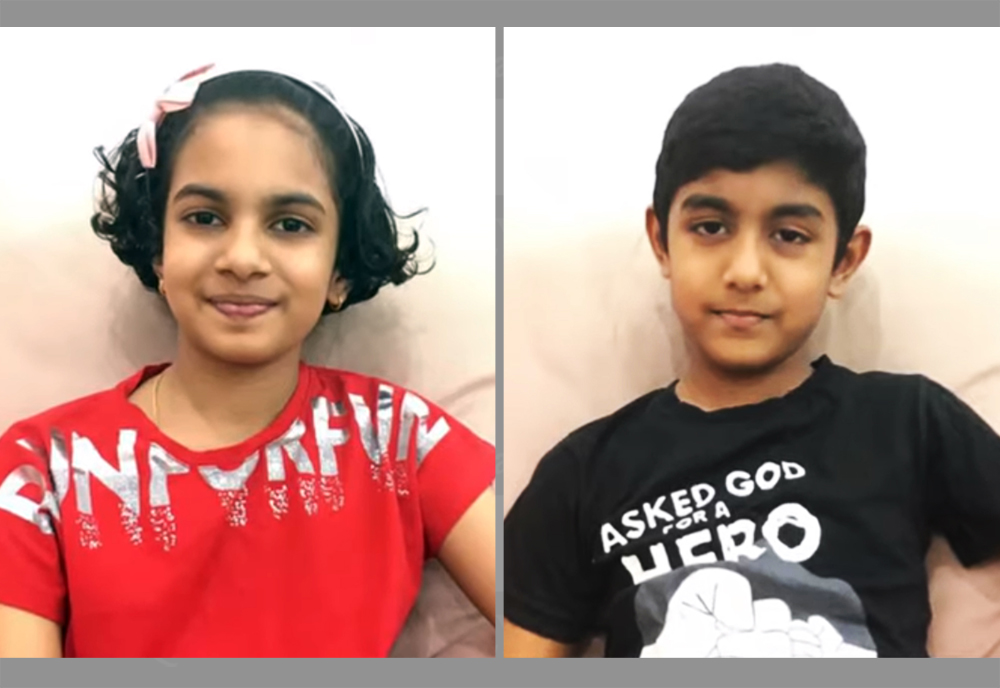
From left: Nada Zubaida Saleel and Jazil Saleel Salam

Doha:

Nada Zubaida Saleel and Jazil Saleel Salam, students of Ideal Indian School (IIS) set new world records in fastest recitation of names of countries, capitals and currencies thus entering the International Book of Records.


Zubaida Saleel, a student of class 6 of IIS recited the names of all countries along with their currencies in two minutes 42 seconds and has set a new world record while Jazil Saleel Salam, a grade 3 student recited names of Asian countries and capitals in a record time of 45 seconds, thus entering the International Book of Records. 

source: http://www.thepeninsularqatar.com / The Peninsula / Home> Doha Today> Community / October 12th, 2021

Date with history: A family’s journey from Medina to Mysore kingdom

KARNATAKA :

Synopsis

When bullock carts were the prime mode of transport, an Arab businessman was pained to see the beasts carry loads up the steep, rough climb.

In the 1930s, when bullock carts were the prime mode of transport, an Arab businessman was pained to see the beasts carry loads up the steep, rough climb from Hebbal Tank. Their hoofs wore thin very soon. So, he levelled the path, spending Rs 10,000 out of his pocket. When this came to the notice of Sir Mirza Ismail, the then diwan of Mysore, he promptly informed Krishnaraja Wadiyar. A private citizen spending for public good, the king thought, reflected badly on his administration. He made good the businessman’s expenses and named the area at the junction of Bellary Road, Jayamahal Road and CV Raman Avenue in his honour. Today , we call it Mekhri Circle.

The selfless businessman was M Enayathulla Mehkri (not ‘Mekhri’ as it is spelt today). The Enayathulla Mehkri Square was inaugurated by Sir John Hope, governor of the Madras Presidency , in April 1935.The space had a lamp post with five lights. A garden around it was maintained by ward officers. Later, in 1965, RM Patil, minister of home and municipal administration, notified it as Enayathulla Mekhri Circle through a notification in the state gazette.

Mehkri’s story , however, goes beyond the one philanthropic initiative he is most known by.

Mehkris were originally based near Medina in Arabia and migrated to India after the Turkish invasion. The family’s legacy dates back to more than 600 years. “While people believe that our name is derived from a place called ‘Mehkr’ in Syria, documents suggest that we were named after Mekhar in Maharashtra,” said Fazal Mehkri, nephew of Enayathulla Mehkri.

In India, the family held key posts under the Mughals and the Mysore maharajas.

Enayathulla Mehkri, born in 1898, went on to become a freedom fighter. At 17, he joined the Indian National Congress.

A contractor by profession, he participated in the freedom struggle, and was jailed for six months at Madras Central Jail along with C Rajagopalachari and EV Ramaswamy Naicker.

Mehkri was the municipal commissioner (between 1947 and 1948) and a councilor of the City Corporation for 16 years before that. He was not only the only member from Karnataka to be on the Advisory Council of the Freedom Fighters Cell of the AICC, he also headed the Karnataka Freedom Fighters’ Association till his death on November 28, 1990.

source: http://www.economictimes.indiatimes.com / The Economic Times / Home> Panache> ET Magazine> Travel> Business News> Magazine / by Divya Shekhar, ET Bureau / April 28th, 2016

Lakshadweep student trolled for video of situation on ground in war zone in Ukraine

LAKSHADWEEP / UKRAINE :

In the video, the student is seen walking with food in his hand. He was saying that the kind of suffering he is facing is beyond description.

A view of the central square following shelling of the City Hall building in Kharkiv, Ukraine, Tuesday, March 1, 2022. (Photo | AP)
A view of the central square following shelling of the City Hall building in Kharkiv, Ukraine. (Photo | AP)

New Delhi : 

A student from Lakshadweep pursuing MBBS in Ukraine was trolled online for putting up videos of his experience in the war-torn country.

Aousaf Hussain, a fourth-year student of Kharkiv National Medical University, was criticised by persons from Kerala and Lakshadweep for going out and getting food for his friends who are living in a bunker in Kharkiv.

The trolls attacked him for walking in the war zone, eating and taking videos of soldiers.

In the video, the student is seen walking with food in his hand. He was saying that the kind of suffering he is facing is beyond description.

“Will someone contact the Indian embassy? What discussions are they having at this point of time? I don’t understand why they are wasting time on discussions”.

After the trolling, Aousaf went into depression. His mother was also hospitalised and had to be kept under observation.

According to his friends, Aousaf had stepped out of the shelter to get food because none of them had eaten anything that day.

“Shawarma was the only food available nearby. After packing the food for his friends, he was rushing back. Because he was hungry, he started eating his share,” said his friend Shana M Shaji.

In the video, Aousaf is also seen saying that he was stopped by some soldiers for shooting videos.

They did not come in an army vehicle, but a car. They asked him to delete the video. He thought he was going to be killed, but somehow managed to escape from the scene.

According to Afsal Husain, Aousaf’s elder brother, this video came under attack from people who posted comments saying he should be killed in the battlefield.

“Some right-wing social media accounts with around 2 million followers asked the Indian government to not evacuate him.”

Another video posted by Aousaf with his female friends also became the target of trolls. The girls allege that a large number of trolls had religious colour.

“We were wearing hoodies in the video and that was thought to be hijab. We were alerted by our parents that online comments are calling us terrorists,” said Shana.  

source: http://www.newindianexpress.com / The New Indian Express / Home> Nation / by Ankita Upadhyay, Express News Service / March 08th, 2022