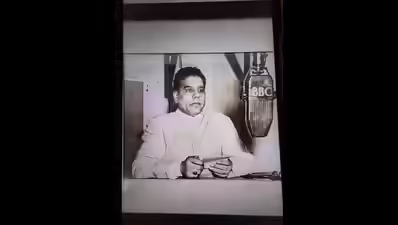
Barrister Mohammed Yaseen Nurie who served as a Minister in B.G. Kher’s cabinet
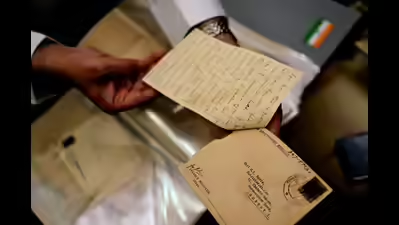
The lane leading from the iconic Mahim Dargah to Mahim police station has an important address: Nurie Villa. But you may never know it unless you enter the haveli-like home and meet its owner Owais Shakir Nurie. At the house’s delightfully decorated drawing room, Owais, 54, pores over a heap of old letters carefully kept in folders.
Look carefully as these letters, mostly typed but many handwritten too, reveal a lot about what Owais calls “the unsung hero, the forgotten freedom fighter who took Pakistan founder Muhammed Ali Jinnah head on.” These letters are addressed to Barrister Mohammed Yaseen (M Y) Nurie (1895-1971), Owais’s grandfather who lies forgotten in the saga of freedom struggle.
If our freedom movement, especially the years after Quit India Movement leading to Independence pockmarked by partition, was strikingly eventful, Nurie must occupy the place of an important player. Educated at Mohammedan Anglo-Oriental College (Aligarh Muslim University since 1920), Barrister from England, incarcerated for two years during Quit India Movement (1942), opposed Jinnah so much that he called Nurie “my fiercest competitor”, elected MLA from Ahmedabad in the 1937 provincial elections for the Bombay province which included Gujarat, made minister of public works in the B G Kher cabinet, Nurie played multiple roles and yet remains largely unsung.
Letters written to him by luminaries like Jawaharlal Nehru, Sardar Vallabhbhai Patel, Lal Bahadur Shastri, Morarji Desai, Syed Mahmud (External Affairs Minister), V K Krishna Menon (Defence Minister), S K Patil (Transport and Communications Minister), testify to Nurie’s importance in national and Maharashtra’s politics.
Yet, if Nurie does not figure immediately in the national imagination created and promoted, post-Independence, through careful curation and diligent deletion, blame it on the “syndicate” within the Congress party which suffered Indira Gandhi’s wrath for opposing her politics.
“Since my grandfather was in the syndicate led by the likes of K Kamraj and Morarji Desai, he too was denied positions in the 1960s and a place in the government-backed history projects,” says Owais, a govt contractor. “My father (Shakir Nurie) had seen how his father and the family suffered for siding with the Syndicate.”
The family was evicted from its rented Colaba home. “Nobody knew that there existed a tranche of letters, photographs and other documents related to my grandfather’s role in the freedom struggle and his interactions with so many important leaders till I opened the cloth bundle dumped at our Bewar (Rajasthan) haveli,” says Owais.
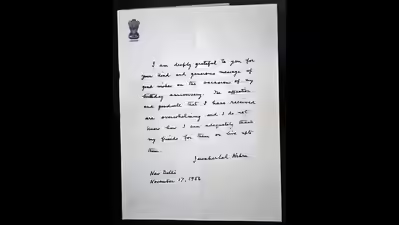
In his handwritten letter (November 17, 1956), Nehru profusely thanks Nurie for his birthday wishes. Through a 31st July, 1954 letter from Istanbul (Turkey), a director friend informs Nurie how Mehboob Khan-directed, Dilip Kumar-starrer Aan (1952) was a huge success in Egypt and he wants to show it in Turkey too.
Among the Nurie papers is a detailed protest letter Nurie lodged against a proposal to turn the historic Khilafat House in Byculla into a musafirkhana for Haj pilgrims. “It was due to his protest that the Khilafat House did not become the Haj House (it came up much later near Crawford Market). Nurie sahab had served the Khilafat Movement and knew its importance in our national life,” observes Khilafat House’s trustee Rauf Pathan, currently engaged in the redevelopment of this iconic building.
Owais thanks his friend Sunil Bhatia who drew his attention to the blog created by the Ministry of Culture as part of its initiative on “unsung heroes” under the Azadi Ka Amrit Mahotsav. Ministry officials jumped with excitement when they saw some of the letters and requested Owais to collect and add more credible information to the project on Nurie’s life.
At a meeting in 2018 in Ahmedabad, held by businessman Zafar Sareshwala, a Hindu businessman felicitated Owais after he learnt he carried the Nurie legacy, the freedom fighter who opposed Jinnah and, as PWD minister (1937-39), must have overseen work on Queen’s Necklace , Marine Drive.
source: http://www.timesofindia.indiatimes.com / The Times of India / Home> News> City News> Mumbai News / by Mohammed Wajihuddin / May 24th, 2026
Can a stable and just democracy flourish on foundations of wilful amnesia and erasure?
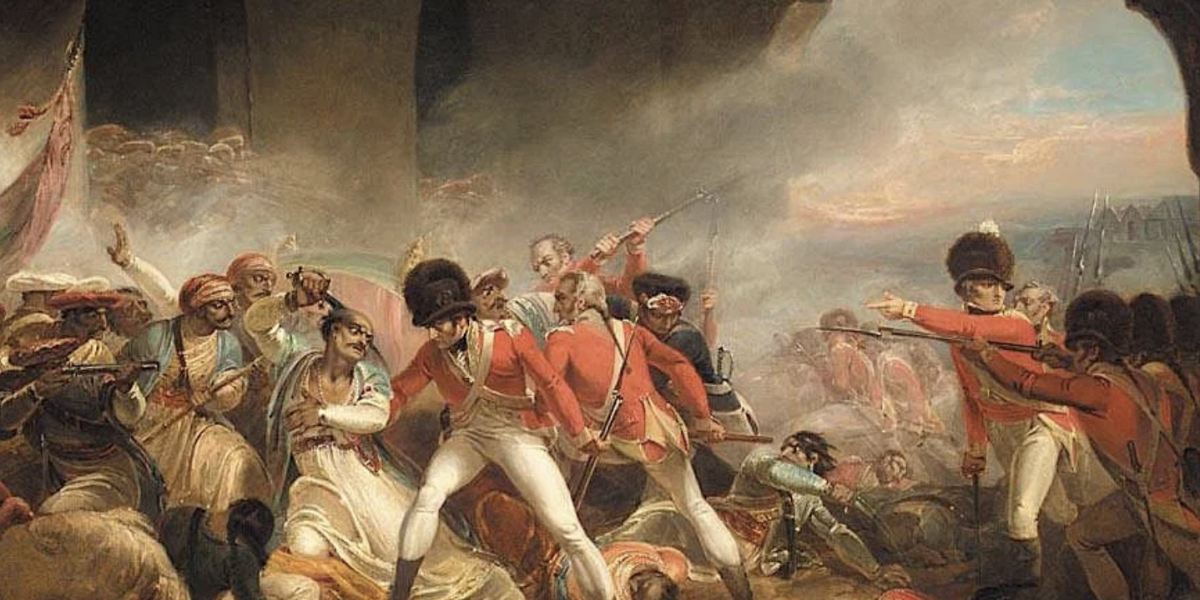
A c. 1800 painting showing the last stand of Tipu Sultan, ruler of Mysore in 1799 at the end of the Anglo-Mysore Wars with the East India Company. Photo: Henry Singleton/Public domain.
Many will ask why a book about Muslims who fought for India’s freedom? There’s no answer to such questions except another question. Had we been better memory keepers as a nation, could we have avoided the peak disinformation and stupidity which normalises reviling ordinary Muslims as outsiders, infiltrator and insurgents?
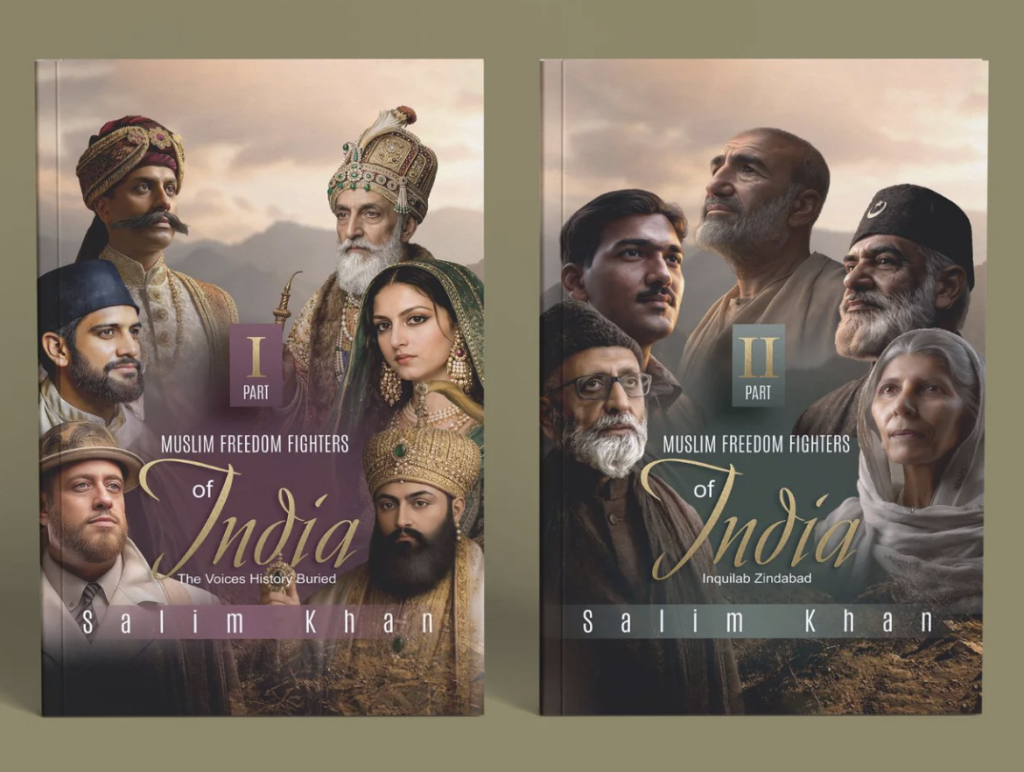
Muslim Freedom Fighters of India is a two-volume biographical compilation by Salim Khan on less-known, mostly forgotten and hardly known Muslim figures. The books aim to clear the fog around Muslim freedom fighters whose names are heard of without them being extensively known and this requires us to understand why this fog exists. Written in an extremely readable and accessible format, these biographical accounts embed the historical figures in the context of their times, responding to unprecedented events with foresight, clarity and conviction that sealed their fate and shaped and the nation’s destiny.
Whether we are reading about Generals of 1857 – Bakht Khan and Khan Bahadur Khan – or the Cambridge-educated Rampur scion Mohammad Ali Juahar of Khilafat moment and his fiery mother Bi Amma, the larger questions seething beneath the stories keep rising to surface. Who does a society and nation choose to remember and celebrate? Whose memories are deemed worthy of preserving? History is always shaped by those who control archives, narratives and memorialisation and hence memory.
Reading about Tipu’s dazzling reign through the three Anglo Mysore wars where he proved superior to British forces, I was reminded of the controversy sparked by the late Girish Karnad’s suggestion of naming the Bengaluru airport after Tipu Sultan. Karnad had said, “It is true that Tipu Sultan was not born in Bengaluru, but he was a son of this soil and a freedom fighter. Had Tipu been a Hindu, he would have achieved the status of Shivaji, and the airport would have been named after him.” I recalled Karnad because his play Dreams of Tipu Sultan echoes the same theme that this two-volume tribute to erased, obscured and deliberately unremembered historical figures echoes: that when politics lays down who should be forgotten, remembering the erased becomes a duty, an affirmation and a political act.
It is important to clarify that this is not a compilation of eulogies but well-researched fact based account of people who had the uncommon clarity to resist colonial domination even before the nationalistic narratives took shape. That they happened to be Muslims is important today because of the distortions that have obscured and erased them. But back then when they fought and resisted, they were simply rallying for the cause of their soil and their watan. From the earliest times they understood that freedom from foreign domination required Hindus and Muslims to put up a united front as in the war of 1857, the Khilafat movement, and the period between 1919 and 1924. Back then too, traitors cut across religious lines – Jagat Seth, Mir Jafar, and Ilahi Baksh.
Muslim Freedom Fighters of India: Part 1 and Part 2’, Salim Khan, Qalam Aur Kaagaz Books.
From Siraj ud Daulah to Tipu to Shahzada Firoz Shah, the book shows how the fog around these personalities is not accidental but meticulously designed – initially by the colonial mind, then picked up by early nationalists and woven into simplistic narratives. The macabre dance of history further stifled Muslim voices. Cataclysmic events like the ‘end’ of the Mughal Dynasty in 1857 and the Partition in 1947 sundered clans, erased family histories, legacies crumbled with no one is around to defend and uphold them. Today, even people who don’t know history have heard of Lakshmi Bai, but many who read history may not have heard about Shahzada Firoz Shah, the Mughal Emperor’s grandson who in August 1857, led a band of armed soldiers to rally the rebels in Rohilkhand and Malwa and who fought alongside Tatia Tope and called for a united Hindu-Muslim front against the Company.
The British understood the dangerous potential of popular memory and subverted any potential for memorialisation of hugely influential figures. No one knows if Shahzada Firoz died in battle or escaped to West Asia. The Maulavi Ahmadulla of Faizabad whose authority and fearlessness scared the British so much that they kept a reward on his head, was likewise interred in an unmarked grave. Knowing that even his memory could become a node to unite the rebels, the British saw to it that no commemoration was permitted or possible. Zafar, the last Mughal was exiled to Rangoon for the same reasons.
In her book, India, 5,000 years of history on the subcontinent, Audrey Truschke, elucidates how Muslim rulers like Nawab Siraj ud Daulah and Tipu Sultan to Zafar felt a responsibility for their subjects no matter what their religion. For example, Siraj ud Daulah actively intervened in times of famines and drought in Bengal. But after the British took over they did nothing to alleviate human suffering, so that 20% of Bengal’s population died in the famine of 1768 and the small-pox epidemic of 1769-70 following it. This had never happened during earlier episodes of failed harvests. Truschke says, British historians initiated the custom of categorising Indian rulers as tyrannical, effete and incompetent, reducing them to their religion and writing in terms of Hindu rulers and Muslim rulers. The British needed to demonise Muslim rulers who were their immediate predecessors in subcontinent so that they might look good by comparison, Truschke notes. It was a part of the colonial propaganda.
Another pattern Salim Khan’s compilation brings out is that from mid-18th century onwards, the first responders and the most committed crusaders resisting colonial domination – the kings, queens, princes, preachers, noblemen – were Muslims. Not only because the British had wrested from them the power they had wielded for centuries (howsoever fragmented or diluted it may have become); but also, because they were looked upon as leaders. In Awadh, for example, the Shia elite took it as their moral-ethical duty (see Chapter 7, volume I: Shia Ullema and Noblemen of Awadh)
Even in the 20th century, Muslim freedom fighters like Hasrat Mohani of the Inquilaab Zindabad fame and Asfaqullah Khan of the Kakori conspiracy who was an icon for Bhagat Singh, remain in the shadows, seen only in a hazy half-light. Were their contributions any less or only less remembered? One of the most important projects post-Independence should have been to restore memory and affirmation to those whom the British put on the wrong side of history, no matter what their religion or caste. But we know this is not what happened.
Since the arrival of the political controversy over Tipu Sultan, we have entered in an era of deliberate distortion of history. The larger question that these accounts refrain from asking but that jumps to any thinking person’s mind is this: can a stable and just democracy flourish on foundations of wilful amnesia and erasure? Should the memory of Muslim freedom fighters be kept only by the Muslims? The heritage and memory of Indian Muslims needs to be reclaimed by them. But equally, these volumes are required reading for the casually miseducated, hopelessly disinformed or simply ignorant Hindus who have been stupefied into denying and distorting their composite history.
Varsha Tiwary is a Delhi-based writer and translator. She has recently published 1990, Aramganj a translation of the best-selling Hindi novel Rambhakt Rangbaz.
Seohar Town (Bijnor District), BRITISH INDIA / NEW DELHI :
For too long, a handful of names have dominated the history of the years leading up to 1947 with Gandhi, Nehru, Jinnah, Patel being the most-often cited.
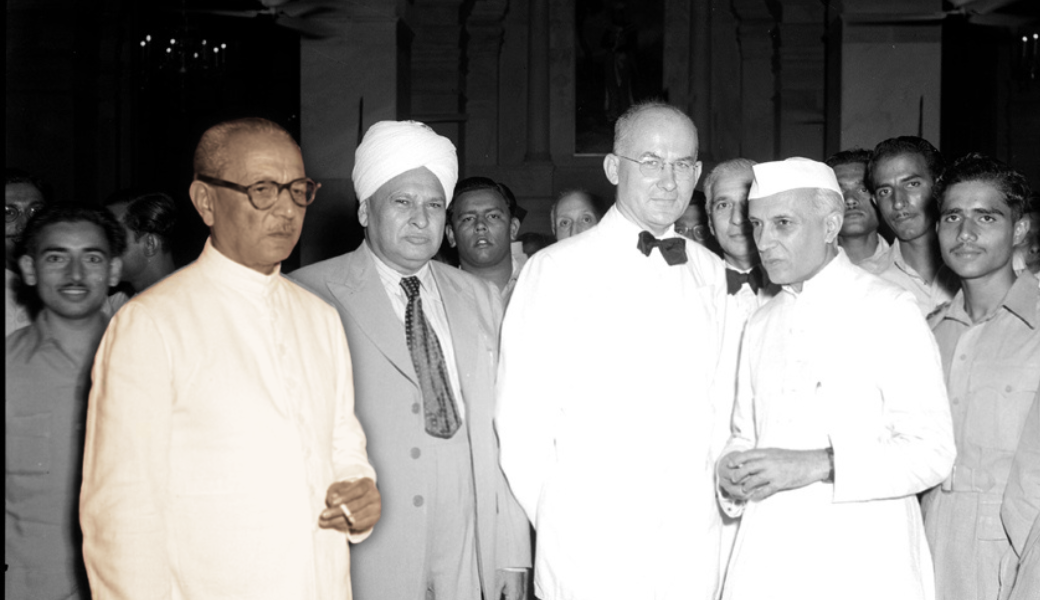
Pandit Jawaharlal Nehru and others at Governor-General‘s Dussehra reception held at Government House, New Delhi on September 29,1949. At extreme left is Asaf Ali, the then Governor of Orrisa. Edited via Canva. Photo: Photo Division, Govt. of India
For several years I worked in a publishing company situated on the bustling Asaf Ali Road, a road that serves as a cordon sanitaire between the squalor of Old Delhi and the (relative) order of New Delhi. Once an important business hub, by the time I went to work there in the late 1980s, this long stretch of colonnaded corridors with a warren of densely-packed offices wore an unmistakably grubby, down-at-heel look. At the head of the road, stood the statue of Asaf Ali in a derelict enclosure near Delhi Gate (or Dilli Gate as the locals pronounced it). The dark statue, generously speckled with startlingly white droppings from the many pigeons that frequent this neighbourhood, looked forlorn, especially so with the shervani-clad, bespectacled figure standing with hands clasped in a peculiarly supplicatory posture.
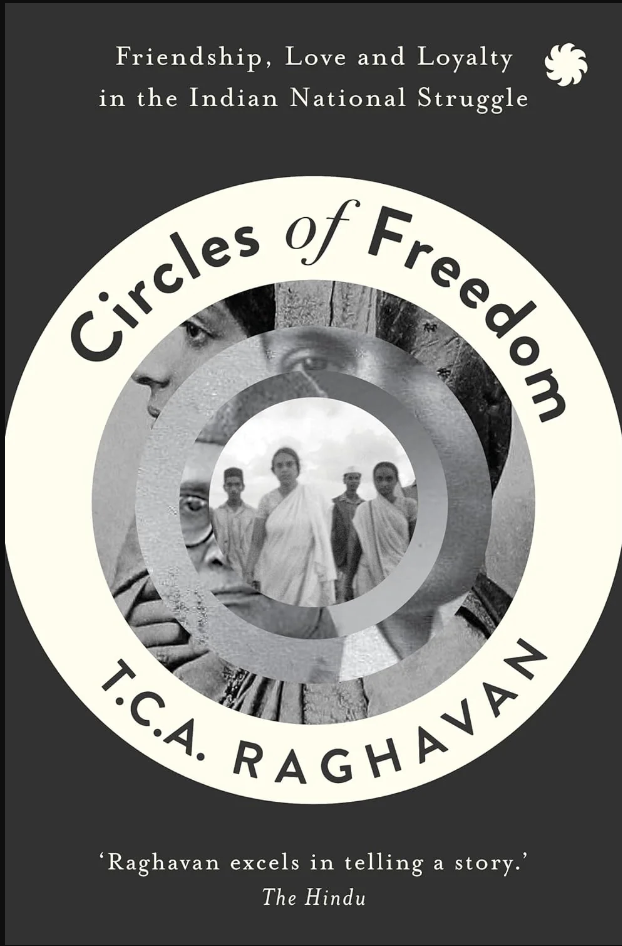
TCA Raghavan, Circles of Freedom: Friendship, Love and Loyalty in the National Freedom Struggle, Juggernaut (2024)
I must confess that in the four years I worked at Asaf Ali Road and passed this statue twice a day, morning and evening, it evoked no curiosity in me and I knew virtually nothing about Asaf Ali. Perhaps, his wife Aruna Asaf Ali’s name seemed more familiar given that she was still alive and active. I suspect I was not alone in this. For most people in Delhi, Asaf Ali is a forgotten footnote from long-ago history lessons, one of the many ‘obscure’ people who were part of the national freedom struggle. If the situation is so dismal in Delhi, where he had lived and worked, a city that had been home to his ancestors, I suspect it can only be worse in the rest of the country.
In writing Circles of Freedom: Friendship, Love and Loyalty in the National Freedom Struggle, TCA Raghavan corrects an old wrong. For far too long the tall poppies of the freedom movement have overshadowed the countless others who devoted their entire lives to the cause of independence and struggle against colonial rule. For too long, a handful of names have dominated the history of the years leading up to 1947 with Gandhi, Nehru, Jinnah, Patel being the most-often cited.
Over the past decade, with history being rewritten by new, dominant players, new names are being invoked and icons fashioned from often slender resources. In this unseemly clamour for space and recognition, some names have almost slipped through the crevices of the popular imagination, neglected and overlooked by the professional historian or, at best, relegated to the lowest rungs in a carefully crafted hierarchy of heroes. A park or a road named after the lesser-known evokes neither curiosity nor interest in their lives and the place they occupied in the shaping of a young nation. Asaf Ali (1888-1953) is one such person.
Raghavan’s book, however, is not a straightforward biography for it is not about Asaf (as the author calls him) alone. Instead, he chooses to tell his story through five protagonists who were inextricably tied by the threads of friendship and solidarity: Asaf Ali, Sarojini Naidu, Syud Hossain, Syed Mahmud and Aruna Asaf Ali. While Aruna enters this narrative quite late when she marries the much older Asaf, the other four meet in England just before the Great War where the three men have gone to study and Naidu, recuperating from an illness, is the erudite diva, eloquent poet, ardent nationalist and a veritable magnet for impressionable young men dreaming impossible dreams.
Over the next four decades, they meet, write long letters to each other, take a lively interest in each others’ lives and careers but ‘what gave meaning to their lives,’ as Raghavan notes in his conclusion, ‘was the great enterprise they chose to become part of’. And so it was the freedom struggle that not just formed the core of their relationship but also, in effect, shaped their lives. Were it not for this one singular, overwhelming zeal to seek freedom for their country, they could very well have lived other lives: Naidu would have remained a dulcet-voiced poet, both Asaf and Mahmud successful and wealthy barristers, Hossain a journalist and Aruna a do-gooder with no special qualifications. But such were the exigencies of the times that all five were caught up in different ways and different degrees with the national freedom struggle and that singular ‘great fight’ defined their lives.
With three extremely well-received books behind him – Attendant Lords: Bairam Khan and Abdur Rahim – Courtiers and Poets in Mughal India, The People Next Door: The Curious History of India’s Relations with Pakistan and History Men: Jadunath Sarkar, G. S. Sardesai, Raghivir Sinh and Their Quest For India’s Past – Raghavan, a former diplomat, can recreate history with the aplomb of a master story-teller and the meticulousness of a professional historian. Here, he weaves the events of the tumultuous years leading up to Independence with the lives of his five principal characters, keeping Asaf at the centre of his concern. Through Asaf, he teases out the nuances and dilemmas of the moderate Muslims in India who refused to be enamoured by the lures and promises of the Muslim League and remained steadfast in their devotion to the Congress and, by extension, Nehru.
The extreme deference that the nationalist Muslim leaders displayed towards Nehru is noted; each time a Muslim leader attempted to bring the ‘communal problem’ to Nehru’s notice, the latter would brush aside these concerns by saying, ‘The real problem is a political problem – the conflict between an advanced organisation like the Congress and a politically reactionary organisation like the League.’ Concerns of leaders such as Asaf who believed ‘self determination was preferable to a union that was forced’ were disregarded. Mindful of the suspicion that Muslim leaders within the Congress evoked amongst their colleagues, Raghavan notes, ‘Because he was a Muslim, the impression among some was that he was a fifth columnist for the League’. The coming of independence didn’t make it any easier for those Muslims who chose to stay on in India. Nationalism increasingly began to mean thinking and living in the Congress way and none other. Those who lived or thought another way came to be regarded as anti-national, a phenomena we see repeated in the New India that is Bharat, except that it is the ruling Bharatiya Janata Party that has replaced the ideological hegemony of the Congress.
Different readers will possibly take different things from this book: the broad brush strokes that delineate milestone moments from modern Indian history, Gandhi’s irresistible call to Quit India, the unfurling of the national flag at Gowalia Tank by a young Aruna that catapults her to national fame, the detailed account of jail-life for a group of high-profile, political prisoners inside the Ahmadnagar fortress, a meticulous dove-tailing of accounts from different sources and disparate perspectives to create a bright, colourful and immensely readable patchwork quilt of modern Indian history, and much else in this engrossing book.
I, however, was left with an ineffable sadness and a sense that the more things change, they remain the same – at least for India’s Muslims. Despite his many sterling qualities of heart and mind, despite a fine legal education, Asaf neither made a mark as a lawyer or a politician. Though seemingly destined for greatness, having aided fate by preparing himself assiduously for a life devoted to the larger good, Asaf never quite scaled the heights he aspired to. The few successes that came his way, such as a seat in the Constituent Assembly (from Delhi) or fighting high-profile cases such as those of Bhagat Singh or Shaikh Abdullah, were marred by controversy or a smaller share in the limelight than he felt he deserved. The mantle of statesmanship that should have fallen on him with the passing of Dr Ansari and Hakim Ajmal Khan, both national leaders from Delhi like him, and a seat at the high table that should have been offered to him as a veteran Muslim leader, did not happen.
Given the price paid by far taller leaders in the Congress – such as C. Rajagopalachari and Bhulabhai Desai – for showing initiative and thus offending the party high command, shows the extent to which the Congress, not unlike the League, was becoming a personality-dominated organisation. Asaf’s case was compounded – to use a modern expression – by the optics; his timorousness, his ‘going to pieces’ fretting with worry over his wife during his long years of incarceration, his marital woes, the shadow of mistrust and suspicion that clung to him all his life combined to create a persona that failed to inspire confidence.
For all his loyalty to Nehru, Asaf was not chosen for any cabinet position or placed on any important committee. Instead, he was sent as Ambassador to Washington, brought back to serve as Governor of Orissa and then sent again as Ambassador to Sweden where he died barely a few months into his tenure.
Just as being a moderate Muslim defined Asaf’s public persona, so did his marriage to Aruna. From a political novice she rapidly transformed into a stormy petrel causing immense anxiety, consternation and eventually a sadness in her husband. Raghavan is to be credited for staying steadfastly away from prurient gossip and portraying the changing contours of the marriage objectively: ‘… in fact the relationship had started changing quite early in the marriage and here Aruna’s own political journey was the driving factor.’ Reading between the lines of Raghavan’s carefully crafted text, one picks up the whiff of misogyny in the higher echelons of our national leadership. While acknowledging Aruna’s bravery and patriotism, Gandhi saw her as a ‘perpetual rebel’ and Nehru went so far as to call her ‘hysterical’ on one occasion – something Aruna never forgot.
Incidentally, Gandhi, who was vehemently opposed to inter-religious marriages and had opposed his son Manilal’s relationship with Fatima (a Gujarati Muslim) and Hossain’s alliance with Nehru’s sister Sarup Rani (later known as Vijay Lakshmi Pandit), endorsed Asaf’s marriage to Aruna. Read Circles of Friendship to find out why.
Rakshanda Jalilis a Delhi-based writer, translator and researcher.
source: http://www.thewire.in / The Wire / Home> Books / by Rakshanda Jalil / August 29th, 2024
More than seven decades after India achieved independence, the role of innumerable martyrs and freedom fighters who gave their blood and offered lives for the motherland, needs to be remembered.
Many of them got harsh punishments, didn’t get proper last rites, remain forgotten and even those whose sacrifices are known, don’t have monuments or memorials built in their memory.
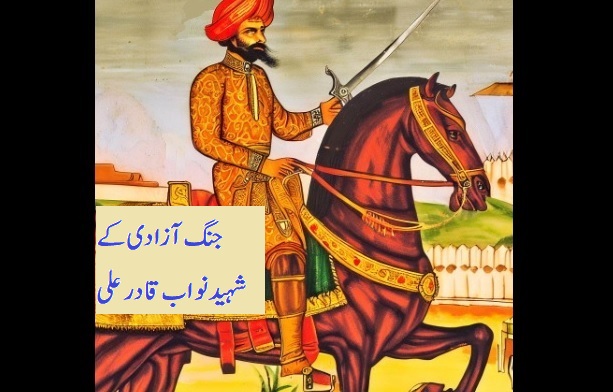
The martyrdom of Nawab Kadar Ali, and his companions, who planned attack on residency and to take on the East India Company forces in Nagpur, also needs to be recalled. They were hanged here for their role in 1857–the first war of independence.
Though there is no monument named after them and no big memorial, they remain heroes in public memory. The fort that had been a base of 118 Infantry Battalion for years, is opened on three days including August 15 and January 26. Thousands of people arrive on these days, and also pay visit to the grave and offer their respects.
The flame for independence was already lit. History books mention that soon after Meerut, the anger was palpable among soldiers and citizens in this region too. On June 13 1857, a large gathering took place near Mission High School. The soldiers too were anxious and ready.
Scared, some of the East India Compnay officials ran towards Kamptee Cantonment, while others went inside the Sitabuldi Fort. It was due to treachery that the attack plans had been leaked and the news reached British officers. More EIC forces were called from other places to control and overpower the rebels.
Rani Baka Bai, wife of late Raghoji II, was supporting the British and issued a warning that anyone abetting or aiding the revolutionaries would be arrested and handed to the East India Company. It’s a long story and how the soldiers and citizens suffered, refused to name the leaders of the movement.
Historical texts say that the signal of a fire balloon was decided. But after the traitors gave information to East India Company officers, Plowden, the commissioner, ordered a regiment to move into the city. The irregular calvary at Tali was dismayed. Major Arrow tried to get information from ring leaders but no one gave names.
Baka Bai summoned all her relations, and dissuaded them with threats. This chilled the spirit of public. However, later when Company officials’ strengthened their hold, the rebels were identified. Arms were collected and after inquiry, Dildar Khan, Inayatullah Khan, Vilayat Khan and Nawab Kadar Ali were tried and executed.
KILLED, HANGED, BURIED IN A COMMON PIT
The Gazetteer briefly mentions that ‘tucked away between the easter walls of the inner fort and the barracks is a large grave known as Nav Gazah Baba…the grave of Nawab Kadar Ali…and his eight associates..who were killed and hanged by the ramparts of the fort due to their role in the war of independence”.
“They were all buried in a common pit, nine yards long. The fort recalls to our mind the memory of the brave soldiers who fought in an attempt to preserve the independence of the mother land”. It was treachery that was responsible for the arrests and the punishment. Those who helped the British, got ‘jagirs’ as rewards.
Ghulam Rasool ‘Ghamgeen’, the poet, wrote these lines in Farsi :
Choo.n Qadar Ali Khan Ameer Kabeer Shud-az-tohmat, ahl-e-balwa aseer
Duaa’e shahaadat ba-raahe Khuda shab w roz mi kard aa.n mahtada … … Khirad guft ee.n misra-e-silk-e-noor Za-daar-e-jafaa shud ba-daar-e-suroor
The last couplet of this long Persian verse, brings out the ‘tarikh’, the year of execution. The complete verse is mentioned in Dr Mohammad Sharfuddin Sahil’s book ‘Tarikh-e-Nagpur’. It shows the impact of the hangings on the people in the region. Nagpur is geographillcally considered to be a part of Central India and is the biggest city in Vidarbha region of Maharashtra.
The fort for a long period remained the base of 118 Infantry Battalion of Territorial Army. Every year, on August 15 and January 26, fort is opened for public so that it can pay respect to the freedom fighters. It’s also opened on May 1 i.e. Maharashtra Day. [Illustration is representive]
source: http://www.newsbits.in / NEWS Bits / Home> Top News / by Shams Ur Rehman Alavi / August 15th, 2021
Munshi Mazahar Ali was a freedom fighter of Belgaum who lived near HESCOM counter at Kacheri Road, Shaniwar Khoot, Belgaum.
He was said to be a butler in the British army at the Belgaum regiment and being a staunch Muslim, was a follower of Wahabi moment. This movement was strictly against British rule in India and played an important role in First Independence war of 1857.
The Belgaum gazette (page 133) refers this great son of the land as “One Muslim Munshi in the army at Belgaum, who had been a Wahabi, was discovered instigating the others, transported for life in the connection “
Munshi Mazahar Ali was involved in the “Reshmi Rumal Movement “and was arrested by the British. He was assassinated at the Race Course grounds in presence of thousands of people.
The Corporation of the City of Belgaum has given the name of Kacheri Road as “Munshi Mazahar Ali Road”. But even now Kacheri Road is used by Govt and the public.
source: http://www.allaboutbelgaum.com / All About Belgaum / Home> History / by editor / August 14th, 2009
In popular memory, historical narratives are more often than not laced with silence, neglect, nostalgia and heroism thus blurring the line between history and fiction. Public memory tends to remember the selective events according to ideological or political conveniences while the whole narrative in its context is often forgotten.
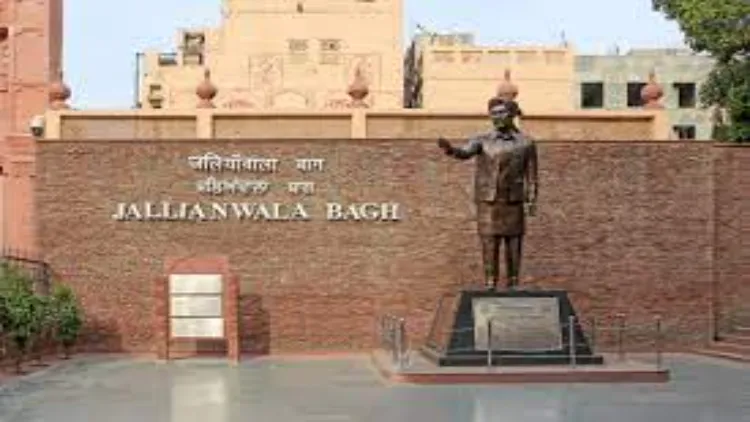
The Jallianwala Bagh Massacre is one such event which stands out in public memory as a solitary incident. Popular imagination puts the killing of hundreds of Indians on 13th April, 1919 at Amritsar as an event completely disassociated from time and space. It is needed that the massacre should be read in context with the time and space.
Why did the people gather at Jallianwala Bagh?
Indian leadership in general supported the war efforts of the British during the World War – I (WWI) on a promise that the country would be granted self rule or some kind of political autonomy after the war would be over. The British, after the war, backtracked on the promise. Rather to check the nationalist voices brought a Rowlett Act in force which enabled police to imprison Indians without evidence. Several Indian Muslims were aggrieved at the humiliation of Turkey and the British believed that it was their only challenge. With the Rowlett Act at their disposal these Pro-Khilafat voices could be easily suppressed. They did not foresee the possibility of Hindus joining hands with the Muslims, and vice versa and pose a problem for their colonial rule.
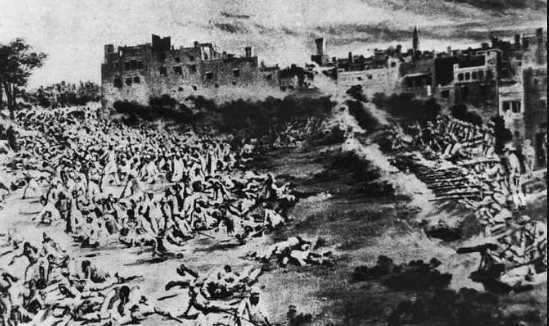
An artist’s depiction of the scene of massacre
On 18th March, 1919, the Rowlett Act was passed. Mahatma Gandhi along with other nationalist leaders termed it a Black Act and called for a protest movement against the same. The day chosen for protests and strikes was the 30th March that was later changed to 6th April. In Delhi a protest was held on 30th, because of lack of communication, and the police did not hesitate from firing upon the unarmed people. More than 50 protestors were killed in Delhi. The British had cleared their intention of using violence against the non-violent protesters.
On 6th April protests and strikes were held across the country, yet Punjab displayed an exemplary zeal of nationalism. What disturbed the British most was the fact that orthodox Hindus of Arya Samaj and orthodox Muslims of different Wahabi and pan-Islamist organizations joined hands against the British. The most popular leaders of Punjab at the time – Dr. Saifuddin Kitchlew and Dr. Satyapal, were prohibited from making public statements but still unity could not be broken. At different places people were fired upon but the nationalist sentiments could not be killed.
On April 9, Muslims came out to celebrate Ram Navami across Punjab. This was becoming too much for the British. In Amritsar Saifuddin and Satyapal oversaw a grand Ram Navami procession where Muslims were as zealous as Hindus were. It led the British to arrest the two leaders and sent them to an unknown location. The people gathered at the Deputy Commissioner’s office to register their protest and they were fired upon. Many were killed. The fear of a Hindu-Muslim unity was so frightening for the British that even after Jallianwala Massacre they arrested and killed Muslims for participating in Ram Navami celebrations.
Ghulam Jilani, who was an Imam of a mosque, was arrested on 16th April with Khair Din for leading the Ram Navmi processions. Police tortured them in the most horrific and inhuman fashion by inserting sticks up in their anus until their excreta and urine would not come out. Khair Din died of the torture while Jilani survived to narrate the ordeal. More than a hundred Muslims were tortured in this manner to celebrate Ram Navmi.
On the other hand in Lahore, on receiving this news, in an unprecedented manner more than 25,000 Hindus and Muslims gathered in Badshahi Mosque and Hindu leaders, like Rambhaj Datta, addressed the people from the pulpit of the mosque. In Lahore, not only the British used bullets but also brought their loyalists into the picture.
A few sold out Indians like the leaders of Muslims League issued statements that allowing Hindus into the mosque and addressing from pulpit amounted to the sacrilege. Still, most of the Muslims in Punjab were supporting the war cry of the protestors: Hindu-Musalman ki Jai (Victory to Hindu-Muslims).
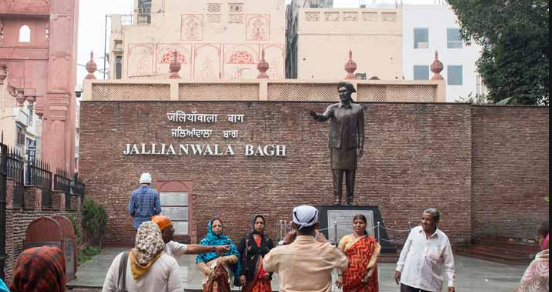
Visitors clicking pictures at Jallianwala Bagh
It was noted in a government report tabled at the British Parliament, “It (Hindu-Muslim) union had only one purpose, a combined attack on the government.”
Meanwhile, on 13 April, the Baisakhi Day, a meeting was scheduled at Jallianwala Bagh, near Golden Temple, to protest the arrests of Saifuddin and Satyapal. Hindus, Muslims and Sikhs gathered at the Bagh. Colonel Dyer with his troops entered the place and fired upon the unarmed protesters. A gory story of blood, death and massacre happened that each and every Indian knows by heart. Hundreds of Indians died. The tale of this massacre became folklore and inspired generations of revolutionary Indians like Bhagat Singh, Ram Mohammad Singh Azad and others. But, what we miss out is that the British did not stop at this. Punjab remained a laboratory of British atrocities.
The next day, April 14, people in Gujranwala woke up to find a beheaded calf at a public place. It did not take a rocket science to decipher a sinister plot to cause enmity between Hindus and Muslims. People gathered and protested such malicious attempts of the government to disturb the peace. Frustrated at their failed attempt and seeing that the unity has strengthened even further, army airplanes were called in to bomb the city. Yes, you are reading it correctly.
Within two decades of the invention of aero planes and less than a decade of its first military use in WWI when the technology was novel even for armies the British used it upon the innocent civilians of Punjab. A fleet of three planes dropped bombs and fired machine guns on the city and adjacent rural areas. Bombs were dropped at schools, hostels, mosques, marriage ceremonies etc. The government report specifically mentioned that the district is dangerous because followers of Arya Samaj and orthodox Muslim Wahabis like Fazal Ilahi and Zafar Ali Khan had joined hands. An armoured train with machine guns mounted in it was also used to kill along the railway tracks in Gujranwala.
The tales of torture, suppression and killings was repeated allover Punjab. While Jallianwala Bagh rightly gets its mention in our books and survived the public memory the causes behind it and a long trail of violence proceeding and succeeding the event have been forgotten. The very fact that the British used their worst form of violence to counter Hindu-Muslim unity itself speaks about the power of this unity. We need to remember the cause for which our forefathers and foremothers had laid down their lives.
(Saquib Salim is a historian-writer)
source: http://www.awazthevoice.in / Awaz, The Voice / Home> Story / by Saquib Salim / 2021
When bullock carts were the prime mode of transport, an Arab businessman was pained to see the beasts carry loads up the steep, rough climb.
In the 1930s, when bullock carts were the prime mode of transport, an Arab businessman was pained to see the beasts carry loads up the steep, rough climb from Hebbal Tank. Their hoofs wore thin very soon. So, he levelled the path, spending Rs 10,000 out of his pocket. When this came to the notice of Sir Mirza Ismail, the then diwan of Mysore, he promptly informed Krishnaraja Wadiyar. A private citizen spending for public good, the king thought, reflected badly on his administration. He made good the businessman’s expenses and named the area at the junction of Bellary Road, Jayamahal Road and CV Raman Avenue in his honour. Today , we call it Mekhri Circle.
The selfless businessman was M Enayathulla Mehkri (not ‘Mekhri’ as it is spelt today). The Enayathulla Mehkri Square was inaugurated by Sir John Hope, governor of the Madras Presidency , in April 1935.The space had a lamp post with five lights. A garden around it was maintained by ward officers. Later, in 1965, RM Patil, minister of home and municipal administration, notified it as Enayathulla Mekhri Circle through a notification in the state gazette.
Mehkri’s story , however, goes beyond the one philanthropic initiative he is most known by.
Mehkris were originally based near Medina in Arabia and migrated to India after the Turkish invasion. The family’s legacy dates back to more than 600 years. “While people believe that our name is derived from a place called ‘Mehkr’ in Syria, documents suggest that we were named after Mekhar in Maharashtra,” said Fazal Mehkri, nephew of Enayathulla Mehkri.
In India, the family held key posts under the Mughals and the Mysore maharajas.
Enayathulla Mehkri, born in 1898, went on to become a freedom fighter. At 17, he joined the Indian National Congress.
A contractor by profession, he participated in the freedom struggle, and was jailed for six months at Madras Central Jail along with C Rajagopalachari and EV Ramaswamy Naicker.
Mehkri was the municipal commissioner (between 1947 and 1948) and a councilor of the City Corporation for 16 years before that. He was not only the only member from Karnataka to be on the Advisory Council of the Freedom Fighters Cell of the AICC, he also headed the Karnataka Freedom Fighters’ Association till his death on November 28, 1990.
source: http://www.economictimes.indiatimes.com / The Economic Times / Home> Panache> ET Magazine> Travel> Business News> Magazine / by Divya Shekhar, ET Bureau / April 28th, 2016