Amidst the blitzkrieg from the Russian military, three students from Kodagu managed to leave the conflict zones in Ukraine and safely returned to India much to the relief of their family members who were pleading for their safe evacuation ever since Russian forces invaded Ukraine.
Alisha Sayyad Ali, Siniya V.J. and M.P. Nirmala, who managed to reach the borders in available modes of transport from their respective cities, returned on Wednesday in the evacuation flights operated by the Indian government.
The girls’ return was confirmed to The Hindu by the Kodagu district administration, whose officials were in touch with the stranded students since the war broke out. A few of the students from Kodagu and Mysuru are said to have reached Poland and are waiting for their evacuation. All of them are safe.
Siniya, who landed in Bengaluru airport on Wednesday evening, was welcomed by her family members.
Jose, her uncle, said Siniya had to walk about 20 km from her shelter in Kyiv along with other students to the railway station to reach Livv. She was evacuated from Budapest in Hungary to New Delhi.
“Minutes before Siniya was supposed to board a flight to Dubai on February 24 from Kyiv to join her sister for a vacation, Russian forces attacked Ukraine and the flights got cancelled. She had to rush back to her accommodation in available means of transport for her safety. Her 40-kg baggage was stuck in Kyiv airport and she flew to India with only a few pairs of clothes as all her belongings are at the airport,” Mr. Jose said.
Alisha, a student of Ivan Francisco Medical University, has also returned.
M.P. Nirmala, a student of Bogomoleth National Medical University in Kyiv, was stranded at a school after the invasion. Her mother Rajani was praying for her early return, pleading with the authorities for her evacuation. Ms Rajani said, “My daughter landed in Delhi this morning and is on her way to Bengaluru.”
Karthik, brother of Likith, who was stranded in Kharkiv with eight others, said his brother and some of his friends have reached Poland. “It was tough for them to reach the borders but they managed and are now away from the conflict zone Kharkiv which is under siege. They are waiting for their turn to board the next evacuation flights,” he said.
source: http://www.thehindu.com / The Hindu / Home> News> National> Karnataka / by Special Correspondent / Mysuru – March 02nd, 2022
Karnataka college girl Muskaan Khan who confronted a crowd by raising slogans of “Allah hu Akbar” during protests that broke out on hijab row, continues to be in news.
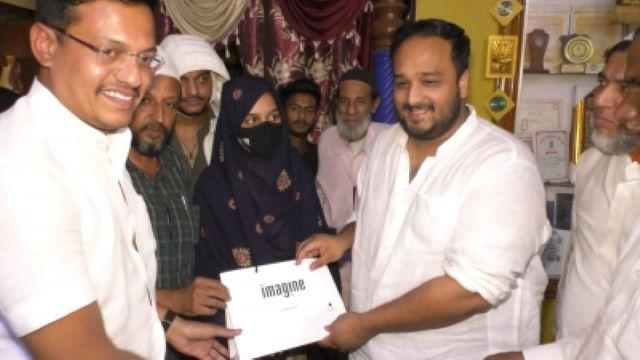
Congress MLA from Mumbai’s Bandra Zeeshan Siddique came all the way from Maharashtra on Friday and paid visit to Muskan’s residence in Mandya city. The MLA appreciated her “courage”, assured support and gifted her an iPhone and smart watch.
“I came from so far to meet the girl from our community who showed exemplary courage. I am happy for her courageous act,” he stated.
“Today whole of Karnataka, entire country is taking pride of her act. She has shown what is the real power of woman. After seeing her brave act, other women who are being pressurised, subjected to harassment and whoever is meted with injustice, they can also confront such acts,” he asserted.
Her act against those zaalims (cruel people) is commendable, he added.
“Wearing hijab is a constitutional right. One can wear clothes of her choice. You have problem with her hijab or with the fact that she is getting educated,” the Congress MLA said.
“There are crores of brothers behind Muskaan to protect her right of wearing hijab. I felt happy after meeting her family,” he added.
Muskaan Khan, the student of PES College of Arts, Science and Commerce in Mandya district was allegedly heckled by a group of students in the college premises for wearing ‘burka’. The group raised slogan of ‘Jai Sriram’ while surrounding and following her. Muskan confronted the crowd with slogan of ‘Allah hu Akbar’. The video is now viral on social media.
Later, she was safely escorted inside the classroom by authorities. Muskaan has later stated that she will abide by the court order and thanked college authorities.
Meanwhile, various Muslim organisations have announced cash reward for her act. Complaint has also been lodged in connection with announcing cash prize to Muskaan.
source: http://www.daijiworld.com / DaijiWorld / Home> Top Stories / by IANS /Bengaluru, February 11th, 2022
Captain has high expectations for his side before opener against Canada in St Kitts
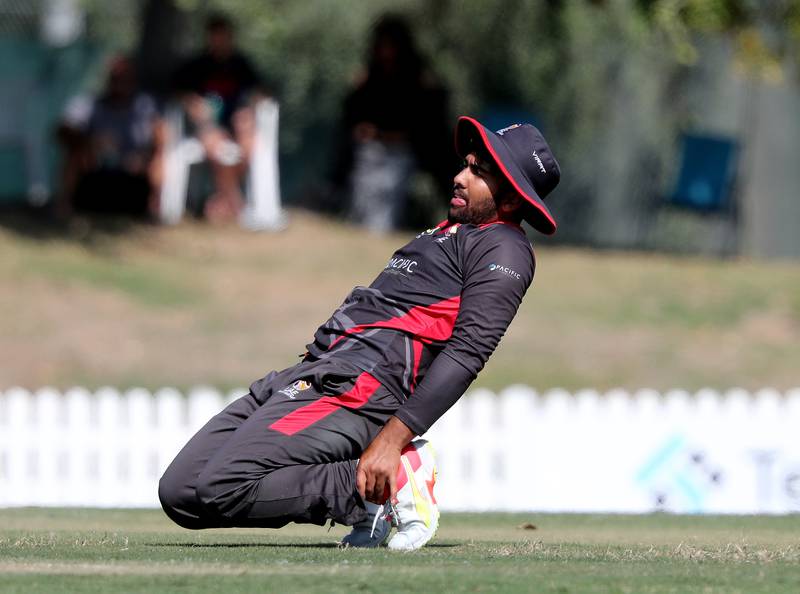
UAE captain Alishan Sharafu in action against Pakistan during the Under 19 Asian Cup at the ICC Academy, Dubai, in December. Chris Whiteoak/ The National
The Covid-enforced dearth of international cricket in 2021 was keenly felt by all of UAE’s leading players, but none more so than CP Rizwan.
The Kerala-born batsman must have thought he had finally cracked international cricket when he scored an uplifting century in a one-day international against Ireland a year ago.
Alishan Sharafu says the UAEare capable of achieving “great things” at the U19 World Cup in the Caribbean.
The national team start their campaign on Saturday against Canada in St Kitts. They then face pool matches against England and holders Bangladesh next week.
The competition marks just the third time the UAE have appeared on the global scale at U19 level. They had free admission as hosts in 2014, before qualifying on the field to play in South Africa two years ago.
A return to the event was sealed in absentia this time. The qualifying process was derailed by Covid, and the UAE qualified on the basis of their record in recent years.
Sharafu, the side’s captain, is one of three players who also represented the country in South Africa in 2020.
The middle-order batsman is grateful to be returning for another crack at the event, and the chance to avenge the disappointment of last time.
The UAE missed out on the business phase of the competition back then after a storm ruined their shot at chasing a win against hosts South Africa.
“It really hurt when a chance of a lifetime of going through to a Super Eight of the U19 World Cup was taken away but fortunately we’ve been blessed with another opportunity and been given another shot at it,” Sharafu said.
“I feel we have a very, very talented group of boys and a more balanced with our bowling being our strength, especially our spin attack.
“A few of us were at the last World Cup and it’s great to pass on that experience to the newer boys and make them want to do well at this one because not many are blessed with this opportunity.”
Although the age-group players regularly train with their senior compatriots, Sharafu is the only player in the U19 squad to have sampled full international cricket so far.
The Kerala-born teen has played six T20 internationals and one one-day international for the national team to date. He is hoping to bring some of that experience to bear when the U19 event gets under way.
“Being around the men’s setup for a while just adds a confidence booster because the challenges here were already simulated or experienced there,” Sharafu said. “That obviously helps to figure and work out solutions to problems at the U19 level.
“What I want to pass on to my players is to just enjoy the opportunity and challenges, and be positive and believe that we together can achieve great things.”
UAE v Pakistan, U19 Asia Cup in December
video
As well as the benefit of experience of Sharafu, Kai Smith and Ali Naseer, each of whom played last time, the players will also be able to lean on the wisdom of Mudassar Nazar. The 65-year-old coach played nearly 200 times for Pakistan, including touring West Indies.
“Most of them are already relishing the chance to rub shoulders against the best in the world,” Mudassar said of his young charges. “So far the confidence is high. Having Alishan and Kai amongst us is a real bonus. Their experience is of immense value.”
The UAE’s two warm up matches on tour included a hefty win over Papua New Guinea , plus a narrow loss to England. Mudassar believes the UAE have a well-balanced side who are capable of improving on their pool-stage exit two years ago.
“I was not around then but I am fairly confident that this bunch of players will be very competitive,” Mudassar said. “I guess our top order batting is settled but we have plenty of allrounders, which provide us with depth.
“Spin bowling is a real asset with at least five who bowl spin. Pitches in West Indies are helpful to spinners. We should be able to defend any reasonable total.”
source: http://www.thenationalnews.com / The National / Home> Sport> Cricket / by Paul Radley / January 14th, 2022
Khan opened his G S Research Centre at Patna coaching hub Chak Musallahpur over five years ago. The centre comprises a big hall with tin shade that can accommodate about 1,000 students at a time.
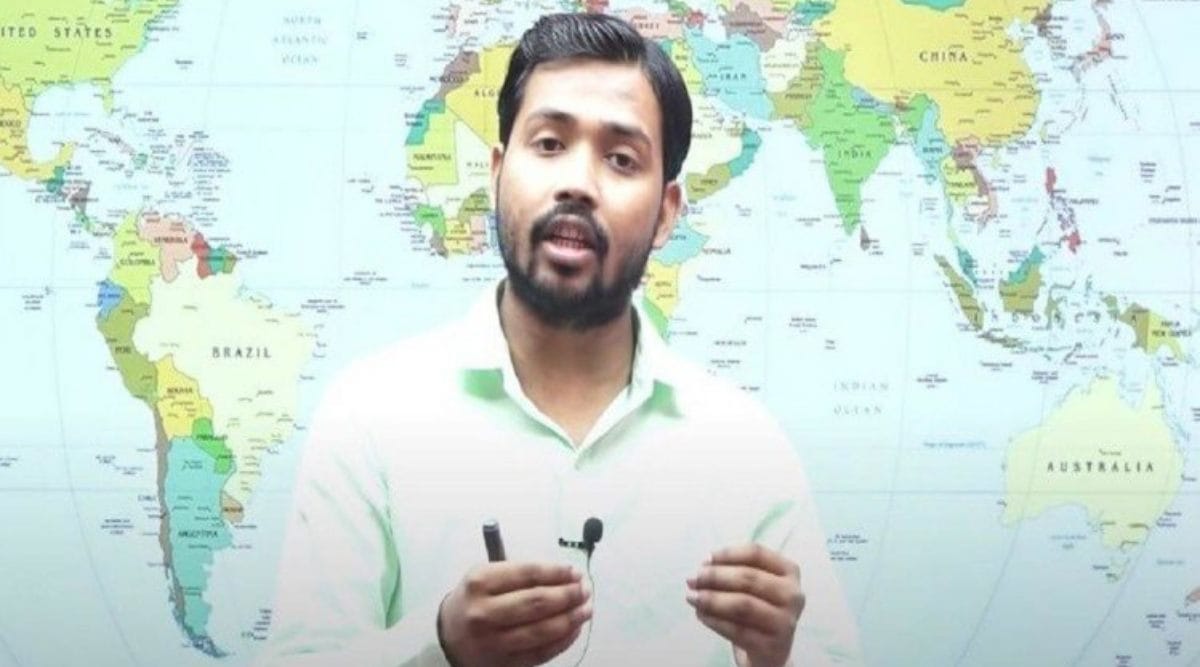
Faisal Khan who has built a You Tube following of 14.5 million from his videos breaking down intricate topics into easily understandable details, denies instigating the applicants (photo videograb @Khan GS Research Centre)
His students can decode all the theories of science but cannot understand how the Railway Recruitment Board (RRB) thinks, says Faisal Khan a.k.a Khan Sir. In the protests that have broken out in mainly Bihar and Uttar Pradesh over recent RRB exam results, the head of a coaching institute and popular YouTuber is among six teachers booked on the charges of instigating the applicants.
Khan, who has built a YouTube following of 14.5 million from his videos breaking down intricate topics into easily understandable details, denies instigating the applicants. However, the 29-year-old says, the workings of the RRB are beyond his comprehension. Talking to reporters on January 26, Khan said: “The RRB people do not know the ground reality.” Adding that the government “can’t be blamed for everything”, he said it was good the Railways has decided to hear out students.
Khan opened his G S Research Centre at Patna coaching hub Chak Musallahpur over five years ago. The centre comprises a big hall with tin shade that can accommodate about 1,000 students at a time.
However, Khan really took off when he started his YouTube channel in 2019, and soon gained an audience for his videos explaining things in Hindi, with a lot of vernacular and proverbs thrown in. In 2021, he started an app called ‘Khan Sir Official’, that has one million-plus downloads.
Khan opened his G S Research Centre at Patna coaching hub Chak Musallahpur over five years ago (photo videograb @Khan GS Research Centre
A teacher in the area said around 12,000-15,000 students used to attend classes at G S Centre in batches before Covid struck. Khan has earlier said he charges fees as per the paying capacity of a student. There is no other teacher at the coaching centre though it does have a devoted “research team”.
The centre gives coaching for examinations conducted by the Railways, Staff Selection Commission, State Teachers Eligibility Test and Institute of Banking Personnel Selection.
Khan did not reply to calls or text messages, remaining unavailable since issuing a video appeal to students on Thursday night to maintain calm.
In an interaction with the media on January 26 and 27, he said he had never provoked students nor told them to take to the roads. But underlining the anger, he pointed out that a “digital protest” by them had drawn “some eight million tweets”. “I just tweeted once, and it had nothing provocative.”
Khan admitted though that, during his classes, he told students how the RRB had changed the format for the exams, leaving many applicants apprehensive that they would not get the jobs for which they had applied back in 2019. The forms released at the time did not mention any change.
“The RRB examinations are very important. A government job means a lot. I have two students who work as daily wagers on the side. If they become station masters, their lives would change forever,” he told reporters, thanking Union Railway Minister Ashwini Vaishnaw for putting the exams on hold after the protests.
While applicants took to the streets and blocked rail lines in both UP and Bihar, the maximum violence was in Bihar, where students burnt empty train coaches. The Indian Express had reported that the two states made up nearly 30% of the applicants for the RRB exams.
In a recognition of how the youth protest – and the police action on them in UP – could backfire amid polls in five states, former Union minister and BJP Patna Saheb MP Ravi Shankar Prasad on Friday urged the government to hear them out.
Little is known about Khan’s background, and he does not say much except that he belongs to Gorakhpur in Eastern UP and wanted to join the Army like his elder brother. Crestfallen after rejection due to a medical condition, Khan has said, he wondered for a long time what to do.
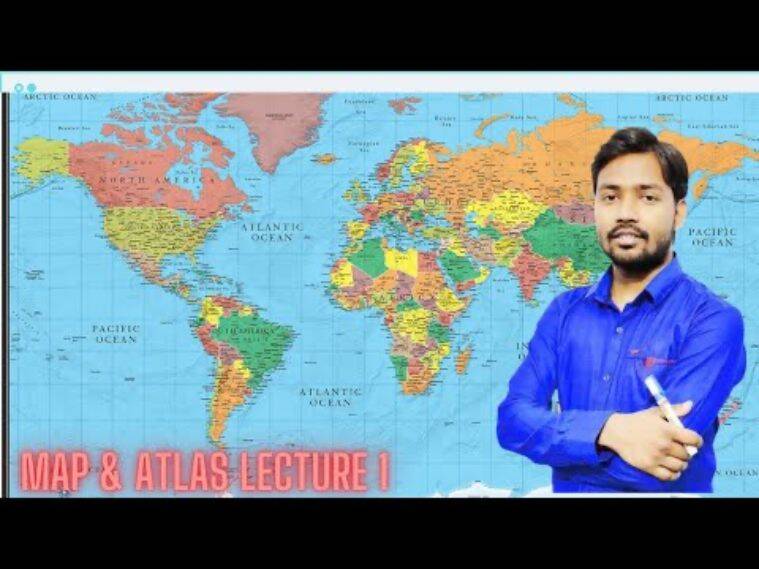
In a video on his channel, he said that with a degree in science and a Masters in geography, he decided to try out teaching. “I started with just six students in Patna. They told me I was good at explaining things. This is when I decided to pursue this field, ” he said.
About his style, his ease at explaining issues like the Galwan Valley crisis – a video of it went viral at the height of India-China border tensions – Khan once said: “Unless a teacher understands the mind of an average student, he cannot teach well.”
He said he liked doing the Galwan video as he is fascinated with defence subjects. “It is my first love. However, a lecture comes after several days of preparation. There are occasions when I spend nights at my studio, ” he said in an interview recently.
In the wake of the RRB protests and the case against Khan, there has been an outpouring of support for him on social media.
Sometime back, there was a controversy regarding Khan’s real identity. “How does it matter if I am called Amit Singh or Faisal Khan? I am only a teacher to my students. One has heard about ‘Guru, Govind dou khade…’ (underlining that if God and your guru were both before you, a wise man chooses the guru)’,” he said at the time.
He also said he revealed his identity wherever necessary. “What’s in a name? Teachers have no religion, I can recite verses from the Quran and also the Gayatri Mantra.”
Khan had also stirred a row in April 2021 when in a viral video, he was heard criticising participation of children in a protest in Pakistan. Criticising their parents, he had said: “18-19 bachche paida honge to kis kaam aayenge? Koi bartan dhoyega, koi bakri kaatega, koi puncture banayega (If one has 18-19 children, what will they do? Some would wash utensils, some would work at meat shops and some would repair punctures).”
Following outrage, he had said that he meant people in Pakistan and not a community.
In a recent video, Khan cautioned police that arresting him would only aggravate the crisis. “I am very relieved that Patna District Magistrate Chandrashekhar Singh gave teachers and the coaching association a patient hearing. I also said that some people were running fake accounts in my name,” he said.
On Friday, the Bihar Bandh called by several student organisations, and backed by Opposition parties, was peaceful. While party workers were seen at some places, the DM said: “We were relieved to note almost nil presence of students. It is good that Khan Sir appealed to students. I met Khan and the other teachers to say we do not have any prejudice against them.”
Asked about the case against Khan and the others, the DM said: “We are scrutinising the facts. The administration will look at the evidence and not do anything that can aggravate the problem.”
Unmarried, Khan has also been fending off other, more pleasant, rumours. “I don’t have any control over them. Someone said I have two girlfriends, some have declared me married… One even ran a news about my death. My mother called me after learning about it,” he said in a video.
source: http://www.indianexpress.com / The Indian Express / Home> India / by Santosh Singh, Patna / January 29th, 2022
In a tragic incident, YSRCP MLC Muhammad Kareemunnisa passed away on Friday night due to a heart attack around 11 pm. She was 65.
According to the sources, Kareemunnisa was shifted to a private hospital after she fell ill where she breathed her last while undergoing treatment.
The YSRCP MLC attended the Assembly meeting on Friday morning.
She started her political career with the Congress party and later joined YSRCP. She was offered MLC seat by the YSRCP chief YS Jagan Mohan Reddy eight months ago.
YSRCP chief YS Jagan Mohan Reddy expressed grief over her death and offered heartfelt condolences to the bereaved family. He also said that the family members of Kareemunnisa will be given all support by the YSRCP.
source: http://www.thehansindia.com / The Hans India / Home> News> State> Andhra Pradesh / by Roja Mayabrahma / Hans News Service / November 20th, 2021
The 31-year-old Arif, who hails from Tangmarg of Baramulla district (Jammu & Kashmir), achieved the qualification in the final FIS Qualification being held in Dubai.
Alpine skier Arif Mohammad Khan
Chennai :
Arif Mohammad Khan on Saturday became the first alpine skier from the country to win a quota for the Winter Olympics by accumulating requisite FIS (International Ski Federation) points.
The 31-year-old Arif, who hails from Tangmarg of Baramulla district (Jammu & Kashmir), achieved the qualification in the final FIS Qualification being held in Dubai. The 2022 Games is scheduled to be held in Beijing in February.
Father Mohammad Yasin Khan was Arif’s first coach. Yasin used to guide mountain tracking expeditions and teach the basics of skiing in Gulmarg. “Arif took up skiing at the age of three and quickly learnt the basics. It’s good that the efforts he had put in in all these years have eventually paid dividends,” said an elated father.
As per the FIS, a skier has to accumulate minimum qualifying points to confirm the Winter Games spot. According to www.olympics.com, in order to qualify for the Beijing 2022 Winter Olympics in the slalom, the average of five best results in the event between the period of July 1, 2019, to January 16, 2022, is considered. For alpine skiers who have competed in less than five events during this period, an extra 20 per cent of average points are added to the International FIS points list.
The four slalom races in Dubai over the past week were the only events Arif has taken part in during the qualifying period.
“It’s a proud moment as earlier the Winter Games Federation of India used to organise trials to pick the teams including the skiers. Arif has become the first alpine skier from the country to secure qualification by earning FIS points,” Rauf Tramboo, member of Winter Games Association of Jammu & Kashmir, told this daily.
Alpine skiing comprises events like downhill, super G, slalom, giant slalom and combined.
Arif will now head to Italy from Dubai to compete in an international event. “Some international event is there. It will be great preparation for him ahead of the Games. He is unlikely to return to the country before the Games,” signed off Rauf.
source: http://www.newindianexpress.com / The New Indian Express / Home> Sport> Others / by Firoz Mirza, Express News Service / November 20th, 2021
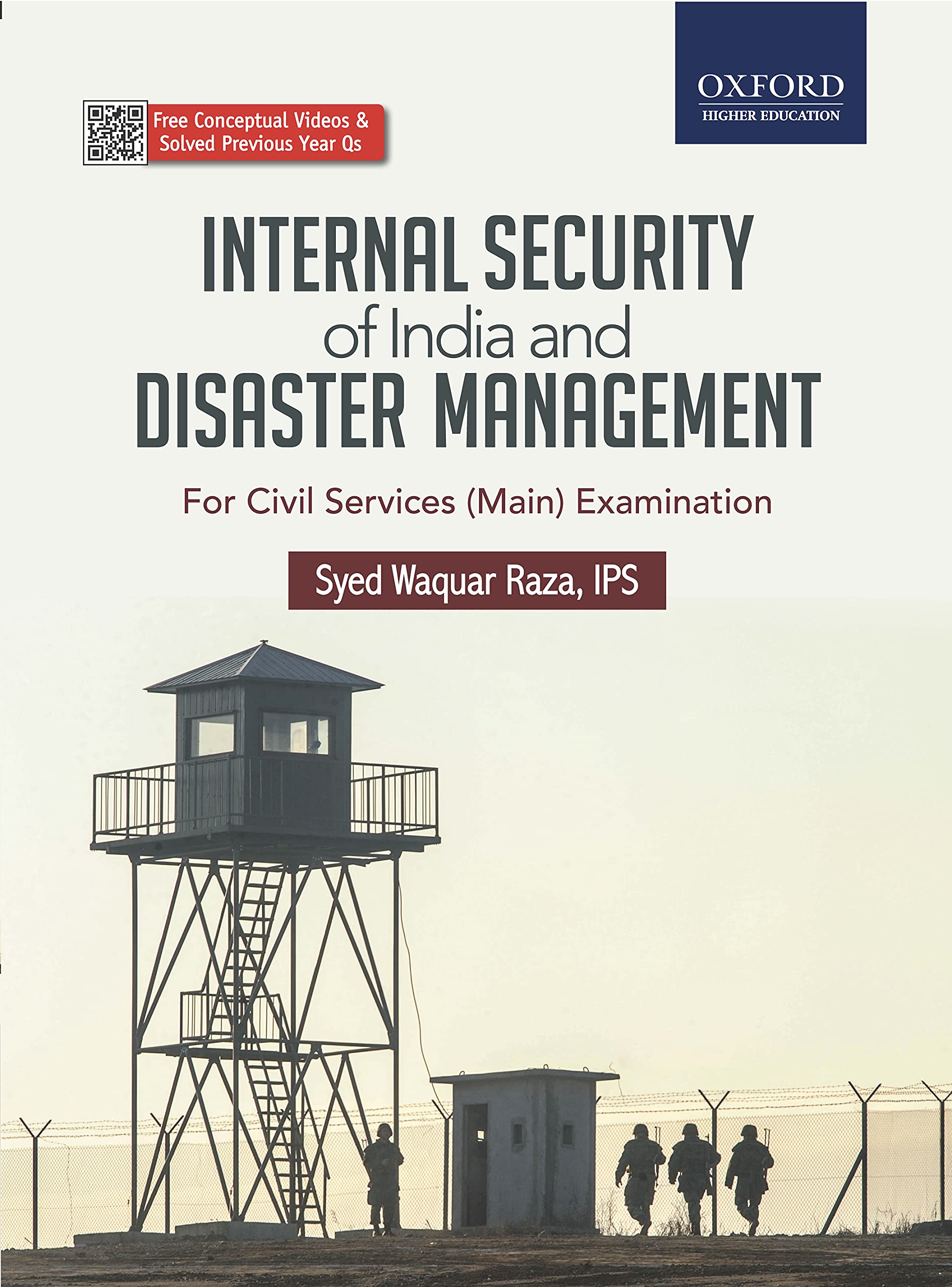
His own experience with cracking the Civil Services Examination (CSE) prompted Syed Waquar Raza, a serving IPS officer, to pen a one-stop guide on internal security and disaster management for future aspirants.
In addition, his 14 years in uniform have given him an opportunity to closely study the security challenges about which there a general idea but cannot be delved deeper “in the dust and grime of everyday policing”.
pix: amazon.in
“Internal Security of India and Disaster Management” (Oxford University Press) has been primarily intended for aspirants of the UPSC Civil Services examination, but “any reader interested in the myriad internal security challenges that India faces will find the book useful and instructive”, Raza told IANS in an interview.
However, beyond generalities, he sidestepped a question on the fresh challenges posed by the situation in Afghanistan, saying service rules did not permit him to do so.
Studying the questions from previous years’ examinations showed that the subject required an analytical understanding of the various challenges along with knowledge of current developments.
“My own experiences of working in different capacities at various places of West Bengal such as in LWE-affected areas, bordering districts, and CID gave me the opportunity to observe closely the various aspects of internal security challenges that India faces today.
Also, as a first responder in times of disasters, the nature of policing job provided me with valuable insights in aspects of disaster management,” Raza said.
“Though I have been working as an IPS officer for over 14 years now, the journey of writing a book provided me with an opportunity to closely study various topics related to security challenges, about which we do have a general idea, but would not have got a chance to delve deeper in the dust and grime of everyday policing.
My aim was to write a book covering the internal security and disaster management portions of UPSC Civil Services syllabus that would be a one-stop solution for the aspirants and would relieve them of the necessity to search and sift materials from various sources, including the Internet. I hope my effort will be helpful for the aspirants,” he added.
He expands on this in the Preface.
“Authors often face the dilemma about which chapters to include, what topics to cover in the chapters, how much to include in each topic and what to exclude. I have tried to throw the net wide, so that an aspirant does not have to look for multiple learning resources – available online and offline – but can solely rely on this book for covering virtually all topics related to the internal security challenges that India faces today, as well as the various types of disasters and their management efforts. At the same time, I have tried to provide just the optimum depth of topics so that the aspirant gains the confidence to answer any related question to the examiner’s satisfaction,” Raza writes.
While writing the book, he relied heavily on articles of many security experts and think tanks including IDSA, CLAWS, ORF, etc. He also referred to books such as “India after Gandhi” by Ramchandra Guha, to understand the historical context of many of India’s current security challenges.
“The Internet provides an excellent tool to search, verify and cross-check facts and figures. Government websites such as that of the Ministry of Home Affairs also provide valuable and up-to-date information related to our internal security challenges,” he said during the interview.
Question: Hitherto, Internal Security in India has focused on three broad areas: Terrorism, Secessionism and Maoism. Have the developments in Afghanistan following the US withdrawal added a new dimension to this and how can the Indian state best cope with the challenge?
“Yes, the current developments in Afghanistan have been a cause of concern for India. It has the potential to cause regional instability and a possible spill-over effect in terms of a surge in terrorism in Jammu and Kashmir. China and Pakistan too have been eager to increase their footprints and influence in Afghanistan. However, the UNSC resolution 2593 requires that Afghan territory should not be used for terrorist activities, and it specially refers to UN-proscribed terrorist organisations such as the LeT and the JeM,” Raza said.
“India has been keenly following the current developments in Afghanistan. It seeks a broad-based and inclusive government in Afghanistan. India has helped build over 500 infrastructural projects worth over $3 billion, which has generated tremendous goodwill for India, among the Afghan people. Owing to her historical friendship and ties with the people of Afghanistan, India should continue supporting the common people there with humanitarian assistance,” he added, declining to go further due to service restrictions.
This does not take away from the value of the book, with important key words highlighted in each of its 18 chapters; maps, diagrams and tables included for conceptual clarity, boxes provided for topics of recent relevance; quick revision provided at the end of each chapter; and conceptual videos for each chapter linked by QR code for easy access.
In sum, this book is a must read not only for CSE aspirants but for the general public too.-IANS
source: http://www.muslimmirror.com / Muslim Mirror / Home> Book Review / by IANS / October 08th, 2021
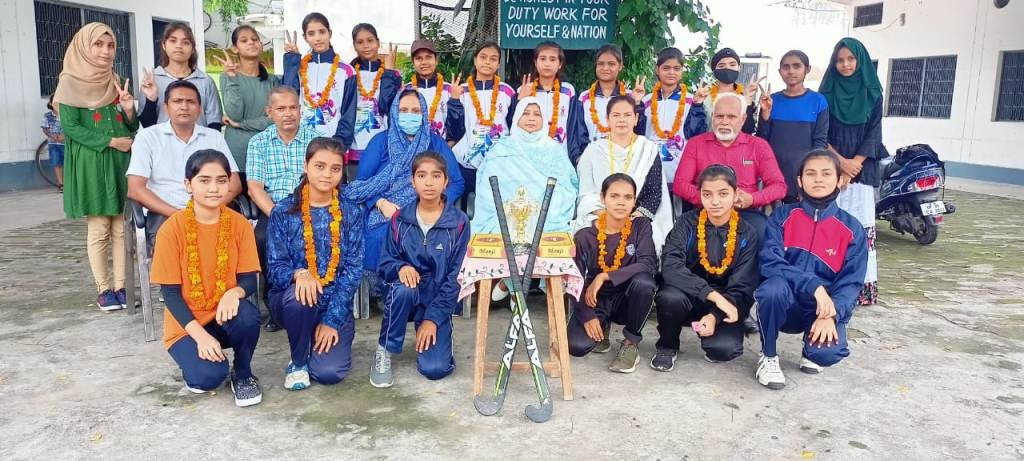
The undeniable girl power of Aligarh Muslim University (AMU) in sports came to the fore in Hockey as a team of AMU ABK High School-Girls clinched a decisive win in the final of the National Hockey Tournament in Goa to bag the Gold Medal.
Team members Aliya Rashid, Simran Shakeel, Rabia Khatoon, Shafiya Shakeel, Amreen Malik, Zenab Mohsin, Saniya, Shaby and others were felicitated in a special function at the school on their return.
Congratulating the team members, Dr Samina (Principal) said that the School hockey team has not only capped an excellent performance in the tournament, but also inspired other girls to take up sport and bring laurels.
Wishing the team more success in the future, Dr Saba Hasan (Vice Principal) said that the team’s performance shows that dreams can come true as long as you work hard.
School teachers, Mr Nadeem Ahmad, Mrs Shaheen Khan, Mr Mahtab Ahmed, Mr Najmur Rahman Faridi, Mr Shamshad Nisar (Sports teacher) and Md Imran Khan (Coach) delivered motivating speeches to encourage the hockey team for more success.
source: http://www.amu.ac.in / Aligarh Muslim University / AMU Public Relations Office / August 24th, 2021
(However) The strength these women brought to the cause has sadly never been recorded or acknowledged, Dr Syeda Hameed said.
Dr Zakir Hussain’s wife Shah Jahan Begum [Shah Jahan Begum, wife of Dr Zakir Hussain – former President of India and one of the founders of Jamia Millia Islamia in a file photo shared by Dr Syeda Hameed.]
Mumbai:
Highlighting their contribution in the movement the result of which we see today as “Jamia Millia Islamia”, Dr Syeda Hameed said women were a presence and a power in the Jamia from its very inception though it was never acknowledged.
“From its very inception in 1920, women were a presence and a power in Jamia Millia Islamia. But they never emerged as individuals, always overshadowed by men, who were undoubtedly committed, dedicated, and passionate, but so were the women”, Dr Hameed, scholar, author, writer and former member of the Planning Commission of India said while delivering 17th Dr Asghar Ali Engineer Memorial Lecture.
“(However) The strength these women brought to the cause has sadly never been recorded or acknowledged. It’s time to speak of these women, the architects of Jamia”, she said.
During her lecture, Dr Syeda Hameed especially praised and acknowledged the contributions of Nawab Sultan Jahan Begum – the Ruler of the Princely State of Bhopal, Shah Jahan Begum – wife of Dr Zakir Hussain , Asifa Mujeeb – wife of Mohammad Mujeeb, and Saliha Abid Hussain – wife of Syed Abid Hussain.
Calling them “The Khwateen-E-Awwal of Jamia” – the first women of Jamia, Dr. Syeda Hameed also detailed the last Begum’s contributions in the fields of education, sanitation, public health and her efforts in establishing Aligarh Muslim University (AMU), of which she was the founding Chancellor, and the first and only woman to have served in the position.
“(But) their roles have been diminished and their work remains unacknowledged in the mainstream”, she said in her key-note address titled “Contribution of Muslim Women to Educational Institutions: The Case of Khwateen-e-Awwal of Jamia Millia Islamia.”
Dr Hameed quoted from Saliha Abid Hussain’s speech on Jamia’s Foundation Day in the mid-eighties to prove her point.
“I want to speak of (the) women of Jamia who were like Mughal era Raj majdoors behind Emperor Shah Jahan and the Royal Architects who built the Taj Mahal and never, ever thought of etching their names anywhere on the marble”.
Dr. Hameed also detailed the accounts of Saliha Abid Hussain and Gerda Philipsborn – a German national who later became known as “German Appa-Jaan” of the Jamia.
Dr. Syeda Hameed talked of the jalsas they organised, and their journey from attending events behind the pardah to firmly holding their ground and being in “high demand” at traditionally-male dominated intellectual and literary gatherings and their outspokenness about the rights of women in Islam.
Dr. Hameed talked of the unfinished works of Saliha and the final resting place of Gerda and of Professor Sughra Mehdi, who wrote extensively on the two women and on Jamia, and on the need for their works to be made accessible to more people and in more languages.
Dr. Hameed also recalled Turkish Poet and Activist, Halide Edib Adivar’s series of lectures at Jamia Millia in 1935, and of the early days of the Jamia in Okhla, the basic environment, the lack of electricity, of running water, of roads, and of sidewalks.
“By the banks of river Jamuna, houses were built, modest houses. Very limited income, but plenty of enthusiasm and lots of spirit, and a desire to live together as a human family in which women were the binding force.”
[Begum Saliha Abid Hussain (R) and Asifa Mujeeb.]
While introducing, Begum Asifa, Dr Syeda Hameed detailed how despite coming from a well-to-do family, she chose to live within the means afforded by the newly moved Jamia.
Dr. Hameed’s also remembered the contributions of Begum Syeda Khursheed, who according to her, “was brought up by parents who literally birthed the Jamia” and Shafiqa Kidwai, wife of Shafiqur Rahman Kidwai, former Minister of Education Govt of India. Sahfiqa Kidwai established Balak Mathia Mahal in Delhi for education of girls, and was the member of various apex committees of the Jamia.
“The spirit of the Jamia comes from all these strong and resilient women who collectively built the Jamia and the Muslim women’s movement over decades”, she said.
“That it transcends the test of time and will continue to surface whenever there is a threat to the core values, imbibed in the idea of India, the idea of the university and the idea of Jamia Millia Islamia”, she said.
Professor Zoya Hasan, while throwing more light on the contribution of women in the founding movement of Jamia Millia Islamia talked about Turkish activist, Halide Edib Adivar, who came to Jamia to deliver a series of eight lectures titled ‘Inside India’.
Professor Zoya Hasan said in her lecture series Adivar admired the Jamia movement for its harmonizing intermingling of anti-imperialism and tradition.
“What she found very interesting and impressive was the combination of Indian nationhood with Islamic identity”, Professor Zoya said.
source: http://www.ummid.com / Ummid.com / Home> India / by ummid.com News Network / June 19th, 2021
As a young boy, Javeed Mehkri would watch his father spend hours with his favourite car — a 1950 model of Morris Oxford, better known in India as the Hindustan 14. Javeed not only learnt about the car and its mechanics but thoroughly enjoyed the drive in it to and from school.
The passion for the Morris Oxford is living on through four generations with Javeed now transferring the ownership of the car to his 22-year-old son Junaid Mehkri. Junaid shares as much passion for the classic beauty as his father.
The car has an interesting history to it and Javeed gets nostalgic when he settles down to talk about it. Javeed says, “My grandfather, AK Mehkri, purchased it. He was working as the superintendent of engineering in the Shimsha hydro-electric station in the erstwhile princely state of Mysore. The car was initially registered and used in Mysore for three years, after which my great grandfather moved to Bengaluru. The car has been with us since,” explains Javeed.
Almost every member of the Mehkri family has driven the car. Those who revelled at its wheel include MG Mehkri, private secretary to the Yuvaraja of Mysore; Dr MS Mehkri, founder of the Bangalore Medical College; and ME Mehkri, a freedom fighter and a well-known philanthropist. “In fact, the landmark, Mehkri Circle, is named after ME Mehkri,” adds Javeed.
Decades after, the car has been restored with some of its parts being replaced and brought to perfect working condition. “The car was taken care of by Rasheed Mehkri, my late uncle. Rasheed passed away in 2013 and wasn’t there to see the car in running condition,” says Javeed.
However, he admits that the biggest challenge, is to maintain the car. “Spare parts for the American-made vintage and classic cars are available online but you will never find perfect spares for British classic vehicles in India. I got some of the parts replicated here but again you have to personally supervise it to make sure you are not taken for a ride. It is an expensive and time-consuming process to maintain these cars,” he says.
Javeed says among those who were drawn to his car was former prime minister of Nepal, Tulsi Giri. “There’s a church just opposite our house and he used to visit the church whenever he was in the City. Once, he saw the car parked outside my house and he asked me why I didn’t do anything to get it back on the roads. When he returned six months later, he again asked me the same question. I got the same advice from my cousin Sajjad. All this hastened the restoration process,” adds Javeed.
Among Javeed’s prized possession is also a 1960 model Lambretta Scooter — his father’s first purchase. “My father rode it and I used to go to college on it. Now, my youngest son Uzair gets dropped by the scooter once in a while,” he says. Like other youngsters of their age — Junaid and Uzair — love swanky cars but they value their two prized possessions more.
The Morris Oxford has been a regular at Karnataka Vintage and Classic Car Club rally for the last two years. And Javeed loves basking in all the adulation the car draws. “It was during one of the rallies that a lady in a car stopped beside us. She asked me: ‘How old is she?’ I said 65. She smiled and said: ‘She’s my age’. Total strangers admire and compliment me on the car,” he narrates.
(Javeed can be reached on Javeedmehkri@hotmail.com)
source: http://www.deccanherald.com / Deccan Herald / Home> Supplements> MetroLife / by Nina C. George / DHNS – Bengaluru , November 10th, 2015