While working on my two books (soon to come: one on Muslim Politics in Bihar and another on Muzaffarpur Muslims, 1857-2011), while looking into primary and secondary sources I came across many personalities and institutions. One such person was Sir Fakhruddin whose contributions towards public life may interest many people. Hence I crave the readers’ indulgence.
[Sir] Syed Mohammad Fakhruddin [Khan Bahadur, 1868-1933] of Patna is credited to have the distinction of being the first Muslim Minister of Bihar and Orissa.
His father Md. Ali of the village Dumri, near Patna, took special care of his quality education. Having imparted elementary education in Arabic, Persian, and Urdu in the village Maktab, Fakhruddin was put under the tutelage of Md. Yahya, advocate, a big rais of Patna, with deep interest in music and literature. Yahya was the husband of Rasheedun Nesa (1855-1926, the author of the Urdu novel, Islahun Nesa, 1881/94, and a pioneer of modern education to women in Patna).
Fakhruddin did his BA from the Patna College in 1891, and B.L. in 1893, and started court practice under the guidance of Yahya in the district court of Patna. He was also associated with the Bihar Provincial Association.
Having earned good reputation as advocate he was elected member Bengal Council in 1910, which Fakhruddin quit after becoming the government pleader (1917-20) in the High Court of Patna, established in 1916-7. In 1921 he was elected member of the Bihar and Orissa Legislative Council, and he kept winning the elections till his death in 1933.
Thus, during 1921-33 he also served as minister of education besides few other significant departments. His contribution as minister in pushing the cause of education is distinctive. His efforts towards promoting primary and secondary education are noteworthy.
The Deputy Directors of Public Instruction were made to undertake tours of Bihar and open schools. Fakhruddin worked hard towards enhancing the budgetary allocation for education. He also made efforts towards charkha operation in the government schools but remained largely unsuccessful in that. He mobilized funds for construction of college buildings and hostels. He was passionate about it.
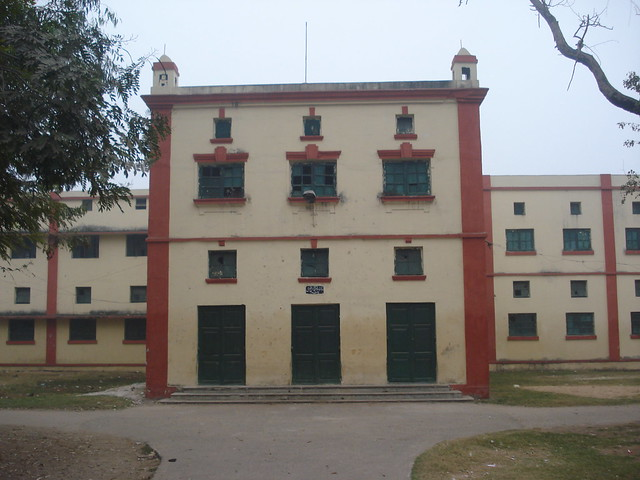
Reconstruction of Patna’s BN College building and its three storeyed hostel, the imposing building of the Science College (Patna), two storyed hostel for the Science College, the Patna College Hostel (later became famous as Iqbal Hostel), two storeyed PostGraduate Hostel of Ranighat (Patna), Patna Training College are his creations.
Besides, he also allocated fund for the buildings and hostels of the Muzaffarpur’s GBB (LS) College, Cuttack’s Ravenshaw College, Bhagalpur’s TNB Colllege, two big buildings for the Madrasa Shams-ul-Hoda, which was taken over by the government, and eight professors’ quarters in Ranighat (Patna) are also his creations. For the cause of Urdu, he set up a Madrasa Board in 1922.
Madrasa Shams-ul-Hoda
Fakhruddin had also prepared an ambitious plan of converting the Patna University in a big residential university for which he also influenced the Nathan Committee to make favourable recommendations. This was to be established in the Phulwari Sharif. But it did not see the light of the day as a large number of the members of the Bihar and Orissa Legislative Council opposed it on the arguments that the campus will go far beyond the city; a member went on to allege that Fakhruddin was taking the University to the doors of his Pir. The Searchlight is said to have regretted this myopic opposition as the Bihar’s capital city was deprived of quality residential university.
He created and institutionalized Bihar Educational Service Class I, and went on talent hunt to recruit meritorious teachers for the Patna University.
With these efforts he brought in Dr Gyan Chand as professor of Economics, Prof. Taraporewala (History), Prof. Jamuna Prasad (Psychology), Prof. Hill (English), Prof. Shiv Parvati Prasad (Physics). They were posted on handsome salaries.
There used to be an insistence by the colonial regime to recruit only those candidates as Class I teachers who had obtained degrees from Europe.
Prof. Nayyar Laeeq Ahmad (who later became Principal, Andheri College, Bombay), and Prof. Jadunath Sarkar were also recruited. Sir Fakhruddin resisted this racism, without much success at the time, even though it was diluted subsequently in 1940s when Prof. K K Datta (History, 1944) was taken in.
Sir Fakhruddin brought a bright professor of Law from BHU to make him Principal, Law College, and Prof. Boman Sanjana of Bombay was brought in the Civil Engineering.
In order to overcome the dearth of talented teachers he also instituted State Scholarship programme on which promising students of BA and MA were sent oxford and Cambridge for higher degrees and they had to return back to teach in the colleges of Patna University.
Kishori Prasad Sinha, Fazlur Rahman, and Kalimuddin Ahmad for English literature; Ghanshyam Das for History, Balbhadra Prasad and Qamruddoja for Chemistry, Bhairavnath Rohtagi for Economics were few such luminaries. Sadly, with the death of Sir Fakhruddin this bright scheme also died.
The Bihar School of Engineering was upgraded to ‘College’ by him. He also established the Veterinary College of Patna and recruited many teachers from outside.
Besides education, he also held the portfolio of cooperative and he made it a movement of sorts, more particularly in Tirhut. He convened a conference of Cooperatives in Hajipur when Ahmad Husain (1886-1948), an Aligarh graduate of Muzaffarpur, was posted as SDO in Hajipur.
For all these unforgettable contributions, Dr Rajendra Prasad held him in very high esteem.
Sir Fakhruddin, a bearded, fair-skinned fellow was a devout practicing Muslim with punctualities of namaz. Sherwani, pajama, Turkish cap was his preferred dress. The masjid near the Patna Railway Junction was reconstructed by him by investing around Rs. 20-25 thousand, which is now the Jama Masjid of Patna; for long it was called ‘Sir Fakhruddin Masjid’.
As a minister, he never used government quarters; rather he preferred to work from his own house in Patna, nor did he accept police protection. He was a good orator in both English and Urdu.
His sons- Azizul Haq was a renowned advocate of Patna High Court, Anisul Haq was Deputy Collector, Habibul Haq was in judicial services.
(Mohammad Sajjad, Assistant Professor at Centre of Advanced Study in History, AMU, Aligarh)
source: http://www.twocircles.net / TwoCircles.net / Home / by Mohammad Sajjad / October 13th, 2025
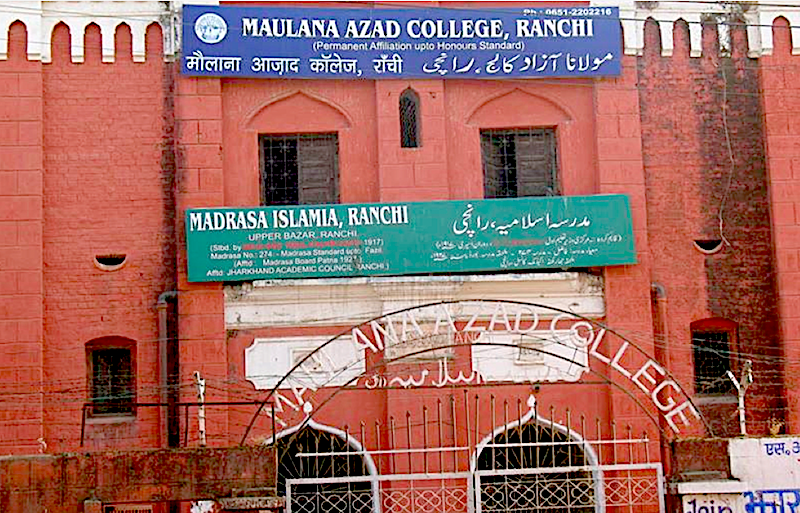
It is ironical that, just in the year of its centenary, the historic Madrasa Islamiya of Ranchi, founded by Maulana Azad (1888-1958) in 1917, is facing extinction. The BJP government of Jharkhand is reportedly contemplating to strangulate it to death by withdrawing its affiliation/recognition as well as fund. Much of the land of the institution has either been encroached upon or been sold out, by the self-serving Muslims, influential in the management of the Anjuman-e-Islamiya, which runs almost 12 subsidiary institutions, including the Madrasa Islamiya. In 1987, it formed a subsidiary called, “Muslim Higher Education Society”, which added a degree college named after Maulana Azad. This Muslim minority college is recognised and funded by the government of Jharkhand. It has got around 500 students.
The management of the Anjuman-e-Islamiya stands divided between two warring factions, respectively by Haji Ibrar and Haji Nesar. The latter is supposed to be making too much of interferences into the functioning of the Anjuman-e-Islamiya. Sections of local population admire Haji Ibrar for having done a lot for the Anjuman; they are supposed to have recently purchased a land few kilometres away from Ranchi, where the Azad College is likely to be shifted.
Because of this dispute, mainly around composition of the electoral college of the Anjuman, election for the managing committee of the Anjuman has not been held since last November. According to the bye-laws of the Anjuman, every three years elections are supposed to be held. Convenor for the election from the provincial government is the Chairman, Jharkhand Waqf Board. The government has not appointed any Chairman since 2014. In its place, an ad hoc CEO is there for the Waqf Board. He has not shown much interest in resolving the dispute, and convening elections, as per the bye-laws of the Anjuman-e-Islamiya. There are various petitions lying before the CEO regarding the composition of the electoral college. The factionalism is also around caste (Biradri). Haji Ibrar is supposed to be representing the Ashrafiya Muslims, whereas Haji Nesar is supposed to be representing Pasmanda (mainly the community of Kalaal) Muslims.
The property (including the buildings) of the Anjuman-e-Islamiya, located in the commercially significant, prime location of the city of Ranchi, has got around 200 shops. Because of self-serving factionalism within the Anjuman-e-Islamiya, the rent of the shops is kept so very nominal and unrealistic that the Anjuman deprives itself of huge revenue. The Anjuman-e-Islamiya also runs a 60 bed, relatively better-furnished, hospital, besides the RahmaniyaMusafirkhana, existing since the days of Maulana Azad. This is a separate (now a four-storey) building. Few years ago, with some fund from the Local Area Development Scheme of the local Parliamentarian, this building has been renovated. It has added a library, a study circle, etc.
There has been some efforts towards getting the main building of the Anjuman-e-Islamiya declared as National Monument, but to no avail, as yet.
The Madrasa Islamiya, at present, has got 900 students, some of them are boarders too. This is an educational institution recognised and funded by the government of Jharkhand’s body, the Jharkhand Academic Council (JAC). Before the creation of the province of Jharkhand in 2000, this was recognised and funded by the Bihar State Madrasa Education Board (BSMEB, Patna), a statutory body of the government of Bihar. There were 126 such madrasas falling in what became Jharkhand. All the 126 madrasas continue to get fund from the Jharkhand government.
After the creation of the province of Jharkhand in 2000, the Anjuman-e-Islamiya, with its ‘autonomy’, has been functioning under the administrative supervision of the Jharkhand Waqf Board.
A Proud History of Anti-colonial Assertion
It is worth re-visiting the historical context in which the Madrasa Islamiya was founded and the ideal objectives its founder envisioned. For this, let us benefit from some historians, such as S. Irfan Habib and Rizwan Qaiser.
For his revolutionary activities, he was into, right since his early ages, Azad was externed from Calcutta in March 1916 under the Defence of India Regulation. In April 1916 he was sent to Ranchi. Influenced with Shyam Sundar Chakravarty (1869-1932) and Aurobindo Ghosh (1872-1950), the Maulana was involved in revolutionary struggle and was preparing for a violent overthrow of British rule. His “continuous exhortation of the Muslims towards education including political education which essentially meant building up self-confidence to resist British rule”, was inviting anxious watch of the colonial regime on him, says Qaiser.
During his internment at Ranchi, for nearly four years (1 April 1916-31 December 1919), Azad established an organization Anjuman-e-Islamiya in August 1917 which started the Madrasa Islamiya. In a list of thirty one donors, headed by Rai Saheb Thakur Das, Rais-i- Ranchi and Babu Jagatpal Sahai, vakil, were also there, among other people, from all walks of life, including Sheikh safdar Ali of Milki (Gaya), informs Prof. Rizwan Qaiser, in his research on the subject. He says that behind all these activities of Azad, the guiding motive was to spread the Islamic education among the less fortunate co-religionists at Ranchi and to mobilise his co-religionists towards the freedom movement. According to Qaiser, Maulana Azad had been thinking around the issues of education in sciences, and also on the medium of instruction, since as early as in 1902, as it comes out of some of the correspondences of Azad.
For the Madrasa Islamiya, a 200 page long document of curricula was prepared by the Maulana Azad; the subjects such as English, mathematics, Indian geography, Indian history, history of Islam and sciences had to be introduced to bring it at par with the government run schools. Azad was very clear about the fact that no system of education could be complete unless the elements of Government University system were also to be introduced. Maulana Azad highlighted the importance of producing more educationists (Mutallemeen), rather than teachers (Muallemeen) alone. The education had to inculcate mazhabi ham-aahangi (mutual religious understanding) and rawadari (tolerance). He addressed from the Jama Masjid on every Friday, teaching them in Hubb-ul-Watani (patriotism), qaumi yekjahti (integration of nationalities), and Mushtareka Wataniyat (composite nationalism). The curricula were actually a part of the one prepared by Maulana Azad for the Madrasa Aliya of Calcutta (established in 1780 by Warren Hastings, mainly to study Arabic, Persian and Muslim Law; during 1826-36, it also taught medical sciences till the Calcutta Medical College was established in 1836; in 2007 it was upgraded as University)
S. Irfan Habib tells us that under Ibn Khaldun’s influence, unquestioning acceptance of theology was something Azad wanted to rectify. Azad found the curricula in the pre-existing Islamic madrasas fundamentally narrow. Its significant omission was mathematics, which is the basis of science and technology. Azad agreed with Rousseau in his advocacy of the children’s necessity and ability to grasp the truth through their own insight.
Another significant influence on Maulana Azad, in the context of science and education was Sir Syed Ahmad Khan Bahadur (1817-98), which attracted Azad towards modern education and modern science for the Muslims, as admitted by Azad, in his very eloquent convocation speech (February 1949) in the Aligarh Muslim University. This is another matter that on political questions, Azad had sharp differences against Sir Syed.
By way of recollection and re-dissemination, Azad’s profound contributions were put together when the National University of Education Planning and Administration (NUEPA), New Delhi, convened a seminar in 2009, and the essays were published in 2010. In the seminar, the then Speaker, Lok Sabha, Somnath Chatterjee, had described that Maulana Azad had re-emphasized the fivefold programme for the expansion of education in the country: These were (a) Universal compulsory basic education for all children of school age, (b) Social education for our adult illiterates, (c) Measures for improvement in the quality of and expansion of facilities for secondary and higher education, (d) Technical and scientific education on a scale adequate to the nation’s needs, and (e) Measures for the enrichment of the cultural life of the community by encouraging the arts and providing facilities for recreation and other amenities.
It is not without any reason that Nehru preferred to take Azad along, as his Education Minister, where he served with great distinction till his death in 1958. It is a lesser known fact that ever since Gokhale proposed in 1910 for right to compulsory free education, it was Azad who pursued it in the Constituent Assembly. Though, it was only as late as in 2009-10, that such a legislation (RTE) could actually be enacted.
During the colonial period unlike Uttar Pradesh, in Bihar, essentially speaking, there was not much of a difference between the votaries of modern education and those of the traditional learning. The Muslim elites of both the streams in Bihar cooperated with each other in imparting both kinds of education. Thus, a modern educated elite, a judge, Nur-ul-Hoda (1854-1935; son of Shams-ul-Hoda) set up the Madrasa Shams-ul-Hoda, at Patna in 1912. It endures till date with buildings constructed in colonial architectural styles, and have got good hostels too. It was recognised by the Government of Bihar in 1919, which affiliated Madrasas across the province, in the capacity of serving as the Bihar State Madrasa Education Board, BSMEB, Patna; the Board was made a statutory body by the Karpuri Thakur led government during 1977-79 ). In 1927, it affiliated the Madrasa Islamiya, Ranchi as well. Ever since then, this Madrasa remains a government recognised and funded institution.
Its syllabi, till Fauqaniya (class X), has all the modern subjects of Natural Sciences, Mathematics, Social Sciences and Literatures of Indian and English language. It has board examination at Middle (Wastania) level as well, which is class VIII. After Independence, this Board became a statutory body.
Interestingly, both the Madrasas (of Patna and of Ranchi) had one person in common, in preparing the curriculum—-Syed Sulaiman Nadvi (1884-1953). The Madrasa Shams-ul-Hoda of Patna produced many students and teachers who participated in the Quit India Movement; after independence some of its students joined the Indian Administrative Services and Indian Police Services.
Another Gift of Maulana Azad’s Stay at Ranchi
Besides the Madrasa Islamiya, another enduring gift of Azad’s stay at Ranchi is the foundation of Imarat-e-Shariah (in 1921, at Phulwari Sharif, Patna) in collaboration with Maulana Sajjad (1880-1940), and the Anjuman-e-Ulema-e-Bihar (founded in June 1917), a precursor of the Jamiat-ul-Ulema-e-Hind. The Sufi shrines—Khanqah-e-Rahmaniya (Monghyr) and Khanqah-e-Mujibiya (Phulwari Sharif, Patna) extended its support.
Maulana Azad elaborated upon this scheme of mobilizing Muslims against the anti- colonial struggle in his Urdu weekly, Paighaam (November 25, 1921).
The Imarat-e-Shariah went on to unwaveringly resist the communal-territorial separatism of the Muslim League. Azad’s protégé, Maulana Sajjad, also talked of confining religion into private spaces, and wrote many letters to Jinnah raising serious questions against his divisive [Pakistan] Resolution of Lahore, 23 March 1940.
He consistently remained in touch with the masses and also edited an Urdu weekly, Naqeeb, (after its fortnightly Imarat was gagged by the colonial state during the Civil Disobedience Movement 1930-34). On 14 April 1940, he wrote in Naqeeb against Jinnah’s scheme of dividing India, Muslim India aur Hindu India Ki Scheme par Ek Aham Tabserah (reprinted in the Naqeeb, 10 January 1946). The Patna historian, Papiya Ghosh (1953-2006), wrote an elaborate academic essay (1997) on the history of Imarat-e-Shariah, 1921-47.
Maulana Sajjad wrote letters to Jinnah asking pertinent questions. Jinnah never responded back. Sajjad, therefore, brought the letters in public circulation, specifically of 26 December 1938 and of 23 January 1939.
Maulana Sajjad also advocated the idea of confining the religious processions and rituals into private spaces rather than a public display of it causing disharmony and group violence. His pamphlet to this effect was captioned, Firqa Warana Ma’amlaat Ka Faisla Kin UsuloN Par Hona Chahiye? (Naqeeb, 20 February 1940)
He launched a political outfit, Muslim Independent Party (MIP) in 1936, with agrarian issues being its chief concern. In 1937, in collaboration with the Congress it contested the provincial elections and emerged second largest party. As the Congress, the largest party refused to form ministry on certain issues of discretionary powers vested in the Governor according to the Act of 1935, it was MIP which formed a provisional ministry, which ran for four months (April-July 1937). Barrister Md. Yunus (1884-1952) was the premier. In its short tenure, it performed very well on all counts, including its agrarian concerns such as irrigation facilities, soft loans, river embankments, etc.
Today, the Imarat-e-Shariah runs charitable institutions of education and health. In its self-proclamation, its jurisdiction extends to Jharkhand and Orissa as well. Should not it look upon the Madrasa Islamiya, Ranchi, in order to resuscitate and revitalise it?
However, this is also a puzzle for the local population that ever since Maulana Azad left Ranchi in 1920, he never looked back towards it. It is something like Gandhiji’s visit to Champaran in 1917. Even though he did re-visit, yet, the three schools established by Gandhiji in Champaran could not survive. As against this, the Madrasa at Ranchi did survive and endures till date.
The Maulana Azad Educational Foundation (MAEF) of the Union government in its existence of about three decades (founded in 1988 to commemorate Azad’s birth centenary) is doing a lot in the stated direction of education. Should not it make an intervention into it to rescuing this wonderful legacy facing extinction? Recognizing the historical significance of Azad’s stay at Ranchi, the then Prime Minister, Rajiv Gandhi, had inaugurated Maulana Azad Research Centre, on the Tagore Hills, Ranchi. It subsequently disappeared with no traces even of the stone plaque testifying the inauguration by Rajiv Gandhi. In January 2015, however, the then Chancellor (of the Ranchi University) cum Governor of Jharkhand, took note of it and persuaded the Ranchi University to establish Maulana Azad Research Centre. Its incumbent Director, Prof. Manzar Husain, has now made it functional, with a library in its building. Besides, the Senate Hall of the University is also named after Maulana Azad, as a token of gratitude.
In 2009-10, Qaiser had also highlighted the sorry state of the institution and gross negligence of the Madrasa by the Muslim dominated management. Yet, it continues to languish in disarray. Qaiser concluded, “There are people who swear by Maulana Azad and his association with Ranchi but have not been able to accord the level of respect that an institution such as Madrasa-i-Islamia deserves”.
Mention may be made specifically of Najma Heptullah, claiming to be a descendant of Azad. Till very recently she was the Union Ministry of Minority Affairs in the cabinet of Narendra Modi. Shall she really make a meaningful intervention to draw attention of the provincial and the Union governments to rescue this dying institution? The then Chairman, Jharkhand State Minority Commission, had approached the minister, Najma Heptullah. She sent her emissary to obtain first-hand knowledge about the state of affairs and requirements of the institution. Nobody knows what really happened to this. Then she no longer remained the minister. People have also been approaching Najma Heptullah’s successor, Mukhtar Abbas Naqvi.
The problem afflicting the Anjuman-e-Islamiya is not convening election of its management committee. The government of Jharkhand and its ad hoc functionary, Hasib Akhtar (CEO, Jharkhand Waqf Board, who is by rules, Convenor of election for the Anjuman-e-Islamiya), rather than convening election, is now contemplating to just withdraw the funding (and recognition) of the historic educational institution, Madrasa Islamiya, sources in the ministry of education, confide.
It is worthwhile recalling that delay in granting affiliation by the government of Jharkhand had compelled the Muslim minority managed Kabir Women’s Degree College (Jamshedpur) to close down. It had more than sufficient infrastructure in comparison to most of the other constituent colleges in the state. But it was forced to pull its shutter down, after having functioned for over two decades.
The local Muslims feel helpless at this attitude of the BJP government of Jharkhand. With a sense of hopeless-ness, they say, ‘this is the kind of era we are living in’. Local media, particularly, ETV Urdu, has been exposing all these details, which fall on the deaf ears of the government of Jharkhand. Let it be said that even the Union government of BJP is keeping such bodies head-less. For instance, the National Commission for Minorities, had become defunct, owing to vacancies. It is only few weeks ago that the Chairman and its members have been appointed. The National Commission for minority Educational Institutions (NCMEI) has got no Chairman, with vacancy of one member too. Yet another testimony that the dominant political wisdom of the day believes in peripheralising the minorities!
(This article was first published in August 2017. It is being republished because of PM Modi’s Madrasa modernisation push)
source: http://www.beyoundheadlines.in / Beyond Headlines / Home> History / by Mohammad Sajjad / June 19th, 2019