The Indian Union Muslim League (IUML) formally opened its first national headquarters in Daryaganj, marking a major step in expanding its role in Indian politics. The five-storey building, named after party founder Qaid-e-Millat Mohammed Ismail Saheb, was inaugurated by National Affairs Committee Chairman Panakkad Syed Sadik Ali Shihab Thangal in the presence of MPs, MLAs, and leaders from across the country.
The IUML, founded in 1948, has until now confined its activities largely to Kerala and Tamil Nadu. In Kerala, it has played an influential role for decades, partnering with both Congress-led and Left-led coalitions. Its participation in government helped secure significant progress for Muslims in education, business, and social development.
To introduce itself in North India, IUML will hold a public meeting at Jawaharlal Nehru Stadium with senior leaders of the INDIA bloc, including Sonia Gandhi, Priyanka Gandhi, and Akhilesh Yadav. Senior advocate and MP Kapil Sibal will deliver a keynote address on “Election Fraud: Death of Democracy.”
IUML leaders said the party plans to engage OBC, Dalit, and minority communities while tackling the challenge of operating in a more polarized political environment. They stressed that the IUML is open to all communities and already has non-Muslims in leadership roles in Kerala.
Analysts believe the Delhi headquarters signals a long-term strategy to counter the influence of AIMIM and provide an alternative Muslim-led voice within the INDIA alliance framework. The move is expected to amplify IUML’s national presence and influence in the coming years.
source: http://www.radiancenews.com / Radiance News / Home> Latest News> Report / by Radiance News Bureau / August 24th, 2025
The All India Muslim Development Council (AIMDC) has officially unveiled the final list of “40 Under 40 Leaders” — a landmark initiative aimed at identifying, nurturing, and empowering the next generation of Muslim leaders in India. The announcement follows one of the most exhaustive and merit-based selection processes in the nation’s recent history, spanning a year-long journey and involving multiple stages of evaluation.
From 950 Applications to 40 Leaders
The initiative drew an overwhelming response, with approximately 95 applications from across the country. Candidates came from diverse fields — education, politics, corporate leadership, engineering, medicine, activism, journalism, law, research, academia, entrepreneurship, economics, Shariah scholarship, counselling, motivational speaking, Ulemas, students and governance.
The journey began with a meticulous application process, requiring detailed documentation of qualifications, achievements, contributions to society, and personal background. Based on rigorous assessment criteria, 215 applicants were shortlisted for personal interviews.
An expert panel then conducted comprehensive interviews, narrowing the field to 112. Following further scrutiny, 105 exceptional candidates earned a place in the in-person finale for 4 days.
Four Days of Intense Evaluation in Bengaluru
In India’s startup capital, Bengaluru, hosted the four-day in-person selection event.
Candidates participated in group discussions, parliamentary-style debates, and collaborative tasks designed to assess both individual brilliance and teamwork capabilities.
Organizers also closely evaluated their commitment to nation-building, sincerity towards the Community, Human Relations and personal discipline
From this stage, 70 leaders were selected, each awarded a Certificate of Leadership in addition to a Certificate of Participation.
Silent Assessment for the Final 40
On July 1, 2025, the same day as the 70 Leaders’ announcement, AIMDC formed an Adhoc (Consultation) Committee of 40 Under 40 Leader blending self-nominated leaders and organizer nominations.
They were asked to pick two projects of their interest from a curated list of initiatives aligned with Community and nation-building. The objective: evaluate their decision-making capabilities, foster team bonding, spark brainstorming, and plant the foundational seeds of advanced leadership skills.
Unbeknownst to many participants, this period doubled as an “invisible” final evaluation. Organizers monitored sincerity, akhlaaq (good character), ikhlaas (pure intentions), punctuality, and the ability to follow through on commitments. Participation in educational events, organizational skills, and collaborative spirit were also critical factors in determining who would advance.
The Final 40 — India’s Muslim Leaders of Tomorrow
After months of observation, assessment, and engagement, AIMDC has now announced the final 40 Under 40 Leaders — individuals under the age of 40 whose vision, expertise, and dedication position them as catalysts for positive change.
We were truly overwhelmed by the remarkable talent, dedication, and vision demonstrated by all 70 leaders who participated in the process. After a rigorous evaluation, the final 40 leaders selected under the 40 Under 40 Initiative will form the National Executive, serving as the strategic and driving force of the initiative.
Recognizing the immense value and potential of the remaining 30 outstanding leaders, we have proudly welcomed them as members of the National 40u40 Team. They will play a pivotal role in executing projects and events at all levels, ensuring our mission reaches communities across the country and contributes meaningfully to nation-building.
“This initiative is more than a recognition program — it is the foundation of a Change,” said an AIMDC Gen Secretary. – Mohammed Imthiyaz “These leaders represent the intellectual, moral, and strategic strength needed to guide our community and contribute meaningfully to the nation.”
“I came here thinking I would meet other young leaders. I leave knowing I am part of a network, a brotherhood and sisterhood of purpose,” said one of the selected leaders from Maharashtra.
“The process was humbling. It wasn’t just about our CVs — it was about our character, our sincerity, and our ability to work for something bigger than ourselves,” added another finalist from Kerala.
Sidebar: Fields of Expertise Represented in the Final 40
• Education Specialists
• Politicians & Policy Advocates
• Corporate Leaders & Entrepreneurs
• Engineers & Doctors
• Activists & Journalists
• Legal Experts & Researchers
• Shariah Scholars & Counsellors
• Motivational Speakers & Coaches
• Economic Policy Experts
• Ulemas
• Students
Names of the Selected Candidates:
Afza Khan
Imaan Hawwa Hafiz
Amreen Farooq
Juveriya Sarkar
Amrin Ayaz Shaikh
K. HAJIRA SULTHANA
Areefa ali
Ramsa Jaan
B Seeni Rahfu Nisha
Raniya Zulaikha
Fathima Saba
Rikza Pervez
Gulzar Karishma Malik
Shabnam Mohammed Akbar Khan
Hina Fatima Sarfraz Ali Sayed
Zulekha S Rajani
Mufti Yahya Moin Samar
Mohd Imad Ali
Abdul Gani Nadeem Punjabi
Mohd Ovais
Adil kampoo
Mohd Zeeshan
Afsar Rayeen
Mossab Mustafa Khan
Asadullah Waliullah Khan
Muhammed Rafi KE
Asiruddin Shaikh
Mujtaba Muneeb
Dr Bilal Sheth
Nawaz S
Dr Mirza Alamdar Ali Baig
Nouman Alam
Fahad Abdul Basit Hani
Ramiz Abdul Wadood
Khan Abdur Rehman
Reyaz Haider
Md Faizan
Sarfaraz Khan
Md Faizan Ahmad
Sarfraj Nawaj
Md Faizul Bari
Seemab Qayyum
Md Fateen Raza
Shaaz ahmed faruqui
Md Hifzur Rahman
Shaik Shabeer
Md Osama
Sharukh Syed
Md Sadaf Kamran
Sheikh Khurshid Alam
Md Saleh Umar
Suhaim ul islam
Md Yazdani Feroze
Syed Ansar Ali
Meer Faisal
Syed Hamid Ali Moin
Mohamed Maaz
Syed Shoaib Qasim
Mohammad Aamir Ansari
Syed Umar Ahmed
Mohammad Abdul Ahad
Tariq Abdullah Akhon
Mohammed Aftab Ahamed
Umar Farooq Masoodi
Mohammed Feroz
Wafi Shihad
Mohammed Gulam Ahmed Khan
Yusuf Mohamedy
Mohammed Ismail
Zubair Ahmed
About AIMDC’s Vision
The All India Muslim Development Council (AIMDC) is committed to fostering leadership that serves both the Community and the nation with excellence, integrity, and unity. The 40 Under 40 Leaders Initiative is envisioned as an incubator for change-makers, equipping them with networks, mentorship, and the moral compass required to navigate the complex challenges of modern society with Collective Efforts
source: http://www.muslimmirror.com / Muslim Mirror / Home> Indian Muslims> Positive Story / by Muslim Mirror Network / August 16th, 2025
Founded in 1988 by Mohammed Ismail, Seahath Canning Company has evolved from a small family-run business into a major player in the global canned seafood industry. Managed by four generations of the Ismail family, the company’s remarkable journey from manual to mechanized processing reflects both its growth and resilience.
The company, which started with a focus on the North East Indian market, has expanded its reach, now supplying canned seafood to Angola, Libya, Turkmenistan, Dubai, Lebanon, Iraq, Yemen, Saudi, Djibouti, Somalia, Togo, Congo, Uganda, Bangladesh, Nepal, Ghana, the Indian Navy, Assam Rivalry and the Indian Army.
Seahath Canning, based in Goa’s Margao Industrial Estate, began its operations in an environment where it faced stiff competition from other companies serving similar markets in India, Thailand, and Myanmar.
The turning point came in 2006, when Seahath received its first major export order from Dubai, African countries, requesting 100 containers of canned sardines. To handle such volumes, Ismail’s sons—Asif, Anis, and Akif—began exploring automation, visiting factories in Indonesia, and integrating high-speed production machinery into their operations. The company’s production line shifted from manual to automated systems, ensuring efficiency and quality.
This investment in technology proved invaluable as Seahath continued to grow, securing more UN contracts and diversifying its client base.
In 2009, Seahath also began supplying the Indian Army with canned seafood, including tuna and mackerel, solidifying its position as a trusted supplier of high-quality seafood. Locally, the company launched its “Oceans Secret” brand in 2008, which catered to the general public, marking a significant step in moving beyond the North East Indian market.
Today, Seahath Canning has expanded to export canned seafood across the Globe – Has a Manufacturing Hub in Goa (India) a distribution Hub in the Middle East, and Africa, and Exporting to 17 countries.
Distribution Hubs – Lome (Togo), Dubai, Saudi, Ghana
Exports – Angola, Libya, Turkmenistan, Dubai, Lebanon, Iraq, Yemen, Saudi, Djibouti, Somalia, Togo, Congo, Uganda, Bangladesh, Nepal, Ghana across Africa, the Middle East, and beyond, including Angola, Ghana, and Zimbabwe.
The company’s commitment to quality is evident in its stringent processes, which involve constant laboratory testing and quality control checks from procurement to packaging.
Seahath’s facilities also boast state-of-the-art machinery sourced from Thailand, China, and Europe, enabling them to manufacture 50,000 cans per day.
Ismail credits the company’s success to a balanced approach of reinvesting profits into the business, maintaining quality, and supporting social causes.
In line with these values, Seahath has provided jobs for over 500 laborers and operates without relying on bank loans. Ismail’s philosophy of social welfare, alongside business growth, has helped foster a thriving enterprise.
Seahath’s future looks bright as the canned food industry in India, particularly in urban markets, continues to grow. With a focus on convenience and quality, the company is now experimenting with ready-to-eat food options, including seafood and chicken, to meet evolving consumer demands.
As Seahath Canning continues to expand, it remains committed to responsible fishing practices, sustainable seafood sourcing, and food safety certifications like ISO 22000:2008 and HACCP.
source: http://www.thehindustangazette.com / The Hindustan Gazette / Home> News> Motivational Story / by The Hindustan Gazette / January 09th, 2025
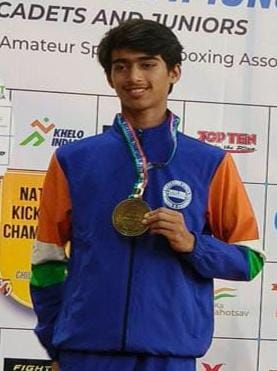
Yusha Ayman Chamundi, a 15-year-old prodigy trained under the guidance of Team Alliance Martial Arts Academy in Bhatkal, has achieved a remarkable feat by clinching the gold medal in the Junior Level Kickboxing National Championship, presented by the Wako India Kickboxing Federation in Ranchi, Jharkhand.
Yusha’s victory has not only earned him the prestigious gold medal but has also secured his position to represent India at the forthcoming international level. Notably, the international kickboxing championship is slated to take place in Uzbekistan next month, scheduled for September.
Currently pursuing his SSLC studies at the esteemed Anand Ashram Convent School in Bhatkal, Yusha’s journey to this achievement began with a triumph at the District Level Kickboxing event held in Bhatkal. His stellar performance continued as he clinched a gold medal at the State Level Kickboxing (Junior Level, Under 57 kg) competition in Mysore on July 16. The young talent’s remarkable consistency propelled him to the national level, where he stood out among competitors from 24 states in the championship held in Ranchi from August 23 to 27.
In an impressive display of his skills, Yusha navigated through the rounds with finesse. Notably, he conquered Maharashtra, Telangana, and Rajasthan in the initial stages and emerged victorious against Haryana in the final, securing the illustrious gold medal. This exceptional feat has not only illuminated Bhatkal and Uttara Kannada but has also brought Karnataka into the limelight.
Beyond kickboxing, Yusha boasts proficiency in volleyball and kabaddi, frequently showcasing his talents in school-level competitions. His achievements extend to the realm of karate, where he has consistently excelled. As he continues to juggle sports and studies, Yusha’s aspirations reach beyond the arena – he envisions becoming a Chartered Accountant after completing his matriculation.
Yusha’s dedication to martial arts traces back to his early years, fueled by a passion that led him to join Alliance Martial Arts Academy under the guidance of Mohammed Ismail and Mohammed Shammas. His late uncle, Athar Armar, also played a pivotal role in nurturing his martial arts skills.
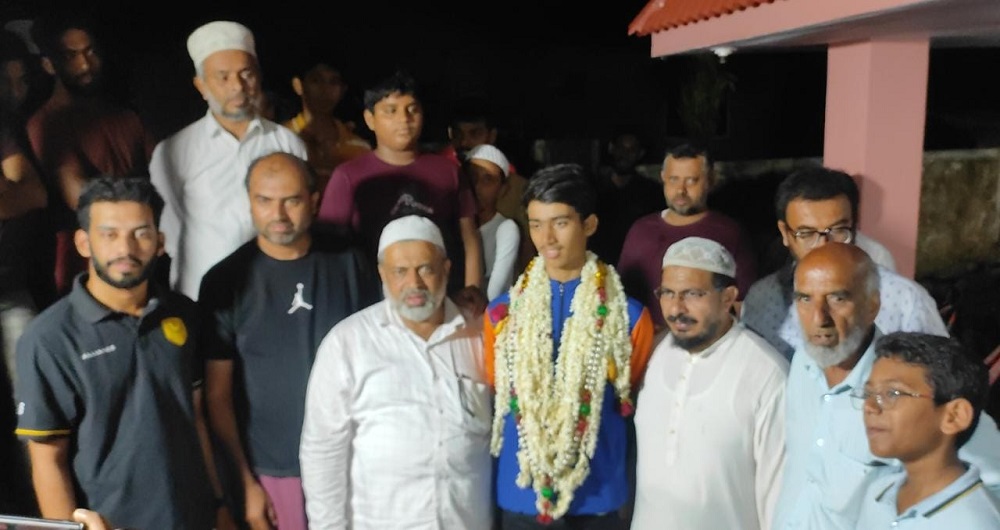
As Yusha returned home to Bhatkal from Ranchi, he was greeted with exuberance by his community. The youth of Madina Colony and Mohiuddin Street, his residential areas, warmly welcomed him, adorning him with garlands in a jubilant celebration of his achievement. Friends, family, and well-wishers filled his home, expressing their pride and admiration.
Azizur Rahman Ruknuddin Nadvi, President of Bhatkal Muslim Youth Federation, joined the chorus of congratulations, offering floral garlands to Yusha and extending his good wishes to both him and his family.
source: http://www.sahilonline.com / Sahil Online / Home> Coastal News> Featured News> Sports News / by S O News Service / headline edited / by IG Bhatkal / August 31st, 2023
That was a question I was recently asked in connection with a reference I had made to Umda Bagh and its links with education in the city for nearly 125 years. Good question, and off I went ahunting for information.
Into the Umda Bagh campus moved c.1895 the Madrasa-I-Azam, the chief Muslim school in the South and which was established in 1849. This developed partially into a Government Muhammadan College with its own buildings in 1934.
In 1948, the College was reconstituted as the Government Arts College for Men. The College moved to Nandanam in 1972 and a women’s college opened in its stead in 1974. This was named the Quaid-E-Millat Government College for Women, leaving many a student puzzling over the prefixed name, which I’m told means ‘Leader of the Nation’.
A Tirunelveli Rowther, Mohammed Ismail went into business in the 1920s and became a leader in the worlds of leather and Madras commerce. That leadership led him into politics, in which he had shown interest from when, as a 13-year-old, he started in 1909 the Young Muslim Society in Tirunelveli.
Nine years later, he founded the Council of Islamic Scholars and joined the Indian Muslim League. In 1946, he led the League’s Madras unit in the Assembly elections and became Leader of the Opposition. He was also elected to the first Lok Sabha, which simultaneously served as the Indian Constituent Assembly. And, an intriguing election that year was as the founding President of the Madras State Mutton Dealers’ Association, which he remained till his death 26 years later.
When Pakistan was born in 1947, the Muslim League divided and an Indian Union Muslim League came into being. Mohammed Ismail was elected its first President. After serving in the Rajya Sabha from 1952 to 1958, he moved into Kerala politics with States’ Reorganisation in 1956. Leading the IUML, he won Lok Sabha seats in 1962, 1967 and 1971. He died a year after his last election, revered in both Tamil Nadu and Kerala as the Quaid-E-Millat, a leader who ensured communal harmony. Interestingly, his education had been in Hindu, Catholic and Protestant schools and colleges!
Perhaps the greatest tribute paid to him was by Congress Chief Minister M Bhaktavatsalam who, describing his dignified and conciliatory behaviour in the Legislature, said he was “a model for all Opposition leaders”.
The chronicler of Madras that is Chennai tells stories of people, places and events from the years gone by and, sometimes, from today
source: http://www.thehindu.com / The Hindu / Home> Society> History & Culture / Madras Miscellany / by S. Muthiah / May 01st, 2017
Researchers hope the government will act to protect the cannon at Gulbarga Fort
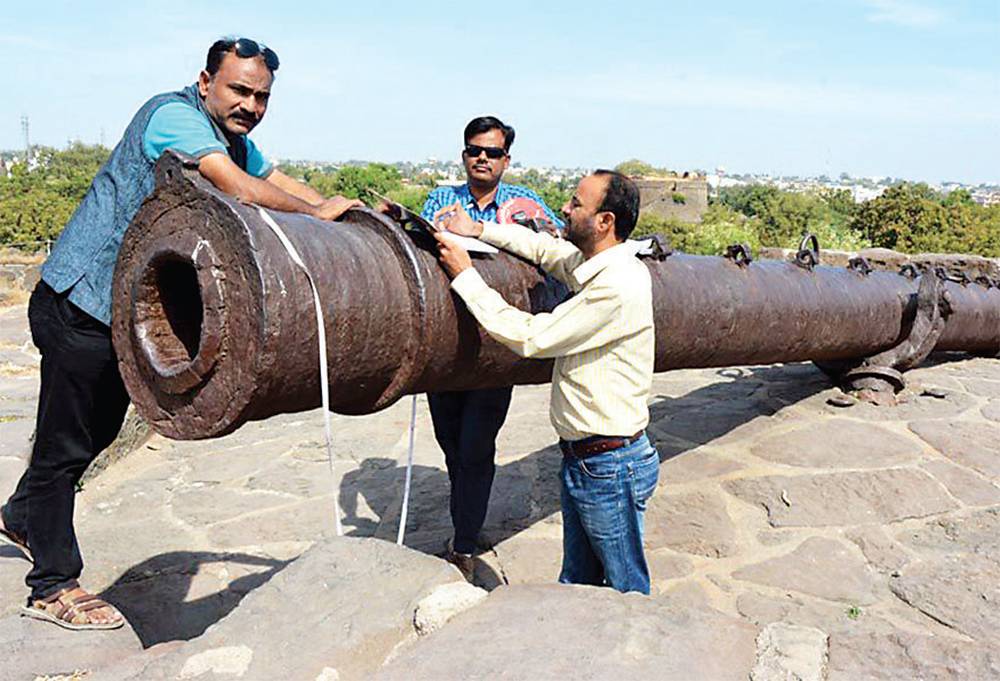
Mohammed Ayazuddin Patel, Dr Rehaman Patel and Mohammed Ismail measuring the Bara Gazi Toph
The three researchers, Mohammed Ayazuddin Patel, the national award winner, artist and photographer, Dr Rehaman Patel, artist and researcher at Indo-Islamic Art, Kalaburagi, and Mohammed Ismail, Bahmani researcher and coin collector who recently discovered a cannon in a fort in Kalaburagi, which they say is the longest in the world, are worried over its preservation.
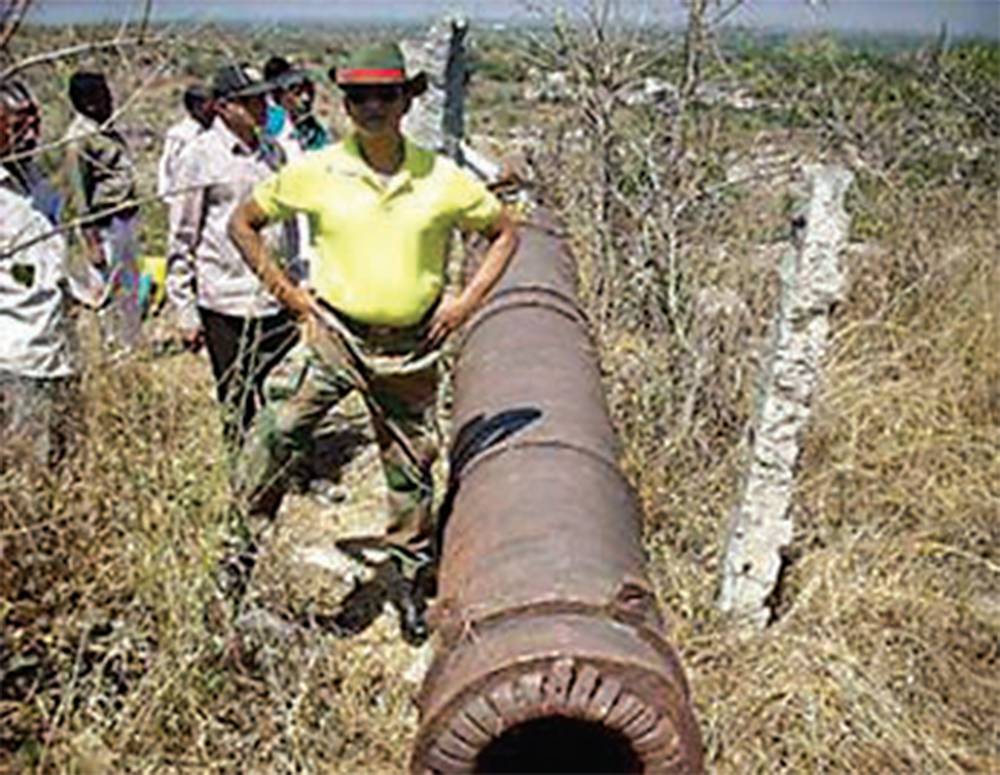
It was their visit to Gulbarga Fort in search of the name of the first Bahmani sultan, Alauddin Hasan Bahaman Shah among the Persian inscriptions on the Jama Masjid that led to its discovery. Speaking of the cannon to Bangalore Mirror, Mohammed Ayazuddin Patel said, “Since 2010, I have been researching on the subject. The existing world record is in the name of Tsar Cannon that is 17.5 feet long and was built in the 15th century in Russia. The cannon has been named in Guinness Book of World Records, when the fact remains that the top three longest cannons exist in India. It is a matter of pride for the people of Kalaburagi and the Hyderabad-Karnataka region that the longest cannon in the world is located in Bahmani Fort and was manufactured during the reign of Bahmani Empire in the 14th century. It is made of the alloy Panch dhatu.”
The cannon is known as Bara Gazi Toph and measures about 29 feet in length. Its circumference is 7.6 feet and diameter 2 feet. The barrel is 7-inch thick. In India, the largest recorded cannon is about 23 feet long and is located in Koulas Fort in Nizamabad district of Andhra Pradesh. Asaf Jah-1 (first Nizam) granted the Koulas Fort to the Rajput king Raja Kunwar Gopal Singh Gaur in 1724 AD for his bravery in the battle of Balapur and Shakkar Keda. The biggest cannon on wheels, built by Raja Mansingh, is in Jaipur and measures 20.6 feet in length.
“The Jaipur cannon weighs about 50 tonnes. We assume that the weight of the Kalaburagi cannon could be around 70-75 tonnes. While, the firing range of the Jaipur cannon is about 35 kilometres, that of Bara Gazi Toph could be 50-55 kilometres,” Ayazuddin Patel said.
The Bahmani monarchs, who ruled from the present Kalaburagi (Ahasnabad), stand out among other rulers for their contribution to the city. The founder Alauddin Hasan Bahaman Shah (1347-1422) made Gulbarga the capital and before his death he became the master of a vast empire. Even as they extended their territory, the rulers made significant contribution to the fields of art, architecture and literature.
The Bahmani sultanate was the first independent Islamic state of the Deccan in South India and one of the larger medieval Indian kingdoms. They ruled for 191 years (1347-1538 AD). Their other capital was Bidar.
The Gulbarga Fort was significantly expanded in 1347 by Alauddin Hasan Bahmani after he cut off ties with the Delhi sultanate. Islamic monuments such as mosques,
palaces, tombs, and other structures were also built later within the refurbished fort. The Jama Masjid built within the fort in 1367, is a unique structure of Persian architectural. It is fully enclosed, and has elegant domes and arched columns, which is unlike any other mosque in India.
The biggest challenge about historic monuments in the state is their protection, a fact not going to be any easy with the region being a backward area. “The Archaeologi-cal Survey of India and state archaeology department should take steps to protect the cannon at the Bahmani Fort and it should be included in the world record list. It should be fenced. The cannon is filled with sand and pebbles, so should be properly cleaned. Also, a signboard stating its details as the longest cannon in the world is a must. The fort and Jama Masjid must be declared heritage centres,” added Ayazuddin.
The team submitted a memorandum with their pleas to the district in-charge minister Sharan-prakash Patil, the deputy commissioner, regional commissioner, as well as the departments concerned.
GIGANTIC CANNONS OF THE WORLD
Jagadamba Bhavani Tope: Located at the historic Koulas Fort in Andhra Pradesh is believed to be the largest cannon in the world. The cannon (left), which is 23 feet in length and weighs 70 tonnes, is predominantly made of iron. It has a 16-inch calibre with an explosive head of 150 kg.
Jaivana: Recorded as the world’s largest cannon on wheels, Jaivana was manufactured during the reign of Maharaja Sawai Jai Singh II (1699–1743) at a foundry in Jaipur, Rajasthan. Jaivana’s barrel measures 20.19 feet in length and 11 inches in diameter. The 50-tonne cannon is mounted on four wheels. The rear wheels are mounted on roller pin bearings, to turn it 360° and fire in any direction. It was designed to fire a 50 kg cannon ball to a distance of 35 km. This cannon was never used in any battle as the Rajput rulers of Amber had friendly relations with the Mughals.
source: http://www.bangaloremirror.indiatimes.com / Bangalore Mirror / Home> News> State / by Deepthi Sanjiv, Bangalore Mirror Bureau / December 28th, 2016