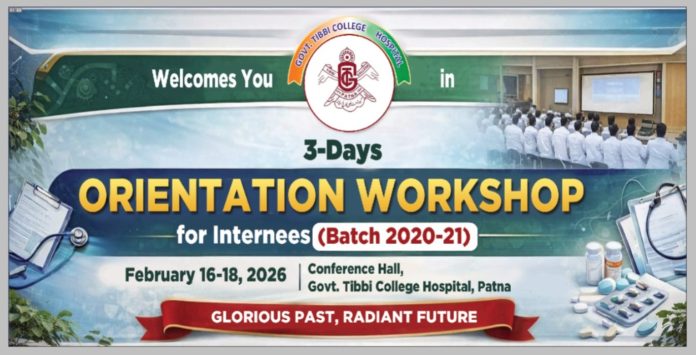
Government Tibbi College Hospital, Patna, will host a three-day special orientation workshop from February 16 to 18, 2026, for the trainee doctors of Batch 2020. The objective of this workshop is to practically acquaint incoming doctors with professional demands, medical laws, administrative principles, and ethical values to ensure they can fulfill their responsibilities effectively.
Under the vision of “A Glorious Past, A Bright Future,” the institution has designed this comprehensive training program.
On the first day, Dr. Mohammad Tanweer Alam will provide a detailed briefing on internship rules and regulations. Dr. Mohammad Razi Ahmad will highlight the importance of vital signs and correct examination methods, while Dr. Khesal Ahmad will explain X-ray diagnosis and study techniques in the ENT (Ear, Nose, and Throat) department.
This will be followed by a detailed discussion on modern diagnostic equipment and its effective use.The second and third days of the workshop will feature experts speaking on various medical topics. Dr. Mohammad Nizamuddin will provide guidance on the principles and rules of prescription writing. Dr. Shoeba Feroz Ahmad will share insights on prenatal and postnatal care, while Dr. Rizwan Ahmad will present practical tips on prenatal and postnatal emergency management. Dr. Raj Kumar Chandan will deliver a lecture on the practical use of anesthesia.
Dr. Amresh Kumar and Dr. Javed Ahmad will deliver a special address on the integration of Physiotherapy and Unani medicine in treating musculoskeletal and joint disorders.
To promote high ethical values alongside professional expertise, a special session on “Medical Ethics” will be conducted by Dr. Mohammad Nafees Iqbal.
On the final day, Dr. Aliya Parveen will hold a detailed discussion on clinical protocols related to infertility management.
The workshop will conclude with an inspiring address by Dr. Shailesh Kumar Pankaj, aimed at instilling new energy and professional commitment in the trainee doctors.
In his message, the Hospital Superintendent, Professor Dr. Shahnawaz Akhtar, stated that this workshop would prove to be a milestone for future doctors. He remarked that the institution’s goal is not merely to award degrees but to prepare physicians who are both technically skilled and ethically sound. He urged all interns to make the most of this opportunity and further refine their skills.
source: http://www.radiancenews.com / Radiance News / Home> Education> Latest News / by Sami Ahmad / February 16th, 2026
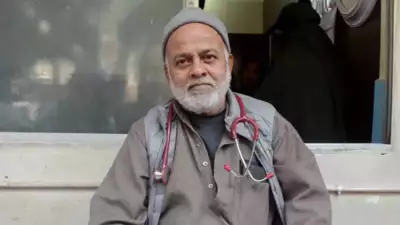
In an era where medical expenses are skyrocketing, a doctor from Patna has been a beacon of hope for the poor and underprivileged.
For an astonishing three decades, Dr. Ejaz Ali has been charging a mere Rs 10 for consultation, earning him the revered title of “messiah” among his patients.
From March 20, 2008, to July 7, 2010, he represented the Janata Dal (United) in the Rajya Sabha from Bihar. He has also served as the National Convenor of the All-India Backward Muslim Morcha, an organization dedicated to campaigning for Dalit Muslims since its founding in 1994.
Since 1984, Dr. Ali has worked as a general surgeon in Bikhna Pahari, Patna. The kind physician took a different approach, while the others around him charged exorbitant fees. By keeping his fees at Rs 10, he made himself available to those in need.
His clinic, which is situated in Bikhna Pahari on Ashiana-Digha Road, draws patients from all across Bihar who are looking for reasonably priced healthcare.
With more than 100 patients every day and multiple surgeries completed, Dr. Ali’s dedication to affordable healthcare is clear. He emphasizes his consistent commitment to aiding people in need. In order to save them money on lodging and other costs, he makes sure that every patient who has travelled to visit him receives a consultation that same day.
In addition to charging minimal fees for consultations, Dr. Ali performs surgeries at a reasonable cost. He permits his patients to pay in installments and even declines to charge them.
The late wife of Dr. Ali was a doctor as well. His three children now work in the same field, truly carrying on their father’s legacy. They asserted that their father has always put patients first.
His daughter, Gynecologist Dr. Suraiya Anjum, says, “He is the type of person who never yells or becomes agitated. Patients frequently regard him like a messiah.
Despite his fame and recognition, Dr. Ali remains humble and dedicated to his work. His clinic continues to attract patients from all over the state.
source: http://www.twocircles.net / Two Circles.net / Home> Articles> Indian Muslim / by TCN News / February 03rd, 2025
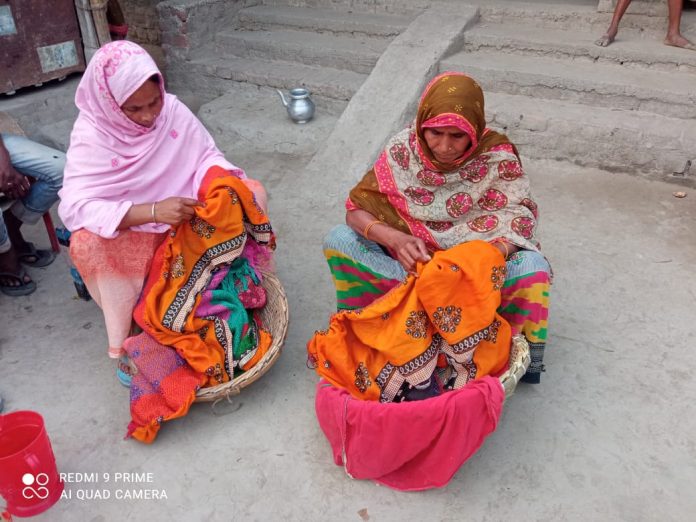
Rural women of Bihar engaged in doing Kheta embroidery work. | Picture by author arrangement
Kheta is said to be a 500-year-old quilting heirloom practised exclusively by Shershahabdi women. Today, Kheta embroidery work is getting popular among non-Shershahabdi people with many women formerly associated with making Beedis taking to Kheta work to earn a decent livelihood.
Bihar :
Razia Khatoon of Kishanganj district of Bihar is getting 45 days of training in Kheta embroidery work. The training will be completed on May 14 and is done under Project Samarth, a scheme for capacity building in the textile sector carried out by the government of India. Earlier, she would make Beedi (plant leaf cigarettes) as a livelihood. She said Kheta has given her a chance to get rid of the health hazards that making Beedi brings on.
For several workers like Razia, the Kheta embroidery work, after acquiring proper training, is expected to be an alternate livelihood instead of the hazardous Beedi rolling job.
Believed to be a 500-year-old quilting heirloom practised exclusively by Shershahabdi women, today the Kheta embroidery work is getting popular among non-Shershahabdi people. Earlier, the intricate embroidery work was done on the layers of pre-used print Sarees and chequered Lungis etc, however, today the use of new clothes for making Khetas is widely done.
“Shershahabdi is a term used for Muslims of the Seemanchal area of Bihar who were settled in the region by emperor Shershah Suri. They are said to be ethnic Pashtuns mixed with local Surjapuris,” Ashraful Haque, a Shershahabdi, who co-ordinates with the Kheta weavers, told TwoCircles.net.
“Kheta is so intricate and organised that officials from Delhi first refused to believe it as a handcraft. When a live demo was done, they were immensely impressed. After the efforts of the local member of parliament Dr Mohammad Jawed, who raised this question of Kheta in the Parliament, we have got this opportunity to train our women not only in making more vibrant Khetas but also make them aware of its marketability,” he said.
To make Kheta embroidery work as a source of income, the artwork is being introduced in new forms with the use of new clothes. This embroidery work is now done on bedsheets, notebook covers, bags, pillow covers, mufflers, table clothes and handkerchiefs etc.
As of now, seventy thousand workers are believed to be associated with this artwork.
Noticeably, unlike other embroidery works, Kheta avoids figurative depictions which are considered to be forbidden in Muslim culture. The colours used for Kheta are generally bright like red, green, yellow, blue, and purple.
Razia, 24, is a Shershabadi woman, and like every other Shershahabadi female, she knew a bit of Kheta.
She expressed her happiness in learning new designs and colour patterns of Kheta. She used to earn around 1$ per day by Beedi making. She now hopes to double her income by part-time Kheta making.
More than the money she is happy as she considers Kheta work as “Izzat wala kam (a respectful job.)”
Another trainee Rulekha Khatoon’s husband is a migrant labourer. Khatoon is 25-years-old and is doing Kheta work regularly for the last six years. She learnt the technique from her mother and grandmothers. “Earlier we used to make Kheta only for family purposes like dowry and gifts etc. This training showed us that we can sell our work too. I hope to earn Rs. 3000-4000 per month with the work of 3-4 hours,” she said.
47-year-old Tajgara Khatoon is a top trainer of Kheta. She told TwoCircles.net, “A needle and some threads are required to do wonders in Kheta embroidery but not without great painstaking concentration. Shershahabdi women learnt it naturally but this training is giving them a wider range of patterns.”
Inderjit De and Saumya Pande of Zameen Astar Foundation write in their paper on Kheta embroidery, “The term Kheta stands for straight running stitches in the local dialect and refers to both embroidery and the product. In its similarity to the word, Khet meaning farm, the term Kheta may resemble the meticulous lines of the paddy fields.”
According to the website involved in the promotion and marketing of Kheta, “the array of designs offered by Kheta resonates with ripples of water, materials used in building make-shift huts, flowers, dry fruits, leaves, among many more.”
Yuman Hussain is the executive director of Azad India Foundation which is actively involved in promoting Kheta and arranging training for workers.
Yuman told TwoCirles.net that the “training helps in benchmarking the skill level and understanding the quality control. It formalizes the knowledge transfer and helps in keeping the next generation interested in continuing the quilting practice.”
The training also provides the trainees with an artisan card with benefits like insurance and access to participate in different exhibitions.
“On average, a Kheta artisan can make 4 to 6 quilts (96″ x 60″ size) in a year. They can earn anything between Rs 10000 to Rs 30000 per year depending on how many quilts they are making, sizes of quilts, the skill level of quilting etc,” she said.
Yuman rued that even though most Shershabadi women know how to make Kheta, the supply of skilled artisans is less. “The work needs to be done on both sides to build awareness in the market and a supply chain base for these quality quilted Khetas,” she added.
Sami Ahmad is a journalist based in Patna, Bihar. He tweets at @samipkb
source: http://www.twocircles.net / TwoCircles.net / Home> Lead Story / by Sami Ahmad, TwoCircles.net / May 05th, 2022