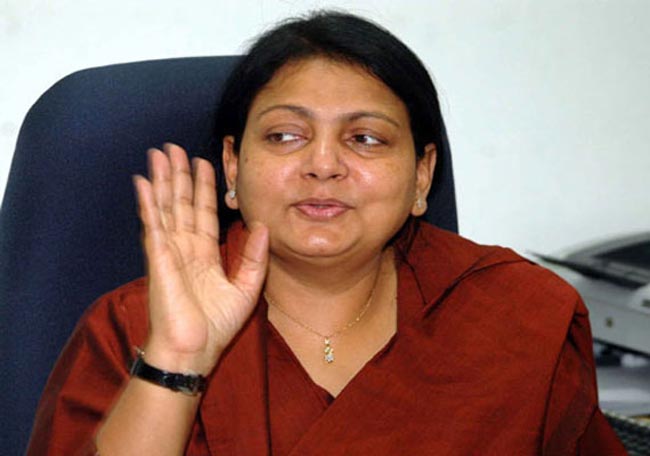
Social activist and Former Bihar Minister Parveen Amanullah passed away today in New Delhi. She was suffering from cancer for some time.
The family had moved from Patna to Delhi for treatment. She also went to America for treatment and recovered from there. Her health had deteriorated for two-three days. she passed away today at seven PM.
Amanullah was the daughter of former Kishanganj MP Syed Shahabuddin and the wife of senior Bihar cadre IAS officer Afzal Amanullah.
Before entering politics she was known for her activism, especially in regard to her use of the Right to Information Act, 2005 to bring out the apathy prevalent in government institutions.
Amanullah was elected as a member of the Bihar Legislative Assembly in 2010 from the Sahebpur Kamal constituency in Begusarai district as a candidate of the Janata Dal (United) after defeating Rashtriya Janata Dal’s Shreenarayan Yadav.
She became the Social Welfare minister of Bihar in Nitish Kumar’s government and held the portfolio until February 2014 when she resigned from JD(U) citing “governance issues” and “lack of work satisfaction”. She joined Arvind Kejriwal’s Aam Aadmi Party two days later.
source: http://www.theindianawaaz.com / The Indian Awaaz / Home> Quami Awaaz / by Indian Awaaz / October 01st, 2023
While working on my two books (soon to come: one on Muslim Politics in Bihar and another on Muzaffarpur Muslims, 1857-2011), while looking into primary and secondary sources I came across many personalities and institutions. One such person was Sir Fakhruddin whose contributions towards public life may interest many people. Hence I crave the readers’ indulgence.
[Sir] Syed Mohammad Fakhruddin [Khan Bahadur, 1868-1933] of Patna is credited to have the distinction of being the first Muslim Minister of Bihar and Orissa.
His father Md. Ali of the village Dumri, near Patna, took special care of his quality education. Having imparted elementary education in Arabic, Persian, and Urdu in the village Maktab, Fakhruddin was put under the tutelage of Md. Yahya, advocate, a big rais of Patna, with deep interest in music and literature. Yahya was the husband of Rasheedun Nesa (1855-1926, the author of the Urdu novel, Islahun Nesa, 1881/94, and a pioneer of modern education to women in Patna).
Fakhruddin did his BA from the Patna College in 1891, and B.L. in 1893, and started court practice under the guidance of Yahya in the district court of Patna. He was also associated with the Bihar Provincial Association.
Having earned good reputation as advocate he was elected member Bengal Council in 1910, which Fakhruddin quit after becoming the government pleader (1917-20) in the High Court of Patna, established in 1916-7. In 1921 he was elected member of the Bihar and Orissa Legislative Council, and he kept winning the elections till his death in 1933.
Thus, during 1921-33 he also served as minister of education besides few other significant departments. His contribution as minister in pushing the cause of education is distinctive. His efforts towards promoting primary and secondary education are noteworthy.
The Deputy Directors of Public Instruction were made to undertake tours of Bihar and open schools. Fakhruddin worked hard towards enhancing the budgetary allocation for education. He also made efforts towards charkha operation in the government schools but remained largely unsuccessful in that. He mobilized funds for construction of college buildings and hostels. He was passionate about it.
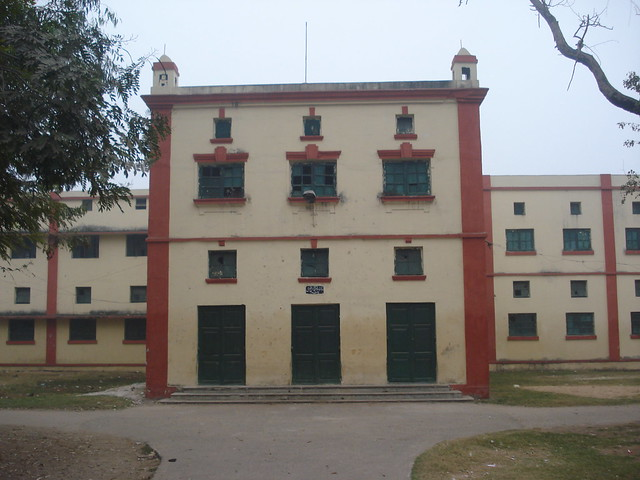
Reconstruction of Patna’s BN College building and its three storeyed hostel, the imposing building of the Science College (Patna), two storyed hostel for the Science College, the Patna College Hostel (later became famous as Iqbal Hostel), two storeyed PostGraduate Hostel of Ranighat (Patna), Patna Training College are his creations.
Besides, he also allocated fund for the buildings and hostels of the Muzaffarpur’s GBB (LS) College, Cuttack’s Ravenshaw College, Bhagalpur’s TNB Colllege, two big buildings for the Madrasa Shams-ul-Hoda, which was taken over by the government, and eight professors’ quarters in Ranighat (Patna) are also his creations. For the cause of Urdu, he set up a Madrasa Board in 1922.
Madrasa Shams-ul-Hoda
Fakhruddin had also prepared an ambitious plan of converting the Patna University in a big residential university for which he also influenced the Nathan Committee to make favourable recommendations. This was to be established in the Phulwari Sharif. But it did not see the light of the day as a large number of the members of the Bihar and Orissa Legislative Council opposed it on the arguments that the campus will go far beyond the city; a member went on to allege that Fakhruddin was taking the University to the doors of his Pir. The Searchlight is said to have regretted this myopic opposition as the Bihar’s capital city was deprived of quality residential university.
He created and institutionalized Bihar Educational Service Class I, and went on talent hunt to recruit meritorious teachers for the Patna University.
With these efforts he brought in Dr Gyan Chand as professor of Economics, Prof. Taraporewala (History), Prof. Jamuna Prasad (Psychology), Prof. Hill (English), Prof. Shiv Parvati Prasad (Physics). They were posted on handsome salaries.
There used to be an insistence by the colonial regime to recruit only those candidates as Class I teachers who had obtained degrees from Europe.
Prof. Nayyar Laeeq Ahmad (who later became Principal, Andheri College, Bombay), and Prof. Jadunath Sarkar were also recruited. Sir Fakhruddin resisted this racism, without much success at the time, even though it was diluted subsequently in 1940s when Prof. K K Datta (History, 1944) was taken in.
Sir Fakhruddin brought a bright professor of Law from BHU to make him Principal, Law College, and Prof. Boman Sanjana of Bombay was brought in the Civil Engineering.
In order to overcome the dearth of talented teachers he also instituted State Scholarship programme on which promising students of BA and MA were sent oxford and Cambridge for higher degrees and they had to return back to teach in the colleges of Patna University.
Kishori Prasad Sinha, Fazlur Rahman, and Kalimuddin Ahmad for English literature; Ghanshyam Das for History, Balbhadra Prasad and Qamruddoja for Chemistry, Bhairavnath Rohtagi for Economics were few such luminaries. Sadly, with the death of Sir Fakhruddin this bright scheme also died.
The Bihar School of Engineering was upgraded to ‘College’ by him. He also established the Veterinary College of Patna and recruited many teachers from outside.
Besides education, he also held the portfolio of cooperative and he made it a movement of sorts, more particularly in Tirhut. He convened a conference of Cooperatives in Hajipur when Ahmad Husain (1886-1948), an Aligarh graduate of Muzaffarpur, was posted as SDO in Hajipur.
For all these unforgettable contributions, Dr Rajendra Prasad held him in very high esteem.
Sir Fakhruddin, a bearded, fair-skinned fellow was a devout practicing Muslim with punctualities of namaz. Sherwani, pajama, Turkish cap was his preferred dress. The masjid near the Patna Railway Junction was reconstructed by him by investing around Rs. 20-25 thousand, which is now the Jama Masjid of Patna; for long it was called ‘Sir Fakhruddin Masjid’.
As a minister, he never used government quarters; rather he preferred to work from his own house in Patna, nor did he accept police protection. He was a good orator in both English and Urdu.
His sons- Azizul Haq was a renowned advocate of Patna High Court, Anisul Haq was Deputy Collector, Habibul Haq was in judicial services.
(Mohammad Sajjad, Assistant Professor at Centre of Advanced Study in History, AMU, Aligarh)
source: http://www.twocircles.net / TwoCircles.net / Home / by Mohammad Sajjad / October 13th, 2025
Around 20 Muslim candidates were runners-up in the 18th Lok Sabha elections. Of them 7 lost to other Muslim candidates and the rest to other candidates.
Two of these were knocked out by Muslim candidates which made a cakewalk for BJP. In Amroha, UP, Danish Ali of INC secured 447836 votes against BJP’s Kanwar Singh Tanwar who got 476506, just 29670 more votes. Whereas BSP’s Mujahid Husain secured 164099 votes and finished third. Another four Muslims were also in the fray as independent candidates who together poled only 4503 votes.
Hafiz Rashid Ahmed Choudhry of INC from Karimganj, Assam lost to BJP’s Kripanath Mallh by just 18360 votes. Whereas the third in row was a Muslim from United Front, Shahbul Islam Choudhry who secured no less than 29205 votes. There were another 10 Muslims in the fray as independent candidates who secured 20162 votes combined. This invites the apolitical Muslim influential individuals’ and organizations’ role in making one strong Muslim candidate winnability bleak.
Shahnawaz of Rashtriya Janata Dal, in Araria, Bihar lost to BJP candidate by 20094 votes. There were five Muslim independent candidates totally scoring 39992 votes.
Mohammad Badruddin Ajmal, AUDF, in Dhubri Assam lost by 1012476 votes. He secured 459409 against the winning candidate Rakibul Hasan’s 14,71,885 votes. There were other eight Muslim candidates from seven different outfits and one independent. All of them put together pooled 486319 votes. Zabed Islam of Asom Gana Parishad who stood third alone secured 438594 votes.
The former Chief Minister of Jammu and Kashmir Mehbooba Mufti lost to National Conference candidate Mian Altaf in Anantnag-Rajouri by a margin of 2,81,794. Another 18 candidates were there to fish in the troubled waters.
Omar Abdulla, National Conference, Baramula lost to Engineer Rasheed, an independent who got 268339, lost by 204142. There were another 19 candidates in the fray.
Waheed ur Rehman Para, Peoples Democratic Party, Srinagar finished second 168450, lost by 188416 votes to Aga Syed Ruhulla of National Conference. Another 19 candidates tried their luck.
Mujahid Alam, Janata Dal (United), Kishanganj, Bihar, ranked second position against Tariq Anwar of INC who secured 343158 votes, lost by 59692 votes. There were another five Muslim candidates who together could not score beyond 45000 votes.
Md Ali Ashraf Fatmi, Rashtriya Janata Dal, Madhubani, Bihar, 2nd position. Lost to BJP. Secured 41483 votes and lost by a margin of 151945 (other Muslim candidates – Md. Waquar Siddiqi of AIMM and Sarfaraz Alam of Akhil Bhartiiya Parivar Party).
Hena Shahab was the only Muslim candidate among the 16 in the fray in Siwan, Bihar. An independent candidate, she scored an impressive figure of 296351 votes but lost to JD(U)’s Vijaylakshmi Devi by 92857 votes.
Mansoor Ali Khan, Indian National Congress, Bangaluru Central, Karnataka finished second, lost to BJP, secured 626208 votes still lost by 32707 votes. It was a straight fight and laser finish despite there were around 21 candidates who together could not cross 45000. In his first attempt, Mansoor has made a tremendous dent in the citadel of three-time BJP MP, Mohan.
AM Ariff of CPI(M) from Alappuzah, Kerala gave a tough fight to one of the general secretaries of Congress, KC Venugopal and secured 341047 votes only to lose by a margin of 63513.
Elamaram Kareem, CPI(M), Kozhikode, Kerala finished second against INC, got 374245 but lost by 146176 votes.
Vaseef and KS Hamza of CPI(M), from Malappuram and Ponnani in Kerala respectively lost to IUML candidates.
Mohammed Faizal PP from Nationalist Congress Party – Sharadchandra Pawar in Lakshadweep fought against Hamdulla Sayeed of INC and lost by 2647 votes.
Imtiaz Jaleel Syed, All India Majlis-E-Ittehadul Muslimeen, Aurangabad, Maharashtra, lost to Shiv Sena, by 134650 votes.
Mohammed Mubarak from All India Anna Dravida Munnetra Kazhagam, Dindugal, Tamil Nadu stood second against CPI(M) candidate.
Md Salim, CPI(M), Murshidabad West Bengal, lost to Abu Taher Khan of TMC by 164215.
source: http://www.radiancenews.com / Radiance News / Home> Latest News> Report / by Mohammed Atherulla Shariff (headline edited) / June 10th, 2024