Tag Archives: Nawab Muhammad Ali Khan

Rampur Royals were patrons of art, literature and cuisine

Rampur, UTTAR PRADESH :

The Rampur Nawabi family with former Prime Minister Dr. Manmohan Singh

In December 2021, I came across a report in a newspaper that said, “After almost 50 years of legal battle, the Rampur District Court has ruled in the Rampur Nawab family’s property dispute. The property will now be divided among 16 legal heirs. Raza Ali Khan, the last Nawab of Rampur, died in 1966. After a long legal battle, the court has announced the division of his property worth Rs 2,664 crore.”

The Nawab family of Rampur with its glorious history is still important played in Rampur and its surrounding districts. While the family ruled the state for a long time, its members joined the institutions of independent India like Parliament and legislative Assembly. Former Members of Parliament Mickey Mian and Noor Begum belong to the family. Many members of this Royal family have played an important role not only in politics but also in promoting the culture, patronizing poets, writers, musicians, and other creative artists.

Khandaan

The Nawabi family of Rampur State

Before the independence, India was dotted with small states and one of them happened to be the state of Rampur, located in today’s state of Uttar Pradesh. It was founded by Nawab Ali Mohammad Khan, a Pushtun leader on 7 October 1774. There have been 11 Nawabs in the state including Nawab Faizullah Khan, Nawab Hafiz Rehmat Khan Barish, Nawab Muhammad Ali Khan, Nawab Ghulam Muhammad Khan, Nawab Ahmad Ali Khan, Nawab Muhammad Saeed Khan, Nawab Yusuf Ali Khan, Nawab Club Ali Khan. Nawab Muhammad Mushtaq Ali Khan, Nawab Hamid Ali Khan.

Raza Ali Khan was the last Nawab of Rampur. Rampur was one of the important States of the British in India as its rulers were plaint and supported the Raj even during the 1857 revolt. It was a 15 cannons gun salute State and its rulers owned a lot of wealth.

Before the independence, the Nawabs of Rampur used to have their own railway station with two special coaches always in readiness in the service of the Royal family. Whenever the Nawab family had to travel by train to Delhi, Lucknow, or elsewhere, they would board their coach and that was added to the passenger train. During the tenure of the ninth Nawab, Hamid Ali Khan the railway line was laid in the district. At that time, he had built a separate railway station for his use. It was close to the main railway station.

The Royal Coach full of Luxuries and modern appliance

Interestingly the two railway coaches that have immense historic and antique value today are among the assets sought to be distributed among the progeny of the Raza Ali Khan. These were originally valued at Rs. 117.42 million. However, due to almost no maintenance, the price was halved.

Interestingly, these coaches had so many modern conveniences that even the heads of the state today can’t dream of. The coaches were equipped with 33mm and 16mm cinema projectors, cameras, imported radio transistors, and tape recorders. These provided all the luxuries like Bedding, chair, carburetor pillow, seat, silverware, glass, whiskey, beer bottles, English crockery, large cigarette and cigar box, silver footstep, eagle, silver canteen set, silver hooka, silver bed, sword, and various kinds of guns, etc.

The Nawab family’s properties include 1073 acres of land, mansions, palaces like Khas Bagh, Kothi Benazir, Lakhi Bagh, Kanda, and Nawab Railway Station, and immovable assets like arms, jewelry, etc. The valuables include silverware like six silver beds, 20 silver pandans, six khasdans, and 20 cigar boxes, and four hookas. Former Member of Parliament Begum Nurbano says that when she came to Khas Bagh in 1956 as a bride she slept on a silver bed. Khas Bagh was India’s first air-conditioned palace.

Khas Bagh Palace was the first air-conditioned palace in India.

Khas Bagh Palace, Rampur

The state of Rampur was not only a political state but also a great patron of education, art, and culture. Nawab Yusuf Ali Khan was a friend of knowledge and also gave scholarships to scholars and students. He made Mirza Ghalib his consultant on literary matters and he became a student of Ghalib. He used to send a reasonable amount of money to Mirza as a stipend. In addition, hundreds of poets, including Mirzadagh Dehlavi, were patronized by the Nawabs of Rampur.

The Library

The Nawab of Rampur was a friend of knowledge. The symbol of his friendliness of knowledge is Raza Library which was once the largest library in India and it is still very important today. Thousands of rare books and manuscripts in Urdu, Persian and Turkish languages ​​are available here.

The Nawab of Rampur was also an epicurean. He had a whole army of cooks and chefs. These chefs would spend the whole day preparing high-quality food and experimenting with new flavors. Elders were invited to the Nawabi Dastkhwan. After the dissolution of the state, it became difficult for the Nawab to continue the Dasthar Khan.

The Nawabs of Rampur patronized traditional music at their court. Mehboob Khan was one of the greatest thinkers of the royal court of Rampur state. This tradition was followed by his sons Inayat Hussain Khan and Inayat’s brother-in-law Haider Khan and Mushtaq Hussain. It was here that the Rampur-Sahswan family of Indian classical music was born. Sahswan is in the present Badaun district.

One of the Palaces of rampur Nawab family

After independence, the Nawab family took an active part in politics and Major Nawab Syed Zulfiqar Ali Khan Bahadur was the first from the family to be elected to the Lok Sabha. He was known as Mickey Mian. He was the second son of Nawab Sir Syed Raza Ali Khan Bahadur. In 1984 and 1989, he was elected to the Rampur Lok Sabha seat on a Congress ticket. It is also interesting to note that Mickey Mian represented Rampur in Lok Sabha for a long time but never spoke in the House.

After Mickey Mian, his wife Begum Noor Bano served as Member of Parliament in the 11th and 13th Lok Sabha. She was elected from Rampur on a Congress party ticket. Begum Noor Bano alias Mehtab Zamani Begum was born to Nawab Aminuddin Ahmed Khan who was the last ruling Nawab of Loharo (Bhiwani-Haryana). She was educated at Maharani Gayatri Devi Girls Public School, Jaipur.

She joined the All India Congress Committee in 1992 and was elected to the Lok Sabha in 1996. In the next election, she lost to BJP’s Mukhtar Abbas Naqvi. An aficionado of music and dance, Noor Banu is the patron of the Devi Foundation and the Rampur family. Bano is interested in historical and cultural Persian and Arabic books and research on environment and forest protection. She enjoys reading, painting, gardening, and music and is a member of several sports clubs across the country.

Micky Mian and Noor Bano with their children

Micky Mian and Begum Noor Bano have three children. One of them is Nawabzada Syed Muhammad Kazim Ali Khan Bahadur. He was elected MLA several times and is also a Congress candidate in the current Assembly elections. His son Nawabzada Syed Haider Ali Khan Bahadur is also contesting the Assembly elections 2022.

In the current elections in Uttar Pradesh, the reputation and honour of the Royal family is also at stake. Samajwadi Party veteran Azam Khan, who has been elected an MLA from Rampur city nine times is contesting from inside the jail against his traditional rival from the Royal family Mohammad Kazim Ali Khan. Kazim Khan popularly known by his nickname of Navid Miyan is contesting as a candidate of Congress Party and is hoping to defeat the ‘tainted’ Azam Khan.

Besides, Azam Khan’s son Abdullah Azam is contesting from the Suar constituency where he is pitted against Naveed Mian’s son Hamza Mian.

The Nawab of Rampur

Azam Khan has dominated the politics of Rampur for 42 years. He has also held ministerial positions in the Samajwadi government four times. He has also been Leader of the Opposition and Member of Rajya Sabha. On the other hand, the Nawab family has also a great influence on Rampur. Naveed Mian Sawar has been MLA four times from the Tanda seat. Once he was also elected to Legislative Assembly from Bilaspur and was a minister too.

His father Nawab Zulfiqar Ali Khan alias Miki Mian has been a Member of Parliament five times and his mother Begum Noor Bano has been a Member of Parliament twice. Both the Congress and the SP have given tickets to the members of the Rampur Royal family. This time, Congress has given tickets to former MLA Naveed Mian as well as his son Haider Ali Khan alias Hamza Mian.

source: http://www.awazthevoice.in / Awaz, The Voice / Home> Stories / by Ghaus Siwani / February 04th, 2022
New Book on Freedom Movement Educates Young Generation About Muslims’ Sacrifices

NEW DELHI :

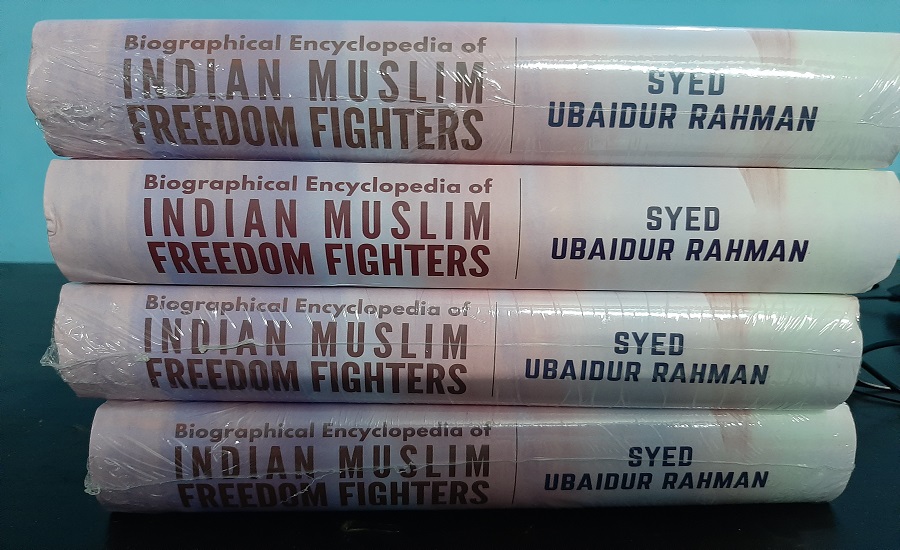
‘Biographical Encyclopedia of Indian Muslim Freedom Fighters’ is an exhaustive work that brings to the fore many unknown facets of the freedom movement beginning with Faraizi Movement to 1857 Mutiny and to later part of the freedom movement.

BE it 1857 Mutiny or the later freedom movements, Muslims have played leading role in all such efforts. British officials and historians have accused Muslims for the 1857 Ghadar. To be true, both British historians and officials have named Muslims as the most important rebels and termed the Mutiny as a sinister plot by Muslim ulema and mujahideen to reclaim their lost powerhouse in India.

Here are excerpts from a chapter on Imam Baksh Sahbai, a great scholar of his time:

Imam Bakhsh Sahbai was one of the most renowned scholars of the 19th century Mughal India. He was among the best scholars of the Persian language and had earned respect as poet and litterateur of the Persian language. At a time when Urdu had almost replaced Persian as lingua franca in much of north India, he was still one of the greatest supporters of the Persian language and spent all his resources in its propagation.

He authored more than thirty books on Persian and Urdu literature that includes three books that were part of the curriculum in the famed Delhi College. He was reportedly appointed a professor of the Persian language there. However, he had a tragic end when after the 1857 Mutiny he and his entire family, including his two sons, who were also renowned scholars in their respective fields, were hauled, taken to Yamuna and shot dead from point blank range. At least 21 members of his family were slaughtered in this most horrendous fashion.

Imam Bakhsh Sahbai was among the most respected scholars of the time and, therefore, every prince wanted to study under him. He was very close to Ghalib, Zauq, Mufti Sadruddin Azurdah, Fazle Haq Khairabadi and even the last Mughal Emperor Bahadur Shah Zafar. Many top scholars of the time were taught by him not just at Delhi College but also at his home. However, the slaughter of his family members including his two sons, and digging of his home by the British thugs had shocked the people of Delhi even during the worst phase of brutality. This digging of his house and the complete destruction of his library also destroyed much of his work. The destruction of his massive library that he had built over a period of decades must have been a huge loss for academia and scholarship.
This is the reason that not much has survived on him.

Some twenty years after his macabre killing, when a Hindu disciple of Sahbai, Munshi Deen Dayal thought of collection and publication of his he couldn’t lay his hands on anything substantial. There was not much available on his life or work. Whatever he could gather, he published it in three volumes as Kulliyat-e-Sehbai.

Sahbai was born in the year 1805 in a respected family of Delhi. His father, Maulana Muhammad Bakhsh settled in Delhi from Thanesar, Punjab. Sahbai’s elder brother Hakim Peer Bakshi was a famed physician of his time. His early education was under Maulvi Abdullah Khan. Sehbai had two sons, Muhammad Abdul Aziz and Molwi Abdul Karim Soz. Both were accomplished scholars and well-known poets. Both were killed along with their father and other relatives after 1857 Mutiny.

While in the mid-19th century the power of Mughal Empire had diminished and its influence confined to the Old Delhi quarters, the capital of the Mughal empire still boasted a huge galaxy of scholars, poets and artists of all sorts. There is no denying the fact that the biggest draw of all were the poets and intellectuals. Altaf Husain Hali said that Ghalib, Zauq, Sahbai and Azurda made the capital one of the best places for the scholars and academics. “There gathered at this time in the capital, Delhi, a band of men so talented that their meetings and assemblies recalled the days of Akbar and Shah Jahan”, wrote Hali.

Hali, who had merely heard the stories of high standards of scholarship in Delhi, its great scholars and poets and great madrasas dotting the town, escaped Panipat and came on foot to Delhi. He eventually got admitted to one of the best madrasas of the town and started frequenting the classes of great scholars of his time before his family tracked him down eventually. However, much before that happened, he had got admission in ‘very spacious and beautiful’ madrasa of Husain Bakhsh and had begun his studies there. He says that he was witness to ‘this last brilliant glow of learning in Delhi, the thought of which now makes my heart crack with regret’.

William Dalrymple while describing the destruction and killing in Delhi in the aftermath of Mutiny says:

Worse still was the slaughter in Kucha Chelan, where an estimated 1,400 Delhiwallahs were cut down. Here Nawab Muhammad Ali Khan had attempted to resist the plundering and had shot dead three British soldiers who had climbed over his haveli wall and entered his zenana. Their companions went back to get the rest of their regiment, and returned with a field gun with which they blew the haveli apart.

Sahbai was respected by fellow scholars including Mughal Emperor Bahadur Shah Zafar, who himself was a top of the line poet and whose respect for scholars and poets was legendary. While Sahbai is not known to have directly fought in the 1857 Mutiny, however, what is known is that he was with Bahadur Shah Zafar and supported his revolt. This was the reason that the rampaging British forces, full of feeling of retribution and revenge were led to his home and the homes of other supporters of Mutiny. These spies were paid Rs 2 for every such input.

When after relentless killing and rapine the British and their allies got tired of killing and bayoneting the inhabitants, they marched forty survivors out to the river Yamuna, lined them up below the walls of the Fort, and shot them. Among the dead were some of top of the line scholars who would have been the pride of the place for any world class capital. While writing about this ghastly massacre Mirza Zahir Dehlavi says, “They were well-known and well-off people, men who were the pride of Delhi…They had had no parallels in their own day, nor will we ever see their like again.’

Mirza Zahir Dehlavi in his Dastan-e-Ghadar writes:

“For example, there was Miyan Amir Panja-kash, the great calligrapher, who had no one comparable to him on this earth. Then there was one of our greatest poets, Maulvi Imam Bakhsh Sahbai and his two sons, and Mir Niyaz Ali, the celebrated story teller of Kucha Chelan. About fourteen hundred people of that Muhalla were killed. Some were arrested and taken through the Rajghat gate to the river side and there they were shot. The bodies were all thrown into the river. Meanwhile, many of their women were so disturbed by what they saw that they left their homes with their children and jumped into the wells. For months afterwards, all the wells of Kucha Chelan were stacked with dead bodies. My pen refuses to describe this further.

“One of the survivors of Sahbai’s family was his nephew Qadir Ali who apparently lived with him in Delhi. He is reported to have told his escape to the Delhi historian Rashid ul-Khairi. “Delhi resembled a place of Judgment. A huge number of prisoners were being shot as hanging them was ‘tiresome’ for their killers.

As the soldiers readied their guns a Muslim officer came forward and told us that ‘your death is imminent. You will be shot to death immediately, so those people who know swimming should immediately jump in the river to survive.’ I knew swimming and was good at it, but Mamun Sahib [Sahbai] and his son, Maulana Soz, didn’t know how to swim. I was not ready to abandon Mamun Sahib and my cousins but he forced me to do so. Ultimately, I jumped in the river and swam away. I kept looking back, and after I had gone fifty or sixty yards, I heard the gunshots and saw the line of people falling dead”.

_______

Excerpted from: Biographical Encyclopedia of Indian Muslim Freedom Fighters by Syed Ubaidur Rahman; ISBN: 81-88869-51-1, PP 626 (Hard Bound), Price Rs 1195, Publisher: Global Media Publications, Tel: 9818327757

__________

source: http://www.clarionindia.net / Clarion India / Home> Books / by Syed Ubaidur Rahman / December 13th, 2021

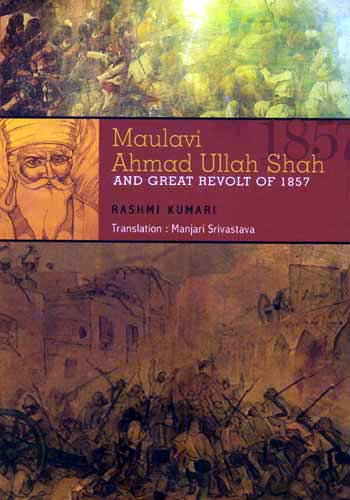
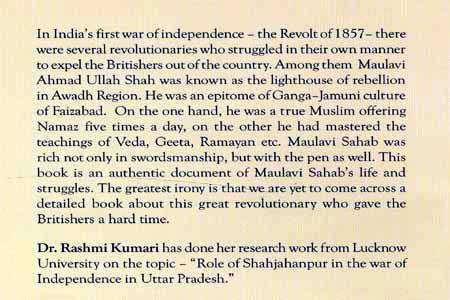
Maulavi Ahmad Ullah Shah and great revolt of 1857

Arcot, MADRAS (now TAMIL NADU ) /  Faizabad, UTTAR PRADESH :

BookAhmedalluhMPOsJAN13mpos2018

BookAhmedalluh02MPOsJAN13mpos2018

source: http://www.nbtindia.gov.in / National Book Trust, India / Home> Books> National Biography