Tag Archives: Muslim Women of Uttar Pradesh

AMU Women’s College Students Win Silver at Indiaskate National Championship

Aligarh, UTTAR PRADESH :

Aligarh :

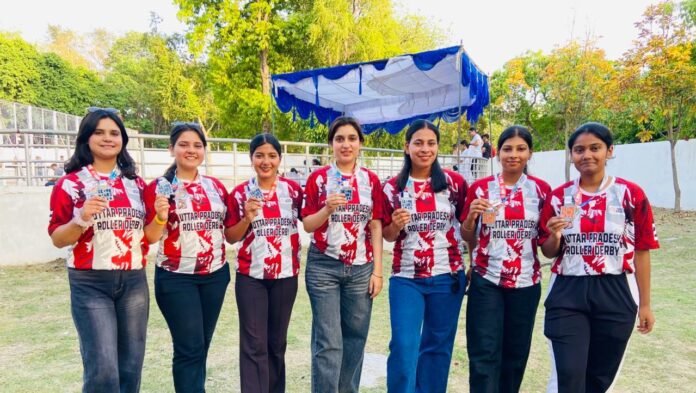
Students of Women’s College, Aligarh Muslim University, brought laurels to the institution as Nabeela Khan (B.Sc. Biochemistry) and Ashfia Khan (B.A. Psychology) secured a silver medal at the Indiaskate National Championship 2026 held from April 23 to 28.

Leading the Uttar Pradesh team, captain Nabeela Khan displayed strong leadership and determination throughout the tournament. In the final against Tamil Nadu, the team delivered a spirited performance, finishing 16–8 to clinch the silver medal.

Both players played a key role in guiding the team to the finals, showcasing excellent coordination, resilience and competitive spirit at the national level.

source: http://www.indiaeducationdiary.in / India Education Diary / Home> National News> University News / by India Education Bureau / May 02nd, 2026

Aligarh’s Amima Jauhar Shines in CBSE 10th Board

Aligarh, UTTAR PRADESH :

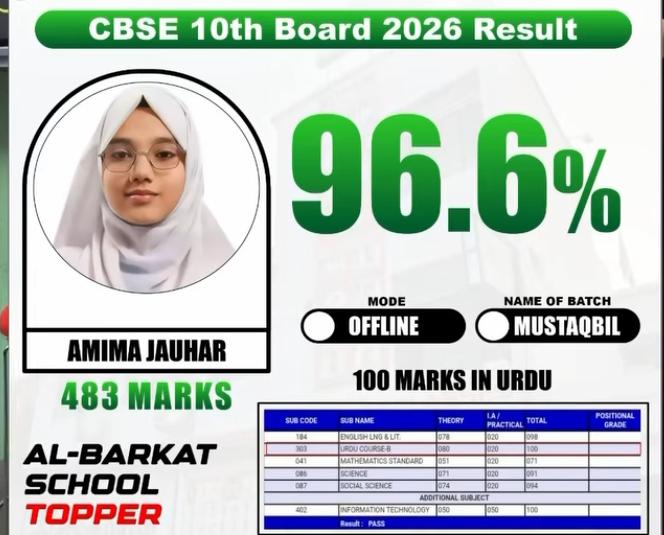
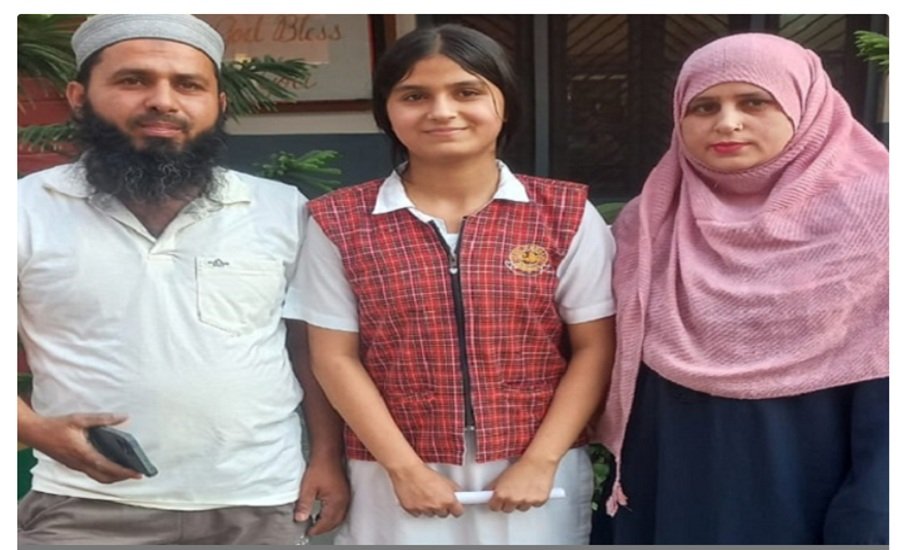
Amima Jauhar, daughter of Mohammad Afaque Jauhar, has emerged as the top scorer of Prestigious Al Barkat Public School, Aligarh, securing an outstanding 96.6% in her CBSE 10th board examinations. Interestingly another student Aleena Akhter also made the school proud by getting the same excellent result.

Amima’s result stood out with a perfect 100 marks in both Urdu and Information Technology, reflecting her exceptional command over languages as well as technical subjects. Her consistent hard work, disciplined study routine, and academic focus have been widely appreciated by teachers and school authorities.

A student of Al Barkat Public School, Amima also received guidance from Image Classes, Aligarh, which played a supportive role in her preparation. Her achievement has brought pride to her family, school, and the Aligarh academic community.

source: http://www.theindianawaaz.com / The Indian Awaaz / Home> Campus / by Indian Awaaz / April 18th, 2026

Muslim Sisters from Meerut Excel in UP Board Exams Without Coaching

Meerut, UTTAR PRADESH :

The sisters come from a modest background. Their father, Abdul Malik, works as a carpenter, while their mother studied up to Class 9. 

 Two sisters from Meerut have drawn attention with their impressive performance in the Uttar Pradesh Madhyamik Shiksha Parishad examinations, securing the top two positions in the district.

Adeeba Malik scored 95.68 per cent in the high school examination to secure first place, while her sister Shifa Malik ranked second with 82 per cent in the science stream.

Their achievement has brought joy to the locality, with residents visiting their home to congratulate the family.

Adeeba attributed her success to discipline and consistency. “I studied for long hours every day and stayed focused. Hard work and a proper routine helped me achieve this result,” she said. She scored full marks in mathematics, her strongest subject.

Notably, she prepared entirely at home without any tuition or coaching support.

The sisters come from a modest background. Their father, Abdul Malik, works as a carpenter, while their mother studied up to Class 9. Expressing his pride, Abdul Malik said, “I could not study much myself, but my daughter is making me proud. There is no difference between a son and a daughter. I want her to study and move ahead.”

The sisters were felicitated at St Joseph Inter College, where teachers and students celebrated their success. Sweets were distributed, and similar celebrations were held at their home.

Family members said the achievement reflects the sisters’ consistent dedication and hard work.

Adeeba aspires to become an IAS officer and serve the country.

Education experts say such success stories are significant, especially in areas where awareness about girls’ education is still evolving and students often face challenges in continuing their studies. The sisters’ achievement is being seen as an inspiring example for others.

source: http://www.clarionindia.net / Clarion India / Home> Editor’s Pick> India> Indian Muslim / by Mohammad Bin Ismail / April 25th, 2026

Ghazipur’s Saima Khan Creates History: Clears UPSC Twice, Secures Rank 135

Usia Village Kamsarbar (Ghazipur District), UTTAR PRADESH / Kolkata, WEST BENGAL :

The daughter of Kamsarbar village in Uttar Pradesh becomes the first woman civil servant from her area, inspiring Muslim girls across the country 

New Delhi :

In a moment of pride for Indian Muslims, especially young women from small towns, Saima Saraj Khan from Kamsarbar in Ghazipur district, Uttar Pradesh, has once again cleared the prestigious Union Public Service Commission (UPSC) Civil Services Examination. This time, she achieved an impressive All India Rank of 135, improving on her earlier success where she secured Rank 165. With this double achievement, Saima joins the rare group of women in the country who have passed the tough exam twice.

Saima, the only daughter among three siblings, hails from Usia village in the Muslim-majority Kamsarbar area of Ghazipur. Her family later moved to Kolkata, where she grew up and studied. Her father, Saraj Ahmad Khan, is a successful businessman and builder, and he played a big role in encouraging her education from childhood. “My father always said education is the biggest power. Once you get it, paths in life open on their own,” Saima recalled.

Most of Saima’s schooling took place in Kolkata. She completed up to Class 8 at St. Paul’s Boarding and Day School in Kidderpore, then did her Class 12 from Ashok Hall Girls Higher Secondary School. She graduated with honours in Sociology from St. Xavier’s College. During her college days, working with an NGO brought her close to real problems faced by people on the ground. “When I met people and saw their struggles, I felt I wanted to help them, even if in a small way. That need for real authority to make change pushed me towards UPSC,” she said.

Saima prepared for the exam at Educate IAS Academy in Kolkata. After clearing prelims in earlier attempts, she also guided other aspirants for some time. Her journey was not easy. She failed three times before her first success in UPSC 2023, which made her the first woman from Kamsarbar to become a civil servant. Each failure tested her deeply. “Every day after those failures, the thought of giving up came. But I had no other plan. All my dreams were tied to UPSC, so I kept going,” she shared.

To focus fully, Saima cut herself off from social media and most social events for four to five years. She rarely visited relatives or attended weddings, limiting outings to occasional meetings with childhood friends once a month. “There was no fixed study time, but I gave as many hours as possible to studies,” she explained.

Her message to other aspirants is clear and practical. “First, be honest with yourself. If you study five hours, focus on quality, not just quantity. Consistency matters most. Don’t worry too much about results—just keep preparing fully.” She also spoke directly to Muslim girls and women: “Dreaming and working to fulfil those dreams is every girl’s right. Women can succeed in any field. Never give up on your dreams.”

Saima’s success brings huge joy to her family, village, and district. People in Ghazipur and beyond see her as a strong example of self-reliance and hard work for Muslim women, where many still face limits on education and careers. Her story shows that with family support and belief in oneself, no goal is too far.

She quoted a line that sums up her journey: “Where there is a will, there is a way.” Saima often repeats that difficulties and failures are part of success. “Don’t let them take over you. Keep pushing.”

Her achievement also connects to Kolkata’s proud history—from Satyendranath Tagore, the first Indian ICS officer from united India, to now Saima becoming the first woman civil servant from Kamsarbar. “Education is the real power,” she stresses, echoing her father’s words from childhood.

As news of her Rank 135 spread, young Muslim girls in Uttar Pradesh and across India are finding fresh hope. Saima proves that with clear goals, steady effort, and strong resolve, women from humble backgrounds can reach the top. In the words of poet Dushyant Kumar that capture her spirit perfectly:

“Kaise aakaash mein suraakh nahin ho sakta

Ek patthar to tabiyat se uchhaalo yaaro”

(How can the sky not have a hole?

Just throw a stone with real courage, friends.)

Saima Khan has thrown that stone with full courage—and broken through barriers for many to follow. Her story is a shining light for education, perseverance, and the power of dreams in the Indian Muslim community.

source: http://www.clarionindia.net / Clarion India / Home> Editor’s Pick> Indian Muslims> Women / by Mohammad Bin Ismail / March 10th, 2026

Turning Failures into Success: UP’s Anjum Ara Tops Judicial Service Exam

Prayagraj, UTTAR PRADESH :

Educated at Allahabad University, the daughter of a State Bank of India officer credits self-study, family support and disciplined preparation to secure first rank

New Delhi :

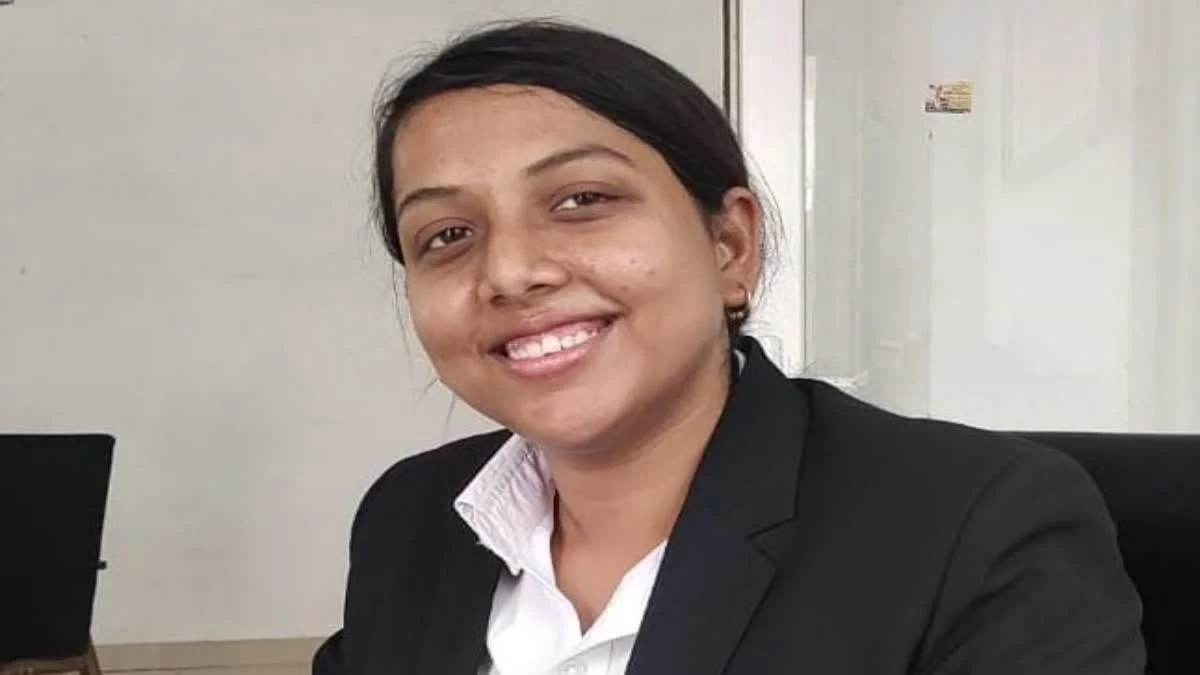
In a story of determination, faith and steady hard work, Anjum Ara from Prayagraj in Uttar Pradesh has secured first rank in the Chhattisgarh Provincial Judicial Service Examination, becoming a judge and bringing pride to her home state. Her success has been widely celebrated in Prayagraj, where neighbours and well-wishers described her achievement as a moment of honour for the city.

Anjum, who comes from an educated Muslim family, said her journey was shaped by a personal loss that changed the direction of her life. Her uncle, whom she lovingly called Bade Abu, served as an Additional District Judge. His death left a deep impact on her and inspired her to choose the path of judicial service. “I used to call him Bade Abu,” Anjum recalled. “After he passed away, I made up my mind that I would become a judge like him and serve society.”

She completed her early schooling at Central Academy in Jhunsi town in Prayagraj District before pursuing her BA and LLB from the University of Allahabad. Reflecting on her university years, Anjum said the Law Faculty played a major role in shaping her approach towards legal studies. “The Law Faculty taught me to understand the law, not just memorise it,” she said. “Our professors focused on practical learning. That helped me a lot in the judicial exams.” She added that because of the strong academic environment at the university, she did not feel the need to rely on costly coaching institutes. “If your basics are clear, you can prepare on your own,” she said.

Her father, Shamim Ahmed, works as an assistant manager at the State Bank of India, while her mother, Akhtari Begum, is a homemaker. Anjum described her parents as her biggest support system. She said her preparation was entirely self-driven and disciplined. “I studied five to six hours every day with full focus,” she explained. 

For the mains examination, she focused strongly on judgment writing. She regularly practised answer writing and carefully studied judgments delivered by local courts in Chhattisgarh to understand how decisions are framed. “I practised writing answers regularly. I also studied judgments from local courts in Chhattisgarh to understand how decisions are structured,” she said. She also credited her habit of reading newspapers daily for helping her during the interview stage. “Current affairs helped me respond confidently,” she added.

At home, her family ensured that her studies were never disturbed. “They made sure there was no noise while I studied. They always encouraged me, especially when I failed in the Rajasthan and Delhi judicial exams,” Anjum said. Her father said the family never allowed disappointment to take over. “We always believed in her ability. Failure is part of life. We told her not to lose hope,” he said. Her mother added, “She worked very hard day and night. We only tried to give her a calm environment.”

Before achieving success in Chhattisgarh, Anjum faced setbacks in other states. She admitted that those failures were painful but also important lessons. “Failures taught me where I was lacking,” she said. “Instead of getting upset, I improved my answer writing and strengthened my understanding of the law.” Her perseverance paid off when the results were declared and she secured the top rank in the state.

Residents in Prayagraj expressed pride in her achievement. A neighbour said, “This is a proud moment for the entire area. She has shown that with hard work, anything is possible.” A former teacher from the University of Allahabad said, “Anjum was always sincere and focused. Her success proves that strong academic grounding and discipline make a real difference.”

Now appointed as a judge, Anjum says her goal is to carry out her duties with honesty and integrity. “I want to fulfil my responsibilities towards society through the judiciary with sensitivity,” she said. “Justice should be fair and humane.” Her achievement is being seen as an inspiration, particularly for young women from minority communities who dream of entering the judiciary.

Anjum also shared advice for aspirants preparing for judicial services. She urged students to build a strong grasp of the basic language of law. She advised regular answer writing practice for the mains examination and stressed the importance of understanding how court judgments are read and written. She encouraged students to maintain a routine of five to six hours of focused study daily and not to lose heart in the face of failure. “There is no easy way,” she said. “You have to stay focused and believe in yourself.”

From the classrooms of Prayagraj to securing the top rank in Chhattisgarh, Anjum Ara’s journey reflects discipline, patience and family support. As she prepares to take her place on the bench, many young aspirants now look to her story as proof that steady effort and belief in one’s goal can turn a dream into reality.

source: http://www.clarionindia.net / Clarion India / Home> Editor’s Pick> Indian Muslims / by Mohammad Bin Ismail / February 23rd, 2026

A doughty warrior builds a mosque for women

Lucknow, UTTAR PRADESH :

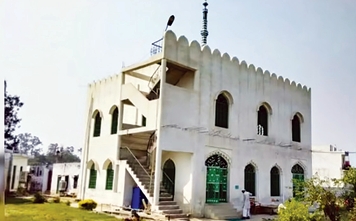
Mosques in Hindi heartland states are an exclusive male preserve. Though Islam doesn’t barentry of women into mosques, they are scrupulously kept away from the holy precincts all across north India. But Amber Mosque in the outskirts of Lucknow challenges this shibboleth. It was founded and built by Ms. Shaista Ambar, a social activist from Lucknow who wouldn’t take such taboos lying down.

Wife of a bureaucrat in Uttar Pradesh, Shaista conceived the idea of a mosque where women could also offer namaz alongside men, in 1995. As a young woman, Shaista would take up social causes during the 1980s and 90s. Construction of a mosque was certainly not on her mental screen. But the rebel in her got awakened when she took a child inside a mosque to introduce him to the collective prayers.

For the imam the sight of woman inside the mosque was no less than a sacrilege. She was ordered out. The outrageous behaviour left a deep imprint on her. Beating a hasty retreat, she vowed to build a mosque where both men and women could pray. She drove straight to Nadwatul Uloom, the world famous centre of Islamic learning in Lucknow seeking an audience with Maulana Ali Miyan, the 7th Chancellor of the seminary and a world re nowned scholar of Islam.

The revered Maulana signalled her to go ahead pledging his full support. Pouring the family’s savings, a 26,000 square feet plot of land was bought in Teli Bagh, 15 kms away from the city centre on the road going to Rae Bareli. She sold away her car and ornaments to raise the required funds. The move gathered support from wider circle of relatives and acquaintances.

Lo and behold! The mosque came up opposite the trauma care centre of the Sanjay Gandhi Post Graduate Institute of Medical Sciences. And it was none other than Maulana Ali Miyan Nadwi who presided over the consecration of the mosque in 1999. (He passed away on December 31, 1999). The mosque can host a congregation of over a thousand persons on a Friday when doughty Shaista Amber ensures her weekly presence.

She presides over the committee taking care of the mosque as the chief mutawalli with several other members of the family. She has resolutely stood against traditional maulvis taking over the management of the mosque. There have been pleas to start a madrassa (Islamic theological school) within the precincts.

She has declined permission and has instead started a dharamshala (stay-homes for wayfarers) within the boundary of the mosque where women attendants of inmates at the Sanjay Gandhi Institute find accommodation at a very reasonable rent. And they could belong to any faith. She says Uttar Pradesh has several thousands of madrassas but no dharamshalas and other such key civic facilities set up by Muslims.

The mosque is open for namaz to Sunnis as well as Shias, the major sects within Muslims. The mosque also runs a counselling centre where family disputes, mainly post-marital, are referred for resolution. Shaista has had differences with the All India Muslim Personal Law Board on several issues pertaining to women’s rights in Islam.

Critical about the rigidity on its outmoded stances, she and several of her supporters set up the All India Muslim Women Personal Law Board nearly a decade ago. The Board has appreciated the law banning the practice of triple talaq at one sitting and has suggested several progressive reforms. One who completed her graduation from the Aligarh Muslim University and later acquired Adib and Kamil certificates, Shaista has willed that her two daughters and son would look after the management of the mosque after her passing away.

Shaista came visiting Bengaluru last May at the invitation of the Azim Premji University for a seminar where this author had a chance meeting as a participant. Log onto www.shaista ambar.com for an overview of her vision and activities. 

source: http://www.newstrailindia.com / News Trail / Home / by M A Siraj / October 19th, 2025

Celebrating Unsung Heroes: Indian Muslim Changemakers

INDIA :

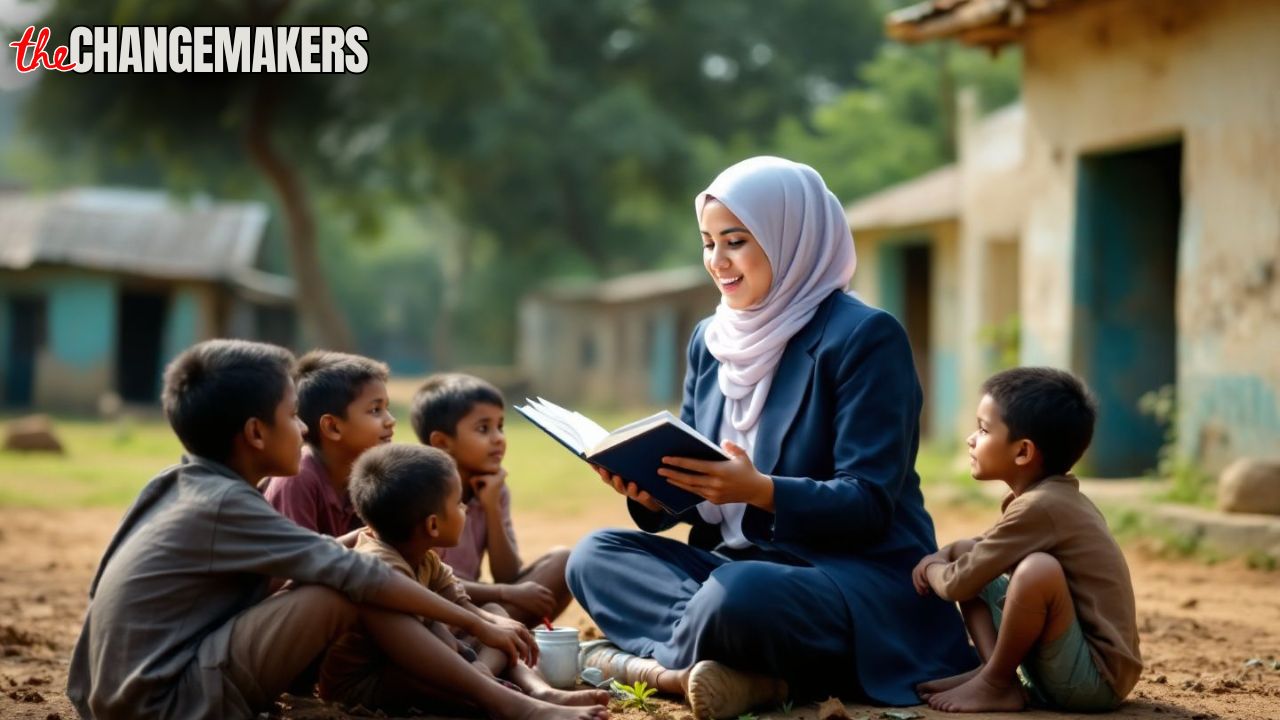
AI generated image

Amid our fast-paced lives, there exists a remarkable group of individuals who believe in slow, steady, and consistent efforts to create meaningful change.

These individuals are known as changemakers—people who quietly dedicate themselves to bettering society, far from the spotlight and the noise of daily routine.

They don’t seek fame or recognition. Instead, they focus on making a positive impact in their communities. Often unheard of, these changemakers influence others through their actions, values, and vision for a better world.

Awaz–The Voice is proud to launch a special series starting this Sunday, spotlighting Indian Muslim changemakers of India.

Through their inspiring stories, we aim to shine a light on individuals whose work exemplifies compassion, dedication, and innovation.

Our editorial team has carefully selected these changemakers based on several parameters, including the authenticity of their efforts and the tangible impact they have made.

These are everyday heroes who are addressing pressing social, environmental, and economic challenges—often with limited resources but unwavering commitment.

They are improving access to education, healthcare, and sanitation; they are empowering women, protecting the environment, and uplifting their communities—all without expecting any rewards or recognition. For them, the satisfaction of doing good is reward enough.

Their actions may seem small, but their impact is profound. As the saying goes, “Every drop counts in making an ocean.” Each changemaker is a vital part of the wave of progress that is quietly transforming India.

One of our key criteria in identifying these individuals was whether they are creating tangible change or inspiring others to become changemakers themselves. For us, a changemaker is someone who brings positivity into the world through innovative solutions, leadership, and a commitment to improving lives and systems.

In a world that often celebrates loud success, we believe it’s important to pause and acknowledge those who uphold the highest ideals of humanity. These changemakers serve as a moral compass, reminding us of our own responsibilities to society and to one another.

We begin our series with changemakers from Uttar Pradesh, featuring stories like that of Capt. Saria Abbasi, who dreamt of joining the Indian Armed Forces from a young age. After earning her engineering degree and receiving multiple job offers, she chose instead to follow her dream and joined the Indian Army—becoming a role model for countless Muslim women aspiring to serve the nation. She has done challenging missions like serving at Indo-China border post at Tawang in October 2021.

Rubina Rashid Ali, who lives in Aligarh Muslim University’s campus has become a champion for women earning their livelihood out of applique (ornamental needlework in which pieces of fabric are sewn or stuck). She has stood up for them to ensure that these women from poor backgrounds get the wages they deserve.

The changemakers of India

Dr Farha Usmani, a medical practitioner who hails from Aligarh, went to US to pursue her career in the United Nations Population Fund in 2007. Leaving behind her family was a tough call for her. She is the only Muslim woman to have risen to the position of director in the UNFPA. Today, she is making world policies for women’s health and rights. She is the Vice President of SAFAR, an organization that is responsible for the overall advancement and rights of minority and marginalized women and girls in India. 

Another inspiring figure is Babban Mian, a businessman who runs a large gaushala (cow shelter) in Bulandshahar, caring for hundreds of cows. Inspired by his late mother’s deep affection for animals, Babban Mian’s work also challenges stereotypes and promotes harmony by offering a different perspective on the Muslim community’s relationship with animal care.

Some of the changemakers will remind you of characters straight from Indian folklore and vernacular literature. People who have been nurtured by Indian civilizational values of compassion and selflessness.

Through these stories and many more, we hope to inspire our readers and celebrate the quiet revolution being led by changemakers who are shaping a better, more inclusive India.

We’d love to hear your thoughts on this series. Write to us at input@awazthevoice.in or engage with us on our social media platforms.

The author is the Editor-in-Chief of Awaz-the Voice portal

source: http://www.awazthevoice.in / Awaz, The Voice / Home> Stories / by Atir Khan, Editor-in-Chief, Awaz-the Voice portal / May 22nd, 2025

For the first time, AMU student union poll sees three women win

Aligarh, UTTAR PRADESH :

For the first time in the history of Aligarh Muslim University Student politics, three women have won the student union elections. Ghazala Ahmad, Sadaf Rasool and Labiba Sherwani all contested the polls for the first time and all three won posts of cabinet members in the AMUSU.

The results of AMUSU elections sent a positive message about gender equality in an university that had gotten bad press for restricting library access for undergraduate women students.

Ms. Ahmad is final year student of Bachelors of Social Work, Ms. Rasool is in the final year of B.U.M.S. and Ms. Sherwani is in her first year of Bachelors of Social Work.

In 2015, one female student had won the union elections. But this is the first time in the history of AMU that three women have won the polls in their maiden attempt.

Kehkashan Khanam, a student of Ph. D. in Theology had won the post of cabinet in the last AMU student union elections. Ms. Khanam had contested this time for the post of vice-president in the AMUSU.

While talking to The Hindu on phone from Aligarh, Ghazala Ahmad said she held the victory of three girls in their first attempt to be a “sign that students of AMU want to see more girls presence and participation in overall student politics”.

When asked how she convinced a male-dominated electorate to vote for her, Ms. Ahmad said, “I told everybody on the campus that time has come to change outsiders’ perception of AMU. I told them, lets show the outside world that AMU campus is friendly and open to girls.”

The twenty-one-year old Ms. Ahmad said her inspiration was her working mother Nahid Fatima, Principal of a Government Primary School in Aligarh.

The job of a cabinet member is to ensure that the problems faced by the students at the departmental and faculty level, should be conveyed and taken up with the president, vice-president and secretary of the AMUSU. “It is a male-dominated campus but the results show that students on the campus want to more participation from girls. After all girls are also there on campus. Who will represent them. It was a tough competition so I had to work really very hard,” said Ms. Ahmad.

source: http://www.thehindu.com / The Hindu / Home> News> India> Other States / by The Hindu / November 01st, 2016

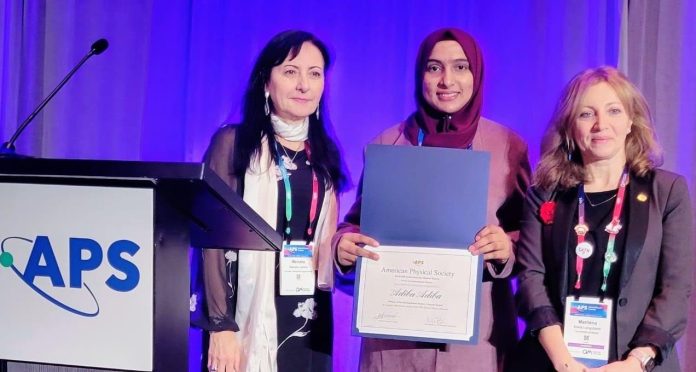
AMU PhD Scholar Adiba Receives Prestigious American Physical Society (APS) Distinguished Student Award

Aligarh, UTTAR PRADESH :

Adiba receiving the Prestigious APS Distinguished Student Award

Aligarh:

Adiba, a PhD student in Physics at Aligarh Muslim University (AMU), has been honoured with the Distinguished Student Award by the American Physical Society (APS) at the APS March Meeting 2025 in Anaheim, California.

Instituted in 2015, the award recognises exceptional early-career researchers from outside the U.S. and supports their participation in APS’s flagship meetings.

Adiba, working under the supervision of Prof Tufail Ahmad, is conducting cutting-edge research on Resistive Random Access Memory (ReRAM) devices for neuromorphic computing – an emerging frontier in physics and artificial intelligence. Her work earned her the prestigious award for outstanding contributions to the field.

Beyond research, she leads as President of the International Centre for Muslim Women in Sciences (ICMWS), championing science education among young women.

Expressing her gratitude to AMU for its role in her success, Adiba said, “Receiving this recognition from APS makes me feel incredibly proud and motivates me to strive even harder.”

source: http://www.radiancenews.com / Radiance News / Home> Latest News> Research> Science & Technology / by Radiance News Bureau / April 08th, 2025

Collective efforts lead to the betterment of the nation: Farooq Siddiqui

UTTAR PRADESH :

Lucknow :

The Uttar Pradesh Chapter of the Association of Muslim Professionals (AMP) organized an ceremony at Hotel Arif Castle for the recipients of the 4th National Awards for Social Excellence and the 8th National Awards for Excellence in Education from Uttar Pradesh.

Among special guests were senior gastro surgeon Dr. Waliullah Siddiqui from Apollo Hospital and Mirza Mubeen Baig from Gautam Budh Nagar. Distinguished educationist and career counsellor Dr. Amrita Das was to attend as the chief guest but could not participate due to health issues, so former senior bureaucrat Zahra Chatterjee filled the role.

The programme began with a recitation from the Holy Quran by Maulana Muhammad Rehan Qasmi.

The welcome address was delivered by AMP’s Zonal Head for Central Zone, Syed Shoaib. AMP’s State Head, Shaheen Islam, introduced the audience to AMP’s objectives and activities, mentioning that this non-governmental, non-political, and non-profit organization was founded in 2007. Over the years, AMP has been engaged in educational, social, economic, and developmental activities aimed at empowering marginalized communities.

Guest of honour Mirza Mubeen Baig emphasized that working for NGOs is becoming increasingly challenging, and only those organizations that serve selflessly and with sincerity will succeed. He stressed the need for collaboration among serious NGOs to benefit from each other’s experiences.

Dr. Waliullah Siddiqui congratulated the awardees for their contributions to education and social services, highlighting that the responsibility for educating and nurturing children lies with both parents and teachers. In today’s changing times, this responsibility has grown even more significant. He shared personal lessons from his life, crediting his parents for playing a central role in his achievements.

Speaking as the chief guest, retired IAS officer Zahra Chatterjee praised AMP’s work and said that every individual’s contribution is crucial for the nation’s development. She stressed the need to reach out to the last individual to ensure educational awareness and economic stability.

Farooq Siddiqui, Head of AMP’s National Coordination Team, addressed the audience, stating that these awards aim to encourage individuals and organizations committed to transforming the nation through their selfless services. He emphasized the importance of collective efforts and mutual cooperation, noting that the welfare of the country and nation lies in unity and partnership.

The vote of thanks was delivered by Mohammad Mohiuddin, Chapter Head of AMP Lucknow, and the event was hosted by Dr. Sumbul Shakeel.

The recipients of the National Awards for Social Excellence included the Best NGO awardees:

Tauheedul Muslimeen Trust, Institute of Social Harmony and Upliftment.

Among the Change Maker Awardees were:

Professor Dr. Nuzhat Hussain from Lucknow, Dr. Mohammad Mubashir, Sabiha Ahmed, Balbir Singh Maan, Dr. Kaleem Ahmed Khan from Kanpur, Dr. Saba Yunus, Shahid Kamran Khan, Sagheer Khaksar from Balrampur, Dr. Saleem Mohammad Khan and Naseem Ahmed Khan from Aligarh, and Ramesh Chandra Srivastava from Ayodhya.

The recipients of the National Awards for Excellence in Education included:

Professor Mirza Mohammad Sufiyan Baig, Professor Naseem Ahmed Khan, Ausaf Azeem Kirmani from Aligarh, Mohammad Shahid Khan, Dr. Mohammad Shamim, Samiullah Ansari from Kanpur, Chitra Maheshwari from Lucknow, Dr. Roohi, and Maulana Mohammad Rehan Qasmi.

Lifetime Achievement Awardees included senior teacher Sheila Lawrence from Lucknow and Jamaluddin Khan from Kanpur.

A large number of attendees were present at the event, including Dr. Anis Ansari (former IAS), Mohammad Khalid Ashu, Mujtaba Khan, Najm-ul-Hasan Rizvi Najmi, Dr. Uzma Mubashir, Syed Abrar, Rizwan Ansari, Mohammad Zeeshan, Mohammad Imran, Javed Akbar Khan Lodi, Shahenshah Ansari, Fahad Mahmood, Ayesha Mahmood, Alma Siddiqui, Ayesha Alvi, Zaheer Baig, and Aqib Rauf.

source: http://www.indiatomorrow.net / India Tomorrow / Home> Education / by India Tomorrow / September 03rd, 2024