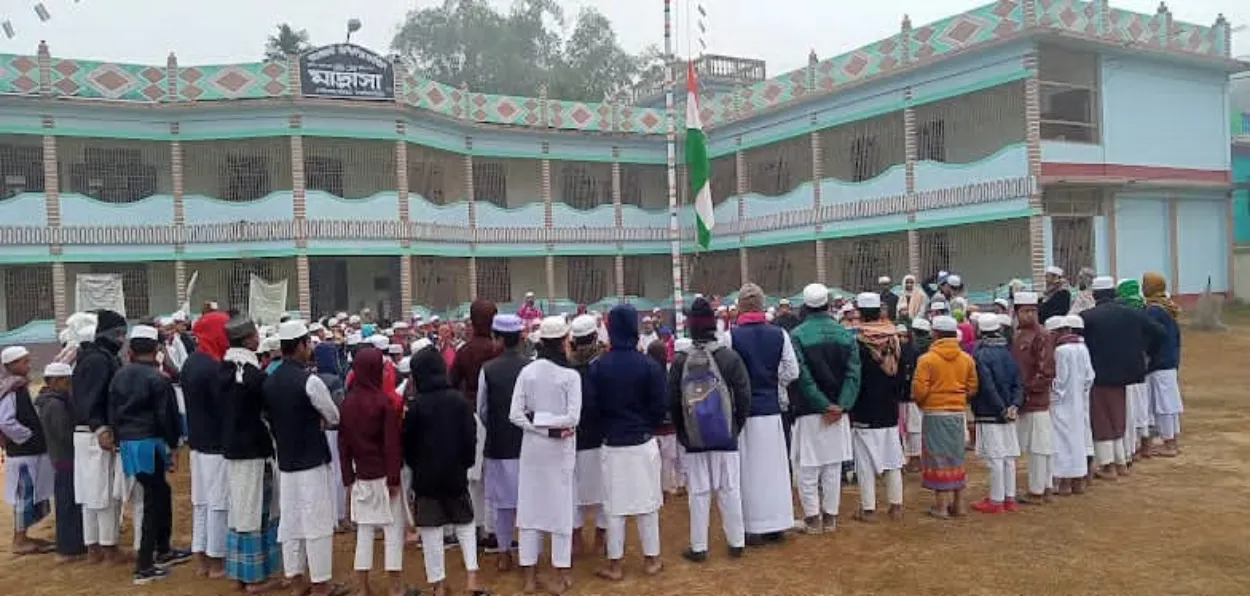
Mohammad Abdullah Zakaria among students in the Madrasa on the Independence Day
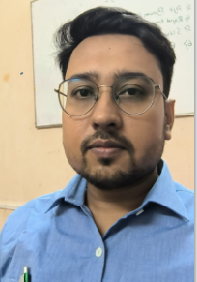
Mohammad Abdullah Zakaria, who received his education from Daudarani Siddikia High School, a small village in Sonamura of Sipahijala district of Tripura, has recently cleared the General Duty Medical Officer examination conducted by the Tripura Public Service Commission.
His success again defies the notion that Madrasa education is not relevant to modern times.
Abdullah Zakaria studied in a Madrasa when such institutions were associated only with religious education.
Zakaria, 37, scored 68.8 out of 100 in the TPSC examination and made it to the top 30 in the list of successful candidates.
Zakaria’s father, Nurul Islam, is an Arabic language teacher, and his mother always supported him and is an inspiration to him.
Abdullah received his primary and secondary education in a madrasa and later studied science in a common school. He cleared the tough entrance examination and joined the MBBS course at Tripura Medical College in 2018.
According to Zakaria, the quality of education in government madrassas of Tripura is no less than that of any government school. He received a good education in general subjects along with the Quran, Hadith, and Arabic.
He says Madrasa education not only imparts religious knowledge to students but also helps in character building and social etiquette.
He said, “Patriotism should not be limited to waving the national flag; it must be practiced with one serving the country and working for the welfare of the society.”
Abdullah Zakaria has three siblings. His elder sister is a junior engineer, and his younger sister is also pursuing MBBS from a medical college.
Zakaria is preparing to write another difficult examination to join the MD (Doctor of Medicine) program to become a paediatrician.
Mohammad Abdullah Zakaria’s success is a tribute to the government-affiliated Madrasa education system of Tripura.
source: http://www.awazthevoice.in / Awaz, The Voice / Home / by Nurul Haque, Agartala / August 31st, 2025
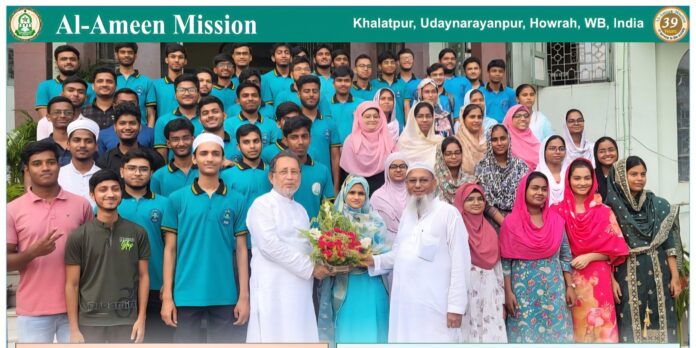
M. Nurul Islam with some of the future doctors at Al Ameen Mission Khalatpur campus
M. Nurul Islam is a proud man as 472 students of Al Ameen Mission have qualified for free medical seats in government medical colleges across West Bengal through NEET (UG) 2025.
Muslims remain one of the most disadvantaged communities in India. In West Bengal—among the more underdeveloped states—their educational and socio-economic struggles are even more pronounced. Districts like Murshidabad and Malda, with significant Muslim populations, rank among the most backward in the country.
When the NEET results were announced, 154 students from Murshidabad and 77 from Malda scored above 500 marks, making them eligible for free medical education in the state’s government colleges.
What stands out is the socio-economic background of these students. Of the 472 successful candidates, 278 (59%) come from modest backgrounds: 194 (41%) belong to middle and upper-middle-income families, 152 (32%) to lower-middle-income groups, and 126 (27%) are from poor and Below Poverty Line (BPL) families.
The success of these students reflects not only academic excellence but also the transformative impact of Al Ameen Mission in empowering underprivileged communities through education.
“This year’s exam was comparatively tougher than in previous years, but by the grace of Allah, our students performed even better,” said M. Nurul Islam, founder general secretary of Al Ameen Mission, while speaking to Muslim Mirror.
Nurul Islam, the visionary general secretary of Al-Ameen Mission—often referred to as the Sir Syed of West Bengal—is widely recognized among the 100 most influential Indian Muslims. He pioneered an educational movement aimed at uplifting underprivileged Muslim students in West Bengal, significantly increasing their representation in medical colleges, even exceeding their population proportion in the state.
Born in 1959 in the small village of Khalatpur in Howrah district, Nurul Islam came from a humble background. His passion for education and community service became the foundation of a lifelong mission. In 1986, while he was a student, he started a hostel with just seven students inside the madrasa building. This initiative was sustained by a grassroots campaign—collecting a fistful of rice from every household in the village. In January 1987, this effort took shape as Al-Ameen Mission.
Today, the Mission has 77 branches across 23 districts of West Bengal, housing nearly 23,000 residential students. Over 49,000 students have passed from Al Ameen Mission, which follows the WBBSE, WBHSE, and CBSE curricula. In 2015, the West Bengal government honored M Nurul Islam with the Banga Bhushan Award for its contributions to education.
The Mission also engages in charitable work, offering financial aid and scholarships to unemployed Muslims. Under Nurul Islam’s leadership, it has become a beacon of holistic education, blending academic excellence with Islamic ethical values. The institution has produced hundreds of successful NEET and JEE candidates, changing the lives of many.
Nurul Islam’s resolute commitment to education and empowerment continues to inspire generations, reshaping the future of Muslim youth in Bengal and beyond.
source: http://www.muslimmirror.com / Muslim Mirro / Home> Education> Indian Muslim> Positive Story / by Jasmine Nehar / June 25th, 2025
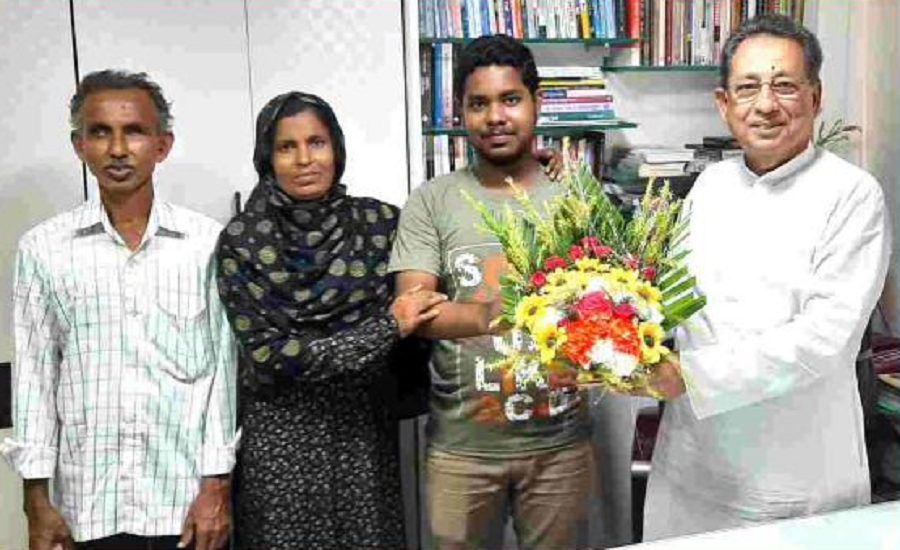
Nurul Islam, general secretary of Al-Ameen Mission (right), with a successful student and his parents.
SPECIAL REPORT
With 63 residential campuses in 20 of the 23 districts of West Bengal, Al-Ameen Mission is mentoring 17,000 students; so far it has produced 3,000 doctors, 2,800 engineers and hosts of civil servants, professors and lawyers.
A SILENT revolution in education is taking place in West Bengal which the rest of India may not be aware of. What is significant about this revolution is that it is happening in the marginalised section of Muslims.
The Al-Ameen Mission, a Howrah-based charitable organisation, has been spearheading a movement for over three decades to educate those who can’t afford quality education. Its success graph is increasing each year. This year, 378 students mentored by Al-Ameen have been selected for medical education (310 for MBBS and 68 for BDS).
This figure is after the first round of counselling held on July 16, 2020, when Clarion India interviewed Nurul Islam, the founder general secretary of the organisation. He is expecting another 100 students to be selected in subsequent rounds of counselling.
A total of 516 students of Al-Ameen have cleared NEET, an all-India written test for admission to medical colleges. Out of that, 378 have already been selected. This is no mean achievement considering the fact that two-thirds of them come from a background where becoming a medical doctor is just unthinkable.
Al-Ameen has been achieving this success year after year. In 2019, its 407 students secured admission in medical colleges for MBBS and BDS education. As many as 370 students were successful in 2018; 115 in 2017; 393 in 2016; 223 in 2015; and 212 in 2014.
Al-Ameen mentors both boys and girls. Thirty per cent of its students come from families who are very poor and categorised by the government as below poverty line. Forty percent are from lower middle income groups. The rest belong to the middle and upper middle income group. That means 70 per cent students enrolled here come from poor families.
Al-Ameen’s journey started in 1986-87 with only seven students. The aim was to give modern education with moral values in a full residential system where students from all strata of society, irrespective of their economic conditions, would stay and learn together. Students coming from the poorest sections of society were given free education. Donations and zakat were collected to meet up with the expenses. Gradually, the name of the mission spread far and wide and people came along and a movement started.
Nurul Islam says that in the 80s when he started his mission, the percentage of Muslim students in medical and engineering colleges of West Bengal was hardly two to three per cent. “But because of Al-Ameen’s efforts that percentage is today between 20 and 30 percent,” he claims.
Admission criteria
The current strength of Al-Ameen is 17,000 students. It admits students from Class V to XII. Those preparing for competitive exams also stay here beyond 12th. Merit is given top priority for admission. A common admission test is conducted for all its branches at 63 residential campuses in 20 of the 23 districts of West Bengal. Those who qualify are called for an objective test followed by interviews of their guardians.
A substantial number of seats are reserved for orphans and meritorious students of very poor families. They are also given special financial aid. In 2019, about 32,000 students appeared for admission tests to classes V to XII. Nurul Islam says his institution is able to accommodate only up to 20 per cent applicants.
Residential facility
Al-Ameen is essentially a residential institution. Those selected are required to stay in one of the 63 campuses that it runs throughout West Bengal. They are taken care of by everything: from education to food to accommodation. A strict discipline is followed by everyone alike from students to teachers to general staff.
Howrah, where it is headquartered, has four campuses in which 3,000 students are living. Al-Ameen also has campuses outside West Bengal: One in Patna, one in Ranchi and one in Tripura. There is one more in Assam which temporarily is not functional.
Scholarship scheme
Fees of the students are determined as per financial capacities of their families. Being a charitable organisation, Al-Ameen gives 100 per cent subsidy in the fees and even takes other responsibilities of education and upbringing of a deserving student if deemed fit. At present, Al-Ameen’s fee structure is divided into three categories:
25 per cent students pay zero to 25 per cent fee. Their subsidy is funded by zakat from across the country;
40 per cent pay fee ranging from 26 percent to 60 per cent. This subsidy is funded through general donations of the public;
35 per cent pay between 61 per cent and 100 per cent.
Focus on school education
Besides preparing students for medical and engineering, Al-Ameen is also focused on basic education of students under its guardianship. This year, 2,223 of its male and female students appeared for Class XII exams of states as well as Central boards. Not only all succeeded, 81 of them even occupied their positions within the rank of 20.
The background of all the successful candidates is noticeable: 605, or 27 per cent, are from poor and BPL families; 775, or 35 percent, from lower middle income groups; and 843, or 38 per cent from middle and upper middle income groups.
Similarly, 1,777 boys and girls took exams for Class 10. Fifteen of them occupied their positions within the rank of 20. Their background: 627, or 35 per cent, come from poor and BPL families; 680, 38 percent, from lower middle income groups; and 470, or 27 per cent, from middle and upper middle income groups.
23,000 Alumni
During the last 34 years of its existence, Al-Ameen has developed a strong base of alumni. They number 23,000, according to Nurul Islam. Out of that, 3,000 are doctors and 2,800 engineers. The rest are in various other fields such as civil services, academia, law and media.
The boys and girls hailing from the most backward areas and lowest strata of society, he says, are now dreaming to become doctors, engineers, civil servants, teachers, professors, researchers, lawyers or journalists.
Nurul Islam calls it a “Silent revolution”.
“Silently, a revolution is taking place. Al-Ameen has become the conduit in this whole churning of transformation which may be defined as a silent revolution,” he says.
A look at the list of Al-Ameen alumni bears testimony to what Nurul Islam is claiming. The list includes successful professionals and academicians in prestigious institutions. What is heartening is their background. Most of them belong to economically poor sections of society. But for this educational movement, they would have remained poor and uneducated. But today, they are respectable members of society and source of inspiration for others.
Some of the notable alumni are listed below:
Md Arif Shaikh, Senior Research Fellow at Harish Chandra Research Institute, Prayagraj, UP.
Dr Safina Begum, MS, Senior Resident at Fort Gloster State General Hospital, Howrah, West Bengal.
Dr Nargis Molla, MS, Specialist Medical Officer (Gynaecology), Dhaniakhali Rural Hospital, West Bengal.
Magfura Parvin, Senior Research Fellow, Vidyasagar University, Midnapur, West Bengal.
Dr Sk Altaf Hossien, MD, DNB Post-Doctoral Fellow, National Institute of Mental Health and Neurosciences (NIMHANS), Bangalore.
Dr Khandekar Fariduddin, MS, Assistant Professor, Malda Medical College and Hospital, Malda, West Bengal.
Dr Hibjul Ali Khan, MS, Assistant Professor, College of Medicine & Sagore Dutta Hospital.
Dr Md Hadiuzzaman, MS, MCH Senior Resident, SSKM Hospital.
Akram Hoque, MBA, Founder Editor, The Policy Times.
Ali Ahmed Alamgir, WBCS, Assistant Labour Commissioner.
Jahangir Mollick, WBCS (Exe), Deputy Magistrate and Deputy Collector, West Bengal.
Shayan Ahmad, WBPS, Deputy Superintendent of Police, West Bengal.
Sk Samsuddin, WBPS, Deputy Superintendent of Police, West Bengal
Ramjan Ali, WBCS, Assistant Commissioner of Revenue, West Bengal.
Dr Kader Ali Sarkar, Assistant Professor, Visva-Bharati University, Santiniketan, West Bengal.
Dr Mukandar Sekh, Assistant Professor, Aliah University, Kolkata.
Md Golam Mortoza, Chartered Accountant, Senior Executive (Finance), Management Development Institute, Murshidabad, West Bengal.
Dr Md Samim Reja, MVSc, Veterinary Officer, Domjur Block, Howrah, West Bengal.
Healthcare unit in Khalatpur
Recently, Al-Ameen has opened a healthcare facility at its main campus of Khalatpur in Howrah district. It is run mainly by its alumni, some of whom are today established medical practitioners. They regularly visit the healthcare unit and give their services to poor and needy people of the locality.
source: http://www.clarionindia.net / Clarion India / Home> Big Story – Special Report / by Shaheen Nazar – Clarion India / November 23rd, 2020
Educational Excellence Celebrated at AFMI’s Silver Jubilee Convention in Delhi
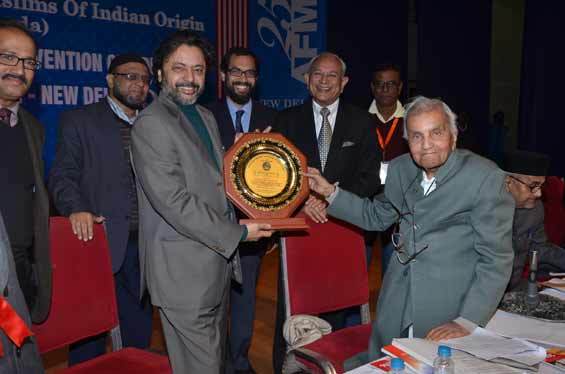
American Federation of Muslims of Indian Origin’s Silver Jubilee convention held at the Kedar Nath Sahani Auditorium in New Delhi Dec.31-Jan.1st celebrated the accomplishments and marked a milestone in the organization’s history. The convention was held in co-ordination with the Delhi Youth Welfare Association.
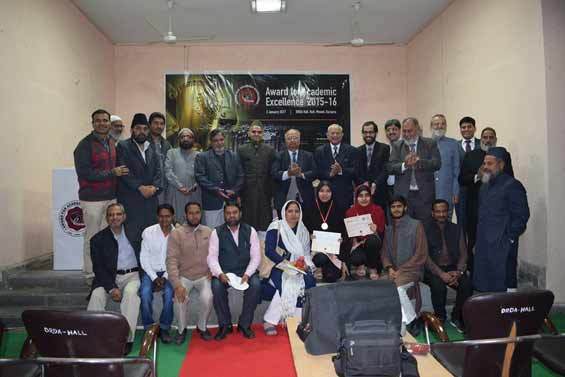
More than 120 Muslim students from across India were awarded with gold, silver, and bronze for attaining meritorious distinction in the board exams. In addition, the prestigious Sir Syed Ahmed Khan Award conferred about leading Mumbai philanthropist Dr. Abdul Kader Fazlani Sopariwala. The Mir Taqi Mir Award was given to Mr. Sanjiv Saraf, founder of the popular web portal www.rekhta.org, for his contributions in promoting the Urdu language. The website now features more than 22,000 titles of Urdu books. Excellence Awards were given to former Chief Electoral Commissioner S.Y.Quraishi and the historic Anglo Arabic Senior Secondary School.
Sanjiv Saraf accepting his award from Justice Sachar
In a first for AFMI convention all the medallists were interviewed by Dr. Fazlani’s philanthropic organization and scholarships worth Rs.4 crore were pledged.
Awards to top students were given at the hands of Delhi Deputy Chief Minister Manish Sisodia. He praised the work of AFMI and that more such efforts need to be undertaken to uplift the society. He mentioned that education remains the top priority of the Delhi government with as much as 25% of the state government’s budget dedicated to it.
AFMI’s flagship awards program has been instrumental in spreading awareness about educational excellence and empowerment across the country. Dr.A.R. Nakadar, AFMI’s founding trustee, said that the fruits sown by AFMI at its inception are now bearing fruit. He said that due to such efforts there has been a remarkable improvement in the educational scenario of Indian Muslims. Citing the latest census reports, published in Indian Express, he stated that there has been a 98.8% increase in the number of Muslim graduates between 2001 and 2011. During the same period the Indian Muslim literacy rate has increased from 59.1% to 68.5%. He said that the day is not too far when, through the collective efforts of all, AFMI’s dream of 100% literacy will be realized.
Dr. Nakadar urged the students to not to rest on the laurels but to use the award as a motivational tool to attain even grater heights of educational excellence. He also asked them to not to forget those who have been left behind and to spread the message of educational empowerment everywhere.
AFMI’s incoming president Dr. Khutb Uddin, a practicing psychiatrist from Indiana, in his remarks applauded the students for their hard work. He urged them to not to be distracted by negative thoughts and to focus on their education. He also pointed out that everyone from the individual to the government should be involved in raising the quality of education in the country and that it should be everyone’s top most priority.
The inaugural session of the convention was addressed by Justice Rajinder Sachar, Mr. Anil Swarup, Secretary Education & Literacy (Government of India), Mr. Naseem Ahmad, Chairman of National Commission for Minorities, and convention chairman Mr. Mohammad Naeem, president of Delhi Youth Welfare Association. The session was ably moderated by AFMI Trustee and leading scholar Dr. Aslam Abdullah.
The convention was also addressed by Prof. Akhtarul Wasey (Vice Chancellor of Maulana Azad University, Jodhpur); Mr.Siraj Hussain, IAS, former VC Jamia Hamdard, Dr. S.Y.Qureshi (former Chief Election Commissioner), Justice Fakhruddin, Mr. Ali Quraishi (New Mexico), Mr. Tayeb Poonawala (New York), Mr. Siraj Thakore (Canada), Mr. Farhad Rahmani, Mr. Ayub Khan, Prof. Janaki Rajan, Dr. Shabistan Gaffar, Mr. Mohsin Siddiqui, Mr. Suhel Tirmizi (Editor, Gujarat Today), Dr. Husain Nagamia (Florida), Mr. Shafi Lokhandwala (Detroit), Mr. Khalil Ahmad, etc.
The convention also featured an AFMI Alumni session in which previous year’s medalists spoke on their experiences after winning the award. They also offered their guidance for the students in choosing their career pathways. Among those who addressed this session include Dr Nurul Islam (pediatric cardiologist), Mrs. Darakshan Khan (IT consultant), Dr. Suhail Qureshi (oncologist), Dr. Naseem Ahmed (Orthopaedic surgeon), Dr. Nabeel A.K., Ms. Samreen Siddiqui, Mr. Uzair Khan, among others.
In his closing remarks Dr. Nakadar thanked all the organizers and volunteers of Delhi Youth Welfare Association, under the leadership of Mr. Mohammad Naeem, for organizing a very memorable convention.
A seventeen member delegation of the American Federation of Muslims of Indian Origin, led by Dr. A.R.Nakadar, met the Vice President of India Mr. Hamid Ansari on January 2, 2017 and appraised him of AFMI’s activities. Mr. Ansari appreciated the efforts of AFMI and the concerns and care of NRIs for improving the quality of education in India.
An AFMI delegation met the Deputy Chief Minister of Delhi Mr. Manish Sisodia on January 3rd and discussed the current situation of education in Old Delhi.
AFMI’s Regional Awards Program in Mewat
AFMI held its regional awards program in Nuh, Mewat in coordination with the Human Welfare Foundation. One of the key organizers of the program is Uzair Khan, a former AFMI medalist, who is now carrying its message to the interiors of Mewat region. He is presently pursuing MBA from Jamia Millia Islamia.
Reviving Delhi’s Educational Institutions
AFMI’s NRI delegates visited a number of educational institutions in Old Delhi which have held aloft the banner of education among trying circumstances. The schools visited include Anglo Arabic Senior Secondary School, Mazhar ul Islam School, and the Fatehpuri School. AFMI’s governing board will soon formulate a a plan for help in the revival of these historic institutions.
source: http://www.milligazette.com / The Milli Gazette / Home> Online News> Education and Careers / January 23rd, 2017