Pakalpara Village (Murshidabad District), WEST BENGAL :
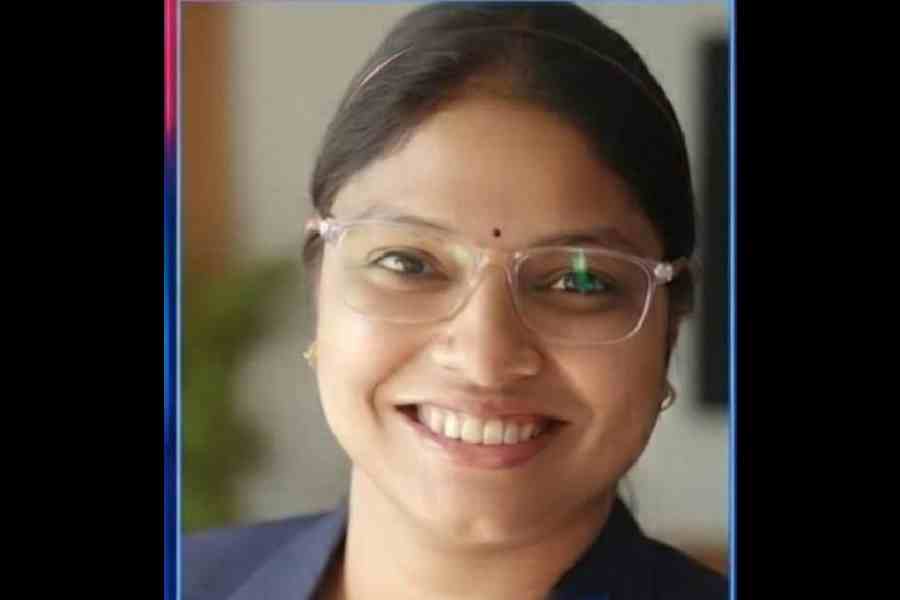
A resident of Pakalpara village, Sana secured an All-India Rank of 764 among 958 candidates recommended in the final list of the 2025 examination, making her eligible for the Indian Revenue Service and other Group-A central government services.
Sana Azmi, a 25-year-old Muslim woman from a modest farming family in Murshidabad’s Sagardighi, brought pride and joy to the region this month by qualifying in the prestigious Civil Services Examination conducted by the Union Public Service Commission (UPSC).
A resident of Pakalpara village, Sana secured an All-India Rank of 764 among 958 candidates recommended in the final list of the 2025 examination, making her eligible for the Indian Revenue Service and other Group-A central government services.
The results of the Civil Services Examination 2025 were declared on March 6.
Though the achievement has been widely celebrated in her village and across Murshidabad district, Sana is dissatisfied with her present rank and has already started preparations to attempt the exam again for a better rank that would enable her to become an Indian Administrative Service (IAS) officer.
The Civil Services Examination, conducted annually by the UPSC, is regarded as one of the toughest in the country with three stages — the preliminary, Main and the personality test/interview. Successful candidates are recommended for appointment to the country’s elite administrative services such as the Indian Foreign Service, Indian Administrative Service, Indian Police Service and Indian Revenue Service.
Born into a large family with limited means, Sana’s UPSC journey has been remarkable on many fronts. Youngest among 10 siblings, Sana grew up in a family focused on education.
That was largely because of her father, Maijuddin Sheikh. A poor farmer with a small patch of land, he had to discontinue his education after Class IX. But he struggled to ensure that all his children, including his seven daughters, received a proper education.
The results of that commitment are now visible.
Two of Sana’s sisters chose to study medicine — one of them, Beauty Khatun, is a doctor at the Burdwan Medical College and Hospital, while another sister is studying MBBS at the North Bengal Medical College and Hospital in Siliguri.
Sana’s success in the UPSC exam has added another feather to the family’s cap.
Sana began her schooling in her native village.
She studied up to Class VIII at Kabilpur High School in a neighbouring village. She later moved to a residential institution run by the Al-Amin Mission, where she completed her Class X and Class XII. She appeared for the Class XII board exams through a high madarsa in Howrah district and stood first in the district.
Then came the big leap.
Encouraged by her family and her own grades, she took admission to the Jamia Millia Islamia in New Delhi, where she graduated in English Honours and completed her MA as well.
During her time in Delhi, she also joined the university’s residential coaching academy for civil services aspirants, where she began a systematic preparation for the UPSC exam.
Remarkably, she cleared the Civil Services Examination in her very first attempt in 2025.
“I had strived hard to crack UPSC, and I thank my family members for their support. I am happy to have done it on my first attempt, but I would not have achieved it without the support of my sister Beauty Khatun. She sent me to Delhi to fulfil my dream. I will take up the job, but ultimately will try to fulfil my dream to become an IAS officer,” said a reclusive Sana, who spoke to the media through her elder brother Md Imran.
Beauty recalled how the family collectively nurtured Sana’s ambition.
“I became a doctor, and another of our sisters is studying MBBS,” she said.
“But we always felt that one of us should become a top civil servant. Sana had that dream. We encouraged her and planned her academic path accordingly. Her admission to Jamia Millia University in Delhi was also part of that plan,” she added.
As congratulations poured in, her mother, homemaker Fulbanu Bibi, couldn’t stop beaming.
“It is a dream come true,” Fulbanu said. “But Sana is not satisfied with the rank she has obtained. Her goal is to become an IAS officer. So she has begun her studies again.”
source: http://www.telegraphindia.com / The Telegraph / Home> West Bengal / by Alamgir Hossain / March 03rd, 2026
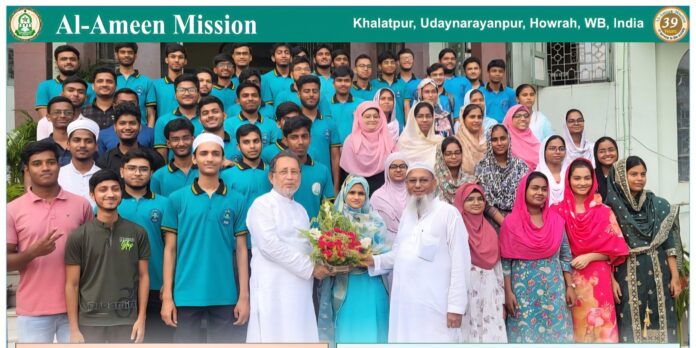
M. Nurul Islam with some of the future doctors at Al Ameen Mission Khalatpur campus
M. Nurul Islam is a proud man as 472 students of Al Ameen Mission have qualified for free medical seats in government medical colleges across West Bengal through NEET (UG) 2025.
Muslims remain one of the most disadvantaged communities in India. In West Bengal—among the more underdeveloped states—their educational and socio-economic struggles are even more pronounced. Districts like Murshidabad and Malda, with significant Muslim populations, rank among the most backward in the country.
When the NEET results were announced, 154 students from Murshidabad and 77 from Malda scored above 500 marks, making them eligible for free medical education in the state’s government colleges.
What stands out is the socio-economic background of these students. Of the 472 successful candidates, 278 (59%) come from modest backgrounds: 194 (41%) belong to middle and upper-middle-income families, 152 (32%) to lower-middle-income groups, and 126 (27%) are from poor and Below Poverty Line (BPL) families.
The success of these students reflects not only academic excellence but also the transformative impact of Al Ameen Mission in empowering underprivileged communities through education.
“This year’s exam was comparatively tougher than in previous years, but by the grace of Allah, our students performed even better,” said M. Nurul Islam, founder general secretary of Al Ameen Mission, while speaking to Muslim Mirror.
Nurul Islam, the visionary general secretary of Al-Ameen Mission—often referred to as the Sir Syed of West Bengal—is widely recognized among the 100 most influential Indian Muslims. He pioneered an educational movement aimed at uplifting underprivileged Muslim students in West Bengal, significantly increasing their representation in medical colleges, even exceeding their population proportion in the state.
Born in 1959 in the small village of Khalatpur in Howrah district, Nurul Islam came from a humble background. His passion for education and community service became the foundation of a lifelong mission. In 1986, while he was a student, he started a hostel with just seven students inside the madrasa building. This initiative was sustained by a grassroots campaign—collecting a fistful of rice from every household in the village. In January 1987, this effort took shape as Al-Ameen Mission.
Today, the Mission has 77 branches across 23 districts of West Bengal, housing nearly 23,000 residential students. Over 49,000 students have passed from Al Ameen Mission, which follows the WBBSE, WBHSE, and CBSE curricula. In 2015, the West Bengal government honored M Nurul Islam with the Banga Bhushan Award for its contributions to education.
The Mission also engages in charitable work, offering financial aid and scholarships to unemployed Muslims. Under Nurul Islam’s leadership, it has become a beacon of holistic education, blending academic excellence with Islamic ethical values. The institution has produced hundreds of successful NEET and JEE candidates, changing the lives of many.
Nurul Islam’s resolute commitment to education and empowerment continues to inspire generations, reshaping the future of Muslim youth in Bengal and beyond.
source: http://www.muslimmirror.com / Muslim Mirro / Home> Education> Indian Muslim> Positive Story / by Jasmine Nehar / June 25th, 2025
The award-winning Bengali author talks about his books, development of minority communities, Kolkata Book Fair, social media, and more.
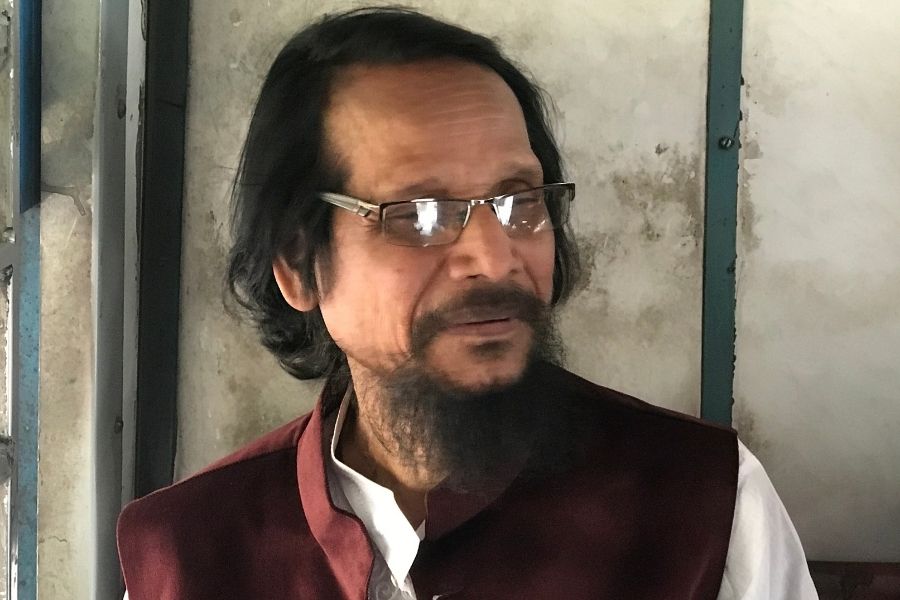
Abul Bashar — the author of ‘Agnibalaka’ and several other popular titles — is one of the prominent voices documenting the lives of minority communities in Bengal / Wikimedia Commons
Born in Murshidabad at a time when the zilla’s literacy rate was 12.9 per cent, it was an uphill battle for Abul Bashar to not just educate himself but also to live his dream of becoming an author.
With 40 books to his name, including popular titles such as Agnibalaka, Marusvarga, Jol, Mati, Aguner Upakkhayan, and Dharmer Grahon, Bashar has documented the lives and issues of minority communities and socio-religious matters through his works. A recipient of top honours such as the Ananda Puraskar and Banga Bhushan, he was awarded the Guild Lifetime Literary Award in 2025 at the 48th International Kolkata Book Fair.
My Kolkata met Bashar at the boi mela for a conversation, discussing India’s evolution, the status of the Bengali Muslims, his career as an author, and more. Edited excerpts follow.
My Kolkata: India celebrated its 76th Republic Day this year. You were born in 1951. As an author who has been documenting the growth of society in his works, how do you see India’s evolution?
Abul Bashar: One thing that has been catching my attention is that the culture that comprises both Hindus and Muslims is in a state of dialectics and adjustment with the ‘Indian culture’. We have imbibed the virtues of Indian society, but there are a few aspects of Bengali society that do not marry well with the Indian society. This concerns me, because this is not how it was earlier. The incidents around the Babri Masjid and the Ram Mandir have changed the political diaspora of India.
It is now a global situation and not just confined to India. It is prevalent in the subcontinent that religious minorities are under attack. Civilisation is under threat, but this is not how it is supposed to be. The Indian Constitution speaks about equality towards minority communities, their representation in the power structure of the society, and a homogeneity of culture. These were the ideals of Rabindranath Tagore and Mahatma Gandhi. The lack of homogeneity in the culture is worrying me. Of course, the extent varies from place to place, but there are a few incidents that happen that make me feel imperiled.
In this country, the constitutional rights and duties of people from all walks of life are directly and intrinsically involved with the idea of democracy. India is a pluralist country where diverse religious identities and cultures cohabit in an interesting milieu, but this fabric is facing a push back.
You have written extensively on Bengali Muslims. What do you think of their current socio-religious status?
More than the religious identity, the Muslim community continues to be backward in terms of financial independence, and I give more importance to financial independence. One of the primary tenets of India is the growth of any backward community — be it among Hindus, Muslims, or any other community. The Constitution aims towards that.
The financial backwardness of the Muslim community has affected the education of modernism. It is difficult for a financially backward community to become modern. The State, thus, has to fulfill its responsibility towards removing this roadblock so that a symbiosis between community and modernism takes place.
I have not only written about the Muslim community, but also about the Hindu community. My novel, Maruswarga, can be termed — ekjon Bangali lekhoker Ihudi upanyash (a Bengali writer’s Jewish novel). My work is extensively based on various mythologies and the folk culture of Bengal, focusing on the baul-fakirs. There is a unique amalgamation of Buddhism and Islam in the bauls, which was evident through the life of Lalon Shah. My thoughts revolve around these aspects, and I want comprehensive development of the Muslim society through cultural amalgamation.
Through my books, I have addressed the religious superstitions and other roadblocks that can cause hindrance to the development of society.
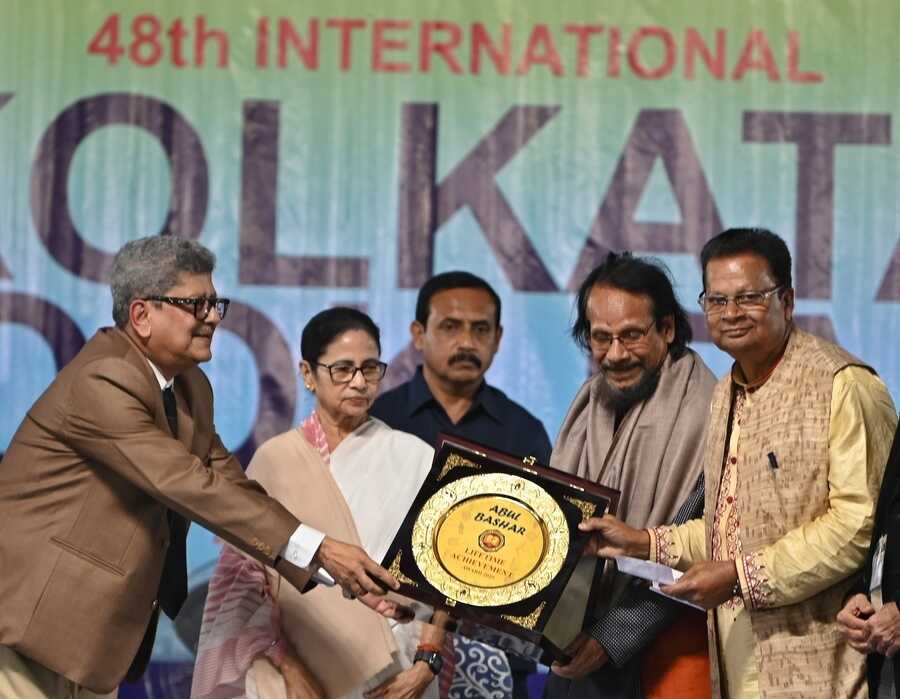
Abul Bashar was conferred the Guild Lifetime Achievement Award by chief minister of West Bengal, Mamata Banerjee, on January 28 at the inauguration of the 48th International Kolkata Book Fair / My Kolkata
Do you think awards and accolades you have received have made it easier for your voice to reach society?
No, absolutely not. In my initial days as an author, I found that the readerbase of my genre of writing in West Bengal was very constricted because I belonged from a backward society. I have had a readerbase in Bangladesh since the inception of my career. Here [in West Bengal], it has taken time, but a community of people who read my kind of writings have developed. My thought process, and my novels that are based on mythology have found an academic discourse, and a doctoral candidate from Murshidabad, did his PhD on my work at Jadavpur University.
What surprised me was that a member of the society that created barriers for me and refused to accept my words did a doctoral thesis on the mythical treatment in my literature as an academic discourse. Society has evolved, and the environment of the present times is removing roadblocks, making way for an educated middle-income strata that is progressive and free thinking.
From Agnibalaka to Bhor Poati Tara — how do you see your evolution as an author?
It is a journey that I made, I would say. I have been influenced by several thoughts at different points in my life. I was an activist of Leftist politics that was different from today’s times. Leftist politics was known as the politics of sacrifice. Agnibalaka’s protagonists, if you notice, are characters who do not conform to societal norms. They are free thinkers and are characters who have imbibed Marxism in order to elevate their lives. They are the voices of dissent against stigmas and stereotypes of society.
Agnibalaka is a political novel in which dialectical materialism among various stratas of the society as well as the dialectics in interpersonal relationships between two political parties is shown. The conflict between the social strata during the 19-month long Emergency period in India, and how Marxism could be brought into praxis — Agnibalaka is an experimentation on that.
However, I do not share the same thoughts today, and by this I mean that it has been removed from my life in some ways. I have not removed it from my life, but the ideology is gradually vanishing on a global scale. It is possible that my experiments or observations are incorrect, but in today’s time, this is how I see it.
When the world starts facing a situation like today in reference to Marxism, existentialism takes its course, and becomes a replacement and anti thesis for Marxism. Everyone is in a state of endangerment, and the very thought that society that was created for its residents, is now in oblivion. Social norms were made for the development of people, but development is not entirely dependent on norms. An excessive emphasis on following social norms has given rise to conflict between man and society. This was the reason behind the two World Wars. This has also given birth to existentialist literature, as well as poets like Jibanananda Das and Michael Madhusudan Dutta.
Abul Bashar at the Kolkata Book Fair, 2025 / My Kolkata
The Kolkata International Book Fair is one of the largest book fairs in the world. In a day and age when social media has diminished attention spans, how do you see the importance of book fairs?
Social media is not a replacement for books. There is no conflict between gadgets that we use on a regular basis versus books. Gadgets like phones are essential to attain information and gain knowledge, but literature is not just information. When we speak of literature, we usually refer to the written. But what about oral literature, which is a significant part of Bengali literature? The works of Lalon Shah, for instance, are originally songs and are kabya sahitya (poetry). Another example is Rabindrasangeet — a youngster, who is engrossed in his or her phone, is also a listener of Rabindranath Tagore’s music.
There is a trough and crest when it comes to readership, but eradicating books from our lives will never be possible — just like classical music, songs like Kaa Karu Sajni, or verses of Kabir. We have to increase our habit of reading because that will increase our creativity and strengthen our culture as well as inter-personal relationships. There is evolution in the publishing industry with the digitisation of books, which has increased the readerbase. And because of book fairs, there is a boost in the number of bibliophiles.
What is your next work?
I intend to go back to my zilla (Murshidabad) to work on a piece that would complete an unfinished novel.
source: http://www.telegraphindia.com / The Telegraph Online / Home> My Kolkata / by Pooja Mitra / February 02nd, 2025