Tag Archives: Pir Muhammmad Munis – Press Correspondent – Pratap

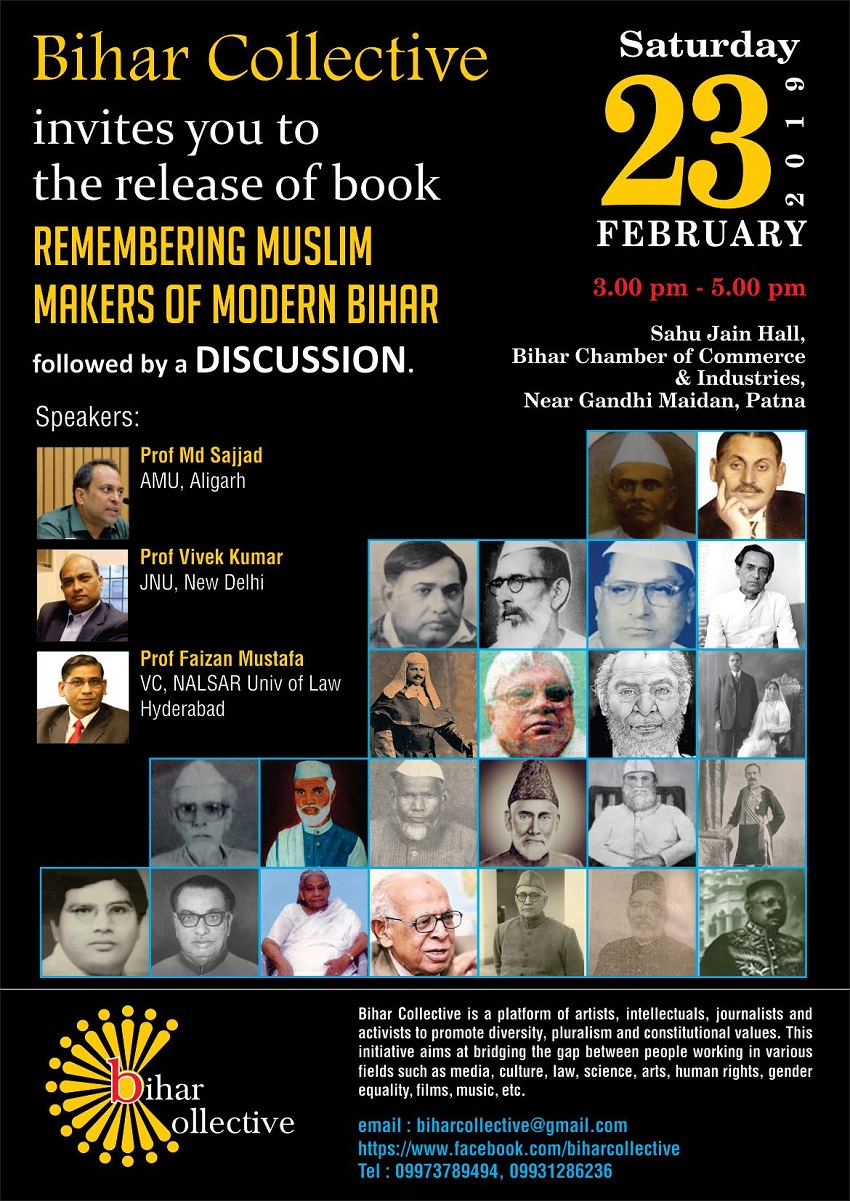
Bihar Collective to Release Booklet “Remembering Muslim Makers of Modern Bihar” in Patna on Feb 23

Patna, BIHAR :

Patna :

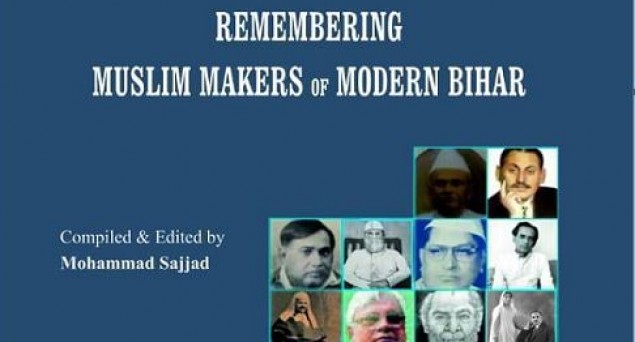
In an era of unprecedented majoritarian ascendance and anti-Muslim hatred, Bihar Collective, a platform of intellectuals and activists, has brought out a booklet highlighting the contribution of eminent Muslims in making the modern Bihar in the last 200 years.

The booklet titled Remembering Muslim Makers of Modern Bihar has been compiled and edited by renowned academician and writer Prof. Mohammad Sajjad on the initiative of Bihar Collective.

The booklet will be released at an event in Patna on Saturday (February 23).

On the occasion, a discussion will also be held with Prof Faizan Mustafa, Vice Chancellor, NALSAR University of Law, Hyderabad; Prof Vivek Kumar, JNU, New Delhi; and Prof Mohammad Sajjad, AMU, Aligarh as panelists.

A Brief about Booklet:


Pre-empting a reasonable question about the title of the booklet, Prof Sajjad, who has compiled and edited it, writes in its preface: “A simple and obvious question that may readily arise is: why only Muslim makers of modern Bihar? Why not others too? This is indeed a valid and pertinent question.”

Responding to the question, he further says: “Candidly put, this is because of an unprecedentedly menacing rise of majoritarianism, bigotry, and anti-Muslim hatred, with open support of the state.

The Muslim identities are ominously threatened. There are also unabated attempts to dilute (or even take away) whatever little accomplishments have been made by the forces of social justice and secularism.

Only the Muslim segment however is threatened by the jingoist, exclusionary, violent nationalists, to be thrown out to another country. As if the other country is a dustbin, owned by these bigots, into which they can throw away everything they dislike! As if only the religious majority constitutes the nation! Notably, these jingoists had aligned with the British and had stayed away from the national movement.”

“Muslim contributions in the nation-making (and in the freedom movement) remain under-acknowledged, forgotten or even omitted. Erasure of their histories and memories seem to have become even more pronounced and vociferous, now, than ever before…The Bihar Collective therefore decided to compile a short profile of these inspiring role models, history-makers…This is small and humble step towards retrieving and restoring the nationalist provincial pantheons bearing Muslim identities,” says Prof Sajjad.

He, however, admits that the list of Muslim heroes of Bihar given in the booklet is not exhaustive as “…many have been left out essentially because of lack of documentations and researches. Not many have left their own accounts/memoirs; the available memoirs/accounts have not written much about all the personalities. In many cases, even otherwise “resourceful” descendants and/or associates of the history-makers have not been able to provide us with adequate (and credible/verifiable) details.”

Prof Sajjad hopes this small exercise may lead to some big academic work on these history-makers. “In short, this kind of venture may be said to be an ongoing exercise. This effort may hope to open up (and obtain) more details about such history-makers and would also get to know about many more of such peoples and processes, we failed to include here in this hastily prepared tiny volume, amidst constraints of resources and time.”

Names of Muslim Makers of Modern Bihar Mentioned in Booklet:
1. Syed Imdad Ali (d.1886]
2. Khuda Bakhsh (1842-1908)
3. Syed Amir Husain (1843-1910)
4. Imdad Imam Asar (1849-1934)
5. Shah Badruddin(1852-??)
6. Syed Ali Bilgrami (1853-1911)
7. Rasheed-un-Nesa (1855-1926)
8. Syed Noorul Huda (1855-1939)
9. Justice Syed Sharfuddin (1856-1921)
10. Shaikh Gulab (1857-1920)
11. Sarfaraz Husain Khan (1860-1931)
12. Maulana Mazharul Haque (1866-1930)
13. Batakh Miyan Ansari (1867-1957)
14. Sir Fakhruddin (1868-1933)
15. Syed Ali Imam (1869-1932)
16. Syed Hasan Imam (1871-1933)
17. Salahuddin Khuda Bakhsh (1875-1931)
18. Shafi Daudi(1875-1949)
19. Khwaja Md. Noor(1875-??)
20. Abdul Wadood (d.1955)
21. Syed Abul Hasan (1878-1960)
22. Sir Sultan Ahmad (1880-1963)
23. Maulana Sajjad (1880-1940)
24. Pir Mohammad Munis (1882-1949)
25. Abdul Bari (1882-1947)
26. Syed Sulaiman Nadvi (1884-1953)
27. Mohammad Yunus (1884-1952)
28. Shah Md. Zubair (1884-1930)
29. Syed Abdul Aziz (1885-1948)
30. Zubaida Begum Daudi (1886-1972)
31. Syed Tafazzul Karim (1886-1964)
32. Mr. Mohammad Shafi (1888-1955)
33. Qazi Ahmad Husain (1889-1961)
34. Dr. Syed Mahmud (1889-1971)
35. Ali Husain Aasim Bihari (1890-1953)
36. Shah Mohammad Umair (1894-1978)
37. Abdul Ahad Mohammad Noor (1894-1975)
38. Hakeem Md. Kabiruddin (1894-1976)
39. Maulana Usman Ghani (1896-1977)
40. Manzoor Ahsan Aijazi (1897-1969)
41. Shah Md Ozair Muni’mi (1899-1961)
42. Maghfur Aijazi (1900-1966)
43. Syed Jafar Imam (1900-1965)
44. Syed Badruddin Ahmad (1901-1983)
45. Mohammad Tahir (1903-???)
46. Syed Jafar Imam (1903-1979)
47. Syed Fida Husain (1904-80)
48. Abdul Qaiyum Ansari (1905-1974)
49. Wajihuddin Minhaji (1907-1984)
50. Syed Md. Aiyub (1910-1964)
51. Abdul Sami Nadvi (1913-????)
52. Abul Hayat Chand (1914-1958)
53. Ahad Fatmi(1915-1980)
54. Zawwar Husain (1916-80)
55. Shafiqullah Ansari (1917-1980)
56. Shah Mushtaq Ahmad (1917-2002)
57. Abdul Ghafoor (1918-2004)
58. Col. Mahboob Ahmad (1920-1992)
59. Taqi Raheem (1920-1999)
60. Zahra Daudi(1923-2003)
61. Shakoor Ahmad (1924-1981)
62. Syed Hasan (1924-2016)
63. Yunus Lohia (1925-2019)
64. Ghulam Sarwar (1926-2004)
65. Syed Shahabuddin (1935-2017)

A Brief about Author:


Prof Mohammad Sajjad teaches late-colonial and post-independent Indian history at the Centre for Advanced Study in History, Aligarh Muslim University. He has written several books including Muslim Politics in Bihar: Changing Contours; and Contesting Colonialism and Separatism: Muslims of Muzaffarpur since 1857.

His articles are published in reputed academic journals from Routledge, Sage, EPW etc. and also in anthologies from the Oxford University Press and Cambridge University Press.
Bihar Collective:
It is a platform of artists, intellectuals, journalists and activists to promote diversity, pluralism and constitutional values. It aims at bridging the gap between people working in various fields such as media, culture, law, science, arts, human rights, gender equality, films, music, etc.
Email: biharcollective@gmail.com
Facebook: https://www.facebook.com/biharcollective

source: http://www.indiatomorrow.net / India Tomorrow / Home> Society / by India Tomorrow / February 21st, 2019
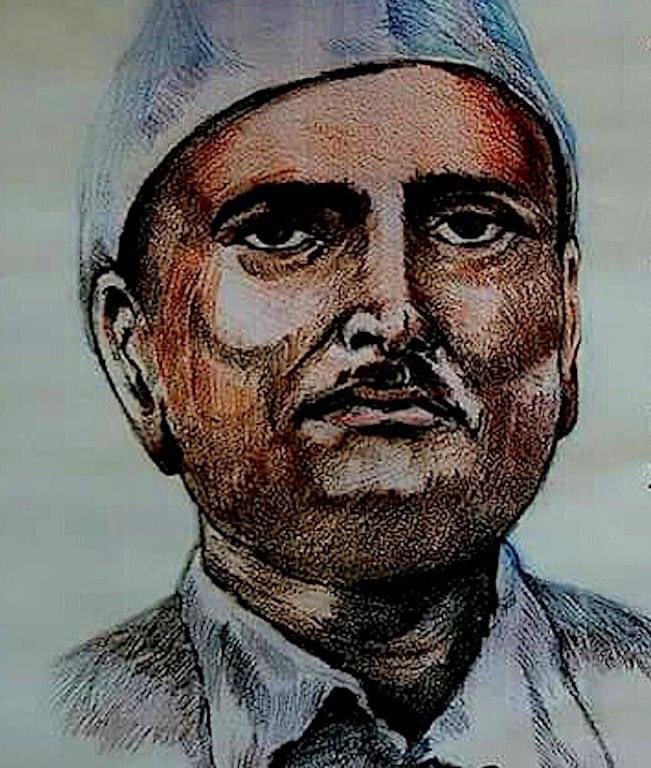
The ‘Rogue Journalist’ Without Whom Gandhi’s Champaran Satyagraha May Not Have Happened

Bettaiah (West Champaran District), BIHAR / Lucknow , UTTAR PRADESH :

The ‘Rogue Journalist’ Without Whom Gandhi’s Champaran Satyagraha May Not Have Happened

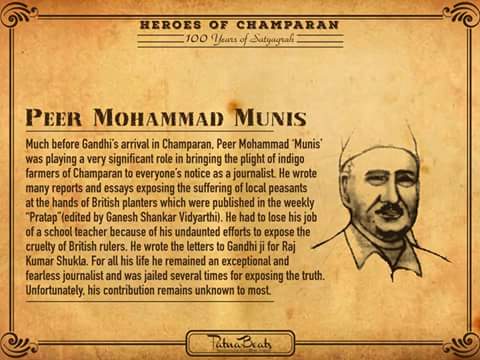
The Champaran Satyagraha is a landmark chapter in India’s history, and an important catalyst for it was journalist Pir Muhammed Munis, whose letter to Gandhi set the stage for the monumental resistance.

In 1917, when British rule prevailed over India, the government prepared a list to keep track of 32 of MK Gandhi’s closest associates. At number 10 was a name that history hasn’t forgotten since. 

Pir Muhammed Munis, a journalist known for the power of his pen, was instrumental in his role in the Champaran Satyagraha movement, also touted as India’s first organised act of civil disobedience.

Through his body of work, he scripted a record of heroism that is etched into the sands of time. 

To truly appreciate Munis’ role in the struggle for Independence, we trace our steps to 1916, when the British Raj was exercising exceeding control over Indians. One particularly vulnerable group were the farmers in Champaran, Bihar. 

The source of contention was the agrarian practices in the region. While the British were intent on the peasants growing indigo, a lucrative cash crop with sizable demand in the markets abroad, the farmers were deprived of land for growing food crops instead. This tussle culminated in a famine, causing the farmers to rise in revolt against the dominion of the British. As the conflict escalated, word reached Gandhi. How? 

Pir Muhammed Munis was behind it. 

Pir Muhammed Munis, a close aide of Mahatma Gandhi and a Hindi journalist

A ‘rouge journalist’ 

The uprising of the peasants in Champaran wasn’t going unnoticed. The country was reading about it thanks to Munis, who left no stone unturned in letting his views reflect his patriotic feelings. In the years to come, Pir Muhammed Munis would go down in history as the journalist who raised his voice when it was most difficult to be heard. 

He chronicled the efforts of the farmers, the unlawful practices of the British and more such news in Hindi — despite the elite class being fluent in Urdu, Persian and English — displaying his ardent love for the language. In his later life, he went on to advocate for Hindi to be propagated amongst the masses. Anecdotes suggest during his later interactions with Gandhi, Munis even went on to teach the legend the language, a skill that greatly helped the latter. 

So persistent and vocal was he about his patriotic opinions that he was termed as “notorious”, “bitter” and “dangerous” by the British, eventually being branded as a ‘badmash patrakar (rouge journalist)

A British Police document from the Azadi Ke Deewane Museum at Red Fort reads, “Pir Muhammed Munis is actually a dangerous and hoodlum journalist who through his questionable literature, brought to light the sufferings of a backward place like Champaran in Bihar.”

The letter that set the stage for the uprising

Pir Muhammed Munis fought for the farmers in the Champaran region of Bihar
Pir Muhammed Munis fought for the farmers in the Champaran region of Bihar, Picture source: Twitter: Muslims of India

But nothing stopped Munis from continuing to write, his pen a double-edged sword. His works appeared frequently in Pratap, a Hindi weekly, and monthlys such as Gyanshakti and Gorakhpur. He was also on the editorial board of Desh launched and edited by Dr Rajendra Prasad.

The most famous letter among his repertoire of literary works is a letter he penned with local farmer Rajkumar Shukla, intended to be sent to Gandhi on 27 February 1917. Shukla conveyed the grievances of the farming community, while Munis coupled this with his power of words. An excerpt from the letter reads, “Our sad tale is much worse than what you and your comrades have suffered in South Africa”. 

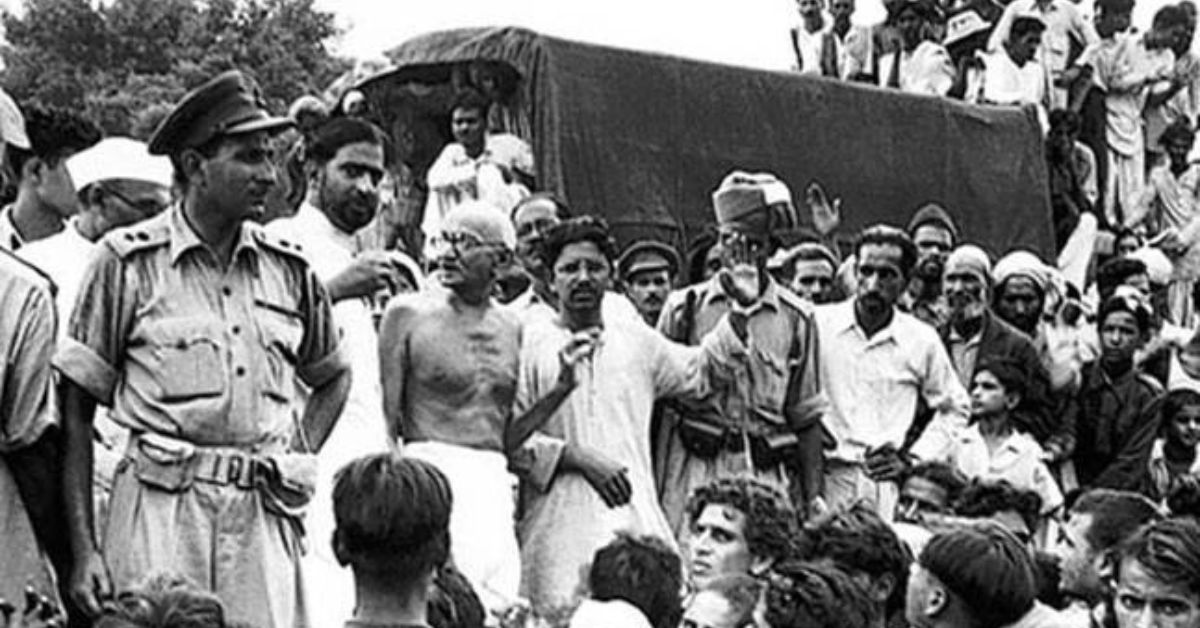
In another letter dated 22 March 1917, Munis once again voiced his concerns about the peasants in Champaran, and asked Gandhi to pay them a visit. And when he did on 10 April 1917, people commended the bond between the two, often calling Munis Gandhi’s pillar as he hatched plans for the Champaran Satyagraha. 

As the first Satyagraha movement, it set the stage for future mass protests and uprisings. Gandhi set up schools in the Champaran area, gathered volunteers, conducted village surveys, organised protests, and strikes, and advocated for control over the sale of crops to be given to the farmers. And through this mutiny, Munis was by his side. 

This did not go down well with the British. As a letter written by W H Lewis, sub-division officer to the commissioner of Tirhut division indicates, “… Mr Gandhi got offers of assistance, the most prominent is Pir Muhammad. I have not (sic) full details of his career, but either Whitty or Marsham could give them. He is, I believe, a convert to Muhammadanism and was a teacher in the Raj School. He was dismissed from his post for virulent attacks on local management published in or about 1915 in the press. He lives in Bettiah and works as a press correspondent for the Pratap of Lucknow, a paper which distinguished itself for its immoderate expressions on Champaran Questions… Pir Muhammad is the link between this Bettiah class of mostly educated and semi-educated men and the next class, i.e. the Raiyats’ own leaders…”

The result of the tyranny 

History never forgets the cries of the just, and the Champaran Satyagraha was proof of this. 

The mutiny ended with the British officers agreeing to formulate the Champaran Agrarian Act of 1918. The Act abolished the forcible cultivation of indigo and thus relieved tremendous pressure being put on the farmers here. The event has gone down in history as one of the first major revolts that forced the English to introduce a Bill in favour of the Indians. 

With the Tinkathia system being abolished, the farmers thought the worst was over. But the British continued to oppress them in different ways. Fuelled by ending this once and for all, Munis started Raiyati Sabha, a platform that would advocate for and protect the rights of the farming community. For this, Munis faced a six-month jail term. 

This wasn’t the last of imprisonment. In 1930 he was imprisoned in the Patna Camp jail for three months for his participation in the Salt Satyagraha of the Civil Disobedience Movement. 

However, nothing could deter him from his goal of protecting the rights of his countrymen. In 1937, he led sugarcane producers who were protesting against intermediaries who were pocketing a major part of the earnings. He was also elected member of the Champaran Zila Parishad (District Board) on the Congress ticket and became President of Bettiah Local Board, from which he resigned to join the Individual Civil Disobedience Movement.

Throughout his lifetime, he advocated for rural development, popularisation of Hindi in primary schools and the rights of his fellow Indians. Until his passing away on 23 September 1949 Munis continued to be a leader worth looking up to for his countrymen.

Lauding the efforts of Munis on his passing away, Pratap editor Ganesh Shankar Vidyarthi, wrote in his newspaper, “We have the utmost sorrow that Pir Muhammed Munis of Bettiah, Champaran district has died. We have the privilege to see such souls who are quietly lying aside. The world doesn’t come to know anything about their issues. The lesser these sons of Mother India are renowned, the more profound is their work, the more philanthropic.”

He further wrote, “You recited the dreadful story of Champaran to Gandhi ji and this was a result of your hard-work only that Mahatma Gandhi visited Champaran which made this land a pious place and the place which is unerasable in the pages of history”.

Sources 
Here’s The Story Of Pir Muhammad Munis, A Hindi Journalist And Unsung Hero Of Champaran Satyagraha by Afroz Alam Sahil, Published on 10 April 2018. 
Republic Day 2022: From The man who designed the Tricolour to Unsung hero of Pasighat… saluting the heroes who made India great by Free Press Journal, Published on 25 January 2022. 
Pir Mohammad Munis: An organic intellectual activist of the Champaran Satyagraha by Two Circles, Published on 1 May 2013.  

source: http://www.thebetterindia.com / The Better India / Home> English> History> Inspirational / by Krystelle Dsouza / July 28th, 2023