Tag Archives: Abdul Bari – Freedom Fighter of India

Bihar Collective to Release Booklet “Remembering Muslim Makers of Modern Bihar” in Patna on Feb 23

Patna, BIHAR :

Patna :

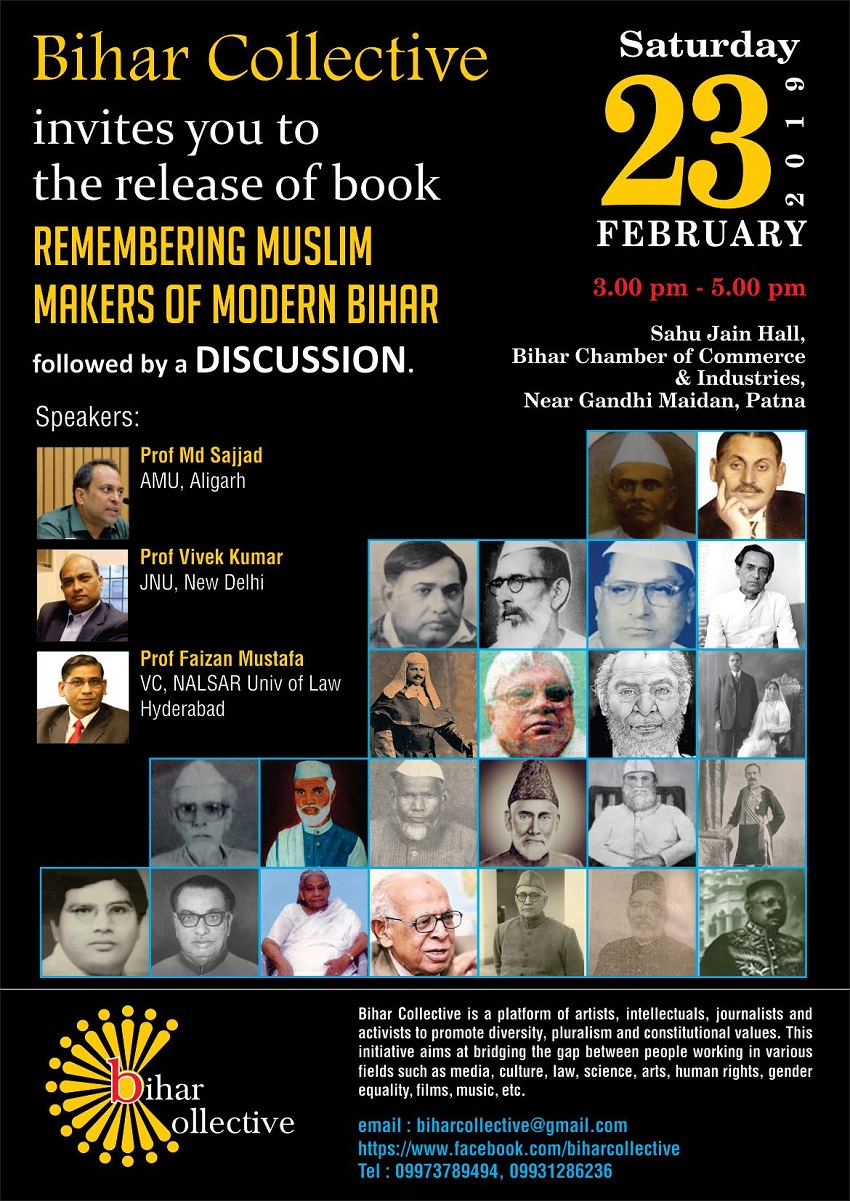
In an era of unprecedented majoritarian ascendance and anti-Muslim hatred, Bihar Collective, a platform of intellectuals and activists, has brought out a booklet highlighting the contribution of eminent Muslims in making the modern Bihar in the last 200 years.

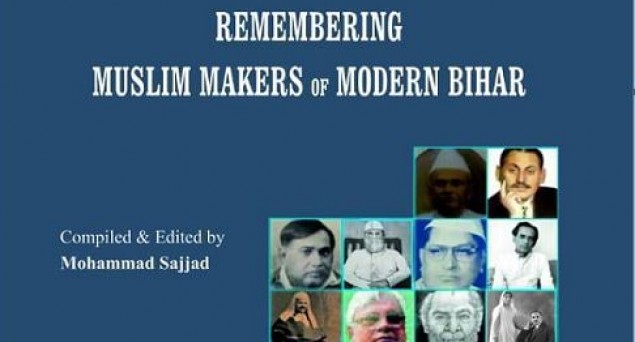
The booklet titled Remembering Muslim Makers of Modern Bihar has been compiled and edited by renowned academician and writer Prof. Mohammad Sajjad on the initiative of Bihar Collective.

The booklet will be released at an event in Patna on Saturday (February 23).

On the occasion, a discussion will also be held with Prof Faizan Mustafa, Vice Chancellor, NALSAR University of Law, Hyderabad; Prof Vivek Kumar, JNU, New Delhi; and Prof Mohammad Sajjad, AMU, Aligarh as panelists.

A Brief about Booklet:


Pre-empting a reasonable question about the title of the booklet, Prof Sajjad, who has compiled and edited it, writes in its preface: “A simple and obvious question that may readily arise is: why only Muslim makers of modern Bihar? Why not others too? This is indeed a valid and pertinent question.”

Responding to the question, he further says: “Candidly put, this is because of an unprecedentedly menacing rise of majoritarianism, bigotry, and anti-Muslim hatred, with open support of the state.

The Muslim identities are ominously threatened. There are also unabated attempts to dilute (or even take away) whatever little accomplishments have been made by the forces of social justice and secularism.

Only the Muslim segment however is threatened by the jingoist, exclusionary, violent nationalists, to be thrown out to another country. As if the other country is a dustbin, owned by these bigots, into which they can throw away everything they dislike! As if only the religious majority constitutes the nation! Notably, these jingoists had aligned with the British and had stayed away from the national movement.”

“Muslim contributions in the nation-making (and in the freedom movement) remain under-acknowledged, forgotten or even omitted. Erasure of their histories and memories seem to have become even more pronounced and vociferous, now, than ever before…The Bihar Collective therefore decided to compile a short profile of these inspiring role models, history-makers…This is small and humble step towards retrieving and restoring the nationalist provincial pantheons bearing Muslim identities,” says Prof Sajjad.

He, however, admits that the list of Muslim heroes of Bihar given in the booklet is not exhaustive as “…many have been left out essentially because of lack of documentations and researches. Not many have left their own accounts/memoirs; the available memoirs/accounts have not written much about all the personalities. In many cases, even otherwise “resourceful” descendants and/or associates of the history-makers have not been able to provide us with adequate (and credible/verifiable) details.”

Prof Sajjad hopes this small exercise may lead to some big academic work on these history-makers. “In short, this kind of venture may be said to be an ongoing exercise. This effort may hope to open up (and obtain) more details about such history-makers and would also get to know about many more of such peoples and processes, we failed to include here in this hastily prepared tiny volume, amidst constraints of resources and time.”

Names of Muslim Makers of Modern Bihar Mentioned in Booklet:
1. Syed Imdad Ali (d.1886]
2. Khuda Bakhsh (1842-1908)
3. Syed Amir Husain (1843-1910)
4. Imdad Imam Asar (1849-1934)
5. Shah Badruddin(1852-??)
6. Syed Ali Bilgrami (1853-1911)
7. Rasheed-un-Nesa (1855-1926)
8. Syed Noorul Huda (1855-1939)
9. Justice Syed Sharfuddin (1856-1921)
10. Shaikh Gulab (1857-1920)
11. Sarfaraz Husain Khan (1860-1931)
12. Maulana Mazharul Haque (1866-1930)
13. Batakh Miyan Ansari (1867-1957)
14. Sir Fakhruddin (1868-1933)
15. Syed Ali Imam (1869-1932)
16. Syed Hasan Imam (1871-1933)
17. Salahuddin Khuda Bakhsh (1875-1931)
18. Shafi Daudi(1875-1949)
19. Khwaja Md. Noor(1875-??)
20. Abdul Wadood (d.1955)
21. Syed Abul Hasan (1878-1960)
22. Sir Sultan Ahmad (1880-1963)
23. Maulana Sajjad (1880-1940)
24. Pir Mohammad Munis (1882-1949)
25. Abdul Bari (1882-1947)
26. Syed Sulaiman Nadvi (1884-1953)
27. Mohammad Yunus (1884-1952)
28. Shah Md. Zubair (1884-1930)
29. Syed Abdul Aziz (1885-1948)
30. Zubaida Begum Daudi (1886-1972)
31. Syed Tafazzul Karim (1886-1964)
32. Mr. Mohammad Shafi (1888-1955)
33. Qazi Ahmad Husain (1889-1961)
34. Dr. Syed Mahmud (1889-1971)
35. Ali Husain Aasim Bihari (1890-1953)
36. Shah Mohammad Umair (1894-1978)
37. Abdul Ahad Mohammad Noor (1894-1975)
38. Hakeem Md. Kabiruddin (1894-1976)
39. Maulana Usman Ghani (1896-1977)
40. Manzoor Ahsan Aijazi (1897-1969)
41. Shah Md Ozair Muni’mi (1899-1961)
42. Maghfur Aijazi (1900-1966)
43. Syed Jafar Imam (1900-1965)
44. Syed Badruddin Ahmad (1901-1983)
45. Mohammad Tahir (1903-???)
46. Syed Jafar Imam (1903-1979)
47. Syed Fida Husain (1904-80)
48. Abdul Qaiyum Ansari (1905-1974)
49. Wajihuddin Minhaji (1907-1984)
50. Syed Md. Aiyub (1910-1964)
51. Abdul Sami Nadvi (1913-????)
52. Abul Hayat Chand (1914-1958)
53. Ahad Fatmi(1915-1980)
54. Zawwar Husain (1916-80)
55. Shafiqullah Ansari (1917-1980)
56. Shah Mushtaq Ahmad (1917-2002)
57. Abdul Ghafoor (1918-2004)
58. Col. Mahboob Ahmad (1920-1992)
59. Taqi Raheem (1920-1999)
60. Zahra Daudi(1923-2003)
61. Shakoor Ahmad (1924-1981)
62. Syed Hasan (1924-2016)
63. Yunus Lohia (1925-2019)
64. Ghulam Sarwar (1926-2004)
65. Syed Shahabuddin (1935-2017)

A Brief about Author:


Prof Mohammad Sajjad teaches late-colonial and post-independent Indian history at the Centre for Advanced Study in History, Aligarh Muslim University. He has written several books including Muslim Politics in Bihar: Changing Contours; and Contesting Colonialism and Separatism: Muslims of Muzaffarpur since 1857.

His articles are published in reputed academic journals from Routledge, Sage, EPW etc. and also in anthologies from the Oxford University Press and Cambridge University Press.
Bihar Collective:
It is a platform of artists, intellectuals, journalists and activists to promote diversity, pluralism and constitutional values. It aims at bridging the gap between people working in various fields such as media, culture, law, science, arts, human rights, gender equality, films, music, etc.
Email: biharcollective@gmail.com
Facebook: https://www.facebook.com/biharcollective

source: http://www.indiatomorrow.net / India Tomorrow / Home> Society / by India Tomorrow / February 21st, 2019
A mahal called farangi: A story from another time, of another Lucknow almost forgotten

Lucknow, UTTAR PRADESH:

The Telegraph visits the haveli where the Khilafat and Non-Cooperation movements came to be mergedThe Telegraph visits the haveli where the Khilafat and Non-Cooperation movements came to be merged.

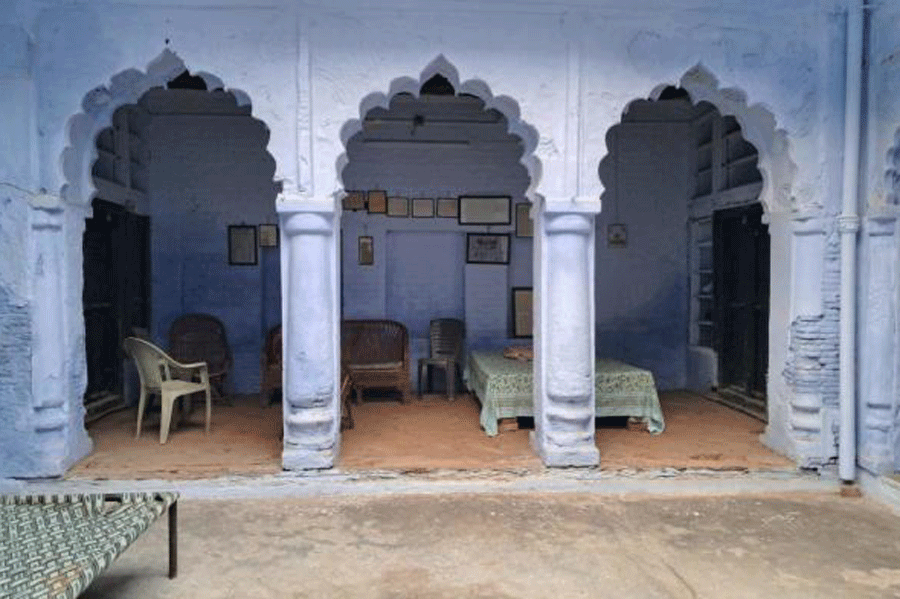
Farangi Mahal in Lucknow. / Photo courtesy: Adnan Abdul Wali

Stepping into Farangi Mahal in Lucknow after skirting rows of low-priced chikankari salwar kameez shops and their steady din is somewhat like stepping into the stillness of a forest after having left a busy city. Only, Farangi Mahal is anything but a forest. It is a cluster of buildings that hold within them a bit of history that has been almost forgotten, as the past often is in India, obscured by new settlements or construction, or billboards, if not demolished altogether.

In Farangi Mahal the past is difficult to see also because of the turn Indian politics has taken.

I am part of a group from Calcutta visiting Lucknow last October.

Inside Farangi Mahal, located in the old neighbourhood of Chowk, we enter its elegant and serene courtyard. The lime-and-mortar white exterior is tinged with a blue, peeling off in places. The afternoon sun slants down on the pillared arches and the exposed bricks but does not take away from the fragile beauty of the structure.

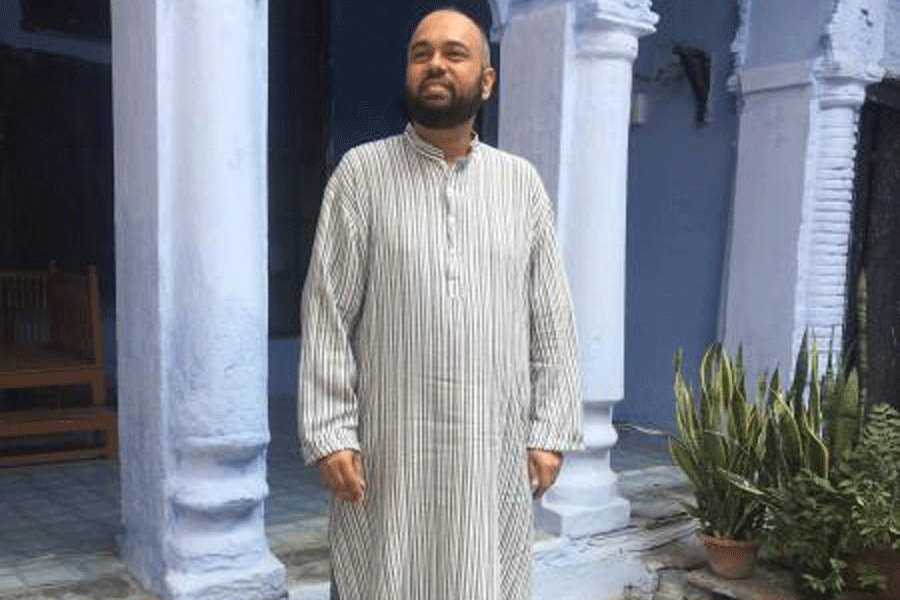
Adnan Abdul Wali, a member of the family that owns the house, the Farangi Mahalis, ushers us into the courtyard. His Urdu and Hindi are as impeccable as his courtesy. He is a direct descendant of Maulana Abdul Bari Farangi Mahali, who was a leader of the Khilafat Movement.

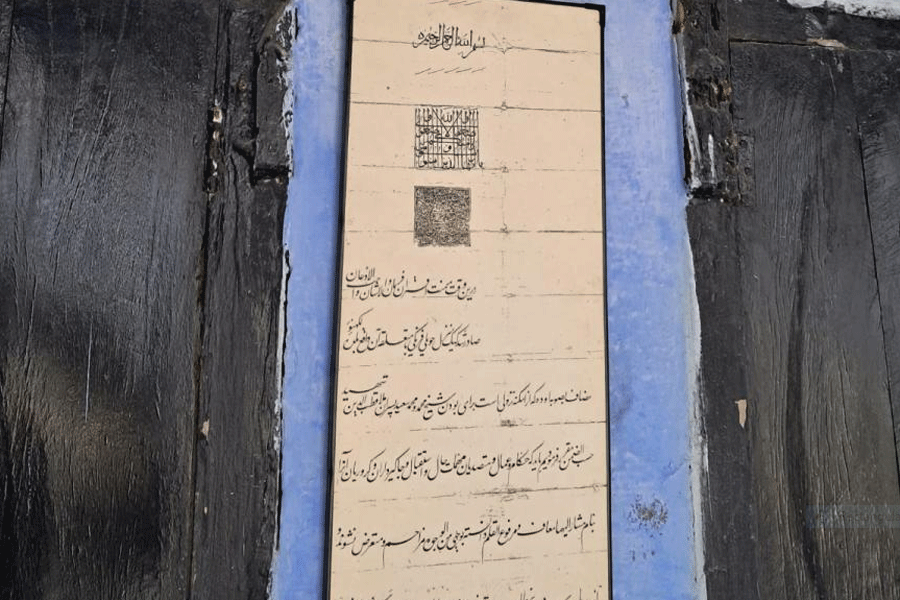
Farangi Mahal’s story, however, goes back beyond the nawabs and the British. It was occupied by French merchants during the rule of Mughal emperor Aurangzeb and that is how it got its name. The merchants, owing to some offence, lost the property and Aurangzeb gave it to Abdul Bari’s ancestors, who needed a safe haven.

The farman issued by Mughal emperor Aurangzeb decreeing that Bari’s ancestors could live here / Photo courtesy: Adnan Abdul Wali

“The Khilafat movement started from here,” says Wali. Farangi Mahal is where the idea of joining the Khilafat Movement and the Non-Cooperation Movement was born and Abdul Bari was the architect of the plan. It was a glorious moment of Hindu-Muslim unity in Indian history and Lucknow played its part in it.

Abdul Bari, an eminent religious scholar who belonged to the tradition of highly respected scholars from his family, was also an astute politician. He had travelled across many Muslim countries and was acutely aware of the impact of British imperialism on the Islamic world.

In March 1919 came the Rowlatt Act, which was to be followed by the horrors of the Jallianwala Bagh massacre in April 1919, one of the events that would lead Mahatma Gandhi to launch the Non-Cooperation Movement. Before that happened, a large number of Muslims in India were already disturbed by the threat of the dismemberment of the Ottoman Empire in Turkey following World War I and the jeopardised future of the Caliph, the Ottoman head of state, who is nominally the supreme religious and political leader of Sunni Muslims across the world. Turkey had been defeated by the Allied Forces, which included the British.

Adnan Abdul Wali, a direct descendant of Abdul Bari and the family that owns the house. / Photo courtesy: Adnan Abdul Wali

Abdul Bari was convinced that in India, Muslims needed to be made aware that the fate of the Ottoman Empire was their religious concern — and the articulation of the Khilafat (Caliphate) cause needed a larger, national platform.

From around 1919, Abdul Bari was raising support in the countryside, says Francis Robinson, a historian who specialises in Islam in South Asia. Abdul Bari had founded a newspaper for the purpose. But more importantly, he wanted to woo Gandhi to the Khilafat struggle.

Gandhi came to stay in Farangi Mahal for the first time in March 1919 and within six months, Abdul Bari had won him over, says Robinson. This also led to a period of a very special friendship between the two men, which was rooted not only in a common political cause but also shared spiritual beliefs and a love for mysticism, as embodied in Sufi philosophy.

Politically, the campaign for Khilafat and Gandhi’s stamp on it saw Abdul Bari reaching the height of his influence during 1919 and 1920.

Abdul Bari and his Farangi Mahal relatives, with the help of the lawyer Chaudhri Khaliquzzaman, drew up the constitution of the All-India Central Khilafat Committee, says Robinson. “He devoted enormous effort first to persuade the Khilafat Committee to adopt non-cooperation as a policy and second, at the Allahabad meetings in June (1920), in persuading the committee to accept Gandhi as chair of the group that was to put non-cooperation into action,” adds Robinson.

From then on till September 1920, Abdul Bari successfully campaigned to organise a significant Muslim presence at the Calcutta Special Congress, which was held from September 4 to 9, 1920. The session passed the resolution of the Non-Cooperation Movement with a demand for Swaraj. The Khilafat Committee and the Congress came together with non-cooperation as the common goal.

After March 1919, Gandhi stayed at Farangi Mahal three times, recounts Wali proudly. Other leaders such as Jawaharlal Nehru, Maulana Abul Kalam Azad and Sarojini Naidu stayed here as well. During Gandhi’s second visit, in September 1919, Muslims in the area abstained from cow slaughter during Bakrid as a mark of respect to Gandhi and appreciation for his support to the Khilafat cause. “Abdul Bari had requested Muslim families to make the gesture,” says Wali.

This was somewhat different from the recent celebration of November 25 as No Non-Veg Day by the BJP government in Uttar Pradesh. The announcement was made to honour the birth anniversary of Sadhu T.L. Vaswani and slaughterhouses and meat shops were required to remain closed that day. There is a world of difference between giving up meat voluntarily and being forced to do so, as there is between non-violence and violence. But such distinctions perhaps do not make much sense anymore in Lucknow, once the capital of nawab-ruled Oudh, now ruled by the BJP with Yogi Adityanath at its helm. Like the No Non-Veg Day, the city has several streets and institutions named after lesser-known Hindu saints.

Abdul Bari is said to have introduced Gandhi to the sufi saint Bakhtiyar Kaki, disciple and successor to Moinuddin Chishti. Three days before his death, Gandhi delivered his last public address at the shrine of Bakhtiyar Kaki in Mehrauli.

Abdul Bari had earlier invited Gandhi to Ajmer, where Chishti is enshrined. At Ajmer Sharif Dargah, Gandhi is said to have experienced his first qawwali on Chishti. It was there that he asked Abdul Bari about Bakhtiyar Kaki. He had first visited Ajmer Sharif in 1921 and would visit it again.

In 1922, after the Chauri Chaura incident, Gandhi withdrew the Non-Cooperation Movement. Abdul Bari did not relent; he was not sparing of Gandhi either, says Robinson, but one has to remember his politics was primarily religious in inspiration. His influence declined steadily from this time and he died in 1926, a disappointed man, according to Robinson.

His name is often seen missing now from the roll call of prominent Khilafat leaders.

And yet Abdul Bari was not only a politician but also an eminent educator, Wali reminds. His ancestors had established a madrasah that became well-known all over the Islamic world and had introduced a syllabus, Dars-e-Nazami, which became a much-respected system of learning.

As a revered teacher in his family tradition, Abdul Bari introduced major changes to the curriculum by stressing the learning of Western sciences and discouraging rote learning.

Wali breaks down. It is very difficult to reconcile the present with the past, he says. Lucknow was never a utopia; communal riots had broken out here around the time of Gandhi’s visits to Farangi Mahal. But now the very fabric of society has changed, he feels. He reads from an Urdu book, and though the meaning of the words remains elusive, the music lingers. Farangi Mahal, with Wali bent over his book, look almost unreal.

But Farangi Mahal still stands, held up by its ancient, sturdy, flat bricks, and memory. Some things stay.

source: http://www.telegraphindia.com / The Telegraph Online / Home> Culture / by Chandrima S Bhattacharya / January 07th, 2024

The Freedom Fighter and Labour Leader Abdul Bari Still Beloved in Jamshedpur

Shahbad District / Patna, BIHAR :

This May Day, remembering Abdul Bari.

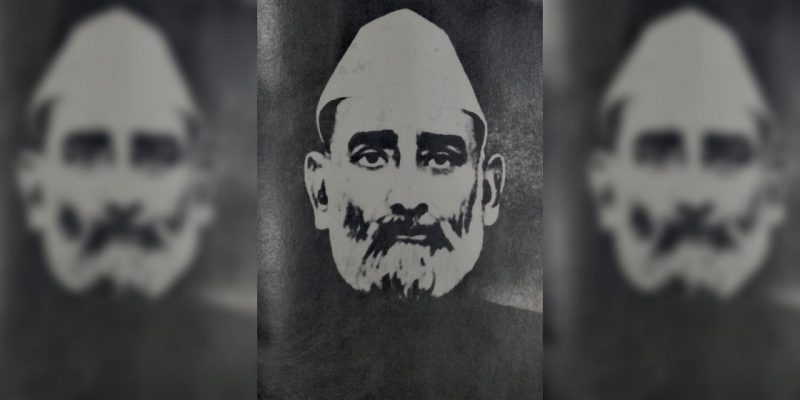
Abdul Bari.

Abdul Bari is not a name that many Indians remember, but Munawwar, a committee member of the Tata Motor Workers’ Union in Jamshedpur, Jharkhand, holds the name in high esteem.

“I don’t see a leader like Abdul Bari [coming up] in the near future,” he said. “It is because of his efforts that we still get high tea at just six paisa.”

“Once, Bari went to the Tatas and he was offered tea. He asked them to first offer it to the workers, and then made an agreement which is still benefitting us. Upmaaloo chaapsamosa all for six paisa in the company’s canteens.”

Asked how they pay six paisa when currency that small no longer exists, he says, “We get token of Rs 2 or more and keep using it for weeks.”

Munawwar visits Bari’s grave every year on March 28, the death anniversary of the pre-independence labour leader, to offer flowers. This duty, he says, was assigned to him by the Tatas.

Thinking of labour in the days of capital

Despite the large numbers of workers who struggle to earn a square meal a day, major political parties remain hostile towards them. In the 55-page Congress manifesto, the words ‘worker’ or ‘workers’ appear 15 times; in the BJP’s 45-page manifesto, the words appears only five times – four while referring to Asha and anganwadi workers. ‘Labour’ figures 21 times in the Congress manifesto, and only twice in the BJP’s.

The Congress does talk about ending the workers’ exploitation and improving working conditions. The party’s manifesto details new schemes and promises to implement old ones related to organised, unorganised and contractual labour. But it is anyone’s guess how schemes that have been on hold for so long will suddenly spring to life.

Dilip Simeon, a founding member of the Association of Indian Labour Historians and former professor of history at Ramjas College, says that nobody talks about labour now because “in today’s context, the labour movement is influenced by communal sentiments”.

“If labour is with the BMS [Bharatiya Mazdoor Sangh] and Shiv Sena, then this is the weakness of the movement; if the labour movement wants to regain its power, then it has to face this challenge.”

Before independence, Simeon says, regardless of community, “leaders came together to advance the struggle of workers in India. Abdul Bari, Maneck Homi and Hazara Singh were their leaders. A Muslim, a Parsi and a Sikh could all be leaders of a workers’ movement.”

“Abdul Bari was so trusted that workers would start their protest first and then ask –what’s our demand?”

Bari was born in 1882, in Bihar’s Shahabad district. He was a student at Patna University in 1919 and was later appointed as a professor of history there, before he started studying law.

He quit to join the Khilafat movement, and actively participated in Gandhi’s civil disobedience movement and salt satyagraha. Bari did not restrict himself to the cause of one social group; he supported several political parties, including the Socialist Party and Swaraj Party, in parallel with the Congress. In addition, he was the voice of the labour movement in India and president of the Jamshedpur Tata Workers’ Union.

What Gandhi said about Bari

The journalist Afroz Alam Sahil has written a book on Abdul Bari, Professor Abdul Bari: Azaadi ki Ladaai Ka Ek Krantikaari Yodhha (Professor Abdul Bari: A Revolutionary Warrior of the Freedom Struggle). The author reveals several stories which won’t be found Indian history books. One such story is around Bari’s mysterious murder, and Gandhi’s reaction to it.

According to a report published by the Times of India on March 31, 1947, Bari was shot dead in the evening of March 28 while on his way home from Khushrupur, 24 miles from Patna. He was then the president of the Bihar Provincial Congress Committee. Following his death, a complete strike was observed, and Tata closed all its plants except essential ones.

Gandhi, in a speech on March 29, 1947, mentioned that he was struck by Bari’s simplicity and honesty. Gandhi added that he was planning to be more closely associated with Bari, and make an appeal to keep his short temper in check as it was not befitting of the highest office in Bihar. Gandhi referred to Bari in the same speech as “a very brave man with the heart of a fakir”. He declared that Bari’s death was the result of an altercation that had ensued between Bari and one Gurkha member of the anti-smuggling force, who was a former member of the Indian National Army.

The author mentions in this book that Bihar’s first Prime Minister (Premium) Barrister Muhammad Yunus had disclosed in an interview to the Orient Press of India that Bari had threatened to disclose the names of some prominent Congress leaders who were involved in the Bihar carnage – just three days before he was killed.

Yunus also said that Gandhi’s statement was given in haste. In his speech, Gandhi had told the audience that there was no politics of any kind in the death, and that it would be unjustified to associate the whole Indian National Army with Bari’s killing just because of one man’s actions.

In another incident discussed in the book, Gandhi arrives at Fatuaha station near Patna in the early morning of March 5, 1947. He travelled from Calcutta to Patna. Bari, chief minister Srikrishna Sinha and others welcomed him on the platform. As soon as Gandhi saw Bari, he laughed and said, “How is it that you are still alive?”

“This book is an attempt at bringing back his identity not just as a leader of the labour movement but a prominent leader of the freedom struggle of India,” the author says. “Professor Bari was one of the biggest leaders of the labour struggle in India. But limiting his role to even that would be unjust, because he was present in every chapter of the independence movement….The speciality of Abdul Bari is that he questioned his own party Congress when it came to the rights of workers.”

In a speech, Bari said, “We are in Congress to serve the poor of this country not to respect Gandhi, Rajendra Babu and Shri Krishna Babu…Lakhs of Indians who walk with them are not there to make them kings but to achieve freedom for this country.”

According to Sahil, “He criticised Gandhi and Rajendra Prasad many times because he was wholeheartedly committed to this struggle. He wanted to organise an all India conference for workers. He had formed the All India Mazdoor Sevak Sangh. He mentioned this in a letter written by him to Sardar Vallabh Bhai Patel on 22 June 1946.”

Why commemorate leaders like Bari today? Sahil has the answer. “Today when Muslim youth talk about Muslim representation, they must read more about Bari, the symbol of Hindu-Muslim unity, in order to understand their own political history and determine how it influences their future.”

Afshan Khan is a Delhi-based freelance journalist.

source: http://www.thewire.in / The Wire / Home> Analysis> Labour / by Afshan Syed (headline edited) / May 01st, 2019