Tag Archives: Positive News of Muslims of Bihar in Education

Where guns used to roar earlier, now ‘Shafqat Aamna’ has become an IAS

Adhakparia Village (East Champaran District), BIHAR :

Motihari: 

A village in East Champaran which was infamous for guns being pulled out on trivial matters and for fights, the village where last year a sarpanch was not only strangled by fearless criminals but also shot dead, now this same village will be known for the stories of Shafqat Amna becoming an IAS.  

Shafqat Amna, daughter of retired teacher Mohammad Zafir Alam of Adhakparia village of East Champaran, has not only brought glory to her family by securing 186th rank in the UPSC Civil Services exam, but has also shown a path to lakhs of Muslim girls with the light of education. 

The whole village is rejoicing at Shafqat’s success. 65-year-old Zafir is not tired of thanking people for this success. 

In an exclusive conversation with BeyondHeadlines, Zafir Alam says, ‘We would like my daughter to work as an honest servant. She should strive for peace and prosperity in the society. And most importantly, she should take today’s new generation forward in the field of education.’

Let us tell you that Zafir Alam has retired as a teacher from an Urdu middle school in Agarwa village near Motihari. 
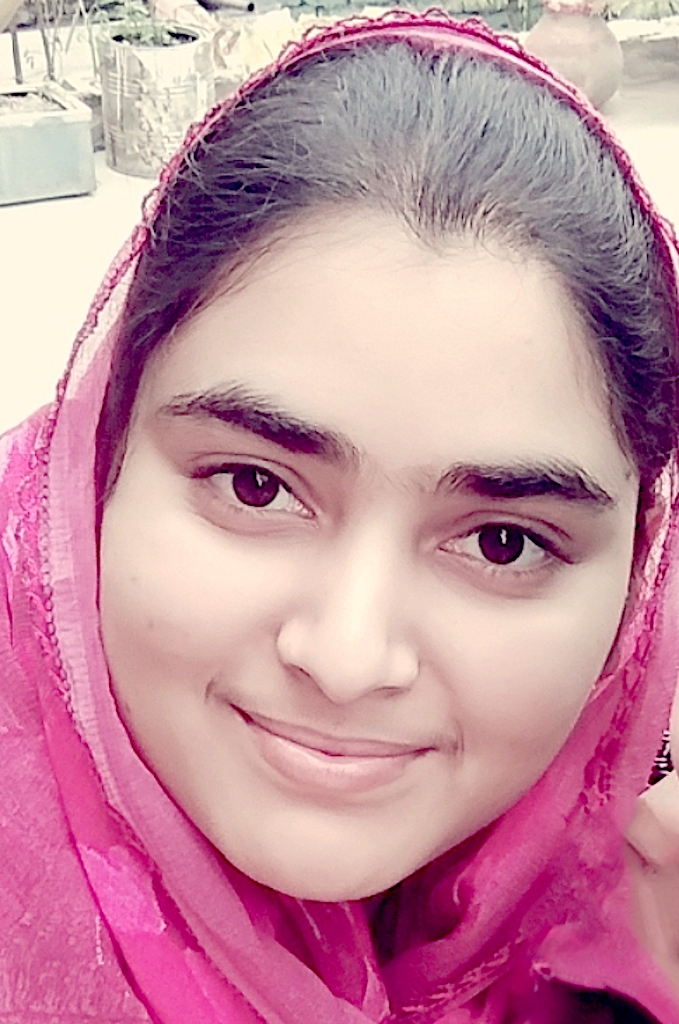
24-year-old Shafqat Amna says in an exclusive interview with BeyondHeadlines that the backwardness of the village and the lack of infrastructure always bothered me. That is why since childhood I wanted to live among the people and do something for them so that I could change their thinking and circumstances. My father, sensing this desire of mine, inspired me to join the civil service. 

Aamna says that my first choice is IAS and I am hopeful that I will definitely get IAS Insha Allah. 

When asked what will you do first after becoming an IAS? 

In response to this question, Aamna says that my first effort will be that whichever district I go to, I will first try to focus on education in the village. Since my father was a teacher, I understand the politics of teachers very well. I will inspire them to teach children honestly, away from that politics.  

What if I get IPS instead of IAS? 

On this question, Aamna pauses for a while and then after thinking says – I am hopeful that I will get IAS and I have not thought of anything else apart from this. But still if I get IPS instead of IAS then first of all I will pay special attention to law and order. I will try to maintain communal harmony in my district at all costs. I will try my best that there is never any fight or quarrel in my district, there is always mutual harmony.

When asked about preparing for civil services, Aamna says that, I would definitely like to tell those who want to join civil services that they should not start preparing for it suddenly, but first understand the syllabus well. If possible, try to take guidance from an IAS or IPS. Then start preparing for it thoughtfully with full courage and passion. Try to study smartly instead of studying like donkeys.

However, she also says that everyone’s way of preparing is different. The positive thing for me was that I had read NCERT books properly in school itself. So all the concepts were clear. I studied Geography very well in graduation as well. And yes, during my entire studies, I always had the habit of making short notes. These notes were very useful in my preparation. I paid full attention to its revision. Apart from that, I participated a lot in test series. 

Let us tell you that Shafqat Amna passed 10th from Jawahar Navodaya Vidyalaya in Bettiah, West Champaran. Then she went to Bokaro for 12th, passed 12th from DPS there. After that, circumstances became such that she had to return to the village. Here she got a BA Honors degree in Geography from a college of Bhimrao Ambedkar University in Motihari. After that, she came to Delhi in 2016 to prepare for civil services. Here she prepared by staying in the residential coaching of Jamia Millia Islamia and after failing twice, she succeeded this time in the third attempt.

Apart from her parents, Shafqat Amna’s family also has three sisters and a brother. Her younger sister is pursuing BA LLB from Jamia Millia Islamia. Her two elder sisters have completed B.Ed and are currently living with their mother in the village. 

Aamna says that the situation at home was never good. My father was the only breadwinner in the house. But he never neglected our education. Whatever I am today is because of my father. 

What would you like to say to the girls of the country? 

On this question, Aamna says that I would like to say that it is very important for you to get educated. And never underestimate yourself. Your hard work, your efforts can change your fate. But yes, for success you will have to make your own policy and your own routing. You will have to decide for yourself what things matter in your life…

source: http://www.beyondheadlines.in / Beyond Headlines / Home> India> Real Heroes / by Afroz Alam Sahil, Beyond Headlines / April 06th, 2019
Sir Fakhruddin (1868-1933): An Educational Visionary of Bihar

Dumri (Patna), BIHAR :

While working on my two books (soon to come: one on Muslim Politics in Bihar and another on Muzaffarpur Muslims, 1857-2011), while looking into primary and secondary sources I came across many personalities and institutions. One such person was Sir Fakhruddin whose contributions towards public life may interest many people. Hence I crave the readers’ indulgence.

[Sir] Syed Mohammad Fakhruddin [Khan Bahadur, 1868-1933] of Patna is credited to have the distinction of being the first Muslim Minister of Bihar and Orissa.

His father Md. Ali of the village Dumri, near Patna, took special care of his quality education. Having imparted elementary education in Arabic, Persian, and Urdu in the village Maktab, Fakhruddin was put under the tutelage of Md. Yahya, advocate, a big rais of Patna, with deep interest in music and literature. Yahya was the husband of Rasheedun Nesa (1855-1926, the author of the Urdu novel, Islahun Nesa, 1881/94, and a pioneer of modern education to women in Patna).

Fakhruddin did his BA from the Patna College in 1891, and B.L. in 1893, and started court practice under the guidance of Yahya in the district court of Patna. He was also associated with the Bihar Provincial Association.

Having earned good reputation as advocate he was elected member Bengal Council in 1910, which Fakhruddin quit after becoming the government pleader (1917-20) in the High Court of Patna, established in 1916-7. In 1921 he was elected member of the Bihar and Orissa Legislative Council, and he kept winning the elections till his death in 1933.

Thus, during 1921-33 he also served as minister of education besides few other significant departments. His contribution as minister in pushing the cause of education is distinctive. His efforts towards promoting primary and secondary education are noteworthy.

 The Deputy Directors of Public Instruction were made to undertake tours of Bihar and open schools. Fakhruddin worked hard towards enhancing the budgetary allocation for education. He also made efforts towards charkha operation in the government schools but remained largely unsuccessful in that. He mobilized funds for construction of college buildings and hostels. He was passionate about it.

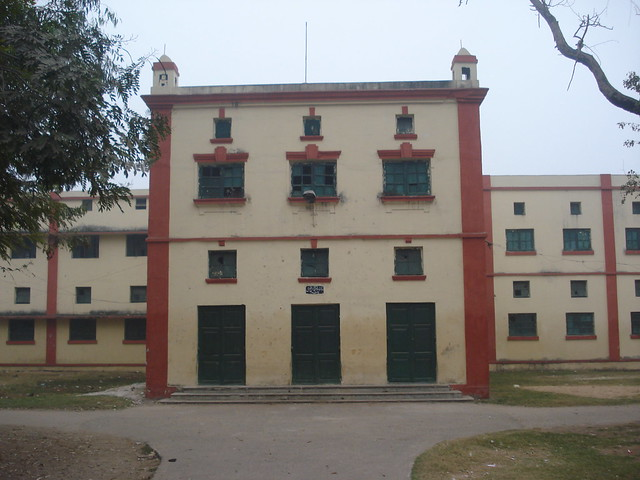
Reconstruction of Patna’s BN College building and its three storeyed hostel, the imposing building of the Science College (Patna), two storyed hostel for the Science College, the Patna College Hostel (later became famous as Iqbal Hostel), two storeyed PostGraduate Hostel of Ranighat (Patna), Patna Training College are his creations.

Besides, he also allocated fund for the buildings and hostels of the Muzaffarpur’s GBB (LS) College, Cuttack’s Ravenshaw College, Bhagalpur’s TNB Colllege, two big buildings for the Madrasa Shams-ul-Hoda, which was taken over by the government, and eight professors’ quarters in Ranighat (Patna) are also his creations. For the cause of Urdu, he set up a Madrasa Board in 1922.

Madrasa Shams-ul-Hoda

Fakhruddin had also prepared an ambitious plan of converting the Patna University in a big residential university for which he also influenced the Nathan Committee to make favourable recommendations. This was to be established in the Phulwari Sharif. But it did not see the light of the day as a large number of the members of the Bihar and Orissa Legislative Council opposed it on the arguments that the campus will go far beyond the city; a member went on to allege that Fakhruddin was taking the University to the doors of his Pir. The Searchlight is said to have regretted this myopic opposition as the Bihar’s capital city was deprived of quality residential university.

He created and institutionalized Bihar Educational Service Class I, and went on talent hunt to recruit meritorious teachers for the Patna University.

With these efforts he brought in Dr Gyan Chand as professor of Economics, Prof. Taraporewala (History), Prof. Jamuna Prasad (Psychology), Prof. Hill (English), Prof. Shiv Parvati Prasad (Physics). They were posted on handsome salaries.

There used to be an insistence by the colonial regime to recruit only those candidates as Class I teachers who had obtained degrees from Europe.

Prof. Nayyar Laeeq Ahmad (who later became Principal, Andheri College, Bombay), and Prof. Jadunath Sarkar were also recruited. Sir Fakhruddin resisted this racism, without much success at the time, even though it was diluted subsequently in 1940s when Prof. K K Datta (History, 1944) was taken in.

Sir Fakhruddin brought a bright professor of Law from BHU to make him Principal, Law College, and Prof. Boman Sanjana of Bombay was brought in the Civil Engineering.

In order to overcome the dearth of talented teachers he also instituted State Scholarship programme on which promising students of BA and MA were sent oxford and Cambridge for higher degrees and they had to return back to teach in the colleges of Patna University.

Kishori Prasad Sinha, Fazlur Rahman, and Kalimuddin Ahmad for English literature; Ghanshyam Das for History, Balbhadra Prasad and Qamruddoja for Chemistry, Bhairavnath Rohtagi for Economics were few such luminaries. Sadly, with the death of Sir Fakhruddin this bright scheme also died.

The Bihar School of Engineering was upgraded to ‘College’ by him. He also established the Veterinary College of Patna and recruited many teachers from outside.

Besides education, he also held the portfolio of cooperative and he made it a movement of sorts, more particularly in Tirhut. He convened a conference of Cooperatives in Hajipur when Ahmad Husain (1886-1948), an Aligarh graduate of Muzaffarpur, was posted as SDO in Hajipur.

For all these unforgettable contributions, Dr Rajendra Prasad held him in very high esteem.

Sir Fakhruddin, a bearded, fair-skinned fellow was a devout practicing Muslim with punctualities of namaz. Sherwani, pajama, Turkish cap was his preferred dress. The masjid near the Patna Railway Junction was reconstructed by him by investing around Rs. 20-25 thousand, which is now the Jama Masjid of Patna; for long it was called ‘Sir Fakhruddin Masjid’.

As a minister, he never used government quarters; rather he preferred to work from his own house in Patna, nor did he accept police protection. He was a good orator in both English and Urdu.

His sons- Azizul Haq was a renowned advocate of Patna High Court, Anisul Haq was Deputy Collector, Habibul Haq was in judicial services.

(Mohammad Sajjad, Assistant Professor at Centre of Advanced Study in History, AMU, Aligarh)

source: http://www.twocircles.net / TwoCircles.net / Home / by Mohammad Sajjad / October 13th, 2025

Abdullah Bihar Topper in JEE (Main), Says Miles to Go

Aunsi (Bisfi – Madhubani District), BIHAR :

Patna:

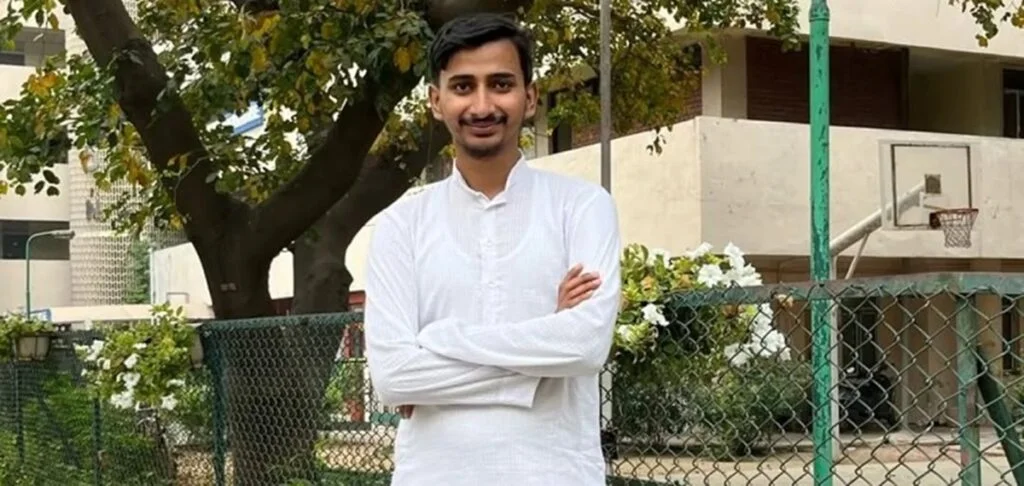
Abdullah, known by only his single name, topped the list of successful candidates from Bihar who appeared for the JEE (Main) 2025, Session 2. The result was announced late at night on Friday. He scored 99.9945499 percentile, but he is not in a celebratory mood. He wishes to top the JEE (Advanced), which ensures admission in the best IIT.

Abdullah hails from Aunsi in Bisfi under Madhubani district. His father, Mohammad Sabir Hussain, is an assistant teacher, while his mother, Tarannum, is a homemaker. Abdullah is the eldest among five siblings.

Abdullah is preparing for the next stage of JEE – JEE (Advanced) at Kota, Rajasthan. He is very keen to study Computer Science. He wants to do better in the upcoming test, while his father says that Abdullah also aims to qualify UPSC.

Abdullah, after getting the result, said that he felt very good for it but it was just beginning and he has miles to go. He said that his routine continues to be the same and he was focusing on completing his daily assignments.

Abdullah completed his matriculation from Madhubani and then moved to Kota for his preparation. He secured 90 percent marks in his I.Sc. examination. Abdullah keeps from smartphone as he considers it a distraction.

source: http://www.radiancenews.com / Radiance News / Home> Education / by Radiance News Bureau / April 20th, 2025

Shakib Shah, Rukaiya Fatima Claim Top Spots in Bihar Board 12th Exam

BIHAR :

Remarkable achievements highlight talent and determination in Bihar’s intermediate results.

New Delhi :

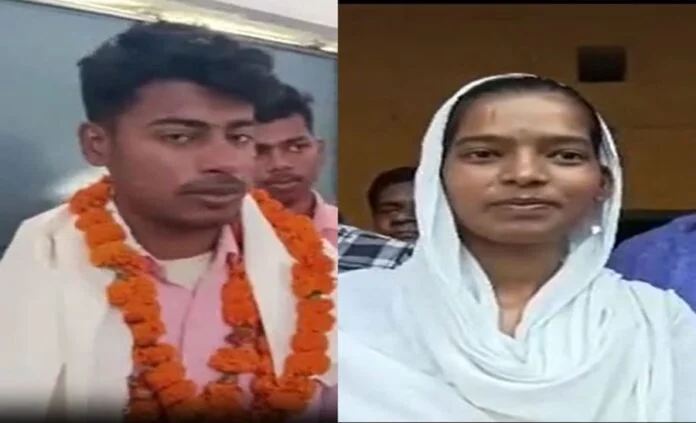
The Bihar School Examination Board (BSEB) on Tuesday revealed the 2025 Class 12 exam results, and this year, two Muslim students from modest backgrounds have made headlines by securing the first and second positions. Shakib Shah from Buxar district and Rukaiya Fatima from Begusarai have not only made their families proud but also demonstrated the power of hard work and ambition in overcoming challenges.

Shakib Shah, a student at Plus Two High School Koransarai in Buxar, achieved an impressive 473 out of 500 marks, securing the top position in the Arts stream. His 94.6% score has ignited celebrations in his village, with locals and teachers praising him as a source of inspiration. “I studied hard every day, and my teachers supported me throughout. My dream is to crack the Bihar Public Service Commission (BPSC) exam and serve as an administrative officer,” Shakib told Zee Media, his determination evident in his words.

Following the announcement of his results, Shakib received a flood of congratulations at his home in Koransarai. Teachers from his school, along with the District Education Officer, visited the school to honour their star student. “Shakib has always been a focused student. His success is a testament to his hard work and the guidance he received here,” said one of his teachers, beaming with pride.

Meanwhile, Rukaiya Fatima, a student at BN High School Teyai in Begusarai’s Teghra subdivision, earned the second position with 471 marks, achieving 94.2% marks. The daughter of Mohammad Abu Salem, a bidi trader from Kolkata, Rukaiya comes from a family of seven sisters, where she is the third child. Despite her father’s modest income and the challenges of supporting a large family, Rukaiya’s resolve to excel never wavered. “I want to become an IAS officer and work for the poor. Education is my way to change my family’s future,” she shared with local reporters.

Rukaiya’s success has brought joy to her community in Begusarai. Her school principal described her as a diligent and bright student who balanced her studies with household responsibilities. “She would often stay back after classes to clear her doubts. Her success shows what girls can achieve with determination,” the principal remarked.

The Bihar Board 12th exams, held between 1 and 15 February 2025, saw over 12.92 lakh students appear across 1,677 centres in the state. This year’s results reflect an overall pass percentage of 86.50%, with the Arts stream recording 82.75%. Shakib and Rukaiya’s stellar performances stand out, not only for their academic brilliance but also for their powerful message of resilience and hope.

For Shakib, topping the state is just the beginning. Growing up in a simple family in Koransarai, he credits his family’s encouragement and his own disciplined routine. “My parents never let me feel any pressure. They just told me to do my best,” he said. His ambition to join the administrative services stems from a desire to uplift his community and tackle local issues like education and employment.

Rukaiya’s journey is equally inspiring. Despite growing up in a family with limited resources, she often studied by candlelight during power cuts. Her father, Mohammad Abu Salem, expressed his pride over the phone from Kolkata: “I always knew Rukaiya was special. She has made us all proud, and I hope she achieves her dream of becoming an IAS officer.” Rukaiya’s six sisters also look up to her, with the youngest saying, “I want to study hard like Rukaiya Apa.”

The success of these two students has also highlighted the untapped potential within Bihar’s Muslim community, which often faces socio-economic challenges. Local leaders and educators have hailed their achievements as a beacon of hope. “Shakib and Rukaiya have shown that talent knows no boundaries. Their success will inspire countless others,” said a senior official from the BSEB during the result announcement press conference in Patna.

However, their triumphs stand in contrast to the broader narrative in Bihar, where tensions between communities have occasionally erupted. Critics have often pointed to the state’s history of communal friction, exacerbated by divisive politics and economic disparities. Some have accused Hindu groups of marginalising minority achievements in educational settings. Yet, Shakib and Rukaiya’s success challenges these narratives, proving that merit and perseverance can overcome prejudice.

To celebrate their achievements, the BSEB has announced cash prizes and scholarships for the toppers, with Shakib set to receive £2 lakh and Rukaiya £1.5 lakh, along with laptops to support their future academic pursuits. These rewards, doubled from last year, reflect the state’s commitment to nurturing talent. “We are proud of all our students, and these two have set an exceptional standard,” said BSEB Chairman Anand Kishore.

As Bihar celebrates its top achievers, the stories of Shakib Shah and Rukaiya Fatima resonate beyond their exam results. Their journeys embody the dreams of millions in a state where opportunities are scarce, and their success serves as a shining example of the transformative power of education. For now, the spotlight remains on these remarkable individuals, whose stories are only beginning to unfold.

source: http://www.clarionindia.net / Clarion India / Home> Editor’s Pick> Indian Muslim / by Mohammad Bin Ismail, Clarion India / March 26th, 2025

From a Village to Google: Zoriz Ahmed’s Journey of Perseverance and Success

Jalwara Village (Darbhanga), BIHAR :

The success story of a villager in Bihar reflects the transformative power of education. secured a prestigious position at Google with an impressive annual package of ₹39 lakh

Jalwara, BIHAR :

Zoriz Ahmed, a bright student from Rahmani30 educational movement started in Bihar state’s capital city of Patna, has recently achieved a remarkable milestone. After completing his engineering degree at IIT Delhi, Zoriz secured a prestigious position at Google with an impressive annual package of ₹39 lakh. His journey, marked by perseverance and dedication, has become a beacon of hope for others.

Hailing from Jalwara, a small village in Darbhanga, Zoriz’s path to success was anything but easy. The QT assembly constituency, where his village is located, has historically struggled with low educational attainment. Despite these challenges, Zoriz’s parents, Shakeel Ahmed and his wife, a homemaker, prioritised their son’s education. Shakeel rented a room in Darbhanga to ensure Zoriz had better schooling.

Zoriz’s aptitude for mathematics and problem-solving became apparent early on, and in 2019, he was selected for Rahmani30, the institution focused on preparing underprivileged students for the IIT Joint Entrance Examination (JEE).

At Rahmani30, Zoriz found the environment that would shape his future. “The teachers at Rahmani30 were exceptional, but what truly set it apart was the combination of a disciplined, religious atmosphere and a laser-sharp focus on academic excellence,” Zoriz shared. The institution’s rigorous training, combined with its focus on values, helped Zoriz hone both his technical skills and personal growth, ultimately leading him to IIT Delhi.

Zoriz’s family faced constant financial difficulties. “There were times when we struggled to make ends meet, but my father never let me feel the burden. His sacrifices and unwavering belief in my potential kept me going,” Zoriz recalled. Despite these hardships, he remained committed to his education, believing that challenges foster growth. “The darkest moments of the night come just before the dawn,” he said, quoting a Chinese proverb that mirrors his journey.

Now, Zoriz stands at the threshold of a new chapter with Google, where he will work with an annual package of ₹39 lakh. “It’s not just about succeeding academically,” Zoriz emphasised. “Education shapes us into better individuals and that is the true measure of success.”

His success is not only a reflection of his academic excellence but also of his values, discipline, and hard work. “The teachers, the values, the hard work — it all comes together to shape the person you become,” Zoriz said.

Zoriz’s journey reminds us of the power of education and perseverance. He encourages others, especially those from underprivileged backgrounds, to remain dedicated to their goals. “If I can make it, so can others. The road may be tough, but it’s worth every bit of effort,” he said.

Zoriz’s success highlights the critical role of institutions like Rahmani30 in shaping the futures of talented youth from underserved communities. “Rahmani30 allowed me to realise my potential. Without it, I wouldn’t be where I am today,” he said, emphasising the importance of mentorship and access to quality education.

Zoriz Ahmed’s story is a powerful testament to the transformative power of education and the importance of perseverance. His success is not just his own; it is a symbol of the potential that lies within every young mind, regardless of background.

source: http://www.clarionindia.net / Clarion India / Home> Featured> India> Indian Muslim / by Team Clarion / December 26th, 2024