NEW DELHI :
New Delhi :
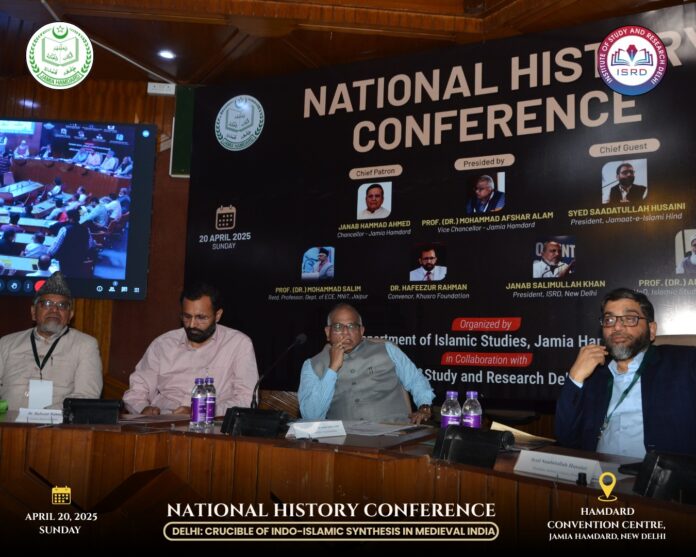
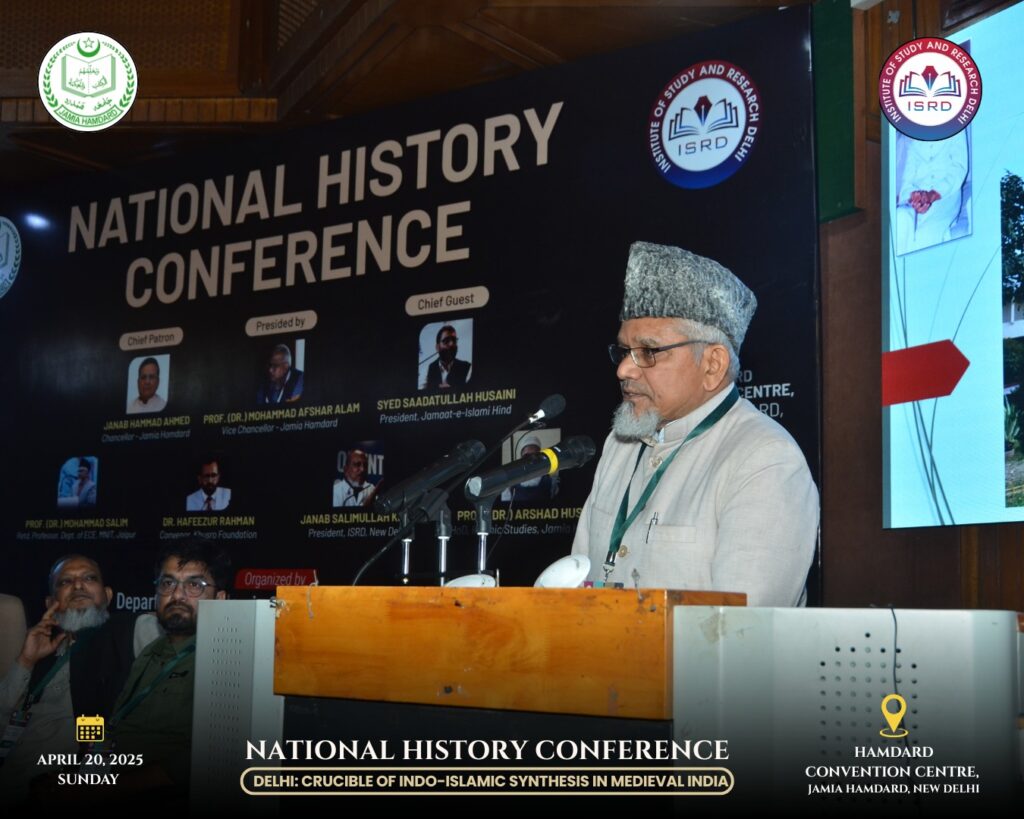
At a landmark one-day national history conference, prominent scholars, professors, and historians Sunday gathered to commemorate the unparalleled contributions of Muslims to India’s cultural and civilizational fabric. Titled “Delhi: Crucible of Indo-Islamic Synthesis in Medieval India,” the conference was hosted by the Department of Islamic Studies, Jamia Hamdard University, in collaboration with the Institute of Study and Research Delhi (ISRD), New Delhi.
Held at the Hamdard Convention Centre, Jamia Hamdard, the conference aimed to explore the profound impact of Islamic heritage on shaping medieval Indian culture, society, and governance, with a special emphasis on Delhi as the epicenter of this cultural convergence.
A wide array of research papers was presented under several sub-themes aligned with the central topic, including the Advent of Islam in North India , Educational Institutions and Knowledge Production, Indo-Islamic Architecture, Sufi Traditions and Sacred Spaces, Language and Literature, Music and Performing Arts Role in the Freedom Struggle, Calligraphy and Decorative Arts, Culinary Heritage and the Culture of Cuisine, Women’s Contributions, Science and Technology, Mughal Gardens and Economic and Administrative Innovations.
As a chief guest, Jamaat-e-Islami Hind Syed Sadatullah Husaini emphasised that the Quran repeatedly encourages the study of history and historical events to extract lessons and guidance. “If lessons are taken from history, it becomes an asset,” he asserted, adding that history serves as a mirror of society.
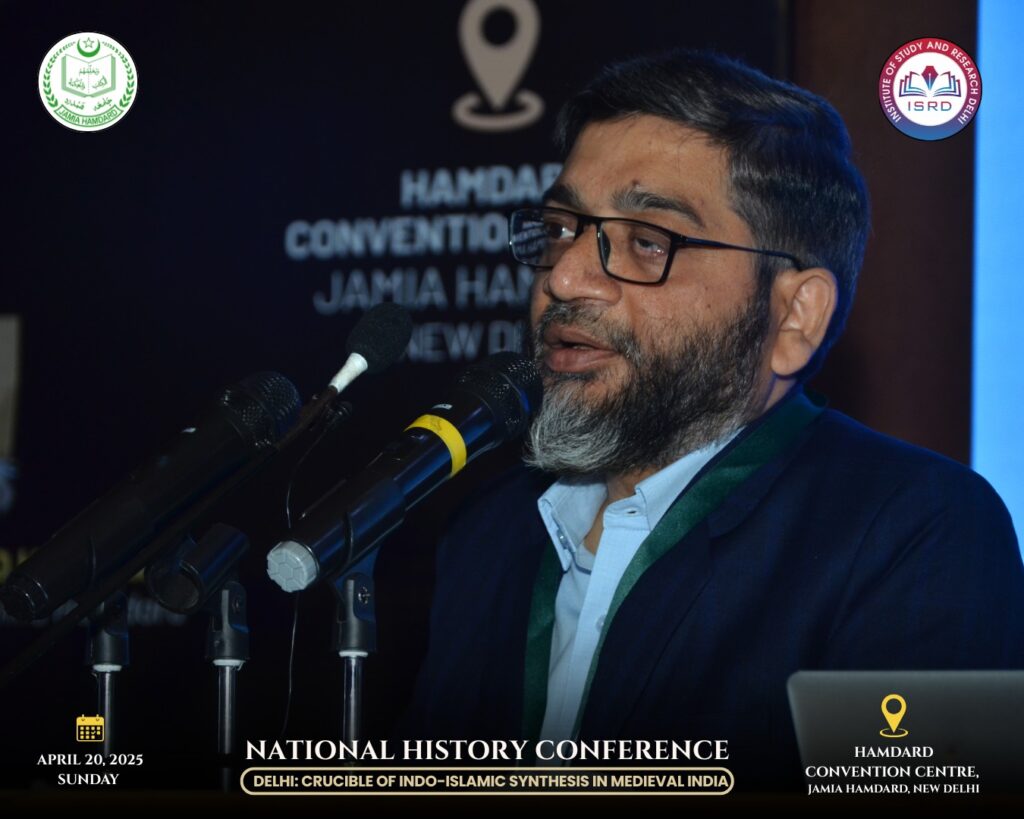
Refuting the prevailing negative narratives surrounding Muslims in India, Husaini remarked, “Muslims are not outsiders or foreign invaders. They are developers, not destroyers; builders, not colonizers; inheritors, not intruders.” He highlighted how the Delhi Sultanate acted as a conduit, connecting India with the thriving global centers of knowledge in the Muslim world.
He cited the example of Sanskrit scholars and experts in numerics being recognized and honored in the court of the Abbasid Caliphate. The Arabs, he noted, never appropriated the intellectual achievements of Indian scholars but instead gave them due credit. “Muslim Sultanates helped disseminate India’s hidden treasures of knowledge across the globe,” he stated.
Husaini also praised the architectural marvels of the Delhi Sultanate, such as the Qutub Minar, calling them a testament to the era’s artistic grandeur. He emphasized that the most valuable contribution of Muslim rulers was the promotion of unity and human equality, bringing together people across religions, castes, and classes under a shared identity of humankind—a concept Allama Iqbal referred to as “Wahdat-e-Khaas Quwwat” (special power of unity).
Referencing Maulana Abul Kalam Azad, he recalled Azad’s fervent appeals to Muslims at the time of Partition to remain in India, invoking their emotional and civilizational connection to iconic Islamic monuments such as the Taj Mahal, Red Fort, and Qutub Minar.
Dr. Afshar Alam, Vice Chancellor of Jamia Hamdard University, presided over the inaugural session. He provided a historical overview of Islamic rule in India, tracing it from Mohammad Ghori’s arrival in the 12th century to the British colonial era, covering the Slave, Khilji, Tughlaq, Sayyid, Lodhi, and Mughal dynasties.
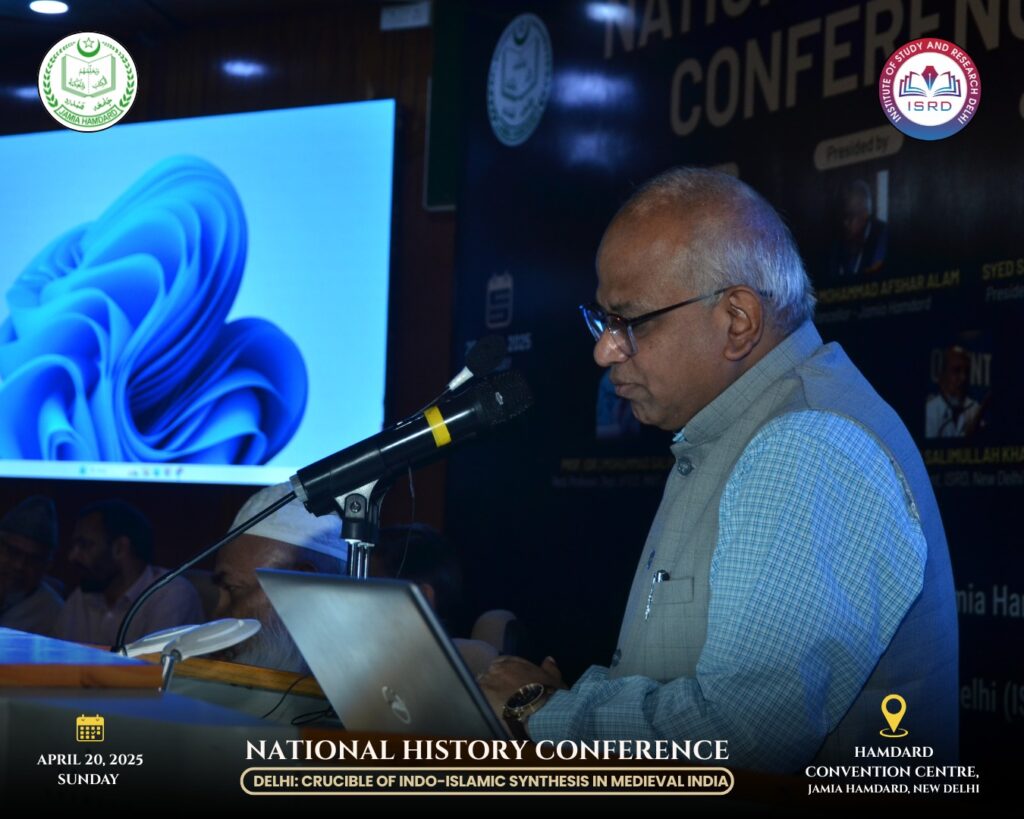
He emphasized how Delhi became the nucleus of Indo-Islamic cultural fusion, with Central Asian and Persian architectural styles merging with indigenous Indian designs. This, he said, resulted in a unique Indo-Islamic architectural identity, visible in the city’s rich heritage.
Alam also elaborated on the contributions of the Islamic period in education, science, music, literature, governance, and social reform, asserting that this synthesis laid the foundation of what is now referred to as South Asian culture. “This fusion didn’t just shape Indian civilization—it gave it depth, diversity, and resilience,” he concluded.
Dr. Hafeezur Rahman, convenor of the Khusro Foundation and an expert in Urdu and Persian, delivered speech as a special guest. He reflected on historiography, distinguishing between pro-establishment and anti-establishment narratives, and praised Islam’s contribution to historical objectivity through the tradition of “Asma al-Rijal” (biographical evaluation of narrators).
He noted, “It is often said that the Mughals gifted India three unparalleled treasures: the Taj Mahal, Mirza Ghalib, and the Urdu language.” Rahman particularly celebrated the role of Sufi saints, especially Hazrat Nizamuddin Auliya and his disciple Ameer Khusrau, a 13th-century polymath and the founding father of the Urdu language. Khusrau, he said, was also a distinguished scholar in astrology, astronomy, and music.
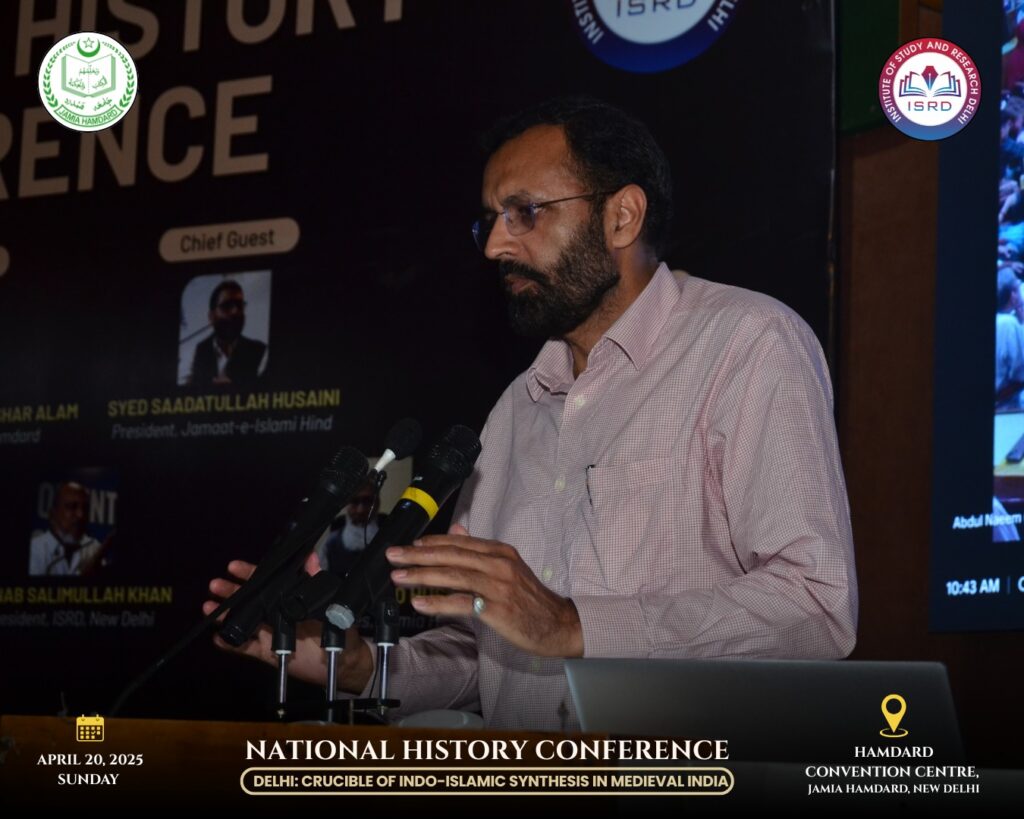
Quoting Khusrau’s oft-repeated teaching from his spiritual mentor—”Agar duniya aap ke raste mein kaante bichhaye, to tum phool bichhao” (If the world throws thorns in your path, you lay down flowers)—he emphasized the Sufi message of love and resilience.
Dr. Hafeezur Rahman further illustrated how cultural synthesis led to creations like biryani and sherwani, both products of Indo-Islamic fusion. He expressed hope that the academic papers presented at the conference would become historical documents in their own right.
Dr. Fazlur Rahman, Assistant Professor in the Department of Islamic Studies, anchored the conference and gave a brief introduction to its aims.
ISRD Secretary and Organizer Asif Iqbal outlined five core objectives and sub-themes of the event. Asif Iqbal emphasized that civilizational interactions—such as those between Islam and Indian culture—often result in positive transformations. He stated that Muslims, while introducing new cultural and civilizational values to the subcontinent, also embraced indigenous practices. “This mutual exchange reshaped the cultural and intellectual landscape of the region,” he said.
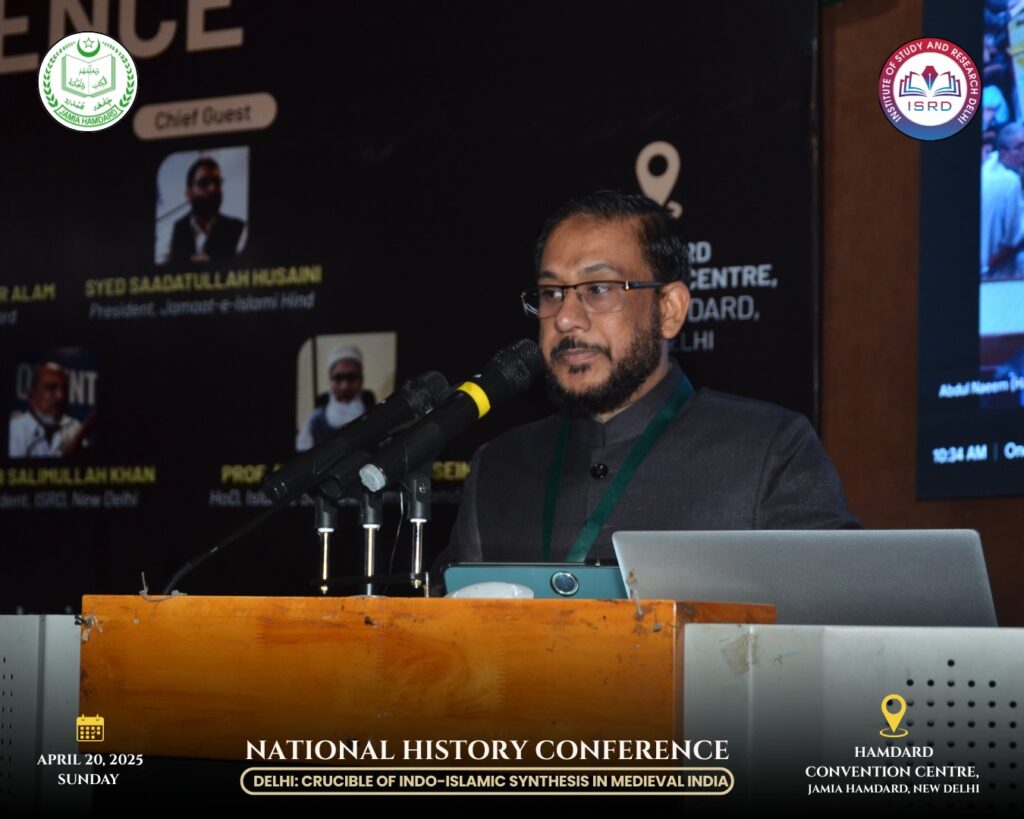
ISRD President Saleemullah Khan offered reflections on the ethical teachings of Prophet Muhammad, citing his instruction to Hazrat Ali to return belongings even to those who plotted to kill him during the Hijrah (migration to Madinah). He also quoted Urdu writer Rashidul Khairi, who praised the skills, cooperation, and intelligence of Delhi’s women during the medieval era.
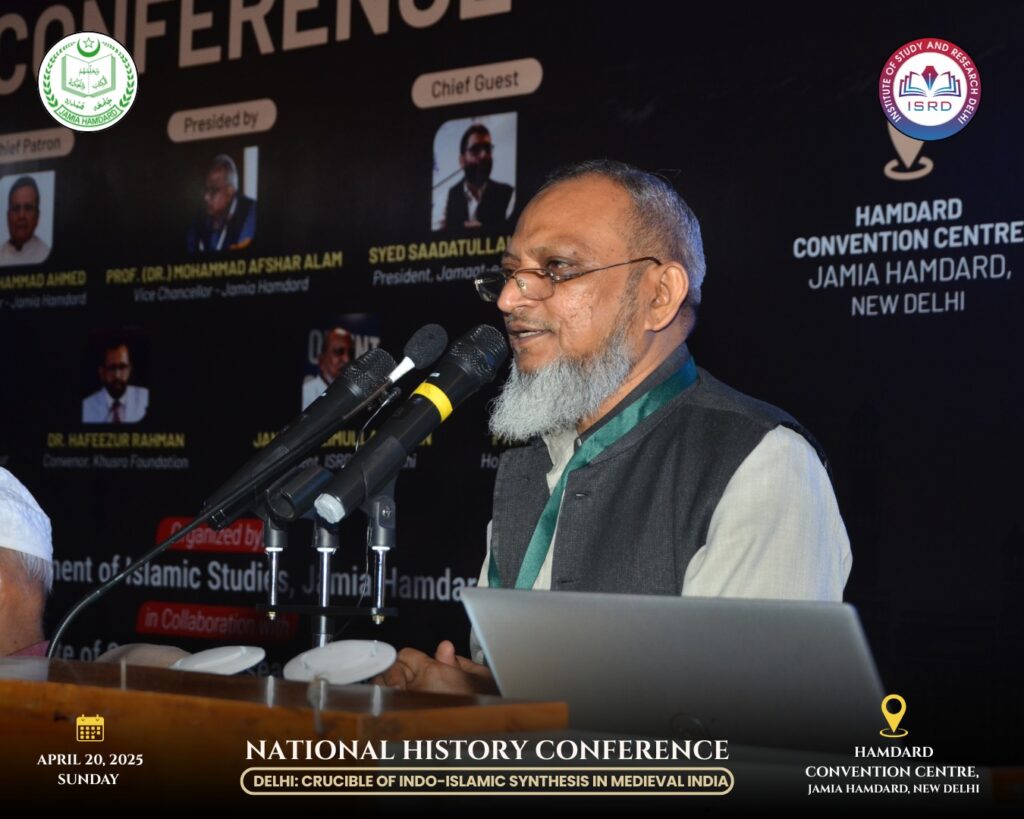
Professor Arshad Hussain, Head of the Department of Islamic Studies at Jamia Hamdard, delivered the welcome address and warmly greeted all dignitaries and guests.
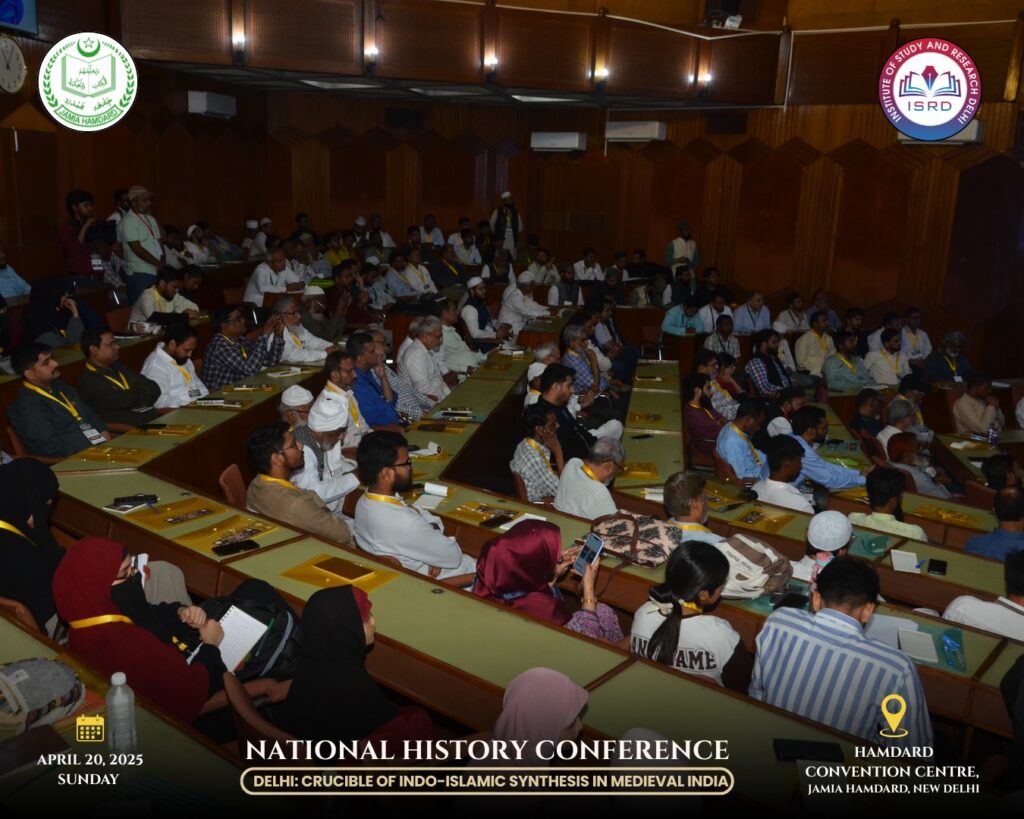
The day featured parallel academic sessions, with 50 research papers presented by scholars and students from institutions including Jamia Millia Islamia (JMI), Aligarh Muslim University (AMU), Jawaharlal Nehru University (JNU), Maulana Azad National Urdu University (MANUU), National Institute of Technology (NIT), Delhi University, and Jamia Hamdard.
Sessions were chaired by eminent professors such as Prof. Obaidullah Fahad (AMU), Dr. Faizan Ahmed (National Archives of India), Dr. Mohiuddin Ghazi (former Dean, Al Jamia Al Islamia, Kerala), Prof. Azizuddin Husain, and Prof. Parvez Nazir. Guest speakers received mementoes, and research scholars were presented with certificates.
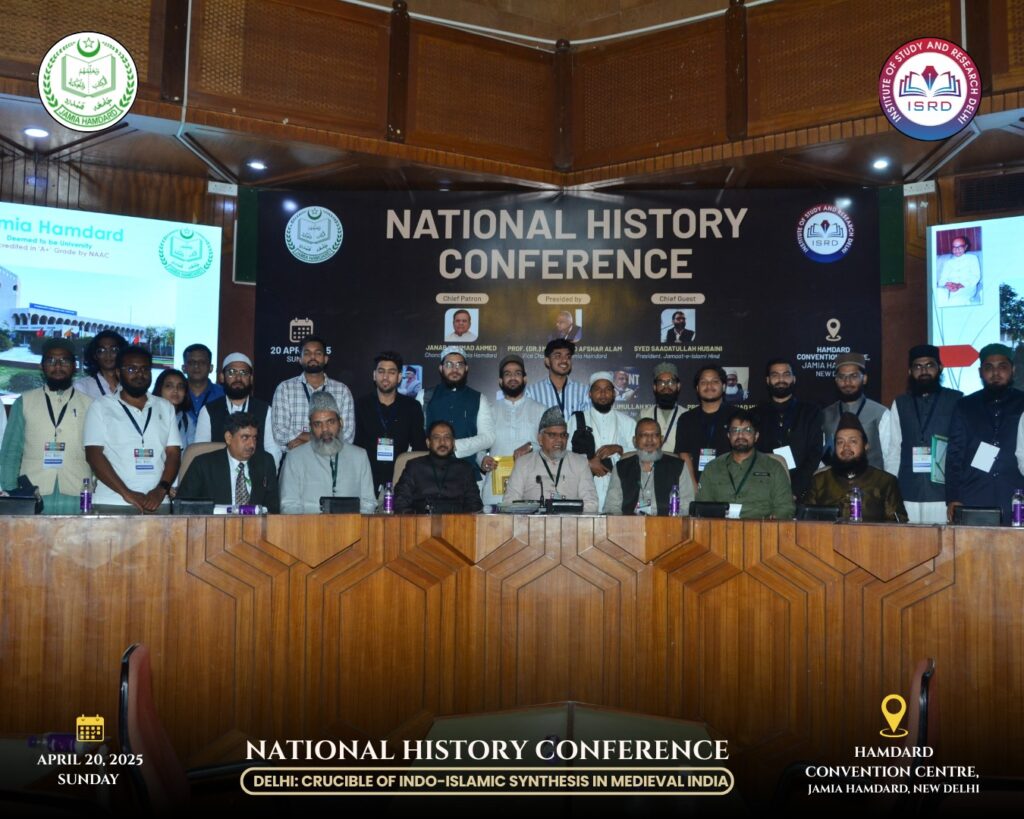
In the valedictory session, Prof. Mohammad Salim Engineer, retired professor from MNIT Jaipur, addressed emerging researchers, emphasizing key research ethics—many of which, he noted, align with Islamic principles. These include academic honesty, objectivity, peer review, and depth over volume. “There’s no shortcut to excellence,” he advised. “Hard work can even surpass intelligence.”
In light of the current communal atmosphere, he urged the Muslim community to take charge of creating history, not just recalling it.
Abdul Kalam, co-convenor of the event, delivered closing thanks, while Dr. Shadab Musa, Assistant Secretary of Jamaat-e-Islami Hind, offered a speech reflecting on the present socio-political environment.
source: http://www.indiatomorrow.net / India Tomorrow / Home> Breaking News> Education> National Interest / by Anwarulhaq Baig / April 21st, 2025