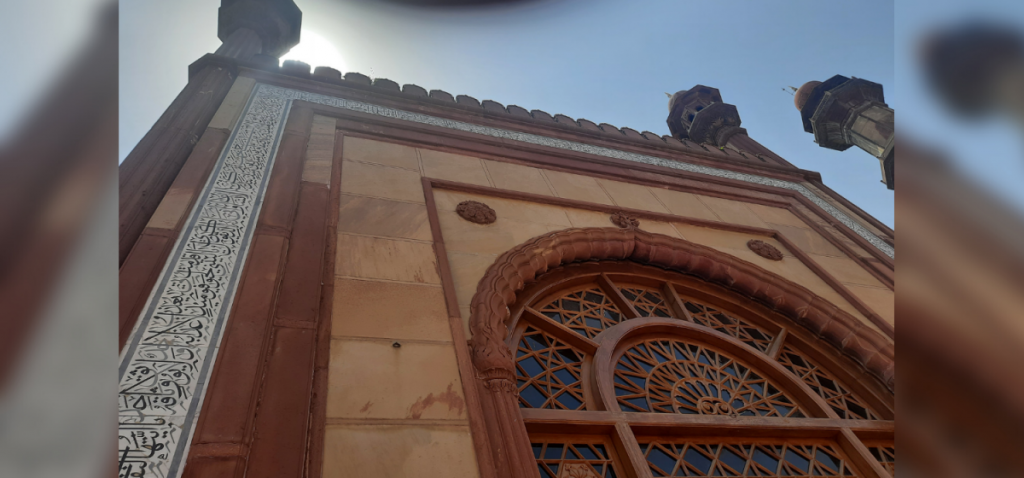
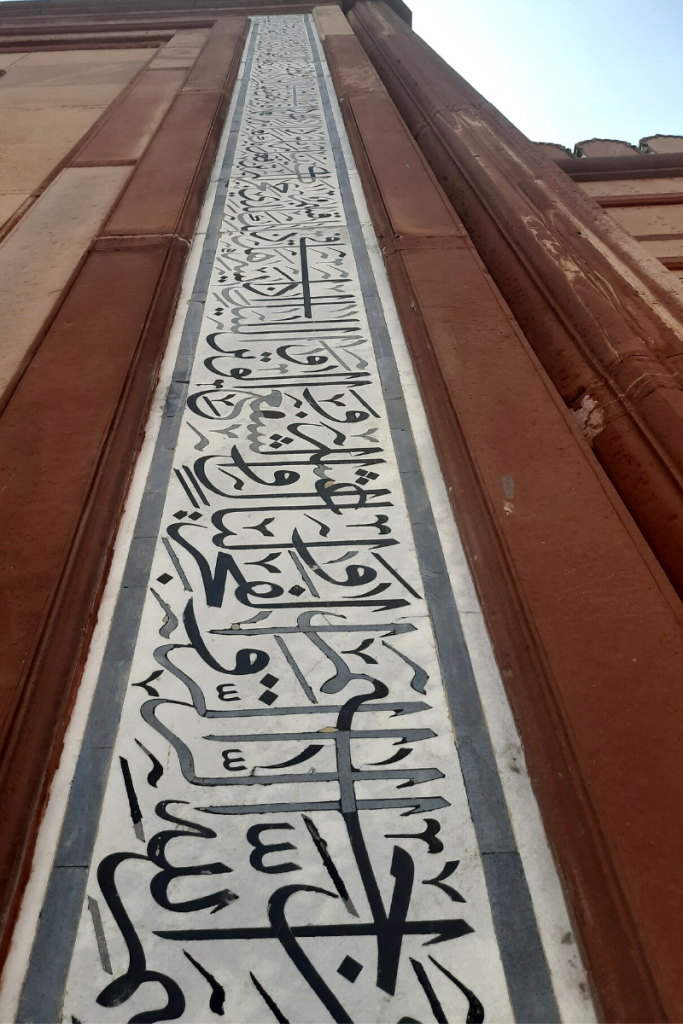
The imposing walls of both the Taj Mahal and Aligarh Muslim University’s Jama Masjid have Quranic verses crafted onto white marbles in black paint.
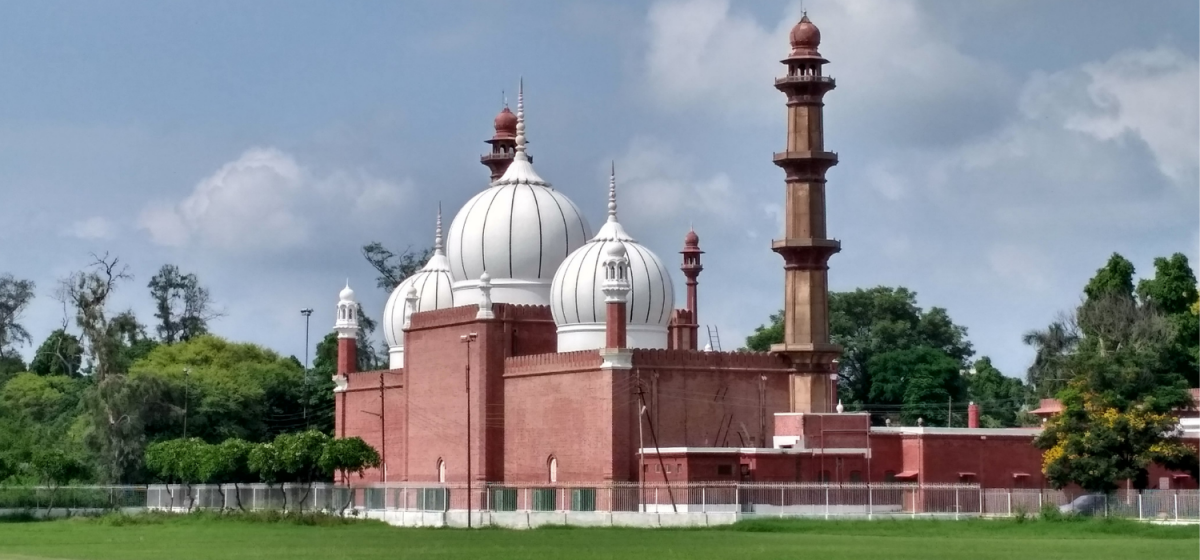
Jama Masjid on Aligarh Muslim University campus. Photo: Author provided.
Constructed nearly 250 years apart, the Taj Mahal in Agra and Jama Masjid at the Aligarh Muslim University (AMU) have an interesting connection.
The construction of the Taj Mahal began in 1632 and was completed in 1653, while the construction of Jama Masjid at AMU began in 1879 and was completed in 1915.
While the Taj Mahal, which is the tomb of Mughal emperor Shahjahan and his wife Mumtaz Mahal, attracts millions of visitors every year, AMU’s Jama Masjid is the main mosque of the university. AMU’s Jama Masjid is, perhaps, the last enduring symbol of the Mughals, constructed when the Mughals lost their kingdom during British rule.
A surprising connection
As one enters the Taj Mahal, beautiful calligraphy adorns all four corners. Several verses from the Holy Quran crafted in black calligraphy on white marble can be seen. This is a unique form of calligraphy, and expert artisans from Persia were involved in creating it. Similar calligraphy can be seem inscribed at the tomb of Mughal King Akbar at Sikandra, Agra, and also at the AMU Jama Masjid.
A closer look at the white marble with Quranic verses in black colour adorning the walls of Jama Masjid in Aligarh Muslim University. Photo: Special arrangement.
In fact, it is believed that the artisan responsible for the calligraphy at the Taj Mahal also brought his expertise to AMU’s Jama Masjid.
Since there is a difference of nearly 250 years between the construction of both architectural wonders, it is interesting to study how this was possible.
During Shah Jahan’s regime, several buildings were constructed, including the Taj Mahal and Delhi’s historic Jama Masjid. The calligraphist used was the same.
Professor Nadeem Ali Rezavi of the Centre of Advanced Studies, Department of History, Aligarh Muslim University, says that the master calligraphist in most of the buildings constructed during Shah Jahan’s regime is the same person.
“His name was Abdul Haq, and later due to his craftsmanship, his rank was elevated. He was given the title of Amanat Khan. In fact, he even signed the bands on this calligraphy with dates,” says Rezavi.
Still, there is a gap of over two centuries between these two buildings, Taj Mahal and AMU’s Jama Masjid.
The connection between the two monuments becomes clear with the involvement of Akbarabadi, one of Shah Jahan’s queens. Her original name was Aiza-un-Nisa. She, in 1650, commissioned the construction of a mosque situated in Daryaganj, Delhi, during the same period. In that mosque, Quranic calligraphy was done by the same artisan in black paint on white marble. This was around the same time as when the Taj Mahal was built.
After nearly two centuries, the Daryaganj mosque was demolished by the Britishers following the 1857 revolt. This was when Britishers gained control over the Red Fort, and the last Mughal emperor Bahadur Shah Zafar was sent in exile to Rangoon. They destroyed many buildings which were supposed to have harboured the rebels. At the site of the destroyed Akbarabadi Mosque, a park was developed and came to be known as Edward Park in 1911, which is now called Subhash Park.
During the same period, Sir Syed Ahmed Khan, the founder of the Mohammadan Anglo Oriental College (which later became AMU) felt the oppression against Muslims after the revolt. He nurtured the idea of setting up an educational institution to try and uplift the community.
A visionary man, Sir Syed had the taste for collecting things, particularly artefacts which had archaeological and historical importance. He was aware of the demolition of the Akbarabadi Mosque in Delhi.
As per the AMU Gazette, the scraps generated at the demolished Akbarabadi mosque were sold to a dealer and later purchased by Sahabzada Suleman Jah Bahadur. These remains were thus sold after over 200 years. These were presented to Sir Syed Ahmed Khan, who planned to use them in the Jama Masjid of the educational institution.
A closer look at the white marble with Quranic verses in black colour adorning the walls of Jama Masjid in Aligarh Muslim University. Photo: Special arrangement.
The white marbles with black calligraphy now present in the Jama Masjid of AMU depict Surah Fajr from the Holy Quran. Thus centuries apart, the two buildings carry the work of the same artisan.
“Even if you compare, it is the same thing and the only difference is in the scale. The artisans are the same who have shown their skills in the construction of the Taj Mahal,” says Prof. Rezavi.
Thus AMU’s Jama Masjid is, perhaps, the last enduring symbol of the Mughals, constructed when the Mughals lost their kingdom during the British rule. On the other hand, the domes of AMU’s Jama Masjid employed techniques of the Mughal era: they are “true domes” as they were built using lime mortar and vousseurs (wedge cornered stones/bricks).
“It is a brick structure, guava-shaped, carrying white marble with black stripes. This is the last true dome. After this, the particular technology faded out, and the buildings constructed after them have concrete domes,” said Rezavi.
Later, in 2016, AMU authorities began the conservation of the Jama Masjid. Now revived at the cost of Rs 90 lakh, the Jama Masjid has a Hauz in the courtyard, three domes, seven arches and two lofty minarets cornered by a Cricket Pavilion at its rear end. Sir Syed, the founder of the institution, was also buried in the same compound.
Faisal Fareed is a senior Lucknow-based journalist.
This article went live on June fifth, two thousand twenty one, at zero minutes past seven in the morning.
source: http://www.thewire.in / The Wire / Home> History / by Faisal Fareed / June 05th, 2021
Tushar Goel’s film, ‘The Taj Story’, has reignited controversy over the Taj Mahal’s origins, claiming it is a Hindu temple rather than a mausoleum built by Mughal emperor Shah Jahan. The film’s debut highlights debates about the interplay of history and ideology in contemporary India.
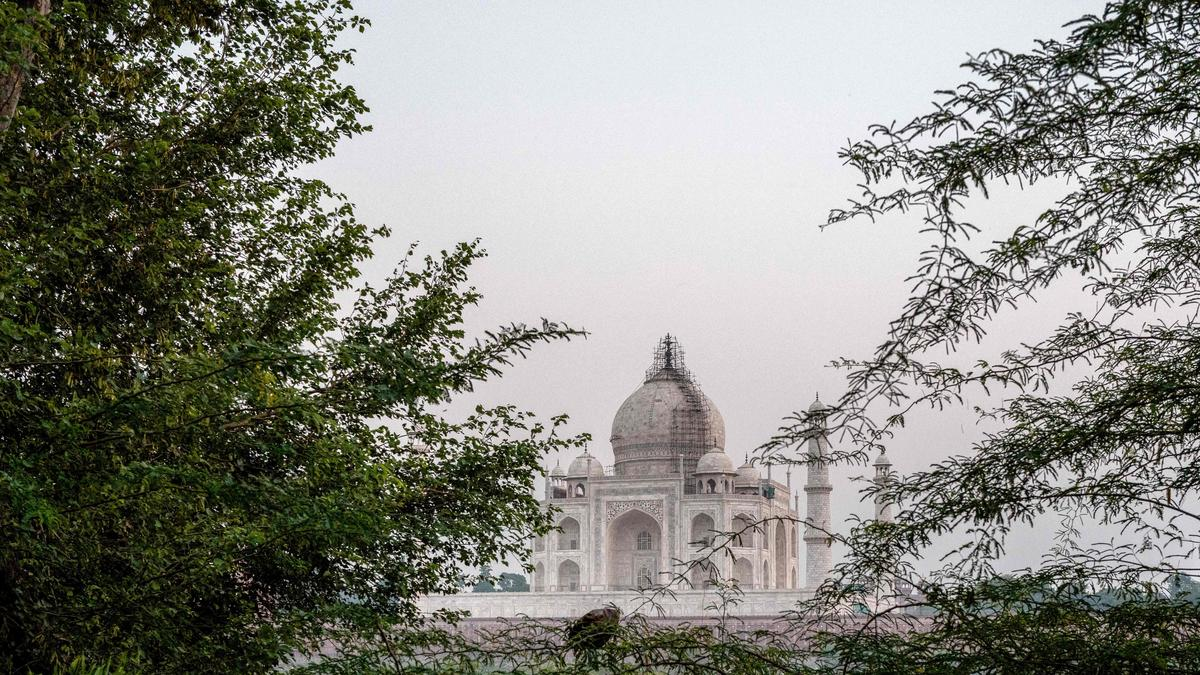
Scaffoldings are pictured as restoration work goes on at the dome of the Taj Mahal in Agra on October 17. | Photo Credit: AFP
A little over 60 years ago, Purushottam Nagesh Oak slept and dreamt. He woke up and claimed that the Taj Mahal in Agra was actually a Hindu palace going back all the way to 4th century. Friends of Mr. Oak, an English teacher-turned-lawyer-turned-journalist but never a historian, told him that the Taj Mahal couldn’t have been a fourth century structure as the technology employed in building the Taj in the 17th century didn’t exist back then. The fantasist turned a pragmatist, and Oak brought his argument forward by a few centuries. The Taj was now claimed to be a Hindu temple. This was in 1989. He wrote articles and a book too, but found no support from historians. Even the Supreme Court dismissed his claims as “a bee in his bonnet” in 2000.
But post-2014, history is like a revolving door, you enter and exit at your ease and pleasure. You pick and choose, you circumvent and invent. Dress it up as a movie and claim you are looking at history anew. That is how we get a movie like Tushar Amrish Goel’s The Taj Story, starring former BJP MP Paresh Rawal; just like we had The Kashmir Files and The Bengal Files, starring Anupam Kher and Mithun Chakraborty, all ideological partners of the Bharatiya Janata Party (BJP).
With The Taj Story, Goel goes where no historian has gone. Proof, evidence and knowledge amount for nothing as the director makes a case for the Mughal monument being actually a Hindu temple, much like the BJP leader Sangeet Som who called it alternately a Shiva temple and a monument built by a man who incarcerated his father. Mr. Som obviously couldn’t make out a Shah Jahan from an Aurangzeb and hence got mixed up. Much like Oak, oops, Goel, who sees no difference between history and mythology, facts and fantasy.
Recorded history
Talking of facts, the Taj Mahal was built by the Mughal emperor Shah Jahan after his favourite wife Arjumand Bano Begum breathed her last after bearing the last of their 14 children. Its chief architect was Ustad Ahmed Lahori. The land for her last resting place was procured from Mirza Raja Jai Singh of Amber who had inherited it from Raja Man Singh, a celebrated general of Akbar, who was Shah Jahan’s grandfather. Shah Jahan compensated Jai Singh with four havelis from the royal property for the massive haveli in which rests Mumtaz Mahal. His firman to Jai Singh, the latter’s agreement and the Mughal emperor’s subsequent letter of granting him four havelis in lieu of one, are all part of history; unlike the claim of The Taj Story which talks in terms of a massacre and genocide of the locals for fulfilling the wishes of an emperor and his consort!
The work on the tomb started in 1632 with the finest craftsmen from across the country and West Asia. The chief mason was Mohammed Hanif from Baghdad who earned ₹1000 a month for his efforts. The pinnacle was built by Qayam Khan of Lahore and its Quranic inscriptions were done by Amanat Khan Shirazi. The mosaic work was done by local Hindu workers. Above all, some 20,000 workmen toiled for 22 years to build the monument to love. Its white marble came from Jaipur, lapis lazuli from Sri Lanka, crystal from China and coral from Arabia. The monument uses the double dome technique, previously seen only in the Humayun’s tomb in Delhi, and never seen in the country before the arrivals of the Turks.
Not the first time
Over the years, many have tried to appropriate credit for its beauty and majesty. In the 17th century, it was claimed by many in the West that the architect of the Taj was Venetian Geronimo Veroneo, a jeweller by profession. Then came the claim by Mughal Beg in Tarikh-e-Taj Mahal that it was designed by Muhammad Effendi, an architect supposedly sent by the Sultan of Turkey. Effendi though was as much an architect as Oak was a historian. In the mid 19th century it was claimed that the monument was the result of the genius of Frenchman Austin de Bordeaux, a jeweller. However, Austin died in 1632, the year the work on the Taj began. With his death all claims of Austin being the Taj’s architect were buried. And facts began to be raised.
As for fantasy, well there is Goel’s film, never mind its claim of presenting the “untold history of the Taj Mahal”. The film, replete with stereotypes of kohl-lined, skullcap-donning Muslims aims at building a nation’s memory on unreasoned mythology, far removed from the well argued debates of history. Much like Oak’s view that Christianity was nothing but Krishan-Niti. Not game for any ridiculous claims in an insipid film which opened with a mere 14% attendance in the first show? Watch M. Sadiq’s 1963-saga Taj Mahal. Sure, you would remember its song, ‘Jo wada kiya woh nibhana padega’, penned by Sahir Ludhianvi and sung with much love by Mohammad Rafi and Lata Mangeshkar. Sadiq’s film with Pradip Kumar and Bina Rai in the lead cast, made no effort at replacing history with mythology.
source: http://www.thehindu.com / The Hindu / Home> Entertainment> Movies> In the limelight / by Zia Us Salam / November 07th, 2025
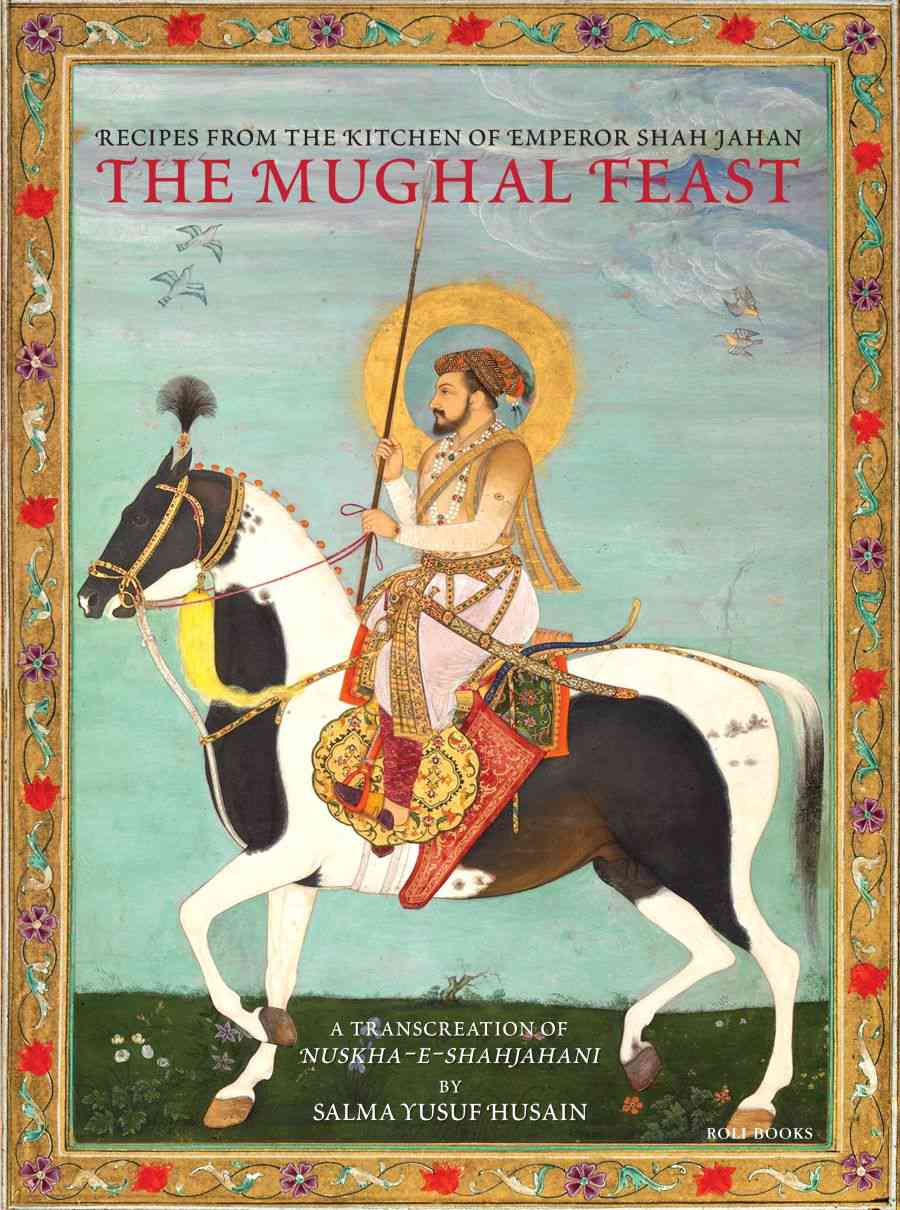
‘The Mughal Feast’ by Salma Yusuf Husain recreates the Persian recipe book ‘Nuskha-e-Shahjahani’, providing a glimpse into a bygone era of pomp and show.
Mughal Emperor Shah Jahan in his court | Google Cultural Institute/Wikimedia Commos Licensed under CC BY Public Domain Mark 1.0].
The silver twilight of Mughal civilization began with Shah Jahan. Delhi was now a sanctuary of an urbane, sophisticated court which had taste, even elegance. By early 1730 the city had absorbed various elements from neighbouring regions and witnessed a mingling of international as well as national strains and an interchange of ideas, customs and food.
The Portuguese relationship with the Mughals had already been established a long time back, along the trade routes. Hence the imperial kitchens, besides Indian ingredients, saw an additional ingredient brought by the Portuguese – the chilli. The chilli was very similar to the long pepper, already in use, and therefore did not look too unfamiliar to royal chefs, but had the hot taste. Other vegetables like potatoes and tomatoes also appeared on the scene and the food of the Red Fort became rich in colour, hot in taste, and varied as compared to the bland food of its ancestors. Qormas and qaliyas, pulaos and kababs, and vegetables in different garb, besides European cakes and puddings, adorned the table.
Cooking and serving food in the royal kitchens was a riot of colours, fragrances, experiments, table manners and protocols. The emperors usually ate with their queens and concubines, except on festive occasions, when they dined with nobles and courtiers. Daily meals were usually served by eunuchs, but an elaborate chain of command accompanied the food to the table. The hakim (royal physician) planned the menu, making sure to include medicinally beneficial ingredients. For instance, each grain of rice for the pulao was coated with silver warq, which aided digestion and acted as an aphrodisiac. One account records a Mughal banquet given by Asaf Khan, the emperor’s wazir, during Jahangir’s time to Shah Jahan – though no outsider had ever seen any emperor while dining except once when Friar Sebastian Manriquea, a Portuguese priest, was smuggled by an eunuch inside the harem to watch Shah Jahan eat his food with Asaf Khan.
Once the menu was decided, an elaborate kitchen staff – numbering at least a few hundred – swung into action. Since a large number of dishes were served at each meal, an assembly line of staff undertook the chopping and cleaning, the washing and grinding. Food was cooked in rainwater mixed with water brought in from the Ganges for the best possible taste. Not only the cooking but the way the food was served is interesting to note – food was served in dishes made of gold and silver studded with precious stones, and of jade, as it detected poison. The food was eaten on the floor; sheets of leather covered with white calico protected the expensive carpets. This was called dastarkhwan. It was customary for the emperor to set aside a portion of food for the poor before eating. The emperor began and ended his meal with prayers; the banquet ran for hours as Shah Jahan liked to enjoy his food, spending long hours at dastarkhwan.
With the passage of time, indigenization in the cooking style became obvious and certain Indian ingredients, like Kashmiri vadi, sandalwood powder, suhaga, betel leaves, white gourd, and batasha, and fruits like mango, phalsa, banana, etc., were used to give different flavours to dishes.
The arrival of every dish was a ceremony and history will never forget the pomp of those times, along with the flavours which remain only in the pages of handwritten manuscripts of those days, such as Nuskha-e-Shahjahani. Not only the imperial kitchens of the emperor, but also the bazaars of the city were charged with the smoke of different kababs, and the environment was filled with the fragrance of nahari, haleem, qormas and qaliyas. The array of breads was dazzling. Festive occasions were never complete without baqarkhani, kulchas and sheermals. Sharbat ke katore and kulfi ke matke added colour to the scenario. The city of Shah Jahan was a paradise of food with the creations of local and foreign chefs.
This luxurious way of serving and preparing food continued only till the time Shah Jahan ruled, as his son Aurangzeb did not believe in luxury, pomp and show. Unfortunately, the last years of this great emperor were unhappy. Deposed by his son Aurangzeb, Shah Jahan was imprisoned in Agra Fort and remained there for eight years until his death in 1666. Legend has it that Aurangzeb ordered that his father be allowed only one ingredient of his choice, and Shah Jahan chose chickpeas. He chose them because they can be cooked in many different ways. Even today, one of the signature dishes of North Indian cuisine is Shahjahani dal, chickpeas cooked in a rich gravy of cream.
QALIYA KHASA DO-PIYAZAH
LAMB COOKED WITH ONIONS, GREEN GRAM AND VEGETABLE | Serves: 4-6
INGREDIENTS
Lamb, cut into medium-sized pieces 1 kg
Green gram (moong dal), washed, soaked for ½ hour ¼ cup / 60 gm
Ghee 1 cup / 250 gm
Onions, sliced 1 cup / 250 gm
Salt to taste
Coriander (dhaniya) seeds, pounded 4 tsp / 20 gm
Ginger (adrak), grated 4 tsp / 20 gm
Beetroots (chuqander), peeled, cut into medium-sized pieces 3 cups / 750 gm
Turnips (shalgam), peeled, cut into medium-sized pieces 3 cups / 750 gm
Carrots (gajar), scraped, cut into cubes 3 cups / 750 gm
Rice paste 4 tsp / 20 gm
Saffron (kesar) 2 gm Freshly ground to a fine powder: Cinnamon (dalchini) ½ tsp / 3 gm
Cloves (laung) ½ tsp / 3 gm
Green cardamoms (choti elaichi) ½ tsp / 3 gm
Black peppercorns (kali mirch), ground 1 tsp / 5 gm
METHOD
1. Heat 100 gm ghee in a pan; sauté the onions and lamb with 2 tbsp water. Add the salt, pounded coriander seeds and grated ginger; cook, on medium heat, until the lamb is tender.
2. Add the beetroots, turnips, carrots and green gram with enough water to cover; cook the vegetables on low heat.
3. When the vegetables and lamb are fully cooked and at least 1 cup water remains in the pan, remove the pan from the heat and separate the lamb pieces and vegetables from the stock.
4. Temper the stock with the remaining ghee. Return the vegetables and lamb to the stock and bring to a boil. Add the rice paste and mix well.
5. Add the freshly ground spices and mix.
6. Transfer into a serving dish and serve garnished with saffron.
NARANJ PULAO
ORANGE-FLAVOURED LAMB CURRY COOKED WITH RICE | Serves: 6-8
INGREDIENTS
Oranges 4 big / 6 small
Rice 4 cups / 1 kg
Yoghurt (dahi), whisked 1 cup / 250 gm
Lemons (nimbu) 2
Sugar 2 cups / 500 gm
Saffron (kesar) ¼ tsp
Ghee 1 cup / 250 gm
Salt to taste
Dry fruits as needed
Green coriander (hara dhaniya), chopped as needed For the yakhni: Lamb, cut into pieces 1 kg
Ghee 1 cup / 1250 gm
Onions, sliced 1 cup / 250 gm
Ginger (adrak) 4 tsp / 20 gm
Salt to taste
Cinnamon (dalchini), 2 sticks 1˝
Green cardamoms (choti elaichi) ½ tsp / 3 gm
Coriander (dhaniya) seeds, crushed 4 tsp / 20 gm
Cloves (laung) ½ tsp / 3 gm
METHOD
1. Peel the oranges carefully so that the case remains intact. Remove the segments and keep aside. Sprinkle salt inside the case and float them in whisked yoghurt for an hour. Remove the cases from the yoghurt and wash with cold water. Boil the orange cases for a minute. Remove and keep aside.
2. In another pan filled with water, squeeze the juice of one lemon and boil the orange cases again. In case lemon is not available, boil in thin yoghurt liquid, simmer to make them tender.
3. Make yakhni with the lamb pieces and all the ingredients mentioned. Temper the stock with cloves.
4. Parboil the rice and keep aside.
5. Prepare a sugar syrup of one-string consistency; keep aside.
6. Remove the seeds and the skin of each segment and coarsely chop and mix with the yakhni. Take 1 tbsp cooked rice and mix it with saffron. Cook on low heat and simmer for 5 minutes. Remove and keep aside.
7. In a separate pan, spread the yakhni, evenly pour 3 tbsp syrup and simmer, when the syrup is absorbed, spread the rice and pour some ghee. Cover the pan and put on dum. While serving, transfer the pulao into a serving dish and place the orange cases over it. Fill one case with almond halwa, another with pistachio halwa, another with saffron and orange rice and another with salted minced lamb*. Garnish all with dry fruits and chopped coriander.
*You can buy almond halwa, pistachio halwa and salted minced lamb at a grocery store, or make them separately. You can also choose your fillings as per your liking.
GURAK KABAB
CHICKEN STUFFED WITH MEAT AND SLOW-COOKED ON CINNAMON BED | Serves: 4
INGREDIENTS
Chicken, cleaned, washed, skinned 2 (700-800 gm each)
Onion juice ½ cup / 125 ml
Ginger (adrak) juice ¼ cup / 60 ml
Salt to taste
Vegetable oil 3 tbsp / 45 ml
Lamb, minced 400 gm
Onion, medium-sized, sliced 1
Coriander (dhaniya) seeds, crushed 1 tbsp / 15 gm
Ginger (adrak), chopped 1 tbsp / 15 gm
Saffron (kesar), dissolved in milk 1.5 gm
Yoghurt (dahi), whisked ¼ cup / 60 gm
Cinnamon (dalchini) sticks to cover the bottom of the pan 8-10
Ghee ½ cup / 125 gm
Black gram (urad dal) flour ½ cup / 125 gm Freshly ground to a fine powder: Cloves (laung) 1 tsp / 5 gm
Cardamom (elaichi) 1 tsp / 5 gm
Black peppercorns (sabut kali mirch) 1 tsp / 5 gm
METHOD
1. Prick the chicken all over with a fork.
2. Marinate the chicken with onion juice, ginger juice and salt; rub well inside and outside the chicken and keep aside for 30 minutes.
3. Heat the oil in a pan; add the minced meat, onion, crushed coriander seeds, chopped ginger and salt. Stir and cook until the meat is tender.
4. Smoke the cooked mixture.
5. Fill the chicken with the minced lamb and tie both legs with twine to keep the shape of the chicken intact.
6. Mix the saffron and ground spices with the yoghurt.
7. Apply the yoghurt and saffron mixture all over the chickens evenly.
8. Spread the cinnamon sticks on the bottom of the pan. Place the chicken on the cinnamon bed and pour the ghee around.
9. Make a semi-hard dough of black gram flour. Cover the pan and seal with this dough.
10. Place the pan on low charcoal heat and cook on dum for 4 hours.
11. Remove the cover, take the chicken out, cut into four pieces and serve over the mince.
BAQLAWA
LAYERED SQUARES GARNISHED WITH PISTACHIOS | Yield: 10
INGREDIENTS
Egyptian lentil 1 cup / 250 gm
Ghee 1 cup / 250 gm
Ginger (adrak) 4 tsp / 20 gm
Salt 8 tsp / 40 gm
Wholewheat flour (atta) 4 cups / 1 kg
Kid fat 4 tsp / 20 gm
Sugar 2 cups / 500 gm
Pistachios (pista), pounded 8 tsp / 40 gm Freshly ground to a fine powder:
Cinnamon (dalchini) ½ tsp / 3 gm
Cloves (laung) ½ tsp / 3 gm
Green cardamoms (choti elaichi) ½ tsp / 3 gm
METHOD
1. Boil the lentil until soft. Remove from heat and drain. Fry the lentil in little ghee with ginger and salt. Then add enough water to cook the lentil, ensuring that it is not mashed and each grain looks separate. Sprinkle the ground spices and smoke the mixture.
2. Knead the flour into a hard dough (in summer one part ghee and two parts kid fat is used while in winter the proportions should be equal).
3. Divide the dough equally into small portions. Roll each portion out into a thin poori, apply ghee and dust with dry flour, sprinkle the lentil mixture lightly and cover with another poori. Repeat the process with 5-7 pooris.
4. Shape them into squares and secure the edges with water.
5. Heat the ghee in a pan; deep-fry the squares. Remove and keep aside to cool.
6. Make a sugar syrup and soak the fried squares in it. When the syrup is absorbed, sprinkle pounded pistachios.
Excerpted with permission from The Mughal Feast: Recipes from the Kitchen of Emperor Shah Jahan, a transcreation of Nuskha-e-Shahjahani by Salma Yusuf Husain, Roli Books.
source: http://www.scroll.in / Scroll.in / Home> Magazine> Book Excerpt / by Salma Yusuf Husain / May 18th, 2019
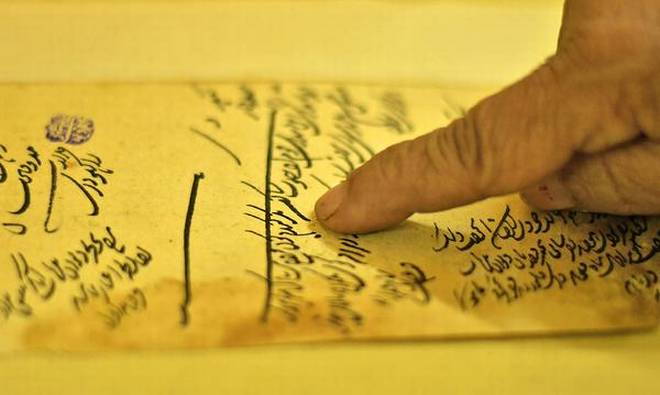
The king’s notes: The Yaddasht-i-Ahkam-i-Muqaddas with Aurangzeb’s imperial instructions. | Photo Credit: G. Ramakrishna
1.5 lakh indelible ink documents preserved in Hyderabad
Think Mughals and you think of Delhi and Agra. But few know that it is Hyderabadthat houses the largest collection of written communications of their reign.
The Telangana Archives and Research Institute holds a whopping 1.55 lakh documents — all on handmade paper — including 5,000 from the period of Shah Jahan (1628-1658) and another 1.5 lakh of Aurangzeb (1658-1707). No other archive in the country, not even the National Archives in New Delhi, boasts of such a collection: it gives a graphic picture of the mansabdari system, military administration and revenue machinery of the Mughals in the Deccan. Written in Persian in Shikasta script, cursive style, the documents are linked and arranged in chronological order — date, month and regnal year-wise.
Slew of orders
The documents include Farman (order of the emperor), Nishan (order of a member of the royal family), Yaddasht-i-Ahkam-i-Muqaddas (memorandum containing imperial orders), Parwana (orders issued by higher authorities), Siyaha-Huzur (proceedings of the provincial court), Roznamcha-i-Waqai (daily news report), Qabzul Wasil (bill payments) and Arz-o-Chihra (documents on personnel and horses).
Aurangzeb spent 13 years as the subedar of Deccan during the reign of Shah Jahan and had vast experience in political and other matters. Even after he ascended the throne on July 25, 1658, he continued to focus on the Deccan to check the activities of his rebellious son Mohammed Akbar and on conquering Bijapur and Golconda, which he did in 1687.
According to State Archives director Zareena Parveen, the accountant-general of the erstwhile Hyderabad State, Syed Muhibuddin, went to Aurangabad (the headquarters of the Mughals) for an inspection in 1916 when he discovered a large number of old documents lying in the vaults of Fort Ark.
He took keen interest in preserving them and reported the matter to Daftar-i-Diwani, the administrative wing of Hyderabad State, headed by the superintendent Syed Khurshid Ali. Steps were taken to shift them to Daftar-i-Diwani, which eventually became State Archives. The paper, made by Chinese professionals, has withstood the vagaries of time. The papers remain intact even after water seeped into the archives a few years ago. “In fact they became brighter as it washed away the acidic material that covered the indelible ink used by the Mughals,” said Ms. Parveen.
An expert in Persian herself, Ms. Parveen arranged the documents chronologically, deciphering the contents, and put them in non-acidic dockets.
The documents reveal Aurangzeb’s administrative skills. The Yaddasht-i-Ahkam-i-Muqaddas shows reports on recommendations of pay hikes for staff sent to the emperor, who also had spies to report on negligence, and actions against the government.
source: http://www.thehindu.com / The Hindu / Home> News> Cities> Hyderabad> Sunday Special / by M. Rajeev / Hyderabad – August 11th, 2018
Mughal emperor Shah Jahan’s Urs (birth anniversary) celebrations are to begin from May 3. This is the only time of the year when the graves of the royal couple at Taj Mahal are opened to the public. An 870m multi-colour chadar, representing different religions, will be laid on the grave of the emperor. Entry to the white marble mausoleum Taj Mahal will be free for three days.
While on May 3 and 4 tourists entry will be free from 2pm to sunset. On the last day, May 5, entry will be free throughout the day. This will be Shah Jahan’s 361st birth anniversary celebrations which will begin with the washing of the graves of the emperor and his queen Mumtaz Mahal.
Every year Khuddam-e-roza (traditional caretakers of the Taj) committee offers a long multi-colour chadar, representing different faiths of the country, at the grave during Urs. Last year it was 810 metre. And this has been increased to 870 metre this year and will be offered on May 5, last day of the event. The unique thing about this offering is that the chadar is made by stitching pieces of cloths presented to the committee by people from different religions on fulfillment of their wishes. Moreover, the chadar starts its journey every year from a religious site, be it a temple, church or mosque.
According to committee member it is the seventh generation which is offering the chadar at the Mughal emperor’s grave. The occasion of urs is chosen to spread message of communal harmony in the society.
Syed Munawwar Ali, president of Taj Mahal Masjid Intezamiya committee, said: “Following the age-old tradition, shehnai and qawwali sessions will be held on all the three days at the royal gate.”
A meeting of senior officials of CISF, UP police, district administration and Archaeological of Survey of India was held to discuss the arrangements made for the annual celebration.
source: http://www.timesofindia.indiatimes.com / The Times of India / News Home> City> Agra / TNN / May 02nd, 2016
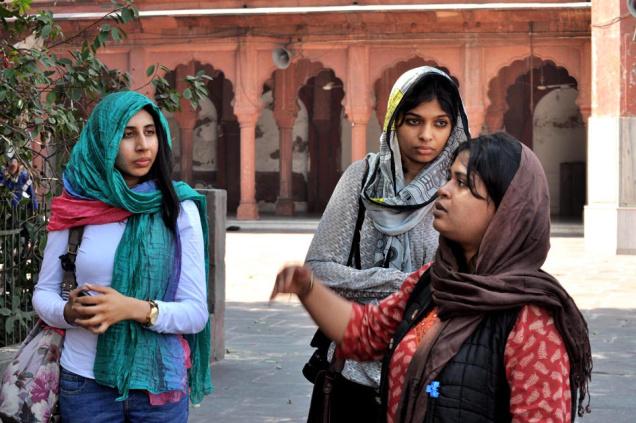
Participants interact at the heritage walk through the Walled City of Delhi on Saturday. / The Hindu
On International Women’s Day, a group of 23 heritage enthusiasts participated in a storytelling walk in the Walled City of Delhi. The walk created awareness about women who stood up for their rights and honour but have long been forgotten.
Barring two men, the rest of the participants were women who satiated their hunger for knowledge by frequently interrupting the host, an excellent raconteur.
Yuveka Singh, who conducted the walk and has experts on archaeology and history in her team, said the walk was conducted after methodical research work and interviewing women living in Old Delhi.
At 10 a.m., the group congregated at the Red Fort main gate. “The two-hour walk was an attempt to know a little more about some fascinating women who are more well known to some of the older residents of the Walled City. We spoke about Razia Sultana because she was far ahead of her times and involved in active politics even before she became the ruler. We wanted the participants, particularly women, to feel that they need to derive inspiration from women of the medieval period and speak up for their rights,” said Ms. Singh, a storytelling expert.
The first visit was to a dilapidated palace of an 18th Century nautch girl, who through her charisma and wit became the ruler of Sardhana.
The group had to pass through labyrinthine streets in the Bhagirath Palace area in Chandni Chowk but a look at the yellowish white edifice, which has nomenclature of erstwhile Lloyd’s Bank Ltd inscribed on it, made them scream with joy. The heritage building is one of the earliest colonial buildings with Greek pillars, which grace its front porch.
Begum Samru’s haveli was the first destination because she played a significant role in saving Delhiites from getting slaughtered by an invading force. “Our visit to Begum Samru’s haveli was a fruitful one as I was able to tell how this courtesan became a ruler of a principality near Meerut. And we also entered the haveli and saw the condition it is in,” said Ms. Singh.
The next destination was the famous Jain temple of Chandni Chowk. This was done to show the syncretic traditions of the Walled City, where Hindus and Muslims have lived peacefully for generations.
The walk concluded with a visit to the Fatehpuri Masjid.
During the walk, participants also learnt about the women in Shah Jahan’s life.
For history enthusiast Jahanara Rabia Raza, the walk gave her an insight into the lives of women who were brave, assertive and not willing to get subjugated by men. “Though I studied History at Delhi University and gave my papers on Razia Sultan, I did not know that the empress used to roam around after covering her countenance with a purdah and smoked hookah with men. She must have had guts to do all that during that period,” she said.
source: http://www.thehindu.com / The Hindu / Home> News> Cities> Delhi / by Madhur Tankha / New Delhi – March 09th, 2014
![Mughal Emperor Shah Jahan in his court | Google Cultural Institute/Wikimedia Commos Licensed under CC BY Public Domain Mark 1.0].](http://www.mpositive.in/wp-content/uploads/2019/05/MughalCookBook01MPOs18may2019.jpg)