Tag Archives: Shahryar

Athar Siddiqui breaks away from tradition and pens some highly evocative sketches

Sahranpur, UTTAR PRADESH / NEW DELHI :

The evocative recapitulation of eminent personalities provides a quick, candid, exquisite and scrupulous portrayal of those who retain their abiding presence without being physically present in the world.
The unprecedented acceptance of monolingualism has put a big question mark on the existence of numerous languages through which people stitch up a warm social rapport and seek to fulfill their cultural aspirations. India, an awe-inspiring repository of innumerable dialects, languages and different linguistic traditions, finds it nerve-racking to carry through the challenges thrown open by the technology-savvy language-English. The domination of English has taken a heavy toll on regional languages, and Urdu, once considered a significant link language, is no exception. Though Urdu is widely used as a spoken language, and its sensitively rendered poetry gets across the country, its script has been fading away with bewildering speed.

It aches much to realize that the popularity draws its sustenance from its oral rendering, and familiarity with its distinct script has been melting away steadily. Barring some notable exceptions, only faculty members and research scholars associated with various departments of   Urdu of the universities and colleges use Urdu as the medium of trifling academic discourse. At a time when Urdu faces the threat of obsolescence,   the gleam of hope emerges from the citadel of learning, Aligarh, where academicians not belonging to humanities draw on Urdu to initiate a perceptive discourse on a plethora of issues without bringing rhetorical flourish into play.

Professor Saeeduz Zafar Chagatai (Physics), Professor  Faseeh Ahmad Siddiqui (Chemistry), Professor  Athar Siddiqui (Zoology), Professor Shaan Mohammad (Political Science), Professor Iftikhar Alam Khan (Museology), Professor Zilur Rehman (Unani Medicine), Professor Mohammad Sajjad( History ), Professor Zafar Mahfooz Nomani (Law) Dr Asad Faisal Farooqui (Mass Communication) and the like seek to strengthen non-fiction prose in Urdu.

Autobiography, memories, diary, letters, sketches and anecdotal scrolls are much-adored genres of non-fiction prose, but in Urdu, they usually betray a strong sense of gushiness and sickening self-adulation. The preponderating narrative of reminisces does not go well with the celebrated author, Professor Athar Siddiqui, whose evocative recapitulation of eminent personalities appeared.

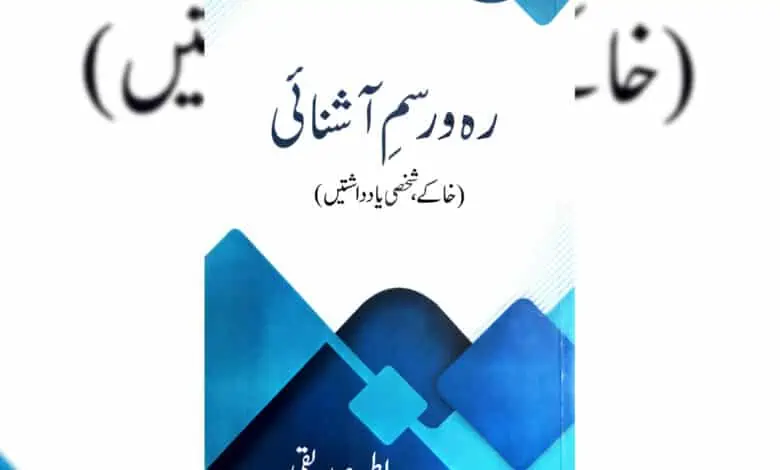
The book Rahe wa Rasm-e-Aashnai (sketches and personal memoirs) provides a quick, candid,   exquisite and scrupulous portrayal of those who retain their abiding presence without being physically present in the world.

Professor Athar Siddiqui, a widely recognized scientist, has produced a captivating narrative of his eventful life, Main Keya Meri Hayat kaya, with disarming humility and jotted down travelogues vividly calling attention to down reaching human experiences that frequent foreign travels produce. Interactive media frequently carry intriguing stories featuring commonplace occurrences. The stories with a strong sense of moral tutoring dished out by the digital world need to be shared with non technology conversant Urdu knowing people.

He left Professor Athar Siddiqui to supplement what had been missing and started translating these pulsating stories into Urdu. It was left to Professor Athar Siddiqui to supplement what had been missing, and he translated these pulsating stories into Urdu.

Tahzibul Aklaqh, a prestigious periodical launched by Sir Syed in 1870, started serializing it with a suggestive title Hairat Sarai Ki Kahaniyan (The stories of wonderland), and two volumes of these laconic and absorbing stories have appeared so far.

He meticulously edited two autobiographies of two illustrious alums of Aligarh Muslim University–Dr. Sheikh Mohammad Abdullah (founder of women’s college, AMU) and Nawab Ahmad Saeed Khan Chattari ( former Governor of Uttar Pradesh). He had astutely done over translating books on Shaheryar and Musa Raza.

Athar Siddiqui’s recently published book, Rah-o-Rasam-e – Aashnai,” creatively maps out the accessible and unchartered terrains of thirty-five personalities in candour-driven idiom, and he hardly holds with the popular notion that put a lock on showing the slightest discourtesy to the deceased. The author asserts, “It is widely mentioned that the sketch writer must not use any indecent or improper word for those resting in the peace. If this sort of exhortation is adhered to, then the sketch, personal article and memories will be read as appreciation and admiration-filled text. If history writing sticks to this principle, then the authentic history of any period could not be produced. I do not buy this argument.”


The subtle wised-up mélange focuses on nine creative writers such as Shahryar, Iqbal Matin, Sajida Zaidi, Qazi Abdus Sattar, Professor Mukhtar Uddin Arzoo, Syed Hamid, Lateefuz Zaman and a couple of close relatives, teachers, friends and former vice-chancellors.

Iqbal Matin, whose awe-inspiring artistic sensibility could not get him the recognition across the country he fully deserved, has come in for a  refined exploration. Athar Siddiqui’s reminiscence is peppered with unusual but fascinating details about the author. The author living in Aligarh tried desperately to contact Iqbal Matin (Hyderabad) when the letter was the preferred communication medium. He realized that his letters were not delivered to the addressee, who was prone to change houses. Iqbal changed thirty-five houses and bore testimony to his nomadic lifestyle.

Much has been written on Jnanpith awardee and prominent poet  Shahryar but a comprehensive and insightful article highlighting his distinctive personal traits and oeuvre is still looked-for. The piece titled  “Shahryar as a man and poet” fills the bill with remarkable ease. Athar saheb cites many instances to prove Shahryar’s unflinching loyalty to his friends but never spitting upon the rivals. The voice of modernism with strong traces of neoclassicism, Shahryar never nurtured animosity and did whatever he could for those who looked up to him in their hours of peril. People, even authors and pushover critics tend to read creative texts in the backdrop of personal details; hence when Shahryar suffering from a terminal illness- cancer–composed a couplet; Aasman ab kuch nahi tere karney ke liye/Ham ne sab taiyaariyan karli hain  marne ke liye (O sky,  now you have nothing to do/I have completed all the preparations for dying) it was considered as the affirmation of impending death. Employing critical acuity, Athar saheb mentioned that the couplet has nothing to do with a nagging sense of personal extinction; the poet laments how we perfected the art of self-destruction reflected in the depletion of Ozone layer manufacturing of weapons of mass destruction.

Athar Siddiqui wrote an immensely readable sketch of Qazi Abdus Sattar, a much overrated and pretentious writer who always took pride in using ornate and florid language in his fiction. His novel Tamam Sultan has been described as magnum opus, but it is hardly more than an oft-repeated titillating story of unrequited love. Athar Saheb and Qazi have had close ties for over fifty years, but Qazi was so intemperate that he pulled ties into pieces as Athar could not attend his facilitation function. It was an act of civility to describe this narcissism as uniqueness of personality.

Prof Zilur Rehman, a widely- respected academician of Unani medicine, is a well-known scholar of Urdu, Persian and Arabic and has more than fifty books to his credit. His books, especially on Ibne Sina, Hakim Ajmal Khan, Sir Ross Masood, Hakim Ehshanullah Khan, and Hakim Abdul Moid, got widespread admiration. In addition to discussing his well-documented and invigorating writings, Athar Siddiqui effortlessly unravels his amenable nature and inimitable passion for books and artefacts. He has a collection of over 70,000 and set up a museum and library, Ibne Sina Academy, which has its website.

Seldom does one attempt to spell out what essentially embodies his wife, going beyond the adulation and berating with a sense of objectivity. This nagging edginess seems to have no bearing on Athar saheb, who painted a stirring wordy portrayal of his wife Zakia Siddiqui, a renowned academician and former principal of Women’s College, Aligarh Muslim University.

One tends to agree with the author when he asserts that during the first ten years wife is treated as the beloved; with the birth of children, she takes over the role of the mother. If harmonious marital life continues, she becomes an inseparable friend who hardly gets perturbed, no matter how annoying one becomes. It is all momentary, and the bond of affinity never weakens.

Athar saheb also evocatively narrated his mother’s life story, and he recollects his memories and anecdotes to document her extraordinary considerate nature. Suhail (son) and Taab (daughter) get pat on the head by the caring and unerring father for their abiding sympathy for others.

The book turns attention to a dozen vice-chancellors and pro-vice-chancellors of AMU, such as Dr Zakir Hussain, Bashir Hussain Zaidi, Badruddin Tyabji, Abdul Aleem, Ali Mohammad Khusro, Syed Hamid, Syed Hashim Ali, Wasiur Rehman, Naseem Farooqui, Mahmoodur Rehman, Hamid Ansari and Abul Hasan Siddiqui.

The author’s appraisal of them looks convincing, but occasionally subjectivity surfaces. The assortment of sketches offers a discerning peep into the life of all who impressed the author. The nuanced and readable prose is used impeccably, and Athar Siddiqui deserves accolades for producing such picturesque vignettes.

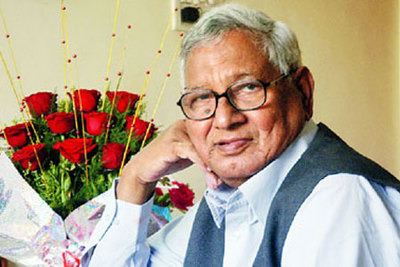
Shafey Kidwai is an Indian academic, communication scientist, translator, columnist, and author. He is the chairman of the Department of Mass Communications at Aligarh Muslim University.

source: http://www.siasat.com / The Siasat Daily / Home> Featured News / by Shafey Kidwai / September 26th, 2025
Rukhsana Jabeen: a doyen of Urdu poetry from Kashmir

JAMMU & KASHMIR:

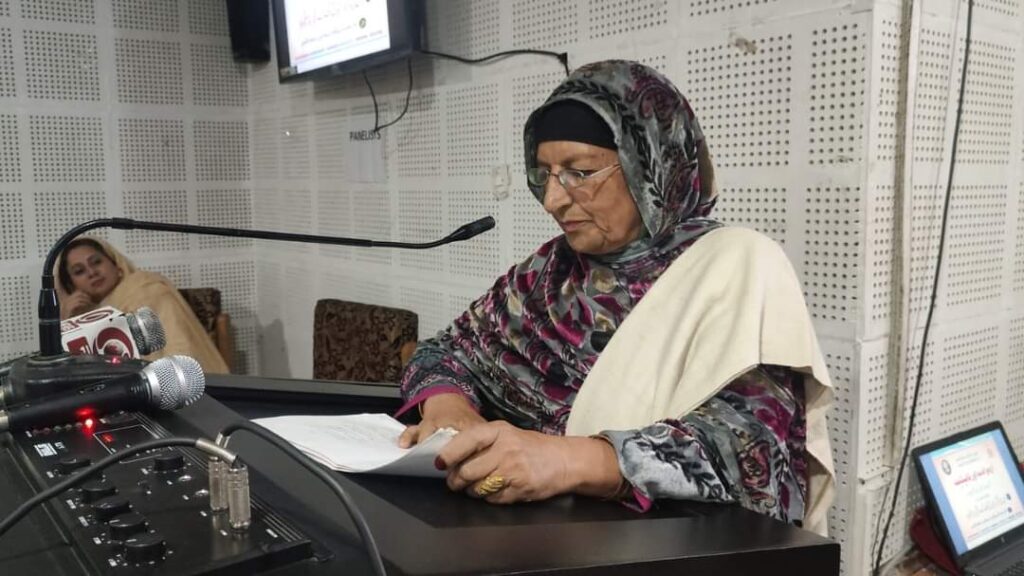
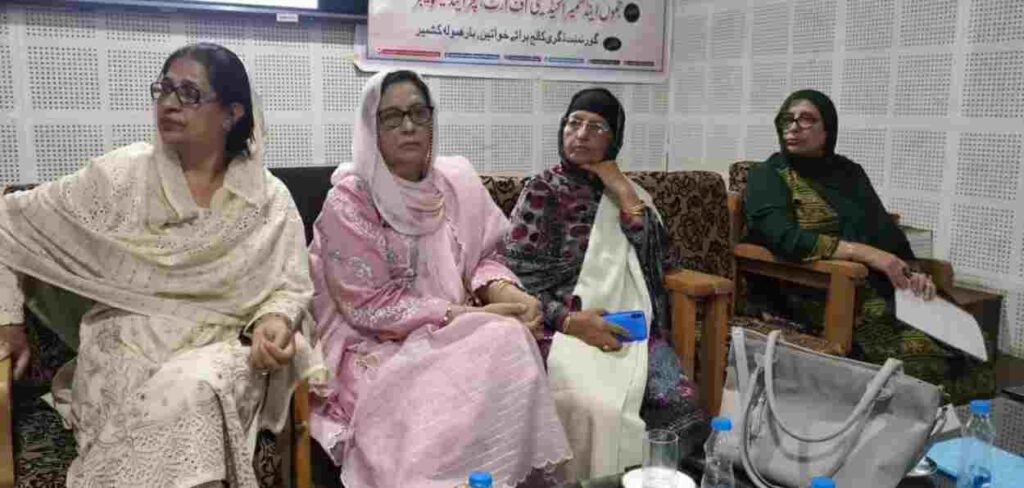
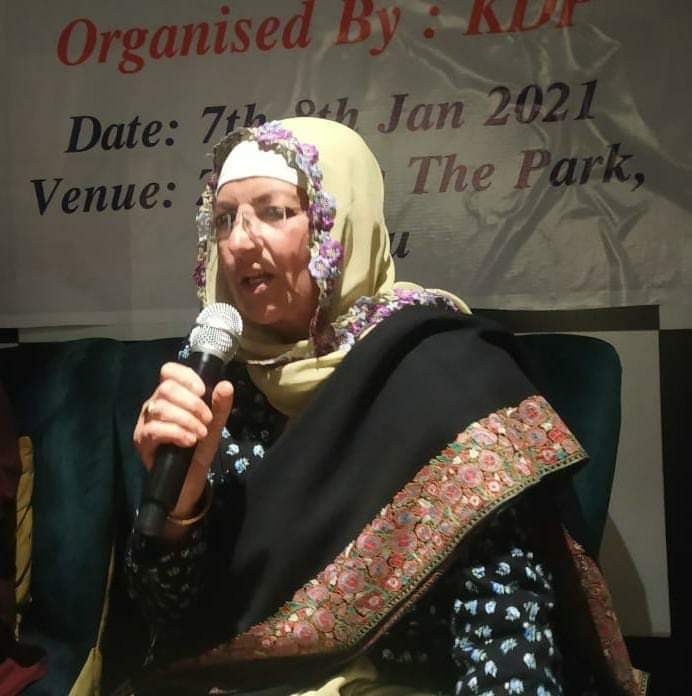
Rukhsana Jabeen (Second from right) at a poetic symposium

Rukhsana Jabeen is one of the very few female litterateurs in Jammu and Kashmir who carved a niche in the Subcontinent’s vast domain of Urdu poetry at the intersection of the 20th and the 21st century. An overarching and unceasing armed insurgency, that muted all expressions in art and literature in the Valley failed to silence her for 33 years.

After serving All India Radio for over 30 years, Jabeen retired as a Director at Radio Kashmir Srinagar in 2015. The participation of a Kashmiri woman in the annual All India Mushaira on the eve of Republic Day or Independence Day was fatally proscribed by terrorists. Jabeen did so without break.

“Whatever came to my mind, I wrote and expressed without thinking a bit about its consequences”, Jabeen revealed to Awaz- the Voice at her winter residence in Jammu.

Born in a family of the decedents of the revered saint and Kashmiri-Persian poet Syed Meerak Shah Kashani in the Khwaja Bazar neighbourhood of downtown Srinagar in 1955, Jabeen did Master’s in Urdu followed by MA and M Phil in the Persian language and literature at the University of Kashmir. In 1983, she joined AIR Srinagar as a program executive.

Rukhsana Jabeen at a poetic symposium

“I was not the first woman to enter the station for an all-India job”, Jabeen said “but in our family setting it was like breaking the glass ceiling. Getting selected for the job in a tough patriarchal competition was like a big success for me. Knowing well that I wouldn’t be permitted to apply for it, I kept it all discreetly concealed from my family”.

“I was also selected as a teacher in the State Education Department. As my father learned about my getting a job at the AIR, he insisted I should join as a teacher. I agreed with him that the AIR officers could be transferred to any Indian State, but I lied that female officers were not posted outside their home States. Thereupon my family relented, and I joined as a program executive”, Jabeen said.

In 1994, Jabeen established AIR’s Poonch station close to the Line of Control in Jammu where she served for three years. In 1999, she was promoted to Assistant Station Director (ASD).

Unlike many of her tribe, Jabeen’s tryst with creative literature began late during her university days. A prominent Urdu poet and literary critic and the head of the Urdu Department, Prof. Hamidi Kashmiri, encouraged Jabeen to write prose and poetry in Urdu. “I was thrilled when Hamidi Sahab refined my first Ghazal and got it published in the annual edition of his department’s magazine ‘Baazyaft’. Under his tutelage, I learned about modern sensibility and the post-modernist literary trends”, Jabeen recalled.

Rukhsana Jabeen recording a radio programme

She narrated how affectionately some celebrated litterateurs like Hamidi at the University of Kashmir and Zubair Rizvi at Radio Kashmir Srinagar gave her select books and literary magazines to hone her talent and faculties as a creative writer.

“One day, incredulously I found five of my poems published together, alongside my profile, in Kumar Pashi’s journal ‘Satoor’. Later, Zubair Sahab disclosed that he had got the same published in the prestigious Urdu magazine. It was an incredible encouragement and my recognition as a poet. Thereafter, a number of my poems were published in the top representative journals like ‘Alfaaz’, ‘Shayir’, ‘Mafaheem’ and ‘Asri Agahi’. Hamidi Sahab and Zubair Sahab steered me to the extensive studies of Shaharyar, Rajinder Manchanda Bani, Nasir Kazmi, and Mohammad Alvi. I am still deeply under the influence of Mohammad Alvi and a few others”, Jabeen added.

Kishwar Naheed, Parveen Shakir, and Fahmida Riaz inspired Jabeen into some new experiments. She was initially also influenced by female Urdu litterateurs like Rafia Shabnam Abidi, Aziz Bano Darab Wafa, and Sajida Zaidi and later shared the stage with them at AIR and all-India poetry symposiums. For over three decades, Jabeen was a regular guest poet at Delhi’s Red Fort and other literary rendezvous, integrating a Sub-continental network of the intelligentsia and defying a hostile ambiance at home.

For several years, Jabeen translated poetry from 22 Indian languages into Kashmiri as a project of the Sahitya Akademi. She participated in many such all-India poetry symposiums at Varanasi and other Indian cities. She remained closely linked to top-notch Urdu poets like Shaharyar, Bashir Badr, Nida Fazli, Makhmoor Saeedi, Ali Sardar Jafri, Kaifi Azmi, Qateel Shifai, Ahmad Faraz besides literary critics like Shamsur Rahman Faruqi, Naiyer Masud and Malikzada Manzoor Ahmad.

“Many of them organized Mushairas in my honour at their homes. It was a unique recognition and hospitality as never before has anyone from Kashmir been entertained to such honours”, Jabeen said. “I invited many of these doyens of Urdu literature to our programmes at Radio Kashmir”.

Ghazal in Urdu and Kashmiri is Jabeen’s forte even as she also tried her pen at the popular genre of ‘Nazam’. “But I no love lost for blank verse and free verse. I believe those who can’t write in Urdu’s traditional meters have little right to write in free verse. Besides, I have seen how many of the aspirants, particularly females, get free verse written by others and read the same as their poetry. They perform such poor poetry at stage. Contrarily, nobody gives out a Ghazal. A Ghazal and Nazam writer is often an authentic poet”, Jabeen said.

In addition to volumes of the translation of short stories from different languages into Kashmiri and a translation of the collection of Hafiz Shirazi, which she accomplished with Dr. Syed Raza of Budgam, Jabeen has three of her collections—two in Urdu and one in Kashmiri—ready to publish.

“But I’m unbelievably indolent. I never get after awards and accolades. I can’t fulfill those formalities. Every year, I decided to publish these three volumes of my poetry but my laziness spoils my endeavour.”

source: http://www.awazthevoice.in / Awaz, The Voice / Home> Story / by Ahmed Ali Fayyaz, Jammu / January 14th, 2024

Shahryar — A Life in Poetry review: Dream merchant

Aonia,Bareilly / Aligarh – UTTAR PRADESH :

ShahryarMPOs14oct2018

Why a flag-bearer of modern Urdu poetry chose to be moderate

In 1936, Munshi Premchand made a seminal speech, Sahitya ka Uddeshya(‘The Aim of Literature’), to the Progressive Writers’ Association. While asserting that literature is meant to critique society, the novelist said it can never regress into propaganda. The point applies to the work of Shahryar, who was born, reportedly, in the same year. For, while being a self-avowed Marxist, he refused to be bracketed into the categories of ‘modernism’ or ‘progressivism’. Finding his voice in the post-Nehruvian period of disillusionment in the 1960s, he turned his gaze inward, into the inner struggles of an individual, while not remaining oblivious of the external environment.

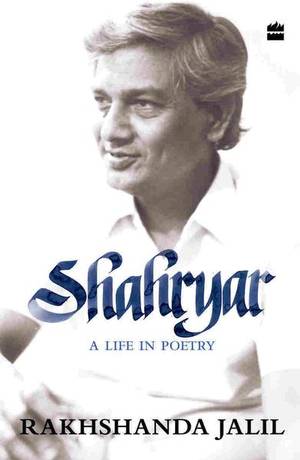
Rakhshanda Jalil stresses in Shahryar: A Life in Poetry that his tone was one of moderation. The poet, who was among the flag-bearers of the jadeed (modern) shayari, did not declaim, he whispered into the reader’s ears his thoughts on social issues. One example is Ek Siyasi Nazm (A Political Poem), where he gently chides a neighbour who has passed on his communal hatred to his children.

Some of the leitmotifs that occupied the poet’s imagination were sleep, dreams and night. His most famous collection, Khwab ke Dar Band Hain (The Doorway to Dreams is Closed), paid tribute to his favourite theme, khwab (dream). In its title nazm, he presents the night as freeing the eyes of the protagonist not only of all ‘sins’ but also of dreams, an act that he calls a punishment.

The poet, among the four Urdu writers to have been given the Jnanpith, is remembered outside Urdu literary circles, and especially among cinephiles, for his association with filmmaker Muzaffar Ali. The partnership resulted in Gaman, Umrao JaanAnjuman and the incomplete Daman and Zooni. It is when Jalil delves into this side of Shahryar that her arguments become a bit problematic, especially when she says that there exists a dichotomy between film lyrics and poetry.

Here, Sahir Ludhianvi’s write-up to his fellow poets is instructive. While Ludhianvi acknowledged that a nagma nigar (lyricist) doesn’t have the freedom of an adabi shayar (poet), as he is constrained by the film’s screenplay and characters, he added that his own attempt was to elevate film lyrics to the status of high art. It is when a film’s lyrics rise above its mere narrative that they take the form of art. What Jalil ignores is that a poetry lover would use such lyrics as a trigger to delve deeper into a poet’s corpus. An appreciation of Seene Mein Jalan won’t stop at listening to the song; it would progress to a reading of Ism-e-Azam, the collection from where the ghazal was taken.

Shahryar: A Life in Poetry; Rakhshanda Jalil, HarperCollins, ₹599.

source: http://www.thehindu.com / The Hindu / Home> Books> Reviews / by Hari Narayan / October 13th, 2018

Umrao Jaan lyricist no more

Aligarh, UTTAR PRADESH :

Shahryar
Shahryar

Acclaimed lyricist Shahryar of Umraao Jaan fame, 75, died of  lung cancer last night at Aligarh in Uttar Pradesh.

Born at Aonla Bareilly, Uttar Pradesh, he belonged to a Muslim Rajput family. Shahryar retired as chairman of the Urdu Department at the Aligarh Muslim University. Later, he used to co-edit the literary magazine Sher-o-Hikmat.

Originally christened Akhlaq Mohammed Khan, he was recognised for his lyrics in Muzaffar Ali’s films like Gaman (1978), Umrao Jaan (1981) and Anjuman (1986).

His last lyrics were for Mira Nair’s critically acclaimed The Namesake (2006). In 1987, he was rewarded with the Sahitya Akademi Award in Urdu for Khwab Ka Dar Band Hai (1987). He was the fourth Urdu writer to win the Jnanpith Award in 2008.
In memoriam
I knew him since 1966. He was family to me. The news of his death came as a great shock to me. He was one of the greatest modern poets. He was my inspiration. I used his poetry in all my films. I met him last when he received the Jnanpith Award. It was two and a half months back. He was undergoing chemotherapy at that time. Actually, I was planning to go to Aligarh to meet him. However, it never materialised.

Shahryar’s death is not only a loss to me but to the world of poetry. He was an extremely well mannered person, particularly sensitive to social issues. As for his work, his maximum contribution was in Umraao Jaan. But you cannot rule out the value that he added to Anjuman and Gaman. It’s an irreparable loss. I will miss him.

I was shocked at the news. Shahryar had done some great work and wrote some outstanding songs in his film career, especially in Umrao Jaan. The songs were immortal. He understood the soul of the movies. Ek se ek gaane likhe the. He received an honorary doctorate, few years back. He also got the Jnanpith award and he deserved these awards. Bahut bade shayar hai hamare mulukh ke.

source:  http://www.timesofindia.indiatimes.com / The Times of India / News> Entertainment> Hindu> Bollywood News / Mumbai Mirror / February 14th, 2012

Shahryar (1936-2012): The poet who gave Umrao Jaan her voice

Aligarh, UTTAR PRADESH :

Akhlaq Mohammed Khan, better known as Shahryar, who breathed his last in Aligarh on Monday following a prolonged battle with cancer, straddled the worlds of pure and popular poetry with equal ease

Akhlaq Mohammed Khan, better known as Shahryar, who breathed his last in Aligarh on Monday following a prolonged battle with cancer, straddled the worlds of pure and popular poetry with equal ease. As a lyricist, he courted fame and riches with the unforgettable lyrics of Umrao Jaan. As a poet, he catered to connoisseurs of the Urdu language. He served both from his perch at Aligarh Muslim University, where he was a widely respected academic. He did not need to change his address to taste success in Hindi films as filmmakers approached him in Aligarh with their stories. A much sought after name in mushairas – poetic soirees – Shahryar was conferred the Jnanpith award in 2008 and the Sahitya Akademi Award for “Khwab ka Dar Band Hai”.

Shahryar got success on his own terms. Eminent filmmaker Yash Chopra offered him three films after Faasle. However, Shahryar turned down the proposal as he did not want to be reduced to a “song shop” ready with wares according to the demands of the consumer. He preferred leisure and solitude for his work, something he got in Aligarh. In his poetry, he preferred to talk of the pain of the deprived, the social concerns of the man on the street. The feeling came out most aptly in the ghazal, “Seene mein jalan aankhon mein toofan sa kyun hai” which became part of Muzaffar Ali’s film Gaman in 1978.

Ali and Shahryar were friends from the student days. It so happened that Ali was a painter and once Shahryar went to show him some of the ghazals he had composed. Later, when Ali became a filmmaker, he used them in Gaman. They again worked together in Umrao Jaan. Incidentally, Asha Bhonsle got the National Award for rendering the ghazal, “Dil cheez kya hai” in the film.

However, Shahryar almost did not become a poet. In his younger days, he wanted to be an athlete. His father wanted him to join the police. Shahryar, though, ran away from his home and honed his craft under the watchful eye of Khalil-ur Rehman. To earn a living, he ended up teaching Urdu fiction in AMU, from where he retired as chairman of the Department of Urdu. He never taught poetry in the university as he believed poetry could never be taught. His first poetry collection, Ism-e-Azam was released in 1965 and he used to co-edit a literary journal Sher-o-Hikmat. He also composed songs for Ali’s forthcoming project Noorjehan.

source: http://www.thehindu.com / The Hindu / Home> Arts / by Ziya Us Salam / New Delhi – February 14th, 2012