Tag Archives: Syeda Hameed

Muslim Mirror Releases List of 100 Most Influential Indian Muslims 2025; Young Faces Gain Prominence

INDIA :

Muslim Mirror’s 100 Most Influential Muslims of 2025

New Delhi: 

Muslim Mirror has released its much-anticipated annual list of the “100 Most Influential Indian Muslims of 2025,” spotlighting individuals who have made significant contributions to India’s public life across a wide spectrum of fields including politics, culture, education, business, media, religion, sports, and social service. Now in its second edition, the list aims to document influence not merely as power or popularity, but as sustained impact, leadership, and the ability to shape public discourse.

A defining feature of the 2025 edition is the growing prominence of younger achievers, signalling a visible generational shift within Indian Muslim leadership. Alongside established national figures, the list includes emerging voices who have built influence through grassroots activism, professional excellence, digital platforms, legal advocacy, education, and community engagement. Editors associated with the project said this was a deliberate attempt to recognise new centres of influence beyond traditional hierarchies.

The list reflects the diversity and plural character of Indian Muslim society, cutting across geography, ideology, profession, and language. From seasoned politicians and religious scholars to artists, entrepreneurs, academics, and social reformers, the compilation offers a broad snapshot of leadership trends at a time when issues of representation, constitutional values, and social justice remain central to national debate.

Representation Across Sectors

The 2025 list features several eminent academicians and intellectuals who have shaped higher education, policy discourse, and social research. Among them are Abul Qasim Nomani, Ameerullah Khan, Furqan Qamar, Shahid Jamil, and Ubaid-ur-Rahman, recognised for their contributions to education, public policy, and academic leadership.

In the business and entrepreneurship category, the list includes influential names such as Azad Moopan, Azim Hashim Premji, Farah Malik, Irfan Razack, M. P. Ahammed, Mecca Rafiq Ahmed, Meraj Manal, Syed Mohamed Beary, P. Mohammed Ali, Shahnaz Hussain, Tausif Ahmad Mirza, Yusuff Ali, and Ziaullah Sharif. Their inclusion underlines the growing economic footprint of Indian Muslim entrepreneurs, both domestically and globally, spanning sectors from retail and healthcare to infrastructure and consumer goods.

Community leadership remains a strong pillar of the list, with figures such as Arshad Madani, Mahmood Madani, Malik Motasim Khan, Mehmood Pracha, Syedna Mufaddal Saifuddin, Navaid Hamid, Pirzada Md Abbas Siddiqui, Qasim Rasool Ilyas, Sadatullah Husaini, Umer Ahmed Ilyasi, and Yusuf Mohamed Abrahani recognised for their roles in religious guidance, legal advocacy, social mobilisation, and institutional leadership.

Culture, Media, and Public Discourse

In arts and entertainment, globally recognised names such as A. R. Rahman, Aamir Khan, Mammootty, Munawar Faruqui, and Shah Rukh Khan continue to command immense cultural influence, shaping narratives that extend well beyond cinema and music into social consciousness.

The list also acknowledges the growing importance of media and journalism in shaping opinion and challenging dominant narratives. Journalists and commentators such as Arfa Khanam, Irfan Meraj, and Seema Mustafa are recognised for their consistent engagement with issues of democracy, minority rights, and constitutional values.

Religious and Intellectual Scholarship

A significant section of the list is devoted to Islamic scholars and religious thinkers, reflecting their continued influence on moral leadership and intellectual discourse. Names such as A. P. Aboobacker Musliyar, Qasim Nomani, Prof. Akhtarul Wase, Asghar Ali Imam Mahdi Salafi, Asjad Raza Khan, Ibraheem Khaleel Al-Bukhari, Javed Jamil, Khalid Saifullah Rahmani, Khaleelur Rahman Sajjad Nomani, Qamaruzzaman Azmi, Rashid Shaz, Shakir Ali Noori, Shamail Nadvi, and Yasoob Abbas find place for their scholarly work, writings, and public engagement.

Politics and Governance

The political category features leaders cutting across party lines and regions, including Asaduddin Owaisi, Ghulam Nabi Azad, Hamid Ansari, Mehbooba Mufti, Omar Abdullah, Salman Khurshid, Najeeb Jung, Syed Naseer Hussain, Engineer Rashid, Akhtarul Iman, Iqra Hasan, Zameer Ahmed Khan, Rakibul Hasan, K. Rahman Khan, Kadir Mohideen, Mohibullah Nadvi, Md Shafi, Agha Mahadi, Asim Waqar, and Sadiq Ali Shihab Thangal. Their inclusion reflects influence exercised through electoral politics, governance, diplomacy, and legislative advocacy.

Changemakers and Social Reformers

One of the most dynamic sections of the 2025 list is that of changemakers and social reformers, featuring individuals such as Safeena Husain, Shahabuddin Yaqoob Quraishi, Syeda Hameed, Zameer Uddin Shah, Mahbubul Hoque, Sabahat S. Azim, Mehmood Pracha, Faiz Syed, and Zahir Ishaq Kazi, among others. Many of these figures have earned recognition through long-term grassroots work rather than formal authority.

International Booker Prize 2025 winner Banu Mushtaq for Heart Lamp, along with renowned poet Wasim Barelvi, has been placed in the category of Literary Figures.

In sports, iconic names Sania Mirza and Irfan Pathan continue to inspire younger generations through excellence and public engagement beyond the playing field.

Beyond Rankings

The editors emphasised that the list does not claim to be exhaustive, nor does it measure influence solely through fame, wealth, or official position. Instead, it seeks to capture real-world impact, moral authority, intellectual contribution, and the ability to shape conversations within and outside the community.

The annual list has increasingly become a reference point for understanding evolving leadership patterns among Indian Muslims. By foregrounding both established figures and rising talents, the 2025 edition reflects continuity as well as change, underscoring how Indian Muslims continue to contribute meaningfully to India’s democratic, cultural, and social field.

source: http://www.muslimmirror.com / Muslim Mirror / Home> Indian Muslim / by Muslim Mirror / January 15th, 2026
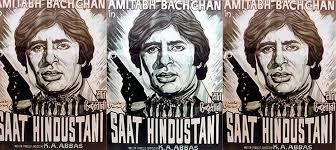
How KA Abbas gave Amitabh Bachchan his big break in ‘Saat Hindustani’

Panipat (Undivided India), HARYANA / Mumbai, MAHARASHTRA :

Multi-hyphenate talent Khwaja Ahmed Abbas worked in Urdu, Hindi and English and across writing mediums. Abbas, who died in 1987 at the age of 71, wrote social realist screenplays for Raj Kapoor and V Shantaram, directed films, published short stories and plays,and contributed a long-running weekly newspaper column. Among the best-known films he directed are Neecha Nagar, Sheharaur Sapna and Saat Hindustani. Set in Goa and tracing the efforts of seven revolutionaries to free the state from Portuguese rule, Saat Hindustani marks the debut of Amitabh Bachchan. An essay from the anthology Bread Beauty Revolution, edited by Iffat Fatima and Syeda Hameed, relates Abbas’s encounters with the “tall young man” and future screen icon. Bread Beauty Revolution includes writings from Abbas’s memoir I Am Not An Island: An Experiment in Autobiography as well as essays, stories,poems, photographs and columns.

The story of Saat Hindustani came out of the Goa struggle reminiscences of my assistant, Madhukar, who would often regale us with the adventures he had while trekking up with the non-violent commandos to hoist the tricolour on every police station they came across…

I was so excited when I finished the screenplay that I telephoned all my friends and informed all my assistants, including Madhukar, to come and hear it in my fourth floor office on the very next day. That was a ritual which they never missed and I would get their suggestions for casting the film.

I wanted to prove by my casting that there was no particular Hindu or Muslim, Tamilian, Maharashtrian or Bengali ethnic type. To begin with, I would transform the smart and sophisticated and versatile Jalal Agha into the Maharashtrian powada singer. Even Jalal was shocked to hear this. But I reassured him that, with the proper make-up and get-up, nobody would recognize him except as a rural Maharashtrian folk singer. Madhukar, who hails from Meerut, would be a Tamilian; Sharma (Brahmin by caste) would also undergo a similar transformation; and Utpal Dutt, the cigar-chewing admiral,would be the tractor-driving Punjabi farmer. So far the casting was clear in mymind. On one of my visits to Kerala I had met Madhu, the handsome hero of the Malayalam screen, and he had approached me and expressed his desire to work in a Hindi film with me. I would make him the sensitive Bengali; I wouldn’t have to work much on his Bengali accent for he had lived with a Bengali family. Now only the Hindi and Urdu fanatics were left. Jalal one day brought with him his friend Anwar Ali (brother of the comedian Mehmood), in whose eyes I saw the Jana Sanghi fanaticism. So I decided to make him the Swayam Sevak who hates Urdu and speaks jaw-breaking Hindi. That left one Indian, the Muslim Urdufanatic. Since I wanted these boys to be of different ages and different heights, the one vacancy left was for a tall and handsome man. He had to be thin, also corresponding to the thin image of my friend, the late Asrarul Haque “Majaz”.

One day someone brought a snapshot of a tall young man and I thought that the boy was in Bombay. I said, “Let me see him in person.” “He will be here day after tomorrow evening.” Again, presuming he was in Bombay, I thought he must be working somewhere and wouldn’t be free till the evening. On the third day, punctually at 6 pm, a tall young man arrived who looked taller because of the churidar pajama and Jawahar jacket that he was wearing. This young man would one day be known as Amitabh Bachchan, the heart-throb of millions. But I did not know his name. Roughly, the following dialogue took place between us:

“Sit down, please. Your name.”

“Amitabh.” (Not Bachchan.)

It was an unusual name — so I asked, “What does it mean?”

“The sun. It’s also one of the synonyms for the Gautama Buddha.”

“Education?”

“B.A. from Delhi University.”

“Have you worked in films before?”

“No one has taken me so far.”

“Who were they?”

He mentioned very prominent names.

“What did they find wrong with you?” The boy spoke with frankness. “They all said I was too tall for their heroines.”

“Well, we have no such trouble. In a way we have no heroine in our film. Even if we had, that wouldn’t prevent me from taking you.”

“Taking me? Are you really going to take me? Without even a test?”

“That depends. First I must tell you the story. Then I must tell you your role and see if you will be enthusiastic about playing it. Then I shall tell you what we can afford to pay you. Only then, if you agree, shall we sign the contract.”

I read him out the complete story and saw his face become alive with interest. I asked him which role he would like to play. He told me the two which particularly impressed him. The role of the Punjabi, and the role of the Muslim. I told him he was perhaps a Punjabi, and that made him unfit to play that role. He asked me why. I gave him the reason, the reason for having a scrambled cast. The idea appealed to him greatly. He said, “I think, I know what you mean. Then I would like to play the Muslim role, specially because he is under a cloud of suspicion. And only at the end the suspicions are removed and he is proved a patriot.” Then I told him we could pay him no more than five thousand rupees,which was the standard figure for all the roles.

He seemed a little hesitant, and I asked him, “Are you earning more than that?”

“I was,” he said.

I asked him what he meant.

He said that he was getting about sixteen hundred a month in a firm in Calcutta.

“I resigned the job and came over.”

I was astonished. “You mean to say that you resigned a job of sixteen hundred rupees a month, just on the chance of getting this role! Suppose we can’t give the role to you?”

He said, “One has to take such chances” with such conviction that I said, “The role is yours.”

Then I called my secretary, Abdul Rehman, to dictate the contract. I asked the tall young man for his name and address.

“Amitabh—” after some hesitation, “Amitabh Bachchan, son of Dr H.R. Bachchan.”

“Stop,” I said. “This contract cannot be signed until I telegraph and get your father’s consent. He is a colleague of mine on the Sovietland Nehru Award Committee. I wouldn’t like to have a misunderstanding with him. I am afraid you will have to wait for two days more.”

“You can ask my Dad, but frankly, do I look like a runaway?”

I told him that runaways don’t have any particular look. So I dictated, instead of the agreement, a telegram to Dr Bachchan in New Delhi and asked him if he was willing to let his son become an actor. Two days later a telegram came reading “No objection where you are concerned.” This is the whole story about how Amitabh Bachchan came into films.

Excerpted with permission from Bread Beauty Revolution, edited by Iffat Fatima and Syeda Saiyidain Hameed, Khwaja Ahmed Abbas Memorial Trust and Tulika Books.

source: http://www.scroll.in / Scroll.in / Home> Book Excerpt / by Khwaja Ahmed Abbas / November 14th, 2015

From the memoir: Human rights activist Syeda Saiyidain Hameed writes about her role as a mother

Srinagar, JAMMU & KASHMIR / NEW DELHI :

An excerpt from ‘A Drop in The Ocean: The Story of My Life’, by Syeda Saiyidain Hameed.

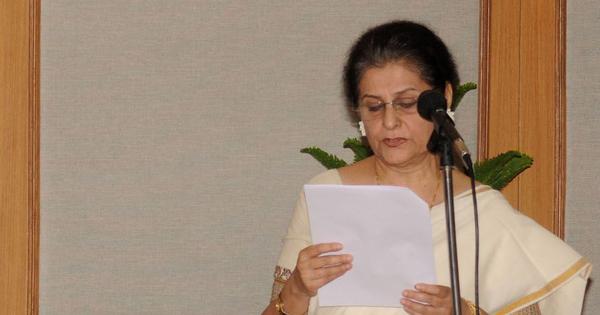
Syeda Saiyidain Hameed. | The Prime Minister’s Office.

My sons, Morad and Yavar, were born in 1968 and 1972, respectively, and my daughter, Ayesha, in 1974. When I was pregnant with Morad, my husband said to me that he hoped for a girl in my image. But I gave birth to a robust ten-pound son! My male gynaecologist, Dr Beck’s remark is my first recollection when I regained consciousness from the Caesarean section, “Congrats, you have a little football player!” A Canadian could not have given a greater compliment. Later I realised that my husband’s desire to have a daughter had no firm basis. Holding his firstborn, he declared to all in the hospital room that from now he wanted only sons!

When I first set my eyes on Morad, I had just come out of general anaesthesia in the maternity ward of the University of Alberta Hospital. I saw his face and I can still feel my own gasp. His face was my mirror. He was lying, neatly bundled beside me. It had been a breach delivery. It took eight days for the stitches to heal before I could be discharged from the hospital. Hameed brought us home, both mother and child, wrapped and bundled. A memory that lingers is placing him on a white sofa before a large bay window overlooking the front lawn in which the grass had begun to turn brown. It was October 12, 1968.

Over the years, how did I see my older son? Introspective, and sensitive, he used to tease me by saying that his sensitivity was the result of his regressive genes! He was thoughtful, gentle, and he always had the right words for the right moment. One summer in Delhi, my children and I were at the Jamia Qabristan to recite Fatiha at their grandparents’ graves. As we waited in the drizzle for Mohammad Yunus, who was like family, to arrive to recite Fatiha for his son, Adil Shahryar, Morad must have felt the immediacy of death. “The land on which peoples’ marble is placed,” he said to me, “is incredibly fertile.” He remarked how lush and green the place was. Death, Morad said, was just a flash in this evergreen process of incarnation and reincarnation.

I think of another side of Morad: to put away his clothes, to pay his bills, to open his cheques, and to eat his packed lunches may not always happen. But he can pick up the brush and carefully clean the cobwebs. He has beautiful hands and a mane of dark curly hair. Tall like Yavar, a little stooping (which Hameed continually checked). Always a smile and word of encouragement for those around him.

“Mother, I was just thinking about you,” he said once as I came in, sweaty, rushed, and irritated.

“About me? What?”

“How beautiful you look and how much I love you.”

Sitting in my father’s home in Delhi years later, I wrote about my children in my diary. At the end of the piece on Morad, I wrote: I hope people can appreciate his quality and I hope I don’t fall into the trap of wanting to protect him. A man who has just finished studying five months of human anatomy. A man who has been running from work to school for two years. Surely, he doesn’t need his mother in that sense. Am I pig-headed?

My second son, Yavar, was born on Canada’s Dominion Day on July 1, 1972. Morad was the firstborn but Yavar was equally the joy of our life. He grew into a responsible young man, as well as a poet and an artist. One year, when I was away in India, he was invited to deliver his class valedictory address in Grade 12. He wore his father’s sherwani and delivered a beautiful speech. Why didn’t I return for the event? It remains one of the deepest regrets of my life. Through handwritten letters exchanged with him and with my sister I learnt how hard he had worked all year. Cleaning the house, mowing the lawn, hauling the garbage, washing dishes, folding laundry, and shovelling snow. Then he would sit down and compose a beautiful poem, play his guitar, paint, act, or run a marathon for the city. Initially, he had considered a career in community medicine or public health, but then he was accepted for a joint Master’s degree in law at the North Patterson School of Carleton University and the University of Ottawa. So he became a lawyer.

In 2009, I timed my return to Canada so that I could be in Ottawa for Yavar’s birthday. He received me at the train station since I had flown directly from Delhi to Toronto and taken the train from there. We drove straight to his office where I asked him about the landmark case he was fighting. Abousufian Abdelrazik was a Sudanese Canadian who was arrested in Sudan, while he was visiting his ailing mother in 2003. He was denied re-entry to Canada based on a United Nations anti-terrorism listing. The Federal Court of Canada later concluded that this arrest likely took place at the request of the Canadian Security Intelligence Service (CSIS). Though never charged, Abdelrazik was beaten, threatened, and tortured during two periods of detention totalling a year and a half. Blocked from returning to his home in Montreal, Abdelrazik went public with his story and took refuge in the Canadian Embassy in Khartoum, where he remained a virtual prisoner for fourteen months. Finally, a groundswell of public support from across Canada and a Federal Court ruling forced the government to issue permission. It was his lawyer, Yavar Hameed, my son, who fought the case with unswerving grit. He flew to Khartoum and returned home with his client.

That night I wrote in my diary: Yavar is on the brink of something big, something which will make him rise to great heights one day. I am so proud of him. His name will be up there with global crusaders for human rights.

From his office, we drove to his apartment which was across the street from the hospital where I had worked when I first stepped on Canadian soil in 1967, General Hospital on Bruyere Street. It has another name now and looks nothing like it was thirty years ago, but its sight revived some precious memories. Looking around Yavar’s well-kept apartment, I was happy to see that my three gifts were beautifully displayed. Three carpets that I had given him over the years: one from Peshawar, a Killam, one from Baku in Azerbaijan, and the third from Bokhara in Uzbekistan. The next morning, Yavar drove me to the airport. I wrote in my diary, “I am going to Edmonton with a heavy heart; it is always painful to leave Yavar.” I told him, “Yavar, you will become our torchbearer towards better climes and hemispheres. I will arrange my work so I can spend a few months with you every year.” Happiness flushed his face. At the end of my life, I say with regret that it never happened.

Excerpted with permission from A Drop in The Ocean: The Story of My Life, Syeda Saiyidain Hameed, Speaking Tiger Books.

source: http://www.scroll.in / Scroll.in / Home> Book Excerpt / by Syeda Saiyidain Hameed / October 03rd, 2024