If published, Amir Rizvi’s work would be the largest set of lexicons
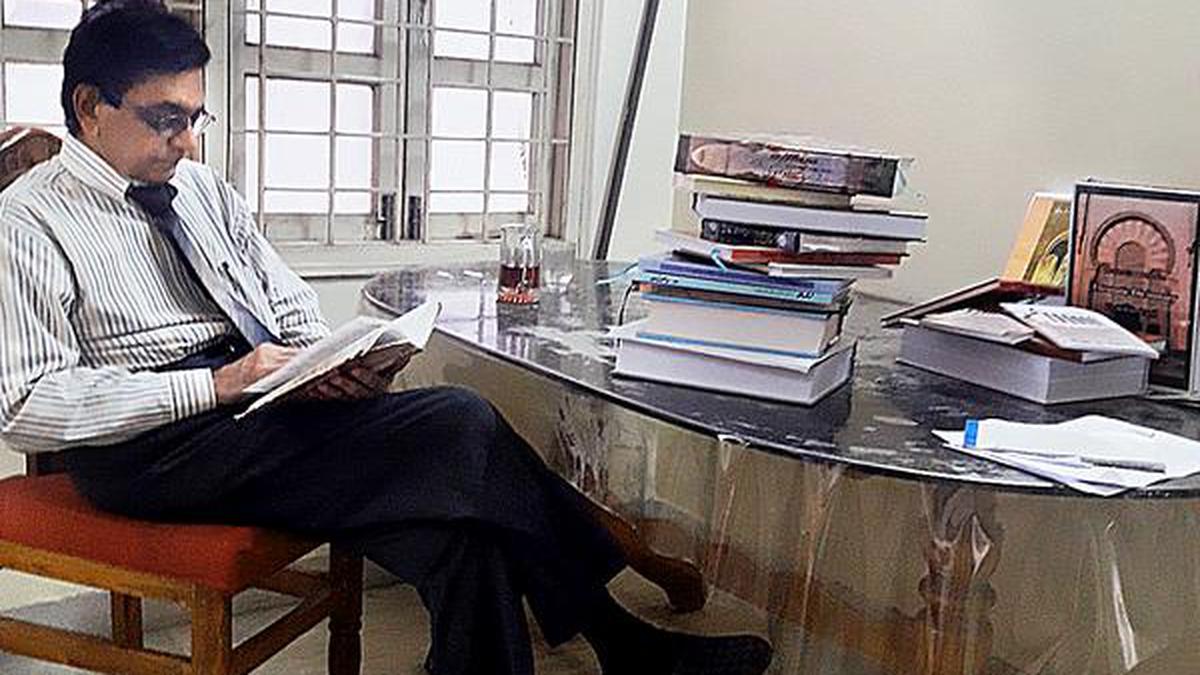
When this monumental work sees the light of the day, Urdu readers will have the largest ever set of lexicons — six dictionaries spread over nearly 4000 pages are awaiting publication. Only, Syed Jafar Amir Rizvi doesn’t have the wherewithal to publish them.
A nuclear scientist by profession and a linguistic buff by passion, Amir has slogged for ten years to write the dictionaries on subjects which are totally new to Urdu language. Having accomplished the task, he is desperately looking for a sponsor to publish his works. His talks with the National Council for Promotion of Urdu Language (NCPUL) and the Maulana Azad National Urdu University in this connection have remained unfruitful.
Lexicography runs in his genes. His grandfather, Syed Tasaduqh Hussain Rizvi, authored the Loghat-e-Kishwari , way back in 1886; that still remains a popular reference point in Urdu. But what triggered Amir’s interest is Gossamer Years’ the tenth century classic of a Japanese writer, presented by his daughter. So impressed was he with the book that he wanted to translate it in Urdu. But when he sat down to translate he couldn’t get appropriate words in Urdu. “It was then that I decided to compile a comprehensive dictionary,” says Amir who served in the Department of Energy, US.
After retirement in 2007 he devoted his time and energy to writing seven dictionaries – Farhang-e-Amir, Farhang-e-Mauzoee (thematic dictionary), Farhang-e-Mutaradif and Mutazad (dictionary of synonyms and antonyms), Farhang-e-Qafia (rhyming dictionary), Urdu Lugath ki Tareekh (history of Urdu lexicography) and Farhang-e-Lisaan (linguistic dictionary). Of these only Farhang-e-Amir has been published; the rest await publication.
Salient features
What is unique about Amir’s lexicons is their encyclopaedic range. They not only provide information related to language and literature but are also a treasure trove of words for students and research scholars. For instance the thematic dictionary is a thesaurus in four languages – Urdu, Persian, Arabic, English. So one can find the meaning of a word in four languages at once. With more than one lakh words, the 1100-page lexicon is structured subject-wise.
Amir has fulfilled a long-felt need for a thesaurus in Urdu with a 2000 page dictionary. “Its benefits will be known once you start using it”, he says.
The Farhang-e-Qafia is also exceptional; it could be of immense help to poets in search of appropriate rhyming words. “Such a dictionary simply doesn’t exist in Urdu”, says Shujat Ali Rashid, a Urdu writer.
Apart from this, Amir has also penned Urdu and English poetry under the title Milak-e-Shairi and Distant Song, and has authored a Hand Book of Nuclear Science and Engineering on design and construction of nuclear power plants. What worries this 80-plus writer is the fate of his lexicons. He wants them published during his lifetime. Will someone come forward to help him?
source: http://www.thehindu.com / The Hindu / Home> Todays Paper> Features> Friday Review / by J S Ifthekhar / December 07th, 2018
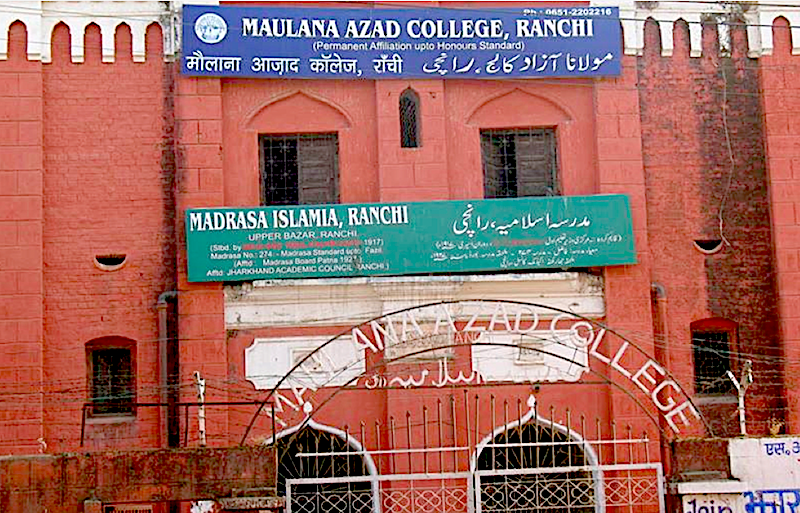
It is ironical that, just in the year of its centenary, the historic Madrasa Islamiya of Ranchi, founded by Maulana Azad (1888-1958) in 1917, is facing extinction. The BJP government of Jharkhand is reportedly contemplating to strangulate it to death by withdrawing its affiliation/recognition as well as fund. Much of the land of the institution has either been encroached upon or been sold out, by the self-serving Muslims, influential in the management of the Anjuman-e-Islamiya, which runs almost 12 subsidiary institutions, including the Madrasa Islamiya. In 1987, it formed a subsidiary called, “Muslim Higher Education Society”, which added a degree college named after Maulana Azad. This Muslim minority college is recognised and funded by the government of Jharkhand. It has got around 500 students.
The management of the Anjuman-e-Islamiya stands divided between two warring factions, respectively by Haji Ibrar and Haji Nesar. The latter is supposed to be making too much of interferences into the functioning of the Anjuman-e-Islamiya. Sections of local population admire Haji Ibrar for having done a lot for the Anjuman; they are supposed to have recently purchased a land few kilometres away from Ranchi, where the Azad College is likely to be shifted.
Because of this dispute, mainly around composition of the electoral college of the Anjuman, election for the managing committee of the Anjuman has not been held since last November. According to the bye-laws of the Anjuman, every three years elections are supposed to be held. Convenor for the election from the provincial government is the Chairman, Jharkhand Waqf Board. The government has not appointed any Chairman since 2014. In its place, an ad hoc CEO is there for the Waqf Board. He has not shown much interest in resolving the dispute, and convening elections, as per the bye-laws of the Anjuman-e-Islamiya. There are various petitions lying before the CEO regarding the composition of the electoral college. The factionalism is also around caste (Biradri). Haji Ibrar is supposed to be representing the Ashrafiya Muslims, whereas Haji Nesar is supposed to be representing Pasmanda (mainly the community of Kalaal) Muslims.
The property (including the buildings) of the Anjuman-e-Islamiya, located in the commercially significant, prime location of the city of Ranchi, has got around 200 shops. Because of self-serving factionalism within the Anjuman-e-Islamiya, the rent of the shops is kept so very nominal and unrealistic that the Anjuman deprives itself of huge revenue. The Anjuman-e-Islamiya also runs a 60 bed, relatively better-furnished, hospital, besides the RahmaniyaMusafirkhana, existing since the days of Maulana Azad. This is a separate (now a four-storey) building. Few years ago, with some fund from the Local Area Development Scheme of the local Parliamentarian, this building has been renovated. It has added a library, a study circle, etc.
There has been some efforts towards getting the main building of the Anjuman-e-Islamiya declared as National Monument, but to no avail, as yet.
The Madrasa Islamiya, at present, has got 900 students, some of them are boarders too. This is an educational institution recognised and funded by the government of Jharkhand’s body, the Jharkhand Academic Council (JAC). Before the creation of the province of Jharkhand in 2000, this was recognised and funded by the Bihar State Madrasa Education Board (BSMEB, Patna), a statutory body of the government of Bihar. There were 126 such madrasas falling in what became Jharkhand. All the 126 madrasas continue to get fund from the Jharkhand government.
After the creation of the province of Jharkhand in 2000, the Anjuman-e-Islamiya, with its ‘autonomy’, has been functioning under the administrative supervision of the Jharkhand Waqf Board.
A Proud History of Anti-colonial Assertion
It is worth re-visiting the historical context in which the Madrasa Islamiya was founded and the ideal objectives its founder envisioned. For this, let us benefit from some historians, such as S. Irfan Habib and Rizwan Qaiser.
For his revolutionary activities, he was into, right since his early ages, Azad was externed from Calcutta in March 1916 under the Defence of India Regulation. In April 1916 he was sent to Ranchi. Influenced with Shyam Sundar Chakravarty (1869-1932) and Aurobindo Ghosh (1872-1950), the Maulana was involved in revolutionary struggle and was preparing for a violent overthrow of British rule. His “continuous exhortation of the Muslims towards education including political education which essentially meant building up self-confidence to resist British rule”, was inviting anxious watch of the colonial regime on him, says Qaiser.
During his internment at Ranchi, for nearly four years (1 April 1916-31 December 1919), Azad established an organization Anjuman-e-Islamiya in August 1917 which started the Madrasa Islamiya. In a list of thirty one donors, headed by Rai Saheb Thakur Das, Rais-i- Ranchi and Babu Jagatpal Sahai, vakil, were also there, among other people, from all walks of life, including Sheikh safdar Ali of Milki (Gaya), informs Prof. Rizwan Qaiser, in his research on the subject. He says that behind all these activities of Azad, the guiding motive was to spread the Islamic education among the less fortunate co-religionists at Ranchi and to mobilise his co-religionists towards the freedom movement. According to Qaiser, Maulana Azad had been thinking around the issues of education in sciences, and also on the medium of instruction, since as early as in 1902, as it comes out of some of the correspondences of Azad.
For the Madrasa Islamiya, a 200 page long document of curricula was prepared by the Maulana Azad; the subjects such as English, mathematics, Indian geography, Indian history, history of Islam and sciences had to be introduced to bring it at par with the government run schools. Azad was very clear about the fact that no system of education could be complete unless the elements of Government University system were also to be introduced. Maulana Azad highlighted the importance of producing more educationists (Mutallemeen), rather than teachers (Muallemeen) alone. The education had to inculcate mazhabi ham-aahangi (mutual religious understanding) and rawadari (tolerance). He addressed from the Jama Masjid on every Friday, teaching them in Hubb-ul-Watani (patriotism), qaumi yekjahti (integration of nationalities), and Mushtareka Wataniyat (composite nationalism). The curricula were actually a part of the one prepared by Maulana Azad for the Madrasa Aliya of Calcutta (established in 1780 by Warren Hastings, mainly to study Arabic, Persian and Muslim Law; during 1826-36, it also taught medical sciences till the Calcutta Medical College was established in 1836; in 2007 it was upgraded as University)
S. Irfan Habib tells us that under Ibn Khaldun’s influence, unquestioning acceptance of theology was something Azad wanted to rectify. Azad found the curricula in the pre-existing Islamic madrasas fundamentally narrow. Its significant omission was mathematics, which is the basis of science and technology. Azad agreed with Rousseau in his advocacy of the children’s necessity and ability to grasp the truth through their own insight.
Another significant influence on Maulana Azad, in the context of science and education was Sir Syed Ahmad Khan Bahadur (1817-98), which attracted Azad towards modern education and modern science for the Muslims, as admitted by Azad, in his very eloquent convocation speech (February 1949) in the Aligarh Muslim University. This is another matter that on political questions, Azad had sharp differences against Sir Syed.
By way of recollection and re-dissemination, Azad’s profound contributions were put together when the National University of Education Planning and Administration (NUEPA), New Delhi, convened a seminar in 2009, and the essays were published in 2010. In the seminar, the then Speaker, Lok Sabha, Somnath Chatterjee, had described that Maulana Azad had re-emphasized the fivefold programme for the expansion of education in the country: These were (a) Universal compulsory basic education for all children of school age, (b) Social education for our adult illiterates, (c) Measures for improvement in the quality of and expansion of facilities for secondary and higher education, (d) Technical and scientific education on a scale adequate to the nation’s needs, and (e) Measures for the enrichment of the cultural life of the community by encouraging the arts and providing facilities for recreation and other amenities.
It is not without any reason that Nehru preferred to take Azad along, as his Education Minister, where he served with great distinction till his death in 1958. It is a lesser known fact that ever since Gokhale proposed in 1910 for right to compulsory free education, it was Azad who pursued it in the Constituent Assembly. Though, it was only as late as in 2009-10, that such a legislation (RTE) could actually be enacted.
During the colonial period unlike Uttar Pradesh, in Bihar, essentially speaking, there was not much of a difference between the votaries of modern education and those of the traditional learning. The Muslim elites of both the streams in Bihar cooperated with each other in imparting both kinds of education. Thus, a modern educated elite, a judge, Nur-ul-Hoda (1854-1935; son of Shams-ul-Hoda) set up the Madrasa Shams-ul-Hoda, at Patna in 1912. It endures till date with buildings constructed in colonial architectural styles, and have got good hostels too. It was recognised by the Government of Bihar in 1919, which affiliated Madrasas across the province, in the capacity of serving as the Bihar State Madrasa Education Board, BSMEB, Patna; the Board was made a statutory body by the Karpuri Thakur led government during 1977-79 ). In 1927, it affiliated the Madrasa Islamiya, Ranchi as well. Ever since then, this Madrasa remains a government recognised and funded institution.
Its syllabi, till Fauqaniya (class X), has all the modern subjects of Natural Sciences, Mathematics, Social Sciences and Literatures of Indian and English language. It has board examination at Middle (Wastania) level as well, which is class VIII. After Independence, this Board became a statutory body.
Interestingly, both the Madrasas (of Patna and of Ranchi) had one person in common, in preparing the curriculum—-Syed Sulaiman Nadvi (1884-1953). The Madrasa Shams-ul-Hoda of Patna produced many students and teachers who participated in the Quit India Movement; after independence some of its students joined the Indian Administrative Services and Indian Police Services.
Another Gift of Maulana Azad’s Stay at Ranchi
Besides the Madrasa Islamiya, another enduring gift of Azad’s stay at Ranchi is the foundation of Imarat-e-Shariah (in 1921, at Phulwari Sharif, Patna) in collaboration with Maulana Sajjad (1880-1940), and the Anjuman-e-Ulema-e-Bihar (founded in June 1917), a precursor of the Jamiat-ul-Ulema-e-Hind. The Sufi shrines—Khanqah-e-Rahmaniya (Monghyr) and Khanqah-e-Mujibiya (Phulwari Sharif, Patna) extended its support.
Maulana Azad elaborated upon this scheme of mobilizing Muslims against the anti- colonial struggle in his Urdu weekly, Paighaam (November 25, 1921).
The Imarat-e-Shariah went on to unwaveringly resist the communal-territorial separatism of the Muslim League. Azad’s protégé, Maulana Sajjad, also talked of confining religion into private spaces, and wrote many letters to Jinnah raising serious questions against his divisive [Pakistan] Resolution of Lahore, 23 March 1940.
He consistently remained in touch with the masses and also edited an Urdu weekly, Naqeeb, (after its fortnightly Imarat was gagged by the colonial state during the Civil Disobedience Movement 1930-34). On 14 April 1940, he wrote in Naqeeb against Jinnah’s scheme of dividing India, Muslim India aur Hindu India Ki Scheme par Ek Aham Tabserah (reprinted in the Naqeeb, 10 January 1946). The Patna historian, Papiya Ghosh (1953-2006), wrote an elaborate academic essay (1997) on the history of Imarat-e-Shariah, 1921-47.
Maulana Sajjad wrote letters to Jinnah asking pertinent questions. Jinnah never responded back. Sajjad, therefore, brought the letters in public circulation, specifically of 26 December 1938 and of 23 January 1939.
Maulana Sajjad also advocated the idea of confining the religious processions and rituals into private spaces rather than a public display of it causing disharmony and group violence. His pamphlet to this effect was captioned, Firqa Warana Ma’amlaat Ka Faisla Kin UsuloN Par Hona Chahiye? (Naqeeb, 20 February 1940)
He launched a political outfit, Muslim Independent Party (MIP) in 1936, with agrarian issues being its chief concern. In 1937, in collaboration with the Congress it contested the provincial elections and emerged second largest party. As the Congress, the largest party refused to form ministry on certain issues of discretionary powers vested in the Governor according to the Act of 1935, it was MIP which formed a provisional ministry, which ran for four months (April-July 1937). Barrister Md. Yunus (1884-1952) was the premier. In its short tenure, it performed very well on all counts, including its agrarian concerns such as irrigation facilities, soft loans, river embankments, etc.
Today, the Imarat-e-Shariah runs charitable institutions of education and health. In its self-proclamation, its jurisdiction extends to Jharkhand and Orissa as well. Should not it look upon the Madrasa Islamiya, Ranchi, in order to resuscitate and revitalise it?
However, this is also a puzzle for the local population that ever since Maulana Azad left Ranchi in 1920, he never looked back towards it. It is something like Gandhiji’s visit to Champaran in 1917. Even though he did re-visit, yet, the three schools established by Gandhiji in Champaran could not survive. As against this, the Madrasa at Ranchi did survive and endures till date.
The Maulana Azad Educational Foundation (MAEF) of the Union government in its existence of about three decades (founded in 1988 to commemorate Azad’s birth centenary) is doing a lot in the stated direction of education. Should not it make an intervention into it to rescuing this wonderful legacy facing extinction? Recognizing the historical significance of Azad’s stay at Ranchi, the then Prime Minister, Rajiv Gandhi, had inaugurated Maulana Azad Research Centre, on the Tagore Hills, Ranchi. It subsequently disappeared with no traces even of the stone plaque testifying the inauguration by Rajiv Gandhi. In January 2015, however, the then Chancellor (of the Ranchi University) cum Governor of Jharkhand, took note of it and persuaded the Ranchi University to establish Maulana Azad Research Centre. Its incumbent Director, Prof. Manzar Husain, has now made it functional, with a library in its building. Besides, the Senate Hall of the University is also named after Maulana Azad, as a token of gratitude.
In 2009-10, Qaiser had also highlighted the sorry state of the institution and gross negligence of the Madrasa by the Muslim dominated management. Yet, it continues to languish in disarray. Qaiser concluded, “There are people who swear by Maulana Azad and his association with Ranchi but have not been able to accord the level of respect that an institution such as Madrasa-i-Islamia deserves”.
Mention may be made specifically of Najma Heptullah, claiming to be a descendant of Azad. Till very recently she was the Union Ministry of Minority Affairs in the cabinet of Narendra Modi. Shall she really make a meaningful intervention to draw attention of the provincial and the Union governments to rescue this dying institution? The then Chairman, Jharkhand State Minority Commission, had approached the minister, Najma Heptullah. She sent her emissary to obtain first-hand knowledge about the state of affairs and requirements of the institution. Nobody knows what really happened to this. Then she no longer remained the minister. People have also been approaching Najma Heptullah’s successor, Mukhtar Abbas Naqvi.
The problem afflicting the Anjuman-e-Islamiya is not convening election of its management committee. The government of Jharkhand and its ad hoc functionary, Hasib Akhtar (CEO, Jharkhand Waqf Board, who is by rules, Convenor of election for the Anjuman-e-Islamiya), rather than convening election, is now contemplating to just withdraw the funding (and recognition) of the historic educational institution, Madrasa Islamiya, sources in the ministry of education, confide.
It is worthwhile recalling that delay in granting affiliation by the government of Jharkhand had compelled the Muslim minority managed Kabir Women’s Degree College (Jamshedpur) to close down. It had more than sufficient infrastructure in comparison to most of the other constituent colleges in the state. But it was forced to pull its shutter down, after having functioned for over two decades.
The local Muslims feel helpless at this attitude of the BJP government of Jharkhand. With a sense of hopeless-ness, they say, ‘this is the kind of era we are living in’. Local media, particularly, ETV Urdu, has been exposing all these details, which fall on the deaf ears of the government of Jharkhand. Let it be said that even the Union government of BJP is keeping such bodies head-less. For instance, the National Commission for Minorities, had become defunct, owing to vacancies. It is only few weeks ago that the Chairman and its members have been appointed. The National Commission for minority Educational Institutions (NCMEI) has got no Chairman, with vacancy of one member too. Yet another testimony that the dominant political wisdom of the day believes in peripheralising the minorities!
(This article was first published in August 2017. It is being republished because of PM Modi’s Madrasa modernisation push)
source: http://www.beyoundheadlines.in / Beyond Headlines / Home> History / by Mohammad Sajjad / June 19th, 2019
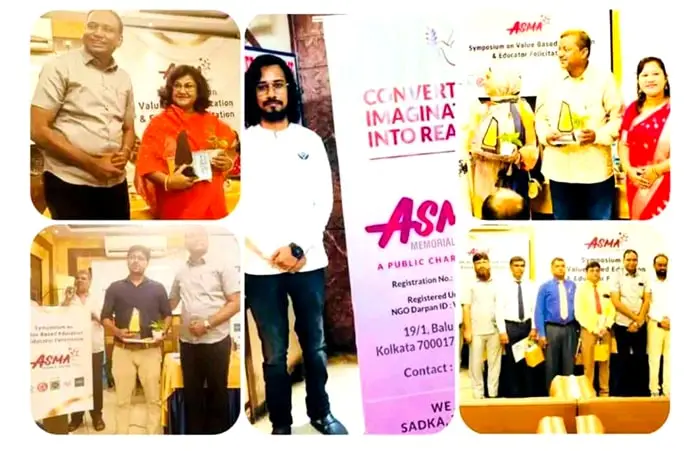
Asma Memorial Trust felicitates 80 educators including retired ones and specially-abled who served without recognition.
(Clockwise) Noor alam with Afaf Jameel, Junaid Kamal, Sangita Gurang (red sari) and the felicitated ones
Kolkata:
When the name of Junaid Kamal was announced, a 32-year-old man, with the help of two crutches, tried to stand up from his seat and began moving towards the stage to be felicitated at Asma Memorial Trust’s function. Soon, the fine art teacher was assisted in walking to receive a memento, a plant, and a set of notebooks and pens.
It was the first time in his 13-year teaching career that the art teacher, who is associated with four different organizations in Kolkata and serves the community, was recognized as a specially-abled person (left leg and right paralysed).
“I am thankful for the felicitation. For someone like me, it is not only difficult to study, but getting a respectable job is another challenge. Even when you succeed, it is rare that people appreciate it in this fast-paced life,” the Academy of Fine Arts graduate told eNewsroom.
Junaid was not alone; at least 15 retired educators, from both government and private schools, were also felicitated at the event.
Dr Umar Khyyam (70) of Maulana Azad College, Mobark Ali Mobarak (65) from Bankura district Urdu School, Nurul Hoda (62) of Kankinara Himayatul Ghurba High School (underprivileged), and Ashraf Ahmad Jafri (65) of Karaya School, Kolkata, were among them.
There were also current teachers, such as Afaf Jameel of Frank Anthony Public School, Sangita Gurung of Assembly of God Church School, Michael A Panja of GD Goenka Public School, Dr Khalid Hossain of Monu Memorial Institution (Kolkata), Debashish from Well and Gold, Md. Shahnawaz of Noble Mission School, Mubashshreen Shakil of KS Consultancy & Academy, Shaguta Adnan, who teaches French, and Manwar Sultana of Sir Syed English Medium School, among the total 80 teachers who were felicitated.
The felicitated and the felicitetors together after Asma Memorial Trust’s event
Teachers from South Point, East West, Goenka, Albani Hall, Islamia, Mohammed Jan, Flair International, and Izma International schools were also honored.
Noor Alam, the founder of NEET Basket, who also established the Asma Trust in memory of his wife to promote value-based education and encourage those involved in it, told eNewsroom, “We used to celebrate Education Day on the birthday of India’s first education minister, Maulana Abul Kalam Azad. But this year, we started the celebration earlier and began by felicitating educators who have served society but have not received any recognition for it.”
Alam, the Rashtriya Shiksha Ratan Award winner also pointed out that during the felicitation, a plant was given to each honoree to symbolize how educators nurture children. Just as trees benefit society in many ways, a well-nurtured child can positively impact the community.
The chief guest, Indian Revenue Service (IRS) officer Shamsher Ahmad, who took voluntary retirement and started Crescent School in one of Kolkata’s ghettos—Topsia—shared his journey as an educator. “When I started the school in Topsia (in 2002), I decorated the building very well. People asked me why I was doing so. I told them that to build confidence in the Topsia students, they must study in a place that is not inferior to other major schools in the city.”
“In later years, to boost their confidence to appear for the Union Public Service Examinations, I used my contacts and made my school a center for the UPSC exam, which produces IAS and IPS officers. As a result, today our school produces doctors and students who pursue higher education after graduating from Crescent,” Ahmad said to the gathering.
Sangita Gurung of Assembly of God said a one liner for the teachers, “Teach what your preach and preach what you teach, is the motto remained in my career and it should be with every teacher.”
Dr Sarfaraz Adil, founder of Izma International School , reminded attendees of the importance of education in Islam and how it has been emphasized. “Getting an education is one of the fundamentals of Islam. It not only includes religious education but also opens doors to physics, astronomy, and chemistry. Before Islam, there was no scientific temperament in religion. Only the rich could study, but Islam made education accessible to everyone. Prophet Muhammad announced that any slave who learned and became educated would be freed. Later, a slave named Hazrat Barira became educated and declared that she should be freed, according to the Prophet’s word. And she was freed. Although it was difficult because she was married to an uneducated slave, she wanted her freedom and to be separated from her husband, so she was granted it.”
Dr Adil also had a message for today’s teachers: “Information is easily shared among students. So, what is important for teachers is to teach students skills and show them
source: http://www.enewsroom.in / E Newsroom India / Home> Bengal> Education / by Shahnawaz Akhtar / September 16th, 2024
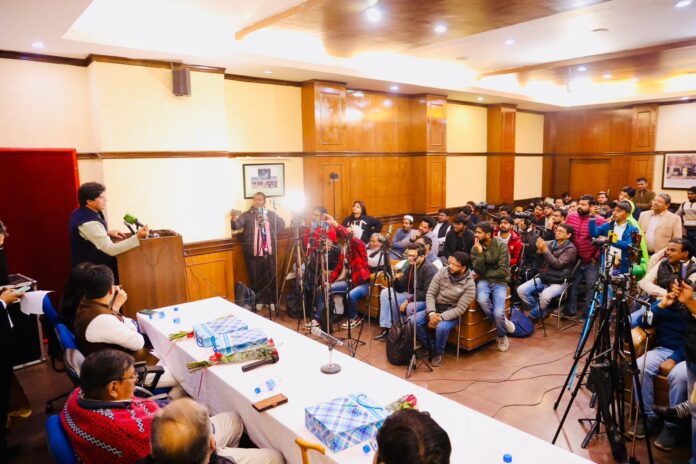
Renowned media house Millat Times celebrated its 9th anniversary on January 18 at the Press Club of India. The event witnessed participation from prominent intellectuals, politicians, and journalists who shared their thoughts on the theme, “The Role of Media in Democracy.” Attendees lauded the platform’s fearless journalism, its remarkable achievements, and its commitment to amplifying marginalized voices.
Former Foreign Minister and President of the India Islamic Cultural Centre, Salman Khurshid, highlighted the media’s role as a mirror of society and emphasized the need for independent responsibility. Praising Millat Times for its unique position in alternative media, he remarked, “Millat Times has countered the mainstream media’s negative propaganda by shaping truthful narratives. Shams Tabrez Qasmi and his entire team deserve congratulations and my best wishes.”
Imran Pratapgarhi, Rajya Sabha MP and Chairman of the Congress Minority Department, expressed delight at the presence of numerous young journalists. Applauding the platform’s achievements, he said, “In challenging times when the voice of the pen is silenced, Millat Times fearlessly speaks truth to power.” He urged the community to financially support independent media platforms to ensure their sustainability.
Former Rajya Sabha MP and Chairman of Indian Muslims for Civil Rights, Mohammed Adeeb, lamented the commercialization of media. “Newspapers are sold even before they reach the readers’ hands, becoming tools of mockery. Amid this, Millat Times lights the path of truth,” he said, commending Shams Tabrez Qasmi for giving a voice to the unheard.
Syed Sadatullah Husaini, Ameer of Jamaat-e-Islami Hind, underscored the importance of free media in sustaining democracy. Expressing concern over India’s low ranking on the Press Freedom Index, he congratulated Millat Times for its responsible journalism. Husaini encouraged expanding the platform’s multilingual content into regional languages like Gujarati and Malayalam.
Veteran journalist Bhasha Singh criticized the communalization and government alignment of mainstream media while lauding Millat Times for upholding journalistic integrity. “Congratulations to Shams Tabrez Qasmi and his team for their steadfast commitment to true journalism,” she said.
Dr. Khalid Anwar, Chief Editor of Hamara Samaj and JDU MLC from Bihar, acknowledged the unparalleled power of media to shape narratives. “In a deteriorating environment, platforms like Millat Times are vital for representing our voices,” he noted.
Gautam Lahiri, President of the Press Club of India, stressed the critical need for independent, people-oriented media. Highlighting the Press Club’s opposition to government-imposed restrictions, he recognized Millat Times as a standout platform and commended Shams Tabrez Qasmi’s contributions.
Iqra Hasan Chaudhary, MP from the Samajwadi Party, sent a written message appreciating Millat Times as a vital need of the hour.
In his inaugural address, Shams Tabrez Qasmi, the Founder and Editor-in-Chief, reflected on the journey of Millat Times. He shared how the platform was established to address the need for amplifying Muslim and marginalized voices. “In nine years, we’ve trained over 100 journalists and covered issues such as riots, mob lynching, crimes, and elections from the ground. Despite hurdles, including FIRs and government actions like shutting down our Facebook page with over a million followers, we remain committed to our work,” he said. He proudly announced that Millat Times now reaches over 70 million people monthly, with nearly five million subscribers and followers across platforms.
The event’s anchoring was managed by Shruti Sharma and Mohammad Sufiyan Saif, while Ruba Ansari delivered the vote of thanks.
Notable attendees included Mirza Qamar Hasan Baig (Chairman, Jamia Cooperative Bank), Mufti Athar Shamsi (Director, Al-Quran Academy), Mufti Ansar-ul-Haq Qasmi (President, Jamia Al-Qasim, Supaul), senior journalists Iqbal Ahmed (BBC) and Armanlesh (NewsClick), activist Safoora Zargar, Aditya Menon (Political Editor, The Quint), and others.
The event’s success was attributed to the dedicated efforts of the Millat Times team, including Mohammad Sufiyan Saif, Ruba Ansari, Mohammad Afsar, Mohammad Tamanna, Mazhar Khan, Sarem Ahmed, Rehan Razi, Talha Shameem, Mohammad Shameem, Sarah Khan, Advocate Abu Nasr, Nazim Hasan, Amir Zafar Qasmi, and Maulana Zafar Siddiqui Qasmi.
With its fearless journalism and unwavering commitment to truth, Millat Times continues to inspire hope for a more inclusive and democratic India
source: http://www.muslimmirror.com / Muslim Mirror / Home> Indian Muslim> Media / by Special Correspondent / January 19th, 2025
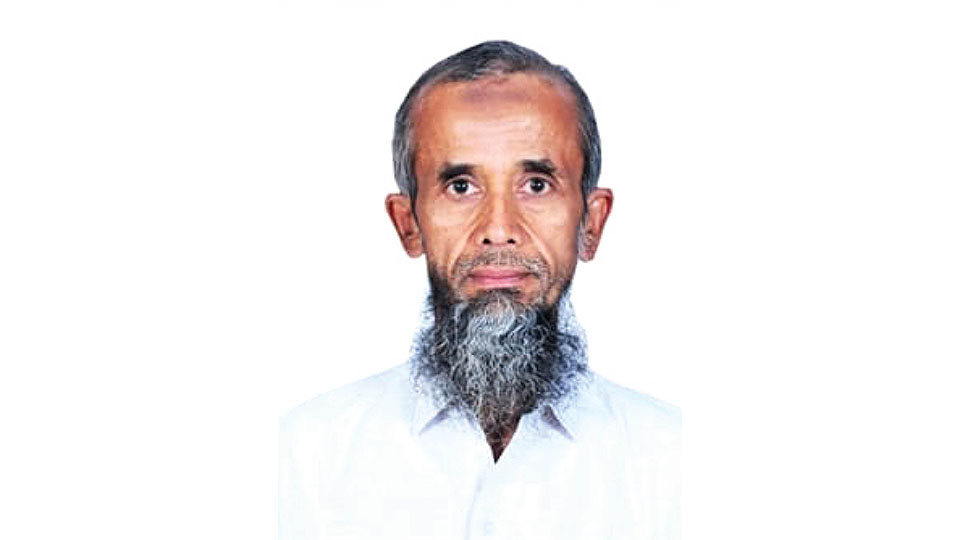
Syed Aslam (62), retired Nuclear Scientist of Bhabha Atomic Research Centre (BARC), Yelwal and a resident of Kalyanagiri Nagar, passed away yesterday in city.
He leaves behind his wife, two sons and a host of relatives and friends.
Namaz-e-Janaza was held today at Abi Akhil Masjid at Azeez Sait Nagar after Namaz Zahur (1.30 pm), followed by the burial at the Muslim Burial Grounds near Tipu Circle.
source: http://www.starofmysore.com / Star of Mysore / Home> Obituary / January 13th, 2025
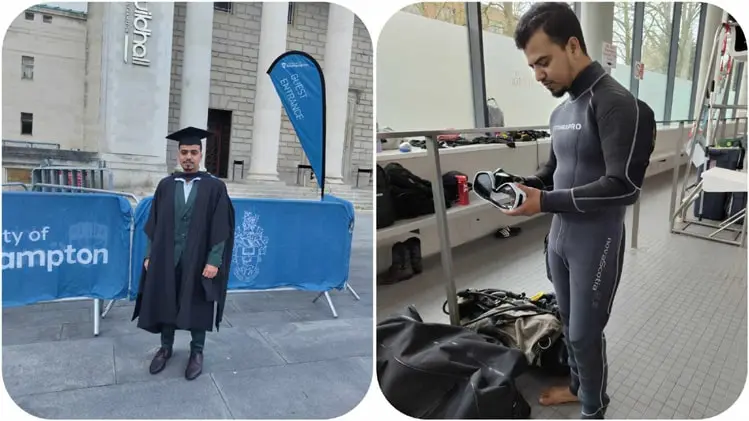
How a Madrasa student Mohammad Israr became a Maritime Archaeologist in the UK
Mohammed Israr on December 19, after the convocation of University of Southampton and in his uniform as Maritime Archeologist | Arranged
Kolkata:
Madrasa Chaap is an abusive or slang term increasingly used to demean Indian Muslims. However, such people should meet Mohammad Israr, who, in the last decade, completed not only his Madrasa education (along with secondary school) but also his senior secondary education, graduation, and a Master’s degree from India’s top college and university. Recently, he earned another Master’s degree from the University of Southampton, that too as a fully funded student.
Last week, Israr, a resident of Kolkata, received his MSc in Maritime Archaeology from the University of Southampton. The 24-year-old, who comes from a modest family, aims to pursue a Doctorate in Philosophy (PhD) at an international university before embarking on a full-time professional career.
Israr’s father, the late Mohammad Mushtaque, passed away when he was only four years old. His father was a small businessman. Since then, Israr’s elder brother, Mohammed Istiak, has been supporting him.
But how did the journey of a Madrasa student, starting in the lanes of Elliot Lane, lead to the United Kingdom?
Inspired by a Friend to Pursue Additional Education Beyond Madrasa
“Since my father passed away early in my life, I was sent to a Madrasa (Jamia Abdullah ine Masood, Kolkata) for studies. However, my childhood friend Hassan Abdul Ghaffar, who attended an English medium school and excelled in academics, inspired my interest in modern and professional courses,” Israr told eNewsroom over phone from Southampton.
His friend is now a software engineer working with Accenture.
“Because of Hassan, I developed an interest in studying at colleges and universities considered mainstream in our country. After my initial studies at Madrasa, I joined Jamia Arifia Madrasa in Allahabad (now Prayagraj), which was recognized by Aligarh Muslim University,” he explained.
Shaikh Abu Saeed, the Founder of Jamia Arifia | Arranged
Jamia Arifia’s curriculum includes English, Mathematics, Science, and Hindi alongside traditional subjects. However, Israr, with clear goals in mind, pursued senior secondary education at AMU.
“After completing higher secondary school, I earned a bachelor’s degree in History (Honours) from AMU. Then, I enrolled at Maulana Azad National Urdu University, Hyderabad, and completed a Master’s degree in History there,” he mentioned.
While studying in Hyderabad, Israr worked at Genpact to support himself financially.
Balancing Work and Studies
Israr worked tirelessly to achieve his degrees. “I had to attend classes from 9 a.m. to 1:30 p.m. and then work from 3 p.m. until midnight. Sometimes, I had to work until 3 a.m. It was a tough schedule, but I succeeded,” he said.
Daring to Dream Big
Israr’s story is not just inspiring for Madrasa students but also for those pursuing modern education.
“After my Master’s, I applied for a fully funded MSc in Maritime Archaeology at the University of Southampton. Although I came from an arts background, I challenged myself to pursue a science-based Master’s degree. Initially, it was difficult, but I began enjoying it. Archaeology is a part of history, but the study of maritime archaeology is still uncommon, especially in India. Nonetheless, I completed the course successfully,” said Israr, who proudly embraces his Madrasa background in ‘New India.’
“In my journey so far, my mother, Amna Khatoon, has been my backbone, supporting me in every decision,” he added.
source: http://www.enewsroom.in / eNews Room India / Home>Bengal> Education / by Shanawaz Akhtar / December 28th, 2024
Kota’s Shadab Hussain and Shahid Husen Shokat Menon of Koday village, Gujarat both secured top two positions
Shadab Hussain (Left), and Shahid Shokat Memon, first and second rank holder of CA Exam
Kota/Kolkata:
He was frantically trying to find out his result online. But slow internet connectivity was playing a truant. A quick call made to his office colleague brought the sweetest news to his ears. He was in a sense of disbelief.
“When my office friend called me back, informing me about me having secured the first rank in CA examination, I was in a denial mode. I had heard that the president had called the topper and I had not received any such calls. But later, I realized that I had actually topped when the President of India called me to congratulate me on my achievement,” he shared.
CA Shadab Hussain with his family members
Overcoming adversities
Meet Kota’s Shadab Hussain, the tailor’s son, who made it to rank one in his first attempt for the Chartered Accountant (CA) exam this year. Shadab, overcame all adversities to make it big in his life. However, despite all the hard work and labour put in, he feels that his father is the bigger hero. “He is a ladies tailor and only a matric pass. My mother, on the other hand, is a school dropout, but they never compromised with our education. My three sisters are all graduates and my father kept motivating me to work. He always believed that I could top the CA exam,” he revealed.
However, the boy from Kota, who has kind of written history, by becoming the first Muslim to top the CA exam (old syllabus), had to face many financial constraints. He even took up a job as an accountant at a private firm. “It was really difficult for me. I used to study from 6 am to 10 am and then work from 11 am until six in the evening, following which I would again study till 10 pm. Long walks and badminton session were my way of distressing,” recounts Shadab, who now wants to join a big corporate house.
On being asked, why he chose to become a CA when aspirants come to Kota with the dream of cracking the engineering and medical entrance examinations, he replied, “The future at present looks bleak for the engineering aspirants. There are too many engineers around. That apart, it’s an expensive course, in comparison to doing MCom along with preparing to crack the CA exam.”
From Kota to Koday
CA Shahid Shokat Menon with his family members
Scoring only 13 marks lesser than Shadab, approximately 837 kilometres away from Kota, in Gujarat’s Koday village, is Shahid Husen Shokat Menon. United by their identity of being representative of the minority community, both have confronted their shares of adversities to make it to the first and second rank of one the most difficult examination to crack in India.
“I come from a small village in the Kutch region of Gujarat. My father is into business. So, financially it was not very difficult for us. But the biggest challenge was to travel 100 kilometres on a daily basis for my preparatory classes for the CA Integrated Professional Competence Course examination,” revealed Shahid.
Even as a school student, he had to travel 10 kilometres a day to his alma mater, St Xavier’s School. Commerce, as a subject had always interested him, hence CA was an obvious career choice for the 23-year-old. Surprisingly, when he had expressed his desire to become a CA, his family, where almost everyone is a businessman, supported him in every possible way.
He said, “When I took the decision of cracking the CA exam, I gave my 100 per cent for the preparation and left the rest to the almighty. I believed that since I had put in my best, my result would also be good.”
What it means for the community?
On being asked what it meant for the community, he said, “Two Muslims securing the top two rank for the CA exam is definitely good news for the community. Our success story for sure will inspire many. It feels great when leaders message to congratulate.”
Answering the same question Kota’s pride, Shadab said, “It’s really amazing to see Muslim youths performing well in competitive exams. It will also make people believe that hard work can help one scale any obstacle. Our success will make many realize that oue religion is not a barrier to our community and individual success. Talent and hard work are all that is needed to make it big in life.”
He also added, “Apart from joining a big corporate house, I also plan to do something for students from financially backward families. Once in a job, I will try my best to support the education of at least three students on an annual basis. We need to help such students so that the poor in our country get empowered.” Shahid too aspires to join a big corporate firm to make it big professionally.
source: http://www.enewsroom.in / eNews Room India / Home>Freshly Brewed / by Shabina Akhtar / January 27th, 2019
The popular notion in vogue is that passing of IAS and IPS examinations is easier as compared to successfully completing chartered accountancy (CA) course. This notion is not totally unfounded. Because, considering the number of aspirants trying to clear the CA examination, the percentage of successful candidates is marginal.
Moreover, the fact that education among Muslim girls has still a long way to go makes this young woman’s feat a truly remarkable one.
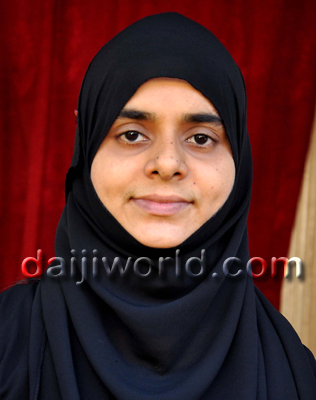
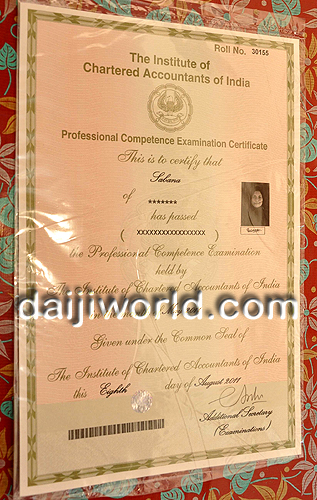
Shabana, a Muslim girl who hails from a poor family based in rural area, has won the admiration of a large number of people by clearing CA exams with sheer hardwork and dedication. Daughter of M A Hussainabba and Bi Fathima residing in the government hospital compound, Karnad, Mulky.
Shabana gets full credit for being the first ever Muslim woman candidate from the coastal region to have registered this landmark achievement. In the entire state, only two or three Muslim women chartered accountants can be found.
Shabana is the third among five children of Hussainabba with two elder sisters, a younger sister, and a brother. Hussainabba,, who worked as supervisor in a local plywood factory, did not allow financial constraints to weaken the prospects of his children, in spite of being the sole earning member.
While Shabana has successfully completed her dream of becoming a CA, her brother, Rashiq, has completed MBA and bagged a job in Bengaluru.
Shabana got her primary education in UBMC school in Karnad, completed PU education in Karnad government PU college, and B Com degree course in Pompei College, Aikala, Kinnigoli. In the CA examination held in November 2014, only 8.23 percent of 181 students who appeared for the examination in the city could clear it. It is learnt that the national average pass percentage pertaining to this examination is eight.
Institute of Chartered Accountants of India having central office at Chennai conducts these examinations. It has a branch office at Padil in the city, and St Aloysius College here happens to be the examination centre for the CA examination.
When Shabana was questioned about how she got interested in CA, she said mathematics happened to be a favourite subject for her since younger days. “When undergoing degree course, I got interested in becoming a CA, and my teachers encouraged me. After the degree, I appeared for the Common Proficiency Test and after passing it, joined for three-year articleship course under Gopalakrishna Aithal, CA based in Mangaluru. After he died last year, I continued the course in his office, and then joined another CA from the city, Keshava Ballakuraya. After the result was announced on January 19, at the advice of Ballakuraya, I have continued to work under him as an associate CA,” she explained.
On the method of preparing for the examination, she explained that she used to start to seriously study for the examination about two months in advance, by beginning studies at around 5 am. After completing first round of study, mostly practical, till 7.30 am, she said she consumed breakfast and took up second round of study. “I used to study theory from 8 am to 10.30 am. Then I took ten minutes rest, and resumed the same subject and continued till 1 or 1.30 pm. Then I took up another subject between 2 pm and 4.30 pm, mostly practical. I then continued study from 5 pm to 10.30 pm. I never studied more than four subjects per day, and did not opt to lose sleep for studying like some others do, as I felt studying in the morning was more effective,” she added. She clarified that she found it difficult to study during working days as it would be late by the time she reached home. She said she used to take leave as the examination approached, and study during this period.
About the support she got at her workplace, she was in profuse praise for her current boss, who she said, used to get case studies done through her by providing her necessary books to study. She said that this had helped her immensely in the CA examination.
On her future plans, she explained that she wants to work for a few months at the present office, where she will get rich experience in handling service tax issues. Her next plan is to work for a year in an auditing firm in Bengaluru, where she will get to study issues concerning foreign clients, as companies in Mangaluru do not get them. After that she wants to set up audit firm either on her own or in partnership with others in the city.
On being congratulated for emerging as an inspiration for Muslim girls and seeking for her message to her Muslim sisters, she said they should hone their talents and should come out and achieve something rather than staying at home. She feels that they should make use of opportunities lying before them.
Her advice to parents is that they should never adopt the policy of educating only the sons and encouraging only them to work. They should equally identify talents of their daughters and encourage them to study and work. Even the girls should be allowed to explore opportunity and carve out a future for themselves, she opines.
Asked about the support she got from her family, she said that her father, who worked in a factory in the local industrial area, supported his children to study what they wanted, although the family was poor. She also said she is grateful to her maternal uncles, who have always supported her plans, and provided all needed support for education. She said they have also promised to assist her to set up her own office.
source: http://www.daijiworld.com / Daijiworld.com / Home> Editor’s Pick / by Sunil Halengady / by Daijiworld Media Network – Mangaluru (SP) / March 12th, 2015
Navi Mumbai students, Gulman Salim Ansari and Hafsa Abdul Wahab Dalvi, secured top ranks in the national CA examination
Mumbai :
In a remarkable display of dedication and hard work, 22-year-old Gulman Salim Ansari and 24-year-old Hafsa Abdul Wahab Dalvi from Navi Mumbai have achieved outstanding results in the final Chartered Accountant (CA) exams held in May this year.
Both students have made their families and community proud with their exceptional performance.
Gulman secured third rank at the national level with an impressive 477 marks. Reflecting on his achievement, Gulman said he had decided to become a CA during his school days. “I started regular CA studies immediately after passing HSC, which helped me achieve my goal,” he said.
Gulman balanced his CA studies with his degree college coursework by studying 12 hours daily at home. “I didn’t attend college lectures due to the extra time required for CA studies but remained fully focused on college exams as well. My success is a result of my strong interest in studies and disciplined use of time,” he added.
Gulman’s father, Qaiser Ansari, works as a company secretary in Govandi, and his mother is a housemaker. They are elated with their son’s remarkable success. “We are very happy with this wonderful achievement of our son,” said Qaiser Ansari.
Similarly, Hafsa Dalvi has also excelled in the CA final year exam. Hafsa, who passed her SSC exam with 93% marks from Gloria English High School, Byculla, continued her academic excellence with 94% and 96% marks in her HSC and BCom final year exams at SIES College, Nerul.
Hafsa began her CA studies after completing her schooling and attributed her success to consistent hard work. “Due to hard work and consistent studies, I got success, which made my parents very happy,” Hafsa said. Her parents are overjoyed with her achievement.
The final CA exam results also highlighted other top performers, with Shivam Mishra from Delhi securing the first rank with 500 marks and Varsha Arora from Delhi attaining the second rank with 480 marks. Kiran Rajendra Singh from Mumbai and Gulman shared the third rank with 477 marks.
The success stories of Gulman and Hafsa underscore the importance of determination, disciplined study habits, and support from family in reaching one’s academic and professional goals.
source: http://www.clarionindia.net / Clarion India / Home> Indian Muslims / by Team Clarion / July 17th, 2024
Ten-year-old Alia Nasreen from Nalbari excels in both the Quran and the Bhagavad Gita
Guwahati :
Assam, known for its diversity of races, languages, and cultures, has once again demonstrated the spirit of inter-religious harmony and unity through the remarkable achievements of a young Muslim girl from Nalbari.
Alia Nasreen Rehman, a ten-year-old student from Nalbari’s Shantipur, has captivated her community with her mastery of both the Quranic verses and the Sanskrit shlokas of the Bhagavad Gita. A student of Vivekananda Kendriya Vidyalaya, Alia’s fluency in these sacred texts has made her a symbol of cultural inclusion and mutual respect.
Her father, Mukib-ur-Rehman, believed in the importance of understanding different religions, saying, “I am teaching my daughter the Gita because we all need to know about each other’s religions. We should not shy away from learning and reading anything.”
Mukib-ur-Rehman ensures that Alia receives a balanced religious education. “As a Muslim girl, I am also teaching her the Holy Quran and Hadith. We send her to the mosque to learn Arabic. She prays with me, although she is still very young for formal prayers,” he added.
Alia’s linguistic talent extends beyond spiritual texts. She can fluently recite Arabic alongside Sanskrit verses, impressing both her local community and educators. Her achievements have earned praise from both Muslims and Hindus, reflecting the spirit of coexistence Assam is known for.
However, her family’s progressive approach has not been without challenges. Mukib-ur-Rehman acknowledged that some within the Muslim community have criticised his decision to teach her the Gita. “There are some ignorant people who criticise her, but we ignore their words. We should study everything and remove all kinds of ignorance,” he stated firmly.
Alia excels in academics and the arts. She is a talented dancer, performing in Satriya and Kathak styles, and has won awards for singing and painting. “She has not taken any formal dance training, but this year, I have enrolled her in an art school where she will receive proper guidance,” said her father.
Recently, Alia was honoured with the prestigious Shilpi Sadhana Award from the Qazi Para Club in Behanpur, Nalbari District, for her exceptional talent. This recognition highlights her growing influence as a young ambassador of peace and understanding.
The support of Alia’s parents, Mukib-ur-Rehman and Papuri Begum, has been instrumental in her development. They ensure she receives quality education but also teach her about her culture, religion, and the importance of harmony. “We want her to become a real human being who respects all cultures,” said Mukib-ur-Rehman.
Alia’s story continues to inspire many in Assam, reinforcing the state’s identity as a land of unity in diversity. Her example stands as a powerful message against communal divisions, showing how understanding different faiths can strengthen societal bonds.
source: http://www.clarionindia.net / Clarion India / Home> Editor’s Pick> India> Indian Muslim / by Team Clarion / January 09th, 2025