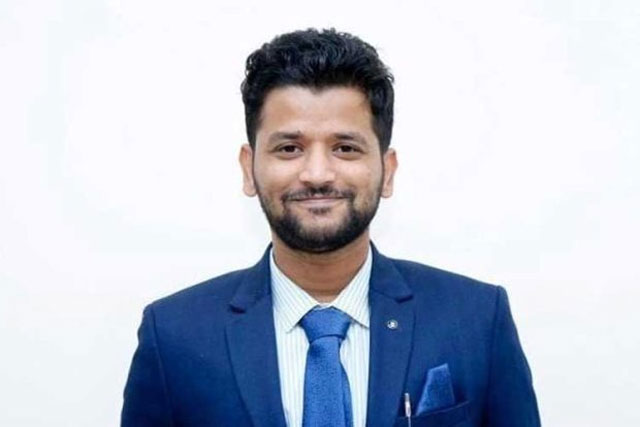
In a proud moment for Karkala, Shoukath Azeem from Salmara has secured the 345th rank in the UPSC Civil Services Examination 2024, turning his long-cherished dream of becoming an IAS officer into reality.
Undeterred by repeated setbacks, Azeem attempted the UPSC exam nine times, finally succeeding with an impressive rank in his last attempt, demonstrating unwavering determination and grit.
He is the son of Sheikh Abdulla and Maimoona from Salmara. His father, a truck driver by profession, raised the family with modest means. Despite coming from a humble background, Azeem’s ambition to join the civil services was ignited during his childhood after watching the Kannada movie Prithvi, starring Puneeth Rajkumar.
Azeem completed his early education at the Karkala Government Urdu School and a private school followed by higher education at a private college in Kukkundoor. He later earned his engineering degree a private college in Moodbidri.
In 2022, he had cleared the UPSC exam and was selected for the accounts division of the defence department, currently serving in Pune. Encouraged to try once more, Azeem made a final attempt and achieved his ultimate goal of becoming an IAS officer.
source: http://www.daijiworld.com / Daijiworld.com / Home> Top Stories / by Daijiworld Media Network – Karkala / April 26th, 2025
Hanipora Village (Pulwama District),JAMMU & KASHMIR :
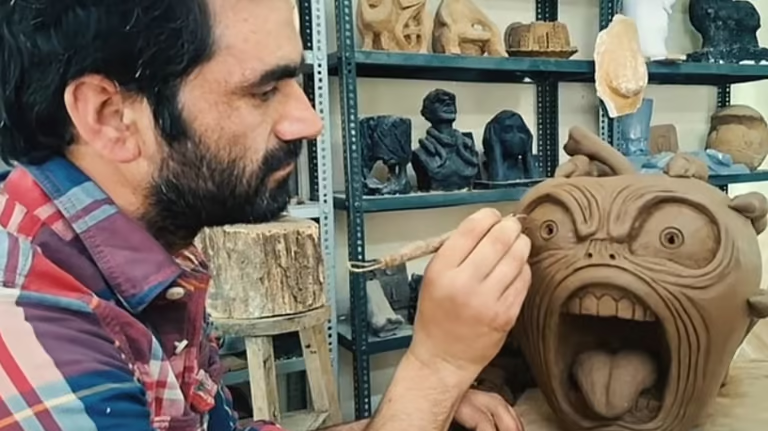
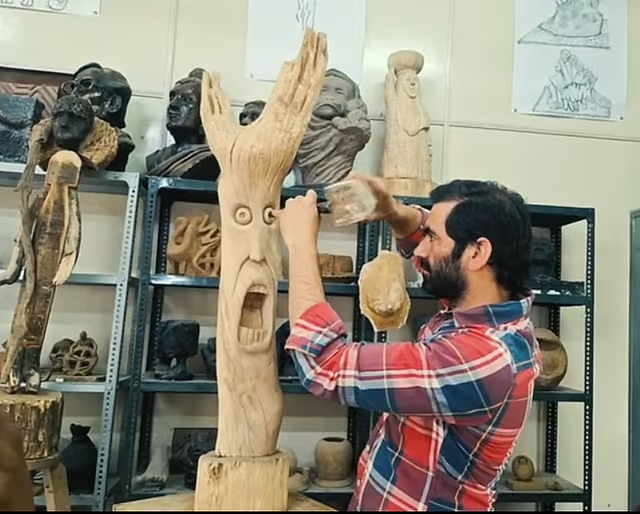
Hearing and speech-impaired, hardships of life never robbed this Pulwama man of his passion for art as he sculpted his way to new heights, Fayaz Wani narrates.
29-year-old Suhail Mohammad Khan / Photo | Special arrangement
Jammu :
The popular saying “where there is will, there is a way” rings true for 29-year-old Suhail Mohammad Khan, a resident of Hanipora village in Jammu & Kashmir’s Pulwama district, who has overcome his deafness and inability to speak through his art. Versatile as he is, he has mastered several different forms of art.
His hard work, determination and never-say-die attitude have made him a source of inspiration for others. An architectural designer, painter, sculptor and sketch artist, Suhail wears many hats. But his path to success has been anything but easy.
Suhail lost his ability to hear and speak when he was just a child. However, that did not diminish his passion for drawing and painting. He always enjoyed rustling up sketches and paintings of his friends. As years passed, he began to explore other forms of art, including sculpture, printmaking and cake designing, instead of confining himself to one specific genre.
After passing out of school, Suhail joined the Institute of Music and Fine Arts at University of Kashmir. His talent and passion soon earned him admiration from his peers and the artistic community.
Describing his journey as an artist, a friend of Suhail beams with pride, saying, “He is an all-rounder who can create anything in art. For him, nothing is impossible. Suhail literally speaks through his art. He does painting, sculpture, videography and photography. His work is realistic and based on creativity. Although he is deaf and dumb, his work is very realistic.”
Ask this friend if Suhail, who communicates through sign language, faces any difficulty in his everyday life because of his inability to hear or speak, and pat comes his reply: “He doesn’t need to speak or introduce himself to anybody. He speaks through his works. His art does all the talking. We must appreciate the courage and passion he has displayed in the face of adversity. After all, he is living proof that nothing is impossible and that anything can be conquered by sheer persistence.”
Contrary to the popular belief that a disability can seal one’s fate, Suhail remains way ahead of many people who are not even differently abled. He did India proud in the International Snow Sculpture Contest held in January this year in Colorado, US. Only 12 teams from the world participated in the contest. Suhail and his team toiled for four days in freezing temperatures ranging from -25 °C to -35°C to craft their sculpture.
Titled ‘Mind in Meditation’, Team India’s masterpiece stood out for its elegance and precision. India secured third position in the competition.
source: http://www.newindianexpress.com / The New Indian Express / Home> The Sunday Standard / by Fayaz Wani / April 20th, 2025
Nandaur Village (Fatehpur, Sant Kabir Nagar District), UTTAR PRADESH :
Photo Credit: PTI
Sant Kabir Nagar :
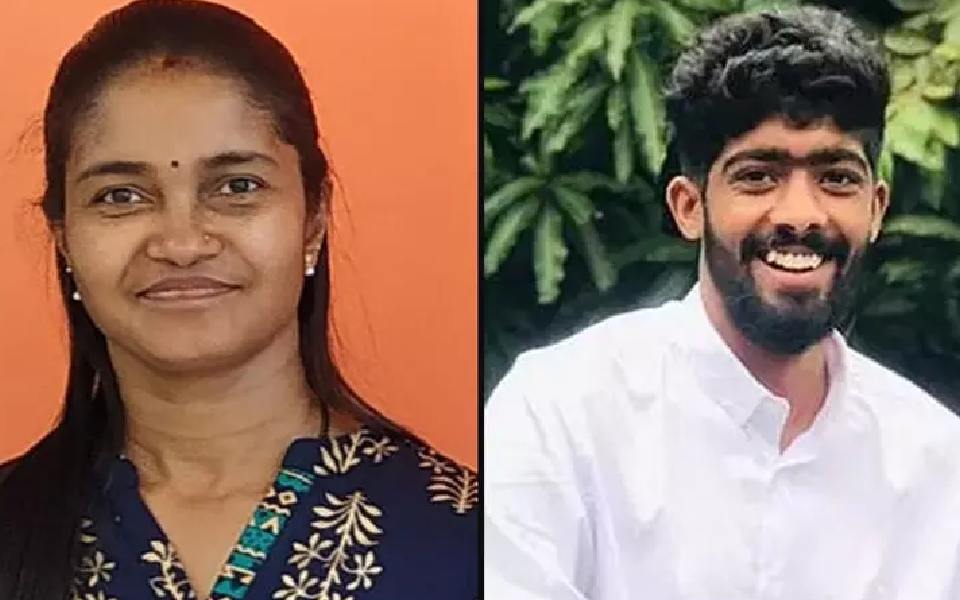
They say that determination, courage, and hard work can turn any dream into reality. This has been proved true by Iqbal Ahmed from Fatehpur (Nandaur) village and Aditi Chhapadia from Khalilabad, who have cracked the prestigious UPSC Civil Services Examination 2024 and brought glory to their district, reported the Asia Times.
Iqbal Ahmed secured an impressive 998th rank in the UPSC exam. Coming from a modest background, Iqbal did not let challenges deter his path. He began his education at a local madrasa, completed high school and intermediate at Begum Ishaq Nabi Khan Girls Inter College in Nandaur, and later earned his BA and B.Ed degrees from Hariharpur. Currently, he is serving as a Labour Enforcement Officer.
His father, Mr. Maqbool Ahmed, used to run a small puncture repair shop near the State Bank of India in Nandaur. Due to health issues, the shop has been closed for the past two years. Among five siblings, two of Iqbal’s brothers are involved in painting work. His achievement has been widely celebrated by former teachers and locals, who expressed pride and wished him a bright future.
Meanwhile, Aditi Chhapadia, daughter of prominent businessman and social worker Mr. Ashish Chhapadia from Khalilabad, secured an All India Rank of 97 in her second attempt and has been selected for the IAS. Her remarkable success has filled not just her family but the entire district with immense pride and joy.
Celebrations have erupted across Sant Kabir Nagar. Both Iqbal and Aditi have emerged as beacons of inspiration for the youth, proving that with true dreams and strong determination, one can rise from any background and succeed in the nation’s toughest examinations.
source: http://www.radiancenews.com / Radiance News / Home> Latest News> Markers of Excellence / by Radiance News Bureau / April 23rd, 2025
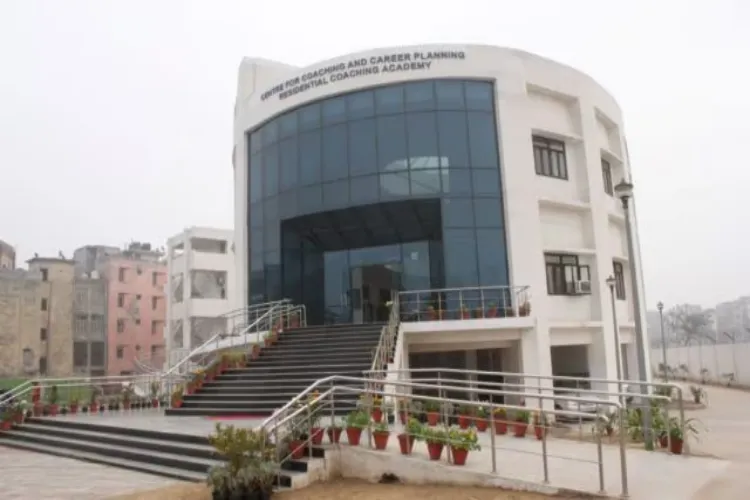
Turning aspirations into achievements, the Jamia Millia Islamia (JMI) university’s Residential Coaching Academy (RCA) has once again proven to be a beacon of hope for civil service aspirants as a total of 32 students trained there have cleared the Union Public Service Commission (UPSC) Civil Services Examination 2024, one of the most competitive exams in the country.
Of the 78 candidates from the RCA who reached the interview stage, 32 made it to the final selection list, according to a statement issued by the JMI.
Twelve among them are women, reflecting the RCA’s strong emphasis on inclusive and gender-responsive education, the statement said.
Alfred Thomas emerged as the academy’s top performer this year with an All India Rank (AIR) of 33. He was followed by Iram Choudhary (AIR 40) and Ruchika Jha (AIR 51), all of whom have earned praise for their inspiring journeys.
Speaking exclusively to PTI, Jha said, “The Jamia Millia Islamia RCA gave me a healthy competitive environment to push myself to work hard. The peer group I got here kept me motivated through tough times. The JMI RCA has played a crucial role in my UPSC-CSE journey.” She added that service allocation is expected in the next four to five months and her first preference is the Indian Administrative Service (IAS) in the AGMUT (Arunachal Pradesh-Goa-Mizoram and Union Territory) cadre.
Several of the selected candidates are likely to be inducted into top services like the IAS and Indian Police Service (IPS), while others will join the India Revenue Service (IRS), Audit and Accounts, Indian Railway Traffic Service (IRTS) and other Group-A services based on their ranks and preferences.
Celebrating the achievement, JMI Vice Chancellor Professor Mazhar Asif said, “This result is a matter of great pride. The RCA continues to uphold its mission of empowering students from socially- and economically-disadvantaged backgrounds. The performance of our women candidates particularly underscores the potential of inclusive education.”
Registrar Professor Mohammad Mahtab Alam Rizvi said, “These results are a reflection of the academy’s rigorous preparation model and the unwavering determination of our students. The RCA has built an environment of excellence that consistently delivers.”
Professor Samina Bano, the in-charge of the RCA, was praised for her personalised mentorship and hands-on guidance, which played a crucial role in this year’s success.
Established in 2010 under the University Grants Commission’s (UGC) initiative, the RCA operates through the university’s Centre for Coaching and Career Planning (CC&CP). It offers free coaching and residential facilities to candidates from Scheduled Castes, Scheduled Tribes, minority communities and women. Admission is based on a national-level written test, followed by interviews.
The academy’s legacy includes Shruti Sharma, the UPSC topper of 2021. Since its inception, the RCA has helped nearly 300 students enter elite services such as the IAS, IPS and Indian Foreign Service (IFS), while more than 300 others have joined services like CAPF, IB, RBI, Bank PO and various state PSCs.
According to the statement, the RCA’s structured programme includes more than 500 hours of classes, mock interviews, special sessions with retired civil servants and experts, and mentorship by successful alumni. It also provides round-the-clock library access, free Wi-Fi and secure residential facilities.
The Civil Services Examination is conducted in three stages — preliminary, mains and interview — to select officers for the IAS, IFS, IPS and other central services.
The preliminary exam was held on June 16, 2024, with 9,92,599 candidates applying and 5,83,213 appearing. A total of 14,627 candidates qualified for the main exam held in September and 2,845 reached the interview stage that was conducted from January 7 to April 17, 2025.
This year, the UPSC has recommended 1,009 candidates — 725 men and 284 women — for appointment to various services.
source: http://www.awazthevoice.in / Awaz, The Voice / Home> Stories / by PTI / Tarique Anwar / April 24th, 2025
The Rampur Nawabi family with former Prime Minister Dr. Manmohan Singh
In December 2021, I came across a report in a newspaper that said, “After almost 50 years of legal battle, the Rampur District Court has ruled in the Rampur Nawab family’s property dispute. The property will now be divided among 16 legal heirs. Raza Ali Khan, the last Nawab of Rampur, died in 1966. After a long legal battle, the court has announced the division of his property worth Rs 2,664 crore.”
The Nawab family of Rampur with its glorious history is still important played in Rampur and its surrounding districts. While the family ruled the state for a long time, its members joined the institutions of independent India like Parliament and legislative Assembly. Former Members of Parliament Mickey Mian and Noor Begum belong to the family. Many members of this Royal family have played an important role not only in politics but also in promoting the culture, patronizing poets, writers, musicians, and other creative artists.
Khandaan
The Nawabi family of Rampur State
Before the independence, India was dotted with small states and one of them happened to be the state of Rampur, located in today’s state of Uttar Pradesh. It was founded by Nawab Ali Mohammad Khan, a Pushtun leader on 7 October 1774. There have been 11 Nawabs in the state including Nawab Faizullah Khan, Nawab Hafiz Rehmat Khan Barish, Nawab Muhammad Ali Khan, Nawab Ghulam Muhammad Khan, Nawab Ahmad Ali Khan, Nawab Muhammad Saeed Khan, Nawab Yusuf Ali Khan, Nawab Club Ali Khan. Nawab Muhammad Mushtaq Ali Khan, Nawab Hamid Ali Khan.
Raza Ali Khan was the last Nawab of Rampur. Rampur was one of the important States of the British in India as its rulers were plaint and supported the Raj even during the 1857 revolt. It was a 15 cannons gun salute State and its rulers owned a lot of wealth.
Before the independence, the Nawabs of Rampur used to have their own railway station with two special coaches always in readiness in the service of the Royal family. Whenever the Nawab family had to travel by train to Delhi, Lucknow, or elsewhere, they would board their coach and that was added to the passenger train. During the tenure of the ninth Nawab, Hamid Ali Khan the railway line was laid in the district. At that time, he had built a separate railway station for his use. It was close to the main railway station.
The Royal Coach full of Luxuries and modern appliance
Interestingly the two railway coaches that have immense historic and antique value today are among the assets sought to be distributed among the progeny of the Raza Ali Khan. These were originally valued at Rs. 117.42 million. However, due to almost no maintenance, the price was halved.
Interestingly, these coaches had so many modern conveniences that even the heads of the state today can’t dream of. The coaches were equipped with 33mm and 16mm cinema projectors, cameras, imported radio transistors, and tape recorders. These provided all the luxuries like Bedding, chair, carburetor pillow, seat, silverware, glass, whiskey, beer bottles, English crockery, large cigarette and cigar box, silver footstep, eagle, silver canteen set, silver hooka, silver bed, sword, and various kinds of guns, etc.
The Nawab family’s properties include 1073 acres of land, mansions, palaces like Khas Bagh, Kothi Benazir, Lakhi Bagh, Kanda, and Nawab Railway Station, and immovable assets like arms, jewelry, etc. The valuables include silverware like six silver beds, 20 silver pandans, six khasdans, and 20 cigar boxes, and four hookas. Former Member of Parliament Begum Nurbano says that when she came to Khas Bagh in 1956 as a bride she slept on a silver bed. Khas Bagh was India’s first air-conditioned palace.
Khas Bagh Palace was the first air-conditioned palace in India.
Khas Bagh Palace, Rampur
The state of Rampur was not only a political state but also a great patron of education, art, and culture. Nawab Yusuf Ali Khan was a friend of knowledge and also gave scholarships to scholars and students. He made Mirza Ghalib his consultant on literary matters and he became a student of Ghalib. He used to send a reasonable amount of money to Mirza as a stipend. In addition, hundreds of poets, including Mirzadagh Dehlavi, were patronized by the Nawabs of Rampur.
The Library
The Nawab of Rampur was a friend of knowledge. The symbol of his friendliness of knowledge is Raza Library which was once the largest library in India and it is still very important today. Thousands of rare books and manuscripts in Urdu, Persian and Turkish languages are available here.
The Nawab of Rampur was also an epicurean. He had a whole army of cooks and chefs. These chefs would spend the whole day preparing high-quality food and experimenting with new flavors. Elders were invited to the Nawabi Dastkhwan. After the dissolution of the state, it became difficult for the Nawab to continue the Dasthar Khan.
The Nawabs of Rampur patronized traditional music at their court. Mehboob Khan was one of the greatest thinkers of the royal court of Rampur state. This tradition was followed by his sons Inayat Hussain Khan and Inayat’s brother-in-law Haider Khan and Mushtaq Hussain. It was here that the Rampur-Sahswan family of Indian classical music was born. Sahswan is in the present Badaun district.
One of the Palaces of rampur Nawab family
After independence, the Nawab family took an active part in politics and Major Nawab Syed Zulfiqar Ali Khan Bahadur was the first from the family to be elected to the Lok Sabha. He was known as Mickey Mian. He was the second son of Nawab Sir Syed Raza Ali Khan Bahadur. In 1984 and 1989, he was elected to the Rampur Lok Sabha seat on a Congress ticket. It is also interesting to note that Mickey Mian represented Rampur in Lok Sabha for a long time but never spoke in the House.
After Mickey Mian, his wife Begum Noor Bano served as Member of Parliament in the 11th and 13th Lok Sabha. She was elected from Rampur on a Congress party ticket. Begum Noor Bano alias Mehtab Zamani Begum was born to Nawab Aminuddin Ahmed Khan who was the last ruling Nawab of Loharo (Bhiwani-Haryana). She was educated at Maharani Gayatri Devi Girls Public School, Jaipur.
She joined the All India Congress Committee in 1992 and was elected to the Lok Sabha in 1996. In the next election, she lost to BJP’s Mukhtar Abbas Naqvi. An aficionado of music and dance, Noor Banu is the patron of the Devi Foundation and the Rampur family. Bano is interested in historical and cultural Persian and Arabic books and research on environment and forest protection. She enjoys reading, painting, gardening, and music and is a member of several sports clubs across the country.
Micky Mian and Noor Bano with their children
Micky Mian and Begum Noor Bano have three children. One of them is Nawabzada Syed Muhammad Kazim Ali Khan Bahadur. He was elected MLA several times and is also a Congress candidate in the current Assembly elections. His son Nawabzada Syed Haider Ali Khan Bahadur is also contesting the Assembly elections 2022.
In the current elections in Uttar Pradesh, the reputation and honour of the Royal family is also at stake. Samajwadi Party veteran Azam Khan, who has been elected an MLA from Rampur city nine times is contesting from inside the jail against his traditional rival from the Royal family Mohammad Kazim Ali Khan. Kazim Khan popularly known by his nickname of Navid Miyan is contesting as a candidate of Congress Party and is hoping to defeat the ‘tainted’ Azam Khan.
Besides, Azam Khan’s son Abdullah Azam is contesting from the Suar constituency where he is pitted against Naveed Mian’s son Hamza Mian.
The Nawab of Rampur
Azam Khan has dominated the politics of Rampur for 42 years. He has also held ministerial positions in the Samajwadi government four times. He has also been Leader of the Opposition and Member of Rajya Sabha. On the other hand, the Nawab family has also a great influence on Rampur. Naveed Mian Sawar has been MLA four times from the Tanda seat. Once he was also elected to Legislative Assembly from Bilaspur and was a minister too.
His father Nawab Zulfiqar Ali Khan alias Miki Mian has been a Member of Parliament five times and his mother Begum Noor Bano has been a Member of Parliament twice. Both the Congress and the SP have given tickets to the members of the Rampur Royal family. This time, Congress has given tickets to former MLA Naveed Mian as well as his son Haider Ali Khan alias Hamza Mian.
source: http://www.awazthevoice.in / Awaz, The Voice / Home> Stories / by Ghaus Siwani / February 04th, 2022
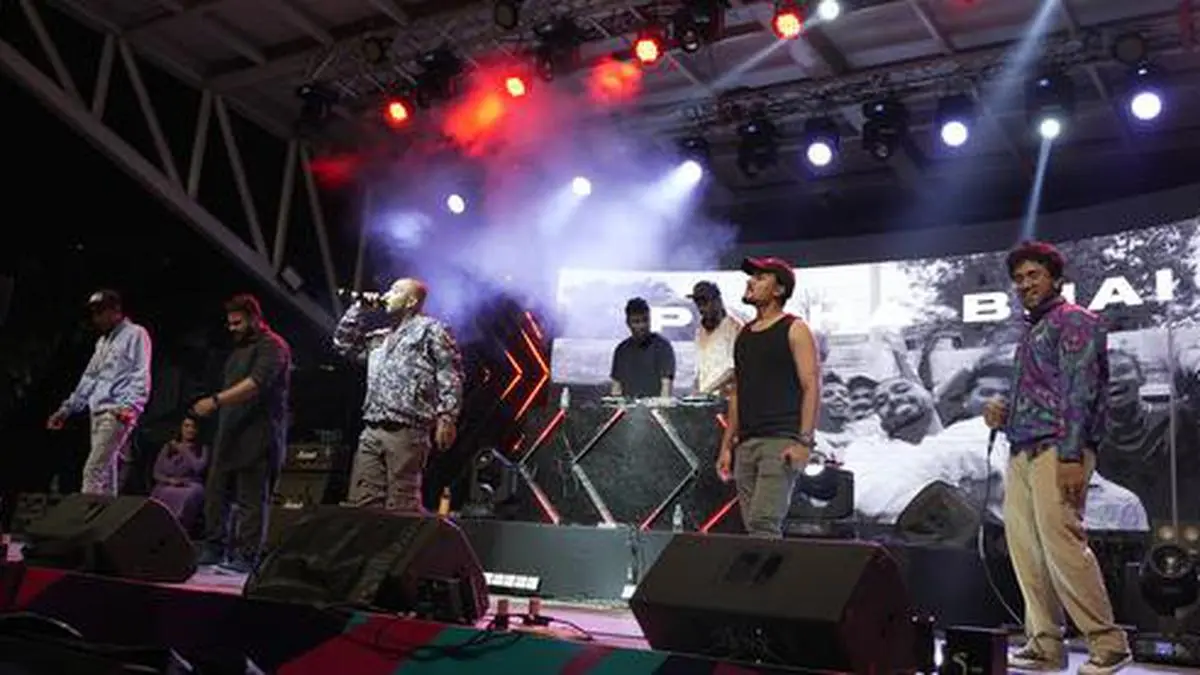
Pasha Bhai’s journey from the Muslim ghetto of Neelasandra to the posh clubs of Bengaluru is as much a story about his art as about Dakhni Urdu, the language he consciously chooses to rap in, making it both a quest for selfhood and for his mother tongue’s history.
Pasha Bhai and members of Clan Bokka Phod performing at Bowring Club on May 7.
Bowring Institute, one of Bengaluru’s oldest social clubs, is pulsing with energy. Raftaar, a sensation in the Hindi and Punjabi rap scene, is the marquee act. Warming up the audience before he comes on is a bunch of Bengaluru-based rappers with funky monikers such as MC Truth, Ray, and Quake. Third in line is Pasha Bhai and his Clan Bokka Phod (CBP). On the evening of May 7, Bowring
When his turn comes, Pasha Bhai bounds onto the stage with his trademark energy. His hair cropped short and wearing a loose, full-sleeved T-shirt with baggy trousers that hang low on his waist, he opens with ‘Eid ka Chand’ (The Moon of Eid), one of his popular songs. A rousing cheer goes up from the audience, which is familiar with this number that has garnered more than 45,000 views on YouTube.
When Pasha Bhai sings the lines: “ ” (I’m my father’s spoilt brat/ My heart is like wax, but I have the courage of steel), some of his fans hum along. Pasha raps in street-Dakhni, and he raps at warp speed, which means that many in the crowd cannot grasp the lyrics but they are bound up in the frenzied covenant between singer and audience, which is part of the frantic mood of a rap concert. Even his band’s name is a Dakhni phrase for ‘ball-breakers’. Ladila Bawa Ka, Bigda Huwa Beta/ Moum Ka Dil, Par Jigra Loha Mera
Pasha follows up the first song with a few more popular solo numbers such as ‘Haraanya’n’ and ‘Kumbhakarana’. Then he is joined by his gang, the infamous Ball-Breakers, and they rap to ‘Khuda Gawah’.
Pasha screams ‘I love you Bangalore!’ before getting off the stage after his set. T-shirt soaked in sweat, he chugs down a bottle of water as fans walk up to him to take selfies. While the 23-year-old rapper has performed in several spaces in Bengaluru, being part of the opening act for Raftaar has added to the growing reputation of this savvy singer. There are some distinct reasons for Pasha Bhai’s success. First, his originality as a lyricist and his intuitive ability to vocalise in Dakhni; second, his moorings in a marginalised social and economic Muslim stratum in Bengaluru that resonates with the ethos of the early Black rappers who emerged from the ghettos of American cities; and third, his conscious use of Dakhni, his mother tongue, which some linguistic scholars argue is a language on its own but which is often dismissed as a dialect of Urdu.
Spoken mainly by Muslims in Karnataka, Telangana, Andhra Pradesh and parts of Tamil Nadu, Dakhni, translated as ‘Deccani’, traces its provenance to the reigns of the Bahmani and Deccan Sultanates between the 14th and 17th centuries whose territories sprawled across the Deccan plateau from the Arabian Sea to the Bay of Bengal. In certain parts of Hyderabad and Bengaluru and across urban centres in south India (except Kerala), Dakhni continues to be the lingua franca of a wide section of the non-Muslim population as well.
Says Bengaluru-based Arjun Sharma a.k.a Quake, the rapper who curated the event: “Pasha Bhai is one of the best thinkers/ writers out there. He’s talking sense and he’s talking reality. People should start understanding Dakhni to listen to him; that’s the only way our language will grow and get recognition. He is the only person representing Dakhni now.”
Pasha Bhai, whose non-rapping name is Mohammed Affan Pasha, has a simple studio, christened ‘Dakhnistan’, on the fourth floor of a nondescript building in the largely Muslim ghetto of Neelasandra in central Bengaluru. To get there, one has to negotiate a maze of narrow, meandering roads dotted with meat stalls, tiny mosques, and food kiosks. Minimally furnished, the most interesting thing in the dingy hangout is a carrom board around which Syed, Demixx, Nimbu Da, Marwan, Shoaib and Maddy of the CBP gang has gathered.
Pasha was born in 1998 and grew up in Neelasandra. “We are the children of rowdies,” he said, referring not to his father, who was an auto-driver and passed away when Pasha was still in school, but to the grimy milieu of violence that engulfed him and his clan members growing up in Neelasandra. Pasha always had an ear for music and as a high schooler he began to listen to American and Indian rappers such as Eminem, 50 Cent, Yo Yo Honey Singh, Raftaar, IKKA and Machas with Attitude.
The Hindi rappers were a tremendous influence on him. Among his greatest inspirations was Mumbai’s Naezy because he “is also a Muslim from the ghettoes of Mumbai”. Pasha began rapping in Hindi at the same time, and the 2019 film about a rapper also had an impact on his nascent career. At this time, Pasha was doing “chhatri kaaman” (petty jobs) for easy money. Having failed in Class 12 and with a floundering love affair to boot, Pasha began working in a garment factory as a helper. His mother worked there too. It took a year of hard work before he realised the importance of education and enrolled himself in evening college. Gully Boy
Amid this tumult, Pasha’s cachet as a rapper was soaring, as he continued to rap in Hindi and began fledgling attempts at rapping in Dakhni. For Pasha, the hip hop and rap culture was alluring because the genre “does not ask you to be anyone but to be real and true to yourself”. Pasha adds that there were “no restrictions while rapping and there is no structure to the music”. Connoisseurs of rap will disagree with this assessment, but Pasha’s confidence only reiterates the intuitiveness with which he has grasped the technicalities of the medium. Pasha says rap gave him the freedom to become a musician without learning music.
He also started a cypher (a gathering of rappers making music extemporaneously) called ‘Wanandaf’ (a shortening of ‘one and a half’) in 2019, the name inspired by the refrain of Bengaluru auto-drivers demanding an inflated fare. Held weekly in open spaces such as Cubbon Park and Lalbagh, Wanandaf attracted budding rappers, hip hop artists, beat boxers and graffiti artists before the pandemic stepped in. Part of why Pasha began Wanandaf was to democratise hip hop in India.
“Hip hop is owned by marginalised African Americans, but when it came to India it was acquired by the elite. It was a closed group of artists and I couldn’t enter its exclusive space. When we’d go to rap concerts wearing slippers, we weren’t allowed in. It made me hate the culture of rap music,” Pasha said. But by 2019, Pasha had surmounted these class barriers and become a respected member of a network of fellow rappers who appreciated him for his ingenuity, which led to creative collaborations and caught the attention of aficionados. Counting singles and collaborations, Pasha has made almost 30 songs so far. He was also a sought-after act during the anti-CAA (Citizenship [Amendment] Act) protests in Bengaluru.
Pasha is India’s first rapper in Dakhni, and this was not accidental. When he “did not find a representation of his language in the rap industry”, he consciously chose to rap in Dakhni and the exercise has turned into a quest to know more about his mother tongue. “As a child I would proudly speak Dakhni even though it was mocked and patronisingly referred to as ‘Broken Urdu’. I was ignorant that the dialect had a name, unaware of its origins, history or associations. Like others around me, I grew up calling it ‘Bangalori Urdu’. As I researched further, I realised that Dakhni has always been under threat of being erased, misnamed or compelled to become a ‘dialect’ of a larger language and cultural group. The legacy of Dakhni poets and artists has been one fraught with constant struggle to keep Dakhni-ness alive.”
Hyderabad-based journalist and researcher Yunus Lasania argues that it is wrong to describe Dakhni as ‘Urdu’ or ‘Hyderabad Hindi’. “Dakhni (or Deccani) is usually mistaken to be a ‘dialect’ of Urdu, especially among northern Urdu speakers. Both Dakhni and Urdu have roots in Dehalvi (also known as ‘Old Urdu’), which existed in Delhi for around a century before it reached the Deccan in the 14th century through the conquests of Mohammed Tughlaq. Dakhni is a mix of Persian, Old Urdu (Dehalvi), Kannada, Marathi and Telugu. It was created when Dehalvi mixed with the three aforementioned languages,” he said.
Karthik Malli, an independent researcher and writer working on south Indian language histories, said, “Dakhni has, in all likeliness, been part of Bengaluru’s social landscape for many centuries now. Numerous Sufi shrines in Chickpet dating back to the 1700s catered to local Dakhni-speaking Muslims. Tipu Sultan [who was born in Devanahalli on the outskirts of modern Bengaluru] was a Dakhni speaker as well, and even commissioned literary works in the Classical Dakhni register cultivated earlier in Bijapur and Golkonda.”
Malli added, “Despite Dakhni’s presence and history in the city, it has seldom found any serious artistic expression. Digital media is helping change that by giving voice to artists like actor and comedian Danish Sait who utilises Dakhni to great effect in his highly popular comedic skits. Sarah Fazal, an RJ, also makes Dakhni skits on Instagram. There are also a number of social media meme pages that utilise Bangalore Dakhni, directly addressing a large local audience that uses the language in everyday life.” Pasha’s name must be added to this short list as someone who is furthering Dakhni in popular culture through rap.
India Foundation for the Arts (IFA) has awarded Pasha a grant for his project titled “ ”, which seeks to “keep Dakhni language and culture alive through the art practice of rap and hip hop”. Said Sumana Chandrashekar of IFA, “With the privileging of certain cultures to the exclusion of many others, there is always the danger of losing sight of the rich multi-textured nature of experiences, narratives, people and languages that collectively form the fabric of this city. From this point of view, IFA is delighted to implement a project with Pasha to explore and engage with Dakhni expressions in Bengaluru’s popular culture. What is special about this project is that it embraces and embodies Pasha’s deeply personal lived experiences with Dakhni and moves on to excavate the deep cultural bond that this language has with the city. For us, the project is not just a celebration of Dakhni as a language but also a reaffirmation of the many cultures, histories and languages that make our city ” Apnich Bol, Dakhnich Bolnamma Bengaluru.
With his rising popularity and the support of respectable patrons such as IFA, Pasha has made the leap from Neelasandra to exclusive music spaces in the city. Looking at his talent and verve, his journey so far seems like the first chapter of a long book. This cocky segment in the collaborative rap piece ‘56’ illustrates his persona and talent more clearly:Pasha bhi aako hin dekho sabbi jane khamush rhao,Gunna ginne scene ni scene huit’ long uthao,Tada dek’ tadpatin kisse to b uska taaluk rhaoChillar’an ku baazu b ni rakhte, chalo baazuk’ jao.
(Pasha bhai has arrived, everybody pipe down!
A scene breaking out, brandish your swords, strictly
no guns
You’re going to get it good – doesn’t matter who you
know,
Now move, you’re loose change, not worth my time,
now go!)
—Translated by Sahar Adil
Street smart
First rapper in Dakhni
source: http://www.frontline.thehindu.com / The Hindu / Home> Lead Story> Cover Story : Pasha Bhai / by Vikhar Ahmed Sayeed / May 17th, 2022
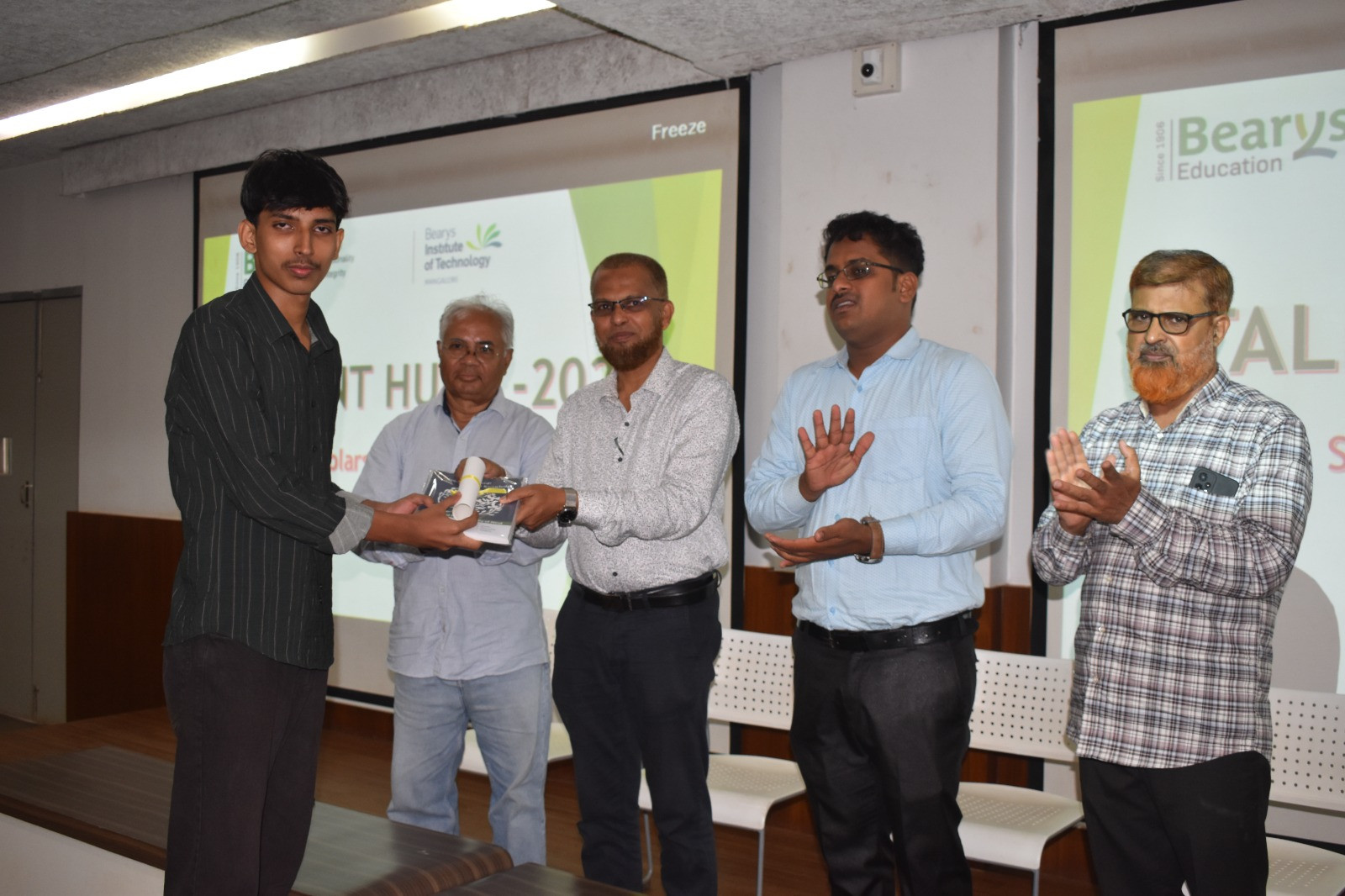
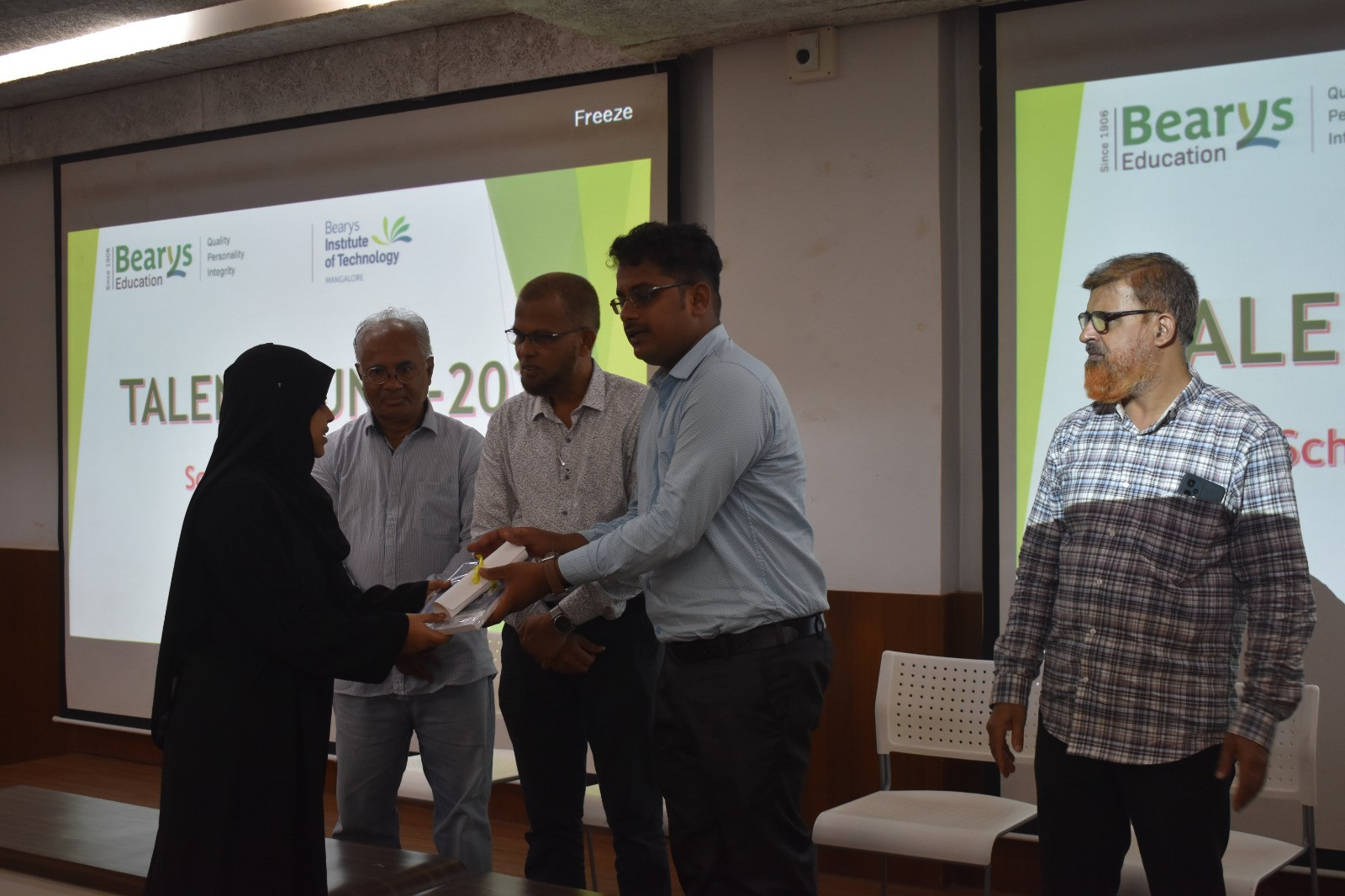
Bearys Institute of Technology (BIT), in association with BEADS, successfully organized the Talent Hunt 2025, an in-house entrance examination aimed at identifying and nurturing young talent among II PUC science students. The event was held on April 12, 2025, at the BIT campus, Bearys Knowledge Campus (BKC), near Mangalore University, Innoli.
The event commenced with a warm welcome address by Dr. Anjum Khan, Faculty of Basic Science, who highlighted the significance of early academic encouragement for budding engineers and architects.
The keynote address was delivered by Dr. S.I. Manjur Basha, Principal of BIT, and Architect Khaleel Abdul Razak, Principal of BEADS. They emphasized the value of integrated learning, innovation, and the vision behind offering generous scholarships to meritorious students through such initiatives.
A large number of students participated in the Talent Hunt exam, and up to 100% scholarships were awarded to the most outstanding performers, with all participants receiving a minimum of 10% scholarship on tuition fees.
The results were officially announced by Heena, HR at BIT.
Among the top achievers, Ibrahim Nasim from Yenapoya PU College, Udyavara, secured a 100% scholarship, while Ayishath Sahla (Anugraha PU College, Vitla) and B U Khadeejath Thabsheera (Dr. APJ Abdul Kalam PU, Ira) were awarded 50% scholarships each.
Seven other students received 25% scholarships for their exceptional performance.
The event concluded with a vote of thanks delivered by Prof. Joyson from the Department of Basic Science.
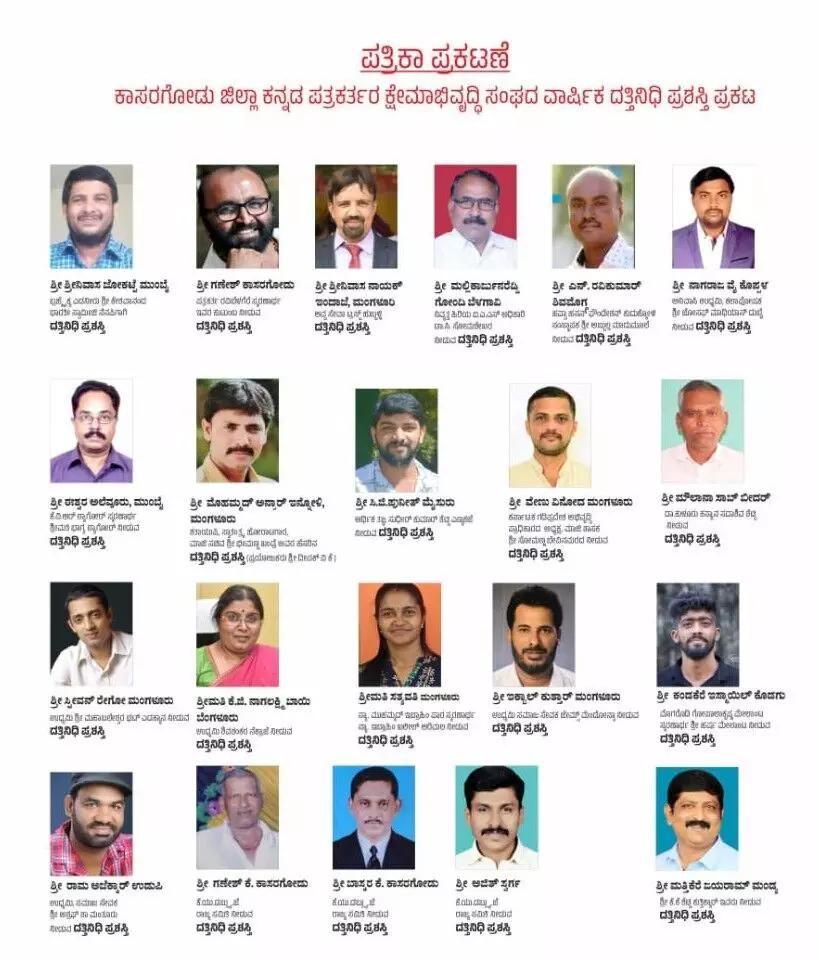
The Kasaragod District Kannada Journalists’ Welfare Association has announced the recipients of its annual Endowment Fund Awards. This year, 21 journalists have been selected for recognition, including Vartha Bharathi Mangaluru Bureau’s senior reporter Satyavati, and Kodagu special correspondent Kandakere Ismail Kodagu.
The award ceremony will take place on May 3 at the Seethangoli Alliance Hall in Kasaragod district. Each endowment award comprises a cash prize, an award certificate, and a memento.
The names of the awardees according to a press release issued by the association are as follows,
Satyavati will be honoured with the Lawyer Muhammad Ibrahim Pare Memorial Award, while Kandakere Ismail Kodagu will receive the Mogarodi Gopalakrishna Melanta Endowment Award. Srinivasa Jokatte from Mumbai, who will receive the Brahmakya Edneer Sri Keshavananda Bharathi Swamiji Memorial Award, and Ganesh Kasaragodu, who will be awarded the Journalist Ravi Belagere Memorial Endowment Award.
Srinivasa Nayak Indaje will be awarded with the Avva Trust Hubballi Endowment, Mallikarjuna Reddy Gondi of Belagavi with Retired senior IAS officer Dr. C. Somashekara Endowment, N. Ravikumar with Hawva Hasan Foundation Kudkoli Endowment, Nagaraja Y. Koppala with Non-resident businessman and art patron Joseph Mathias Dubai Endowment, Iswara Alevoor from Mumbai with KVR Tagore Memorial Award, and Muhammad Ansar Inoli with Freedom Fighter and Former Minister Bhimanna Khandre Endowment.
Others receiving awards include C.J. Puneeth of Mysuru (Economist Sudhir Kumar Shetty Enmakaje Endowment), Venu Vinod of Mangaluru (Somanna Bevinamarad Endowment), Maulana Saab Bidar (Kuluru Kanyana Sadashiva Shetty Endowment), Steven Rego of Mangaluru (Mahabaleshwar Bhat Edakkana Endowment), and KG Nagalakshmi Bai of Bengaluru (Sivashankar Nekraje Endowment).
Also recognized are Iqbal Kuthar (James Mendonsa Endowment), Rama Ajekar (Ashraf Shah Manthur Endowment), Ganesh Kasaragod (KWJ State Committee Endowment), Bhaskar K. Kasaragod (KWJ State Committee Endowment), Ajith Swarga (KWJ Endowment), and Mattikere Jayaram of Mandya, who will be awarded the K.K. Shetty Kuttikar Endowment.
The Kasaragod District Kannada Journalists’ Welfare Association, active for over two decades, works in collaboration with pro-Kannada organizations to promote and preserve Kannada language, culture, and art. The association also acts as a cultural bridge between Kannada and Malayalam-speaking journalists.
The May 3 ceremony will be chaired by the reception committee head K.K. Shetty Kuttikar.
The event will be graced by dignitaries including Karnataka Legislative Council Speaker Basavaraj Horatti, Agriculture Minister Chaluvaraya Swamy, Forest Minister Eshwara Khandre, Karnataka Border Area Development Authority Chairman Somanna Bevinamarada, Chief Minister’s Media Advisor K.V. Prabhakar, Karnataka Working Journalists’ Association President Shivananda Tagadoor, and Kasaragod District Kannada Development Authority President Ravi Naikap, read an official statement.
source: http://www.english.varthabharati.in / Vartha Bharati / Home> Karavali / by Vartha Bharati / April 22nd, 2025
Tipu Sultan’s largesse to temples as recorded in the 19th century Inam Registers of Malabar shows that he was sensitive to the religious sensibilities of Hindus.
Karnataka Chief Minister Siddaramaiah paying tribute to Tipu Sultan in Bengaluru on November 10.
The Congress government in Karnataka led by Chief Minister Siddaramaiah has marked the birthday of Tipu Sultan on November 10 as “Tipu Jayanti” for the past three years. While Tipu is honoured as a freedom fighter for opposing the British in the Anglo-Mysore Wars and dying on the battlefield in 1799, there are intense protests against this event as well. The protests are led by a wide array of bodies that draw their support from the Hindutva ideology spearheaded by mainstream politicians of the Bharatiya Janata Party in Karnataka. They allege that Tipu was a religious bigot whose reign was marked by the plunder of temples and forceful conversions of Hindus to Islam.
There are allegations that Tipu forcefully converted non-Muslims in three parts of his domain: first, among the Kodavas of Kodagu in modern Karnataka; then among the Nairs of Malabar in present-day north Kerala; and the Christians of Mangalore (now Mangaluru) in coastal Karnataka. Frontline has discussed the broad reign of Tipu Sultan and his legacy (“Contested legacy”, December 11, 2015) and scrutinised the allegations of religious excesses made against him in Kodagu (“Tipu-Fact & Fiction”, January 6, 2017). This essay attempts to analyse the allegations made against Tipu Sultan in Malabar.The Inam registers
Deep inside the Regional Archives of Kozhikode, amid lakhs of valuable documents, is a set of seven registers dating to the 19th century, compiled by J.W. Robinson, the Inam Commissioner of Malabar. The seven British-era taluks the Inam registers pertain to are Ernad, Choughuat, Old Betatnad, Calicut, Kurumbranad, Valluvanad and Wynad. (These taluks have been absorbed into various districts in modern Kerala.) An “inam” is a gift, and inam land is land given as a tax-free grant to an institution or an individual, usually in perpetuity unless it is rescinded, as happened all over India through various land reform laws after Independence. The registers have archived for posterity the minutiae of the process of renewal of inams in the region.
The registers are long and broad and the calligraphy is stylised to the point that at first glance all that one can discern is a series of neatly slanted squiggles.
The register pertaining to Choughuat taluk (also known as Ponnani) lists nine temples whose inam lands were renewed. Of this, the largest land grant (of 613.2 acres) that was renewed belonged to the Guruvayur temple in central Kerala. A close perusal reveals that the text lists the beneficiary as Uralers, or trustees, of the “Guruvayur Kshetram”.
The extended note reads: “A sum of Rs.1,428-9-2 [rupee-anna-paisa] appears to have been allowed for the support of the temple by Tippu Sultan and continued by the British Government upto 1841, when the necessary examination was made and the money allowance commuted into a grant of the lands yielding an annual assessment equivalent to the money grant. The lands are still held as inams and are accordingly confirmed as such for such time as the conditions of the inam are fulfilled under date the 20th Nov. 1841.” This note was endorsed by G.A. Ballard, the then Collector of Malabar, and subsequently confirmed by W.J. Blair, the then Officiating Inam Commissioner of Malabar, on June 20, 1866. In other columns relating to this entry, a mention is made that the inam was first granted by Tipu Sultan in 1776-77 and verified by the British administration of Malabar. The basis of the British confirmation was the pioneering “paimash” (survey) land revenue records prepared by the Brahmin administrative clerks of the Mysore rulers, who wrote in the Modi script, the precursor to the Devanagari script used to write modern Marathi.
The Archives have around 500 bundles of these land revenue records, each around 100 pages. The pages are slightly frayed but the script is legible. These records in the Modi script are a gold mine for academics interested in the land reforms carried out by Hyder Ali and Tipu Sultan in Malabar, which had a long-term impact on Kerala society.
What is more germane to our times, when Tipu’s legacy is hotly debated, is that the Inam Registers contain detailed records of the substantial land grants he made to several temples. This is valuable evidence to counter reductive Hindutva propaganda that alleges that Tipu was a religious bigot whose ambitious expansionist ventures were only a jehad to spread Islam by destroying temples and forcefully converting Hindus in the region.
According to an estimate made by Muhamad Ismail, details of which are available in his unpublished PhD thesis, 6,931.03 acres of land were given as inam by Tipu Sultan. Of this, 5,434.07 acres were given to Hindu institutions and individuals, while 1,494.27 acres were given to Muslim institutions and individuals (“Religious Policy of Tipu Sultan: Malabar Region”, Unpublished Doctoral Thesis, 2016).
Grants were made under three categories: devadayam grants to 48 temples, dharmadayam grants to seven “sathrams”, and grants to three individuals (see table). Considering that local Muslims known as “mappilas” made up about a quarter of the population of Malabar, this stark disparity in the largesse of a “religious bigot” is startling. If anything can be argued through these land grants, it is that like in other parts of his kingdom, Tipu was keenly sensitive to the religious sensibilities of Hindu citizens in Malabar as well. He wanted to establish a long-term presence in Malabar, and his perspicacity is evident in his support to temples.The Mysorean interlude
The late 18th century was a period of transition in Indian history. The Mughals were in a state of continuous decline and the East India Company had emerged as a major player in the affairs of the subcontinent after the Battle of Plassey in 1757. The Marathas had established their sway over vast swathes of the subcontinent as well. In peninsular India, various powers were battling for expansion of their territories. Hyder Ali, a faujdar (military commander) in the Mysore Army, rose to become the de facto ruler of Mysore in 1761. His territory was threatened by the Marathas, the Nizam of Hyderabad, the Nawab of the Carnatic and the English under the aegis of the East India Company. The French were also an important power that could not be ignored.
North Kerala at the time was broken up into several small principalities. An early estimate states that there were four important kingdoms and 42 principalities across Kerala. Hyder invaded Malabar through Mangalore and Cannanore (now Kannur) in February 1766. Hyder was embroiled in the affairs of Malabar indirectly from the time he was in Dindigul. The Raja of Palghat (now Palakkad), who had a constant feud with the Zamorin of Calicut (now Kozhikode), reached out to him for help, providing Hyder the excuse he needed to come to Malabar as he had always wanted access to a long coastline and a share in the lucrative trade of spices. His fort in Palakkad, around which the modern town has developed, also dates to this era. Tipu, the eldest son of Hyder, who would have been a teenager at the time, accompanied his father on this campaign.
Hyder’s invasion was successful and he swiftly conquered the minor principalities of Malabar. The Zamorin of Calicut, defeated and forced to pay a tribute, committed suicide. The disunity among the rulers of Malabar and the disciplined approach of the Mysorean Army led by its cavalry were responsible for this easy victory for Hyder, who intended to march all the way down south to Travancore via Cochin), but the monsoon hindered his plans. He returned after appointing a governor called Madanna and fixing tributes for the local chieftains. Soon after, his outposts in Malabar were threatened by a rebellion led by the Nairs, who formed the fighting corps of the Kerala kings.
While this rebellion, which some historians see as a native resistance to a foreign ruler, was quelled, it did lead to Hyder severely restricting the privileges of the Nairs. Many upper caste Hindus, including the Namboodiris, the Nairs and chieftains, fled to Travancore during Hyder’s invasion.
Over the next few years, Hyder was fighting the marauding Marathas and the First Anglo-Mysore War (1767-69) and could turn his attention to Malabar again only at the end of 1773. This time, many local chieftains who had not been regular with their tributes were not reinstated, and Malabar came to be directly ruled as a province of the Mysore kingdom. Hyder’s plan of attacking Travancore was again left incomplete. A detailed land survey was done by Sreenivas Rao, the governor in charge of civil affairs, and the land records at the Regional Archives of Kozhikode date back to this era.
When Hyder came to Malabar, several European powers, led by the East India Company, were already deeply involved at various levels in local affairs as they all had trading outposts along the coast of Malabar. They included the English, the Dutch, the French, the Portuguese and the Danes. Among them, the English and the French had substantial trading interests from their bases in Tellicherry (now Thalassery) and Mahe. During the Second Anglo-Mysore War (1780-84), Tipu was in Malabar fighting the English. He was about to score a crucial victory when he received the news of Hyder’s death. Tipu swiftly returned to Seringapatam (now Srirangapatna), but his territory in Malabar was restored to him as per the Treaty of Mangalore in 1784. Malabar remained a part of Tipu’s domain until the end of the Third Anglo-Mysore War in 1792, but he had lost control over it by 1790. It eventually became a part of the Madras Presidency as Malabar district.Impact of Mysorean rule
“The great significance of the Mysorean occupation of Kerala for more than 25 years, lies in the fact that it marked an era of transition from the medieval to the modern,” writes C.K. Kareem in his book Kerala Under Haidar Ali and Tipu Sultan (1973). Although Malabar was officially part of the Mysore kingdom between 1766 and 1792, the Mysore rulers had only limited control for many years. Tipu ruled the region directly only for six years. While the period of direct rule was short, it had a long-term impact on Malabar society. Hyder and Tipu brought about an integration of the small principalities of Malabar for the first time and a feudal system of administration was replaced by centralised rule, much like it had been done in Travancore. A network of roads was built in the region for the first time. Trade and industry flourished during the time and European merchants who had secured favourable terms from the Malabar chieftains suffered as Tipu imposed a state monopoly on a number of items, including pepper. He also attempted to build a navy here and appointed the ruler of Cannanore as the chief of his naval force.
Perhaps the greatest impact of Hyder and Tipu was in the area of land administration. In this area one can also see the displacement of dominant castes, which gave rise to accusations of religious bigotry. Historians have written about how there were no land taxes in Malabar before it came under Mysore rule. The “jenmis” (landed aristocracy) were the absolute owners of land with the tiller having no claims. The Mysorean rulers shook up this system and settled land revenue claims directly with the tiller. In this way, Hyder and Tipu can be seen as early reformers in land administration. The rulers ensured that temple land remained untaxed. Land settlement became easy because the landowners—the Namboodiris, the chieftains and the Nairs—had fled from Malabar to Travancore. The tenants, who were mainly mappilas or lower caste Hindus, benefited from this.
Tipu also saw himself as a social reformer and attempted to change some of the traditional aspects of Nair society. For instance, he was appalled when he found out that Nair women cohabited with several men. He was also disgusted by the practice of lower caste women not being permitted to cover their breasts. Tipu forbade these practices, which was resented by the Nairs, who saw this as an encroachment on their religious and social rights.
Nairs and Namboodiris comprised a fifth of the population of Malabar and the upheaval wrought about by Hyder and Tipu in the caste and class privileges of these two communities led to social upheaval. The Namboodiris and the Nairs suffered the most during the time of Tipu. These two castes were severely affected by the political, social and economic reforms undertaken by Tipu. Kareem writes: “It was, therefore, the economic and social reforms that paved the way for the accusations of religious bigotry brought against Tipu Sultan.” It was also easy to see the issues of land and social reform along religious lines, as the main beneficiaries of Tipu’s land reforms were the mappilas. Some scholars have also made connections between the social upheaval caused due to the Mysorean interlude and the mappila rebellion of 1921.Problematic sources
Mark Wilks, an officer of the East India Company who participated in the final storming of Srirangapatna in 1799, recorded in his work that Tipu warned the Nairs that if they continued to adhere to their regressive caste practices and disobeyed his commands he would march all of them to Srirangapatna and convert them to Islam. The aspect of Tipu threatening conversion is strangely not contained in the account of Mir Hussain Ali Khan Kirmani, the avid court chronicler of Hyder and Tipu’s reigns who tinged his histories with an Islamic slant and never failed to present Tipu as a champion of Islam. The early works of writers like Wilks provided the basis for later writers like William Logan, who, as Collector of Malabar, wrote the two-volume Malabar Manual in 1887. Much of the allegations against Tipu regarding religious violence in Malabar come from this writer.
Thus, if one were to examine closely the various sources that vilify Tipu in Malabar, they are usually of two kinds: first, British writers who found in Tipu their arch villain and exaggerated aspects of his religious policy, and second, the writings of local upper castes who had lost considerable privileges during the Mysore rule.
However, there are young historians like M.P. Mujeebu Rehman, assistant professor in the Department of History at the University of Calicut, and Abhilash Malayil, a PhD student at the School of Humanities and Social Sciences, Indian Institute of Technology Mandi, who have assessed the Mysorean interlude in Malabar history objectively by faithfully historicising the period rather than seeing it in the surcharged communal atmosphere of contemporary politics.
Rehman writes in his book The Other Side of the Story: Tipu Sultan, Colonialism and Resistance in Malabar (2016): “The falsified image of Tipu Sultan, popularised fervently by the colonial writers, in fact was of ‘religious bigotry’. They had realised the fact that no other stereotypes could be so sensitively worked out among the Hindu believers than that of religious bigotry. Both colonial and nationalist historians highlighted religious aspects of Mysorean interventions concealing its political or economic aspects. For instance, they maintained that Tipu invaded Malabar and hundreds of thousands of native non-Muslims were hanged, circumcised or exiled. Several such statements have reverberated even in contemporary discourse without any substantial evidence other than the colonial narratives.”
Muhamad Ismail writes: “It is high time that we reinvestigate on the basis of true historical records, however meagre they may be, everything that has been unleashed against Tipu Sultan and the Mysore administration. It has been proved by recent historians engaged in the study of the Sultan’s history that the descriptions of the widespread arson, loot and violence that the Hindus of Malabar faced at the Mysorean interlude were mostly fallacies of imagination or the result of the retaliation of the Sultans against rebels.”
Tipu was aware that he was a Muslim king while his subjects were mainly Hindu and he legitimised his reign through generous support to temples in his domains. As the Inam Registers have shown, Tipu gave generously to the temples of Malabar as well and none of his actions suggest that he was a religious bigot.
S. Rajendu, a Palakkad-based historian and author of Mysore Padayottam–Irunnoottiyanpathu Varshangal (Mysore Rule-250 Years) (2017), says: “There are instances of Hyder and Tipu plundering temples but that was only because wealth was hoarded in the temples in Malabar. There was no conception of nation or religion at the time that motivated the ruler’s actions.”
This become evident when we see that mappilas like Athan Gurukkal of Manjeri also revolted against Tipu in 1788-89 and Tipu suppressed this rebellion with the help of Ravi Varma, who belonged to the Zamorin’s family.
Tipu intended to have a long-term base in Malabar and even began to build a fort at a place that he founded some distance from Calicut called Farooqabad (now Feroke). Construction began at the site when Tipu visited Malabar in 1788, but it was never finished as Tipu’s forces were driven out before it could be. Locals who have seen the site say that the foundations and initial constructions are still visible, but access to the site is now blocked as the path leading to the fort falls in a site that is being legally contested. A sign from the Kerala Department of Archaelogy at a locked gated passage greets visitors attempting to look for the fort of Farooqabad, the capital that Tipu planned for his province of Malabar.
Soon, Tipu would cede his claim on Malabar and in 1799, this last bulwark against the great expansion of the East India Company, would be killed on the battlefield.
source: http://www.frontline.thehindu.com / The Hindu / Home> India> History / by Vikhar Ahmed Sayeed in Kozhikode / December 21st, 2017
The discovery of 1,700 Mysore rockets belonging to the 18th century gives a fillip to the argument that Tipu Sultan was a progressive king who made great advances in arms technology and was a formidable bulwark against the British East India Company in south India.
Rudrappa Shejeshwara, the curator of the Government Museum (Shivappa Nayaka Palace), Shivamogga, showing the rockets.
THE Congress-Janata Dal (Secular) coalition government in Karnataka has decided to continue the commemoration of the 18th century Mysore ruler Tipu Sultan’s birthday on November 10 as Tipu Jayanti. Ever since the Tipu Jayanti celebrations began in 2015 when the Congress, headed by Siddaramaiah, was in power in the State, the Bharatiya Janata Party (BJP) and right-wing Hindutva groups that accuse Tipu Sultan of being a religious bigot have opposed them vehemently.
As preparations for this year’s event began, Pratap Simha, the BJP Member of Parliament from Mysuru, asked Chief Minister H.D. Kumaraswamy not to go ahead with Tipu Jayanti as it hurt Hindu religious sentiments.
The allegations that Tipu Sultan was a religious bigot were examined in detail in the previous issues of Frontline . The article titled “Contested legacy” (December 11, 2015) provided an overview of Tipu Sultan’s reign and his role in fighting the British East India Company. The article “Tipu–Fact & Fiction” (January 6, 2017) discussed the accusation that Tipu Sultan had forcibly converted Kodavas of Kodagu, and “Tipu in Malabar” (January 5, 2018) examined the charge that the Mysore ruler had committed religious excesses in what is today north Kerala.
Tipu Sultan and, before him, his father, Hyder Ali, ruled Mysore for a brief period, between 1761 and 1799, but left a lasting impression on society and polity in the region. Both of them consistently opposed the British and fought four wars (known as the Anglo-Mysore Wars) against the East India Company. Hyder Ali was a perceptive and ambitious leader, but Tipu Sultan’s fame transcended that of his father. Tipu Sultan died on May 4, 1799, battling British soldiers, thus establishing his legacy as one of India’s earliest fighters against colonialism. It is for this reason that he is still feted.
Ever since Tipu Jayanti began to be marked, there has been an overwhelming focus on Tipu Sultan’s religious policies, with scores of articles written on the theme, but what has not been examined substantially is another important aspect of his reign. During his brief rule, he attempted to bring about significant modernisation in a number of areas through the establishment of an industrial state. This includes advances in arms technology, a continuation from Hyder Ali’s time that would eventually have a global impact.
Of all the advances that Tipu Sultan and Hyder Ali made in creating a modern army with lethal weapons, the rockets that were used against the British during the Anglo-Mysore Wars have left an indelible impression for two reasons. First, the rockets caused tumult and bedlam in enemy ranks. English soldiers have chronicled this aspect of Tipu Sultan’s warfare. For instance, the use of these rockets was the chief reason for the victory of the Mysore Army in the Battle of Pollilur (1780) in the Second Anglo-Mysore War. Rockets were also used subsequently, as documents show. Tipu Sultan’s army even had dedicated companies of rocket men. Colonel Bayly, a British officer, writes vividly about the havoc these Mysorean rockets caused as his regiment faced off Tipu Sultan’s army on April 5, 1799.
He wrote: “The ground of encampment was on the upper part of an inclined plane, at the foot of which, on the opposite bank of the River Cauvery, stood the proud fortress of Seringapatam, at three miles’ distance, from whence they already began to throw shot from guns of a huge calibre, and so pestered were we with the rocket boys that there was no moving without danger from these rocket missiles…. The rockets and musketry from upwards of 20,000 of the enemy were incessant. No hail could be thicker. Every illumination of blue lights was accompanied by a shower of rockets, some of which entered the head of the column, passing through to its rear causing deaths, wounds and dreadful lacerations from the long bamboos of twenty or thirty feet, which are invariably attached to them. The instant a rocket passes through a man’s body it resumes its initial impetus of force, and will thus destroy ten or twenty until the combustible matter with which it is charged becomes expended. The shrieks of our men from these unusual weapons was terrific; thighs, legs, and arms left fleshless with bones protruding in a shattered state from every part of the body, were the sad effects of these diabolical engines of destruction” (“Diary of Colonel Bayly: 12th Regiment” by Colonel Bayly, 1896).
The second reason is that Tipu Sultan’s rocket was the progenitor of the superior “Congreve” rocket, which was subsequently used by the British in the 19th century. The Mysorean rockets were found after the fall of Srirangapatnam and were transported to England, where they were studied closely.
About this, Roddam Narasimha, an aerospace scientist, writes that the Mysore “…rockets made an extraordinary impression on the British, and led, from 1801, to what would now be called a vigorous research and development programme (at the Royal Woolwich Arsenal). Sir William Congreve made systematic studies of propellants, analysed performance applying Newton’s laws, developed a series of rockets of different sizes and characteristics, made a comparative cost analysis and published three books on the subject. Rockets were soon systematically used by the British during the Napoleonic Wars and their confrontation with the U.S. during 1812-14.” ( Rockets in Mysore and Britain, 1750-1850 A.D. by Roddam Narasimha, 1985.)
Monumental find
Considering that these rockets marked a profound moment in the history of armaments, there were surprisingly few extant samples available. Only five iron-case Mysore rockets were known to be available for more than two centuries. Of these, three were housed at the Government Museum, Bengaluru, while two were at the Royal Artillery Museum, Woolwich Arsenal, in England. The three kept in Bengaluru were incomplete as they were mere shells. So, when in July this year a cache of 1,700 iron-case Mysore rockets from Hyder Ali’s or Tipu Sultan’s era was found, it was nothing short of a monumental discovery.
“The rockets were found in and around a large well owned by a farmer named Nagaraja Rao in Nagara village,” said Rudrappa Shejeshwara, the curator of the Government Museum (Shivappa Nayaka Palace) in Shivamogga. Nagara is around 80 kilometres from Shivamogga town in western Karnataka and was an important town in the 18th century. The site was chosen for excavation as a chance discovery at the same location a few years ago had revealed 160 rockets. They were not identified immediately, but were recognised subsequently as the famed Mysore rockets of Hyder Ali and Tipu Sultan. The State’s Department of Archaeology, Museums and Heritage, sanctioned an expedition and this led to the discovery of a larger cache of rockets.
The rockets are housed at the Government Museum in Shivamogga. They are not uniform and vary in length, measuring between half a foot and one foot. The small ones weigh about half a kilogram while the larger ones can almost weigh up to 2 kg. While some can be grasped easily, there are a few that are so thick that it is not possible to grasp them. It is remarkable that the farmer did not sell the rockets, which look like unusual pestles, as scrap. Nagaraja Rao actually had the foresight to communicate the information to the Archaeological Department.
While the fact that the Mysore rockets were a pioneer in arms technology is known, detailed tests on the rockets had not been conducted before simply because there were not enough samples to conduct tests. With the Shivamogga find, it became possible for the first time to conduct a thorough examination to find out what made these projectiles provide a fillip to the strength of the Mysore Army. Nidhin G. Olikara, an independent researcher based in Shivamogga, and Shejeshwara have sought to study just this aspect. They have co-authored a paper on their recent findings (“Rockets from Mysore under Haidar Ali and Tipu Sultan: Preliminary Studies of ‘Tipu Rockets’ from the Nagara Find” by Rudrappa Shejeshwara and Nidhin G. Olikara published in Journal of the Arms and Armour Society , Vol. XXII, No.6, September 2018).
Olikara explained how the rockets worked. He picked up a piece of paper and made a cylinder out of it. “Steel plates were folded into cylindrical tubes like this. Then, they were coated with clay, as this would act as a thermal insulator, and then stuffed with saltpetre and sealed at both ends with metal discs,” he said, as he cut two circular strips of paper and wedged them on the ends of his paper tube.
Pointing to the rockets, in which a tiny hole that has been sealed can be discerned, he said: “A fuse, most probably made of silk as these rockets were used even during the rainy season, was then tightly inserted perhaps by using a tool, which we found at the site. The rocket would then be tied to a bamboo staff with leather strips,” Olikara said. He pointed to a painting by Robert Home, called “Mysore rocket man”, which is currently in the collection of the Victoria and Albert Museum in London. “Once the fuse was lit, the rocket would travel for two to three miles,” he said.
The Mysore rulers, he said, used different kinds of rockets. While some would fly through the air before landing on enemy ranks, others would whoosh through the enemy lines at knee level. There were also swords attached to some of these bamboo poles, thus making them deadlier as they scythed through the disciplined lines of East India Company soldiers.
What is more interesting about these rockets is that they were not cast from a mould but forged from steel sheets that contained a very low level of carbon, which in itself was a grand technological advancement for the time.
Olikara and Shejeshwara write: “There can be no doubt that the Mysorean Rocket with its ferrous metal case and deployment in large numbers was unparalleled anywhere else in the world. It represented the pinnacle of Mysore’s technological prowess and its capability to experiment and innovate. It also showed that Mysore possessed the prerequisites to manufacture iron-cased rockets on an industrial scale. As a consequence of such qualities, Mysore was able to stem the colonial tide for twenty years whilst internecine strife was sweeping most other Indian states into the subjection of Britain.”
Why were so many rockets found in Nagara? Nagara was an important town of the Keladi empire. Hyder Ali conquered it in 1759, expanding the power and wealth of the Mysore kingdom substantially. Thus, it is not surprising that Hyder Ali and, subsequently,Tipu Sultan set up a manufacturing unit in the region.
T. Venkatesh, Commissioner, Karnataka’s Department of Archaeology, Museums and Heritage, who oversaw the discovery in July, concurred with this. He said: “While we are not yet certain about why the rockets were found at this location, we strongly suspect that a manufacturing unit must have been located in the vicinity.”
Ajay Kumar, an independent researcher based in Shivamogga, painstakingly began to work with the knowledge that a manufacturing unit had to be present in the region. Using Google satellite imagery, he identified spaces close by that had large quantities of iron slag. Going back and forth from contemporary chronicles of the 18th century to travelling around in the region, Ajay Kumar took six months to piece together his findings.
“To manufacture these rockets, you needed iron ore, saltpetre, bamboo, silk wicks, strips of leather, limestone, charcoal and clay. Based on my research, I have identified five sites in the villages of Tammadihalli and Chittihalu [pronounced as Chattanhalli by locals], which are 60-65 km from Nagara, as possible manufacturing units. We can also see pieces of iron in these iron slags that must have been part of the tuyere required for iron smelting,” he said.
It is unclear why these rockets were discarded in a well, but the serendipitous finding tangibly reinforces the idea of Tipu Sultan as a progressive king who used modern weapons. He was the last bulwark against the East India Company’s push to rule India directly.
At an event held in Bengaluru on October 30, the BJP’s national spokesperson, Sudhanshu Trivedi, said Tipu Sultan was a killer of Hindus. He said he would urge the Union Railways Minister to rename Tipu Express, which runs between Bengaluru and Mysuru.
The BJP’s opposition to the celebration of Tipu Sultan’s legacy stems from his Muslim identity. But it is not possible to disregard the various contributions he made to the region and to rocket technology. Hyder Ali and Tipu Sultan made a deep impact in the area of southern Karnataka, which formed the nucleus of their kingdom.
source: http://www.frontline.thehindu.com / The Hindu / Home> India> Discovery of Mysore Rockets / by Vikhar Ahmed Sayeed recently in Shivamogga / November 08th, 2018