Kuttippuram (Tirur Taluk , Malappuram District), KERALA :
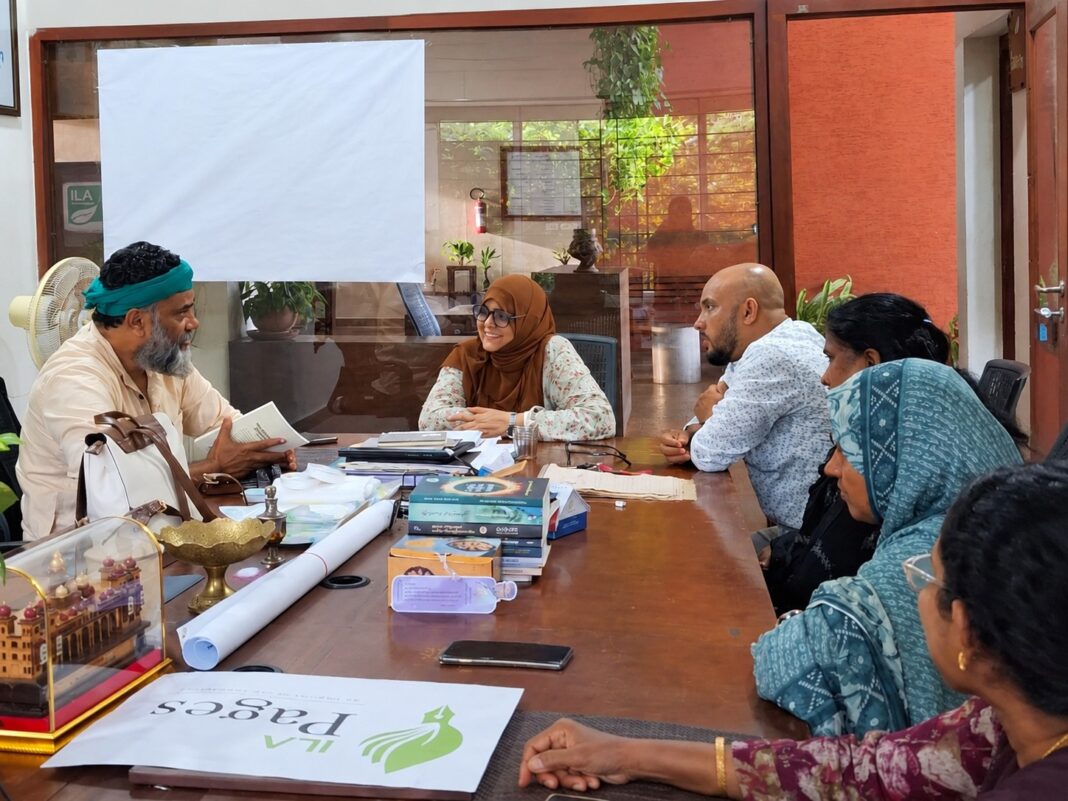
Author Sajida A Zubair with volunteers and members of the Ila Foundation during a discussion at its centre in Kerala.
“We human beings have started living in compartments. Muslims go to the masjid, Hindus go to the temple, Christians visit the church, and Sikhs go to the gurudwara. But where are the spaces for human beings, for all of us to visit simply as human beings?” –Ila Foundation’s Mohammed Najeeb.
Kuttipuram (Kerala) :
Travelling to Kuttipuram in Kerala was not merely a journey I had planned. It was a journey that carried with it a deep sense of emotion and transition. When I boarded the flight to Thiruvananthapuram earlier this month, I was setting out to leave my youngest daughter to follow her own choice of college and take the next step towards her higher education. As a parent, it was a moment filled with conflicting emotions: Pride in watching her move towards her dreams, and a quiet ache in letting her take those steps away from home.
After completing all the formalities and spending some cherished time with friends during the Onam holidays, I set out once again, this time by train. It was my first train journey in 22 years. A small journey in distance, perhaps, but one that felt significant in ways I had not anticipated. I finally reached Kuttipuram, carrying with me a sense of gratitude and anticipation, to meet Mohammed Najeeb Kuttipuram and thank him personally for the remarkable work he has been doing.
Though I went straight to their home from Tirur railway station, I met him only the following morning. I was told that Najeebka is a man who is deeply disciplined when it comes to time. There was no exception to that rule.
That morning, I was not simply meeting Najeebka. I was about to be introduced to a dream he had nurtured with conviction and purpose- the Ila Foundation.
The first question I asked him was perhaps the most natural one: “Why Ila?”
Najeebka, as he is fondly called by those around him, paused for a moment before answering.
“Life is a lesson,” he said. “We spend this journey going to school, finding a job, getting married, raising children, and then focusing on their education and building a house. We spend much of our lives fulfilling these responsibilities. But what’s next? What comes after all these responsibilities are fulfilled? That thought gave me the push to do something beyond these responsibilities.”
Here are excerpts from my conversations with the founder and volunteers of the Ila Foundation, recorded during my visit.
Sajida A Zubair (SAZ): What is Ila?
Najeebka: Ila which means leaf, comes from the fable of the ‘Ant & Leaf.’ Ila is a breathing space We human beings celebrate the first breath of life, and we mourn the last. In between those two moments, we breathe every single day, every single moment, yet we rarely pause to think about those breaths. We take them for granted. Ila is a space that allows us to pause- to breathe, to reflect and simply be. We human beings have started living in compartments. Muslims go to the masjid, Hindus go to the temple, Christians visit the church, and Sikhs go to the gurudwara. But where are the spaces for human beings, for all of us simply as human beings? Ila is that space. It belongs to everyone. That is why Ila has no doors. It is open to everyone. There are no compartments at Ila Foundation that differentiate among human beings.
SAZ: How is Ila’s palliative care initiative different from other such center?
Najeebka: I felt that there was very little change or evolution in the way palliative care was being provided in many centres. Many of them remained where they were when they first began. The focus was largely on medicines, injections, catheter changes and other forms of medical support. But Ila was conceived as something beyond medical care. We wanted to provide emotional support as well, to create a space where people could feel heard, cared for and valued.
SAZ: What makes Ila different from other organisations? What does it mean to be a volunteer at Ila?
Every volunteer who comes here is first made to understand one thing: before anything else, we are human beings. Learning how to be a human being is the first lesson we give to anyone who comes here to contribute. Our volunteers come from different religions, castes, races and creeds. But the understanding that we are human beings first is what brings us together and makes us a family. That is also why Ila does not have the usual hierarchy. We don’t have board members, a president or a secretary. We simply have volunteers. We come together because we believe in the same purpose.
We need to realise that the health we have is one of the greatest blessings we receive in life. The moment we truly understand that, we should feel the responsibility to reach out to those who are struggling with their health. At Ila, we try to see ourselves simply as human beings, and to see the people we care for in the same way.
Ila foundation is not just to care for those who are suffering, but to make all of us a little more human in the process.
SAZ: What is Ila doing to prepare the next generation with this same idea?
Najeebka: One of our important initiatives is the CEEP- Capital Exploration and Enhancement Programme, which begins with children from the eighth standard onwards.
We want to encourage these children to ask themselves some fundamental questions: Who am I? What am I capable of? What do I want to achieve in my life? We train them to discover their strengths, develop a sense of purpose and build a mission for their lives. More importantly, we help them understand how to face and overcome the challenges that life will inevitably bring.
We give special attention to the training of female students as well. So far, 24 training sessions have been conducted. These children will, in another ten years, become part of different sections of society- some may enter politics, some may become professionals, teachers or take up other roles. Wherever they go, Ila hopes they will carry with them the values they have learned here and contribute to a positive and compassionate transformation of society. Our dream is not simply to train children for successful careers. It is to nurture human beings who can make a meaningful difference wherever life takes them.
SAZ: How would you describe your association with the idea behind Ila?
Sulfikhar, Volunteer, Ila Foundation: Najeebka is my childhood friend and an elder brother for me. I have known him for many years. He is a traveller, and during his journeys across North India, particularly through villages, he spent a great deal of time doing social work and reaching out to people in need.
For more than 25 years, these travels became a part of his life. It was through these experiences, and the people he encountered along the way, that the idea of the Ila Foundation gradually took shape.
But Ila is much more than a charity or a place that simply provides assistance. It offers care and compassion to people dealing with health challenges, but its purpose extends beyond those who are unwell.
Ila is also a space for those who are healthy. It’s a place where they can look within themselves and work towards cleansing their inner selves. We all carry our own diseases of the soul- ego, jealousy, anger and many other negative emotions. Ila encourages people to recognise these within themselves and try to overcome them.
That, for me, is what makes Ila different. It is not only about caring for a person’s physical suffering; it is also about helping people become better human beings.
SAZ: What kind of care and support does Ila Foundation provide?
Fasina, who coordinates the palliative care volunteers: Ila provides support to people with a range of health needs. The Drug Bank provides medicines, particularly for psychiatric patients. Those requiring rehabilitation support are registered, and the medicines they need are provided to them. We also have a dialysis unit with 10 machines, operating in two shifts. At present, 34 patients are receiving dialysis care through Ila.
Our palliative care programme extends beyond the walls of the Foundation. We have four home-care units that visit patients at their homes every 15 days. The visits include checking their vital signs, wound dressing and attending to other medical needs.
But medical care is only one part of what we do. Just as important is the time we spend with them, sitting beside them, listening to them and offering emotional and moral support. Sometimes, simply knowing that someone is there for you can make a great difference to a person who is suffering.
During my visit to the Ila Foundation, I had the opportunity to accompany one of its home-care units. We set out at 9 in the morning, travelling from one home to another and meeting families who, despite the immense difficulties they face, continue to hold on to hope and remain remarkably positive about life.
What struck me most was the way many of them spoke about Ila, not merely as a source of medical care, but as an institution that had brought a sense of confidence, dignity and hope back into their lives.
One such story is that of Shabiri Girish, 45, who lives with his wife and two school-going children. A construction worker by profession, his life changed dramatically when he fell from the fourth floor of a building and suffered a serious head injury.
For nearly three years, his family explored every available avenue of treatment, hoping that he would one day regain the ability to walk. But despite their efforts, he eventually lost movement in his legs.
It was then that Shabiri Girish registered for palliative care with the Ila Foundation.
When Ila’s care began, it offered him something that went beyond medical assistance. The emotional and moral support he received gradually helped him regain confidence and look at life with renewed hope. In time, Ila provided him with an electric wheelchair and helped him set up a small shop beside his home.
Today, Shabiri Girish has regained a measure of independence that once seemed almost impossible. His journey is not simply a story of overcoming physical limitations; it is also a story of dignity, resilience and the power of being supported when life seems to have taken everything away.
He and his family now speak of Ila with deep gratitude. More than recipients of its care, they hope to remain connected with the Foundation and contribute as volunteers, sharing their own journey to inspire others who may be going through similar struggles.
I was also given the opportunity to spend some time with a group of specially abled beneficiaries of Ila. We sang, played games and shared moments of laughter. They welcomed me into their circle with such warmth and innocence that, for those few hours, there seemed to be no sense of difference-only the simple joy of being together.
One of the children smiled and told me, “We love coming here every week. We wait eagerly for Tuesdays for these sessions.”
The excitement in those words said more about what Ila means to them than any explanation could. For these children, Tuesday is not just another day of the week. It is a day they look forward to- a day of friendship, play, laughter and belonging.
And that’s when I knew Ila Foundation is indeed a space to breathe freely and perhaps that is the most powerful aspect of Ila’s work-the transformation of those who once needed support into people who themselves want to become a source of strength for others.
If you are in Kerala, Ila Foundation deserves to be on your itinerary.
source: http://www.indiatomorrow.net / India Tomorrow / Home>Health / by Sajida A Zubair /edited in headlines / September 14th, 2026