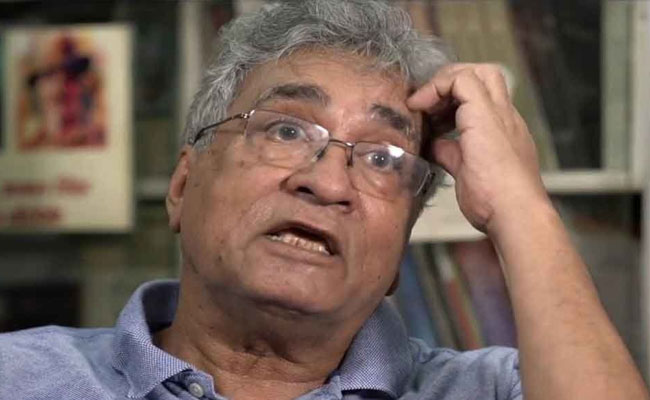
Renowned researcher, author, and former Associate Professor of Political Science at the University of Delhi, Dr. Shamsul Islam, is scheduled to deliver the BV Kakkilaya Inspired Oration for 2023. The oration, titled “Joint Martyrdoms, Joint Heritage of 1857 War of Independence,” will take place on Saturday, September 9, 2023, at 10 a.m. at Ravindra Kalabhavana, University College, Mangaluru.
The annual BV Kakkilaya Inspired Orations serve as a tribute to the life and contributions of Sri BV Kakkilaya (1919-2012). Kakkilaya was a freedom fighter, a leader in the Karnataka unification movement, a prominent figure in the Communist Party of India and All India Trade Union Congress, a member of the first Rajya Sabha, and the Karnataka State Assembly.
He was also an award-winning writer and thinker. The oration aims to promote alternative thoughts and approaches to address the challenges faced by the underprivileged masses in India. The event is organized by Hosatu Monthly, Bangalore, MS Krishnan Trust, Bangalore, and Samadarshi Vedike, Mangalore, in collaboration with the Department of History, University College, Mangaluru.
During the event, Dr. Shamsul Islam’s book, “The Untold Amazing Stories of 1857,” will be released in its Kannada translation, titled “Bharatada Modala Swatantrya Sangrama 1857 – Helade Ulida Adbhuta Kathegalu.” The book is translated by Dr. B.R. Manjunath and published by Navakarnataka Publications. Dr. Jayaraj Amin, Vice Chancellor of Mangalore University, will have the honor of unveiling the translated work.
Additionally, the event will feature the publication of the names of 128 martyrs from Karnataka, who hailed from diverse backgrounds including various castes, religions, sects, and socio-economic strata. These martyrs gave their lives during the 1857-58 anti-British revolts. Dr. Shamsul Islam compiled this list from national archives, and the occasion will be marked with tributes to these brave individuals.
The public is warmly welcomed to attend this significant event.
source: http://www.varthabharati.in/ Vartha Bharati / Home> Karnataka / by Vartha Bharati / September 09th, 2023
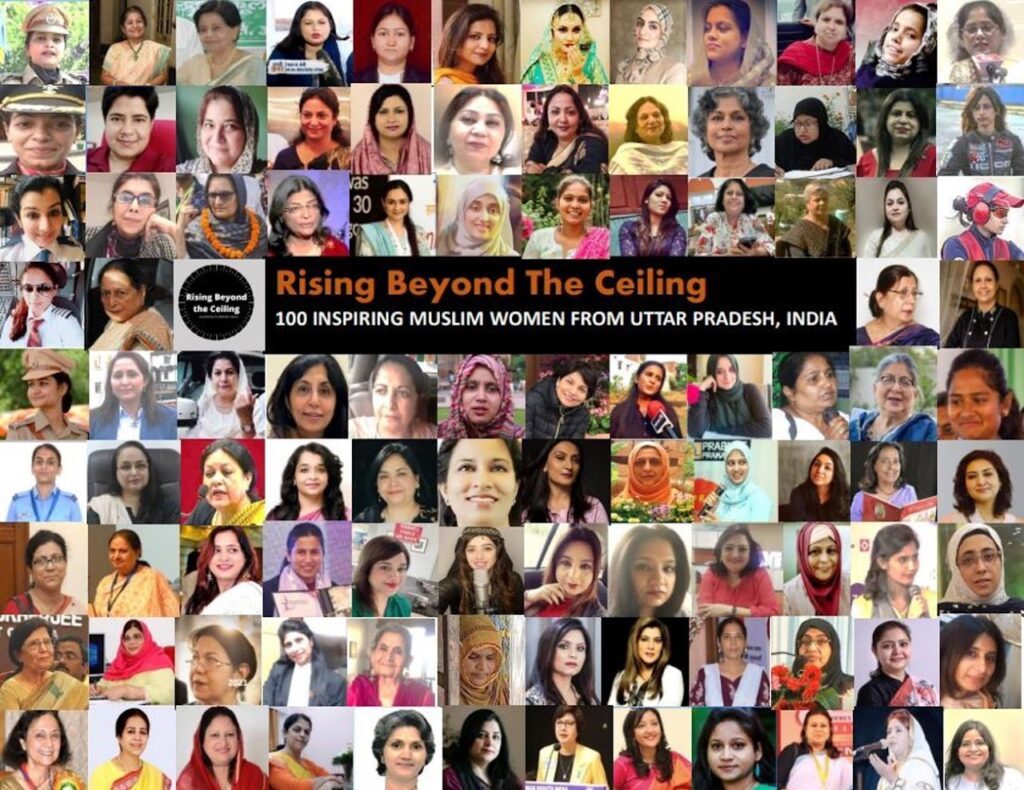
Muslim women are not a monolith, says Dr Farah Usmani, the founder and honorary editor of the “Rising Beyond The Ceiling” (RBTC), an initiative born out of frustration with the stereotypical narrative surrounding Muslim women in India. RBTC is preparing a directory of Muslim women who have excelled in different fields.
However, millions of Indian women, who identify themselves as Muslim, reach across spectra of ethnicities and languages, states and union territories, do not look the same or sound the same and contribute towards nation building in a variety of ways, says Dr Usmani adding that the compendium is under finalisation.
Member, UP Sunni Central Waqf Board, Sabiha Ahmad, who is busy preparing the list of prominent Muslim women in Uttar Pradesh, said, “The organisation is in the process of preparing a directory of such Muslim women who hold certain positions in social, corporate and professional workspace.”
She says the women spotlighted here from Uttar Pradesh do many things—they fly planes, serve in police and armed forces, they are skeet shooters and bike riders, write books and poetry, create art, play snooker and tennis, administer and govern, espouse social issues, serve as lawyers, scientists and doctors, are entrepreneurs and corporate professionals and are substantive contributors to the progress of the country.
Recently an online international meeting was organised in which the issue was discussed at length.
Veteran politician Mohsina Kidwai; vice chancellor, Era University, Lucknow, prof Farzana Mahdi; writer Sabeeha Anwar; artist Dr Farzana Shahabuddin and Samreen Ahmad were prominent among those who attended the virtual event.
Ahmad further says there is a myth surrounding Muslim women in India that they are highly conservative, prefer to stay home, not at par in education with women of other communities.
“Rising Beyond the Ceiling (RBTC), a non-profit organisation focused on supporting and promoting Indian Muslim women and their leadership and contributions in their respective fields, is working to bust this myth,” says Ahmad, who is also incharge, RBTC UP 100 .
RBTC UP 100 is a congregation of 100 women representing 22 million (2.2 crore) Muslim women from UP.
It is working under the leadership of Dr Farah Usmani, the founder and honorary editor of RBTC initiative who is also serving at United Nations Population Fund (UNFPA) headquarters in New York as director-1 level.
“The stories of these Indian Muslim women are for all women and girls to draw inspiration, role model them and thus become mentors in their own districts and neighbourhoods thereby become inspirations themselves for future generations,” Ahmad adds.
source: http://www.hindustantimes.com / Hindustan Times / Home / by HT Correspondent, Lucknow / September 22nd, 2021
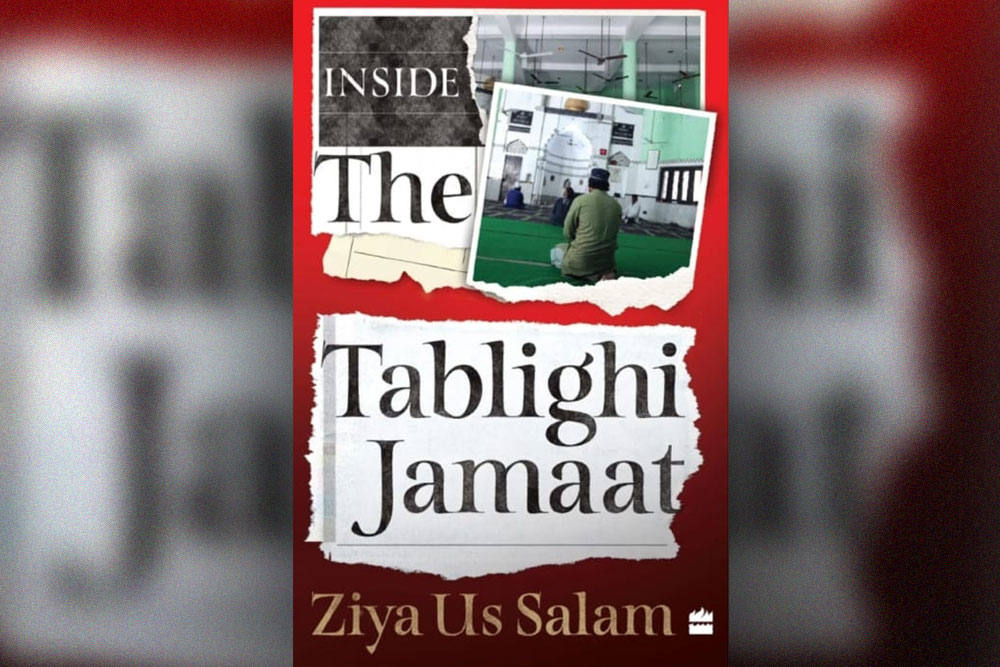
As Tablighis came under the scanner of the government post lockdown in India for allegedly ‘ spreading the coronavirus intentionally’, journalist and noted author, Ziya Us Salam pens down a topical book on the history and evolution of this Jamaat. The book is being published by Harper Collins India.
Cover Page of The Book : Inside The Tablighi Jamaat
A book such as Inside the Tablighi Jamaat is an important intervention to understand the historical continuity of a contemporary phenomenon, more so in the context the controversy involving the movement and its headquarters popularly known as Markaz. Tablighi Jamaat has been in existence for almost one hundred years but it preferred a life of quietude till such time it was made the focus of sustained media attention in the month of April for its congregation in the context of the pandemic.
Many would have preferred to remain quiet on the issue but Ziya us Salam chose to dig out material from the history and place them and the movement in the contemporary context. Devoting twenty four chapters and 260 pages to unravel the layers of the existence of the movement must be viewed with as much seriousness as the book deserves. The scholarly community as well as an interested reader would find mist evaporating from the body and the movement that were initiated about a hundred years ago.
The clarion call of the movement has been to invite the Muslims to become better Muslims and follow the prescribed rituals of Islam. But in the course of doing so it moved in the direction of revivalism in personal life of a member of Jamaati and then spreading out to those who would come under its influence through personal contacts in the course of conducting Chilla whether for three days or forty days or a year. The very fact that the Jamaatis would invite their contacts to live a life of piety as modeled during the times of the Prophet Muhammad and his companions.
For the purpose of helping a new entrant to the charmed circle of the Jamaatis, a book consisting of several volumes known as Fazail-i-Amal was compiled, generally believed to have been done in good faith preaching lessons from the Islamic scholarship and traditions. Among the jamaatis the book evokes tremendous respect and acceptability. As a matter of matter of fact in their circle the book attracts much greater attention than any other book. It is believed that for a Jamaati there is no word beyond Fazail-i-Amal. But the author is not quite impressed as his scholarly scrutiny of the movement takes him to argue, “In other words, Fazail-i-Amal introduces a lot that is biddah (a practice not approved in Islam) based on hearsay. The stories and anecdotes might seem attractive to a layman, but they do not always pass the crucible with scholars of Islam.” (p.102)
An overwhelming emphasis on the good conduct and personal piety does not create conditions of bringing about social reforms within the community of believers. For instance it has opened the door of the Jamaat on women without laying emphasis on social reforms leading to an ideological and cultural climate of gender equality. The Tablighi Jamaat has been shying away from the question of women performing namaz in masjids. The author has highlighted instances where tablighi controlled masjids have been openly hostile to the idea of men and women performing namaz simultaneously. Precedents from the instructions by Hazrat Umar are invoked while a reference to Surah Tauba talking about men and women going for prayers in a masjid is ignored.
The author explains has argued that the tablighis rarely engage themselves in issues which social and political bearings. This benign neglect of contemporary issues such as Tripple Talaq or the issue of Babri Masjid judgement etc. is borne out of their understanding of the movement that it must not get involved in the worldly affairs. This reclusive approach has helps the movement to keep itself away from the gaze of public and the government of the day. However, the fact remains that values imbibed on social plane have bearings in personal life too as it become hard to maintain a distinction between the two. Seen in this perspective, life of an average tablighi is reflective of the larger values they inculcate in the course of their interactions within the organization.
However, such an approach has borne them fruits of a different kind. Their apolitical nature and tendencies to avoid getting involved in contentious issues have gained them access to far off land in the Western hemisphere. They have significant bases in countries such as the UK and USA in a significant way. They have managed to penetrate certain African nations such as South Africa and others without difficulty. However, South-east Asian nations such Indonesia and Malysia have proved to be fertile grounds for the expansion of the Tablighi work. But in the Central Asian countries a similar luck eluded the movement as many regimes suspected it for spreading too much religious mindedness and making masjids as centers of their activities.
While the author has subjected the tablighi movement to scrutiny in a number of ways especially as regards gender justice in spiritual spaces he emerges a trenchant critic of the movement as regards the leadership issues. He raises the issue of absence of democratic values within the oragnisation as no member of the organization has risen to the leadership position due to the stranglehold of the family since the time of Maulana Ilyas. There is a dedicated chapter, ‘All in the Family’ and has argued, “Right from the 1920s to 2020 not a single president has come from outside the family.” (p.138)
The most interesting aspect of the book is its journey into the past to explore historical dimensions of the Tablighi Jamaat and return to the contemporary to examine the continuity and digressions and adjustments. Attempts to locate its genesis take the readers to 1920s when the Shudhi movement under the aegis of the Arya smamaj, especially it’s leader Swami Shradhanand was launched. Culturally vulnerable groups were targeted. Much like the Ghar Wapsi campaigns in recent years.
The author has cleverly used his skills of navigating between the popular and academic language format, which makes the book immensely readable. While it is a book on Tablighi Jamaat, it quietly introduces myriad dimensions of the Islamic religious traditions to the readers.
( Views are personal)
The Reviewer, Prof. Rizwan Qaiser teaches History at Jamia Millia Islamia.
The Author , Ziya Us Salam writes for Frontline Magazine.
source: http://www.outlookindia.com / Outlook / Home> Books / by Rizwan Qaiser / September 29th, 2020
The skull of a martyr Sepoy Alam Baig of the first war of Indian independence in 1985 must be brought to India for burial at the site where he was blown into pieces with a cannon for rebelling against the British Army in 1857.
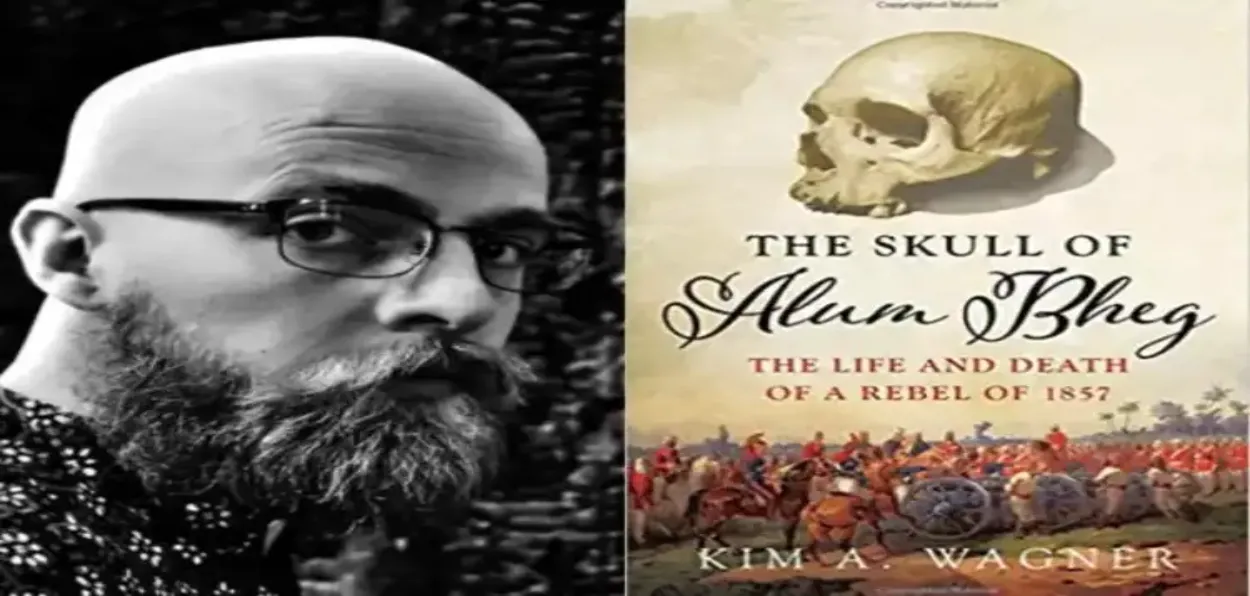
This campaign is being run by British Professor Kim A. Wagner, who teaches Global and Imperial History at Queen Mary University of London and is also the author of the book The Skull of Alum Bheg: The Life and Death of a Rebel of 1857.
Prof Kin Wagner is an authority on the subject as he has published several books like ‘Thuggee: Banditry and the British in Early Nineteenth-Century India’, ‘The Great Fear of 1957: Rumours, Conspiracies and the Making of the Indian Uprising’, and ‘Amritsar 1919: An Empire of Fear and the Making of a Massacre’.
Wagner says this grisly war trophy was found in a pub in south-east England in 1963. The owner handed it over to him in 2014 and he published this book on Alum Bheg in 2017.
Wagner says the skull was brought to Ireland by someone from the British authorities and later changed hands.
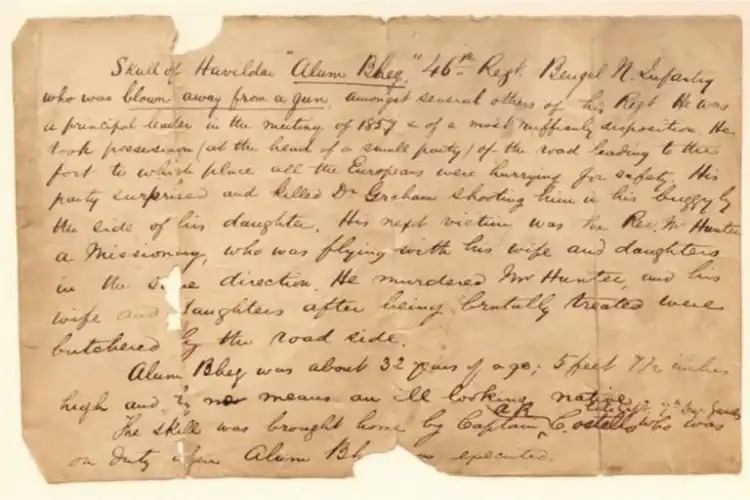
“The handwritten note found with it revealed the skull to be that of Alum Bheg, an Indian soldier in British service who had been blown from a cannon for his role in the 1857 Uprising. His head had been brought back as a grisly war trophy by an Irish officer present at his execution,” writes Kim Wagner.
Prof. S. Sehrwat of the Department of Anthropology, Punjab University had said in a statement that during the revolution of 1857, Havaldar Alam Baig (the way it is spelled in India) was captured and blown up with cannon. His skull was found in England.
He said Wenger had told him about this.
The note found with Alam Baig’s skull
A complete search record of the skull has been found. The scientists are now keen to do a DNA test to ensure the identity of the skull. It is known that Alam Baig was from the Kanpur area of Uttar Pradesh and even a family has claimed him to be their ancestor.
According to Prof Dineshwar Chaubey, who teaches genetics at BHU, Varanasi, two types of tests can be done on Alam Baig’s skull. A Kanpur family living in Delhi has claimed to be related to Alam Baig. Their genes can be matched with it.
Kim Wagner and other historians are campaigning for givinh a due burial to at some place along the India-Pakistan border, where he was done to death.
Wagner says the British had accused Baig of killing a Christian priest family and it was a fabricated charge. The record says that he was a sepoy of the 46th regiment of the Bengal Native Infantry.
Kim Wagner believes that it is the right time to bury Havaldar Alam Baig in his country, at the same spot where he fought in the Battle of Trimu Ghat on the banks of the Ravi River in the border region between India and Pakistan.
He said, “I do not consider the return of Alam Baig’s skull as political. My aim is only to bring the mortal remains of Alam Baig to his homeland so that he may rest in peace long after his death.
Although the historian’s statement has also passed a long time, there is no progress in this matter to date. It is also waiting for the time when the skull of one of the great sons of India will be brought to India and buried in the soil here.”
The Natural History Museum confirmed its likely authenticity and Wagner, with little evidence to go on, traced Bheg’s history using various sources.
source: http://www.awazthevoice.in / Awaz, The Voice / Home > Story by ATV / by Ghaus Siwani, New Delhi / posted by Aasha Khosa / September 02nd, 2023
New Delhi / Shillong, MEGHALAYA / Bengaluru, KARNATAKA:
Anjum Hasan’s novel considers what it is like to live in troubling times.
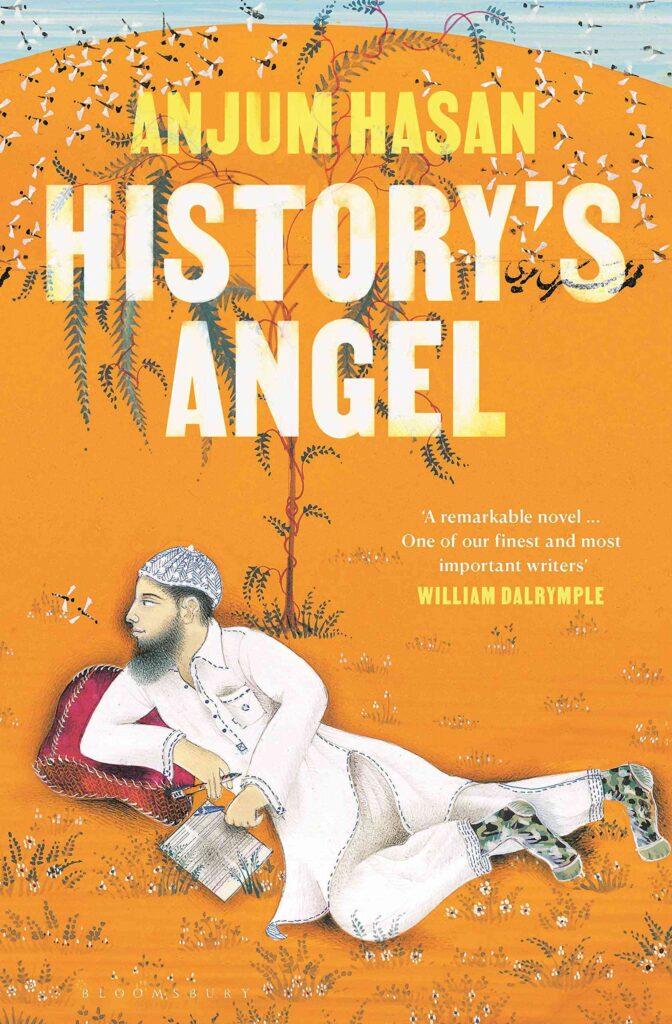
History’s Angel, Anjum Hasan, Bloomsbury India.
Living in an ancient city is like living in two time periods – the present (when you are alive) and the past (when the city was alive and you were not). It’s a strange conundrum. In a city like Delhi, where Alif from History’s Angel lives, the past creeps into the present in ordinary, mundane ways. There’s Humayun Tomb to visit, the Red Fort that you see on your way to work, the ruins of Tughlakabad where people reside…the city of Delhi is effortlessly ancient and ever-expanding. And what about the intangible past – the memories of what Delhi used to be, the violence that ravaged it and the unexpected friendships that were born in dire times, the natural seat of power that stood strong even as the city exchanged hands between emperors and regimes? History is a double-edged sword – there’s pride in continuing the legacy and there’s a burden of living with its failures.
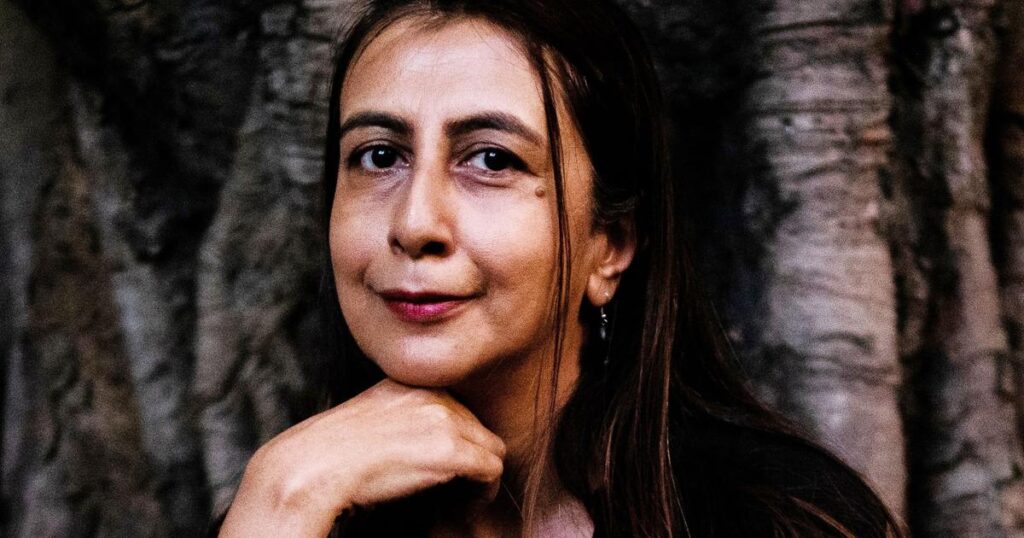
Author Anjum Hasan. | Lekha Naidu
Anjum Hasan’s latest offering, History’s Angel considers what it is like living in Delhi in troubling times (something the city always seems to be in). Alif teaches history to students aged between nine and 14 at a private school. He believes in history – its nuances, nonlinear existence, and its ability to make its students upright, empathetic people. But Indian school education system does not care for holistic scholarship. As long as the students successfully mug up facts and figures and hurl them onto the answer sheets, the teacher’s job is done. But Alif has bigger aspirations – he wants the children to understand and appreciate history in all its complexity. And in striving for this noble goal is where the trouble begins.
Humayun, Hanuman, Hindustan
Hell breaks loose when nine-year-old (upper caste Hindu student) Ankit Kumar disappears from his sight on an excursion to Humayun’s Tomb. Alif imagines the worst, but after a brief period of great anxiety, Ankit is finally found. Overcome with relief, Alif is only too happy to indulge the child when he seeks permission to ask a question. Only it is not what Alif was expecting.
Ankit asks his teacher, “Are you a dirty Mulla?” Perhaps before Alif could even make sense of the child’s question, he reaches for the boy’s ear and twists it. Corporal punishment is a punishable offence – as it should be – but in this case, it is something of a reflex action. Alif is stunned and he feels helpless.
Always keeping himself out of the way of trouble, and with his faith dialled down to the minimum, Alif does everything he can to be a “good Muslim”. However, the India he lives in is not so kind. The story, as it moves from one tongue to another and one imagination to another, takes a grotesque form. The final version is this: Ankit disappeared after Alif insulted his god Hanuman and threatened to throw him out of the rickshaw. In the absence of any reliable eyewitnesses, it is Alif’s words versus the majority’s hostility which is ever ready to exaggerate the failings of Muslim citizens.
The school where Alif teaches is a mini India. There are people of all faiths and cultures but one seems to be quickly taking precedence over the others. Alif wonders why the children stopped singing Muhammad Iqbal’s Saare Jahan Se Achcha in the assembly, why the principal was conducting a havan on the school premises, or why history lessons on Muslim emperors were no longer essential. The principal clearly instructed him to not bring religion into the school – visits to Humayun’s Tomb etcetera – while Hindu traditions were proudly being paraded as the culture of the country. Alif can see the gradual shift from Iqbal’s Hindustan to the narrow-minded, saffron-tinted Bharat. And so can we.
The state of any minority in our country has never been worth much and now, even more so. The hostility and open call for violence is not just encouraged but rewarded. The news cycle works on repeat – lynchings of Muslims, the murder of an untouchable, a Kashmiri’s freedoms curbed, a journalist attacked or jailed, a farmer dead from suicide. And screaming news reporters who are oblivious to it all. An endless, vicious cycle that sucks the common man dry. And it is in this soul-sucking, gut-wrenching India that people like Alif and his wife Tahira strive to be perfect (Muslim) citizens.
Horrors, hounding, humiliation
Simple things like renting a house become an impossible dream as brokers ask the couple if they slaughter goats at home and tell them – feigning kindness – that there are no mosques or madrasas nearby. Tahira and Alif are made to participate in humiliating interrogation – they are not only questioned about their faith and eating habits but made to answer for Muslim invaders and also those who stayed back. The fact that these events happened many centuries ago and the “invaders” had long since integrated with the Indian peoples is immaterial.
The indignity that Muslims are subjected to in India is one-of-its-kind. Disparaging remarks are always at hand and fingers are quick to point to Muslims when something goes wrong in the nation-state. Alif’s mother says stoically, “Things are bad…but if that is what’s bothering you then forget it. Because it is not new.” It is not new. Through the elderly lady’s voice, Anjum Hasan tells us that this has always been the reality of being a Muslim in India. It always has been humiliating. Of course, things have become alarmingly bad in the last decade, but none of us should think even for a moment that India was a secular haven before.
Alif’s is an interesting characterisation – his history teacher persona makes him acceptable as an upright citizen. In India, a teacher exists beyond the classroom – they are considered quite literally a “guru”. In the same way, Alif exists beyond the textbook. He contemplates the Sufi way of life, sorrowfully remembers the demolition of the Babri Masjid and the violence that followed, and imagines the horrors of the Partition.
Not just the past, Alif must also answer for the loud azaan and “land jihaad” of the present. It’s a life of questions and interrogations and like most of us – any of us – Alif does not always have an answer. He is no more responsible for the actions of Muhammad Ghori than Hindus are for the pillaging and killing that many kings of their religion were known for. But only one of them is allowed to cut the cord from the notorious past.
While Hasan easily incorporates the past in her portrayal of the contemporary Indian Muslim, the figures and events of this past can sometimes be distracting. The nine-year-old child who gets the wheel turning on Alif’s ruination fades into the shadows – how did the child become so hateful, what made him falsely accuse his teacher, and why did he not fear being punished? I wanted to know more.
Ahmad, a minor character in the novel, is a devout Muslim. And being devout often means enforcing one’s personal beliefs on others. He complains that Alif’s family “shirks shirks shirks” their faith –photos of human faces adorn the walls at home, Alif’s mother does not cover her head, the men do not always attend prayers at the mosque, the women go out to work, and the children are not being educated in madrasas. Hindus have alienated and hounded Muslims, and so have Muslim fanatics. The common Muslim who just wants to go about their day without getting into trouble is on the losing side of a lost war. Hasan’s attack on Muslim orthodoxy is subtle yet impressive.
History’s Angel ends on a predictive note. You can see it coming however it does not dampen the reading experience – surely you were not expecting justice to be delivered to a wronged Muslim history teacher?
pix02
source: http://www.scroll.in / Scroll.in / Home> Book Review / by Sayari Debnath / July 30th, 2023
Syed Akthar Ahmad, also known as Akthar Orenvi, was a Bihar-born Urdu writer who produced exceptional literary works, devoted his life to Urdu, and died in 1977 after suffering from a severe illness.
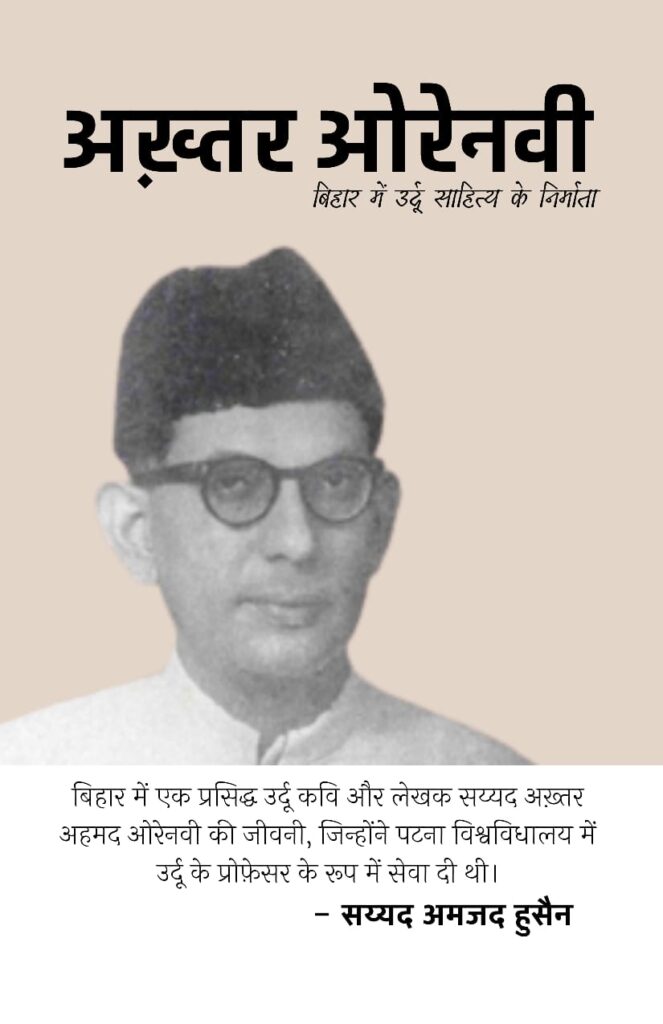
Now, almost 35 years after Orenvi’s death, Syed Amjad Hussain, an 18-year-old aspiring writer, is writing a book about him in Hindi, an extraordinary task for a student in his first year of college.
“Bihar has been home to many Urdu writers and poets, some of whom are still remembered, while others have been relegated to obscurity in an era when the language itself is on the verge of extinction,” said Hussain, who is currently pursuing BBA at the Maulana Abul Kalam Azad University of Technology in West Bengal, adding that he has chosen to write a book about Orenvi and “re-introduce him to the youth of today.”
Why Akthar Orenvi?
Hussain was introduced to Urdu writers in his house, where education has always been a priority, through the elders who spoke about prominent Urdu writers of Bihar and also narrated the stories written by them.
“ My great grandfather had married a girl from Oren. She was the daughter of Magistrate Syed Irshad Hussain. And my father, his cousins all spent their childhood in Oren. And whenever they visited our house there used to be a lot of discussions about the village and the prominent people of the village, one of whom was the poet Akthar Orenvi” said Hussain to Two circles.
This connection with the Oren village and all that he heard about Akthar sahab gave young Amjad Hussain the idea to write about him.
Hussain was also moved by the fact that Orenvi suffered from severe illnesses but kept on writing till his last breath.
“In the current era of reel, people have been cut off from real life. And in the process, they have forgotten the rich Indian culture of reading. Earlier there were book clubs despite the fact that not all people had access to them. Today when people have such easy access to books, they are no longer interested in reading,” Amjad said.
“Akthar Sahab suffered from typhoid thrice. And in those days medical treatment was not advanced, and we can imagine how much he suffered then. Even while sick he never stopped writing; such was his devotion to writing. And I felt such commitment and dedication needs recognition. But sadly, non-Urdu readers don’t know much about him. So, I decided to write his biography.”
Cover page of the Hindi book authored by Syed Amjad Hussain
Amjad said his fascination about History and his own love for the Urdu language were also reasons why he chose to write the biography of Orenvi.
Amjad shared that there is one very popular book by Orenvi titled ‘Bihar mein Urdu Zaban -O-Adab ka Irtaqa’ which also played a role in prompting him to write about him.
And surprisingly his parents agreed to his project with no questions asked!
What the book contains
Syed Akthar Ahmed hailed from Urain or Oren, a village in Munger division of Bihar State. The book Amjad is writing is titled ‘ Akthar Orenvi: Bihar mein Urdu Sahitya ke Nirmata’ and has roughly around 70-80 pages containing a brief history about Orenvi – birth, education, marriage, achievements, his meeting with Pandit Jawaharlal Nehru, his sickness, his works and his death.
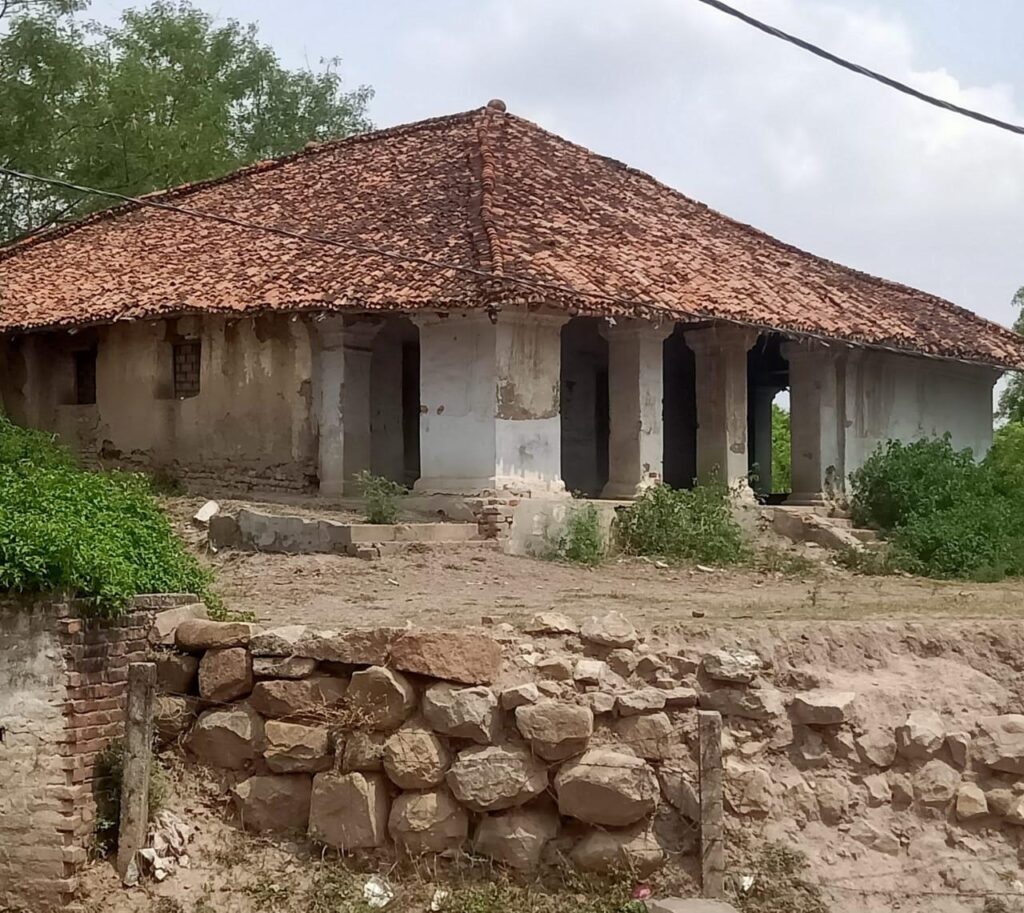
“Unfortunately, not much material is available about Akthar Orenvi”, said Amjad to Two circles, “I did extensive research, even visited Oren the place where Akthar sahab belonged to. His house in the village is intact. And I found some pictures which I shall include in my book,” he added.
Amjad spoke to the people of the village, especially the elders who had more to tell. He started his research in October 2022 and began writing the book in January 2023.
The people in the village told him that Akthar sahab shifted to Patna after his marriage so they did not hear much about him later. “His house in the village is intact and so are his memories in our hearts”, said one of them.
Akthar Orenvi’s brother Syed Fazal Ahmed retired as Inspector General. Akthar Orenvi did not have any children but has some popular descendants (nephews) who are well known TV and theatre personalities like Roshan Seth who played the role of Pandit Jawaharlal Nehru in the epic movie ‘Gandhi’ and Aftab Seth, retired Indian diplomat.
Akthar Orenvi’s works are included in the syllabus of many a Urdu University all across India. And his short stories are included in SSC Board exams. And Amjad’s favourite story by Orenvi is ‘Ek Darakht ka Qatal’.
Akthar Orenvi’s house in his village Oren
Future plans
Amjad feels this book, slated to release on the 14th of July will not only introduce the poet, writer AKthar Orenvi to the youth but also make them want to learn Urdu so they can read the original works of the author.
The first edition will have 300 copies only which will be sold online through Notion Press, Chennai.
Interestingly Amjad has worked on the book alone, reading, re-reading, spell check, proofreading etc.
Amjad, originally from Shaikhpura, Bihar now lives in Kolkata pursuing his studies while his parents and siblings continue to live in Bihar.
His father, Syed Ahmad Hussain founded ‘Madrasatul Banat Azizul Uloom’ in the 90s which is exclusively for girls. Syed also looks after their business along with his eldest son while his younger siblings are studying.
Amjad plans to write another book about Sufism in Bihar. He likes reading Urdu Shayari, especially the works of Juan Elia Sahab and Imam Ahmed Raza Khan.
He wants to work towards preserving the Urdu language because he feels that it is foolish to associate any language with one particular community and discriminate against it.
But overall, he is just like any other teenager, fun loving and hangs out with his friends.
source: http://www.twocircles.net / TwoCircles.net / Home> Indian Muslim> Lead Story> TCN Positive> Youth / by Nikhat Fatima, TwoCircles.net / July 05th, 2023
The famous writer Kushwant Singh, once wrote: “Indian Freedom is written in Muslim blood, since their participation in the freedom struggle was much more, in proportion to their small percentage of the population.”
The story and history of India’s independence are written with the blood of Muslims. According to historical references, 65% of those who stood, fought and sacrificed against the British for India’s independence were Muslim freedom fighters, the hams live reported.
A large number of people from all religions and castes took part in the freedom struggle, undoubtedly. However, the struggles of many Muslim prominent personalities who also contributed to India’s freedom and even sacrificed everything including their lives are little known. Muslims have been at the forefront to oppose the British and stood shoulder to shoulder with people from other communities while fighting against them. Getting freedom was not easy, our ancestors had to go face a lot of struggles and difficulties to get us the freedom that we are enjoying now.
The First Call To Oppose British
In the 1750s, Nawab Siraj-ud-Daulah was the first awakened Indian ruler, who stood his ground against the British. He lost the Battle of Plassey in 1757 due to the betrayal of Mir Jafar (Commander of Nawab’s army). With this, Siraj-ud-Daulah’s reign marks the end of the last independent rule in India and the beginning of the East India company’s rule that was unabated for the next two hundred years.
First Freedom Struggle By Muslim Rulers
The first freedom struggle against the British was started by the rulers of Mysore Hyder Ali and his son, Tipu Sultan, during the 1780s and 90s. Both used the first iron-cased rockets and cannons effectively against the British invaders.
Tipu Sultan is considered to be one of India’s first freedom fighters for his fierce fight and brave against the East India Company. He resisted the conquest of the British in southern India and was reluctant to welcome them on his soil. He was the only Indian ruler who understood the dangers that the British posed to India, and fought four wars to oust them from the country.
The Unsung Heroines Of India’s Freedom Struggle
Begum Hazrat Mahal, the unsung heroin, played a very important role in India’s war of Independence. Being a woman, she led a rebellion against the British East India Company in 1857. She shot the British ruler, Sir Henry Lawrence and defeated the British army in a conclusive Battle at Chinhat in 1857.
In the great revolt of 1857, as many as 225 Muslim women sacrificed their lives in the uprising. These unsung Muslim women freedom fighters who have sloganeered, shed blood and given their lives for the country’s independence have now been forgotten to due biases.
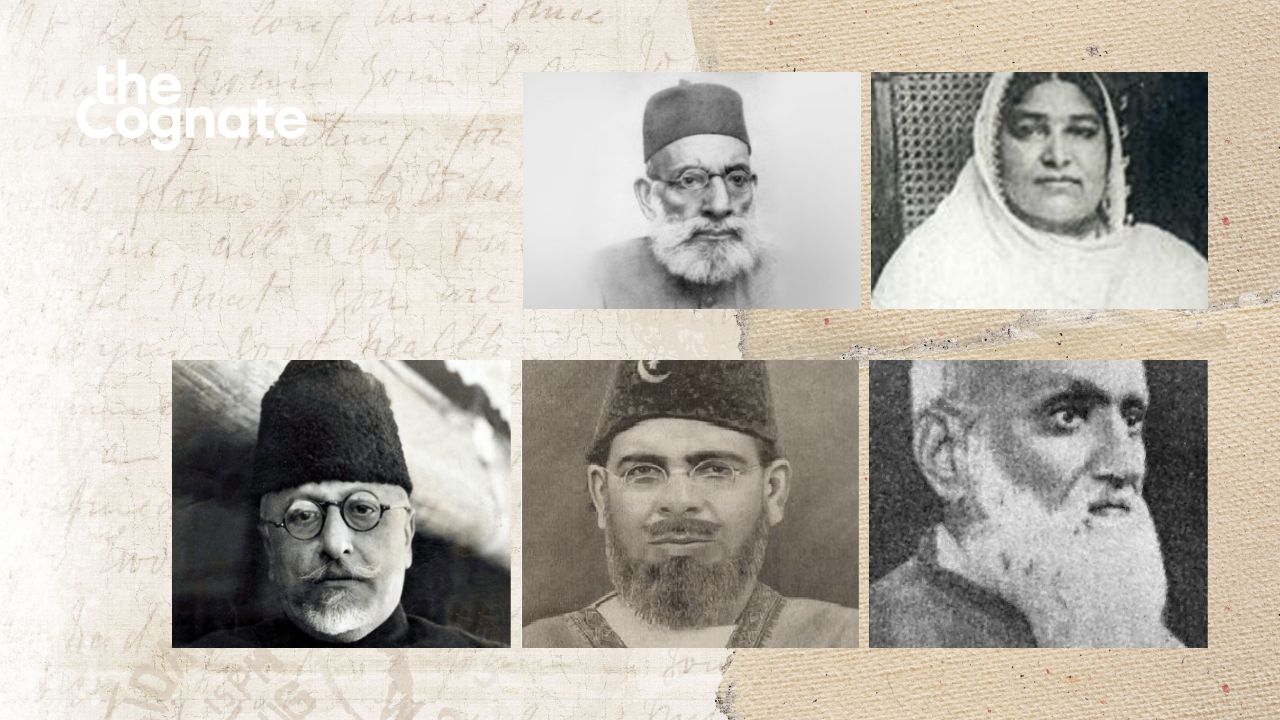
A majority of freedom fighters did a nameless service to the nation and one such lesser-known name was Abadi Bano Begum (Bi Amma). Bi Amma was the first woman to address a political rally wearing an abaya. She took part in National freedom struggles, Khilafat Movement and propagated Hindu-Muslim unity. Following Mahatma Gandhi’s advice, Bi Amma played an. An important role in encouraging women to take part in the freedom movement. Further, she played a pivotal role in the Swadeshi movements.
In the book, Gandhi and the Ali Brothers: Biography of a Friendship by Rakhahari Chatterji, Maulana Mohammad Jouhar says, “Suffice it to say that, although she was practically illiterate, I have, in all experience, of men of all sorts of types, come across none that I could call wiser and certainly that was more truly godly and spiritual than our mother.”
Bi Amma was also the mother of Muhammad Ali Jauhar and Shaukat Ali popularly known as the Ali Brothers whom she raised on her own after her husband died when she was young.
Amjadi Begum, the wife of Muhammad Ali Jauhar and daughter-in-law of Bi Amma, is yet another Muslim women freedom fighter. Mahatma Gandhi also dedicated an article on her titled ‘A Brave Woman‘ where he admired her as a courageous wife of a courageous man.
At the age of 45, Asghari Begum, another forgotten Muslim woman, has also taken part in the 1857 revolt and challenged British rule in the present-day Uttar Pradesh. However, she was captured by the British in 1858 and burnt alive.
Habiba, a Muslim woman’s fought many battles against the British in Muzaffarnagar in 1857. However, she was captured and hanged along with 11 other female warriors at the age of 25.
The Great Revolt of 1857
During the Great Revolt of 1857, Hindus and Muslims under the leadership of the last Mughal emperor Bahadur Shah Zafar tried to oust the British from India. A majority of Hindu sepoys requested Zafar to lead them in the war of Independence. Although the Revolt failed due of several reasons, Muslims have always stood on the front line to oppose the British.
Former Prime Minister of India, Rajiv Gandhi during his visit to Bahadur Shah’s grave, wrote in the visitor’s book: “Although you (Bahadur Shah) do not have land in India, you have it here; your name is alive… I pay homage to the memory of the symbol and rallying point of India’s First War of Independence….”
Muslims came to India and ruled here for over 800 years but they did not steal anything from here as the British, the Dutch and the French did. By bringing plenty of knowledge in literature, architecture, judiciary, political structure, government body and management structure, which is still used in Indian management strategy, they helped India to progress into a unified and civilized nation.
Lighthouse of Rebellion
How many of us know that the organizer and leader of “First Indian freedom struggle” in 1857 was Moulavi Ahamadullah Shah. Known as the ‘Lighthouse of Rebellion’ in Awadh, he Faizabad free from British rule for almost one year, until his death at the hands of British agents on June 5, 1858.
“With being a practicing Muslim, he was also the epitome of religious unity and Ganga-Jamuna culture of Faizabad. In the revolt of 1857, royalties like Nana Sahib of Kanpur, Kunwar Singh of Arrah fought alongside Maulavi Ahmadullah Shah. Maulavi’s 22nd Infantry Regiment was commanded by Subedar Ghamandi Singh and Subedar Umrao Singh in the famous Battle of Chinhat,” according to researcher and historian Ram Shankar Tripathi.
The important role of Muslims in the uprising is the reason that the British government singled out the community for the worst revenge. From the Nawab, the King of Mysore, the last Mughal King, Princes, the landlords, the Ulemas, intellectuals, Urdu journalists, including common people, all members of the Muslim community have made great sacrifices for the freedom of India.
In the uprising of the 1857 revolt, thousands of ulema were slaughtered and the whole of Delhi was emptied of Muslims, according to excerpts from Syed Ubaidur Rahman’s book Biographical Encyclopedia of Indian Muslim Freedom Fighters. They were not even allowed to return to their homes and reclaim their properties.
First Journalist To Sacrifice His Life During The Great Revolt
Moulvi Muhammad Baqir, a scholar and activist of Indian independence activist was the first journalist to be executed following the rebellion in 1857. The editor of Urdu newspapers, Delhi Urdu Akhbar, was washed dead on 16th September 1857 for writing Nationalist articles, without even a trial.
Although India got independence on 15 August 1947, the foundation of the freedom struggle was laid before 1857. Since the time of the Revolt of 1857, which is considered to be the beginning of India’s freedom struggle, Muslim leadership has spearheaded the cause.
First Muslim To Be Hanged For Conspiring Against East India Company
At the age of 27 years, Shaheed Ashfaqulla Khan was the first Muslim to be hanged for conspiring against the British Raj. Khan was hanged to death on December 19, 1927. With this, he became a martyr and a legend among the people because of his love for the country and his unshakeable spirit.
Reshmi Rumal Tehreek (The Silk Movement)
Muslims not only took the lead in the uprising, but also stood in the front line in all other efforts to topple the British colonial regime in India.
After the revolt of 1857, the Muslim leaders changed their strategy of resistance by setting up educational institutions across the country. Reshmi Rumal Tehreek or The Silk Letter Movement (1913-1920) was an initiative by Deobandi Leaders Maulana Mahmud Hasan and Maulana Ubaidullah Sindhi to topple the British Empire.
However, when British intelligence learned about it, hundreds of sympathizers of the initiative were arrested and put in prison for years without any trial. The top leaders including Maulana Mahmud Hasan and half a dozen of his followers were banished to Malta after a faux trial where they faced the worst hardship.
Role of Muslims in Congress’ anti-colonial struggle
Justice Abbas Tyabji, an Indian freedom fighter from Gujarat and associate of Mahatma Gandhi, was the first Muslim president of the Indian National Congress party. Justice Tyabji is also known for leading Salt Satyagraha following Gandhi’s arrest in 1930.
Another Congress president during the colonialism was Maulana Abul Kalam Azad, who is one of the chief Muslim leaders of the anti-colonial nationalist movement. He became the youngest President of the Indian National Congress in 1923 at the age of 35. He faced multiple imprisonments by the colonial state.
From Justice Tayabji to Maulana Abul Kalam Azad, there have been eight Muslim leaders who were in the Indian National Congress’s freedom movement. The other prominent Muslim leaders include, Muhammad Ali Jauhar, Shaukat Ali, Maulana Azad, Dr Mukhtar Ansari, Hakim Ajmal Khan, Maulana Mahmud Hasan and many others. They made every possible sacrifice for the cause of the end the colonial rule.
Frontier Gandhi
Khan Abdul Ghaffar Khan was a Pashtun independence activist who campaigned to end the rule of the British Raj in India. He founded the Khudai Khidmatgar resistance movement against British colonial rule in India. He was also known as Frontier Gandhi for his principles of non-violence and friendship with Gandhi. Khan worked towards the formation of a united, independent, secular India.
Muslim Man Coins “Jai Hind”
The patriotic slogan “Jai Hind” was initially coined by Zain-ul Abideen Hasan, but it was adopted by Netaji Subhash Chandra Bose. It is now used as a way of salutation throughout India. It means “Victory to India” in English.
The Creation Of the National Flag
For a majority of us, the current national flag was designed by Pingali Venkayya. However, it was a Muslim Lady Surayya Tyabji, who created the flag’s final look today.
Although we have recounted several names of the Muslims who have contributed to India’s freedom struggle, there are several thousands of them who fought on the streets against the British Raj.
source: http://www.thecongnate.com / The Cognate / Home> History / by Rabia Shireen / August 15th, 2022
Mohammed Baig Ehsas was one of the most progressive and prolific Urdu writers of recent times. He made a name for himself through his many short stories that revolve around the heritage, history, tradition and people of Hyderabad. He famously won the Sahitya Akademi Award (Urdu) in 2017 for his short story collection Dakhma. He turned 75 on Thursday.
Baig Ehsas was born in 1948, merely months before Hyderabad’s annexation by India, which was marked by several administrative, ecological and infrastructural changes. Baig Ehsas was first-hand witness to this transformationof the city of Hyderabad. His works are a reflection of the same. His award-winning collection Dakhma, published in 2015 portrays just that.
Dakhma is a collection of 11 short stories, with a central theme that revolves around the lives of the people of Hyderabad after the city’s ascension to India.
The short story Dakhma, after which the collection is named, revolves around the death of Sohrab, a Parsi, and the narrator’s fears surrounding Sohrab’s last rites.
A Dakhma or a Tower of Silence is a circular raised structure used for Parsi death rituals. The corpse is placed at the top of the structure, to subject it to decomposition by natural processes and eaten away by vultures. It is believed that vultures only arrive upon the death of the righteous. But vultures had stopped frequenting the city, owing to the changing landscapes and conforming of rituals. Yet, vultures flock to Sohrab’s corpse as soon as he is laid there, much to the narrator’s relief.
Dakhma, full of nostalgia, captures the anxieties of Hyderabadis in the face of changing times. Baig Ehsas intertwines the past and present of the Parsi community in Hyderabad with flawless storytelling and imagery that draws the reader in, keeping them hooked to the book.
Curfew, another famous stories from the collection centres around a woman who gets trapped, unable to contact her husband due to the sudden imposition of a curfew. The story, hauntingly allegorical, details the suffocating and anxiously tense situations endured by the citizens during state curfews.
Apart from Dakhma, some of his other noted short story collections include Khosha-e-Gandum and Hanzal, both published in 1979, containing stories set in the backdrop of Hyderabad, chronicling the lives of people of the city, as is often the theme of Biag Ehsas’ stories.
Dakhma was so highly rated among Urdu literary critics, that in 2020, the Allahabad University’s Urdu Department included the story in their MA Urdu syllabus.
The same year, select stories from the collection Dakhma were translated into English by S M Fasiullah’s book Shades of the City. Apart from Fasiullah, HCU Professor Tutun Mukherjee and former OU English Literature Professor Khalid Qadri also contributed to the process of translation.
Baig Ehsas’ short stories aren’t merely of literary value, they are accounts, parts of Hyderabad’s heritage and tehzeeb, pieced together; a looking glass into the history and culture of the city and the transformation the city went through.
I believe Baig Ehsas’ works should be viewed as a documentation of the evolution of Hyderabad. This is one of the most important reasons, apart from his literary prowess, that brought him the national acclaim. Baig Ehsas’ works brought much needed attention to the stories of the South, which have often found themselves bereft of recognition or acknowledgement at a national level.
And, honestly the writer’s national acclamation is nothing short of extraordinary. He was one of the most progressive Urdu writers in recent times.
Born and raised in Hyderabad, Baig Ehsas was among the first batch of scholars to complete their Ph D from the then newly found Urdu Department of the University of Hyderabad. His doctoral thesis, submitted in 1984, shone light on the life and works of progressive writer and playwright Krishen Chander.
He served two terms as the Head of Department of Urdu Studies at Osmania University after completing his PhD. Post this he served as Professor and later, Head of the Department of Urdu, UoH, before retiring in 2013.
Up until his passing, Baig Ehsas was as an executive member of Idara-e-Adabiyaat-e-Urdu and the editor of Sab Ras, a monthly published by the Idara.
Baig Ehsaas had honours bestowed on him that not many have been lucky enough for. His 2017 Sahitya Akademi Award for Dakhma marked him as the first Hyderabadi in 20 years to win the award. Gian Singh Shatir had won it in 1997.
In 2016, the Telangana Urdu Academy presented him with the Makhdoom Award. He was also the recipient of the Jashn-e-Adab award for Excellence in Fiction.
During the pandemic, Baig Ehsas fell victim to the COVID-19 virus after which his health started deteriorating. Eventually, Baig Ehsas, passed away in September 2021 following cardiac arrest; leaving behind a remarkable legacy.
Baig Ehsas’ works and contribution to Urdu have all but immortalised him. So long as those who love and promote Urdu remain, Baig Ehsas’ name will never be forgotten.
source: http://www.siasat.com / The Siasat Daily / Home> Featured News / by Fatima Fareeha / August 11th, 2023
Bollywood industry have been criticised by viewers for its Islamophobic portrayal. Be it woke series like Family Man or commercial flicks Batla House and Sooryavanshi, Muslims are always portrayed as sleeper cells, terrorists or smugglers. Films always acted as an integral compound for the Hindutva nationalist project. Only a few films stood as exception. This year, May 27 witnessed a unique release.
An industry, which parroted the state narrative of Muslim being the terrorists dared to tell the story of an innocent Muslim teacher Wahid Shaikh who was falsely implicated in 7/11 Mumbai train blast and spent almost nine years in jail to satisfy the ‘collective conscience’ of the state. Haemolymph movie, directed by Sudarshan Gamare, got released in more than 120 theatres across India in its initial phase.
“The title Haemolymph, loosely translated as the ‘blood of the ant’ symbolises how the life of a common can be easily crushed by the authorities similar to how an ant can be easily crushed,” the director Sudarshan Ghamare said to Maktoob.
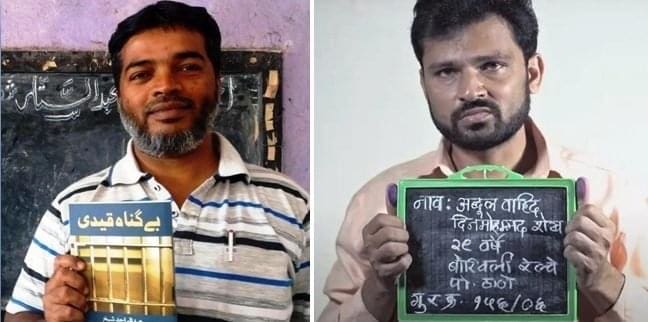
Wahid Shaikh, a primary school teacher respected in the neighbourhood, got picked from Mundra as an accused in the 7/11 Mumbai train blasts of 2006. Shaikh had to spend almost nine years in jail to prove his innocence. Of the 13 accused charge sheeted by the Mumbai Anti-Terrorism Squad, Wahid was the only one to be acquitted of all charges.
Wahid Shaikh was not excited when he got a call from Sudarshan Gamare asking permission to make a biopic on him. ”Many people had contacted me telling their interest to make movie on my life. But all of them got dropped in the midway. I guess nobody had the courage to tell my story,” said Wahid Shaikh.
Sudarshan Gamare got hooked to Wahid’s story after reading NDTV journalist Sunetra Choudhury’s book “Behind Bars” which featured a chapter on Wahid Sheikh . After completing the book, Gamara read Beguna Qaidi( Innocent prisoner), a book wrote by Wahid Shaikh on his experience inside the jail. The book was a documentation of the torture, fabricated charges, forced confessions, prejudice from the investigative agencies and jail authorities and the deep rooted Islamophobia.
“His life story was very horrifying. I can empathise with his pain and I felt so guilty after reading his story. I realised that this is an important story and it need to be shared with the public,” Sudarshan Gamare said.
Gamare discussed the story with his friend Riyaz Anvar, who later played the lead role of the film, and decided to meet Wahid.
The filmmakers met Wahid at a hotel in Mumbai and had a long chat with him. Later, they travelled to Wahid’s home in Mumbra, talked to his friends and family. The team went through the chargesheet of 20,000 pages and the copy of the judgement. They referred all the case-related documents available in public domain and the articles written on the case. The crew even contacted Mumbai Police and the family of victims of the bomb blast to extract their version on the incident.
”It took us almost 15 months to finalise the script; 11 months for research and 4 months to write the screen play. Wahid gave suggestions through out the process,” the director and the screenwriter Sudarshan Gamare said.
“It was really a difficult task to show nine year’s story in two hours. I had to recollect many important incidents happened in those nine year period for the movie. Many unpleasant memories flashed through my mind. It reminded me of the grave injustice done to me. It was not an easy task to revisit those traumatic experience. But I want people to understand what happens to innocent people like me in Indian prisons,” said Shaikh.
The lead actor Riyas Anwar, who was with the crew since the research stage, described the process as an emotional journey.
Riyas talked with Wahid for hours and prepared notes on Wahid’s life, interests, habits etc. “The character preparation started from the very soul of Abdul Wahid Sheikh. I started interacting with the people he was close to. Practised writing with the left hand. I wore the type of clothes Wahid loves to wear and travelled in crowded local trains. We sat for hours outside the Arthur road jail to get an idea on what Wahid might have gone through,” said Riyas.
“The film is a labour of love by my friends. It’s the debut project of cinematographer Rohan Mapuskar and editor Hemant Mahajan. I and three other friends started the production house, Ticketbari. Later, Adiman studio and AB Films Entertainment joined the production,” the director said.
Wahid Shaikh said that there are hundreds of similar stories to be told. “A state sponsored terrorism exists in this country. Most of the victims are Muslims. Be it a blast in a temple or Masjids, Muslim youth were picked as suspects. SIMI, ISIS, Al Qaeda are used as excuses to vilify Muslims,” Shaikh said to Maktoob.
Following his acquittal, Wahid Shaikh, with the help of rights activists, retired judges and lawyers, started an organisation – The Innocence Network.
The organisation mainly works on prisoner rights and exonerates prisoners wrongfully accused by providing pro bono legal services.
“We organised a tribunal in Delhi in 2017 which demanded compensation for the acquitted prisoners. The network organises lectures on Mumbai bomb blast anniversaries and advocates for prison reliefs,” Shaikh said.
Wahid Shaikh, the teacher who wrote major chunk of his book Begunah Qaidi inside the Arthur Road prison, pointed the deep rooted Islamophobia in the state institutions and the effects of the war on terror following the 9/11 attack as the reason behind the wrongful incarceration of Muslim youths.
“The Home ministry of the Union government maintains a war book. It contains name and other details of all Muslims arrested or charged in terrorism related cases in India. My name is still in the book. I got to during a hearing with the National Human Rights Commission,” Shaikh said.
source: http://www.maktoobmedia.com / Maktoob / Home> Features> Film & TV India /by Ashfaque EJ
2 Jamia Professors, alumnus scoop Delhi Urdu Academy Award
It is a matter of pride for Jamia Millia Millia (JMI) that a current Professor, a retired Professor and an alumnus of the university received prestigious awards for their literary contributions by the Urdu Academy, Government of Delhi.
The award function was organised at the Auditorium of the Delhi Secretariat, IP Estate on 6th July, 2023.
Prof. Mohammad Asaduddin of the Department of English has received the Award for Translation for the year 2021-22 by the Urdu Academy, Government of Delhi.
Prof. Shamsul Haque Usmani, a retired Professor of the university received Pt. Brij Mohan Dattataria Kaifi award for the year 2021-22 .
JMI alumnus Dr. Aadil Hayat received award for Children Literature for the year 2019-20 by the Academy.
Prof. Najma Akhtar, Vice Chancellor, JMI congratulated the awardees and wished them good luck for their future endeavours.
It is worth mentioning that Dr. Abdul Naseeb Khan, Secretary to the Vice Chancellor, JMI and Prof. Anisur Rahman, a former Professor of English at JMI received Urdu academy, Delhi’s Award for Translation in the year 2018 and 2019 respectively.
source: http://www.theokhlatimes.com / The Okhla Times / Home> JMI-EDU/ by The Okhla Times / July 08th, 2023