Navare’s lasting memory of her father was when he visited her in Boston in July 2008 four months before 26/11
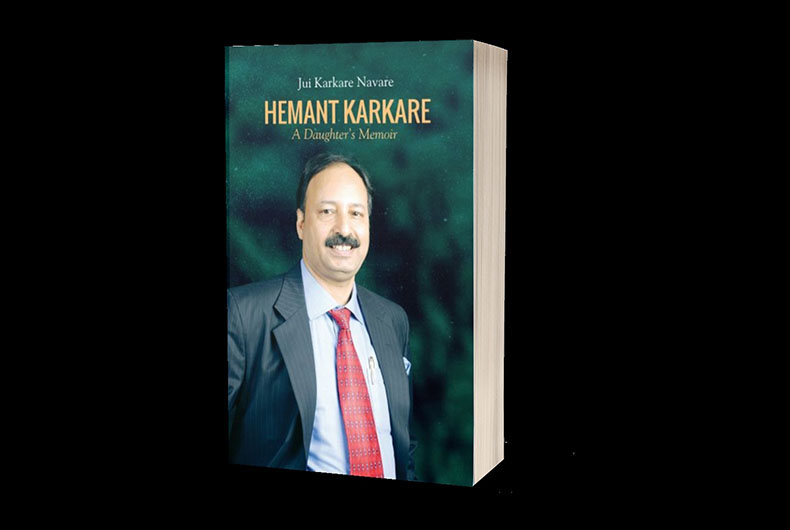
The cover of the book “Hemant Karkare: A Daughter’s Memoir”.
Mumbai:
Hemant Karkare, the head of the Maharashtra Anti-Terrorist Squad (ATS) was midway through his dinner when he was informed around 9.45 p.m. of the attack on the Chhatrapti Shivaji Terminus (CST), one of the first targets of the 26/11 attackers. He switched on the TV as the first images came on about what would turn out out to be one of the worst terrorist assaults on Indian soil. With his driver and his bodyguards, he immediately left for CST, where he donned a flak jacket and a helmet and helmet and entered Platofrm No 1 but found it deserted.
Karkare was then informed that the terrorists had moved to the Cama and Albless Hospital next to the Azad Maidan police station. Accompanied by Additional Commissioner Ashok Kamte and Senior Inspector Vijay Salaskar, Karkare headed for the spot but came under a hail of fire in a narrow lane between St. Xavier’s College and Rang Bhavan, a stones throw away from the Crime Branch office. All three died.
Eleven years after that horrific night, Karkare’s daughter has penned a moving tribute to her father in “Hemant Karkare: A Daughter’s Memoir” that she says was “very difficult” to write but is “satisfied” she has been able to complete it.
“It was certainly very difficult because at first I did not know what I should be writing about; what was happening on 26/11. And then I thought I should only write about what I know about my father’s life. So, the focus of my book is about my dad’s journey, how he moulded himself to become what he was, focusing on the positives and providing an inspirational story for all,” Navare told IANS in an interview.
“Hemant Karkare: A Daughter’s Memoir”, published by The Write Place, was released at the Crossword Book Store in Mumbai on Monday.
Jui Karkare Navare, 38, had got married in 2007 and moved to Boston with her husband, an investment banker. The couple has two daughters aged eight and five. On a visit to India soon after her father’s death, she found the diaries he had written when he was in his early 20s and the seed for the book was laid.
“I found his diaries he wrote when he was 21 and 22, and I was fascinated by how he minutely planned his day even when he was so young. For example, he would participate in a debate and immediately write about the things he did well, what were the things he did not do well and so on. I mean very basic things like you should be using simple sentences and the like.
“He wrote these diaries in 1977 and then in 1983 he reviewed those diaries. So he always constantly looking at things…how he could improve. That was the most important lesson that I learnt – that you have to keep on introspecting and seeing how best can you improve upon things. That was what fascinated me,” Navare said.
The book brings to life a stalwart of the Indian Police Service (IPS) who was well-respected not only for his immaculate and noteworthy professionalism but also for his creativity in art, culled from the Maoist-infested jungle of Chandrapur, where he was posted in 1991.
The heart-warming memoir pays tribute to Karkare’s myriad roles – as an exemplary police officer, a family man, an artist, a dog lover, a social worker, a book lover and above all, a good human being.
Navare’s lasting memory of her father was when he visited her in Boston in July 2008 four months before 26/11.
“The most recent memory I have of him was when he visited me in Boston in July 2008. He was in Boston for 15 days and that was the last time I saw him and I still remember those days because he was on a vacation and he had the entire day available for me. We used to go for long walks together; me, my mom and my father – the three of us. We went to visit the Niagara falls. That was the first and last time he visited me so I often think of those days,” she said.
Speaking of her early days, Navare recalled how her father constantly egged her on as she constantly had to change schools whenever he was posted to a new place.
“I studied in 10 different schools all over Maharashtra so every time we moved to a new place I had to start all over again…make new friends. When I spoke about this to my dad he said try to look at it this way that every time you move to a new place, you’re learning so much more, you’re able to adapt to a new environment. He said that is very important in today’s life and you’re someone who can easily adapt to any new environment and you will learn so much,” Navare said.
What of the future?
“Right now I am happy that I have completed this book about my father. This was my first book and it was a very difficult book to write because of the subject but at the same time, I am satisfied that I was able to complete it. Hopefully I’ll plan to continue writing. Fiction or non-fiction? I don’t see myself writing fiction as of now. Subjects? I like reading inspirational stories about people like my dad and I think that would be a subject that i would be interested in writing about,” Navare concluded.
(Vishnu Makhijani can be reached at vishnu.makhijani@ians.in)
source: http://www.ummid.com / Ummid.com / Home> Life & Style / by Vishnu Makhijani / IANS / November 26th, 2019
Waris Shah’s 300th birth anniversary on January 23 may have gone unnoticed, but the Sufi poet’s magnum opus — a narrative of threatened love in a space governed by unbending socio-religious norms — still finds huge resonance. He remains, by far, the most important Punjabi qissakaar.
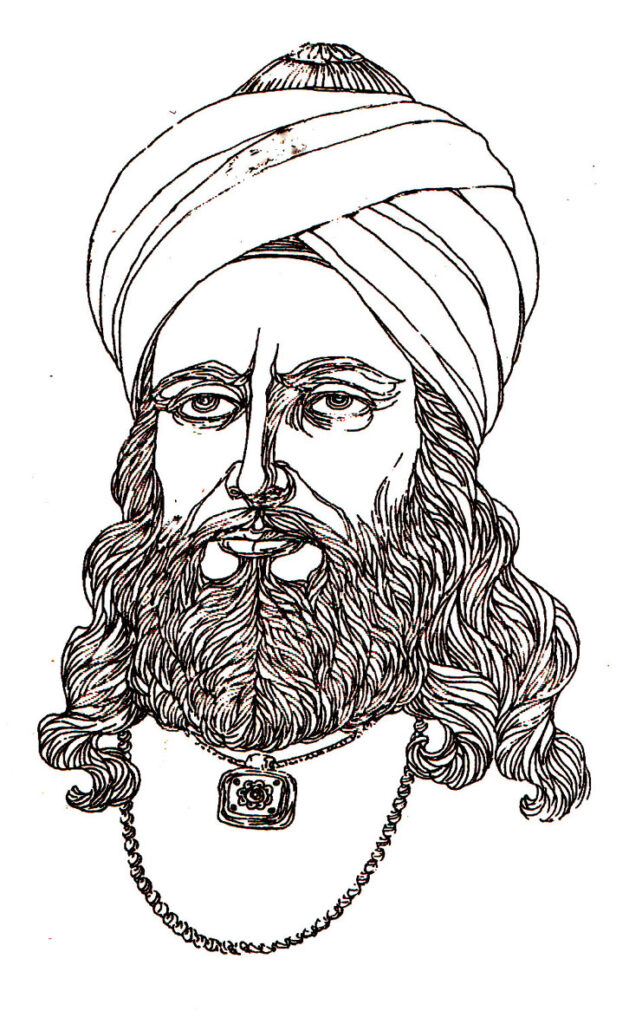
A sketch by Imroz.
I FIRST heard the name literally in my infancy. In the semi-refugee colony where I grew up in Delhi, I recall faint invocations of this name, Waris Shah. It must have been in the late 1950s.
The streets of Naiwalan were now full of people who had been displaced from the multiple regions of Punjab during the Partition of 1947. They spoke different dialects and were not always comfortable conversing with people from other regions.
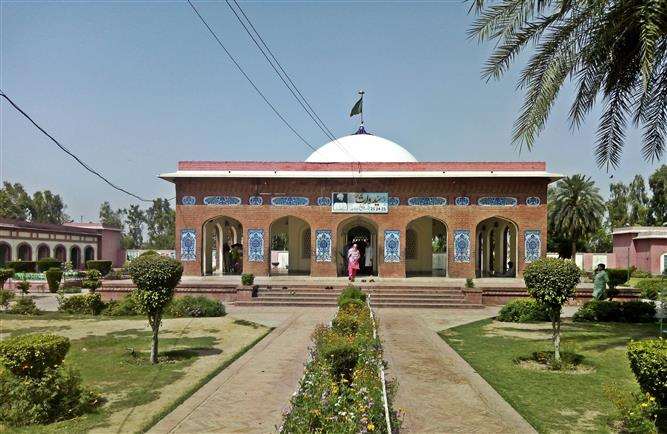
Waris Shah’s tomb at Jandiala Sher Khan in West Punjab, Pakistan. Courtesy: Saif Tahir
There were a few culturally uniting features though. For the young, the great unifier was the Indian film music and All India Radio. For the rest, there were the gurdwaras and the unbroken chain of Gurbani recitation, and singing on the one hand and the rare but energising jagrata gatherings on the other. The Muslim presence had nearly been wiped out from the cultural imagination of the Punjabis, who had been thrown into alien lands full of unfriendly sounds. However, the feminine work culture had retained an inherent link to a past. Early morning, my mother and foster grandmother would recite verses from Guru Granth Sahib under their breath even as they went about setting up the house for the day ahead. Most prominently, we would overhear Baba Farid being mentioned — from whom the Sufis had drawn much of their local identity. That was one side of the story. The other was Farid’s formidable presence within the field of language from where all Punjabis drew their ethical core. The very grain of their existence would wake up to his ‘dar derveshi’.
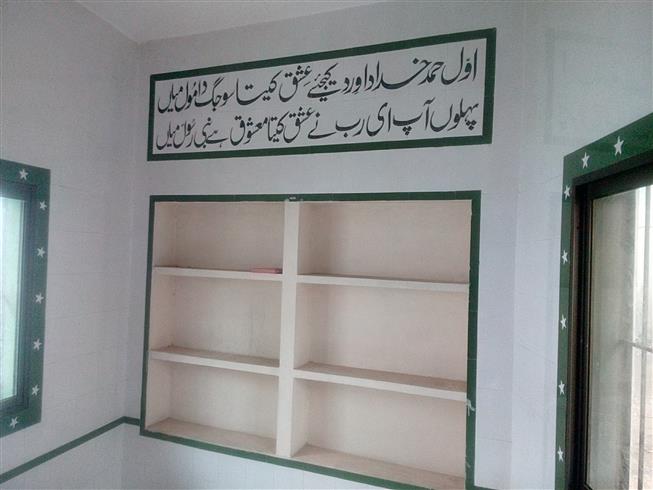
The hujra(small room) at a mosque in Malka Hans, (erstwhile Punjab now in Pakpattan, Pakistan), where Waris Shah composed ‘Heer’. The wall shows the opening couplet (translation above) of the Sufi poet’s epic work. Photo courtesy: Muhammad Imran Saeed
Outside of this religio-cultural space, there were two Muslim poets that, as children, we heard on almost a daily basis: Baba Bulleh Shah and Waris Shah, who could well have been near contemporaries, separated as they were by nearly 40 years of age difference. I wonder if the two ever met, especially as both shared a fiercely transgressive spirit.
Waris Shah’s 300th birth anniversary, which fell on January 23, went unnoticed on both sides of Punjab. That the State is past caring is a no-brainer, but how could the community of litterateurs forget the day?
Waris Shah was born in Jandiala Sher Khan of Sheikhupura (now in Pakistan Punjab) at a time when the Mughal empire was showing early signs of disintegration. There was, hence, an abounding atmosphere of increased repression and latent rebellion all around. Waris grew up as an orphan. He is said to have been a keen observer of the ordinary life — a fact to which his magnum opus bears testimony. He remains, by far, the most important qissakaar of our language and among the finest across the globe.
People sing verses of ‘Heer’ near Bulleh Shah’s mazaar in Kasur, Pakistan. Amarjit Chandan
There were a few editions of Waris Shah in Gurmukhi and Shahmukhi in our library, which I was unfortunately not able to read as I went to a Hindi medium school. However, there was one particular passage from ‘Heer’ — “Doli charhdeyaan maariyaan Heer cheekan” (Ascending the palanquin, Heer cried out bitterly, complaining) — which was repeatedly played on the radio and which initially seemed to catch everyone’s attention. The singer happened to be the iconic Asa Singh Mastana, who was more than an acquaintance of my father and had visited us a few times in the 1960s. His arrival was always greeted with excitement. Those were the days when I heard Waris Shah being mentioned in almost axiomatic two-liners that the wise and elderly would often use to clinch an argument…
It was much later in life that I heard Mastana singing a passage from ‘Heer’, where this newly married rebel of a girl named Heer pours her heart’s pain out to her father before being put into the palanquin and ceremoniously sent away to her husband’s home. This singing seemed as much about forced exclusion as the pain and suffering the refugees had experienced as part of the exodus from their homeland from which they had not quite recovered.
_______________
Kehi Heer di tareef kare shayar: Matthe chamakda husn maahtab da ji…
How does the poet praise Heer:
Her crown shimmers like the beauteous moon…
A Couplet from Heer
Begin by remembering the Cosmic Self
Who created the world in the image of love
He began first by Himself falling in love
The Prophet Nabi Rasool is His beloved
Opening Couplet from Heer
Aashiq, bhaur, faqeer te naag kaale/bhaajh mantron mool na keeliye ni
Lovers, bumblebees, faqirs and king cobras cannot be tamed without special spells
A Couplet from Heer
__________________
The song was unlike any other I had heard as a child. The melody unfolded in a slow, languorous narration. It had a feel of haunting simplicity that encouraged many of us to try it out in the seclusion of our houses. However, things became a little complex when within the same slow rendition, there arose a sudden burst of fast, quivering, high notes around a single word, or even a lone vowel sound. It was like an unexpected gush of turbulence in the otherwise gently flowing waters. This melodic surge returned equally suddenly to its sedate narrative core, but by now the maelstrom of emotions that had been stirred moved the young and old to look deeply into what had hit them.
Women often cried as the poetic narration took off in musical notes. Men, too, were visibly moved even if they soon recovered their wits to make parodies of these verses to restore their somewhat damaged masculine ego back to health. Many years down the line, when I became a little known as a singer, the impassioned audiences would still persist with requests to sing Heer’s heartbreaking send-off, even if that passage had by then been declared as an unacceptable interpolation.
‘Heer Waris’ stood out as an emotive link to our erased folk memory. The poetic thread ran through an incredibly detailed landscape of a people’s life — their mornings, evenings and nights; their work cultures; their rites of passage; their undying bonds, desires and envies; their transgressions of the social, religious and gender codes; their masquerades. No other poet had been able to embark upon such a vast cultural map with a comparable poetic intensity and masterly conviction. Through his qissa, one could enter the playful piety of playful hamds (Odes to the Almighty) and manqabats (Odes to the Dervishes) of the Punjabi Sufis; the spaces of longing through the lived carnivals and heartbreaks of the ordinary lives; thus, the Punjabi qissakari tradition would come alive spontaneously and with unmistakable signs deep of yearning, despite the unexpunged ghosts of Partition. Thanks to Waris Shah, we were still the people that we once were… Heer-Ranjha’s tale of almost willed displacement in languorous pursuit of love, as against the forced exodus of the people, had its lasting lure. There was still hope for a creative resurgence of a community of people who had walked through the inferno of 1947 and lost the rhythmic beat of celebration and had fallen into a litany of pain…
I walked across the other part of Punjab primarily through how ‘Heer’ was rendered by a range of iconic singers and how it had been received by both the ordinary folks and the cognoscenti. The sheer experience of being exposed to such an incredible range of styles and diverse grain of voices was a heady experience. To begin with, I was introduced to Tufail Niazi Saab’s rendition by a non-Punjabi and my dearest friend, the late Safdar Hashmi. Tufail Saab is, in fact, the reason why I took to singing beyond the anonymity of my house. Listening to his singing, I understood why ‘Heer’ demanded a melodic narration without the support of percussions. Both he and Inayat Bhatti Saab would interrupt their singing with ready dialogic wit and commentary. I heard the distinct flavours of their dialects from Doab and Gujarat interacting with the poetic registers of Waris Shah’s Majhaili. This was quite unlike the ‘Heer’ I had heard in our part of Punjab. This also became a way of recovering a lost cultural selfhood that the unfortunate Partition had buried so insensitively. Through ‘Heer Waris’, I was able to significantly break down the uneasy gap that had created a tangible ‘other’.
Much later, when I was gifted an audio tape of ‘Heer Waris’ rendered by the matchless Sharif Ghaznavi by Ajoka Theatre’s Shahid Nadeem, I felt nearly ready to take the narration of ‘Heer Waris’ on to public platforms. It was the time in the late ’70s and the entire following decade when nothing was making sense anymore. The State and the ideologues of a particular persuasion were engaged in a fiery exchange. For me, the singing of ‘Heer’ by Waris and the Kaafis of Baba Bulleh Shah sublimated into cri de coeur and eventually an act of faith. The melody, its projection and its interpretations on stage were beginning to change, especially as the real stakes of existence were getting increasingly intractable and no longer easily resolvable. Waris’ text was coming out of a limited cultural interiority to now address larger anxieties all across. This was approximately the time when I heard Rabbi Shergill’s angry outpouring to the so-called neutral letter writer about his grievously wounded love. As Bob Dylan would have put it, ‘The times they are a-changin’…
— The writer is a composer, musician
source: http://www.tribuneindia.com / The Tribune / Home> Features / by Madan Gopal Singh / February 27th, 2022
Andaleeb Wajid is a Bangalore-based writer who attempts to authentically portray India’s Muslim diaspora through novels that focus on life, food, family and relationships.
The young Indian Muslim writer Andaleeb Wajid has published five books in almost as many years. Courtesy Andaleeb Wajid
Modestly dressed in a pretty headscarf and shalwar kameez, the Bangalore-based writer Andaleeb Wajid smiles as she talks about her short but successful writing career – she has published five books in six years, most of them featuring a Muslim setting and credibly representing the community in India.
Wajid, 36, says she has been writing since she was 10. Her first book, Kite Strings, was released in August 2009 followed by Blinkers Off (August 2011), My Brother’s Wedding (May 2013) and More Than Just Biryani (January 2014). No Time For Goodbyes, released in April this year, is her latest book and the first in the Tamanna Trilogy series, books on time travel targeted at young adults. The other two will be released in September and December this year.
How did you begin writing?
I have been writing stories since I was 10. When I was in Grade 12, I was left very confused about what I would do with my life. There weren’t many options for girls from orthodox Muslim families. Then it occurred to me to take up writing as a career. I was certain that no one would stop me.
Is there a reason why many of your books have been set in a Muslim milieu?
I’m quite amused with the way Muslims are depicted in Bollywood films and on television in India. My stories attempt to show a slice of Muslim life, which is no different from anyone else’s. I wrote More Than Just Biryani only because I strongly felt that the world has labelled us as just biryani-eaters and I wanted them to be aware of the diversity in Muslim cuisine. Kite Strings discusses the issues a young girl from an orthodox Lababin Muslim [a community from Tamil Nadu] family faces. But a large number of non-Muslim fans also reached out to me, saying how much they identified with the character, which proves that some things transcend religious boundaries.
More Than Just Biryani was conceived as a recipe book. What prompted you to turn it into fiction?
My brother and I had thought of writing a culinary memoir but the idea never took off because I realised early that I could never do justice to non-fiction. Instead I wrote about three women and the role food plays in their lives. Nearly every chapter of the book has a recipe, which is woven into the story.
Have you drawn upon your personal experiences to craft stories?
Yes. Like most writers, I started off writing about what I knew best. In Kite Strings, the protagonist Mehnaz is a rebel without a cause and behaves a lot like I did as a teenager. The story is set in Vellore, Tamil Nadu, where as a child I spent several holidays with my grandparents. In More Than Just Biryani, one of the protagonists loses her father. It was the most painful chapter I have ever written.
What else is in the pipeline?
I have one more young-adult novel in my kitty, about a girl whose mother has left the family. Then there’s another about a crochet teacher and the four women who learn this beautiful craft from her and end up baring their lives to her.
• Andaleeb Wajid’s books are available on Amazon
artslife@thenational.ae
source: http://www.thenationalnews.com / The National / Home / by Priti Salian / July 05th, 2014
In a just-released tell-all book, the first woman Muslim minister of Karnataka doesn’t spare anyone who was unjust to her. Read on to know what she thinks about the Gandhi family members and others.
Nafees Fazal talks to the then Congress President Rajiv Gandhi during an Iftar party in the Vidhana Soudha banquet hall, Bangalore in 1990 (supplied)
If what the first woman Muslim minister of Karnataka says is true, politics is a horribly dirty sport where ministers and others take bribes, men can be lecherous, and foes within your party can go to any extent to bring you down.
Things got so bad for Nafees Fazal at one point that she asked Indira Gandhi’s Man Friday RK Dhawan whether she was not rising in politics because she wasn’t playing “bedroom politics”. Dhawan told her never to take that path: “They will pass you around till you become a whore.” She took the warning to heart.
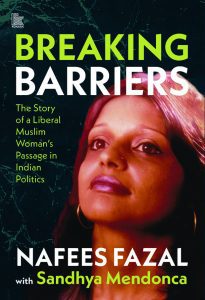
The front cover of the book ‘Breaking Barriers: The Story of a Liberal Muslim Woman’s Passage in Indian Politics’ (Supplied)
In a just-released tell-all book (Breaking Barriers: The Story of a Liberal Muslim Woman’s Passage in Indian Politics, with Sandhya Mendonca, Konark Publishers), Nafees doesn’t spare anyone who was unjust to her.
Guided by Margaret Alva
Rebelling against convention, she plunged into politics at age 31 without any benefactor and became the first Muslim woman minister in Karnataka at age 52 in 1999. Religion and gender, however, shackled her. It did not help that she was feisty, had a husky voice, and dressed fashionably.
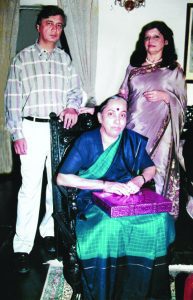
Nafees Fazal and her husband Hassan Fazal with her godmother and politician Margaret Alva at their residence in Bangalore in 1999 (Supplied)
Margaret Alva, whom she admires, guided Nafees and made her the president of the Bangalore wing of the Mahila Congress.
But prominent leaders from her own Muslim community didn’t like her. She was too glamorous. One of them was CK Jaffer Sharief, who proved duplicitous. Sharief was overtly nice but felt, like many other conservative Muslim men, that Muslim women should be confined to the home or remain low-key. “Muslim men,” she says with authority, “are the biggest MCPs and my opinion was reinforced in politics”.
Bribes, daggers, and knives
When she joined SM Krishna’s Cabinet, her learning was rapid. “Once you get the chair, you have to do your darndest to hold on to it. This meant that you had to be on the lookout constantly for the daggers and knives that many seen and unseen enemies would be holding.”
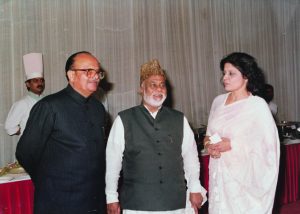
With Arjun Singh and Jaffer Sharief at an iftar party hosted by the former at his residence in New Delhi in 1994 (Supplied)
While a minister, the son of a trustee of a reputed college wanted government hospitals to import medical equipment. An IAS officer warned her against the deal. So she put her foot down. But Chief Minister Krishna was told that Nafees demanded ₹30 lakh as bribe. Krishna confronted her and was stunned when she told him that there was no question of seeking ₹30 lakh when she was offered ₹3 crore!
“I did not want the illegal money, and I did not want a bad name,” she writes. “Ministers and politicians often receive such bribes and perhaps take it, if not for themselves, then in order to fill the party coffers. How else would they hold on to their posts? This is how many of them operate. Nowadays the amounts offered would be several hundred crores.”
Sonia Gandhi & ‘an empty promise’ to Nafees Fazal
Nafees constantly faced attacks from known and unknown detractors. BJP leader (later chief minister) BS Yediyurappa tried to link her with the Telgi counterfeit stamp paper scam.
A Congress bigwig accused her of drinking alcohol at a party, almost leading to her sacking as the medical education minister. After one more allegation, she met Congress President Sonia Gandhi. “Don’t make an issue of it. I will look after you,” Sonia said. “It was an empty promise. She did nothing,” she writes.
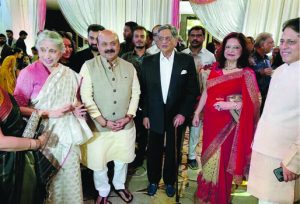
Nafees Fazal with current Karnataka Chief Minister Basavaraj Bommai (second from left), former chief minister SM Krishna (centre), his wife Prema, and former minister RV Deshpande’s son Prasad (right) at Deshpande’s golden wedding anniversary celebrations in Bengaluru in 2022 (Supplied)
Nafees has been asked if there’s a casting couch in politics. “I always counter by asking: ‘Why should politics be different than any other sector?’ It’s a known fact that certain women have risen to prominence because they have the attention and protection of powerful men. Some of these could be in a physical relationship with their sugar daddies and some may have used their position to do the work they set out to do.”
Rahul Gandhi leadership ‘disastrous’
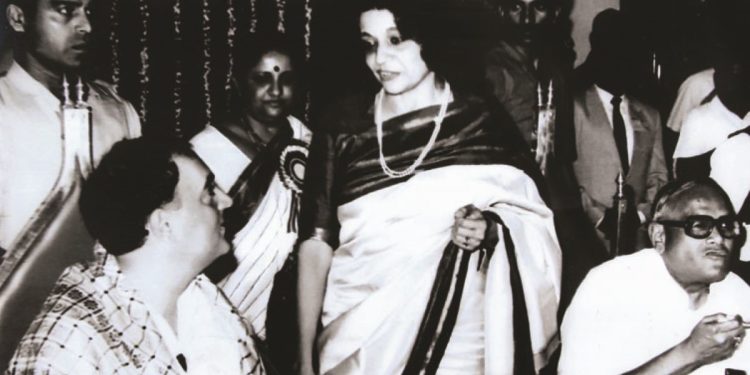
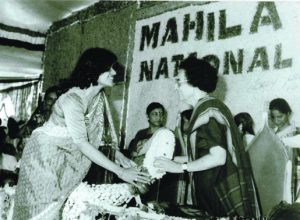
Nafees Fazal with her idol and Prime Minister Indira Gandhi at the All India Mahila Convention held in Bangalore in September 1984 (Supplied)
While she was a childhood fan of Indira Gandhi, and both Rajiv (“Rajiv’s decisions were sometimes hasty”) and Sonia Gandhi (“Sonia’s only weakness is her son”) too earned her respect, Nafees dubs Rahul Gandhi’s leadership of the Congress as “disastrous”. There is no place for any other leader to grow in the Congress, she says.
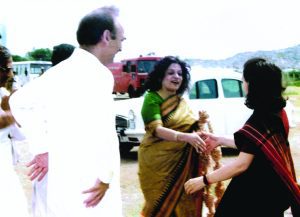
Nafeesa Fazal welcomes Sonia Gandhi, who was contesting the Lok Sabha elections from Bellary, and party observer Ghulam Nabi Azad in 1999 (Supplied)
While she pats Rahul for taking steps to cut corruption in the party, she is bitter for insulting her in front of Karnataka party leaders.
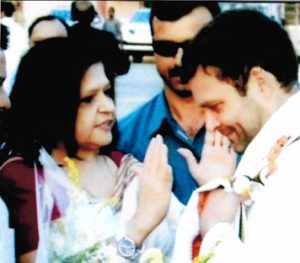
Nafees Fazal with Congress leader Rahul Gandhi in Bengaluru in 2009 (Supplied)
She had submitted an application seeking nomination to the Legislative Council. Rahul saw a doctor’s picture on her brochure. It was a renowned heart surgeon with whom she had worked for years to help underprivileged people. Rahul turned livid: “Because of him you are disqualified. I will never entertain you again and I will never give you an appointment.” The public humiliation forced Nafees to quit the Congress.
Ahmed Patel was ‘busy meeting mullahs’
Ahmed Patel was very powerful in the Congress during the UPA regime. “Unfortunately, he had no time to hear the second-rung leaders as he was always busy with meetings with mullahs. It was a Herculean effort to get an appointment with him.”
She tried to gatecrash. “At times, I was treated badly by his watchman who would slam the gate on my face and chase me away like a pariah… Perhaps he (Patel) didn’t like me because I was a Muslim woman.”
‘Set dosas’ of Karnataka Congress
Sonia Gandhi, she says, once referred to SM Krishna as “a white-collared politician” who could not woo voters in rural areas.
Nafees Fazal with Mallikarjun Kharge (left), now the Congress president, and former Karnataka chief minister N Dharam Singh at a lunch hosted by the author for RK Dhawan at her residence in February 1999 (Supplied)
When she wanted to contest an election from Vijayapura in north Karnataka, then opposition leader and now Congress President Mallikarjun Kharge was unhappy. He had never forgiven her for her role in displacing Dharam Singh, his friend, as the Karnataka Congress President. Nafees says that some colleagues called Kharge, HK Patil, and Dharam Singh as “set dosas” as they formed a powerful clique.
On hijab and UCC
While Rahul Gandhi talks about women’s empowerment, “the reality is that Muslim women are being denied a voice, and the support is only for our male counterparts”. Women with political ambitions must develop a thick skin, she feels.
She opposes the insistence on wearing hijab, finds the All India Muslim Personal Law Board “medieval and regressive”, and welcomes the Uniform Civil Code if it applies to Hindu Undivided Families too.
She admires Prime Minister Narendra Modi for outlawing triple talaq. After SM Krishna joined the BJP, she wanted to emulate him. But Yediyurappa objected. She also found the BJP too communal. So she quietly paid ₹10 and rejoined the Congress.
On her family and grandfather, a former sheriff of Madras
Nafees calls her father a philanderer, cruel, and sadist who enjoyed physically abusing his wife in front of his children. One of her uncles was a sexual predator. Her mother-in-law treated her like a maid and once clobbered her with a rolling pin.
Her grandfather, Khan Bahadur Mohammed Moosa Sait, a former sheriff of Madras, was a community leader but treated everyone, women in particular, very badly. All this “added to my mistrust of men, and I still carry residual anger against them”. One of the few men she has utmost love for is Hassan Fazal, her husband who backed her all the way from the time he began courting her.
(MR Narayan Swamy is a freelance journalist in New Delhi. He began his career more than four decades ago. He had a long innings in UNI, AFP, and IANS. His focus areas are diplomacy, politics, and spirituality, and he loves to read and review books. He is the author of three books on the Sri Lankan conflict)
source: http://www.thesouthfirst.com / South First / Home> Karnataka / by Narayan Swamy / November 02nd, 2023
Veteran film journalist and writer Rauf Ahmed, a native of Mangaluru, who was known for introducing changes in film journalism in the mid-1970s, died at his residence in Versova here on Sunday morning, after a short bout of ill health.
He is survived by his wife, son and daughter.
The son of Abdul Rahim, a retired judge from Bunder, Mangaluru, Rauf Ahmed completed his graduation at St Aloysius College, Mangaluru, before moving to Mumbai where, in 1975, he joined the Times of India training course, with contemporaries M J Akbar.
With an interest in film journalism, Ahmed launched the magazines ‘Super’ and ‘Movie’, after which, he took charge as editor of ‘Filmfare’, the film magazine of the Times of India. Sidelining film industry gossip that was popular during his times, he gave the news and articles on the industry a fresh look, while this change gave a new look to film journalism.
Ahmed’s wonderful style of writing and artistic design of the magazines caught the attention of the readers. Under the veteran, vintage music, parallel cinema and full-fledged nostalgia also found an inlet into mainstream film magazines. As a result, serious and studious writing joined the regular entertainment matter in the magazines.
Rauf Ahmed was the editor of ‘Filmfare’ for six years. During his tenure, the Filmfare Award ceremony too witnessed major changes. The venue of the ceremony was shifted while the style of the award ceremony was changed to that of the Academy Awards.
The journalist worked with many superstars in the film industry, including Amitabh Bachchan.
Ahmed worked with the Asian Age magazine and other fields of journalism, but film journalism remained his favourite.
In his 2016-book ‘Shammi Kapoor – The Game Changer’, Ahmed describes in an interesting manner how veteran actor Shammi Kapoor changed the very style of the Hindi film hero.
Yet, it would be well worth noting that Rauf Ahmed was himself a game changer in film journalism in India.
source: http://www.english.varthabharati.in / Vartha Bharati / Home> India / by Vartha Bharati / February 07th, 2023
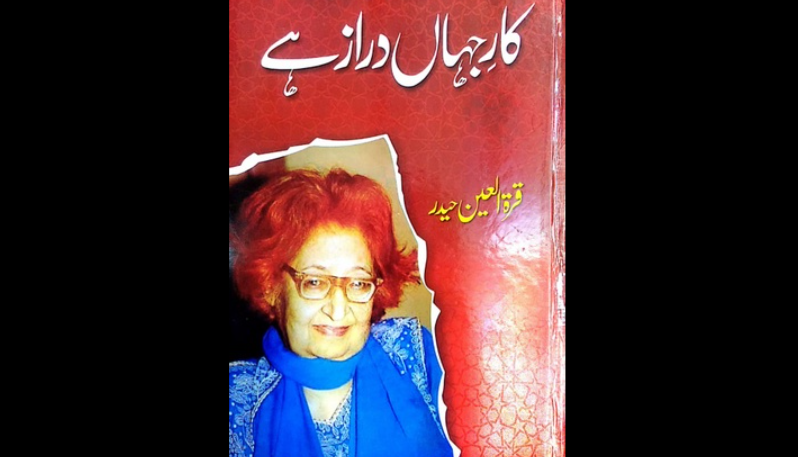
On Urdu writer Qurratulain Hyder’s 95th birth anniversary on January 20, remembering her last classic novel, Kare Jahan Daraz Hai, which is a treat in style and content.
Kare Jahan Daraz Hai (The business of the world goes on), Urdu novel in two parts, bound in one volume, Qurratulain Hyder, Educational Publishing House, Delhi, First edition 2003, Pages 766, in large size, Price: Rs 600.
One of the most significant novels of Urdu writer Qurratulain Haider, Kare Jahan Daraz Hai, is the winner of India’s highest literary award—the Jnanpith. Hyder is known for her magnum opus, Aag ka Darya, which has been translated in many languages. She herself translated it in English as River of Fire.
Kare Jahan Daraz Hai is perhaps her last published novel in her journey which started with Mere Bhi Sanamkhane, her first novel, published in 1949. Incidentally, most of her novels have been translated and are popular in Hindi, except her first and the last.
On my Facebook page comments, I got to know that her novella Sitaharan is also well rated by her readers.
Apart from her above mentioned novels, Hyder has to her credit-Safina-e-Game Dil-1952, Patjhar ki Awaz (a short story collection)-1965, which fetched her the prestigious Sahitya Akademi award in 1967, Roshni ki Raftar –1982, four novellas — Chay ke Bagh, Sitaharan, Agle Janam Mohe Bitiya na Keejo and Dilruba and Aakhri Shab ke Humsafar (Travellers of Last Night).
Hyder, who had to her credit 12 novels and novellas, four collections of short stories, many translations from classic world literature, worked as journalist with magazines Imprint and Illustrated Weekly of India and also taught at Jamia Milia Islamia and some US universities. She was offered a Sahitya Akademi Fellowship in 1994 and awarded Padma Bhushan in 2005. She also received the Ghalib award and Bahadurshah Zafar award.
Hyder was born on January 20, 1928 to Sajjad Haider Yildarim and Nazar Sajjad Haider, both Urdu writers. She started writing at the age of 11 and wrote her first novel, Mere Bhi Sanamkhane, at the age of 19, which was published, when she was just 21 years old. After Partition, she migrated to Pakistan, from where her most significant novels were published. She returned to India after many years and lived in Delhi. She passed away on August 21, 2007 at the age of 79. She did not marry and was perhaps against the institution of marriage.
Kare Jahan Daraz Hai (the title chosen from a couplet of Iqbal, who along with Faiz Ahmed Faiz is idolised by writers and people in both India and Pakistan) and is an autobiographical novel, focusing on Hyder’s long family history. She has delineated the family history from 740 A.D to almost 20th century-end. The first part of the novel depicts family history from 740 A.D to 1947 in almost 440 pages and 11 chapters, while the post-1947 family history is covered in the second part in 310 pages and five chapters — a total of 16 chapters.
It was in 1962, while visiting her ancestral house in Mohalla Sadaat, Nehtor/Nehtur, Bijnor district in Uttar Pradesh, that the idea struck to Hyder to write novel on the history of the place. She goes back to Zaid, her ancestor in 740 A D, who went to Georgia, established their rule in Tabristan , made Tirmiz their nation, and if they had not moved toward Hindustan in 1180 A D from Turkmenia, they would had been part of the then Soviet Union, she writes.
The story begins from the city of Tirmiz and the second part of the chapter moves the story from Jehon to Jamuna when the family comes to the ‘country of Shakuntala’ and settles somewhere near Kumaon and Garhwal. The Tirmizi family gets land there and makes a new beginning. Members of the family serve kings and one member of the family follows Emperor Aurangzeb in his pursuits.
Hyder has collected documents from family and archival sources to write an authenticated history of her family in narration form, which makes it an extremely readable historic/autobiographical novel. In the first chapter itself, the story reaches the 1857 revolt against the British, in which one rebel, Mir Ahmad Ali, from the family joins the rebellion, while the others remain loyal to the British. The narrator cites some events of the rebellion, particularly in Bijnor district, through documents and family stories.
Every chapter has been provided with references in the end, rather unusual for a novel. In the first chapter’s reference, it has been mentioned that Zaid Bin Imam Zean Albadan was martyred in year 744 A D. Mir Ahmad Ali Tirmazi of this family gave his life in the 1857 revolt as he was executed.
The writer refers to river Gagin, passing through Nehtor and going toward Moradabad. In fact, the story of the family from 740 AD to 1857, is just referral, the novel focuses upon 1857-1947 in first part of the novel and 1947-1987 in second part of the novel.
Hyder’s narration is filled with historic references and depiction of nature, like mentioning rivers like Gomati, Ramganga and Ravi, which makes the novel interesting in its style. She refers to her grandparents, but the real story of novel moves from the depiction of her father Sajjad Haider Yildaram and mother Nazar Baqar’s life story from the days of their school to the end of their lives, which carry on in the second part of the novel as well.
The story of Sajjad Hyder is also the story of development of Muslim educational institutions and the story of women’s education among the Muslim community. It is a fascinating story of the development of Aligarh Muslim University (AMU) as well, which became the base of enlightenment among Muslims in pre-Partition India.
Hyder’s mother’s development as an Urdu fiction writer and father Yildaram’s development as a diplomat, writer and traveller, create an aura of romance for that period of history. Yildarim was fond of travelling and moved around many countries, particularly in West Asia. Hyder got the thirst for travel from her father and she, too, travelled many parts of the world.
The novel is full of her travelogues as well and particularly interesting is her description of Egypt during Gamal Abdel Nasser’s regime, changing into a modern nation. Her depiction of the Nile River, Egyptian Mummies, Alexandria, Suez Canal, assertion of independence from the West by Nasser, are all narrated in fascinating style. She describes the geo socio-cultural-natural locale of all places in a manner that transports the reader there.
In the second part of the novel focusses on life in Karachi, where Hyder had migrated with her family. Here she grows into a celebrated writer, who goes through much turmoil as well. There are petty attacks on her writings, she has a casual and carefree temperament, and does not bother about the malicious attacks. She had strong support from friends and family.
Poet Faiz ‘s appreciation and attachment with her family is described so is author Sajjad Zaheer’s underground life in Pakistan mentioned. Hyder spent a lot many years in London. She exposes the Pakistan government’s anti-woman attitude and bureaucratic favouritism.
Affectionately called Ainee Apa, Hyder ‘s return to India was not melodramatic; rather she makes it look casual and matter of fact, does not damn Pakistan, just comes back and faces almost similar struggles as in Pakistan.
This novel seems to have been translated and published in Hindi by Vani Prakashan, Delhi, in Hindi in 2020 at a prohibitive price of Rs 5,000 with an introduction by Gopi Chand Narang, but the same can be downloaded free as a pdf file from Urdu Digest Novels website.
When I read this novel, its Hindi or English translations were not available and, with my too slow speed in reading Urdu, it took me few months to complete it. But, this was the one of the best reads I have done in my life.
The writer retired as professor in Hindi translation from Centre of Indian Languages, JNU, New Delhi; was Dean, Faculty of Languages, at Panjab University, Chandigarh, and at present is honorary advisor at Bhagat Singh Archives and Resource Centre at Delhi Archives. The views are personal.
source: http://www.newsclick.in / News Click / Home / by Chaman Lal / January 20th, 2023
The first Muslim judge of a high court in colonial times, Syed Mahmood’s professional conduct offers a counterpoint to the declining standards in Indian judiciary.
WHEN Justice Abdul Nazeer addressed the 16th national council meeting of the RSS-affiliated Akhil Bharatiya Adhivakta Parishad at Hyderabad last December, he said, “Great lawyers and judges are not born but made by proper education and great legal traditions, as were Manu, Kautilya, Katyayana, Brihaspati, Narada, Parashar, Yajnavalkya, and other legal giants of ancient India.” In the symposium on “Decolonisation of the Indian Legal System”, Justice Nazeer also said the “continued neglect of their great knowledge and adherence to the alien colonial legal system is detrimental to the goals of our Constitution and against our national interests…”.
Perhaps Justice Nazeer should have also recalled 19th-century jurist Justice Syed Mahmood (1850-1903). A pioneer in bold assertions against the colonial judiciary, he produced incisive legal commentaries that reflect an audacious dissenter’s point of view. Writing in an Urdu newspaper, his father, Sir Syed Ahmed Khan, narrates Mahmood’s resignation from the Allahabad High Court in 1893 to “protect the self-respect of Indians against the racism of British judges”.
In that era, conceptions of nationhood were still evolving in India. Indian judges would not muster the courage to contest the racism of the imperial power or fellow European judges. But Mahmood did, in intrepid ways. Khan founded the Mohammedan Anglo-Oriental (MAO) College at Aligarh in 1877 and figures prominently but contentiously, stereotyped as a British loyalist and separatist in debates on contemporary nationalism. Mahmood supported his father’s modern education project, but unfortunately, his contributions are largely ignored by historians and the legal fraternity.
By 1920, MAO College, now Aligarh Muslim University, was the most prominent residential university in the country. Its history department has been a premier centre for advanced studies for a half-century. In 1889, primarily on Syed Mahmood’s initiative and his gifts in terms of books, journals and cash, AMU established a law department. Yet, he was neglected in its research. Only in 1973, seven years after the centenary of the Allahabad High Court, the Aligarh Law Journal brought out Mahmood’s contributions, and legal scholars reflected on his high calibre as a lawyer and judge.
The good news is, in 2004, Alan M. Guenther did his doctoral thesis on Mahmood at McGill University, Canada, which is available online for the public to access. His meticulous and well-researched account touches almost every aspect of Mahmood’s public life. Guenther also published an extended essay in 2011on Mahmood’s views on English education in 19th-century India. (In 1895, Mahmood had written a book on the theme for his speeches at the Educational Conference.)
In 1965, Asaf Ali Asghar Fyzee (1899-1981) complained, “Syed Mahmood’s contributions to the transformation of Muslim law in India have been largely neglected by historians and survive primarily as footnotes in legal texts on Muslim law.” Guenther, too, observes, “…overshadowed by the life and writings of his illustrious father, Ahmad Khan, his legacy has not received the attention it deserves. A large part of his father’s achievements in the reform of education, in fact, would not have been possible without the assistance of Syed Mahmood. But when he reached the age at which his father had made his most significant achievements, [Mahmood] had his life cut short.”
Mahmood had laid out his life plans clearly. S. Khalid Rashid, writing in 1973, reports that Mahmood decided early on that, like his ancestors, he would devote the first third of his life to educating himself, the second to earn a living, and the last to “retired study, authorship and devotion to matters of public utility”. But Guenther writes about how Mahmood’s health had deteriorated through alcohol abuse and disease. He died before he turned 53, broken by forced retirement, estranged from his father (who had died five years previously), stripped of responsibilities at the college he had helped found, separated from wife and son, and in poverty. He was selling personal items to repay debts. “His father’s numerous writings and letters are still republished, but Syed Mahmood’s contributions to Muslim thought are hidden in bound volumes of the Indian Law Reports and brittle files of government correspondence,” Guenther writes.
One aspect of Mahmood’s last years is captured by Prof. Iftikhar Alam Khan’s Urdu books, Sir Syed: Daroon-e-Khana (2006, 2020) and the recent Rufaqa-e-Sir Syed: Rafaqat, Raqabat wa Iqtidar Ki Kashmakash. These accounts expose the smear campaigns of the three companion successors of Sir Syed—Samiullah, Mohsin-ul-Mulk and Viqar-ul-Mulk—against Syed Mahmood as they vied for the secretary’s post at MAO College. Often European members of MAO College conspired with them. Exploiting his weaknesses and eccentricities, they ousted him to get a hold over college affairs, compounding his hurt during his tragic final years.
SYED MAHMOOD’S ROLE IN SIR SYED’S EDUCATIONAL ENTERPRISE
Having returned to India in 1872 after studying in England, Mahmood took time out of his budding legal career to assist his father’s reform work, particularly setting up MAO College. He prepared a detailed plan along the lines of his experiences in Cambridge. His specific aim, explained in February 1872, was to produce future leaders of India through an educational institution whose residential nature would be “as indispensable an education as the course of study itself”. The aim was to create a society of students and teachers quite different from the rest of society.
He travelled with his father to Punjab in 1873 and spoke at a rally to promote the project. In 1889, Sir Syed introduced a motion to nominate Mahmood as joint secretary of the board of trustees of MAO College by highlighting his assistance despite the opposition he faced. In particular, he considered his son’s influence the primary factor that persuaded European professors to come to India and teach there.
European staff members confirmed this around six years later when there was renewed opposition to Mahmood continuing as joint secretary. The principal, Theodore Beck (1859-1899), testified, “Syed Ahmad….acknowledged his reliance on Syed Mahmood for advice in all matters, and his imprint could be noted in the correspondence relating to the school. He declared his firm conviction that Syed Mahmood was the one person who shared his vision for the college, and apart from him, no one would be able to administer the school in keeping with that vision.” However, Samiullah (1834-1908) disagreed with Sir Syed on this count. As a result, a tussle for power began in the college management. The power-play could explain why AMU felt inhibited in bringing out a biography of Mahmood, a research gap that Guenther’s doctoral thesis fills. He has extensively relied on important correspondences of Mahmood preserved in the London India Office (British) Library.
SYED MAHMOOD’S TRYST WITH MUSLIM LAW
Mahmood is a forgotten pioneer of the transformation of Muslim law in modern South Asia. In 1882, at just 32, he became the first Muslim judge of the high courts in British India. He delivered numerous landmark decisions that shaped Muslim law, the law in general, and its administration.
Earlier, he blazed a trail his younger contemporaries followed in their judicial roles in British India. He was one of the first Indian Muslims to study in England and train in the English system of jurisprudence, the first Indian to enrol as a barrister in the High Court of Judicature at Allahabad in 1872, the first appointed as a district judge in the restructured judicial system of Awadh in 1879 and the first Indian assigned as a puisne judge to the High Court at Allahabad. He was the first Muslim in any High Court of India. He cleared a path for Indian Muslims to participate in administering justice in India. But his contribution is not limited to creamy career opportunities for Muslim youngsters. His lasting legacy is how Muslim law is perceived and administered in South Asia today.
CHAMPION OF ACCESSIBLE JUSTICE
An abiding concern of Mahmood was the cost of administration of justice. Court procedures were lengthy and expensive, and the “mass of law” was complicated. Distance from courts was another concern, for which he proposed a network of village courts for “on-the-spot” adjudication. He sought to make justice accessible through unpaid tribunals and honorary munsifs. He prepared a comprehensive draft for this, Guenther informs.
Furthermore, he attacked the [racial] mindset and court fees and stamp duties on legal documents. He ruled in August 1884 and February 1885 that “…if justice costs the same amount [to the] rich and poor, it follows that the rich man will be able to purchase it, whilst the poor man will not.” He declared, more than once, that British judges in India were too quick to find fraud.
In a speech at the Allahabad Bar in April 1885, Mahmood raised the language issue in judicial transactions, saying laws should be in languages intelligible to the masses. He insisted on the vernacular in arguments, pleadings and justice delivery and translated verdicts so that people unfamiliar with English could rest assured that judgments are reasoned. Of course, the issue of judicial language continues to be debated, and for this, acknowledgement is due to Mahmood.
AN INDIAN DISSENTER IN THE HIGH NOON OF BRITISH COLONIALISM
Mahmood is known most for outstanding dissenting judgements. In volume 2 of his 2021 book, Discordant Notes, Justice (retd.) Rohinton F. Nariman writes that Mahmood was known for detailed judgments, some of which stand out for thoroughness and fearless language. Mahmood would refer to the original Sanskrit versions when ruling on Hindu laws and the Arabic texts for Muslim laws, rather than using interpretations of the relevant texts.
From the 1860s to 1880s, during the codification of laws, he sought limits on importing British laws and protested that the local context was getting overlooked. His concern was not just the laws but their efficacy and adaptability within India’s cultural diversity.
Guenther observes, “…throughout his life, he identified himself as a Muslim as well as an Indian and a subject of the British crown, and that he was actively involved in the education and improvement of the Indian Muslim community. At the same time, Mahmood… [made] efforts to promote harmony between people of diverse backgrounds, and…[supported] initiatives that improved the situation of all Indians, regardless of religious affiliation…”
An anecdote from Altaf Hali’s Hayat-e-Javed (1901), cited by Shamsur Rahman Faruqi (2006), is worth sharing. “Contrary to the culture of sycophancy and genuflecting before the English colonial authority….Syed Ahmad Khan and his high-profile and brilliant son Syed Mahmud strived to conduct themselves as if they were equal to the English….Syed Ahmad Khan had stayed away from the [1867 Agra] Durbar because Indians had been given seats inferior to the English. A medal was to be conferred on Syed Ahmad Khan at that Durbar. Williams, the then Commissioner of Meerut, was later deputed to present the award to Syed Ahmad Khan at Aligarh railway station. Willams broke protocol and showed his anger at having to do the task under duress and said that government orders bound him, or he wouldn’t be presenting the medal to Syed Ahmad Khan. Syed Ahmad Khan accepted the medal, saying he wouldn’t have taken the award, except that he too was bound by government orders.”
Indian democracy is an outcome of anti-colonial nationalism, and dissent is its core component: Mahmood’s dissent contributed to nationalism in his time. In 2022, the V-Dem Institute described India as an electoral autocracy where dissent is being criminalised, and the judiciary is failing to contain the majoritarian upsurge. Mahmood’s professional conduct is an encouraging counterpoint to the degeneration in the Indian judiciary.
WHAT DID MAHMOOD THINK OF THE INDIAN NATIONAL CONGRESS?
According to Guenther, though Mahmood never joined the Congress, he was “equally aloof” from the anti-Congress propaganda his father indulged in. “…a rare catholicity characterised his views on most of the controversial questions,” he writes. He adds, “His acceptance among the Hindus [elites] generally was demonstrated by the fact that they tried to send him as their representative to the Imperial Legislative Council, though he never received that appointment.”
Nonetheless, like his father, Mahmood harboured class and regional prejudices. Guenther reveals an article Mahmood wrote in The Pioneer on 4 September 1875, suggesting the government must strive to with the sympathies of the “higher classes of natives”. When challenged to defend his position by “Another Native” in the same newspaper two weeks later, Mahmood responded that people in Punjab and the North-western Provinces [now Uttar Pradesh] were, historically speaking, of “much greater political significance” than those of Lower Bengal. Gunther cites his write-up: “…any educational system that succeeded in ‘attracting the Bengalee and fail(ed) to exercise any influence upon the higher classes of the Rajpoot, the Sikh, and the Mussulman’ must be regarded as a failure.”
Considering the socio-regional composition of top functionaries of AMU, even impartial insiders would testify that it still harbours regional and sub-regional prejudices. The Sir Syed Academy is releasing many publications during the ongoing centenary celebration of AMU. Publishing Guenther’s dissertation may be a fitting tribute to Mahmood, who must be regarded as a prominent co-founder of MAO College.
Mohammad Sajjad teaches modern and contemporary Indian History at Aligarh Muslim University. Md. Zeeshan Ahmad is a lawyer based in Delhi. The views are personal.
First published by Newsclick.
source: http://www.theleaflet.in / The Leaflet / Home> History / by Mohammad Sajjad and Zeeshan Ahmad / April 01st, 2022
“Sadkon Par Sheharoan ki Rooh Basti hai” (it is on the streets where the essence of the city lies), says Sadaf Hussain, a chef and an author of the book Dastan-e-Dastarkhwan. On a given weekend, Sadaf can be found exploring the food joints in Delhi. Sidelining all the rumours of his roots to Rampur’s erstwhile Nawabs, Sadaf says, “As much as rumours are alway welcomed I am just a fan of Rampur foods, my paternal grandfather may have been something but otherwise we are mango people..(aam aadmi)..”
Sitting on his couch comfortably at his home in Noida, while sipping “adrak-elaichi chai” (ginger-cardamom tea) he spoke with Awaz-the Voice on his journey to fame. Sadaf’s Instagram handle says he is a “khansaman” and he explains this.
“Khansamans are considered gourmet chefs who are known for making very specific portions of food, Khansaman is basically someone who is not trained at a culinary school he learns from their family, parents and so on, it could be as simple as learning how to make kababs or something basic like chopping onions. Similarly I have never been to a culllinary school, I have learned it from my parents, from the golgappa (Crispy fried semolina-wheat balls filled with onion, chickpeas and spicy water) vendors of my street, that is what made me interested in food and that is why I call myself a Khansaman.“
The Sunday Longread
Reminiscing his childhood Sadaf says, “I wanted to be the fattest kid on earth”, this because he was and still is a foodie. Speaking about his childhood days, Sadaf told Awaz-the Voice since the school was just 10 minutes away from his home he was fed like a king daily, his motivation behind attending school was to get good food,“School wese bhi koi padhne ke liye nahin jata hai, na hi hum jaate the (I wonder whether anybody attends school to study, neither did I). I used to go to school to eat food, not midday meals. School used to get over by 10. Thus a normal weekday in my life included a breakfast at 7 then recess at 9 and after coming back home a good hearty lunch, thus in a span of 4-5 hours I ate 2-3 times…”, he laughs loud.
Why he has a name that is generally given to girls? “My mother wanted a girl child, and she did a lot of experiment on me. It is because of her that I am very much in touch with my feminity, in our home, we just had our mother as a female figure, I was 8-9 years old and my mother got paralysed; My parents always worked as a team, I have always been into food, cause I grew up with food makers…”. Sadaf proudly says,
“I am glad I broke the age-old custom of women cooking food, serving men and eating last, at my place I make food,serve all and eat last..”.
Sadaf has studied advertising from St.Xavier’s, Ranchi, Jharkhand. He worked in the media industry In 2015 he started the culture of pop-up cafés in Delhi, “We did it in home and invited friends over where they got to meet each other, every month we cooked European cuisine though I love eating Indian food. We made pasta, spaghetti and other stuff. I always loved cooking for people and of course needed validation..”
In 2016, Masterchef India happened to him and he ended reaching the final round. “I have a philosophy of life – try everything, for one has nothing to lose, try toh karo nahi mila toh koi na, pehle bhi kaun sa tha hi. With this in mind, I entered the Masterchief competition. Those were Ramzan days and i presented the food to the judges without tasting it. We were shooting in Udiapur, Rajasthan. I saw these stars (Top-Ranking Chefs) for the first time…”
Haling from a small town Ramgarh in Jharkhand, it was a dream come true moment for Sadaf, “When you come from a different class and a different area simple and small tasks look big, thus this platform altogether was surreal..after that the environment really pushed me to do bigger things…While I was there, I was thinking chalo office se ek hi din ki chutti hogi (it’ll be a day off from the office) but somehow it was more than that…”; he adds, “one day Chef Vikas (Khanna) called and asked me: Why are you here? I told him that I don’t know but yeah I do know that I am not there to become a celebrity but if I win, 10 log jaante the pehle ab shayad 50 log jaan jayenge, log jane mujhe, mere hunar ko jane bas yahi kafi hai (Earlier 10 people knew me now maybe 50 would, I just want people to know my skill)…
Hussain says after the Masterchef he didn’t want to carry his identity everywhere as he didn’t want just one thing to define him, “I wanted to ditch my identity from Masterchef as I wanted to be something more than that,Meri haisiyat and aukat yeh nahin hai ki mai khud ko Masterchef bolta, mai nahi hu Masterchef, mai chef hu, lekhak hu (I am not worthy enough to be labelled Masterchef).I am an author, I am a chef ..”
Talking about the democracy involved in food and the difference between Diwan-e-Aam (House of Commons) and Diwan-e-Khas (House of Royals), Sadaf believes that the rich will always have a bigger table and more food dishes, “Think about it this way, when we are in college we just avoid any kind of parties, when we start earning we start eating better and at times our platter increases from noodles to spagetting and then maybe we start exploring cuisine, but for those born with a golden spoon they always have a spine…”.
“I believe taste evolves with time, earlier the Nawabs used to employ dieticians who supervised simple and non-simple foods, from Nahari to Murgh-Mussallam. Royals used to add dry fruits in every dish, today I think anything that one can afford is aam (commons) and rest everything is Khas (special)..”
He says that any food becomes Shahi (royal) when served with dry fruits and saffron, even a simple milk tea would be termed royal if these ingredients are added. He says the manner in which the food is prepped is democratic, “a Hindu, Muslim and Dalit will make it differently, cause of their backgroud also the usage of Ghee…”
When asked about the disparity among the food he says, “There is disparity and there will be always be disparity, sablog ek level pe ni a skte (not everyone is at the same level), but democracy for me would be if everybody can cook basic food and of course dal-chawal, chicken, rice, curd, ghee, mustard oil and so on are a staple in any cuisine that is democracy…”
“…not everybody can use cheese in their cooking, I feel the rich create demand in the society and then people start using it…for example Blueberries, if the demand is more the supply would increase and prices would go down..but yes basic nutritious food is something that everybody should be able to afford
He told Awaz-the Voice that every century the ruler has tried to maintain a food democracy…food eating habits are the easiest way to make people surrender to food as it is something everybody should be able to afford, “organizations like the UN are trying to make food affordable but then it is a policy-level discussion, the ration system is one way to democratize food but I believe food shouldn’t be available for free, it should be worth something cause then the wrong message sets deep in the psyche..”
Sadaf has recently worked upon a project called The forgotten foods of Rampur, “Dr Tarana Hussain, (author) is responsible for this project, along with Siobhan YH (historian). It was her professor at the University Prof Dunc Cameron who asked her to pursue this project..I was hosting a pop-up cafe one day and that is how I stumbled into Tarana, she was looking for people who were practioners and wanted to document food..thus I became a part of the project…”
Mentioning Rampur’s cuisine Sadaf says, “Urad dal ki khichadi served with Gobhi gosht or Saag ghost and of course mooli Ka achar..then there are kababs, ghalawati kababs, qorma and much more.
On the history of food documentation, Sadaf says, “documentation of food started really late..I think it was Ibn-e-Batuta, Marco Polo who started documenting food”.
He says Qorma is different in every state, from Rampur to Lucknow, Hyderabad gravy or Salan as we call it will be prepped in a different manner. On the history of food, Sadaf says that when potato was discovered, it was ridiculed and even considered bad for health but then there were so many wars happening and though it is not Indian, it is cheap and a like chameleon, Potato can take the flavours of every curry, “from sweets, to Vodka to Biryani, it is multifaceted..”
Talking about similarities in cuisines of the world, Sadaf says, “Every country has Dumplings and Cheese..”
On asked to explain he says, “Everybody used to have veggies, milk and meat and off course people started inventing different ways to utilize and preserve it. Thus different ways of cheese were made, “Kalari cheese is prepped in the mountains while Bandel cheese in Calcutta, Cheese of Bombay is called tapela…”
Coming to dumplings and custard he say, “they are very easy to make and then they can be made in a different ways from Momos to Modak to Phare to Litthi..all are versions of stuffed dumplings while custards or kheers are another very basic version of milk puddings..”
Winding off Sadaf says, “Breads I believe are PanchPoorats, as they are made of five elements—fire, earth, air, water, space…”
source: http://www.awazthevoice.in / Awaz, The Voice / Home / by Shaista Fatima / January 24th, 2023
Okhla-based leading Arabic scholar, author and recently retired Jamia Prof no more
A well-known Arabic scholar, author of several books and editor of Urdu monthly magazine Allah Ki Pukar, Professor Syed Khalid Ali Hamidi, passed away a few hours ago in a local hospital in Okhla, according to family and friend sources.
The reason behind his sudden death couldn’t be ascertained till the filing of this report as three days ago he was live on his YouTube channel: Tazkeer e Quran By Khalid Hamidi. After the third Covid wave hit India, including Delhi and curbs being imposed to control the spread, Professor Hamidi was holding his weekly Quran porgramme online, interacting with his fans in the virtual world.
UPDATE: It was today (Wednesday morning) when while going out for some work, he fell in his parking and died within hours in a local hospital where he was rushed, said a resident who knows the family, adding that he could not be resuscitated in the hospital.
Born in 1956 in Rampur to Syed Hamid Ali, a writer and Jamaat-e-Islamia (Hind) stalwart, and Aisha Bee, Professor Hamidi was a known face in Okhla and Jamia. He retired from the Arabic Department of Jamia just a few years ago where he was Head of the Department.
Professor Hamidi initially studied in madarsa and did Almiat and Fazilat from Jamiatul Falah in Azamgarh. After which he came to Jamia and did his BA in 1979 and MA in 1981 from the university. He was a gold medalist at Jamia. His PhD was on India’s contribution to Hadeeth literature in Arabic in six volumes.
He did a doctorate in Arabic in 1993 and then joined Jamia as a lecturer in 1981. Besides a prolific writer, Professor Hamidi was a good orator.
Professor Hamidi’s father Syed Hamid Ali disassociated himself from JIH in later life.
Prof Hamidi was also a critic of JIH policies. He was a well-known Islamic scholar and wrote 20 books and used to give dars-e-Quran at his Abul Fazal residence every Saturday and Sunday, said sources.
Till his last days he continued to publish his magazine Allah Ki Pukar where he penned hart-hitting opinion pieces.
Friendly with junior, he was known to shares his view openly.
source: http://www.theokhlatimes.com / The Okhla Times / Home> Local / by theokhlatimes / January 19th, 2022
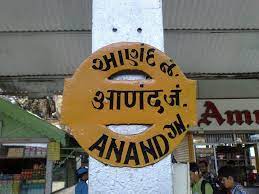
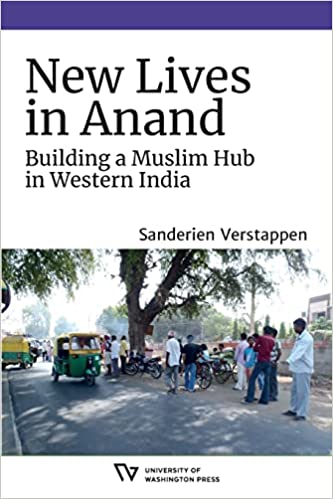
Sanderien Verstappen’s ‘New Lives in Anand’ shows us how new lives and connections are made by communities who have deep ties to a region and a way of life that cannot be reduced to the word ‘Muslim.’
Photo: Superfast1111/CC BY-SA 3.0
In 2005, I was back in Ahmedabad collecting stories of Hindus, Muslims and Dalits living beside each other in the eastern part of the city in a neighbourhood called Vatva. I had worked as a volunteer in the Qutb-e-Alam dargah relief camp in Vatva in the aftermath of the 2002 pogrom. Vatva lacked basic infrastructure – the sewers were overflowing with garbage, the roads were broken, and the air was pungent with chemicals from local industries. The area had a sizeable population of Muslims who often lived beside Hindus and Dalits.
As part of my research, I met a lower-level bureaucrat at the Ahmedabad Municipal Corporation (AMC) to learn more about the history of the neighbourhood. Opening large survey maps of the area, he was puzzled by my interest in Vatva. “It was a bad area,” he said, an expression and attitude that accompanied discussions of Muslim-majority neighbourhoods in Ahmedabad far beyond the corporation offices.
Sandrien Verstappen’s wonderful new book New Lives in Anand tells us that the story of Gujarati Muslims does not end with violence and displacement. Verstappen focuses on the attempts of one Muslim community, the Charotar Sunni Vohras in Anand, to make a new life in the aftermath of state-sanctioned public violence in 2002. Violence that forced many Muslims to flee Hindu-majority villages and seek safety in Anand.
By focusing on the attempts of the Vohra community to make a meaningful life, secure marriages, do business, and “bring the community together,” we get a glimpse of a world where Muslims are not permanent outsiders in Gujarat but essential to the creation of a region through their embeddedness in Charotar’s fertile agricultural economy. By telling the story of Gujarati Muslims through the prism of a specific region, Verstappen can describe their similarity with local Hindus, like the Patidar community. The lens of region, not religion, allow us to see the flimsiness of the idea of a homogenous Muslim community that is being served all day in contemporary India.
A board member of the Charotar Sunni Vohra community jokingly refers to Anand as a “Mecca of Vohras” and yet the joke is serious because it is a reminder to readers that despite the best efforts of Hindu supremacists in India to portray Muslims as foreigners in Gujarat (and India), Indian Muslims are building spaces that are safe for them; spaces that cannot be reduced to suffering and marginalisation but open new opportunities for middle-class Muslims.
But why Anand? The book begins with the exodus of Muslims from Hindu-majority rural areas to urban centres like Anand after the 2002 pogrom. We learn that the pogrom has left no one untouched. It has instilled a fear even in places where there was no violence. Because, as Verstappen writes, “the fact that that there has not been any large-scale violence in Gujarat since 2002 is not considered an indication that peace has been restored and the violence is over.” However, the Vohra community’s successful attempt at building a hub in Anand through ‘regional belonging’ (the fact that they are from the Charotar region) must be seen in the light of the fact that they are a wealthy and powerful community amongst Muslims in Gujarat.
The book describes how, despite the setback of the Partition, the Vohra community organised itself through history writing, associations (such as Charotar Sunni Vahora Young Men’s Association in Bombay in 1936), and community halls and overseas organisations in the UK, US and Canada. Significantly, the Vohra community narrates it past as emerging from local Hindus who converted to Islam and therefore showing their links with local Hindu groups like the Patidar community in Gujarat.
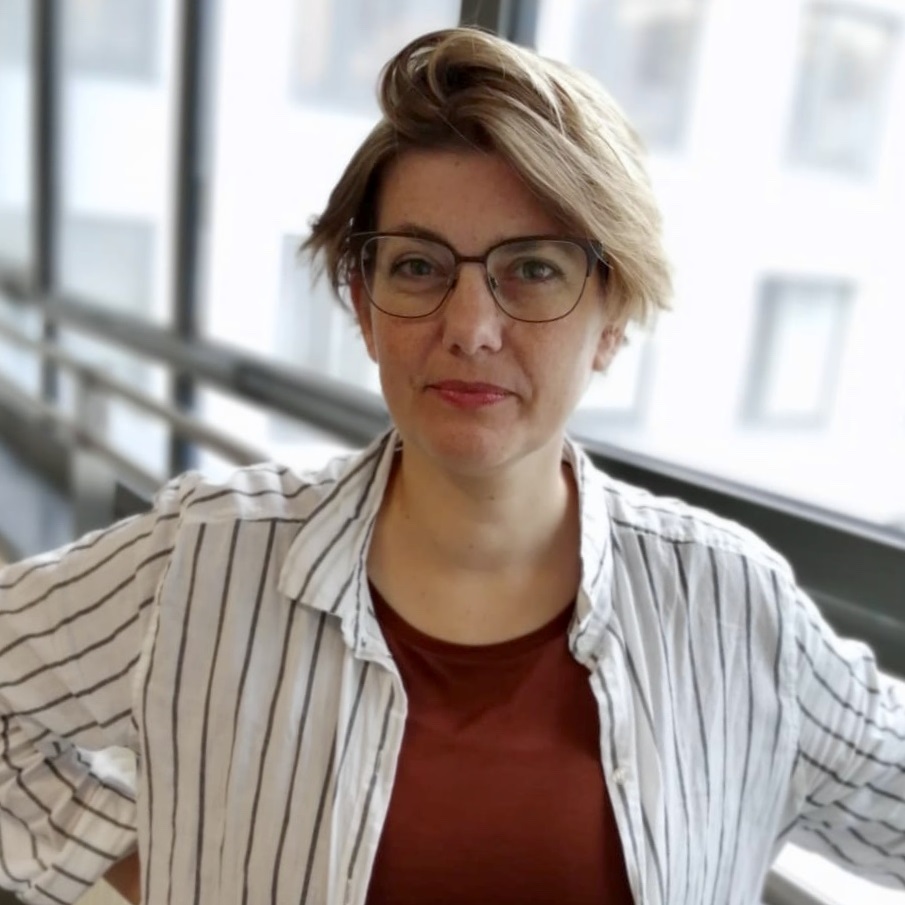
Sandrien Verstappen.
Verstappen’s account of how the Vohras tell their history, manage their lives, and make claims of belonging in Gujarat is a powerful reminder of the importance of local ancestry, village-based marriage circles, and agricultural practices in the making of a community. What joins the Muslim Vohra community with their Hindu neighbours is as important as what separates them. And yet despite the valiant efforts of the Vohra community to build Anand as ‘hub’ for prosperity, the ongoing movement of Muslims from Hindu-majority villages and Hindus from Muslim-majority areas is a deeply troubling phenomenon that is not limited to Anand and should worry us all.
Anti-Muslim violence has created a vicious cycle which justifies segregation and the making of Hindu/Muslim majority neighbourhoods in the name of ‘peace.’ But this is not peace but apartheid. And it has significant effects on the well-being of those who live in Muslim-majority spaces. For instance, a resident of Gamdi in Anand says that “the municipality is only maintaining the roads in places where Hindus live.”
So regardless of communities perceive themselves, religiously segregated neighbourhoods can lead to the situation where certain areas are deliberately neglected by the government simply because they are inhabited by minorities. Segregated areas help politicians to clearly mark spaces that did not vote for them and then punish them. Even though Verstappen is keen to show that Vohras are part of a wider form of urbanisation in India and are not moving to Anand only because of safety but also to rise up the social ladder, I feel that state-sanctioned segregation cannot be understood through only a regional lens. Here the regional lens can be a limitation rather than an aid to understanding minoritisation.
The process of segregating and isolating Muslims in India within specific neighbourhoods is now a national issue and is connected to the second-class status accorded to Muslims beyond Gujarat. Having seen this process unfold in Gujarat over the last two decades, I cannot fail but notice that residential segregation is part of a larger fabric that creates the infrastructure for segregated laws, segregated schools, and segregated life. In some situations, like the current rise of Hindu supremacy in India, it is liable to become the bedrock for the unequal and unfair treatment of minorities.
Verstappen also tracks the transnational links of the Vohras, who like other Gujaratis overseas, send remittances home, invest in real estate, and support charitable organisations. In this way, the community uses the opportunities opened up by the overseas citizenship scheme and contributes to the development of Anand as a ‘hub’. Here, again, I am reminded of the recent violence in Leicester that shows that the domestic politics based on the false and pernicious idea that Hindus and Muslims belong to separate worlds and are forever at war may be spreading to the diaspora, which can have significant effects on the Vohra community in general.
In sum, Verstappen’s book is important because it tried to tell new stories about Indian Muslims, a story that does not begin with violence and end in suffering but shows us how a particular community, in a particular region is transforming displacement and segregation in the aftermath of anti-minority violence into the making of a ‘hub’ – a space for mobility, a space for aspirational middle-class Muslims to access Hindu spaces, a space to forge an identity that is not a prison. A story of the making of an aspirational Muslim middle-class that cannot be reduced to victimhood. In other words, the book shows us how new lives and connections are made by communities who have deep ties to a region and a way of life that cannot be reduced to the word ‘Muslim.’
Moyukh Chatterjee is a Visiting Scholar at the University of Edinburgh and is the author of the forthcoming book, Composing Violence: The Limits of Exposure and the Making of Minorities, Duke University Press (2023).
source: http://www.thewire.in / The Wire / Home> Books / by Moyukh Chatterjee / January 27th, 2023
:quality(70)/cloudfront-eu-central-1.images.arcpublishing.com/thenational/ACD5KFPDRSOD3UNOBQCGVOPNHM.jpg)