Hyderpur Village (Narkelbara Paragnas) , WEST BENGAL:
The Wahabi movement enjoyed a special status when it comes to revolts against the British rule in India, and Titu Mir, whose real name was Syed Mir Nisar Ali, added a militancy to it. It became the source of inspiration for several movements in the Struggle for Independence of India.
Titu Mir was born in a peasant family in 1782 at Hyderpur village, in the Narkelbaria paragana of West Bengal. Syed Mir Hasan Ali, Abida Roqayya Khatun were his parents. He was a renowned wrestler during his younger age and was engaged in several petty jobs. Syed Mir Nisar Ali went on a pilgrimage to Mecca in 1822 and met the founder of the Wahabi movement, Syed Ahmed Barelwi and the founder of the Farazi movement, Haji Shariatullah. The meeting of the three leaders had strengthened the ‘Wahabi[1]Farazi’ movements.
After his return from Mecca, he settled in Hyderpur. He travelled extensively and saw the atrocities of the officials of the East India Company, Zamindars and Mahajans. Syed Mir Nisar Ali witnessed the woes of the people who suffered in the clutches of these exploiters. Titu decided to put an end to the exploitation and undertook a campaign to arouse the people for a rebellion against the foreign rulers along with his spiritual campaign. He started armed struggle against the British Police and East India Company armed forces, who were supporting Zamindars and Mahajans. Zamindars and their men were collecting taxes for wearing beards and harassed Muslims.
Opposing the oppressive taxes levied by the Company rulers and inhuman activities of local Zamindars, Titu Mir himself personally led several revolts. Titu Mir was irked by atrocities and attacks on the common people by Zamindars, Mahazans and British force. Syed Mir Nisar Ali was so courageous that he was even informing the East India Company officials and police about his attacks in advance. His courageous approach attracted the poor towards him.
Thousands of people, irrespective of religious and class barriers, followed him in his rebellion and fought for him against the police and British forces. Titu Mir built a bamboo fort in Narkelbaria where he trained his followers in armed struggle and frightened the Company rulers for about a decade. The British commanders attacked the fort of Syed Mir Nisar Ali (Titu Mir) on 19 November, 1831 at Narkelbaria, where he succumbed to injuries in 1832 .
source: http://www.siasat.com / The Siasat Daily / Home> Featured News / by Nihad Amin / August 28th, 2020
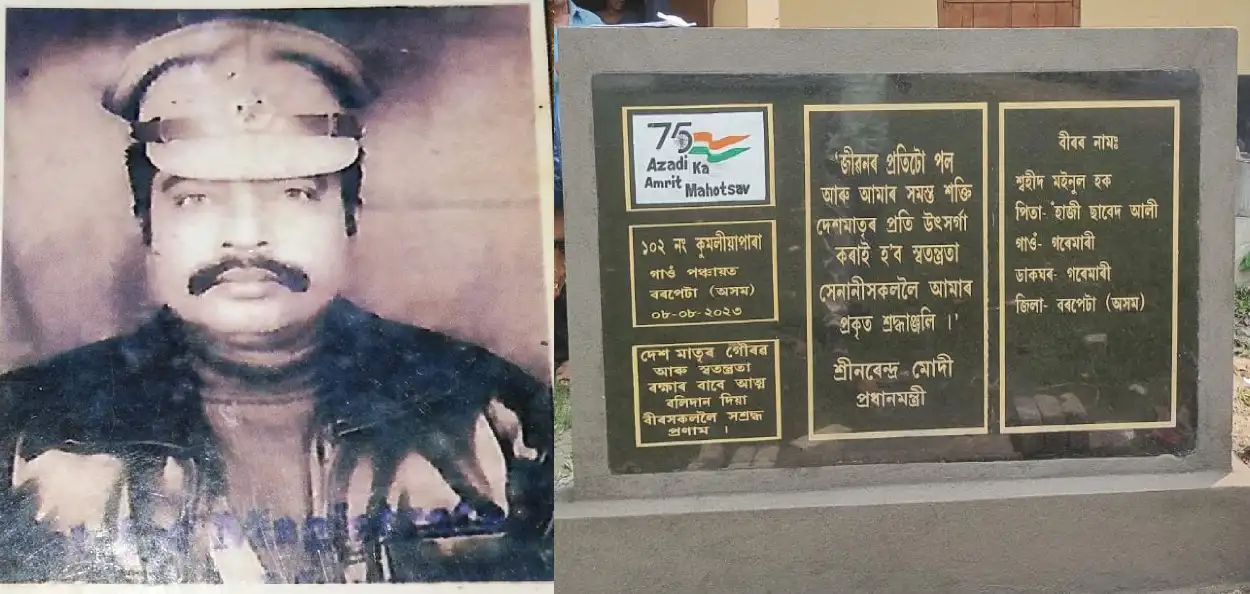
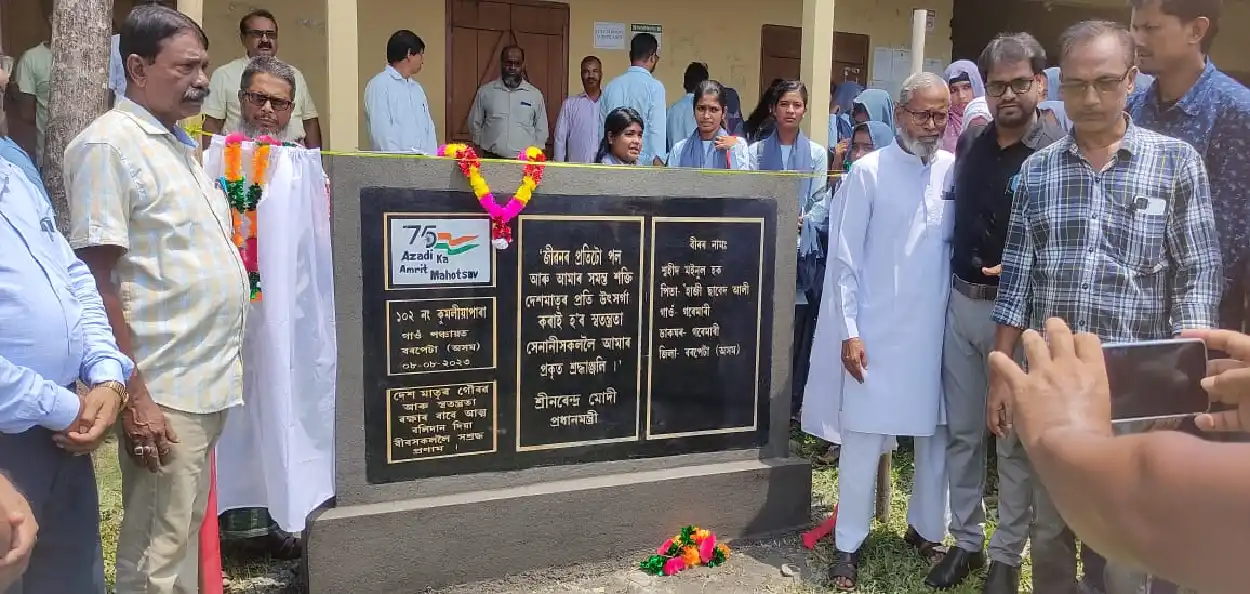
Martyr Police Officer Moinul Haque and the martyr’s altar erected in Barpeta (from left)
Three decades after Police officer Moinul Haque made supreme sacrifice while fighting insurgents in Barpeta city of Assam, the government has declared him a martyr.
The move has sent a wave of joy and pride in his native village of of Garemari in the Barpeta district and the local panchayat has installed a memorial in his honour in the local school.
Sub-Inspector Moinul Haque of the Assam Police was shot dead on January 21, 1991 while he was on duty at the District Special Branch of the Police in Barpeta.
The 102nd Kumalliapara Gaon Panchayat recently erected a plaque in Moinul Haque’s memory at the local college in his native village on the occasion of the 75th anniversary of the country’s independence.
The scene at the inauguration of the martyr’s altar in memory of Moinul Haque
Born in 1948 in Garemari village, Moinul Haque was a skilled and brave police officer and a socially conscious person. He was the founder of the Garemari Primary Health Centre, Babur Ali Molla ME Madrassa and other institutions in the Garemari area.
Soon after his schooling he was appointed in the Assam Police.
The local people, various organizations and his family members have expressed their gratitude to the government for honouring him after 32 years.
“We are pleased that the government has declared Moinul Haque, who sacrificed his life for the sake of the motherland, as a martyr,” said Bulbul Hussain, the government village chief of Garemari village.
He said the supreme sacrifice of the police officer to protect the dignity of Mother Assam will remain an example for the younger generation of Garemari area.
The 102nd Kumullipara Gaon Panchayat President Ruma Parbin Sultana Khanam said she was happy and proud to erect a martyr’s altar in the name of heroic martyr Moinul Haque during the Amrit mahotsav, the celebration of 75 years of India’s freedom
“My father, Shaheed Moinul Haque, was shot dead by militants on January 21, 1991 while on duty in the Assam Police. After 32 years, albeit late,” said Ismail Hussain, son of martyred police officer said.
“The government has declared him a martyr. I would like to express my sincere thanks and gratitude to the Government of Assam and the Government of India for that. I also wish the souls of all the martyrs who sacrificed their lives for the sake of the motherland.”
The event was attended by the Acting Principal of the college Sirajul Haque, Assistant Inspector of Silk Department Hurmuz Ali, family members of martyred police officer Moinul Haque, officials of various local institutions and local people.
source: http://www.awaazthevoice.in / Awaaz, The Voice / Home> Story / by Saiju Rahman, Bapeta / September 11th, 2023
Khan, a resident of Damoh district, was deployed for security of Amarnath pilgrims in Jammu and Kashmir.
Bhopal: Union minister Prahlad Patel and others pay tributes to Aqeel Khan, a Border Security Force (BSF) jawan on Tuesday | FP PicsBSF Jawan’s body at Bhopal airport |
Bhopal (Madhya Pradesh):
Union minister Prahlad Patel and others paid tributes to Aqeel Khan, a Border Security Force (BSF) jawan, after his body was brought to Raja Bhoj Airport on Tuesday. His funeral will be performed in Damoh.
Khan, a resident of Damoh district of Madhya Pradesh, was deployed for the security of Amarnath pilgrims in Jammu and Kashmir.
As soon as the family of Aqeel living in Futera ward of Damoh got the news of his death, there was mourning in the family. Aqeel Khan was recruited in BSF since 2008. He is survived by a daughter, son and mother. With the news of Aqeel’s death pouring in, the district administration is in touch with the BSF.
According to family members, Aqeel, who dreamt of joining the army since childhood, had joined the BSF in 2008. With this his dream was fulfilled. Aqeel bid farewell to his mother Shakeela Begum and had left with great joy pledging to serve the country. His family was very happy with this. Aqeel is survived by his wife Shazia Khan, an 8-year-old daughter, a 3-year-old son, mother and two brothers and a sister.
source: http://www.freepressjournal.in / The Free Press Journal / Home> Bhopal / the FPJ Staff Reporter / May 24th, 2022
Renowned researcher, author, and former Associate Professor of Political Science at the University of Delhi, Dr. Shamsul Islam, is scheduled to deliver the BV Kakkilaya Inspired Oration for 2023. The oration, titled “Joint Martyrdoms, Joint Heritage of 1857 War of Independence,” will take place on Saturday, September 9, 2023, at 10 a.m. at Ravindra Kalabhavana, University College, Mangaluru.
The annual BV Kakkilaya Inspired Orations serve as a tribute to the life and contributions of Sri BV Kakkilaya (1919-2012). Kakkilaya was a freedom fighter, a leader in the Karnataka unification movement, a prominent figure in the Communist Party of India and All India Trade Union Congress, a member of the first Rajya Sabha, and the Karnataka State Assembly.
He was also an award-winning writer and thinker. The oration aims to promote alternative thoughts and approaches to address the challenges faced by the underprivileged masses in India. The event is organized by Hosatu Monthly, Bangalore, MS Krishnan Trust, Bangalore, and Samadarshi Vedike, Mangalore, in collaboration with the Department of History, University College, Mangaluru.
During the event, Dr. Shamsul Islam’s book, “The Untold Amazing Stories of 1857,” will be released in its Kannada translation, titled “Bharatada Modala Swatantrya Sangrama 1857 – Helade Ulida Adbhuta Kathegalu.” The book is translated by Dr. B.R. Manjunath and published by Navakarnataka Publications. Dr. Jayaraj Amin, Vice Chancellor of Mangalore University, will have the honor of unveiling the translated work.
Additionally, the event will feature the publication of the names of 128 martyrs from Karnataka, who hailed from diverse backgrounds including various castes, religions, sects, and socio-economic strata. These martyrs gave their lives during the 1857-58 anti-British revolts. Dr. Shamsul Islam compiled this list from national archives, and the occasion will be marked with tributes to these brave individuals.
The public is warmly welcomed to attend this significant event.
source: http://www.varthabharati.in/ Vartha Bharati / Home> Karnataka / by Vartha Bharati / September 09th, 2023
The skull of a martyr Sepoy Alam Baig of the first war of Indian independence in 1985 must be brought to India for burial at the site where he was blown into pieces with a cannon for rebelling against the British Army in 1857.
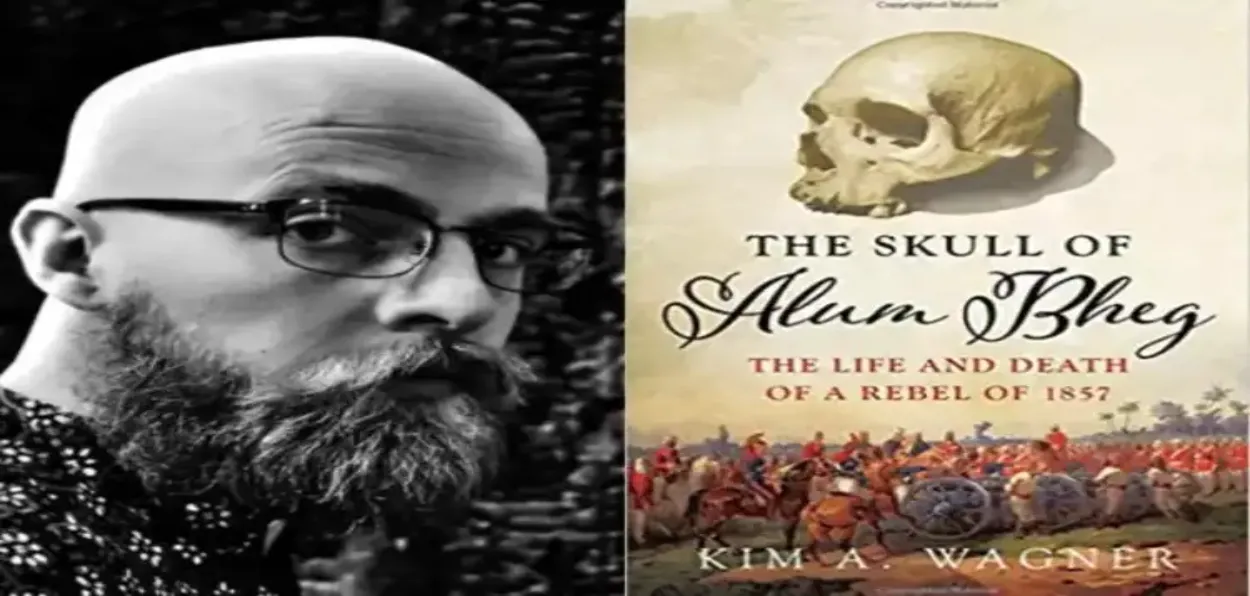
This campaign is being run by British Professor Kim A. Wagner, who teaches Global and Imperial History at Queen Mary University of London and is also the author of the book The Skull of Alum Bheg: The Life and Death of a Rebel of 1857.
Prof Kin Wagner is an authority on the subject as he has published several books like ‘Thuggee: Banditry and the British in Early Nineteenth-Century India’, ‘The Great Fear of 1957: Rumours, Conspiracies and the Making of the Indian Uprising’, and ‘Amritsar 1919: An Empire of Fear and the Making of a Massacre’.
Wagner says this grisly war trophy was found in a pub in south-east England in 1963. The owner handed it over to him in 2014 and he published this book on Alum Bheg in 2017.
Wagner says the skull was brought to Ireland by someone from the British authorities and later changed hands.
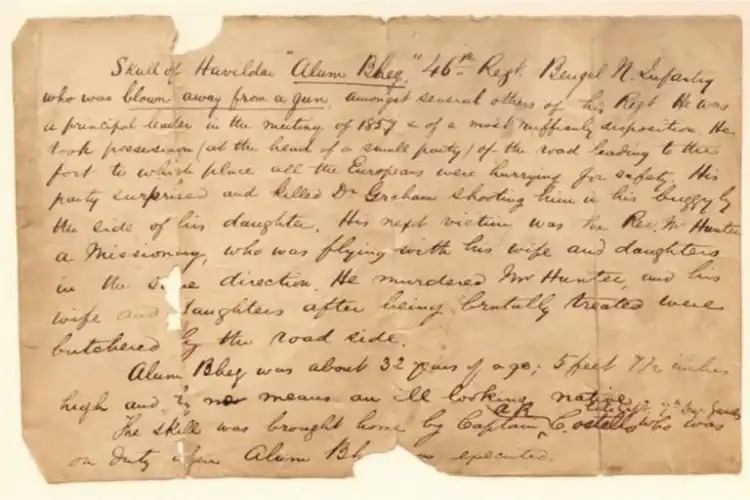
“The handwritten note found with it revealed the skull to be that of Alum Bheg, an Indian soldier in British service who had been blown from a cannon for his role in the 1857 Uprising. His head had been brought back as a grisly war trophy by an Irish officer present at his execution,” writes Kim Wagner.
Prof. S. Sehrwat of the Department of Anthropology, Punjab University had said in a statement that during the revolution of 1857, Havaldar Alam Baig (the way it is spelled in India) was captured and blown up with cannon. His skull was found in England.
He said Wenger had told him about this.
The note found with Alam Baig’s skull
A complete search record of the skull has been found. The scientists are now keen to do a DNA test to ensure the identity of the skull. It is known that Alam Baig was from the Kanpur area of Uttar Pradesh and even a family has claimed him to be their ancestor.
According to Prof Dineshwar Chaubey, who teaches genetics at BHU, Varanasi, two types of tests can be done on Alam Baig’s skull. A Kanpur family living in Delhi has claimed to be related to Alam Baig. Their genes can be matched with it.
Kim Wagner and other historians are campaigning for givinh a due burial to at some place along the India-Pakistan border, where he was done to death.
Wagner says the British had accused Baig of killing a Christian priest family and it was a fabricated charge. The record says that he was a sepoy of the 46th regiment of the Bengal Native Infantry.
Kim Wagner believes that it is the right time to bury Havaldar Alam Baig in his country, at the same spot where he fought in the Battle of Trimu Ghat on the banks of the Ravi River in the border region between India and Pakistan.
He said, “I do not consider the return of Alam Baig’s skull as political. My aim is only to bring the mortal remains of Alam Baig to his homeland so that he may rest in peace long after his death.
Although the historian’s statement has also passed a long time, there is no progress in this matter to date. It is also waiting for the time when the skull of one of the great sons of India will be brought to India and buried in the soil here.”
The Natural History Museum confirmed its likely authenticity and Wagner, with little evidence to go on, traced Bheg’s history using various sources.
source: http://www.awazthevoice.in / Awaz, The Voice / Home > Story by ATV / by Ghaus Siwani, New Delhi / posted by Aasha Khosa / September 02nd, 2023
The famous writer Kushwant Singh, once wrote: “Indian Freedom is written in Muslim blood, since their participation in the freedom struggle was much more, in proportion to their small percentage of the population.”
The story and history of India’s independence are written with the blood of Muslims. According to historical references, 65% of those who stood, fought and sacrificed against the British for India’s independence were Muslim freedom fighters, the hams live reported.
A large number of people from all religions and castes took part in the freedom struggle, undoubtedly. However, the struggles of many Muslim prominent personalities who also contributed to India’s freedom and even sacrificed everything including their lives are little known. Muslims have been at the forefront to oppose the British and stood shoulder to shoulder with people from other communities while fighting against them. Getting freedom was not easy, our ancestors had to go face a lot of struggles and difficulties to get us the freedom that we are enjoying now.
The First Call To Oppose British
In the 1750s, Nawab Siraj-ud-Daulah was the first awakened Indian ruler, who stood his ground against the British. He lost the Battle of Plassey in 1757 due to the betrayal of Mir Jafar (Commander of Nawab’s army). With this, Siraj-ud-Daulah’s reign marks the end of the last independent rule in India and the beginning of the East India company’s rule that was unabated for the next two hundred years.
First Freedom Struggle By Muslim Rulers
The first freedom struggle against the British was started by the rulers of Mysore Hyder Ali and his son, Tipu Sultan, during the 1780s and 90s. Both used the first iron-cased rockets and cannons effectively against the British invaders.
Tipu Sultan is considered to be one of India’s first freedom fighters for his fierce fight and brave against the East India Company. He resisted the conquest of the British in southern India and was reluctant to welcome them on his soil. He was the only Indian ruler who understood the dangers that the British posed to India, and fought four wars to oust them from the country.
The Unsung Heroines Of India’s Freedom Struggle
Begum Hazrat Mahal, the unsung heroin, played a very important role in India’s war of Independence. Being a woman, she led a rebellion against the British East India Company in 1857. She shot the British ruler, Sir Henry Lawrence and defeated the British army in a conclusive Battle at Chinhat in 1857.
In the great revolt of 1857, as many as 225 Muslim women sacrificed their lives in the uprising. These unsung Muslim women freedom fighters who have sloganeered, shed blood and given their lives for the country’s independence have now been forgotten to due biases.
A majority of freedom fighters did a nameless service to the nation and one such lesser-known name was Abadi Bano Begum (Bi Amma). Bi Amma was the first woman to address a political rally wearing an abaya. She took part in National freedom struggles, Khilafat Movement and propagated Hindu-Muslim unity. Following Mahatma Gandhi’s advice, Bi Amma played an. An important role in encouraging women to take part in the freedom movement. Further, she played a pivotal role in the Swadeshi movements.
In the book, Gandhi and the Ali Brothers: Biography of a Friendship by Rakhahari Chatterji, Maulana Mohammad Jouhar says, “Suffice it to say that, although she was practically illiterate, I have, in all experience, of men of all sorts of types, come across none that I could call wiser and certainly that was more truly godly and spiritual than our mother.”
Bi Amma was also the mother of Muhammad Ali Jauhar and Shaukat Ali popularly known as the Ali Brothers whom she raised on her own after her husband died when she was young.
Amjadi Begum, the wife of Muhammad Ali Jauhar and daughter-in-law of Bi Amma, is yet another Muslim women freedom fighter. Mahatma Gandhi also dedicated an article on her titled ‘A Brave Woman‘ where he admired her as a courageous wife of a courageous man.
At the age of 45, Asghari Begum, another forgotten Muslim woman, has also taken part in the 1857 revolt and challenged British rule in the present-day Uttar Pradesh. However, she was captured by the British in 1858 and burnt alive.
Habiba, a Muslim woman’s fought many battles against the British in Muzaffarnagar in 1857. However, she was captured and hanged along with 11 other female warriors at the age of 25.
The Great Revolt of 1857
During the Great Revolt of 1857, Hindus and Muslims under the leadership of the last Mughal emperor Bahadur Shah Zafar tried to oust the British from India. A majority of Hindu sepoys requested Zafar to lead them in the war of Independence. Although the Revolt failed due of several reasons, Muslims have always stood on the front line to oppose the British.
Former Prime Minister of India, Rajiv Gandhi during his visit to Bahadur Shah’s grave, wrote in the visitor’s book: “Although you (Bahadur Shah) do not have land in India, you have it here; your name is alive… I pay homage to the memory of the symbol and rallying point of India’s First War of Independence….”
Muslims came to India and ruled here for over 800 years but they did not steal anything from here as the British, the Dutch and the French did. By bringing plenty of knowledge in literature, architecture, judiciary, political structure, government body and management structure, which is still used in Indian management strategy, they helped India to progress into a unified and civilized nation.
Lighthouse of Rebellion
How many of us know that the organizer and leader of “First Indian freedom struggle” in 1857 was Moulavi Ahamadullah Shah. Known as the ‘Lighthouse of Rebellion’ in Awadh, he Faizabad free from British rule for almost one year, until his death at the hands of British agents on June 5, 1858.
“With being a practicing Muslim, he was also the epitome of religious unity and Ganga-Jamuna culture of Faizabad. In the revolt of 1857, royalties like Nana Sahib of Kanpur, Kunwar Singh of Arrah fought alongside Maulavi Ahmadullah Shah. Maulavi’s 22nd Infantry Regiment was commanded by Subedar Ghamandi Singh and Subedar Umrao Singh in the famous Battle of Chinhat,” according to researcher and historian Ram Shankar Tripathi.
The important role of Muslims in the uprising is the reason that the British government singled out the community for the worst revenge. From the Nawab, the King of Mysore, the last Mughal King, Princes, the landlords, the Ulemas, intellectuals, Urdu journalists, including common people, all members of the Muslim community have made great sacrifices for the freedom of India.
In the uprising of the 1857 revolt, thousands of ulema were slaughtered and the whole of Delhi was emptied of Muslims, according to excerpts from Syed Ubaidur Rahman’s book Biographical Encyclopedia of Indian Muslim Freedom Fighters. They were not even allowed to return to their homes and reclaim their properties.
First Journalist To Sacrifice His Life During The Great Revolt
Moulvi Muhammad Baqir, a scholar and activist of Indian independence activist was the first journalist to be executed following the rebellion in 1857. The editor of Urdu newspapers, Delhi Urdu Akhbar, was washed dead on 16th September 1857 for writing Nationalist articles, without even a trial.
Although India got independence on 15 August 1947, the foundation of the freedom struggle was laid before 1857. Since the time of the Revolt of 1857, which is considered to be the beginning of India’s freedom struggle, Muslim leadership has spearheaded the cause.
First Muslim To Be Hanged For Conspiring Against East India Company
At the age of 27 years, Shaheed Ashfaqulla Khan was the first Muslim to be hanged for conspiring against the British Raj. Khan was hanged to death on December 19, 1927. With this, he became a martyr and a legend among the people because of his love for the country and his unshakeable spirit.
Reshmi Rumal Tehreek (The Silk Movement)
Muslims not only took the lead in the uprising, but also stood in the front line in all other efforts to topple the British colonial regime in India.
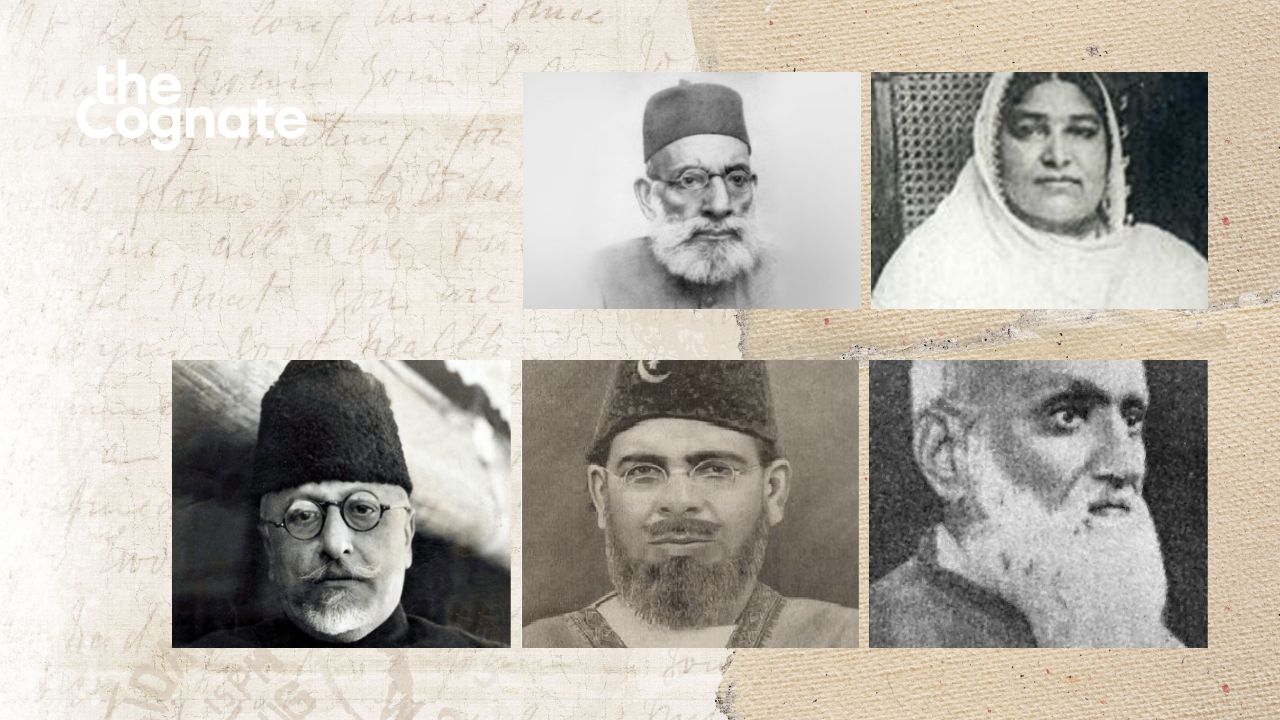
After the revolt of 1857, the Muslim leaders changed their strategy of resistance by setting up educational institutions across the country. Reshmi Rumal Tehreek or The Silk Letter Movement (1913-1920) was an initiative by Deobandi Leaders Maulana Mahmud Hasan and Maulana Ubaidullah Sindhi to topple the British Empire.
However, when British intelligence learned about it, hundreds of sympathizers of the initiative were arrested and put in prison for years without any trial. The top leaders including Maulana Mahmud Hasan and half a dozen of his followers were banished to Malta after a faux trial where they faced the worst hardship.
Role of Muslims in Congress’ anti-colonial struggle
Justice Abbas Tyabji, an Indian freedom fighter from Gujarat and associate of Mahatma Gandhi, was the first Muslim president of the Indian National Congress party. Justice Tyabji is also known for leading Salt Satyagraha following Gandhi’s arrest in 1930.
Another Congress president during the colonialism was Maulana Abul Kalam Azad, who is one of the chief Muslim leaders of the anti-colonial nationalist movement. He became the youngest President of the Indian National Congress in 1923 at the age of 35. He faced multiple imprisonments by the colonial state.
From Justice Tayabji to Maulana Abul Kalam Azad, there have been eight Muslim leaders who were in the Indian National Congress’s freedom movement. The other prominent Muslim leaders include, Muhammad Ali Jauhar, Shaukat Ali, Maulana Azad, Dr Mukhtar Ansari, Hakim Ajmal Khan, Maulana Mahmud Hasan and many others. They made every possible sacrifice for the cause of the end the colonial rule.
Frontier Gandhi
Khan Abdul Ghaffar Khan was a Pashtun independence activist who campaigned to end the rule of the British Raj in India. He founded the Khudai Khidmatgar resistance movement against British colonial rule in India. He was also known as Frontier Gandhi for his principles of non-violence and friendship with Gandhi. Khan worked towards the formation of a united, independent, secular India.
Muslim Man Coins “Jai Hind”
The patriotic slogan “Jai Hind” was initially coined by Zain-ul Abideen Hasan, but it was adopted by Netaji Subhash Chandra Bose. It is now used as a way of salutation throughout India. It means “Victory to India” in English.
The Creation Of the National Flag
For a majority of us, the current national flag was designed by Pingali Venkayya. However, it was a Muslim Lady Surayya Tyabji, who created the flag’s final look today.
Although we have recounted several names of the Muslims who have contributed to India’s freedom struggle, there are several thousands of them who fought on the streets against the British Raj.
source: http://www.thecongnate.com / The Cognate / Home> History / by Rabia Shireen / August 15th, 2022
In the freedom struggle, Muslim freedom fighters played a predominant role.
In the Indian freedom struggle, though, Muslim freedom fighters played a predominant role, right-wing organisations are trying to erase their history. In view of it, it is essential to know the important Muslim freedom fighters who fought for Indian Independence.
Indian freedom fighter and former aide of Subhash Chandra Bose Abid Hasan Safrani. (Photo: Siasat)
Abid Hasan Safrani
Abid Hasan Safrani, an Indian National Army (INA) soldier from Hyderabad is one of the unsung heroes of Hyderabad. He not only played role in India’s independence but also coined the slogan ‘Jai Hind’ which was later declared the salutation of the Indian Army and government employees.
Safrani was constantly with the INA fighting from Burma to Imphal in India.
After India attained freedom, then Prime Minister Pandit Jawahar Lal Nehru inducted him into the Indian Foreign Service (IFS). He was posted to several countries including Egypt, China, Switzerland, Iraq, Syria, Senegal and Denmark.
After retirement, Safrani settled at a farm in Shaikpet, Tolichowki. He passed away in 1984.
Maulana Abul Kalam Azad
Maulana Azad, a distinguished Islamic scholar, author, academician and a prominent freedom fighter, was elected as the youngest President of Indian National Congress aged 35, and later led the historic Khilafat Movement.
After Independence, Maulana Azad served as India’s first Education Minister for over 10 years, during which he laid the foundations for the country’s massive academic network. Acknowledging his contributions, his birthday – November 11 – is celebrated as National Education Day.
Siraj-Siraj-ud-Doulah
Siraj-Siraj-ud-Doulah, the Nawab of Bengal was the first Indian king to foresee the threat posed to the future of the country by the English East India Company which entered India in the name of trade but transgressed its limits. He took bold initiatives to thwart the company’s evil designs.
Mir Khasim Ali Khan
Mir Khasim Ali Khan was a warrior Nawab who fought against the East India Company till his end with the conviction that he could ensure safety for his kingdom and liberty and prosperity for his people only by driving the British out of India.
Hyder Ali
Hyder Ali, who is famously known as ‘the Napoleon of South India’ for his relentless fighting against the conspiracies of the East India Company and its henchmen and for checkmating the British ambitions of expansion in South India
Tipu Sultan
Tipu Sultan, the ‘Tiger of Mysore’, was a great visionary who exposed the expansionist designs of the British imperial forces and gave a clarion call to his fellow countrymen and native rulers to unite and fight against the East India Company.
Syed Mir Nisar Ali
The Wahabi movement enjoyed a special status in the history of revolt against British rule in India, and Titu Mir, whose real name was Syed Mir Nisar Ali, added militancy to it. It became the source of inspiration for several movements in the Struggle for Independence of India.
Haji Shariatullah
Haji Shariatullah, who militantly led the Farazi Movement that stood as a source of inspiration for several revolutionaries in the Indian Freedom Struggle
Ghulam Rasool Khan
Ghulam Rasool Khan, the Nawab of Kurnool in Andhra Pradesh, created terror among the officials of the East India Company.
Moulana Peer Ali Khan
Moulana Peer Ali Khan fought against the British military force declaring that sacrificing oneself in the cause of liberation of one’s motherland is a proof of one’s love for his country.
Moulvi Ahmadullah Shah Fyzabadi
Moulvi Ahmadullah Shah Fyzabadi created panic among the British camps. In the First War of Indian Independence of 1857, he fought against the forces of East India Company and registered several victories over them.
Sheikh Bikhari Saheb
Sheikh Bikhari Saheb raged against General Dalhousee’s ‘Doctrine of Lapse’ whose sole objective was to expand the British empire. He stood in support of the freedom loving native rulers and fought against the foreign rulers.
Azimullah Khan
Azimullah Khan was renowned as a strategist in the First War of Independence, 1857.
He retreated to the forests of Nepal along with Nana Saheb, Hazarat Mahal and others, when the First War of Independence had faced the situation of near defeat. Azimullah Khan passed away in October 1859, while making efforts to secure financial and military support to fight back against the British.
Mohammad Bakht Khan
Mohammad Bakht Khan provided leadership to the heroes and heroines of The First War of Independence of India of 1857 against the forces of the East India Company, by taking up the responsibility of Commander-in-Chief.
He streamlined the troops after his appointment as the Commander-in-Chief by the Mughal Emperor, Bahadur Shah Zafar.
Khan Bahadur Khan
Khan Bahadur Khan, the ruler of Rohilkhand, fought against the British to liberate the motherland.
Declining a very high official post offered by the East India Company, Khan Bahadur Khan revolted against the British at the age of 70. He declared Independence at Bareilly, the capital of Rohilkhand on 31 May, 1857.
Bahadur Shah Zafar
Bahadur Shah Zafar, the last Moghul Emperor, led the First War of Independence, which was recognized in history as the symbol of anger among the people of India against the British.
He breathed his last in jail on 7 November 1862.
Mohammad Sher Ali
Mohammad Sher Ali, an embodiment of anti-British spirit , was born in 1842 at Peshawar, presently in Pakistan. He was inspired by the Wahabi movement that arose against the British in his younger age. His family migrated to Ambala from Peshawar in 1863. He was sentenced to death on 2 April, 1868.
Begum Hazrat Mahal
Begum Hazrat Mahal was a prominent woman of the 1857 rebellion. There was a fierce battle between the Company troops and the Begum troops. When defeat became inevitable, Begum Hazrat Mahal retreated to the Nepal forests along with the co-revolutionary leaders like Nana Sahib Peshwa and others.
Begum Hazarath Mahal struggled for the independence of her state till her last breath. She passed away at Kathmandu of Nepal on 7 April 1879.
Moulvi Syed Allavuddin
Moulvi Syed Allavuddin was a spiritual leader. He used to exhort people of Nizam State, one of the strongest princely states of South India, to rebel against the British hegemony. He stood in the forefront of the direct fight against the British Government.
He was a native of Hyderabad, the capital of erstwhile Nizam princely state. Allavuddin intensified his rebellious activities soon after the First war of Independence of India was started in 1857.
British forces arrested and sent Moulvi Allavuddin to the cellular jail in Andaman on 28 June 1859. After leading a miserable life of 25 years as a prisoner, Moulvi Syed Allavuddin passed away in 1884.
On the occasion of Independence Day, all Indians need to pay tribute to all the freedom fighters who took part in the Indian freedom struggle.
source: http://www.siasat.com / The Siasat Daily / Home> News> India / by Sameer Khan / August 15th, 2023
Indian revolutionaries in Kabul where they announced a government in exile
On 24 April 1918, Ram Chandra was shot dead by Ram Singh in a courtroom in San Francisco, USA. A few moments later, a policeman shot Ram Singh. Who were these Indians? Ram Chandra and Ram Singh were the leaders of a revolutionary Ghadar Party in the USA. They were planning to wage a war against the British Empire with the help of the German government. Ram Singh suspected Chandra of being a traitor and thus he killed him on the last day of the trial.
Though Muslims and Sikhs were also accused of being part of the conspiracy, for some reason the case was famously called the Hindu German Conspiracy case. The German High Commissioner had allegedly provided the revolutionaries with money and arms.
Rabindranath Tagore was also featured in the charge sheet. It was accused that he took money from the revolutionaries in the USA and handed it over to the Japanese government to arrange for arms. It was the costliest court case ever argued in the USA till that time.
Indian revolutionaries had always used foreign territories to wage war against the British Empire. In 1845, Haji Imdadullah Muhajir Makki of Saharanpur went on the Haj with a plan to stay there. He wanted to teach at Makkah. Another Indian and his senior Maulana Ishaq met him in Makkah and asked him to return to India and wage a war against the English East India Company rule. Ishaq was one of the many Indian ulemas, who lived in Makkah and Medina to preach anti-colonialism among the pilgrims.
Imdadullah returned to India, planned a revolt in coordination with several leaders, and joined the War of Independence in 1857. He liberated Shamli for a few weeks before the English recaptured it. Thousands of his followers were killed in the battle and he moved to Makkah.
Imdadullah lived for 30 more years and used Makkah as a base to preach nationalism among Haj pilgrims from India and create links among different colonized nationalities.
Shyamji Krishna Varma, an Arya Samaj leader, established India House in London to train educated revolutionaries for the freedom struggle. V.D. Savarkar, Virendranath Chattopadhyay, Haider Raza, Ali Khan, Bipin Chandra Pal, and Acharya were a few prominent Indian revolutionaries trained at this hostel. They were given fellowships to study in England. Asaf Ali, who later argued the case of Bhagat Singh in court, was also associated with the India House. Savarkar’s book describing events of 1857 S inspired a generation of revolutionaries.
Madan Lal Dhingra was one of the most prominent revolutionaries from this house. He assassinated an English official after which the house had to be closed down. Savarkar was arrested and sent to Andamans. After that, these revolutionaries shifted bases to Berlin, Paris, etc.
Indians, especially Punjabis, living in the USA formed the Ghadar Party in 1913. Ghadar is a term used for the War of Independence of 1857. The party aimed to re-enact the scenario by making the Indian sepoys of the English army rebel.
The revolutionaries contacted Germany and Turkey for money and arms. A date doe revolt was fixed in India for the revolt. Hundreds of the revolutionaries came back to India in 1915, Rash Behari Bose, Jatin Bagha, and M N Roy were also working for the success of the plan. A traitor told the British about the plan. Hundreds of revolutionaries were caught and hanged in what came to be known as First Lahore Conspiracy. Kartar Singh Sarabha was one of the more famous among those hanged. Jatin Bagha was killed. Ras Behari Bose and M N Roy had to leave the country.
The Ghadar Party succeeded in causing a mutiny in Singapore. In February 1915, Indian soldiers killed English officers and captured the island country. It took two days and the help of the Russian and Japanese armies to recapture Singapore from the British. More than four dozen Indians were killed by a firing squad in a public execution. At least 40 of the killed soldiers were Muslims from Haryana.
Raja Mahendra Pratap was an Arya Samaj activist from Hathras. As the war started he travelled to Turkey and Germany where the Sultan and Kaiser respectively gave him letters of authority to form a provisional government of India at Kabul. He reached Afghanistan with a Ghadarite, Barkatullah, where Maulana Ubaidullah Sindhi, a Deobandi scholar, was waiting for them. A provisional government with Pratap as the President, Barkatullah as the PM, and Ubaidullah as the Home Minister was formed in Kabul.
A plan to raise an army was also chalked out. Maulana Mahmood Hasan, a Deobandi scholar, and Maulana Husain Ahmad Madani were coordinating the efforts from Makkah. Letters written on silk cloth were used to communicate which were uncovered by British intelligence. Maulana Mahmood and Madani were arrested from Makkah and sent to Malta as prisoners of war. Hundreds of others were also arrested in what came to be known as the Silk Letter Conspiracy.
The war had ended. M. N Roy, Andul Rab, and MPT Acharya established a military school in Tashkent in the USSR. It trained mostly Muslims who migrated to Afghanistan after a fatwa asked them to in 1915. The people trained here took part in major revolutionary activities in India later on. Mian Akbar Shah is well known for his role in the famous escape of Netaji Subhas Chandra Bose from Kolkata (Calcutta) to Peshawar. He is supposed to be the most important person to have planned and executed the escape in 1941.
Ubaidullah went to the USSR and traveled to several countries before settling at Makkah in the 1930s. He used it as a ground to preach like Maulana Ishaq and Imdadullah before him. In 1938 he returned to India and met Netaji Subhas Chandra Bose. He planned future armed action with Netaji and gave him several contacts with Japan and Germany. Japan already had his old comrades in Raja Mahendra Pratap and Rash Behari Bose.
Around the same time Sardar Ajit Singh, an uncle of Bhagat Singh, and Iqbal Shaidai organized an army in Italy. They had been active in foreign lands since the last World War.
The story of Netaji forming an army in Germany and later leading Azad Hind Fauj formed by Ras Behari Bose in Japan is well-known and needs no retelling.
source: http://www.awazthevoice.in / Awaz, The Voice / Home> Stories / by Saquib Salim / August 11th, 2023
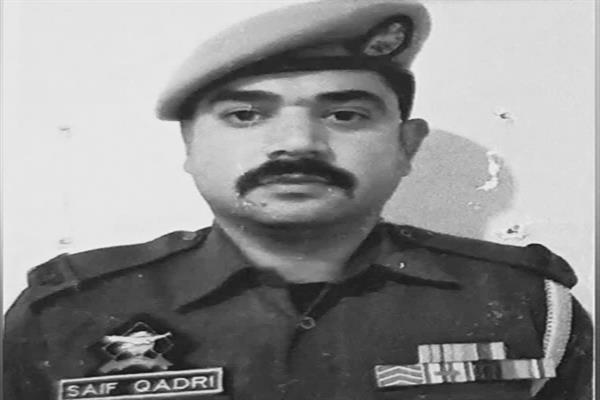
India’s bravest cop Saifullah was reflection of courage & compassion.
Srinagar :
It has been four days when terrorists shot dead a senior constable of Jammu and Kashmir Police, Saifullah Qadri in Soura locality, besides, injuring his 9 year old daughter, a number of people can still be seen visiting his shattered family and his graveyard.
As per the family, slain Qadri joined the Jammu and Kashmir Police services in 2012 and was a senior constable. He was deputed with police’s elite anti-terrorism unit Special Operations Group (SOG), whose headquarters is dubbed ‘Cargo’.
Qadri was killed when he was on his way to drop off his daughter at the tuition center. Both father and daughter were rushed to SKIMS medical facility however the former succumbed to his injuries.
The slain policeman’s brother, Mohammad Syed Qadri told Rising Kashmir that his brother was helpful to everyone in the locality. He was off duty when the incident took place.
Terming his killing as “cold-blooded murder”, Mohammed stated that his brother was hope for the family. He was innocent and was doing his work professionally, he added.
“Saifullah was humble and why was he killed? He was running a family of five. I do not know whom to question!” asked confused Mohammed.
His 9-year-old daughter identified as Safa Qadri, who is a Class 3rd student, also sustained a bullet injury during the attack.
However, her condition is stated to be stable and undergoing surgery at a hospital.
Another family member said Qadri had returned just two days before as he had left for New Delhi for some work. He was a brave and hardworking person.
Narrating the fateful incident, he said Qadri was home that time after her 9-year daughter compelled him to drop her at the tuition center.
“Once the duo stepped out of their house and they were attacked by two bike-borne gunmen. They first fired upon his daughter and then fired six bullets at him, leaving him critically injured. Later he succumbed to his injuries at a hospital,” he said.
The family member further added that his daughter had pleaded before the gunmen not to kill her father but they did not listen to her screams.
Qadri was born and brought up in Khawaja Bazar and then his family shifted to Khanyar. After his marriage, he purchased his new house in Soura, where he was living with his family.
The father of slain policeman, Muhammad Syed Qadri is still in utter shock and was not able to speak to anybody. He is being treated and gets unconscious every now and then.
Another relative, Mohammad Usman, who had come to console the bereaved family, says this family has seen tragedy in their entire life.
Usman said before their son, their two daughters had also died,” he said.“It is painful to see them. Why did they (gunmen) kill him? He had not killed or harmed anybody in his entire life. We have never seen him carrying a gun or pistol in his hand,” he said.“But his killing broke our back,” he said. “I don’t know what crime he had done to deserve a death like this!”
As per neighbors, Saifullah was a caring and compassionate character and at the same time touched many lives in a short time. He was an ideal son who was an “obedient, responsible, and loving” person.
The slain cop is survived by his wife, two daughters (one injured), and a son.
Condemning the killing, Lieutenant Governor Manoj Sinha had tweeted, “I strongly condemn the cowardly terror attack in Soura, Srinagar. I assure the people that those behind this despicable attack will not go unpunished.”
Earlier this week, Inspector General of Police, (IGP) Kashmir Vijay Kumar said the entire society including families of the terrorists should condemn the attacks on an unarmed policeman and her 09-year-old daughter. “We will soon identify the attackers and kill them. Terrorists have been attacking the unarmed policemen who are on leave. We pay our rich tributes to the slain for his supreme sacrifice and stand by his family at this crucial juncture, “the IGP said.
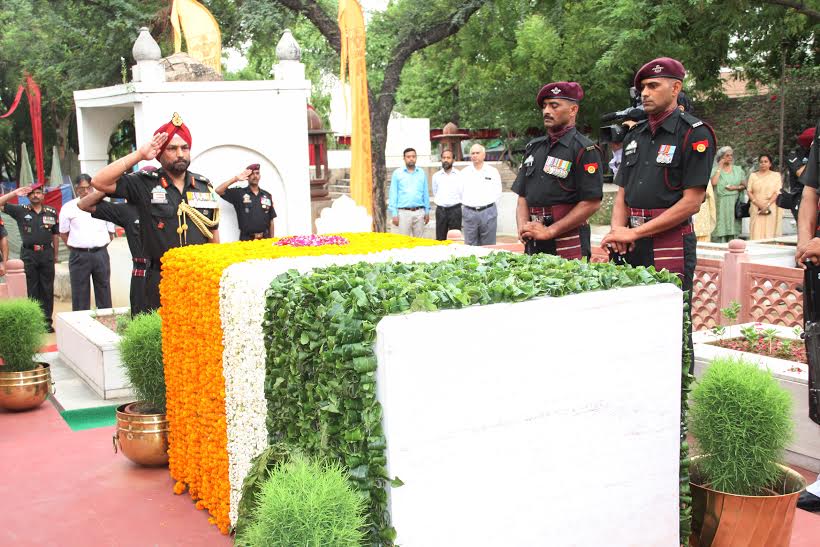
The wreath-laying ceremony of slain SgCt Saifullah Qadri was held at District Police Lines, Srinagar.
Civil, CAPFs and & Police officers led by IGP Kashmir Vijay Kumar laid floral wreaths on the mortal remains and paid rich tributes to the martyr for his supreme sacrifice in the line of duty.
source: http://www.risingkashmir.com / Rising Kashmir / Home / May 28th, 2022
A Wreath Laying Ceremony to commemorate the death anniversary of Brigadier Mohammad Usman, MVC (P) was organised at his Memorial in Jamia Millia Islamia (JMI) Cemetery on 03rd July 2023.
Several Retired and Serving officers including Lt Gen Pushpendra Singh, SM** Col of the PARA Regiment and DG OL & SM, Brig. Rajneesh Mohan Cdr 50 (I) PARA Bde, Lt. Gen Gurbir Pal Singh, AVSM, VSM, DG NCC Delhi, Lt. Gen Velayudhan Sreehari, AVSM, SC, SM, AG’s BR DG (MP&PS), Lt Gen Subriti S Dahiya, SM VSM, Comdt NDC and Maj Gen Prashant Srivastava, AVSM, SM, Addl MS (B) attended the function and paid their tributes by laying a wreath at the Memorial of Brig. M. Usman, MVC (P).
A wreath was also placed at the Memorial of Brig. M. Usman PVC (P) on behalf of JMI Vice Chancellor Prof. Najma Akhtar (Padma Shri), as her tribute to the memory of the gallant officer. NCC cadets and officers were also present to witness the solemn occasion and pay their respects.
Under Brig. Mohammad Usman, MVC (P) Para Brigade successfully defended the city of Naushera against Pakistani Tribal forces, and then valiantly recaptured the city of Jhangar.
Late Brigadier Mohammad Usman, also known as the savior of Naushera, was responsible for the recapture of Jhangar & Naushera (Jammu & Kashmir) during 1947- 48 war with Pakistan.
The gallant officer attained martyrdom on 03rd July 1948 when an enemy artillery shell landed close to him in Naushera.
source: http://www.jmi.ac.in / Jamia Millia Islamia – JMI / Home / by Public Relations Office / July 03rd, 2023


.webp)