Category Archives: Martyrs of the Nation

The Indian revolutionaries on foreign lands

INDIA:

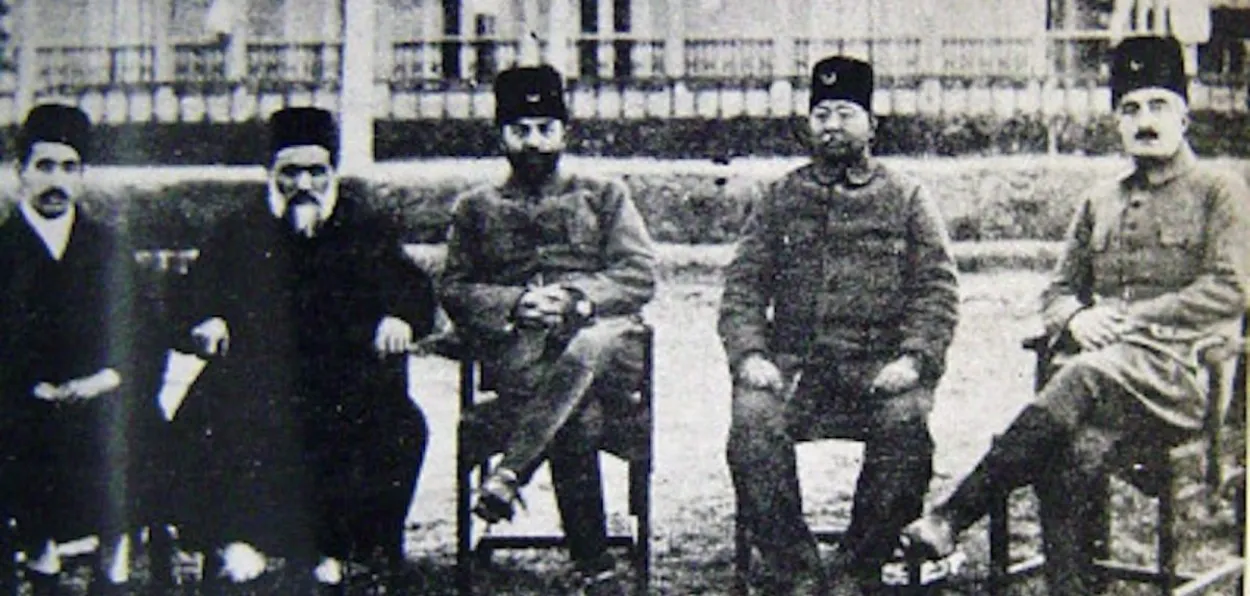
Indian revolutionaries in Kabul where they announced a government in exile

On 24 April 1918, Ram Chandra was shot dead by Ram Singh in a courtroom in San Francisco, USA. A few moments later, a policeman shot Ram Singh. Who were these Indians? Ram Chandra and Ram Singh were the leaders of a revolutionary Ghadar Party in the USA. They were planning to wage a war against the British Empire with the help of the German government. Ram Singh suspected Chandra of being a traitor and thus he killed him on the last day of the trial.

Though Muslims and Sikhs were also accused of being part of the conspiracy, for some reason the case was famously called the Hindu German Conspiracy case. The German High Commissioner had allegedly provided the revolutionaries with money and arms.

Rabindranath Tagore was also featured in the charge sheet. It was accused that he took money from the revolutionaries in the USA and handed it over to the Japanese government to arrange for arms. It was the costliest court case ever argued in the USA till that time.

Indian revolutionaries had always used foreign territories to wage war against the British Empire. In 1845, Haji Imdadullah Muhajir Makki of Saharanpur went on the Haj with a plan to stay there. He wanted to teach at Makkah. Another Indian and his senior Maulana Ishaq met him in Makkah and asked him to return to India and wage a war against the English East India Company rule. Ishaq was one of the many Indian ulemas, who lived in Makkah and Medina to preach anti-colonialism among the pilgrims.

Imdadullah returned to India, planned a revolt in coordination with several leaders, and joined the War of Independence in 1857. He liberated Shamli for a few weeks before the English recaptured it. Thousands of his followers were killed in the battle and he moved to Makkah.

Imdadullah lived for 30 more years and used Makkah as a base to preach nationalism among Haj pilgrims from India and create links among different colonized nationalities.

Shyamji Krishna Varma, an Arya Samaj leader, established India House in London to train educated revolutionaries for the freedom struggle. V.D. Savarkar, Virendranath Chattopadhyay, Haider Raza, Ali Khan, Bipin Chandra Pal, and Acharya were a few prominent Indian revolutionaries trained at this hostel. They were given fellowships to study in England. Asaf Ali, who later argued the case of Bhagat Singh in court, was also associated with the India House. Savarkar’s book describing events of 1857 S inspired a generation of revolutionaries.

Madan Lal Dhingra was one of the most prominent revolutionaries from this house. He assassinated an English official after which the house had to be closed down. Savarkar was arrested and sent to Andamans. After that, these revolutionaries shifted bases to Berlin, Paris, etc.

Indians, especially Punjabis, living in the USA formed the Ghadar Party in 1913. Ghadar is a term used for the War of Independence of 1857. The party aimed to re-enact the scenario by making the Indian sepoys of the English army rebel.

The revolutionaries contacted Germany and Turkey for money and arms. A date doe revolt was fixed in India for the revolt. Hundreds of the revolutionaries came back to India in 1915, Rash Behari Bose, Jatin Bagha, and M N Roy were also working for the success of the plan. A traitor told the British about the plan. Hundreds of revolutionaries were caught and hanged in what came to be known as First Lahore Conspiracy. Kartar Singh Sarabha was one of the more famous among those hanged. Jatin Bagha was killed. Ras Behari Bose and M N Roy had to leave the country.

The Ghadar Party succeeded in causing a mutiny in Singapore. In February 1915, Indian soldiers killed English officers and captured the island country. It took two days and the help of the Russian and Japanese armies to recapture Singapore from the British. More than four dozen Indians were killed by a firing squad in a public execution. At least 40 of the killed soldiers were Muslims from Haryana.

Raja Mahendra Pratap was an Arya Samaj activist from Hathras. As the war started he travelled to Turkey and Germany where the Sultan and Kaiser respectively gave him letters of authority to form a provisional government of India at Kabul. He reached Afghanistan with a Ghadarite, Barkatullah, where Maulana Ubaidullah Sindhi, a Deobandi scholar, was waiting for them. A provisional government with Pratap as the President, Barkatullah as the PM, and Ubaidullah as the Home Minister was formed in Kabul.

A plan to raise an army was also chalked out. Maulana Mahmood Hasan, a Deobandi scholar, and Maulana Husain Ahmad Madani were coordinating the efforts from Makkah. Letters written on silk cloth were used to communicate which were uncovered by British intelligence. Maulana Mahmood and Madani were arrested from Makkah and sent to Malta as prisoners of war. Hundreds of others were also arrested in what came to be known as the Silk Letter Conspiracy.

The war had ended. M. N Roy, Andul Rab, and MPT Acharya established a military school in Tashkent in the USSR. It trained mostly Muslims who migrated to Afghanistan after a fatwa asked them to in 1915. The people trained here took part in major revolutionary activities in India later on. Mian Akbar Shah is well known for his role in the famous escape of Netaji Subhas Chandra Bose from Kolkata (Calcutta) to Peshawar. He is supposed to be the most important person to have planned and executed the escape in 1941.

Ubaidullah went to the USSR and traveled to several countries before settling at Makkah in the 1930s. He used it as a ground to preach like Maulana Ishaq and Imdadullah before him. In 1938 he returned to India and met Netaji Subhas Chandra Bose. He planned future armed action with Netaji and gave him several contacts with Japan and Germany. Japan already had his old comrades in Raja Mahendra Pratap and Rash Behari Bose.

Around the same time Sardar Ajit Singh, an uncle of Bhagat Singh, and Iqbal Shaidai organized an army in Italy. They had been active in foreign lands since the last World War.

The story of Netaji forming an army in Germany and later leading Azad Hind Fauj formed by Ras Behari Bose in Japan is well-known and needs no retelling.

source: http://www.awazthevoice.in / Awaz, The Voice / Home> Stories / by Saquib Salim / August 11th, 2023
Daredevil Saifullah

Soura (Srinagar District), JAMMU & KASHMIR:

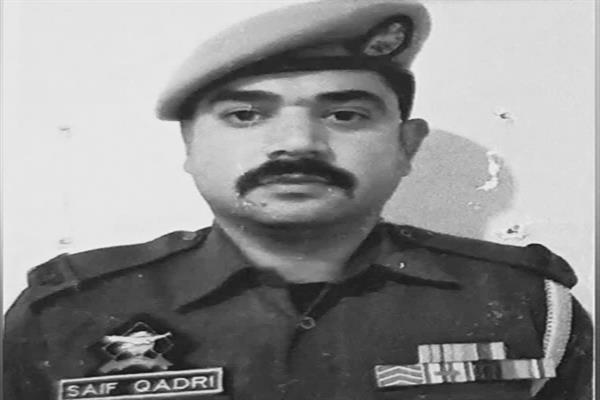
India’s bravest cop Saifullah was reflection of courage & compassion.

Srinagar : 

It has been four days when terrorists shot dead a senior constable of Jammu and Kashmir Police, Saifullah Qadri in Soura locality, besides, injuring  his 9 year old daughter, a number of people can still be seen visiting his shattered family and his graveyard.

As per the family, slain Qadri joined the Jammu and Kashmir Police services in 2012 and was a senior constable.  He was deputed with police’s elite anti-terrorism unit Special Operations Group (SOG), whose headquarters is dubbed ‘Cargo’.

Qadri was killed when he was on his way to drop off his daughter at the tuition center. Both father and daughter were rushed to SKIMS medical facility however the former succumbed to his injuries.

The slain policeman’s brother, Mohammad Syed Qadri told Rising Kashmir that his brother was helpful to everyone in the locality. He was off duty when the incident took place.

Terming his killing as “cold-blooded murder”, Mohammed stated that his brother was hope for the family. He was innocent and was doing his work professionally, he added.

“Saifullah was humble and why was he killed? He was running a family of five. I do not know whom to question!” asked confused Mohammed.

His 9-year-old daughter identified as Safa Qadri, who is a Class 3rd student, also sustained a bullet injury during the attack.

However, her condition is stated to be stable and undergoing surgery at a hospital.

Another family member said Qadri had returned just two days before as he had left for New Delhi for some work. He was a brave and hardworking person.  

Narrating the fateful incident, he said Qadri was home that time after her 9-year daughter compelled him to drop her at the tuition center.

“Once the duo stepped out of their house and they were attacked by two bike-borne gunmen. They first fired upon his daughter and then fired six bullets at him, leaving him critically injured. Later he succumbed to his injuries at a hospital,” he said.

The family member further added that his daughter had pleaded before the gunmen not to kill her father but they did not listen to her screams.

Qadri was born and brought up in Khawaja Bazar and then his family shifted to Khanyar. After his marriage, he purchased his new house in Soura, where he was living with his family.

The father of slain policeman, Muhammad Syed Qadri is still in utter shock and was not able to speak to anybody.  He is being treated and gets unconscious every now and then.

Another relative, Mohammad Usman, who had come to console the bereaved family, says this family has seen tragedy in their entire life.

Usman said before their son, their two daughters had also died,” he said.“It is painful to see them. Why did they (gunmen) kill him? He had not killed or harmed anybody in his entire life. We have never seen him carrying a gun or pistol in his hand,” he said.“But his killing broke our back,” he said. “I don’t know what crime he had done to deserve a death like this!”

As per neighbors,  Saifullah was a caring and compassionate character and at the same time touched many lives in a short time. He was an ideal son who was an “obedient, responsible, and loving” person.

The slain cop is survived by his wife, two daughters (one injured), and a son.

Condemning the killing, Lieutenant Governor Manoj Sinha had tweeted, “I strongly condemn the cowardly terror attack in Soura, Srinagar. I assure the people that those behind this despicable attack will not go unpunished.” 

Earlier this week, Inspector General of Police, (IGP) Kashmir Vijay Kumar said the entire society including families of the terrorists should condemn the attacks on an unarmed policeman and her 09-year-old daughter. “We will soon identify the attackers and kill them. Terrorists have been attacking the unarmed policemen who are on leave. We pay our rich tributes to the slain for his supreme sacrifice and stand by his family at this crucial juncture, “the IGP said.

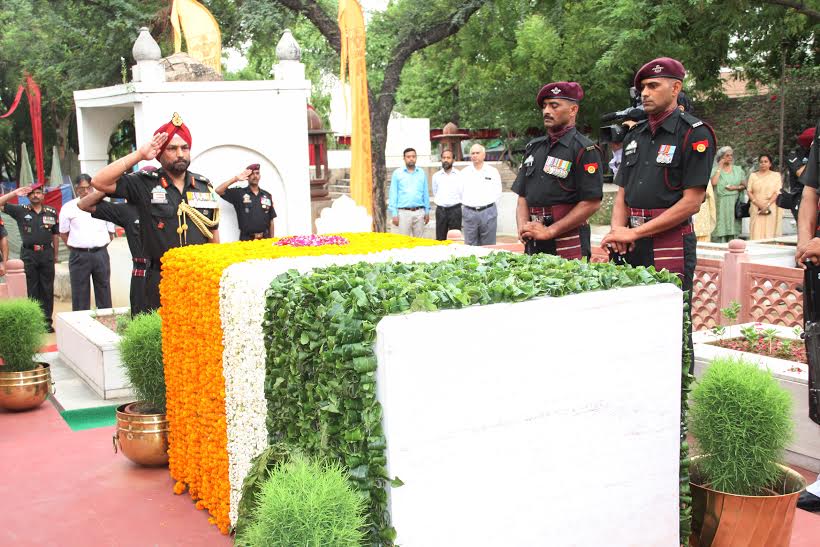
The wreath-laying ceremony of slain SgCt Saifullah Qadri was held at District Police Lines, Srinagar.

Civil, CAPFs and & Police officers led by IGP Kashmir Vijay Kumar laid floral wreaths on the mortal remains and paid rich tributes to the martyr for his supreme sacrifice in the line of duty.

source: http://www.risingkashmir.com / Rising Kashmir / Home / May 28th, 2022

Wreath laying ceremony to commemorate death anniversary of Brigadier M. Usman, MVC (P), July 03rd

INDIA:

A Wreath Laying Ceremony to commemorate the death anniversary of Brigadier Mohammad Usman, MVC (P) was organised at his Memorial in Jamia Millia Islamia (JMI) Cemetery on 03rd July 2023.

 Wreath laying ceremony of late Brig Mohd Usman held


Several Retired and Serving officers including Lt Gen Pushpendra Singh, SM** Col of the PARA Regiment and DG OL & SM, Brig. Rajneesh Mohan Cdr 50 (I) PARA Bde, Lt. Gen Gurbir Pal Singh, AVSM, VSM, DG NCC Delhi, Lt. Gen Velayudhan Sreehari, AVSM, SC, SM, AG’s BR DG (MP&PS), Lt Gen Subriti S Dahiya, SM VSM, Comdt NDC and Maj Gen Prashant Srivastava, AVSM, SM, Addl MS (B) attended the function and paid their
tributes by laying a wreath at the Memorial of Brig. M. Usman, MVC (P).


A wreath was also placed at the Memorial of Brig. M. Usman PVC (P) on behalf of JMI Vice Chancellor Prof. Najma Akhtar (Padma Shri), as her tribute to the memory of the gallant officer. NCC cadets and officers were also present to witness the solemn occasion and pay their respects.

Jamia Millia Islamia (NAAC A++ Grade Central Univ) on Twitter: "A wreath  laying ceremony to commemorate the death anniversary of Late Brigadier M.  Usman, MVC was organised today by a contingent from


Under Brig. Mohammad Usman, MVC (P) Para Brigade successfully defended the city of Naushera against Pakistani Tribal forces, and then valiantly recaptured the city of Jhangar.

Late Brigadier Mohammad Usman, also known as the savior of Naushera, was responsible for the recapture of Jhangar & Naushera (Jammu & Kashmir) during 1947- 48 war with Pakistan.

The gallant officer attained martyrdom on 03rd July 1948 when an
enemy artillery shell landed close to him in Naushera.

source: http://www.jmi.ac.in / Jamia Millia Islamia – JMI / Home / by Public Relations Office / July 03rd, 2023

Forgotten role of Saudi Arabia in the Indian Freedom Struggle

SAUDI ARABIA / INDIA:

Maulana Obdaiullah Sindhi (Second from left) in Turkey

It’s a little-known fact that Saudi Arabia played an important role in the Indian Freedom Struggle. This country was the only one outside British India to provide support to the Indian revolutionaries during the 150 years of freedom struggle.

At the outset of the Second World War, Netaji Subhas Chandra Bose planned to send his men for Haj, and under that cover, they were to recruit anti-British people in Azad Hind Fauj. At that time Indian revolutionaries were operating from Hejaz (now Saudi Arabia).

Before announcing his fight against the British during World War II, Bose met Maulana Ubaidullah Sindhi in 1939. Sindhi was an Indian revolutionary who had formed a Free India Government in exile with Raja Mahendra Pratap and Barkatullah at Kabul in 1915. After World War I he toured countries like Russia, Germany, Italy, etc to create an alliance for the next war of Indian independence. In the 1930s, Sindhi settled down at Makkah after being granted asylum. However, British intelligence alleged that he was preaching Indian Nationalism among Muslim pilgrims visiting the holy city.

A grand plan was prepared at Makkah. The city provided one of the best communication channels to other parts of the world because of Haj. Sindhi returned to India in 1938. According to a letter written by Maulana Abul Kalam Azad to Maulvi Zahirul Haque, Sindhi had told him that he wanted to send Bose abroad for a final battle against the British. Azad wrote that Bose and Sindhi met in Delhi to talk about the future of the Indian Freedom Struggle. They again met in Calcutta (Kolkata) after a few months. Ubaidullah handed over important letters of reference and documents to be given to the Japanese authorities.

Sindhi wasn’t the first Indian revolutionary to use Saudi as his ground of action. The government he formed in 1915 in Kabul was part of a larger plan known as the Silk Letter Movement. This was a collaboration of Ulema, Ghadarites, Bengali revolutionaries, and others to free India by an armed revolution. The leader of the movement was Maulana Mahmood Hasan. He was arrested in 1916 from Hejaz along with  Maulana Husain Ahmad Madani, Anzer Gul, Wahid Ahmad, Hakim Nasrat Husain, and others.

Hasan and Madani were teaching at Makkah and Medina and also influencing pilgrims. They were sent to Malta as Prisoners of War because the British believed,  “if they were kept in confinement in the Hedjaz for a long period they might become interesting and exciting objects of pilgrimage or schemes for help or rescue to many fanatical Muhammadans in India and Afghanistan”.

Maulana Mahmood Hasan, the head of Darul Uloom, Deoband, was also a member of this group. Deoband considers Haji Imdadullah as its spiritual head; Imdadullah’s disciples founded the Madrasa at Deoband after 1857 to prepare revolutionaries.

Imdadullah went for Haj in 1845, where another Indian Shah Muhammad Ishaq directed him to fight the British. Imdadullah wrote, “The conditions of India are not hidden as India is my motherland” and returned to India in 1846. In the districts of Muzaffarnagar, Saharanpur, and Shamli, he started raising an army with the help of his students like Hafiz Muhammad Zamin, Maulana Qasim Nanautvi, Maulana Rashid Ahmad Gangohi, Maulana Mazahar, Maulana Munir Nanautvi.

This army led by Imdadullah fought the British forces in 1857 and liberated Shamli. A civil government governed the town for a few days before the British recaptured it. Thousands of people were killed, and Imdadullah took refuge in Makkah. He reached Makkah in 1859 and used it as a ground to preach anti-colonial ideas among the pilgrims.

Why did Ishaq, who lived in Makkah, ask Imdadullah to fight for Indian independence? In 1821, Syed Ahmad Shahid undertook a journey to Makkah and Medina. He was an Islamic scholar and soldier in Maratha forces. When Marathas signed a treaty with the British, Syed left their army and left for Makkah with a group of people. On his return from Haj, he attained martyrdom while fighting the British.

In the 1920s, 30s, and 40s, British intelligence raised several alarms with the Saudi authority to check Indian revolutionaries in Makkah, Medina, and Jeddah. Indian revolutionaries in the name of Haj visited Saudi Arabia to meet each other freely. British intelligence kept an eye on them. Memoirs of all these revolutionaries show that the local Arabs fully supported their cause and mission.

source: http://www.awazthevoice.com / Awaz, The Voice / Home> Stories / by Saquib Salim / July 10th, 2023

Mumbai Dock worker’s son among 04 from HCoI Coaching cleared UPSC exams

Mumbai, MAHARASHTRA :

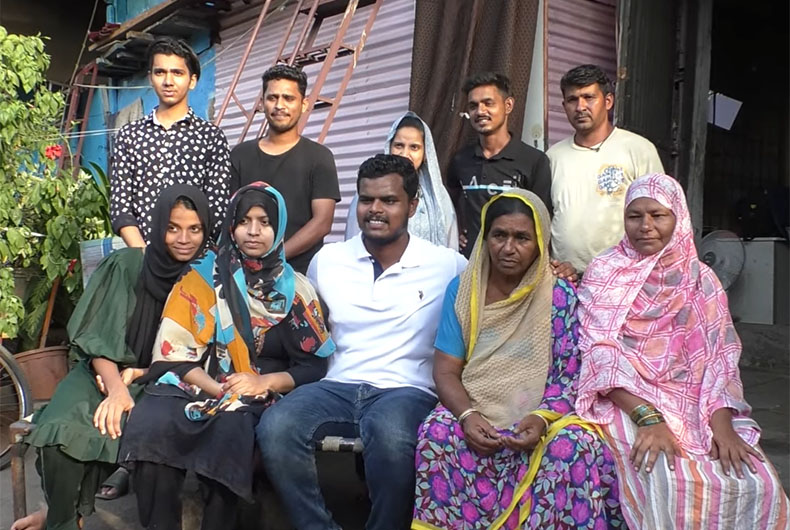
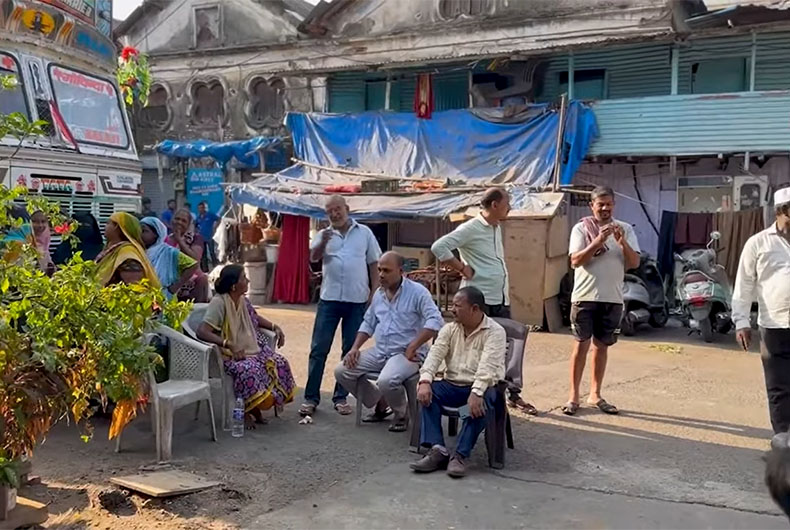
Syed Mohammed Husain lives at the Wadi Bunder slums in Mumbai with his extended family, which includes his maternal grandmother, parents, elder brothers, and their wives and children.

UPSC Civil Services 2022 Toppers: 

A total of 04 students of Haj Committee of India (HCoI) Coaching Centre, including Mumbai Dock worker’s son Sayed Mohammed Husain, have cleared the 2022 UPSC Civil Services Exams the result of which was declared Tuesday.

Syed Mohammed Husain lives at the Wadi Bunder slums in Mumbai with his extended family, which includes his maternal grandmother, parents, elder brothers, and their wives and children.

Hussain’s father started as a labourer loading and unloading goods from trucks at the dockyard and went on to become a supervisor. Tuesday however brought the family the moment they were waiting for since the last five years.

It was when Husain cleared the UPSC 2022 Civil Services exams in his 5th attempt and secured 570th rank.

“The last failure really broke me. I spent a lot of time in a mosque contemplating about my situation and came out resolved to give it another shot,” Hussain said while talking to reporters after his success in the coveted Civil Services exams.

Road to Civil Services

Syed Husain obtained school education till 7th at Khoja Isna Asheri Jamaat School in Dongri, and later took admission in St Joseph High School to clear SSC board exams. After completing graduation in Commerce from Mumbai’s Elphinstone College, he started preparing for the civil services exams.

Besides taking help from various coaching classes in Pune and Delhi, Husain is also a beneficiary of the Haj Committee of India Residential Coaching Centre.

Others from HCoI Civil Services Coaching Classes who cleared this year’s Civil Services exams are Qazi Ayesha Ibrahim (Rank 586), Taskeen Khan (Rank 736) and Md Burhan Zaman (Rank 768).

Ayesha Qazi

In total contrast to Husain, Ayesha Qazi is a daughter of a businessman, and belongs to a well to do family residing in Kalwa, Thane area of Mumbai Suburbs.

Ayesha completed her SSC from JVM New English School and later passed HSC exams from Abdullah Patel Junior College, Mumbra. She started preparing for the Civil Services Exams in 2019 after graduation in Arts from Joshi Bedekar College, Thane.

The UPSC announced the final result of Civil Services Exams Tuesday, and recommended a total of 933 candidates from different parts of India for IAS, IPS, IFS, IRS and other Civil Services Posts.

Among the 933 candidates who cleared this year’s CSE a total of 30 are Muslims.

source: http://www.ummid.com / Ummid.com / Home> India> Education & Career / Zohair M. Safwan, ummid.com / May 24th, 2023

Karnataka: Harihar soldier dies during firing practice in Pokharan

Harihar (Davangere District), KARNATAKA:

A soldier of the Indian Army from Harihar died during a demolition firing in Pokhran in Rajasthan on Monday.

Javed

Bengaluru / Davangere :

A soldier of the Indian Army from Harihar died during a demolition firing in Pokhran in Rajasthan on Monday. The body is expected to reach Bengaluru on Wednesday.

According to defence sources, the soldier is identified as Javed (33), a resident of PB Road area in Harihar in Davangere district. He was attached to an engineer regiment of the Indian Army located at Secunderabad. Javed who had been serving the Army for 14 years is survived by his wife and two children.

Lt Col Manish Ojha, Defence spokesperson, Rajasthan said, “During the demolition firing being conducted in Pokhran by an engineer regiment of the Indian Army  as part of its annual training firing practice, a shaped charge exploded accidentally, resulting in the death of one soldier and injuring four others.” All injured were evacuated by air to Military Hospital in Jodhpur. An inquiry has been ordered to ascertain the exact cause of the accident, he added.

Javed was the second son of Abdul Khader Sab and Fathima Bi. He studied at MRB school at Harihar and did his second PU at SJVP College in Harihar. Soon after completing PU, he joined the Army in 2005 and later completed his BCom through distance education while in service. Javed had married Sartaz Bhanu in 2013 and had two daughters — Ameena Kaiser (3) and Umme Javera Aiyath (18 months), family sources said.

Javed used to talk to his mother over the phone daily and had called her on Monday morning. On Monday afternoon, he had informed his wife that he was going to attend a training at Pokhran, family sources said. The body is expected to arrive from Jodhpur to Bengaluru on Wednesday and reach Harihar late night. Final rites will be performed at Harihar on Thursday, source said.

source: http://www.newindianexpress.com / The New Indian Express / Home> States> Karnataka / by Express News Service / February 14th, 2018

The Freedom Fighter and Labour Leader Abdul Bari Still Beloved in Jamshedpur

Shahbad District / Patna, BIHAR :

This May Day, remembering Abdul Bari.

Abdul Bari.

Abdul Bari is not a name that many Indians remember, but Munawwar, a committee member of the Tata Motor Workers’ Union in Jamshedpur, Jharkhand, holds the name in high esteem.

“I don’t see a leader like Abdul Bari [coming up] in the near future,” he said. “It is because of his efforts that we still get high tea at just six paisa.”

“Once, Bari went to the Tatas and he was offered tea. He asked them to first offer it to the workers, and then made an agreement which is still benefitting us. Upmaaloo chaapsamosa all for six paisa in the company’s canteens.”

Asked how they pay six paisa when currency that small no longer exists, he says, “We get token of Rs 2 or more and keep using it for weeks.”

Munawwar visits Bari’s grave every year on March 28, the death anniversary of the pre-independence labour leader, to offer flowers. This duty, he says, was assigned to him by the Tatas.

Thinking of labour in the days of capital

Despite the large numbers of workers who struggle to earn a square meal a day, major political parties remain hostile towards them. In the 55-page Congress manifesto, the words ‘worker’ or ‘workers’ appear 15 times; in the BJP’s 45-page manifesto, the words appears only five times – four while referring to Asha and anganwadi workers. ‘Labour’ figures 21 times in the Congress manifesto, and only twice in the BJP’s.

The Congress does talk about ending the workers’ exploitation and improving working conditions. The party’s manifesto details new schemes and promises to implement old ones related to organised, unorganised and contractual labour. But it is anyone’s guess how schemes that have been on hold for so long will suddenly spring to life.

Dilip Simeon, a founding member of the Association of Indian Labour Historians and former professor of history at Ramjas College, says that nobody talks about labour now because “in today’s context, the labour movement is influenced by communal sentiments”.

“If labour is with the BMS [Bharatiya Mazdoor Sangh] and Shiv Sena, then this is the weakness of the movement; if the labour movement wants to regain its power, then it has to face this challenge.”

Before independence, Simeon says, regardless of community, “leaders came together to advance the struggle of workers in India. Abdul Bari, Maneck Homi and Hazara Singh were their leaders. A Muslim, a Parsi and a Sikh could all be leaders of a workers’ movement.”

“Abdul Bari was so trusted that workers would start their protest first and then ask –what’s our demand?”

Bari was born in 1882, in Bihar’s Shahabad district. He was a student at Patna University in 1919 and was later appointed as a professor of history there, before he started studying law.

He quit to join the Khilafat movement, and actively participated in Gandhi’s civil disobedience movement and salt satyagraha. Bari did not restrict himself to the cause of one social group; he supported several political parties, including the Socialist Party and Swaraj Party, in parallel with the Congress. In addition, he was the voice of the labour movement in India and president of the Jamshedpur Tata Workers’ Union.

What Gandhi said about Bari

The journalist Afroz Alam Sahil has written a book on Abdul Bari, Professor Abdul Bari: Azaadi ki Ladaai Ka Ek Krantikaari Yodhha (Professor Abdul Bari: A Revolutionary Warrior of the Freedom Struggle). The author reveals several stories which won’t be found Indian history books. One such story is around Bari’s mysterious murder, and Gandhi’s reaction to it.

According to a report published by the Times of India on March 31, 1947, Bari was shot dead in the evening of March 28 while on his way home from Khushrupur, 24 miles from Patna. He was then the president of the Bihar Provincial Congress Committee. Following his death, a complete strike was observed, and Tata closed all its plants except essential ones.

Gandhi, in a speech on March 29, 1947, mentioned that he was struck by Bari’s simplicity and honesty. Gandhi added that he was planning to be more closely associated with Bari, and make an appeal to keep his short temper in check as it was not befitting of the highest office in Bihar. Gandhi referred to Bari in the same speech as “a very brave man with the heart of a fakir”. He declared that Bari’s death was the result of an altercation that had ensued between Bari and one Gurkha member of the anti-smuggling force, who was a former member of the Indian National Army.

The author mentions in this book that Bihar’s first Prime Minister (Premium) Barrister Muhammad Yunus had disclosed in an interview to the Orient Press of India that Bari had threatened to disclose the names of some prominent Congress leaders who were involved in the Bihar carnage – just three days before he was killed.

Yunus also said that Gandhi’s statement was given in haste. In his speech, Gandhi had told the audience that there was no politics of any kind in the death, and that it would be unjustified to associate the whole Indian National Army with Bari’s killing just because of one man’s actions.

In another incident discussed in the book, Gandhi arrives at Fatuaha station near Patna in the early morning of March 5, 1947. He travelled from Calcutta to Patna. Bari, chief minister Srikrishna Sinha and others welcomed him on the platform. As soon as Gandhi saw Bari, he laughed and said, “How is it that you are still alive?”

“This book is an attempt at bringing back his identity not just as a leader of the labour movement but a prominent leader of the freedom struggle of India,” the author says. “Professor Bari was one of the biggest leaders of the labour struggle in India. But limiting his role to even that would be unjust, because he was present in every chapter of the independence movement….The speciality of Abdul Bari is that he questioned his own party Congress when it came to the rights of workers.”

In a speech, Bari said, “We are in Congress to serve the poor of this country not to respect Gandhi, Rajendra Babu and Shri Krishna Babu…Lakhs of Indians who walk with them are not there to make them kings but to achieve freedom for this country.”

According to Sahil, “He criticised Gandhi and Rajendra Prasad many times because he was wholeheartedly committed to this struggle. He wanted to organise an all India conference for workers. He had formed the All India Mazdoor Sevak Sangh. He mentioned this in a letter written by him to Sardar Vallabh Bhai Patel on 22 June 1946.”

Why commemorate leaders like Bari today? Sahil has the answer. “Today when Muslim youth talk about Muslim representation, they must read more about Bari, the symbol of Hindu-Muslim unity, in order to understand their own political history and determine how it influences their future.”

Afshan Khan is a Delhi-based freelance journalist.

source: http://www.thewire.in / The Wire / Home> Analysis> Labour / by Afshan Syed (headline edited) / May 01st, 2019

Jallianwala Bagh: A symbol of Muslim, Hindu, Sikh Unity

Jallianwala Bagh, (Amritsar), PUNJAB:

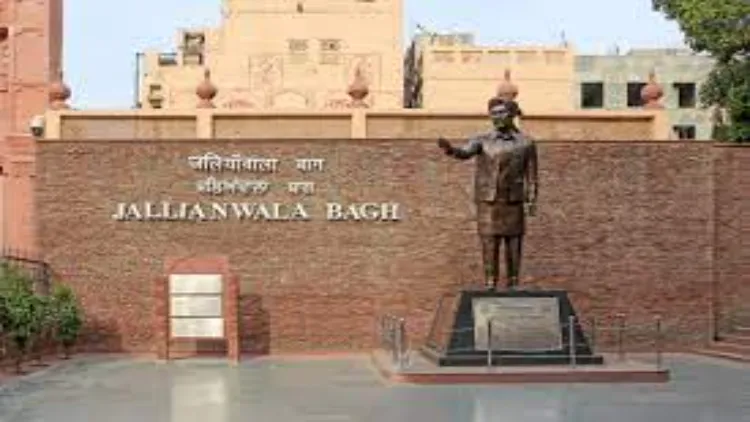
Jalianwala Bagh
Jalianwala Bagh

In popular memory, historical narratives are more often than not laced with silence, neglect, nostalgia and heroism thus blurring the line between history and fiction. Public memory tends to remember the selective events according to ideological or political conveniences while the whole narrative in its context is often forgotten.

The Jallianwala Bagh Massacre is one such event which stands out in public memory as a solitary incident. Popular imagination puts the killing of hundreds of Indians on 13th April, 1919 at Amritsar as an event completely disassociated from time and space. It is needed that the massacre should be read in context with the time and space.

Why did the people gather at Jallianwala Bagh?

Indian leadership in general supported the war efforts of the British during the World War – I (WWI) on a promise that the country would be granted self rule or some kind of political autonomy after the war would be over. The British, after the war, backtracked on the promise. Rather to check the nationalist voices brought a Rowlett Act in force which enabled police to imprison Indians without evidence. Several Indian Muslims were aggrieved at the humiliation of Turkey and the British believed that it was their only challenge. With the Rowlett Act at their disposal these Pro-Khilafat voices could be easily suppressed. They did not foresee the possibility of Hindus joining hands with the Muslims, and vice versa and pose a problem for their colonial rule.

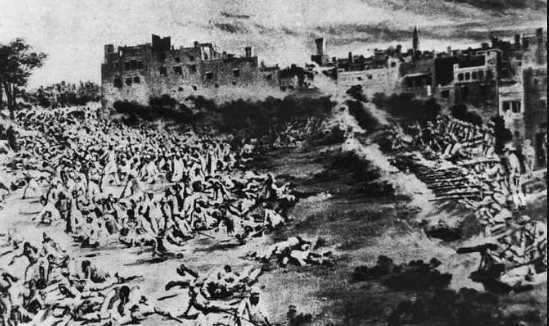
An artist’s depiction of the scene of massacre

On 18th March, 1919, the Rowlett Act was passed. Mahatma Gandhi along with other nationalist leaders termed it a Black Act and called for a protest movement against the same. The day chosen for protests and strikes was the 30th March that was later changed to 6th April. In Delhi a protest was held on 30th, because of lack of communication, and the police did not hesitate from firing upon the unarmed people. More than 50 protestors were killed in Delhi. The British had cleared their intention of using violence against the non-violent protesters.

On 6th April protests and strikes were held across the country, yet Punjab displayed an exemplary zeal of nationalism. What disturbed the British most was the fact that orthodox Hindus of Arya Samaj and orthodox Muslims of different Wahabi and pan-Islamist organizations joined hands against the British. The most popular leaders of Punjab at the time – Dr. Saifuddin Kitchlew and Dr. Satyapal, were prohibited from making public statements but still unity could not be broken. At different places people were fired upon but the nationalist sentiments could not be killed.

On April 9, Muslims came out to celebrate Ram Navami across Punjab. This was becoming too much for the British. In Amritsar Saifuddin and Satyapal oversaw a grand Ram Navami procession where Muslims were as zealous as Hindus were. It led the British to arrest the two leaders and sent them to an unknown location. The people gathered at the Deputy Commissioner’s office to register their protest and they were fired upon. Many were killed. The fear of a Hindu-Muslim unity was so frightening for the British that even after Jallianwala Massacre they arrested and killed Muslims for participating in Ram Navami celebrations.

Ghulam Jilani, who was an Imam of a mosque, was arrested on 16th April with Khair Din for leading the Ram Navmi processions. Police tortured them in the most horrific and inhuman fashion by inserting sticks up in their anus until their excreta and urine would not come out. Khair Din died of the torture while Jilani survived to narrate the ordeal. More than a hundred Muslims were tortured in this manner to celebrate Ram Navmi. 

On the other hand in Lahore, on receiving this news, in an unprecedented manner more than 25,000 Hindus and Muslims gathered in Badshahi Mosque and Hindu leaders, like Rambhaj Datta, addressed the people from the pulpit of the mosque. In Lahore, not only the British used bullets but also brought their loyalists into the picture.

A few sold out Indians like the leaders of Muslims League issued statements that allowing Hindus into the mosque and addressing from pulpit amounted to the sacrilege. Still, most of the Muslims in Punjab were supporting the war cry of the protestors: Hindu-Musalman ki Jai (Victory to Hindu-Muslims).

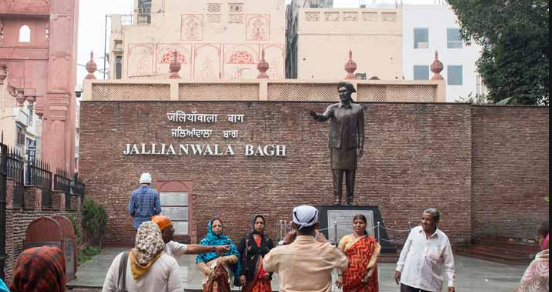
Visitors clicking pictures at Jallianwala Bagh

It was noted in a government report tabled at the British Parliament, “It (Hindu-Muslim) union had only one purpose, a combined attack on the government.”

Meanwhile, on 13 April, the Baisakhi Day, a meeting was scheduled at Jallianwala Bagh, near Golden Temple, to protest the arrests of Saifuddin and Satyapal. Hindus, Muslims and Sikhs gathered at the Bagh. Colonel Dyer with his troops entered the place and fired upon the unarmed protesters. A gory story of blood, death and massacre happened that each and every Indian knows by heart. Hundreds of Indians died. The tale of this massacre became folklore and inspired generations of revolutionary Indians like Bhagat Singh, Ram Mohammad Singh Azad and others. But, what we miss out is that the British did not stop at this. Punjab remained a laboratory of British atrocities.

The next day, April 14, people in Gujranwala woke up to find a beheaded calf at a public place. It did not take a rocket science to decipher a sinister plot to cause enmity between Hindus and Muslims. People gathered and protested such malicious attempts of the government to disturb the peace. Frustrated at their failed attempt and seeing that the unity has strengthened even further, army airplanes were called in to bomb the city. Yes, you are reading it correctly.

Within two decades of the invention of aero planes and less than a decade of its first military use in WWI when the technology was novel even for armies the British used it upon the innocent civilians of Punjab. A fleet of three planes dropped bombs and fired machine guns on the city and adjacent rural areas. Bombs were dropped at schools, hostels, mosques, marriage ceremonies etc. The government report specifically mentioned that the district is dangerous because followers of Arya Samaj and orthodox Muslim Wahabis like Fazal Ilahi and Zafar Ali Khan had joined hands. An armoured train with machine guns mounted in it was also used to kill along the railway tracks in Gujranwala.

The tales of torture, suppression and killings was repeated allover Punjab. While Jallianwala Bagh rightly gets its mention in our books and survived the public memory the causes behind it and a long trail of violence proceeding and succeeding the event have been forgotten. The very fact that the British used their worst form of violence to counter Hindu-Muslim unity itself speaks about the power of this unity. We need to remember the cause for which our forefathers and foremothers had laid down their lives.

(Saquib Salim is a historian-writer)

source: http://www.awazthevoice.in / Awaz, The Voice / Home> Story / by Saquib Salim / 2021

Shaukat of INA liberated Manipur on 14 April, 1944

Moirang (Manipur), ASSAM:

INA memorial at Moirang, Manipur

“The Indian National Army (INA) has now crossed the Indo-Burmese border and in the course of the struggle for the liberation of the people of India from the British Yoke, we have now reached Moirang, the ancient citadel of Manipur. Our commitment is the march to Delhi and the unfurling of the Tricolour Flag then at Lal Quila.

Many had died on our way to reach near Moirang and many would die on our way to Delhi. However, the expulsion of the enemy from the sacred soil of India is a compulsion for us… Freedom of India is very near and near at hand. We shall win it and we shall have progress and prosperity of the people of India after it.” Colonel Shaukat Ali Malik of Azad Hind Fauj addressed these words to a large gathering at Moirang in Manipur on 14 April 1944 after hoisting the National Tricolour. In this way, Moirang became the first liberated territory of India, which came under the administration of Azad Hind Sarkar headed by Netaji Subhas Chandra Bose. 

Col. Malik led INA’s victory march over Moirang, liberated the Indian territory, unfurled the national flag, and established a national government.

In his recently published book, Professor Kapil Kumar wrote, “Col. Malik while commanding the Unit, always led from the front and displayed Great feats of Bravery in difficulties achieving successes at various places. Netaji conferred upon him the great honour of Tamgha-e-Sardar-e-Jang.”

Kumar also lists several Indians from Manipur who joined INA forces. Prominent among them were Mairembam Koireng Singh, who later became CM of Manipur, and Naqi Ahmed Chaudhary, an INA soldier from Manipur who helped Col. Malik with the local language and terrain.  

But, the importance of this operation goes beyond the hoisting of the flag and establishment of civilian government. 

In the official newsletter of Azad Hind Fauj, Dr. M. R. Vyas one of the most trusted men of Netaji explained the importance of the victory of Moirang. He wrote, “When the INA first entered India, it appeared as if they would launch a direct assault on Imphal, the capital of Manipur. The British, in this expectation, concentrated powerful forces, consisting of 3 divisions and 2 motorized brigades at Imphal. However, the INA troops avoided any such frontal attack which would necessarily have meant big losses. Instead, the Indian and the Japanese High Command planned for the rendering impotent of a powerful enemy force by encircling it.” 

So, the capture of Moirang “brought about the virtual encirclement of Imphal, thus rendering an entire British force of 60,000 – 80,000 men impotent of launching a major counter-offensive. This force became dependent on air supplies, which, from their very nature, are limited and insufficient for big operations.” 

The plan was to further annihilate this British force with the onset of Monsoons. For more than two months, INA under Col. Malik remained in total control and kept attacking the British posts from there. The British would have faced a humiliating defeat if US Air Force wouldn’t come to their rescue. 

More than 100 US fighter planes bombed Moirang and Bishnupur in Manipur. Fleets of B-25, P-51, and A-31 started bombing INA positions and civilians on 8 May 1944. Hundreds of these US fighter planes bombed civilian areas, INA positions, bridges connecting Myanmar to Manipur, and any supply line available to the Indians. The scale of US operations in Moirang is a testimony to the importance of this victory. 

source: http://www.awazthevoice.in / Awaz, The Voice / Home> Stories / by Saquib Salim / April 14th, 2023

Moulvi Syed Allavuddin: Hyderabad’s unsung hero of Indian freedom struggle

Hyderabad / British India:

Moulvi Allavuddin was sent to cellular jail in Andaman on June 28, 1859.

Moulvi Syed Allavuddin

Moulvi Syed Allavuddin who was a spiritual leader used to exhort the people of Nizam State, one of the strongest princely states of South India, to rebel against the British hegemony. He stood at the forefront of the direct fight against the British Government.

Moulvi Syed Allavuddin was a native of Hyderabad, the capital of the erstwhile Nizam princely state. He intensified his rebellious activities soon after the First war of Independence of India was started in 1857. 

A  rebellion started in Aurangabad which was part of Nizam State. The rebels who took part in the revolutionary activities in Aurangabad, escaped arrest and came to Hyderabad. They were arrested by the Nizam state police and kept in jail. The people and prominent citizens of Nizam state were angry when  Nizam rejected their plea to release the arrested rebels. They met in Mecca Masjid on July 17, 1857, and decided to attack the British Residency in Hyderabad.

That afternoon at 4 pm about five hundred people led by Moulvi Allavuddin and another revolutionary leader Patan Turrebaz Khan marched ahead from Sultan Bazar with war cries to attack the British Residency, a symbol of British Supremacy. Nizam Nawab, being a friend of the British, informed the English officers of the imminent attack. The armies of the English and the Nizam moved strategically and confronted the attackers with additional forces.

Firing continued between the two sides throughout the night. The rebels retreated as the enemy forces gained an upper hand. The angry armies of the British and the Nizam cracked down on the people of Hyderabad. An award of four thousand rupees was announced on the head of  Moulvi  Syed Allavuddin.

Moulvi went underground. After taking shelter for one and half years from his close friend named Peer Mohammed, he started consultations with freedom fighters and revolutionaries like Syed Bhikkoo, Syed Lal, and Mohammed Ali to put an end to the hegemony of the British on his land and people. At last British forces arrested and sent Moulvi Allavuddin to the cellular jail in Andaman on June 28, 1859. 

After leading a miserable life of  25 years as a prisoner, Moulvi Syed Allavuddin passed away in 1884.

source: http://www.siasat.com / The Siasat Daily / Home> News> India / by Syed Naseer Khan / April 03rd, 2023