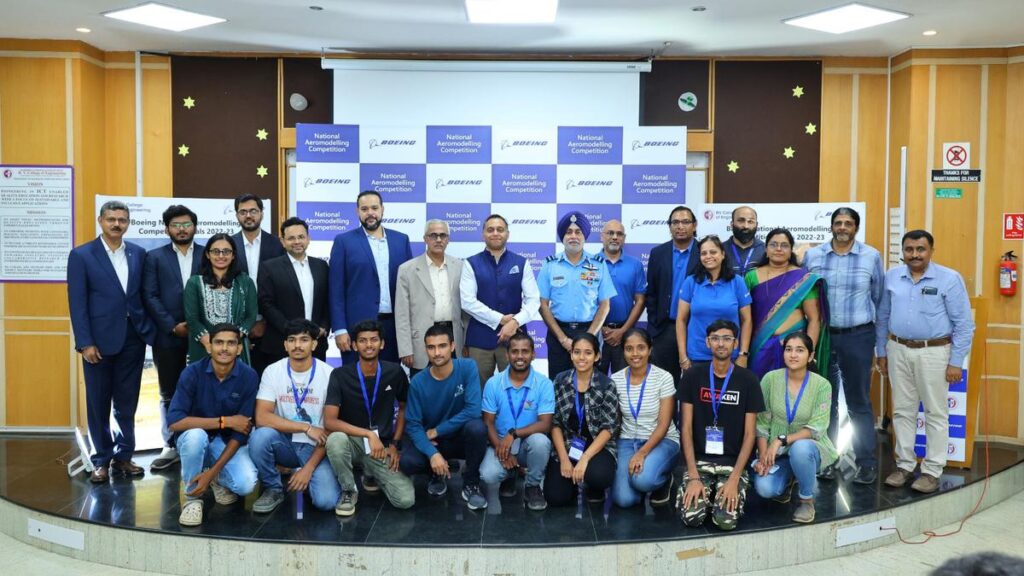
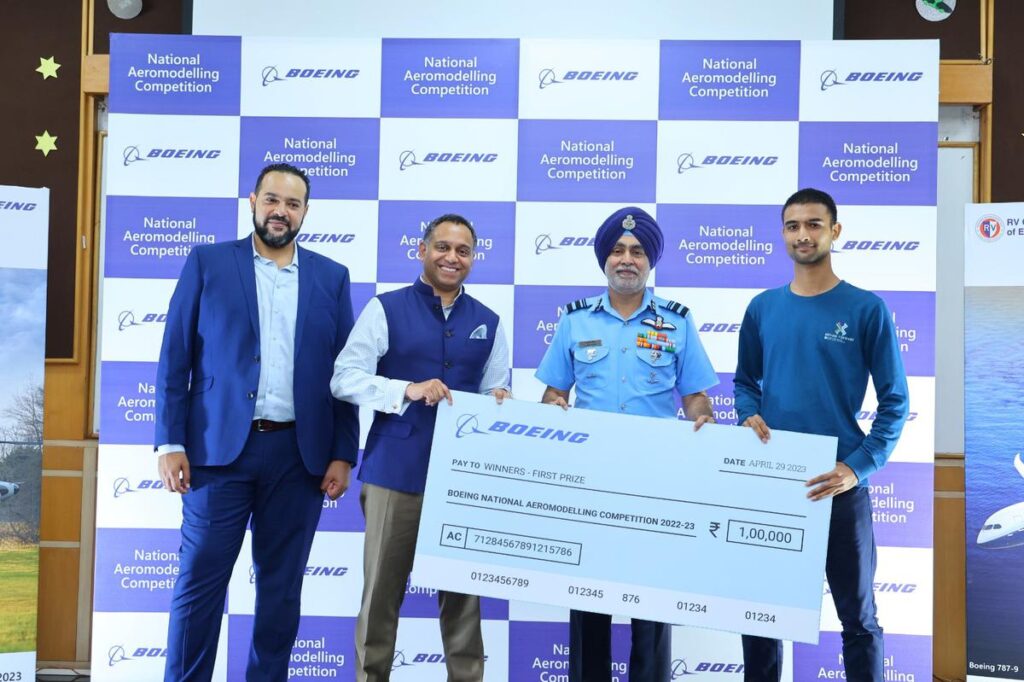
Winners of the 2023 Boeing National Aeromodelling Competition. 39 finalists from 12 teams were selected for the finale, which was held at R.V. College of Engineering in Bengaluru.
Bengaluru:
This year’s competition attracted close to 2,200 students across India.
Boeing announced the winners of the 8th annual Boeing National Aeromodelling Competition in India, on May 3.
This year’s competition attracted close to 2,200 students across India, and saw a two-fold increase in participation across zonal and national rounds. 39 finalists from 12 teams were selected for the finale, held at R.V. College of Engineering in Bengaluru.
Arshad Khan (right) from Rabindranath Tagore University, Bhopal won the 2023 Boeing National Aeromodelling Competition. The finale was held in Bengaluru
Arshad Khan from Rabindranath Tagore University, Bhopal was declared winner of the competition.
Sharanya Acharya Nishmithe, Aman Kumar Srivastav and Gagan G. Nayak from Nitte Mahalinga Adyanthaya Memorial Institute of Technology (NMAMIT), Nitte, Karnataka bagged the second spot
Divyamshu, Rathan Raj K. Nancy and Anantha Krishna, also from NMAMIT-Nitte, took the third spot.
The zonal rounds of the competition were held at IIT Kanpur, IIT Bombay, IIT Kharagpur, and IIT Madras. The top three teams from each zone then travelled to Bengaluru for the finale.
The competition started as an annual event in 2013 to provide a nationwide platform for students who have a keen interest in aerospace engineering and related fields. The competition allows them to demonstrate their skills and creativity in designing, building, and flying fixed-wing aircraft models of different types and sizes.
Salil Gupte, president, Boeing India, said, “This national aeromodelling competition provides an excellent platform for young aviation and technology enthusiasts to present their creativity, and engineering and design skills. It is a testament to our commitment to encourage engineering talent to pursue careers in aerospace and defence in India.”
Ahmed Elsherbini, managing director, Boeing India Engineering & Technology Center, and chief engineer, Boeing India, said, “Aeromodelling competition plays a crucial role in the aerospace sector. It brings fresh perspectives, new ideas, and a willingness to challenge conventional thinking. With the aerospace industry constantly evolving, student innovation can be a driving force in the development of new technologies and sustainable solutions.”
Over the years, Boeing has strategically invested in developing talent for the aerospace sector in India.
Its programs, including Boeing University Innovation Leadership Development (BUILD) Program, the Boeing HorizonX India Innovation Challenge, and the Accelerated Aircraft Maintenance Engineers (AME) Apprenticeship program, have all helped empower entrepreneurs and contributed to building a skilled frontline workforce for India.
source: http://www.thehindu.com / The Hindu / Home> News> Cities> Bengaluru / by The Hindu Bureau / May 03rd, 2023
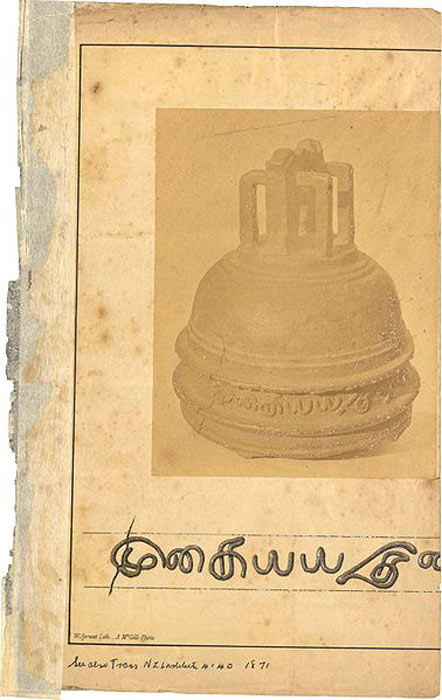
It was 1836 when William Celenso, a Christian missionary from Cornwall in England, first stumbled upon the mysterious Tamil Bell in a remote Maori village in New Zealand. It was being used as a cooking pot by some of the local people, who told the fluent Maori speaker that it had been found under the roots of a large tree, swept up from the ground by a storm many years prior.
Upon inspection, Celenso discovered a series of markings and runes in an unfamiliar language. Realizing the strangeness of the find, he traded it for a cooking pot, and deposited the curiosity in the Otago Museum in Dunedin. It was later bequeathed to the Dominion Museum, which today is the Museum of New Zealand Te Papa Tongarewa in Wellington.
Deciphering the Strange Inscriptions on New Zealand’s Tamil Bell
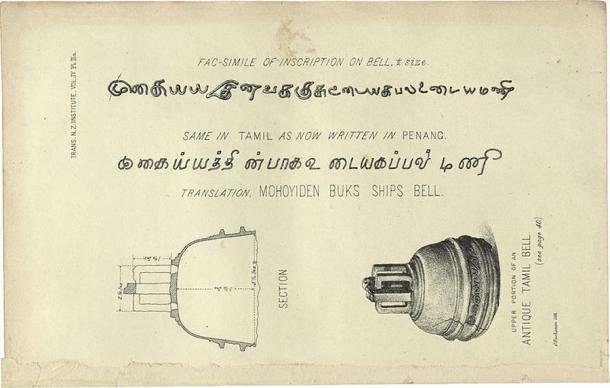
In 1870, ethnographer J. T. Thompson chanced upon the bell, and puzzled by the strange archaic writing, he took photos and sent them all around India in the hope of producing a translation. Just two months later, Thompson had replies from Ceylon, which is modern-day Sri Lanka, and Penang, a settlement on the Malaysian Straits.
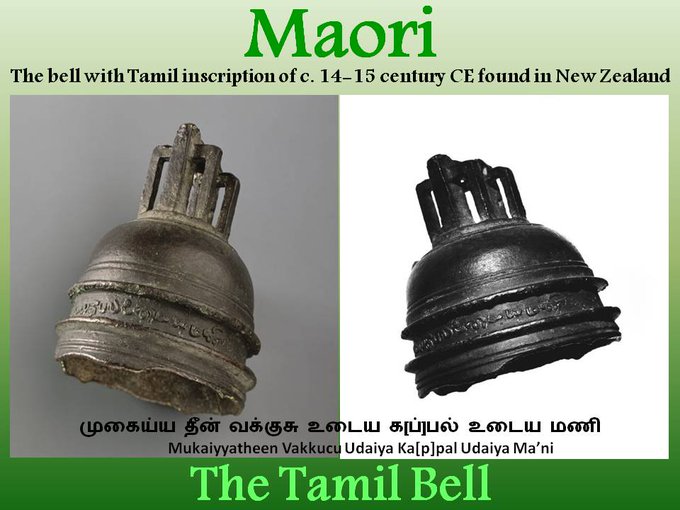
The obscure inscriptions had been identified as ancient Tamil, a language that hadn’t been in use for hundreds of years. The primitive words that adorned the curious metal oddity were Mohoyideen Buks , which were translated to mean “Bell of the Ship of Mohaideen Bakhsh.”
This led to several fascinating revelations. It illustrated that the owner was a Muslim Tamil, of high stature and probably from a famous Indian shipping company based in Nagapattam, in the south-east of India. This was because his name was Arabic, and his first name came from the Tamil phrase meaning “owner of ships.”
Later, in 1940, the age of the Tamil Bell was estimated to be 400 to 500 years old, dating back to the period between 1400 to 1500 AD. This was a remarkable surprise, suggesting that outside contact with New Zealand had been made hundreds of years before English captain Thomas Cook landed on the windswept coast of Poverty Bay in 1769. But had it really?
Facsimile of inscription on the Tamil Bell. ( Public domain )
Evidence of a Tamil Colony in New Zealand
Only 7 years later, another perplexing discovery would further mystify the people of New Zealand, leading to a possible explanation for the out-of-place artifact. In 1877, a shipwreck was discovered half-buried in sand between the ports of Raglan and Aotea. It was first assumed to be a modern ship, as the New Zealand coast was renowned for being extremely dangerous and accidents were common. But this was different.
The vessel appeared to be of Asian origin and extremely old. C. G. Hunt noted how the ship was constructed of teak beams that were placed diagonally and secured by wooden screws, strongly suggesting it was built in South East Asia. Inside, a brass plate with Tamil inscriptions and a plank of wood containing the familiar name Mohoyd Buk were found.
Inexplicably both pieces of tantalizing evidence vanished in Auckland, and experts were never able to compare it to the timeworn letters of the Tamil bell. Nevertheless, several early theories were put forward by the historians of the day. Some argued this was proof of an early Tamil colony on New Zealand. Others maintained that the skillful construction and expertise of the Tamil seafarers made it perfectly possible they could have sailed to New Zealand.
On the other hand, the evidence for such arguments remains scarce. As far as historical record is concerned, the eastern-most frontier for Indian sailors was the island of Lombok, next to Bali in current-day Indonesia. Furthermore, the Spice Islands of West New Guinea, where nutmeg, mace, and cloves could be exclusively found, although in use, were never controlled by the Tamils and instead remained in the hands of local magnates of Ternate, Tidore, and Amboyna. Add to this that no other Indian relics have ever been found in New Zealand.
Facsimile of inscription on the Tamil Bell. ( Public domain )
A Lost Portuguese Trading Ship?
Another theory put forward is that the Tamil Bell was originally Portugese, and from a lost ship sent as part of a fleet by the Portuguese emperor to secure the Spice Islands. From the 1490s, the Portugese became a major player in the Indian Ocean trade network, securing Asian goods for a booming demand back in Europe. In 1511 the Portuguese even established a trading colony on the Malacca Straights and in many places on the Indian mainland.
One of these places was Goa, and in 1521 the Portuguese Viceroy sent out a fleet of three caravels captained by Cristovas de Mendonca, to explore the lands beyond the Spice Islands. Only Mendonca’s caravel returned, the other 2 being lost at sea and never seen or heard from ever again.
In 1877, the shipwreck found on the New Zealand coast was identified as being constructed in Goa, precisely where the Portuguese ships had set out from. Tamil was widely spoken in Goa which neatly explained the Tamil writing on the bell.
However, all of this is incredibly unlikely. There is no direct evidence that points to a bell being on the Portuguese caraval. Lastly, the Portuguese had already established an incredibly lucrative trade system, which meant there was no motive for them to explore further as the known world of the Indian Ocean was already providing them sufficiently.
Spanish Castaways or Anthropological Science Fiction
One of the most famous and controversial theories was advanced by Robert Langdon in his book The Lost Caravel , in which he proclaimed that the Tamil Bell was brought to New Zealand by a group of Spanish sailors from the East Indies who became disorientated and eventually settled in New Zealand, hundreds of years before Thomas Cook’s arrival.
He wrote that in 1524 the King of Spain ordered an expedition to the Spice Islands, sending a sortie of six ships. A maelstrom of disasters ensued, with two wrecked on the coasts of Patagonia and the Philippines, one reaching Mexico, another returning to Spain, and the remaining two disappearing. One of the stray caravels, the San Lesmes, which contained the Tamil Bell, was last observed in 1526, voyaging across the Pacific Sea.
After running aground at Amanu, an atoll of French Polynesia, where four cannons were later discovered, the crew repaired their ships and sailed on to the atolls of Ana and Raiatea, where several of them settled down and married the native woman. Later on, in a bid to return to Spain, the weary seamen set out west, discovering New Zealand in the process and deciding to make a home on its verdant shores.
The descendants of the castaways explored further, discovering new lands as far as Easter Island, and introduced new cultures, customs, and languages to the Polynesian people influenced by their Basque origins. Langdon was convinced that the additional discovery of a Spanish helmet dated from the 16th century in Wellington Harbor in the 1880s gave his hypothesis more credibility.
However, like the Tamil and Portuguese ship propositions, Langdon’s argument has been highly criticized for its extravagant interpretation of available evidence. Bengt Danielsson, an academic from French Polynesia, described it as “anthropological science fiction.” Throughout his account, Langdon disregarded all existing archaeological and historical literature of the Pacific which often contradicts and disproves his ideas.
The existence of Caucasian-like individuals with fair-skin, red hair, and blue eyes on many Pacific Islands was deemed proof of his hypothesis. While there is no doubt that these traits existed, even in the earliest contact with Polynesian natives, Langdon argued the Spanish castaways were the only source of these genetics, a fact that is impossible given that there were only reportedly 20 to 50 castaways in the forgotten band. It was equally as unlikely that they had travelled to all of the Polynesian Islands .
Next, Langdon pointed to linguistic anomalies as a sign that Spanish words were absorbed into the local dialects. However, there are no identifiable Spanish words in the languages of Eastern Polynesians. Without a shred of evidence, Langdon explained that this was because the children only learned the language of their mothers, leading to the decline and eventual disappearance of the Spanish, Basque, and Galician languages of the fathers. He even proposed that the lack of sounds in the Polynesian tongue meant that Spanish words could easily have been changed beyond recognition after only a day or two.
On the other hand, in all other cases of European and native intermixture in Polynesia, European languages were adapted into the local speech. A diverse array of English words still remain in Polynesian languages today after being incorporated 200 years ago. For example, on the Pitcairn Islands, where only one Englishman lived with eight native women, his descendants still speak English!
In addition, Langdon believed that the indigenous beliefs of Polynesians were derived from the Christian faith of the Spanish diaspora. He utilized sources from 1874 from Catholic missionary Albert Montiton, who remarked on how Christian the native religion seemed to him. Yet Langdon completely ignored the wide conversion of natives to Christianity that happened from 1817 onwards, which presents a more reasonable explanation.
Finally, Langdon cited the “talking boards” of Easter Island, a series of stone tablets discovered in the 1860s with archaic runes, as a type of script invented by the Spanish castaways. Yet his main source for this point was a native guru called Hapai, a man who claimed that Europeans had inhabited Easter Island, and whose evidence was subsequently found out to be fabricated. In the end, Langdon’s farfetched argument was systematically disproven, and the confusion over the Tamil Bell persisted.
There are many examples of ghost ships found floating at sea without any sailors. ( muratart / Adobe Stock
The Derelict Theory: Did the Tamil Ship Drift to New Zealand?
After years of fantastical hypothesizes, Brett Hilder entered the debate with a theory more rooted in reality. His so-called derelict theory re-invigorated the earlier claim that the bell came from a Tamil ship. Hilder’s theory attacked the assumption prevalent in most theories that the crew who possessed the Tamil bell were alive. In the choppy, capricious oceans, there had been many instances of intact wooden ghost ships being found without any sailors.
The Flying Dutchman was perhaps the most famous example, having been discovered with full sails and without anyone on board. Nearer the Pacific, the wreck of the sailboat Joyita, on a journey from Apia to the Tokelau Islands, was observed to have no remaining personnel when it was detected half-submerged in the sea.
These “derelicts” were usually still floating, even after many years at sea, because of the buoyancy of their hulls. Hilder entertained the idea that the Tamil Bell originated from a Tamil merchant ship that was caught in the eastward sea current between Antarctica and the southern parts of the continents.
During the late 1400s and 1500s, when the bell was dated, Tamil seafarers dominated the trade networks of the vast Indian Ocean. Muslim Tamils were particularly skilled navigators, plying their wares across the sea as far as the eastern coast of Africa. Indeed, modern examples of the power of the great Southern Current, which stretches from New Zealand to the Cape of Good Hope in South Africa, cement his idea.
For instance, in June 1973 it was reported in the Nautical Magazine of Glasgow that an unmanned lifeboat had travelled 7,000 miles from the coastline of East London, South Africa, to the Princess Royal Harbor in Albany, Australia. Thirty jars of barley, sugar, and lifeboat biscuits were found in perfect condition, sealed in two compartments. It is more likely, then, that a similar fate befell a Muslim Tamil ship, and that the preservation of its wooden hull helped bring the Tamil Bell to a wild new frontier of the world.
@tamilancient
Enduring Enigma of the Tamil Bell
Since its discovery in 1836, most theories surrounding the Tamil Bell were highly speculative and lacked the sufficient evidence to be taken seriously. Unlike others, Brett Hilder’s focus on the Great Southern sea current, a real geographical phenomenon, presented a case for the Tamil Bell that finally made sense without the mental leaps and bounds taken by other theorists such as Langdon, whose sole proof that the crew of the San Lesmes reached Amanu and married the native woman was the fact that four rusty old cannons had been found there.
Yet even Hilder’s theory has weaknesses. All of the theories incorporated the 1877 shipwreck as a key piece of evidence that identified if the bell was brought by the Tamils, Portuguese, or Spanish. Yet by 1890 the shipwreck, said to be half-sunken in the sand, had mysteriously disappeared, never to be seen again. Subsequent attempts to re-find the wreck, as late as 1975, were all unsuccessful.
“The problem with all these and other ‘mystery’ items, such as ancient shipwrecks on New Zealand’s wild west coast beaches that are reputed to be uncovered briefly in storms, is that in the absence of hard evidence to explain their existence and context, numerous fanciful interpretations are often placed upon them according to particular agendas,” explained Katherine Howe, summing up the situation perfectly. Thus, the mystery of the Tamil Bell lives on.
Top image: Representational image of a tamil bell from inside of Meenakshi Hindu temple in Tamil Nadu, South India. Source: Владимир Журавлёв / Adobe Stock
Jasovar Village (Mirzapur District), UTTAR PRADESH :
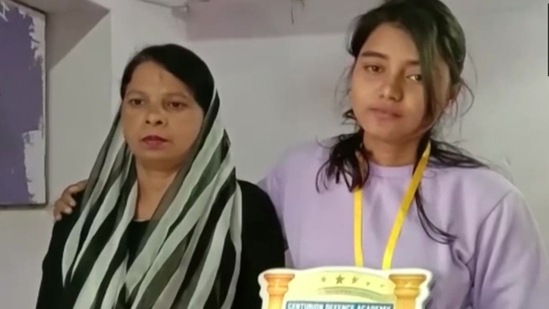
Sania Mirza of Uttar Pradesh’s Mirzapur district earned this position by passing the National Defense Academy 2022 examination (NDA) exam.
On December 27, Sania Mirza will join NDA Khadakwasla in Pune.(ANI)
Sania Mirza, daughter of a TV mechanic from Mirzapur, has been selected to become a fighter pilot in the Indian Air Force and would be the country’s first Muslim girl and the state’s first IAF pilot.
Sania Mirza is a resident of Jasovar village under the Mirzapur Dehat Kotwali police station area. She secured this position by passing the NDA exam. She has brought laurels not only to the district but also to the state and the country.
Sania, who studied in a Hindi medium school, said that Hindi medium students too can achieve success if they are determined. On December 27, she will join NDA Khadakwasla in Pune.
The parents as well as the villagers are feeling proud at her.
Sania’s father Shahid Ali said, “Sania Mirza considers the country’s first fighter pilot Avni Chaturvedi as her role model. From the beginning, she wanted to be like her. Sania is the second girl in the country who has been selected as a fighter pilot.”
She studied from primary to Class 10 at Pandit Chintamani Dubey Inter College in the village itself. After that, she went to Guru Nanak Girls Inter College in the city. She was the district topper in the 12th UP Board. She started her preparations at Centurion Defense Academy.
She gives the credit for success to her parents as well as to the Centurion Defense Academy.
She said that only two seats were reserved for women in fighter pilot in National Defense Academy 2022 exam . “I could not grab a seat in the first attempt but I have found a place in my second attempt.”
Sania’s mother Tabassum Mirza said, “Our daughter has made us and the entire village proud. She fulfils the dream of becoming the first fighter pilot. She inspired every girl in the village to follow their dreams.”
In the National Defense Academy 2022 examination, there were a total of 400 seats including male and female. In which there were 19 seats for women, and two seats were reserved for fighter pilots. In these two seats, Sania managed to get a place on the strength of her talent.
source: http://www.hindustantimes.com / Hindustan Times / Home> India News / by ANI / posted by Lingamgunta Nirmitha Rao / December 23rd, 2022
With petrol prices increasing, Asad Abdullah conceptualised the idea of developing an electric cycle in which six people can be accommodated.
Innovation on a dozen wheels by ITI-trained diploma engineer in electricals, Asad Abdullah. (Photo | EPS)
Innovation on a dozen wheels
All that innovation needs is a brilliant mind and passion coupled with the patience to apply it. Asad Abdullah, 22, of Azamgarh proved it by developing a 6-seater electric cycle. Asad’s innovation got recognised by none other than Anand Mahindra, chairman of Mahindra Group, who tweeted a small video of the cycle and made the innovation so viral that the video crossed 1 million views since December 1.
Mahindra tagged the chief design officer of the auto sector of his company asking if this device could find global application. With petrol prices increasing, Abdullah conceptualised the idea of developing an electric cycle in which six people can be accommodated.
He used scrap material and the motor of an old battery-operated. two-wheeler to develop the cycle in a month’s time at a cost of Rs ₹10,000-12,000. “I want to make it commercial and sell it to others at an affordable price,” says Asad Abdullah, an ITI-trained diploma engineer in electricals.
Lucknow touches zero covid mark
After a long span of 32 months, the city of Nawabs touched zero Covid figure mark as the last patient recovered from the ailment and no new case was reported, claim health authorities. The last patient who recovered and was discharged on Tuesday had tested positive last week. “This zero is a precious figure and we are making all efforts to sustain the status in Covid,” said Dr Manoj Agrawal, Lucknow CMO.
Lucknow has never had a status of zero Covid active cases since the 2020 pandemic. The first case in the state capital was reported in the third week of March 2020. Lucknow’s first Covid-19 patient was a doctor who returned from Canada. The second case reported was also that of a doctor and the third one was of a Bollywood singer Kanika Kapoor, who turned out to be a mass spreader after returning from the UK.
10 UP heritage sites up for adoption
UP Archaeological directorate has shortlisted 10 heritage sites up for adoption under the ‘Adopt Heritage Scheme.’ These sites include the Alambagh building of Lucknow, Potrakund in Mathura, Kalpa Devi and Astik Baba temples in Sitapur, Caves of Devgarh of Lalitpur, Raj Mandir Guptar Ghat in Ayodhya, Lakshmi temple in Jhansi, Fort of Tahrauli in Jhansi, Fort of Balabehat in Lalitpur, Digragarhi in Jhansi and Shiv temple of Bithoor in Kanpur.
Those interested in adopting the heritage site would be known as Smarak Mitra who would sign a memorandum of understanding (MoU) with the department and work towards the conservation of the site. Smarak Mitras will also be responsible for arranging logistics for the tourists at the site.
source: http://www.newindianexpress.com / The New Indian Express / Home> Nation / December 07th, 2022
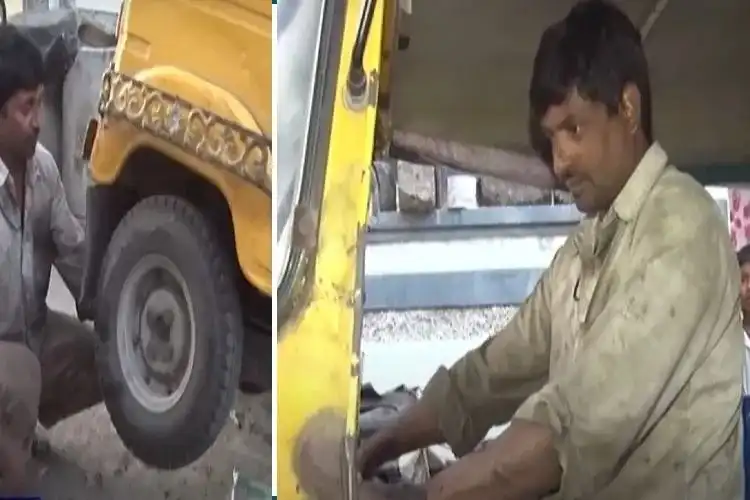
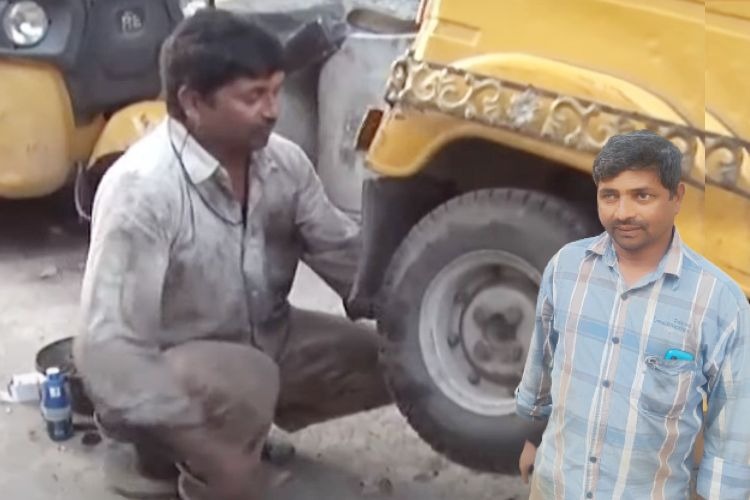
It may sound unbelievable but is true. Mohammad Hafeez, who is blind in both eyes, is a much sought-after auto mechanic. He lives his life with dignity and is not paralyzed due to a lack of physical vision.
Muhammad Hafeez, a resident of Kashibagh, Warangal district, was not born blind; he lost his eyesight in two accidents and yet he never gave up on life.
Not to break under a spell of tragedies and misfortunes, Mohammad Hafeez is good at detecting the problem in a vehicle through its acoustics. The sound of its parts is what makes him understand the problem in a vehicle that has come for repair.
The 50-year-old Muhammad Hafeez was leading a happy life as an auto electrician when a heavy thing fell on his head in 2003. Due to the accident, he suffered a serious injury and ended up losing sight in his left eye. This badly affected his income.
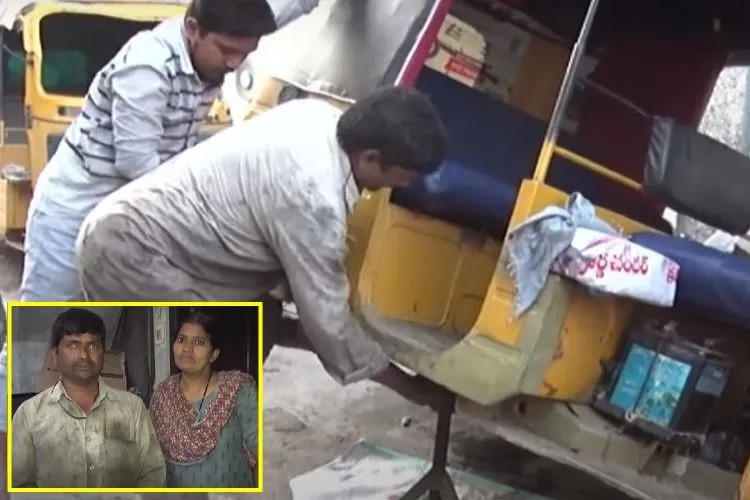
Mohammad Hafeez with his wife
However, he did not give up. With the support of his family and well-wishers, he bought an autorickshaw and started driving it to support his family. However, fate had something else in store for him.
Another tragedy rocked Mohammad Hafeez’s life. In 2005, a burning firecracker hit his right eye and he again lost his vision for life.
Mohamad Hafeez comes from a poor background. His father MD Afzal Anu works as a private security guard in Mamula Bazaar, while his mother Meher Nisa is a housewife and suffers from heart disease.
Mohammad Hafeez started working as an electrician in 1994. His wife Nazima works as an Anganwadi worker.
After her husband lost his eyesight. Nazima was offered this job on a humanitarian basis.
They have a daughter, Afsana, and a son, Muhammad Muzamil. Afsana works in Hotel Gachibowli in Hyderabad, while Muhammad Muzamal is a first-year student of the ITI. The family lives in a rented house. Muhammad Hafeez earns five hundred rupees a day.
Speaking with Awaz The Voice, Mohammad Hafeez said that he is alive today because of top police officer B Somati. When he met with an accident in the year 2003, the then DSP B Somati reached the spot in time and shifted him to MGM Hospital, Warangal.
Muhammad Hafeez said that he is alive today because of Somati Madam’s timely help and he thinks of her as a messiah.
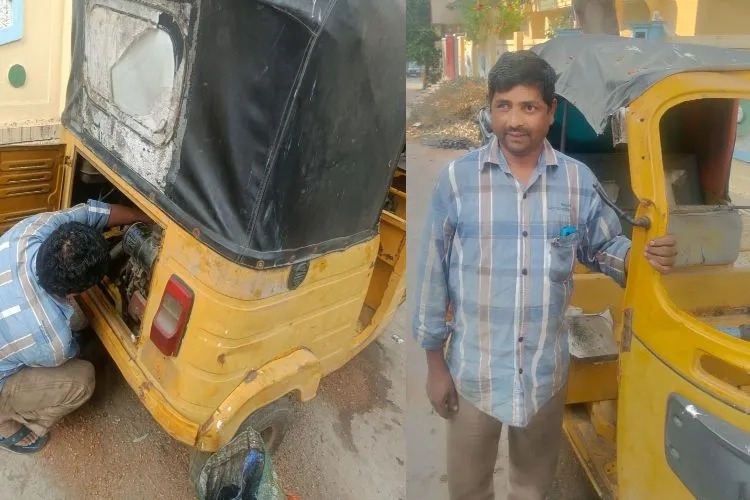
Mohammad Hafeez with an auto that he has repaired
He said that after the accident, the then member of the Legislative Assembly Biswa Raju Saria, Mayor Erabili Sorna, and a few corporators donated an autorickshaw to him. “I started the second innings of my life as an auto driver. My other eye was also damaged in the accident and I was permanently blind, although my eye was operated open I could never regain my vision.”
Mohammad Hafeez did not give up and started learning auto repair work. He detects the engine malfunction by the sound of the car and repairs the car by touching the parts with his hands.
Muhammad Hafeez said that he learned the job for one and a half years. He was happy to support the family by paying for auto repairs and the education of his two children. He said his wife was very supportive.
Mohammad Hafeez said that any work is difficult but not impossible. He said that the youth, especially the disabled, should look for ways to live a dignified life based on their strengths and abilities instead of depending on someone and extending a helping hand.
He said he is supporting his family by working hard. He asked all the good-hearted humans and the rich to come to the help of others so that people like him get encouragement.”.
source:http://www.awazthevoice.in / Awaz, The Voice / Home> India /by Sheikh Muhammad Yunus, Hyderabad / by awazthevoice.in / December 09th, 2022
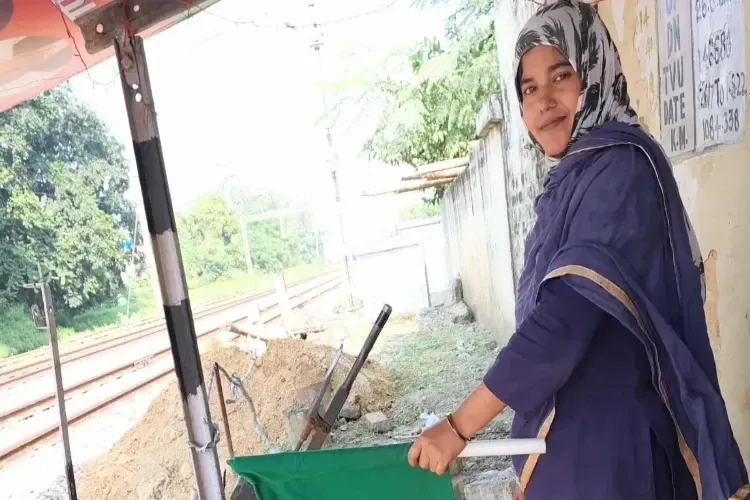
Mirza Salma Baig is India’s first woman to man the Railway crossing. She is stationed at Malhore Railway Crossing, one of the busiest intersections of railway and road traffic, located a few kilometers from Lucknow, the capital of Uttar Pradesh.
Salma Baig, 29, a mother of a toddler, has been working at this crossing for the past 10 years.
Seeing a hijab-clad woman turn a heavy wheel to shut the gate when the train is about to arrive at that point and then open it for pedestrians and other road traffic, the onlookers often stop to take selfies with her.
People show respect to Salma Baig for her job. Seeing her for the first time, many people stop to just look at how she works.
Mirza Salma Baig was appointed as the country’s first Gate Woman in 2013 at the age of 19. She hails from Lucknow, Uttar pradesh.
Malhore crossing is a busy intersection between railway track and the city road and it’s challenging to control and direct the traffic. She has to frequently close the gate for the vehicular traffic as many trains cross this point all through the day. Salma turns a heavy wheel with a lever to close the gate and then unwinds it to open it.
The gates open as soon as the train passes. Salma says that while closing and opening the gate, she has to take care not to hurt anyone. She stands with a red and green flag in hand until the train has crossed the gate.
Interestingly, many people had questioned Salma’s appointment in 2013 as the newspaper reports of 2013 suggest.
Mirza Salma Baig opening the railway gate
The railway authorities had to clarify that this job was always open to women but not many serious contenders for this job had ever applied.
Salma’s father Mirza Salim Baig was also a gateman at the Railway crossing. Due to hearing impairment and other ailments, he had to take voluntary retirement much earlier than it was due. Salma’s mother had suffered a stroke and after father’s retirement, there was no bread winner in the family.
At this stage the Indian Railways offered Salma a job. Salma quit her studies and accepted it. Her relatives were angry but she chose what was best for her and the family under the given circumstances.
She credits her parents for her success.
Salma is proud of her 10-year career and smiles when asked about the snide comments made by many when she first joined.
When she started working at the crossing, the staff told her that being a girl she would not be able to open the crossing gate. They told her that a train passes this crossing every one minute and many predicted she would leave the job in four days. Salma worked hard and never gave up.
She has been standing here for the last 10 years. Salma says, everyone in the staff has become her supporter.”
She performs her 12-hour long duty with full responsibility and competence. Salma says that girls should have the same freedom as housewives.
source: http://www.awazthevoice.in / Awaz, The Voice / Home> Women / by M Mishra, Lucknow / November 07th, 2022
Sahil had a love for vehicles since childhood but he started getting fond of vintage cars when he bought one and got it restored.
New Delhi:
Syed Sahil Agha, a resident of Abul Fazal Enclave in Delhi’s Okhla, has more than 50 American, British cars as also the cars of the erstwhile Rajas and Nawabs in his collection.
Sahil had a love for vehicles since childhood but he started getting fond of vintage cars when he bought one and got it restored.
People would look in awe every time he drove out in his car. Soon enough, another connoisseur of vintage cars, bought his car and paid him a good sum for it. Sahil invested that money into buying two more vintage cars.
Gradually, he fell in love with these cars and started collecting them. Today, his collection of more than 50 vintage cars, includes a Singer 6 of 1931 and Standard Sports of 1929, which are the only two in the whole world.
Apart from these, Sahil also owns a 1947 V12 Lincoln, a Mustang and many special sports cars.
Sahil also included the cars of many rajas and maharajas in this journey to preserve vintage cars.
He believes that awareness should be raised amongst people to save such vehicles. He also helps the owners of such vintage cars in fixing them.
Agha says his motive is to preserve these cars which were usually scrapped, he does so by buying and restoring them. He believes that these cars are a part of India’s history which cannot be brought back once extinct.
Sahil is a graduate from Jamia, Delhi and has done his Post Graduate Diploma in Acting from Shri Ram Bhartiya Kala Kendra, Delhi. He is the son of senior journalist Mansoor Agha.
source: http://www.ummid.com / Ummid.com / Home> India> Life & Style / by IANS / October 21st, 2022
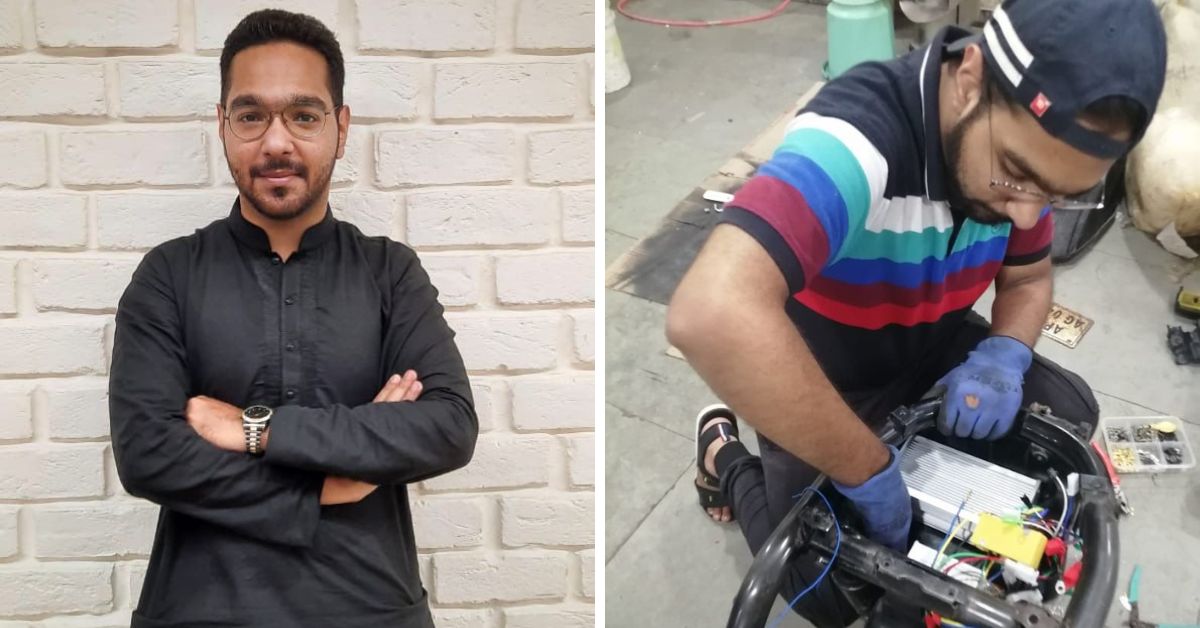
Hyderabad engineer Maaz Ahmed Khan founded his startup Torq Electric to convert old two-wheelers into electric vehicles.
In 2021, Maaz Ahmed Khan was still a mechanical engineering student when his interest in electric vehicles began brewing . “It started when I got into the EV subject of the syllabus in final year,” he recalls, adding that he would look closely into the working of these machines and formulate his own ideas to make his own version of them.
But the 23-year-old’s idea was not to build a new design. Instead, it was to convert existing fuel vehicles — which would otherwise be turned to scrap — into fully functioning EVs.
The then final year student of Methodist College of Engineering and Technology, Telangana, started looking for someone’s help to start building on his vision. This brought him to a non-academic startup incubator EdVenture Park, which focuses on student innovations. He applied for a job here and was selected.
With their support, the youngster began working on his dream project, eventually founding Torq Electric in March 2021.
“A few years ago, I happened to attend the launch of Tata Nexon. Even though the vehicle excited me, I also thought, ‘Why should we buy a new EV if there exists a technology to convert existing vehicles?’,” he tells The Better India.
He continues, “I also had ‘electric vehicles’ as a subject in college. I learned that after 15 years of running, the fuel usage of any vehicle goes up and it contributes to greater pollution. Instead of turning it to scrap, you can convert it.”
On 27 August 2021, Maaz came up with the prototype of a two-wheeler EV, which he built by transforming an old petrol scooter and spending Rs 60,000. The model was covered widely by the media and popularised further through the internet, he recalls.
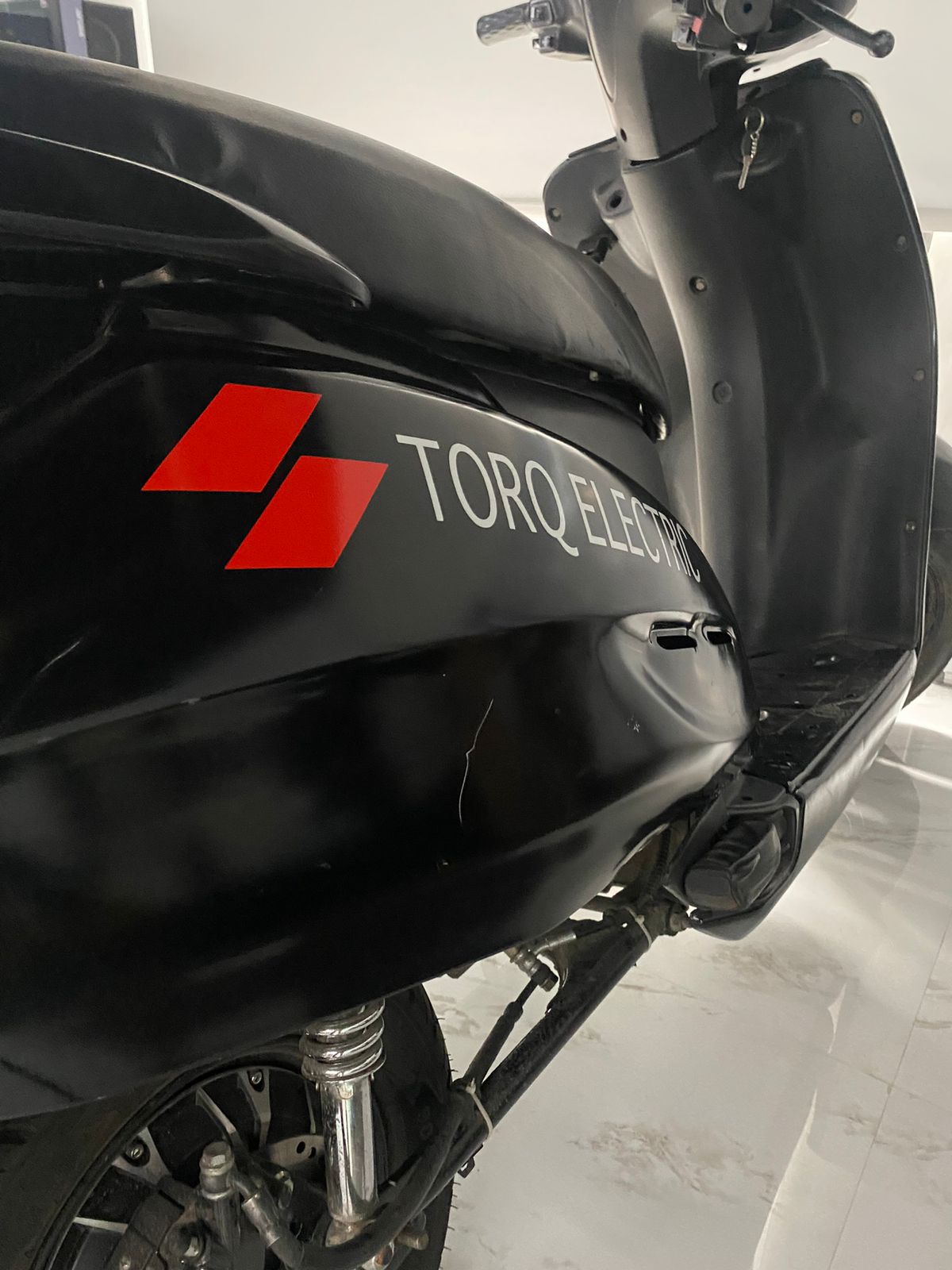
The EV by Torq Electric.
“Even then, it took time to gain people’s trust. A few months later, I managed to get some customers. A majority of them were unwilling to let go of their two-wheelers due to emotional attachments and similar reasons. Converting these into electric vehicles seemed like a great idea to keep your old favourite bike,” he explains.
Maaz says he has so far converted seven bikes, and received orders for 15 more.
Additionally, he helps engineering students to take up college projects related to EV and supports them with the related technical know-how.
For a greener future
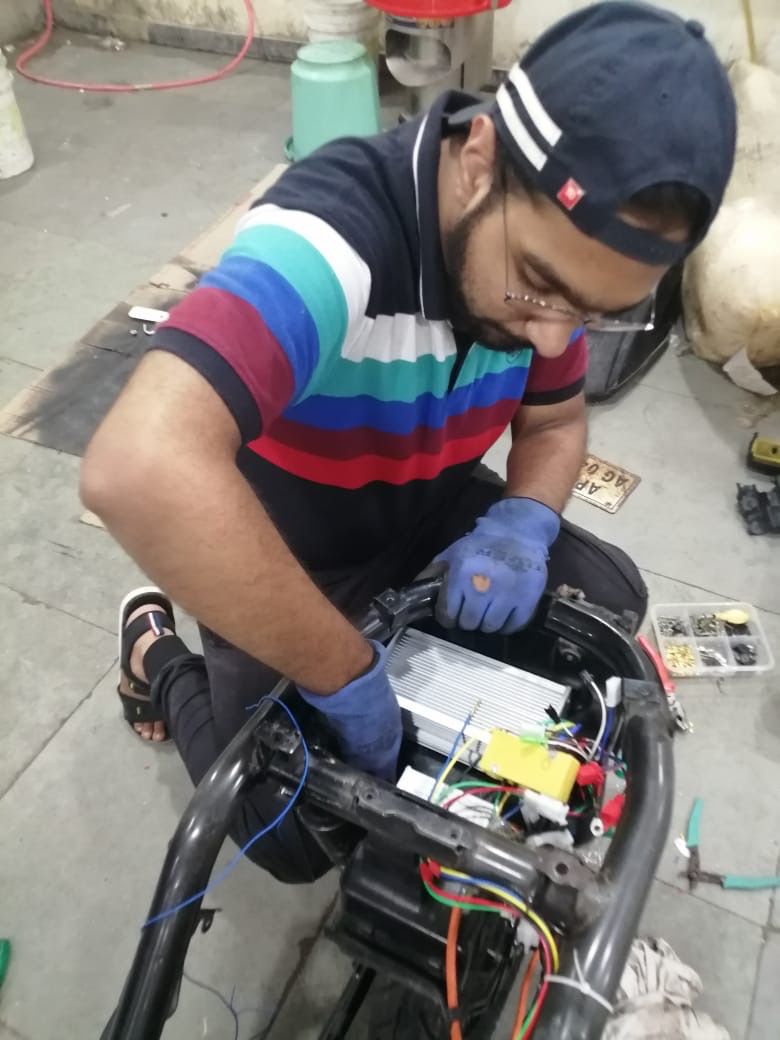
Even though it takes just 5-7 hours to convert a two-wheeler into an EV, Maaz asks for two days to check and ensure the vehicle’s safety after riding.
Maaz busy at work.
He provides two types of models — fully electric and hybrid vehicles. Those who wish to keep fuel as an option can opt for the latter. He says the price to convert any type of two-wheeler into a fully electric EV is Rs 50,000. For hybrid, he charges Rs 55,000.
“In fully electric two-wheelers, the engine and fuel tank are replaced with a powerful motor and batteries. In hybrid conversion, a motor and battery are added to the existing engine. This gives the flexibility of driving on both electric power and engine power,” says the engineer.
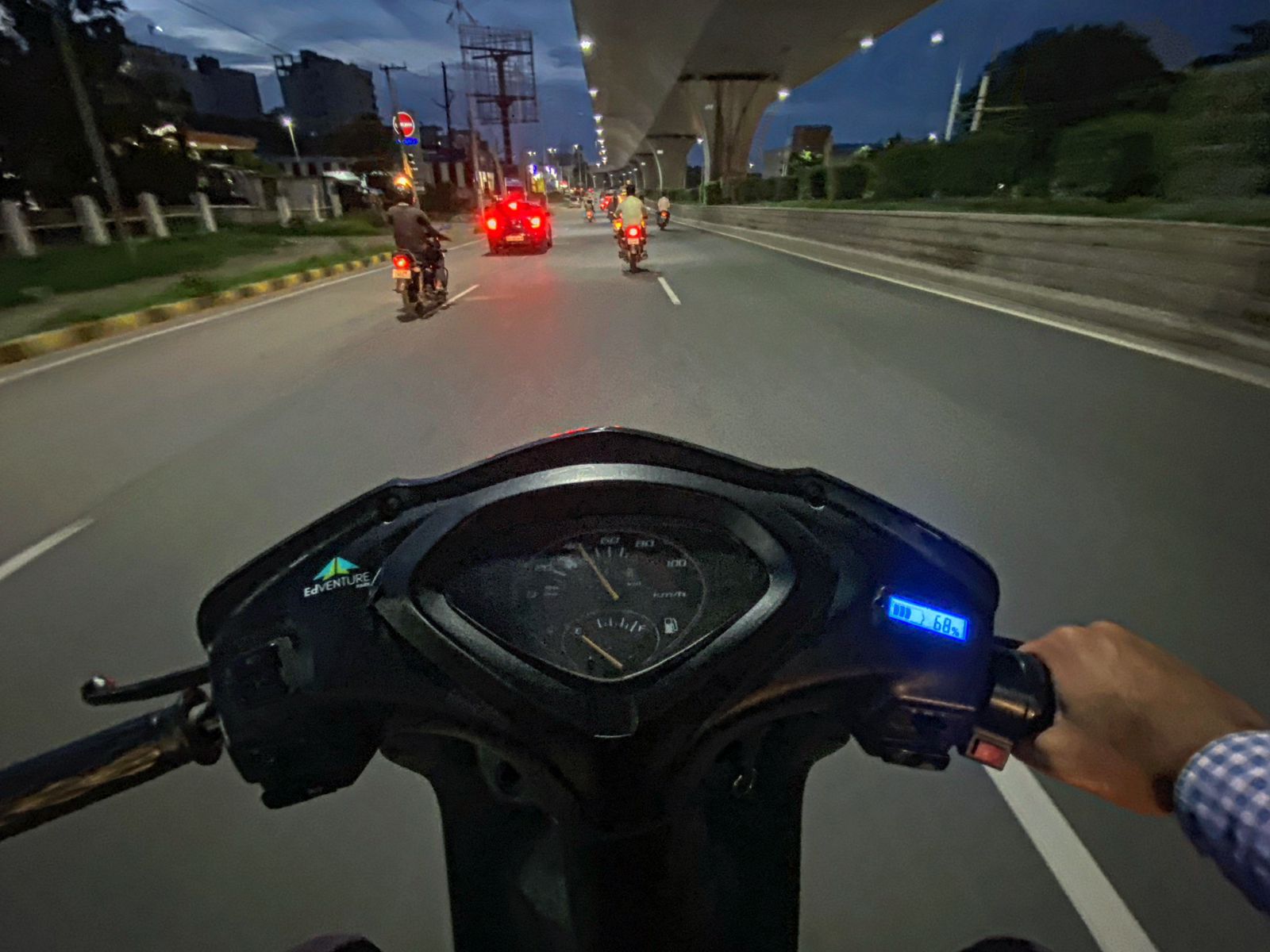
The base variant of the vehicle takes about three to four hours to charge, and can run up to 75 km at an average speed of 45 km/hr, Maaz says. Customers can also give their preferences, for which prices may differ.
“EVs are in their early days in India. But undoubtedly, they are the future. It is important to be aware of the pollution from fuel vehicles. Soon, we might be living in a country where breathing feels like smoking a cigarette. But we can prevent this by showing responsibility. Like shifting from plastic bags to cloth bags, or using public transport, opting for an EV is a great step,” Maaz says.
The electric vehicle built by Maaz.
Through his company, he aims to create sustainable living through automotive manufacturing, with the vision to create an eco-friendly world.
Even though his current innovation is receiving great response, the engineer’s dream is to launch his own design of an EV, exclusively for Indians. He also plans to extend the current innovation to three and four-wheelers.
Maaz Ahmed Khan — the engineer.
“The rise in fuel prices has most affected the auto drivers of the country. After a little research, I discovered that if they switch to EVs, they can save around Rs 400 a day. This accounts for Rs 12,000 a month. Thus, my plan is to launch an innovation pertaining to three-wheelers,” he shares.
Visit his website www.torqelectric.com
Edited by Divya Sethu
Photo Credits: Maaz Ahmed Khan
source: http://www.thebetterindia.com / The Better India / Home> English> Electric Vehicles – Sustainability / by Anagha R Manoj / September 20th, 2022
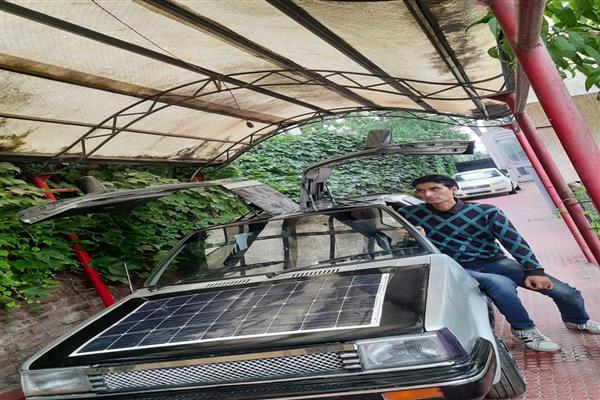
Breaking the notion that only the elite can have luxurious rides, Bilal Ahmad, a mathematics teacher as well as an innovator from Srinagar has made a solar car which is not only luxurious but is also affordable for the common people.
Hailing from Sanat Nagar area of Srinagar, Bilal has been working on this project for over 11 years and today he drives his solar car with confidence. The innovative car made by him works on solar energy and has solar panels all over the surface.
He watched and studied about various luxurious cars which were made since 1950. He also studied about an engineer and innovator named Delorian who started a company DMC which helped him and motivated him to make a car which is luxurious and simultaneously affordable for the common people.
“Cars like Mercedes, Ferrari, BMW are just a dream for a common person. Only few people are able to afford it while it remains a dream for others to drive such cars and roam in it. I thought of something to give a luxurious feel to the people as well,” he said.
He started working on the car and modified it by watching the various videos and started adding the features in it.
Initially he wanted to make a car for disabled people but due to his financial conditions, he couldn’t conceive the idea which made him put his idea on hold. “Government didn’t help me at that time. I was not financially sound so I couldn’t take the cost of the innovation,” he said.
Keeping in view the rising price of the fuel, he thought of using solar energy to run the car. In 2019, he went to Chennai to get in touch with the solar panel making company. Furthermore he researched and brainstormed with a number of experts of the field.
“In Kashmir, most of the time, the weather is gloomy. I used solar panels which can give higher efficiency even in low sunlight days. I went to many solar companies to check the efficiency of solar panels,” he said.
The challenge of how the solar panels can be used over the car and how much efficiency it can give on the less surface area was overcome by him with the use of monocrystalline solar panels.
“The surface area of a car is less as compared to the surface area of the roof of the house. I got the solar panels which take less space but give high efficiency,” he said.
Pertinent to mention here that there are two types of solar panels – monocrystalline and polycrystalline. Bilal used monocrystalline solar panels which occupied less space and gave more efficiency.
Further he worked on the weaknesses of the solar innovative car. At times, the doors of the car when parked at the place received light sunlight, to overcome this problem, he made a Gullwing door which opens upwards like the ones in a Ferrari. Making and balancing the gullwing doors was a challenge as well as a difficult task for him. “With gullwing doors, the solar panels attached to the doors will also raise up and the sunlight will directly fall on them,” he said.
Further, the solar panels automatically can change their direction with the changing directions of the sun. For this he has made a remote control which works within the range of 1.5 kilometers which can control the direction of panels so that more light can be absorbed by them.
Also he has increased the seating capacity of the car. “The sports car only has seating capacity of two people but here 4 people can sit conveniently. Also the braking system will regenerate the power to its batteries to save energy. It is eco-friendly and works on free energy resources. It has a huge potential to revolutionize the market,” he said.
“The car is not a prototype, it is a fully luxurious car. The other luxurious cars available in the market have huge costs in crores. I want affordable inventions to reach common people. I want people to make use of advanced technology at affordable prices,” he further said.
He has driven the car on the roads and has received good response from the passers-by.
He said he has used a Lead Acid battery in the car. “We can also use a lithium battery in it but we have to use a protection circuit with it additional protection can be added,” he said.
Talking about his difficulties, he said that the unavailability of the equipment and gadgets is a major difficulty which innovators face here. “Lack of exposure among the local mechanics is another problem. The knowledge they possess is limited which makes it really difficult to explain them,” he said.
He further said that the youth of Kashmir have more talent but lack exposure and platform to showcase it.
He is of the opinion that a place like Kashmir should have attractive things to attract the tourists as well as locals. “The electric vehicles plying on roads don’t have that luxurious look. Kashmir is a tourist place and we should have attractive things like in any other foreign place like Switzerland.”
He wishes to soon start his company for its mass production which can also generate employment for the youth of Kashmir. “I will name the company as YMC after the names of my children- Yosha and Maisha. The company will be making luxurious cars for the common people,” he added.
Bilal is an innovator associated with IIED center NIT, Srinagar. The center will provide him assistance for this innovation. Saad Parvez, head, IIED center said, “The IIED center will help him to develop his innovation and will connect him with the industries or forum that can help him. Our local innovators need motivation and a marketplace. The challenge is to market the innovation.”
Despite having a B.Tech degree in civil engineering, he has a good interest in electronics. He has an experience of 14 years in teaching as he has worked in various colleges and schools as assistant professor. In the past, in 2009, he has made a LPG gas controlling safety device. The device which can automatically turn off the LPG cylinder from anywhere via a mobile app.
source: http://www.risingkashmir.com / Rising Kashmir / Home / by Insha Latief Khan / June 20th, 2022
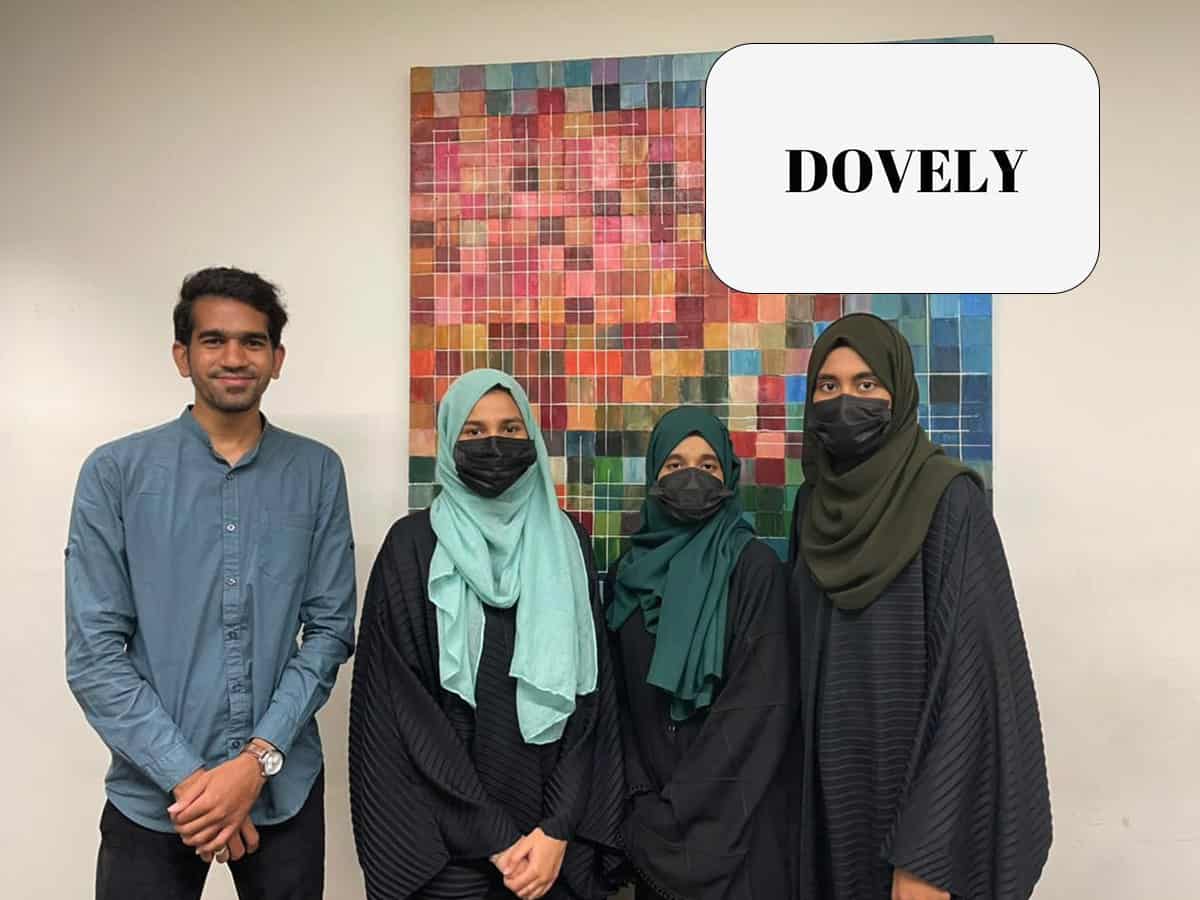
Team Dovely (from Left to Right Mohammed Obaidulla Khan, Zainab Khatoon, Uzma Khatoon and Masarrat Fatima)
Hyderabad:
How often do casual conversations on women’s safety get realised into full-fledged businesses focusing on women empowerment? One such conversation led to the creation of the ‘Dovely’ app by-city-based siblings Uzma Khatoon and Zainab Khatoon.
Concerned over women’s safety, Uzma and Zainab thought of coming up with a solution to address the issue. The Dovely app provides a bike taxi service exclusively run by and for women. Apart from ensuring women’s safety, the entrepreneurs also aim to make women financially independent.
The four-person run application comprises founder Zainab who is a final year B. Pharmacy student, Uzma, a final year B.com Computers student, and Masarrath Fatima and Obaidulla Khan who are final year B. Tech students.
As of now the platform has 20 riders and over 400 users and functions through its website and connects riders and passengers through WhatsApp.
The app is still undergoing improvements. “We will be able to develop a full-fledged app only after we reach a certain milestone like 200 rides,” said Masarrat.
She further added that the company can’t risk putting up the app on the app store or the play store since users may face challenges as it is manually operated at present.
Speaking to Siasat.com the founder and CEO of Dovely, Zainab Khatoon said, “The idea to create Dovely first struck me and originated from a conversation between me and my mom, who wanted to visit my granny and was looking for cost-effective and safe rides.”
The idea only came into existence following an unpleasant autorickshaw experience, aimed at ensuring women feel safe and secure during their journey.
“The idea struck me once again while I was travelling with my friend in an autorickshaw when the driver looked at us from the rear view mirror making me feel uncomfortable,” Zainab added.
“We sat down with our parents to discuss the name of the company. After going through about 400 names, our father came up with the name Dovely,” said Chief Operating Officer and co-founder Uzma.
“Apart from providing rides for women, the app also allows women to connect with us as Dovely partners. To access information regarding the platform one may visit the Dovely website. At the time of filing the story, Dovely successfully completed 37 rides,” Zainab said.
Addressing the query regarding profit sharing, Chief Marketing Officer (CMO) Obaid Ulla Khan said, “Currently all the money earned is being kept with the riders themselves, and we aren’t earning any commission.”
Bootstrapping for funding Dovely:
Running a startup is not an easy task and requires consistent funding. However, Obaid believes in “Bootstrapping”, where entrepreneurs fund their own ventures. “Even if we approach venture capitalists at this stage they would set milestones based on which they would provide the money, hence it is better that we set a milestone for ourselves before we reach out to investors.”
“In order to pitch the business idea, we are collecting all the information ranging from the number of riders to the number of users along with the IDs of our riders in an excel sheet, this will make it easier for us to attract investors,” he explained.
With regards to the credibility of the riders, Zainab said, “I personally handle the onboarding process for Dovely. As part of the hiring process we ourselves take long distance rides with the candidates to test their driving skills.”
On Safety
Shedding light on the steps taken to ensure the safety of the riders and passengers, Uzma said, “One of us is constantly checking on the live location from the beginning to the end of the ride, and the riders are only supposed to switch off the live location after completing the ride.”
Adding to Zainab’s response, Obaid said “More than the candidate’s driving skills, we focus on their behaviour since we want to provide the best possible service to our customers”
Addressing the query on whether riders have to be logged in for a specific period of time on a daily basis, he said, “Keeping in mind the household responsibilities of our partners, we don’t have any specific login timings for now.”
A few Dovely partners were also present during the interview and they shared their experience with Siasat.com. Nahera Lohreen, one of the partners said,” The first ride was a bit challenging since I was hesitant as to how it would go, but after a while, I felt comfortable and it has been a great experience.”
Nahera is also the first partner to be roped in by Dovely.
Zareena Begum, another partner with the firm said,” It is a great opportunity since it gives us financial independence and I was looking forward to such an opportunity”
Speaking of future plans, the company’s CEO Zainab said, “As of now we are focusing on a minimum of 10 rides per day, we will gradually expand into three and four-wheeler markets.”
She further said, “Apart from bike taxis, we are planning to deal with transport and logistics which will also be led by women. The greater vision of the company is to empower women across India and make them financially independent.”
www.dovely.org
source: http://www.siasat.com / The Siasat Daily / Home> News> Hyderabad / by Mohammed Baleegh / June 19th, 2022




.webp)