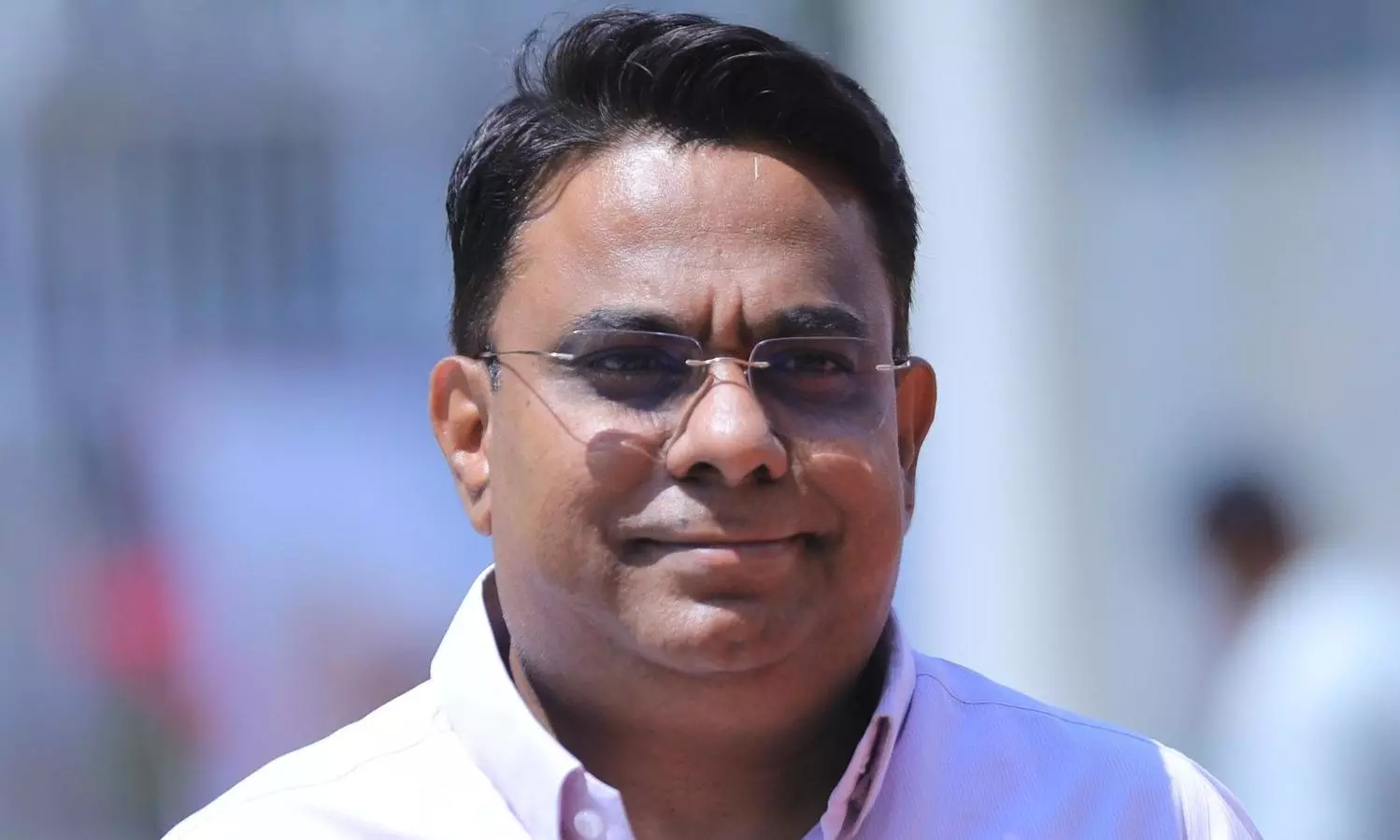
SP MLA Rais Shaikh counters BJP minister Nitesh Rane’s claim with historical evidence of Muslim chieftains in Shivaji’s forces.
SP MLA Rais Shaikh presents historical records listing Muslim chieftains in Chhatrapati Shivaji Maharaj’s army, challenging BJP minister Nitesh Rane’s statement. (Image: Facebook)
Mumbai:
To counter BJP minister Nitesh Rane’s claims that Muslims were not part of Chhatrapati Shivaji Maharaj’s army, Samajwadi party MLA Rais Shaikh has dashed off a letter to the saffron party leader listing out 10 Muslim chieftains in the legendary Maratha king’s forces.
In the letter to Rane, the SP MLA has given the names of 10 Muslim chieftains of Chhatrapati Shivaji Maharaj. These are Siddi Hilal and his son Siddi Wahwah, who supported the Maratha king in the siege of Panhalgad, cavalry chief Noor Khan Beg, Sardar Shama Khan, navy chief Ibrahim Khan, bodyguard Siddi Ibrahim, navy official Daulat Khan, trusted servant Madari Mehtar and lawyer Qazi Haider. Shaikh has also added evidence of historical sources to back up the names of these chieftains.
“Like Saint Tukaram and Saint Ramdas, Shivaji Maharaj also respected the Muslim Saint Baba Yakut of Ratnagiri. Shivaji Maharaj’s rule was not a religious war. He continued the tradition of gifting Pir, Dargah, and Mosque, as is documented in historical sources. These references are also provided in the letter, along with details of primary historical sources,” said Shaikh.
The SP MLA has also gifted Rane two books ‘Chhatrapati Shivaji: Kaal Aani Kartrutva’ (Times and Achievements of Chhatrapati Shivaji) by the renowned historian Jadunath Sarkar and ‘Who Was Shivaji?’ by Govind Pansare. “Minister Nitesh Rane should read objective history so that he does not make prejudiced statements distorting history, which could further increase rifts between communities,” said Shaikh.
Rane, while speaking at a meeting in Sangameshwar, Ratnagiri, had claimed that Shivaji Maharaj never appointed a Muslim chieftain and his war was against Muslims.
When asked, Rane said he was yet to receive Shaikh’s letter and he will comment on it after reading it. “But whatever I have said is true. Muslims were never a part of Chhatrapati Shivaji Maharaj’s army,” he said.
source: http://www.deccanchronicle.com / Deccan Chronicle / Home> Nation / by Bhagwan Parab / March 24th, 2025
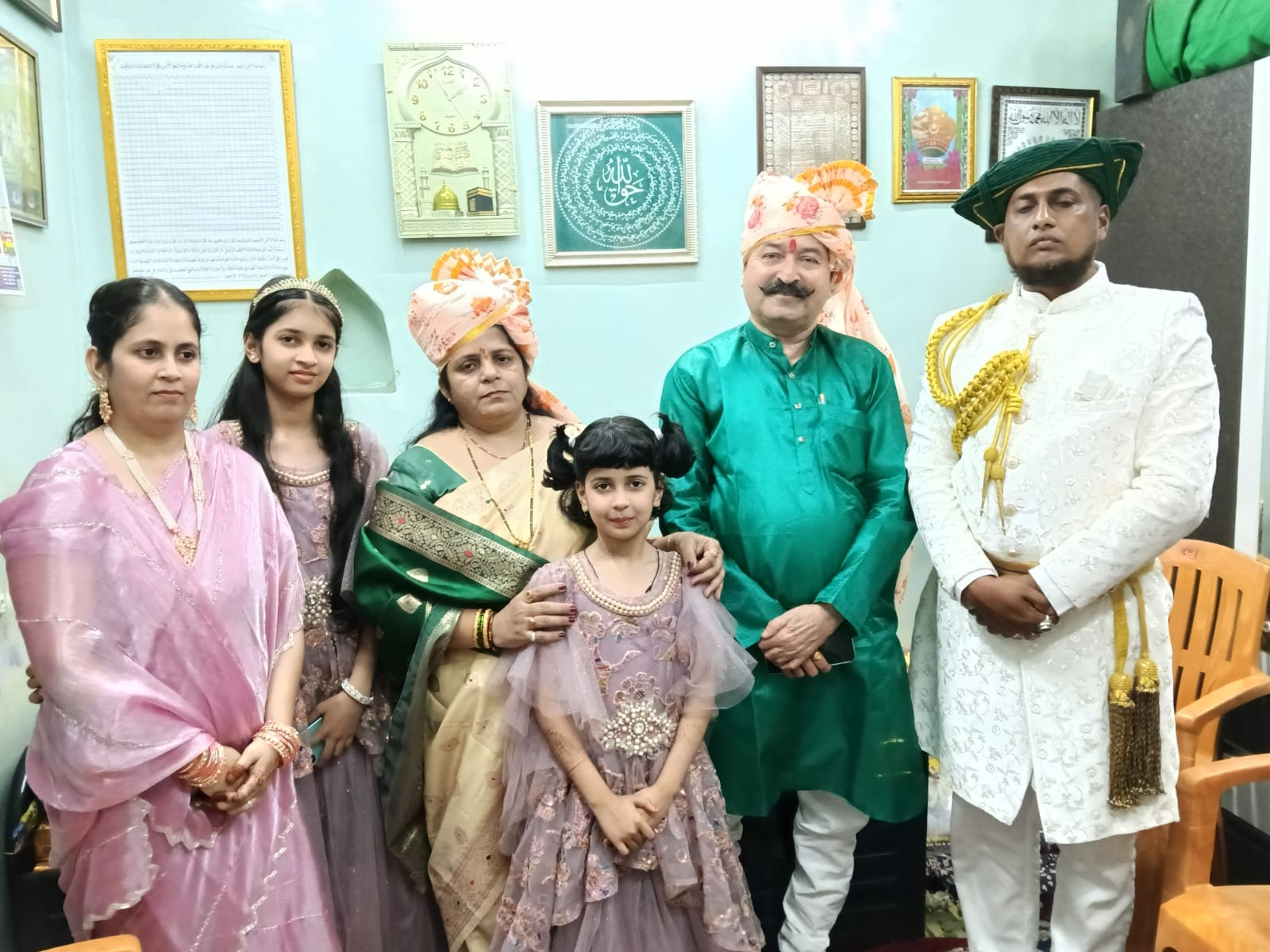
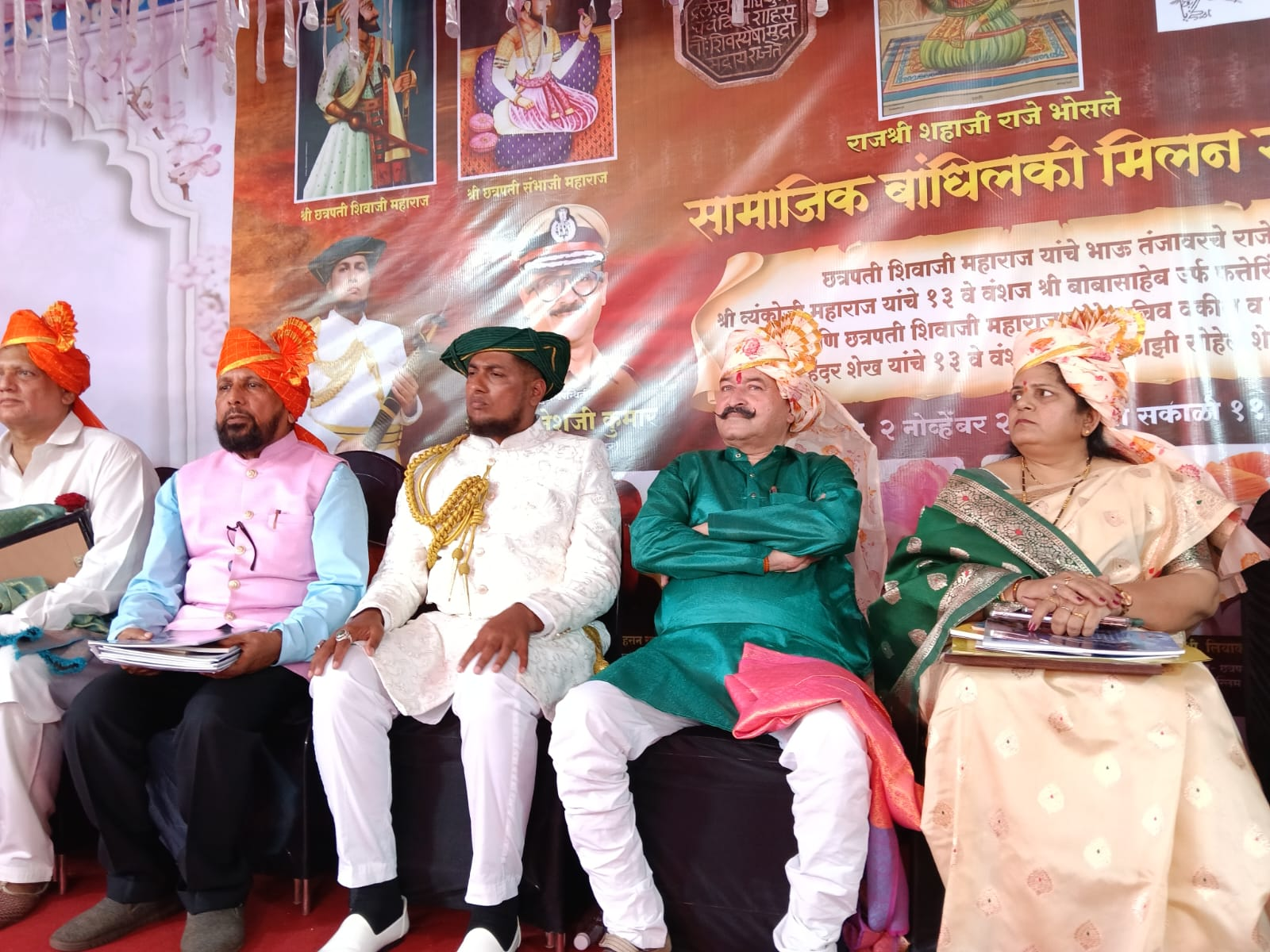
Sohail Shamshuddin Shaikh with Fattesingh Raje Bhosale at Pune
The home of Sohail Shamshuddin Shaikh in Pune, Maharashtra, is a piece of living history. He has preserved the legacy of his ancestors’ service and valour dating back to the era of Chhatrapati Shahajiraje Bhosale (the father of the iconic 17th-century Maratha king, Chhatrapati Shivaji Maharaj) and the Peshwas.
This story begins about 400 years ago. Shahajiraje Bhosale had granted a special sanad (royal charter) to Sohail Shaikh’s ancestors. Sohail Shaikh has preserved this charter to this day. It is not just a document; it is a testament to his family’s glorious history and their unbreakable bond with the Bhosale dynasty.
After Shahaji Maharaj’s passing, the Shaikh family continued to serve. Later, during the Peshwa era (the period of the Maratha prime ministers), his ancestors served in an important position of Qazi (an Islamic judge). For eight to ten generations, they served the Swarajya (Shivaji’s self-rule movement) and later the Peshwas.
The families of Sohail Shamshuddin Shaikh and Fattesingh Raje Bhosale at the Pune meet
Sohail Shaikh has also preserved many judicial documents and historical records from Shivaji’s time. These documents offer insights into the work of his ancestors and the social system of that era.
Today, his 14th generation is settled in Pune, and remarkably, they have continued the legacy of service. Just as his ancestors were in the service of the king and the state, today’s generation is in government service. Following in his ancestors’ footsteps, Sohail Shaikh is the fifth generation of his family to serve in the police force.
Unfortunately, this great legacy of Sohail Shaikh’s family was largely overlooked. However, ‘Awaz Marathi’ brought his story to all of Maharashtra through a video. Since that time, Sohail has been interviewed by many news channels and media outlets. He has since become known as a descendant of Qazi Haider, who held an important position in Chhatrapati Shivaji Maharaj’s court.
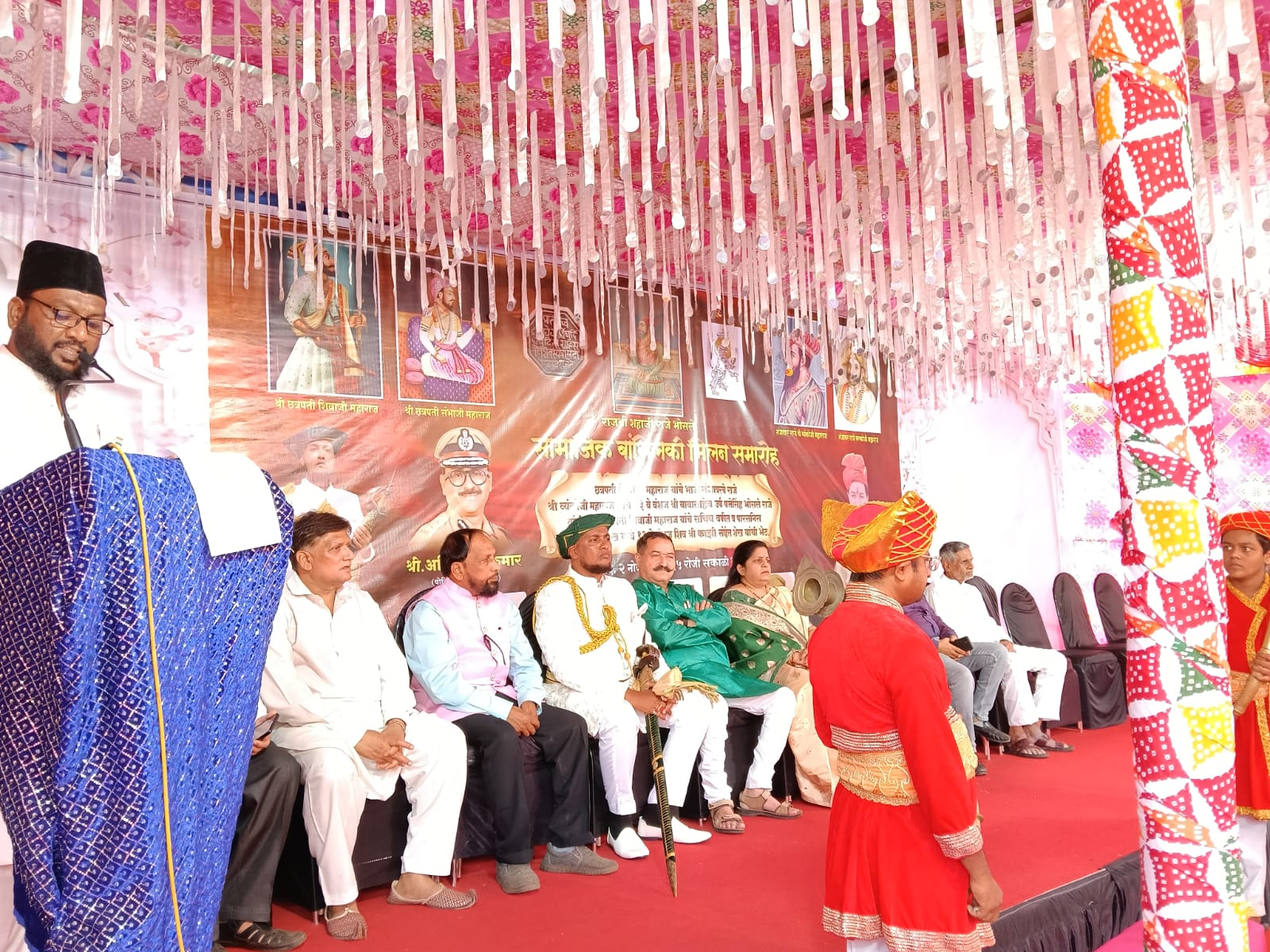
The Pune meeting
As the next step, a historic event took place on November 2. A meeting was held between Babasaheb alias Fattesingh Raje Bhosale, the 13th descendant of Raja Vyankoji Maharaj of Tanjore (Chhatrapati Shivaji Maharaj’s brother), and Qazi Sohail Shaikh, the 13th descendant of Chhatrapati Shivaji Maharaj’s secretary, lawyer, and envoy, Qazi Haider Shaikh.
This is an example of how historical religious harmony is being preserved. ‘Awaz-the Voice, Marathi played a significant role in making this meeting happen.
Speaking about this meeting, Sohail Shaikh says, “‘My interview with Awaz Marathi made this meeting possible. My video reached Fattesingh Raje Bhosale, and he immediately contacted me. He then set a date and came to meet me. This meeting was historic and upheld social commitment, which is why we named the ceremony the ‘Social Commitment Meet’.”
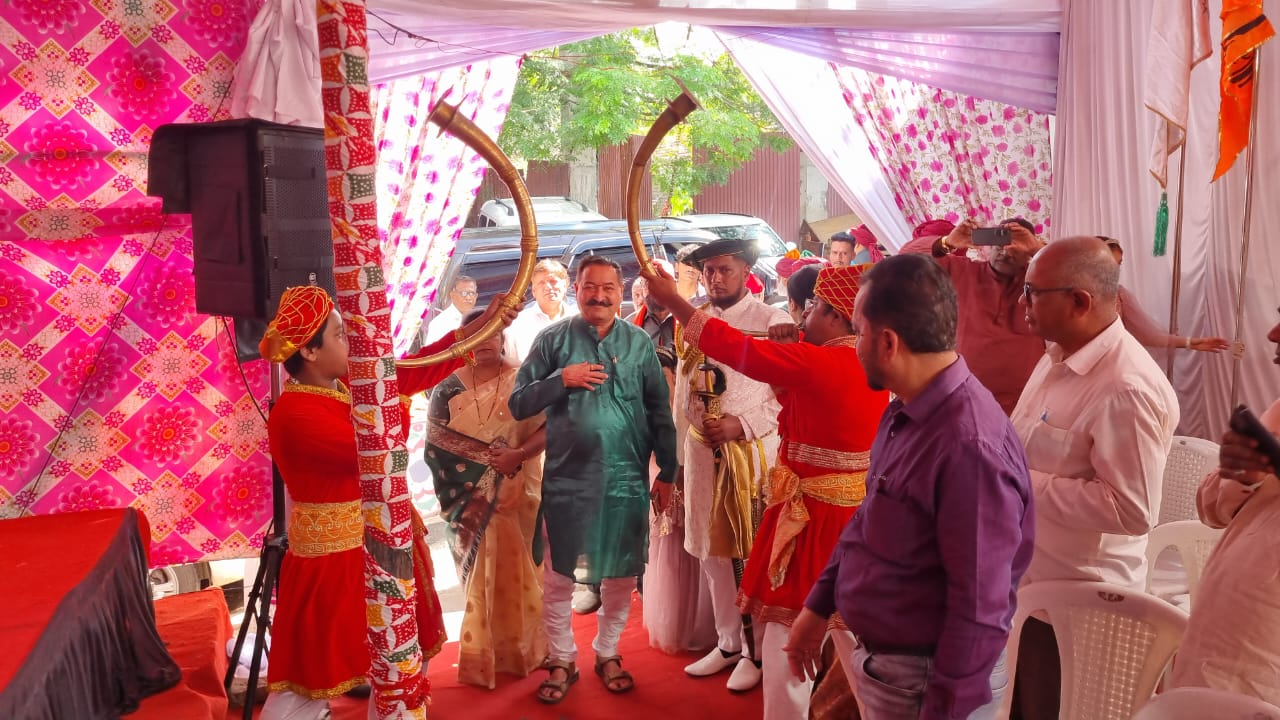
Fattesingh Raje Bhosale entering the venue of the meeting in Pune
Sohail Shaikh said, “This ceremony was truly historic. Descendants of Maharaj’s Muslim and Maratha commanders, police officers, and social activists were present. Fattesingh Raje was overjoyed to see this all. He spoke to everyone with deep emotion and pride. We have put up banners outside my residence detailing my ancestors’ history, which were inaugurated by Raje.”
He added, “Speaking with Maharaj, we learned more historical facts. About 375 years ago, when Chhatrapati Shivaji Maharaj was on his Karnataka campaign, he went to meet the Qutubshah of Golconda. At that time, our ancestor Qazi Haider was with him, along with other commanders. That is when Vyankoji and my ancestors had met. Meeting Chhatrapati Shivaji Maharaj’s family is a matter of pride”
Sohail Shaikh proudly states, “We have always had a place of deep respect for Chhatrapati Shivaji Maharaj in our hearts. And for our families to be connected is truly a matter of great pride. This was a golden moment for Fattesingh Raje and me to meet after nearly 375 years. We are happy to be part of this.”
Sohail Shamshuddin Shaikh with Fattesingh Raje Bhosale at the Pune meet
Babasaheb alias Fattesingh Raje Bhosale, the 13th descendant of Raja Vyankoji Maharaj of Tanjore, told Awaz-the Voice, Marathi, “This meeting was very important for maintaining unity in society. The main purpose behind this meeting was to stop the ongoing Hindu-Muslim disputes in society and to re-establish an atmosphere of harmony, just like in the old days.
“We have to carry forward the principles of Chhatrapati Shivaji Maharaj and Vyankoji Raje, which was to take everyone along—the Bara Balutedar (the 12 traditional village artisans) and the Athara Pagad Jati (all 18 castes and communities) … We all must follow the constitution that Babasaheb Ambedkar wrote based on Shivaji Maharaj’s principles.”
Fattesingh Raje Bhosale said that this meeting was held to create harmony in society. He said, “Today, political people are fanning the flames of caste disputes for their own benefit, which must stop somewhere. All communities must maintain their unity. This is our heartfelt wish.”
source: http://www.awazthevoice.in / Awaz, The Voice / Home> Stories / by Bhakti Chalak, Pune / November 07th, 2025
Muslim-majority Malerkotla has been declared as the 23rd district of the state, with the Punjab government fulfilling a decade-long demand of its residents.
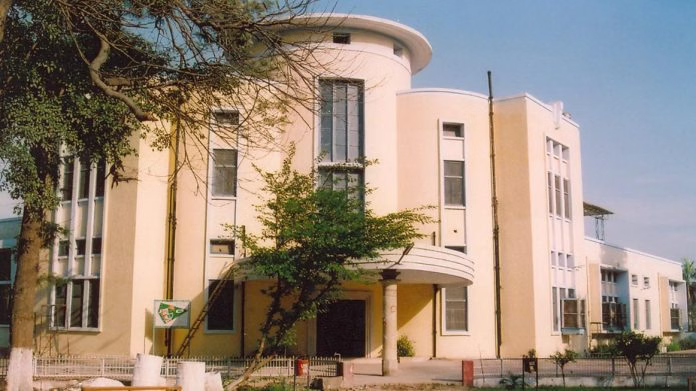
The government college in Malerkotla | Wikimedia commons
Chandigarh:
On the occasion of Eid-ul-Fitr Friday, Punjab Chief Minister Captain Amarinder Singh declared the Muslim-majority Malerkotla as the 23rd district of the state, while announcing a slew of projects for the development of the historic city.
The move fulfils an at least decade-old demand in Malerkotla and a promise that the ruling Congress had made in its manifesto ahead of the 2017 assembly elections.
Punjab’s decision, however, hasn’t gone down well with the BJP, particularly Uttar Pradesh Chief Minister Yogi Adityanath.
Adityanath tweeted Saturday that the move was “proof of the Congress’ divisive politics”.
“Any distinction on the basis of religion is contrary to the basic spirit of the Constitution of India,” the Uttar Pradesh CM said. “Presently, the formation of Malerkotla (Punjab) is a reflection of the divisive policy of the Congress.”
मत और मजहब के आधार पर किसी प्रकार का विभेद भारत के संविधान की मूल भावना के विपरीत है।
इस समय, मलेरकोटला (पंजाब) का गठन किया जाना कांग्रेस की विभाजनकारी नीति का परिचायक है।
Tarun Chugh, the BJP’s national secretary from Punjab, weighed in, saying the decision was clearly “communal” and that it was for the first time in the history of Punjab that an administrative decision was taken to further communal interests.
None of these charges, however, will find any resonance in Punjab, where Sikhs and Malerkotla’s Muslims share historically harmonious ties. So entrenched is this solidarity, that the Muslim-majority region saw no violence even as the rest of Punjab went up in flames during Partition in 1947.
The Punjab chief minister even alluded to this while responding to his UP counterpart.
“What does he (Yogi Adityanath) know of Punjab’s ethos or the history of Malerkotla, whose relationship with Sikhism and its Gurus is known to every Punjabi? And what does he understand of the Indian Constitution, which is being brazenly trampled every day by his own government in UP?” Amarinder asked in a statement issued Saturday evening.
A 300-year-old legacy
Punjab Sikhs’ reverence for the Muslims of Malerkotla dates back chiefly to one singular event in history.
According to Anna Bigelow, associate professor of Islamic Studies in the Department of Religious Studies at Stanford University, the Nawab of Malerkotla, Sher Muhammad Khan, had in 1705 opposed the death penalty handed out to nine-year-old Baba Zorawar Singh and seven-year-old Baba Fateh Singh — the sons of Guru Gobind Singh, the 10th Sikh Guru.
Bigelow, who has researched Malerkotla’s history, writes that despite Khan’s protests, the then Mughal governor of Sirhind, Wazir Khan, bricked alive the two children.
The Malerkotla nawab’s defiance, referred to as “ha da naara (cry for justice), however, earned him the respect and adoration of Sikhs.
“Guru Gobind Singhji blessed Sher Muhammad Khan and ever since Malerkotla has become an icon of Sikh-Muslim brotherhood,” said the Shiromani Akali Dal (SAD) general secretary Dr Daljeet Singh Cheema. “Even during Partition, this town remained completely peaceful.”
The new district will also have a government medical college in the name of Nawab Sher Muhammad Khan.
The Opposition SAD has backed Chief Minister Amarinder, with Cheema issuing a statement that Adityanath’s tweet was in bad taste and symbolic of his complete lack of historical knowledge about Malerkotla town and its significance for Sikhs.
“Malerkotla town is a unique example of Sikh-Muslim communal harmony that has lasted for over 300 years,” Cheema said.
A Muslim-majority region
Malerkotla was part of a jagir of several villages that the then Delhi Sultan Behlol Lodhi granted as dowry to the Afghani Sufi Saint Sheikh Sadruddin-i-Jahan (also called Haider Sheikh) in 1454.
According to Bigelow, the original settlement was called “Maler” and it remains the name of the neighbourhood surrounding the Sheikh’s tomb.
Following the advent of Mughal rule in India, the descendants of the Sheikh became the nawabs of Malerkotla.
Bigelow writes that Kotla came to be in 1657 when Mughal emperor Aurangzeb granted permission to Bayazid Khan, the first ruler of Malerkotla, to build a fortified city.
Bigelow also states that during British rule, Malerkotla was as turbulent as the other smaller principalities of the time, marked by infighting and ever-changing loyalties. The last ruler of Malerkotla was Nawab Iftikhar Ali Khan.
During Partition in 1947, Malerkotla remained absolutely peaceful and when the princely state merged with India, Iftikhar Ali Khan was its first chief minister.
Malerkotla was later merged with other princely states of the region to form the Patiala and East Punjab States Union (PEPSU). During the reorganisation of states in 1956, Malerkotla became a part of Punjab.
Modern-day Malerkotla
With almost 70 per cent of its population comprising Muslims, the Malerkotla assembly constituency has always been represented by a Muslim.
Nawab Iftikhar Ali Khan served as MLA twice while his second wife Begum Yusuf Zamani and fourth wife Begum Sajida were legislators as well. All of them were part of the Congress party.
The Malerkotla seat has, in the last few decades, been alternating between the Congress and the Akali Dal.
Razia Sultana, the current Congress MLA from Malerkotla, is representing the constituency for the third time (2002, 2007 and 2017). She is the wife of former Punjab DGP Mohammad Mustafa. In 2012, however, Farsana Alam, the wife of another IPS officer, Izhar Alam, was elected as the Akali MLA from here.
The constituency’s politics has not been without its intrigue. In 1981, the last nawab divorced Sajida Begum. She then went on to marry Anwar Ahmed Khan of the Shiromani Akali Dal, against whom she had fought multiple elections.
The nawab died in 1982 and Sajida Begum in 2006. The legacy of the last nawab continues as an ugly family litigation for property and palaces.
On Friday, Chief Minister Amarinder Singh, himself the scion of the Patiala royal family, recalled his ties to the last nawab of Malerkotla, whom he fondly called Chachaji (Uncle) and who he said lovingly addressed him Bhateej (nephew).
Amarinder also said he had written to the Aga Khan Foundation to undertake conservation and restoration of Mubarak Manzil Palace, occupied by Begum Sahiba Munawwar ul-Nisa, the wife of the last nawab.
The Punjab government, the chief minister said, has acquired the Mubarak Manzil Palace, adding that “its restoration and upkeep would be a fitting tribute to the nawabs of Malerkotla”.
A decade-long demand
The demand for district-hood is not new.
Malerkotla falls on the Ludhiana-Sangrur road and is part of Sangrur district. It’s almost equidistant from the district headquarters of Ludhiana and Sangrur and for every administrative work residents had to go to Sangrur, which is over 40 km away.
The town is full of small steel units and is specially known for manufacturing badges and uniforms.
The Congress’ manifesto had also promised district status for Malerkotla.
According to the government’s order Friday, the subdivisions of Malerkotla and Ahmedgarh, as well as the sub-tehsil of Amargarh, would be included in the newly-created district. The process of bringing villages under the jurisdiction of Malerkotla district would begin later, after the conclusion of the census operations, the order said.
The chief minister has also directed the Sangrur deputy commissioner to find a suitable building to immediately start the functioning of the district administration office. The deputy commissioner for the newly-carved district would be appointed soon.
(Edited by Arun Prashanth)
source: http://www.theprint.in / The Print / Home> India / by Chitleen K Sethi / May 16th, 2021
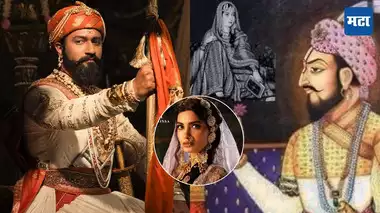
Marathi actor Kiran Mane has sparked widespread discussion with a social media post highlighting an overlooked aspect of history—the compassion of Mughal emperor Aurangzeb’s daughter, Zeenat-un-Nissa, towards Chhatrapati Shahu Maharaj.
Mane revealed that Zeenat-un-Nissa played a crucial role in raising Shahu Maharaj and ensuring the well-being of his mother, Maharani Yesubai, during their captivity, reported the INN.
According to Mane, after Chhatrapati Sambhaji Maharaj was executed, his five-year-old son, Shahu Maharaj, was taken prisoner by the Mughals. Despite the captivity, Zeenat-un-Nissa treated Shahu Maharaj like her own son and cared for Maharani Yesubai as a sister. This humane side of Aurangzeb’s daughter, often ignored in historical narratives, is now being recognized through Mane’s revelations.
Mane further shared that, in gratitude for her kindness, Shahu Maharaj later constructed the historic Begum Mosque in Satara, naming it after Zeenat-un-Nissa. The mosque stands as a testament to her generosity and the bond that transcended political hostilities.
His post has ignited debate on social media, with many expressing surprise at this lesser-known chapter of history. Mane also criticized historians who have misrepresented Zeenat-un-Nissa’s role, urging people to acknowledge historical truths backed by evidence.
Zeenat-un-Nissa was known for her compassion toward the poor and underprivileged, which even influenced her father, Aurangzeb, to grant her the title of Padshahi Begum. Her charitable works and humane nature set her apart, making her an inspiring figure in an era marked by conflicts.
At the time of Chhatrapati Sambhaji’s death, Shahu Maharaj was still a child, and his mother was held captive. Despite the circumstances, Zeenat-un-Nissa’s care left a lasting impact, prompting Shahu Maharaj to honor her memory through the construction of Begum Mosque, which still stands in Satara today.
source: http://www.radiancenews.com / Radiance News / Home> Latest News> Report / by Radiance News Bureau / March 09th, 2025
A new study has revealed narratives of syncretism that counter the politically motivated and polarised versions of the Valley’s history.
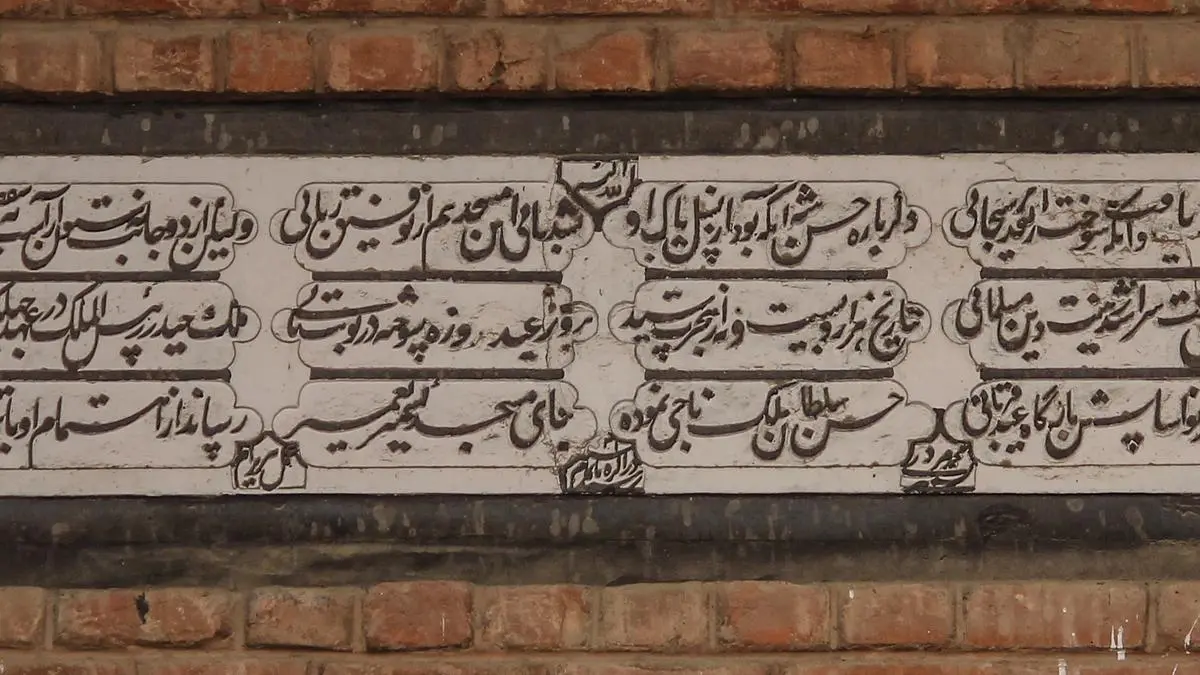
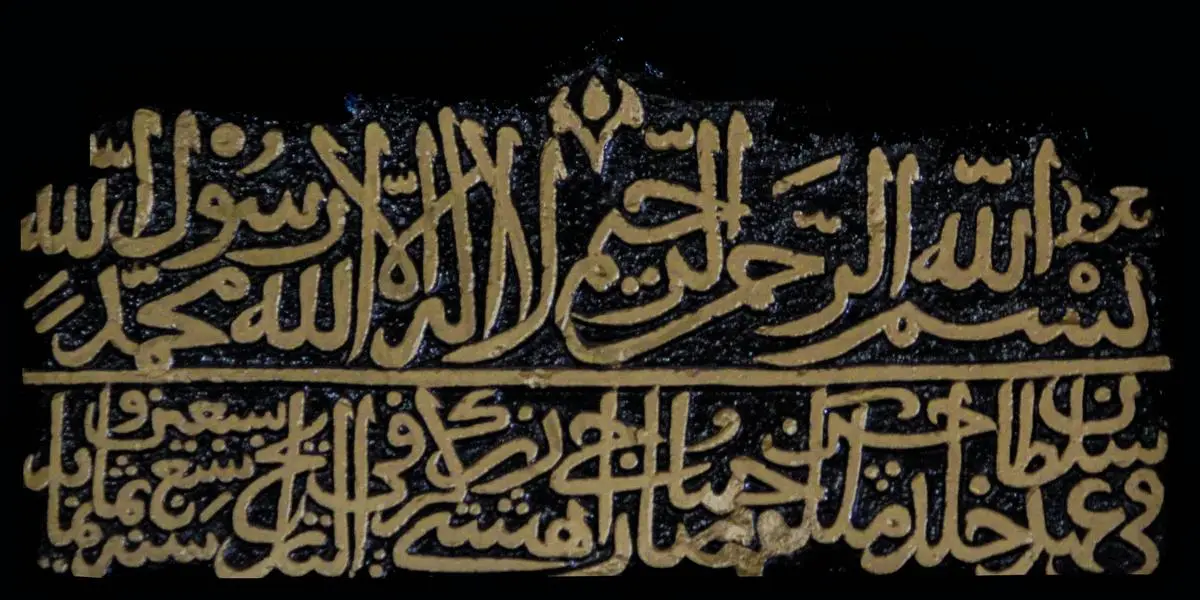
The 17th century limestone slab in the walls of Jamia Masjid in Srinagar. At the bottom, a small engraving reads, “the work of Hari Ram”. | Photo Credit: Tabish Haider, Barakat Trust
Strolling inside the quadrangle of Kashmir’s 600-year-old Jamia Masjid, worshippers stop to take pictures of the mosque’s large steeple, its outlines sharpened against the backdrop of Hari Parbat, the famous fort-hill of Srinagar. What they usually overlook is a limestone plaque with Persian inscriptions embedded in the wall just above the mosque’s entrance.
In January 2024, when the Srinagar-based art historian Hakim Sameer Hamdani (he is currently the Design Director of the Jammu and Kashmir chapter of the Indian National Trust for Art and Cultural Heritage) examined the slab, he found that it mentioned names of medieval-era sultans and their governors involved in the repeated repair and rebuilding of the mosque since its original construction in 1402. At the bottom, he noticed the name of the engraver: Hari Ram. Hamdani told Frontline: “Based on our investigation, it appears that Hari Ram, who inscribed the text on the limestone plaque, was a master carver in the Mughal atelier. There is no information about Hari Ram in any Mughal source. But from this slab we know now that he was Hindu and part of the overall Mughal patronage system.”
The Jamia mosque was constructed during the reign of Sultan Sikandar Shah Miri in 1402, a few decades after the Turkic-origin Shahmirid dynasty took over the reins of the kingdom from the royal house of the Loharas, who were Hindus. In Kashmir’s narrative tradition, the mosque is invested with great symbolism: Jamia Masjid embodies not just the crowning of Islam as the State religion of Kashmir after eight centuries of Hindu rule, but also the start of the spread of a culture heavily influenced by Persia.
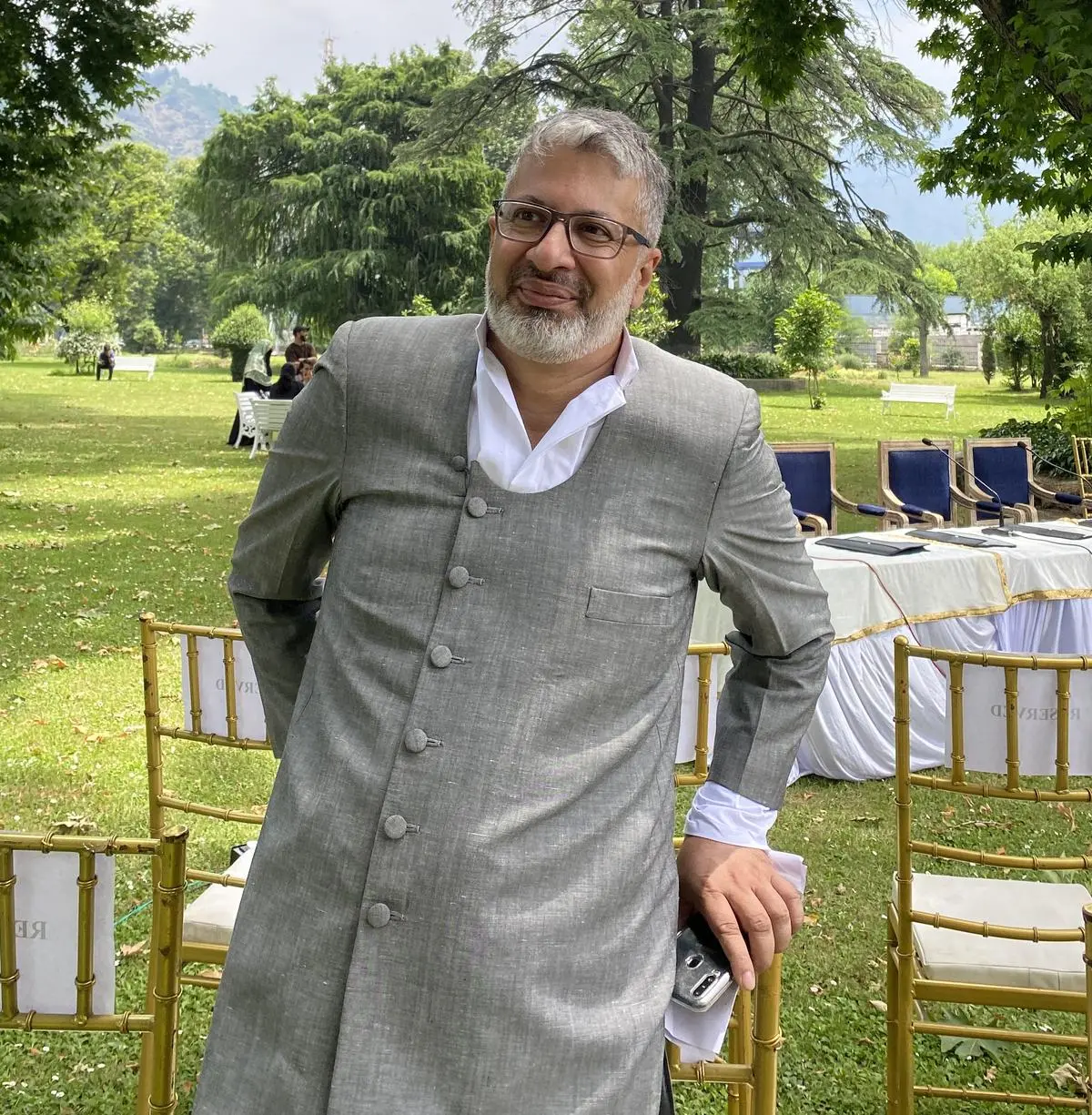
Hakim Sameer Hamdani, Srinagar-based architect and art historian who led the documentation project. Hamdani is Design Director with INTACH, Jammu & Kashmir. | Photo Credit: By Special Arrangement
The medieval era in Kashmir, particularly the 14th and 15th centuries, when it gradually transitioned to Islam, has been sought to be presented in contemporary political and cinematic discourse as a period of widespread persecution of Hindus. The movie The Kashmir Files (2022), for example, has a scene where the protagonist describes the Kashmir of yore as a thriving seat of Hindu learning until it was despoiled by Islamic rulers in the 14th century. However, historic epigraphs such as the one in Jamia Masjid and elsewhere in Srinagar point to a culture that was more syncretic than confrontational.
With such discoveries, Hamdani’s project intends to counter the politically motivated narratives around Kashmir’s history. He embarked on the project earlier in 2024, roping in a team of heritage architects and graphic designers from Srinagar. The team consisted of Umar Farooq (Assistant Professor, Department of Architecture, Islamic University of Science and Technology, or IUST, Jammu and Kashmir), who surveyed the inscriptions; Tabish Haider (cultural activist and Young India Fellow, 2022, at Ashoka University), who took life-size images of the plaques; Mehran Qureshi (Assistant Professor, Department of Architecture, IUST), who investigated the epigraphs and translated them into English; and Taha Mughal (a specialist in preservation), who rendered them into measured drawings. The team has examined several epigraphs, dating from the 15th to the 19th centuries, engraved in various heritage sites across the Valley. While the majority of them are in Persian, there are texts in Arabic and Sharda (an ancient script of Kashmir) as well.
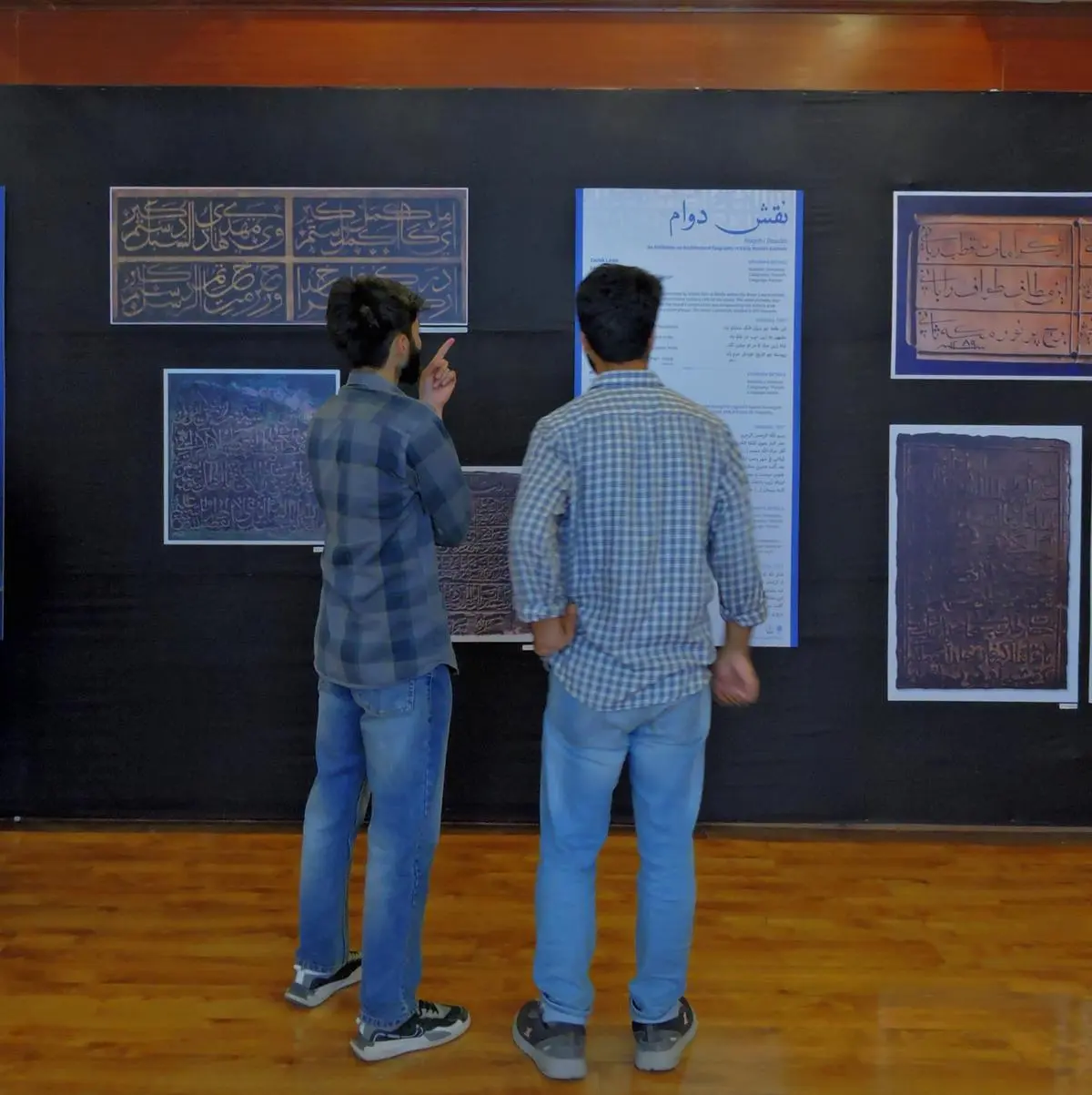
Many of these inscriptions have been rendered almost undecipherable by the passage of time—the main reason why they had escaped the attention of historians so far. Hamdani and his team used technology and linguistic expertise to decipher their content and to bring the information to the public domain for the first time. Of the over 100 slabs that the team has investigated across Kashmir, the details of 40 were catalogued and put on display in an exhibition, “Naqsh-i-Dawaam”, held in Srinagar in June 2024. Hamdani is currently writing a coffee-table book that will make the findings accessible to readers across India and the world. Qureshi is further expanding the scope of the investigation by surveying similar inscriptions found in medieval-era tombstones in Kashmir. Qureshi’s work is sponsored by the Netherlands-based Prince Claus Fund while the grant for Hamdani’s project came from London’s Barakat Trust, which researches the art, architecture, and history of the Islamic world.
_______________
Highlights
A documentation project undertaken by Srinagar-based architect and art historian, Hakim Sameer Hamdani, has added layers to Kashmir’s history, challenging its unipolar representation in popular narratives.
———— Of the over 100 slabs that Hamdani’s team has investigated across Kashmir, the details of 40 were catalogued and put on display in an exhibition, “Naqsh-i-Dawaam”, held in Srinagar in June 2024.
———— Hamdani is currently writing a coffee-table book that will make the findings accessible to readers across India and the world.
________________________________
“The idea was to add a layer of nuance to Kashmir’s history,” Hamdani said while talking about his project. “We tried to flesh out what we already knew about the transmission of knowledge and culture from the Central Asian regions into Kashmir at the onset of the Sultanate period in the 14th century.”
Adding layers
The investigation has added layers to the understanding of Kashmir’s history. Take the Jamia Masjid slab, for instance. It dates back to 1622, when Jahangir was the emperor of Hindustan. In 1589, Jahangir’s father, Akbar, had forced Kashmir to surrender its sovereignty to the larger Mughal Empire. This created resentment, sparking off rebellion and political unrest that continued for years until a semblance of stability was achieved during Jahangir’s rule. To mark the end of hostilities, Jahangir commissioned a renovation of the mosque and installed the slab, which attempts to naturalise him as the legitimate ruler of Kashmir.
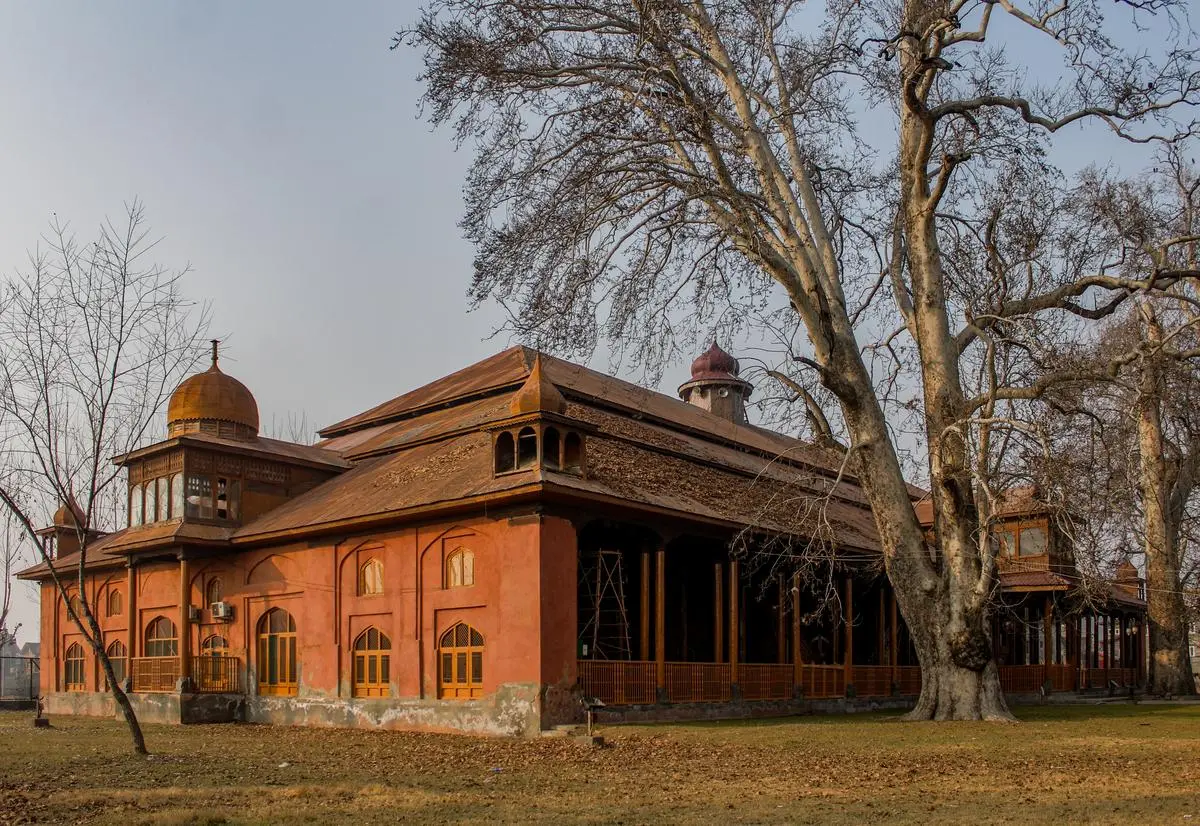
The 15th century Aali Masjid, Srinagar’s second largest mosque. It combines Mughal, Kashmiri and Safavid architectural styles. | Photo Credit: Tabish Haider, Barakat Trust
Hamdani said: “The text seeks to connect Jahangir to a historical project, showing him as continuing the work of the sultans of Kashmir, who reigned before the Mughal annexation.” The association of a Hindu craftsman with a major imperial programme tells us something about the prevailing milieu, where royal patronage could be sought and obtained regardless of the craftperson’s religious affiliation.
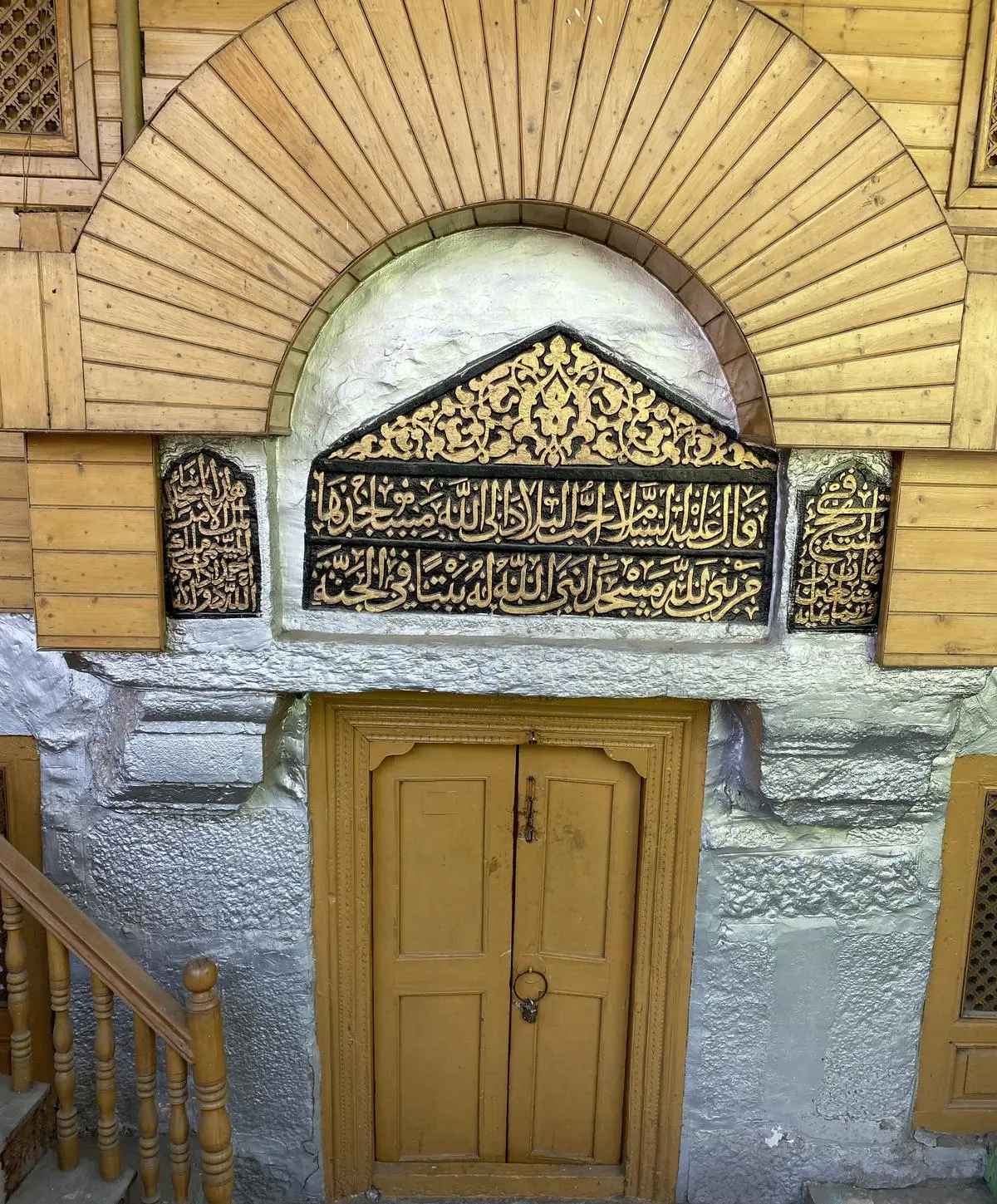
The idea of exploring epigraphs to unravel history came to Hamdani when he was working on his thesis on Islamic architecture at the School of Planning and Architecture, New Delhi, six years ago. As part of his study, he examined extant Islamic epigraphs in the monuments and buildings of Kashmir. Among the ones he analysed was an Arabic hadith (essays on the words and actions of the Prophet Muhammad) etched on the 15th century hospice of a Sufi mystic, Malik Ahmad Itoo, located at Safa Kadal in Srinagar city. It is a small hermitage on the banks of the Jhelum river. The verses, engraved on the shrine’s tympanum, remind the faithful of the spiritual rewards that would accrue to the builder of a mosque.
The Persian slab inside Aali Masjid which identifies the architect of the mosque as Raja Bihisti Zargar. | Photo Credit: Tabish Haider, Barakat Trust
Hamdani said: “Such inscriptions, commonly seen in Kashmiri shrines, are different from medieval Islamic epigraphy found in Delhi.” Speaking of the latter, the scholar Anthony Welch said that their “principal function in late-twelfth-century India was to warn the non-Muslim majority to accept Islam” (in his 2008 essay, “The Emperor’s Grief: Two Mughal Tombs”). The epigraphs associated with early Islam in Kashmir, by comparison, are devoid of such hegemonic overtones. “Their stress is rather on cultivating personal piety,” Hamdani said.
His project has thrown up unexpected stories that often go against the recorded textual histories of Kashmir. Consider the case of Aali Masjid, Srinagar’s second largest mosque. The 15th century mosque embodies a fusion of Iranian, Mughal, and Kashmiri architectural styles. Added during a renovation in the 17th century, the balusters of its portico rest on distinct stone bases reminiscent of those of Safavid pavilions in Iran; the technique was brought to Kashmir by the Mughals. Although the 1887 Persian text Tarikh-e-Hasan—thought to be an authoritative commentary on Kashmir’s medieval history—attributes its construction to Ali Shah, the eighth sultan of the Shahmirid dynasty, the stone slab restored by Hamdani names a different patron: Sultan Hasan Shah, who reigned 50 years later. The epigraph identifies Raja Bihisti Zargar as the architect of the mosque.
Startlingly, the same name was once engraved on a stone pillar inside Srinagar’s Shankaracharya temple. Today, no trace of this inscription remains in the temple, but it is important to remember its existence in view of recent attempts to polarise sentiments by creating a controversy over the name of the Shankaracharya hill, also called Takht-e-Suleiman.
The Shankaracharya temple is one of the oldest temples in Kashmir, mentioned by Kalhana, author of the 12th century Sanskrit text Rajatarangini (River of Kings), which gives a history of Kashmir. The Rajatarangini remained a text in progress for a long time, with Brahmin court historians adding bits to it at different periods. After Kalhana, Jonaraja took it up in the 15th century, followed by Srivara and Shuka in the 16th century.
The hadith inscription on the shrine of Sufi mystic, Malik Ahmad Itoo, in Srinagar. It is one of the earliest surviving Islamic epigraphies in Kashmir. | Photo Credit: Shakir Mir
Hamdani’s team was able to access a preserved facsimile of the temple epigraph in a book titled Illustrations of Ancient Buildings in Kashmir (1869), based on a survey conducted under the Archaeological Survey of India by Henry Hardy Cole. In the survey, Cole suggested that the inscriptions (there were more than one) were linked to repair work done in the temple in the 16th century. But he could not identify the ruler under whose leadership the work was carried out.
Cole was not the only one whose interest was piqued by the presence of Persian inscriptions inside a Hindu temple. The British explorer Alexander Cunningham (1814-93) also mentioned them in his “Essay on the Arian Order of Architecture in Temples of Kashmir” (1848), which says that he had copied out an inscription (a different one at the same site): “but since then it has been so completely defaced by the Dogar [Dogra] soldiery that I could with difficulty trace the name of Takht-i-Suliman”.
Later, in 1875, a group of European travellers made another attempt to decode the writings, scrawling a rudimentary translation in their diary. “This idol… was made by Haji Hashti… in the year 54 of the Samut (Samvat) or Hindoo era,” they wrote, adding that “the foot of the back part of the pillar states that he who raised up this idol was Quajah Rukm, son of Mirjan.”
The case seems to be have been buried in 1935 after it received a clumsy dismissal from an antiquarian, Pandit Anand Koul, who concluded: “Islam was unknown in that remote period when this temple was built, so there could not have been a Khwaja or a Mir then…. Nor would a Muhammadan build a temple as his own” (Archaeological Remains in Kashmir, 1935).
The restored epigraphs were put on display at an exhibition in Srinagar in June 2024. | Photo Credit: Tabish Haider, Barakat Trust
But when Hamdani’s team examined the Aali Masjid slab, a different story emerged: the Muslim architect (Raja Bihisti Zargar) responsible for designing the mosque was the same one who oversaw the repair of the Shankaracharya temple in the 16th century. This suggests that even in the late Sultanate era, often depicted as a period of widespread destruction of Hindu places of worship, Muslim rulers continued to extend their patronage to Hindu cultural spaces. Understandably, the Dogra militia had tampered with this evidence in the 19th century.
Folds of history
Another epigraph documented by Hamdani was written in Sharada on the limestone wall of a 15th century almshouse at Khonmoh in Srinagar, built by a Hindu merchant, Purnaka. The text seems to heap praises on one of the Shahmirid kings by describing him as the son of the “illustrious Sakandra” (Sultan Sikandar). The effusive language used for Sikandar by a Hindu merchant is especially significant because the sultan was depicted as an iconoclast by the contemporary Brahmin chronicler Jonaraja in Rajatarangini. Jonaraja’s characterisation of Sikandar was perpetuated by colonial historiographers. In his 1848 booklet, Cunningham invoked the “destroying hand of Mahomedan [sic] bigotry” to explain the ruin into which Kashmir’s ancient temples had fallen.
But the Khonmoh inscription reveals that there existed a multiplicity of narratives around Sikandar in the 15th century and not all of them told the same story. “We are not denying that persecutions have happened in the past,” Hamdani said. “Our project drives home the point that history never uncoils in a linear way. History has many folds, each one with layers and textures of its own.”
Shakir Mir is a freelance journalist based in Srinagar. He was previously a correspondent with The Times of India.
source: http://www.frontline.thehindu.com / Frontline / Home> Arts & Culture> Heritage> History / by Shakir Mir ./ September 13th, 2024
Among the change makers from Kerala are pioneers and achievers in various fields of life. They have either been trying to bring about changes in society or the fields of business. They have used music, literature, and sometimes love to bring humanity closer, to spread joy and peace.
The list includes social activists, singers, spiritual mentors, lawyers, teachers, and even IAS officers.
Ayisha Abdul Basith
Ayisha sings Naat or Islamic devotional songs, and at the age of 20, she has enthralled listeners in over 80 countries. Born in Kerala, Ayisha has migrated to Abu Dhabi, where she is pursuing spiritual music as a way to universal peace and joy, as she puts it.
Safna Nazruddin
She dreamt of becoming someone who could help the disadvantaged sections of society. Safna Nazruddin thought being an IAS officer would help her achieve that goal.
And she took her dream so seriously that at the age of 23, she became Kerala’s youngest Muslim IAS officer.
PC Musthafa
He wanted to pull his family out of their poverty. Growing up in rural Wayanad, watching his father toil in the fields as a farm labourer, he wanted to change his parents’ lives for the better.
When he completed his studies at IIM, he started small with his cousins in a 500 square feet room, selling 100 packets of idli batter to 30 shops in Bangalore.
Today, he is the king of idli batter supplying in more than 10 countries outside India and reigning over a 4000 crore business.
VP Suhara
VP Suhara has been fighting for changes in the Muslim personal law and is one of the petitioners appealing for equality of gender in the matter of succession rights.
She says she is not very optimistic, but she is not ready to give up her fight.
Kadeeja Mumtaz
Kadeeja is a novelist who won the Sahitya Academy award for her novel. But today she has taken to activism on a full-time basis, and her main preoccupation is with bringing different religious communities together to improve mutual understanding and communication.
Advocate Sukkur
Advocate Sukkur did the unthinkable when he remarried his legally wedded wife just to make a point to all his fellow Muslims.
He wanted to tell them that they can overcome the barriers to succession rights of their daughters by remarrying their spouses under the Special Marriages Act.
Noor Jaleela
Noor means light, and the luminous smile on Noor Jaleela’s face echoes her name. She was born without her four limbs. But her smile does not betray any such disability. She has been a model for courage and creativity in the worst circumstances.
She has been an influencer and also an artist, and a singer.
Padma Shri Mumtaz Ali
Mystic and spiritual mentor Padmashri Mumtaz Ali, or Sri M as his followers call him, hails from Thiruvananthapuram and heads a spiritual group called Satsang Foundation. His spiritual pursuits and his work among the people as a symbol of the oneness of humanity and the divine have made him transcend all man-made boundaries and divisions.
He has become an example of universal oneness and love as his life’s work and teachings appeal to people of different nationalities and religions. He asks them to continue following their religion while practising meditation and other spiritual pursuits to realise themselves.
Hadiya Hakeem
Can a football mean anything other than a game? Well, Hadiya Hakeem has turned a football into a statement for the empowerment of women.
She is a freestyle football performer born in Kozhikode who has overcome all possible barriers of gender, nationality, and religion through her talents and her hard work in excelling in a unique kind of performance.
Onampally Faisy
Progressive scholar and Sanskrit enthusiast Onampally Faisy has tried to transcend boundaries by promoting interfaith education in his madrassa. A well-known scholar from Thrissur in Kerala, he has been working towards building bridges of understanding and communication between Muslims and other communities in Kerala.
Since he believes in becoming the change he wants, he started teaching holy texts of other religions in his madrassas in order to remove the veil of ignorance and bring communities closer.
source: http://www.awazthevoice.in / Awaz, The Voice / Home> The Changemakers / by Sreelatha Manon / August 17th, 2025
The bond between Assamese Hindus and Assamese Muslims is very strong and no one can easily break the traditional friendship between the two communities, Wasbir Hussain, author and executive director of Centre for Development and Peace Studies, has said.
Addressing the fourth anniversary celebrations of the Assamese Syed Welfare Trust, an organisation representing the Assamese Syeds, Hussain on Sunday urged Gauhati University to start a chair in the name of Azan Pir, a 17th-century Muslim reformer and Sufi saint, on the subject of ‘inter-faith harmony or harmony of communities’.
Assamese Syeds are one of the five Muslim groups officially recognised by the Assam government as indigenous communities of the state.
Hussain said except religion, there is no difference between Assamese Hindus and Assamese Muslims. Their language is the same, culture is the same, food habits are the same and they dress the same way, he said.
“I strongly believe that no one can easily break the traditional bond of friendship between Assamese Hindus and Assamese Muslims,” he said.
Hussain, who is also the editor-in-chief of Guwahati-based Northeast Live, spoke about how the indigenous Muslims of Assam follow cultural Islam compared to religious Islam and live peacefully with the larger Hindu population of the state.
He complimented Assam Chief Minister Himanta Biswa Sarma for taking initiatives for the protection of the heritage of the Assamese Muslim community and its overall growth.
Gauhati University Vice Chancellor Nani Gopal Mahanta, the chief guest of the event, said people or communities can have multiple identities that transcend religion.
He cited the example of Assamese Muslims and Syeds who are descendants of Sufi saint Azan Pir, saying they are part of the greater Assamese society.
Mahanta assured that he will push for the Assamese Syed Welfare Trust’s proposal to introduce the Azan Pir chair in Gauhati University and that he will work towards republishing the works of renowned Assamese writer Syed Abdul Malik’s ‘Jikirs Aru Jari’.
Assamese Syed Welfare Trust president Syed Abdul Rashid Ahmed also spoke on the occasion.
source: http://www.english.varthabharati.in / Vartha Bharati / Home> India / by Vartha Bharati / January 20th, 2025
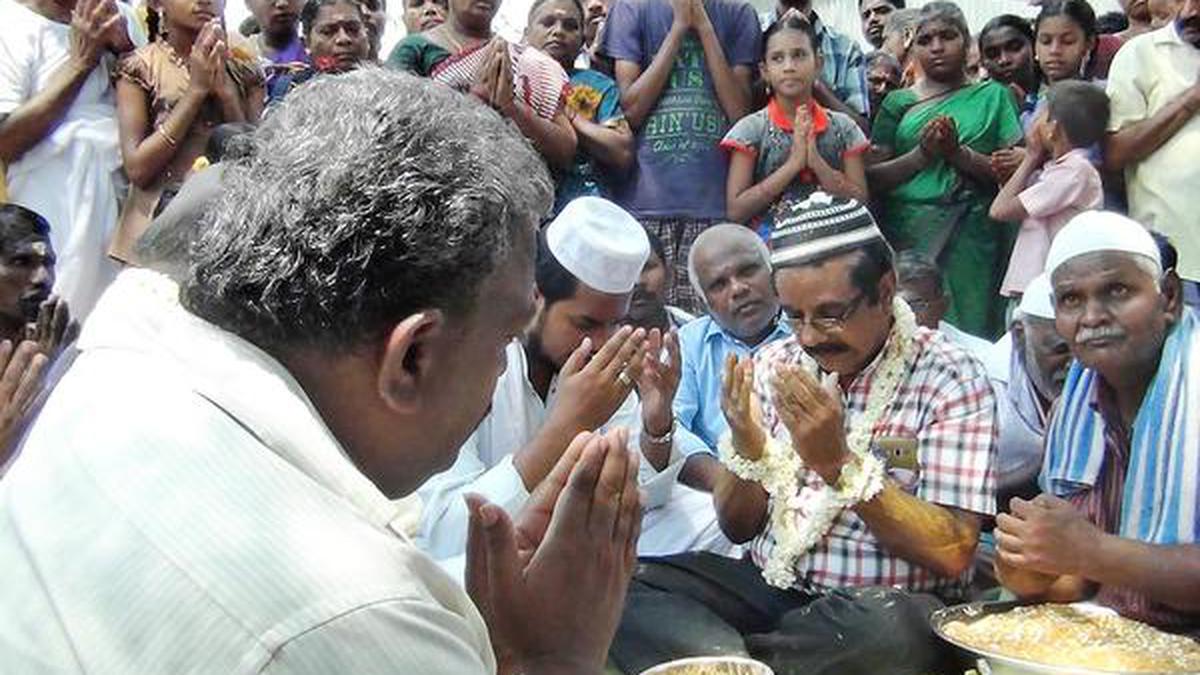
Joint celebration: Hindus and Muslims at the valediction of the Panguni Uthiram festival in Namakkal.
By honouring members of the Muslim community at the annual Panguni Uthiram festival on Wednesday, the Hindus in Gurusamipuram, a small village near Rasipuram, have set a worthy example of communal harmony.
It is a thanksgiving gesture to the Muslims of Rasipuram town, whose forefathers were believed to have cured through prayers many children of the Hindu community of cholera.
This practice has been in vogue for over a century now, the village elders say.
The Panguni Uthiram is a major festival of Arulmigu Sivasubramaniar Temple and is celebrated with usual gaiety every year. It is at the valediction of this festival the Hindus honour the Muslims.
According to K. Thalamuthu, a former school headmaster and president of the Sengunthar Nala Kalvi Arakkattalai, and Devarajan, its treasurer, many children of the weaver community in Gurusamipuram were affected during a cholera outbreak in the village.
On learning about this, the Muslims of Raispuram who used to visit the village for business transactions, offered special prayers by tying a white holy flag to a tree. They smeared sandalwood paste on the doors and walls of each and every house in the village. Following this, all the children were believed to have recovered.
Since then, the residents of the village make it a point to honour the Muslims of Rasipuram at the annual Panguni Uthiram festival.
The organising committee of the festival visited Rasipuram and extended invitation to members of the Muslim community belonging to Achukatti Street Mosque Jamath.
The Jamath members, accepting the invitation, visited the village on Wednesday with fruits and sweets . The Hindus and Muslims holding the holy white flag went through all the streets in the village, when the Muslims smeared sandalwood paste on the doors of all the houses. After tying the flag to the tree, which is popularly known as ‘jhanda’ (flag) tree, they assembled at the Paavadi ground.
The Hindus honoured the visiting Muslims with garlands and vice-versa. Special ‘fathiha’ was recited by the Muslim religious scholar for communal harmony , followed by the distribution of a mixture of jaggery and roasted gram by the visitors.
Later the Muslims took leave.
“This is a worthy gesture practised by our forefathers and we are continuing this tradition in the interest of strengthening the bond between both the communities for decades together,” says Mr. Thalamuthu.
source: http://www.thehindu.com / The Hindu / Home> Today’s Paper> National> Tamil Nadu / by Syed Muthahar Saqaf / April 15th, 2017
The Margazhi Peruvizha Committee functioning in the city has set a worthy example for communal harmony for other associations to emulate by inviting scholars of other faiths to address the Margazhi and Navarathri festival programmes.
T.M. Abdul Khader, an eminent Tamil scholar and former Head of the Department of Tamil, Islamia College, Vaniyambadi, is a regular at the Margazhi and Navarathri festival programmes here for the past 15 years at a stretch, along with the scholars of other faiths.
The Margazhi Peruvizha Committee has been organising special discourses, lecture programmes and poets’ symposium etc for the past 33 years without any break during the Margazhi and Navarathri festivals.
The committee members have been ardent followers of Vallalar, a famous Tamil saint and one of the greatest poets, who endeavoured to eliminate caste and promote a society sans religious and caste considerations.
The committee has been organising programmes to create awareness on the religious practices which had negative impact on the entire society. It invited scholars of all religious faiths from across the country and also from Sri Lanka to address its members.
According to A.K. Palaniappan, president of the Margazhi Peruvizha Committee, the Navarathri festival is celebrated for 10 days and the Margazhi festival for about a month every year.
The committee has made it a point to invite like-minded scholars from all faiths to participate in their programmes. “Kavikko” Abdul Rahman and Periyar Dasan, who later converted to Islam, have addressed the Margazhi gatherings in the past.
Mr. Palaniappan said that Prof. Khader has been attending the Margazhi and Naravathri programmes for the past 15 years. His lectures always evoked good response and the jam-packed hall on Saturday when he spoke on the topic ‘Bothimarathu Kilaiyil Poonthamizh’ (Tamil on the branch of Bothi tree) was an ample proof of his popularity with the local audience, he said.
Prof. Khader also presided over the poets’ symposium on the topic ‘Kodugalal or Kolam’ on Sunday evening.
Mr. Palaniappan said Jegath Gaspar Raj, a Chennai-based Catholic priest and founder of the “Tamil Maiyam”, will be addressing the gathering on January 5.
Politicians including Vaiko and Nanjil Sampath have also addressed these festivals.
Another highlight of both the festivals organised by the committee is the equal importance given to women. Many women scholars are regular in delivering special addresses at these meetings.
Uma Devarajan of Salem, N. Vijayasundari of Tiruchi, Devi Gunasekaran of Salem, Desa Mangaiyarkarasi of Chennai, and M. Uma Maheswari of Coimbatore are among the list of speakers for this year’s meetings.
source: http://www.thehindu.com / The Hindu / Home> Today’s Paper / by Syed Muthahar Saqaf / January 02nd, 2017
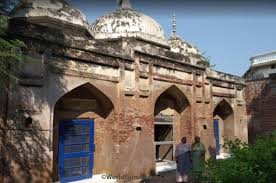
A 17th century mosque in Punjab declared declared as a symbol of religious tolerance by the UNESCO and UNDP has no Muslim worshippers. Called Guru ki maseet (Mosque of the Guru) it is being looked after by the Sikhs.
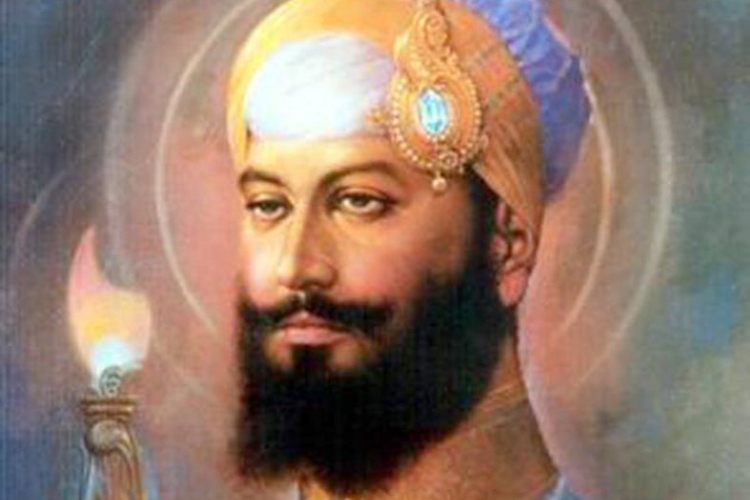
Its story dates to the early 17th century. When the sixth Sikh Guru, Hargobind Singh, took over the throne, Emperor Akbar’s efforts to bring all religions together had already failed. In the reign of Jahangir, animosities based on religious difference had begun to surface across India.
Soon, Hargobind Singh realized that in the midst of growing tension and threats, only spirituality would not work.
With this idea, Guru Hargobind Singh started wearing two swords on his body. He called them the swords of Piri and Miri. Piri referred to spirituality and Miri to power. He also raised an army to fight wars.
In one of his armed campaigns, his army camped on the banks of the Beas River. Soon a big settlement came up here and it was called Hargobindpur. Today one can reach this place while travelling on Hoshiarpur-Batala Road in Punjab.
The township had people of all religions. Soon a temple and a Gurudwara were built there. There were only a few Muslims there and they had no place of worship. As their numbers were low, building a mosque was not feasible at the community level.
They went to Guruji and told him their problem.
Guru Hargobind Singh instructed his authorities to build a mosque for the Muslims to worship. In no time the mosque was built on a small hillock on the banks of the Beas River. The sound of Azan from the mosque reverberated in the air for the next several hundred years.
Guru ki Maseet at Hargobindpura, Punjab
However, after the partition of India and many Muslims leaving for Pakistan in 1947, this mosque was deserted. All the Muslim families of Hargobindpura had left for Pakistan.
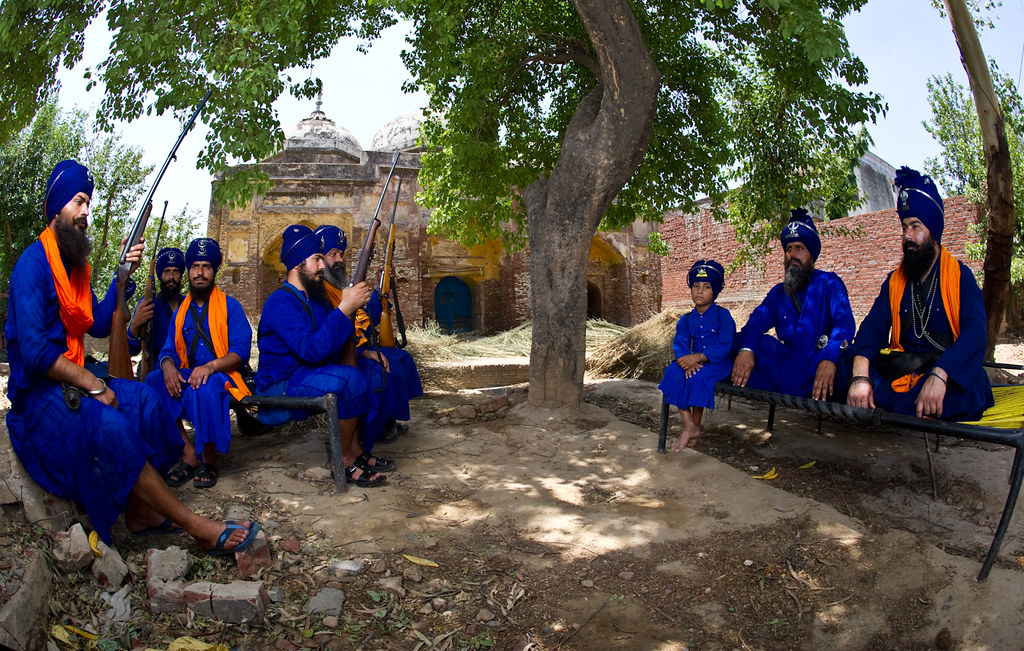
As the mosque was related to Guru Hargobind Singh, the Nihang Sikhs built a Gurudwara there. Today, the sounds of Gurbani resonate there the place every morning and evening.
In the last decade of the twentieth century, Muhammad Rizwanul Haq of the Punjab Waqf Board visited the town and met many Sikh leaders. He requested the Sikhs that since this mosque was built on the orders of Sikh Guru it should be allowed to remain a mosque.
The Sikh leaders consulted historians; they too concurred with the idea of the place being retained as a mosque.
Soon a consensus was reached. Once again the kar seva started and the mosque was renovated. Some people from the Punjab Waqf Board also came there but most of the kar seva was done by Sikhs.
Nihang Sikhs who look after the mosque sitting outside Guru ki Maseet
The mosque was restored to its original shape in 2002.
For its inauguration, the locals invited Imam Maulana Hamid Hussain Qasmi of Amritsar’s Jama Masjid to lead the Eid-ul-Fitr prayers at the mosque.
Even today there is no Muslim living in Hargobindpur and yet the mosque stands tall. Today, Guru ki Maseet is cared for by Nihang sevadars.
In 2003, this historic mosque gained international recognition when UNESCO and the UNDP’s Culture for Peace project highlighted its importance as a symbol of religious tolerance.
(The author is a senior journalist)
source: http://www.awazthevoice.in / Awaz, The Voice / Home> Stories / by Harjinder / April 01st, 2025