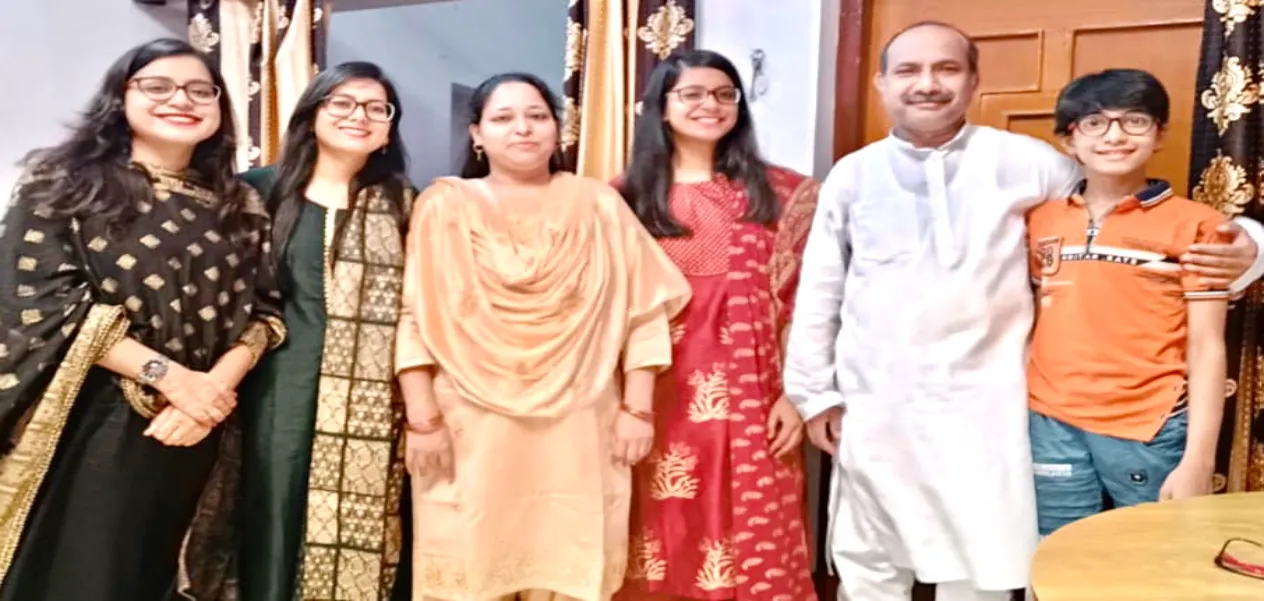
Sherghati, a small town in the Gaya district of Bihar which till recently was known for the Naxal insurgency is in the news for good reason. Three daughters of a local artist Imran Ali – Bushra, Saadia, and Anam – are studying to become doctors.
The three sisters are perhaps the first ones from a middle-class Muslim family in the district to have achieved this distinction.
In the recent NEET examination Bushra, the youngest of Ali’s daughters was declared successful and she followed in the footsteps of her sisters, Saadia and Anam, and joined the Medical College.
Aman Imran, the firstborn of Imran Ali and Zareen Kausar, is pursuing her doctorate from the National Institute of Homeopathy (NIH), Kolkata, one of the country’s top medical colleges. The second daughter Sadia Emala is studying in her final year of degree course at Mahesh Bhattacharya Homeopathic Medical College and Hospital, Kolkata.
Bushra Kausar has also been admitted into the Government Homeopathy Medical College and Hospital. The sisters have chosen homeopathy.
People in Sherghati are proud of the three sisters and everyone speaks about them.
Imran Ali and Zareen Kausar live in the Urdu Bazaar locality. On May 21, Imran Ali was awarded the Rajiv Gandhi Global Excellence Award 2023 in New Delhi.
Imran Ali and Zareen Kausar withtheir daughters and son
He runs an advertising agency and undertakes projects for publicity painting and advertising flex hoardings.
He is also a musician and given his music for the Bhojpuri films. He also performed the official functions on Republic Day and Independence Day for two decades.
Anam, Saadia, and Bushra grew up in a middle-class family, and through hard work reached this position.
The Sherghati sub-division was once highly infested with Naxal violence.
While studying at DAV, Bushra Kausar became the state topper in the inter-school slogan writing competition and was awarded ₹ 10,000 by the then Deputy CM of Bihar Sushil Kumar Modi.
She cleared her medical entrance examination on her second attempt and got admitted into the Medical College. She is planning to sit again for NEET to join the MBBS course in a medical college.
Imran Ali and Zareen Kausar believe that daughters are born to lucky parents.
Zareen Kausar said that along with becoming doctors, her daughters have set their eyes on the civil services. “You should not ignore your daughters but give them enough opportunities to move forward,” she said.
source: http://www.awazthevoice.in / Awaz, The Voice / Home> Story / by Seraj Anwar, Patna / November 09th, 2023
Suhra fought with her family and patriarchal society at large to pursue higher education, overcoming many hurdles.
Suhra with her daughter / Picture by Abdul Shafeeque KP
Jamia Millia Islamia, one of the heritage universities of our country, last year celebrated its 102nd foundation day. Gerda Philipsborn was a founding member of Jamia who fled from Germany when the Nazis came to power. Her biggest contribution to the university was to take care of young children. To commemorate her, Jamia named its daycare centre after her.
Comparing Suhra Hasan to Gerda Philipsborn may be a stretch, but Suhra somewhere touches the motive of Gerda’s foundational ideas. She hails from a village in Kerala, from a family that was expected to marry her off before the age of 20. She fought with her family and a patriarchal society at large to pursue higher education, overcoming many hurdles.
She does not call them hurdles, though, but serendipity. However, for a Muslim girl reaching college and university was a dream, mainly because of compromised economic conditions and societal and religious pressure.
What is tougher? Being a woman in our society, being married, being a mother, being a PhD scholar? Suhra is everything: a married woman, a mother, a scholar who recently finished her PhD at my university, Jamia Millia Islamia, New Delhi.
Mother scholar
Suhra joined Jamia for her PhD in 2015. She met her future husband on campus and got married in 2017, giving birth to a daughter in 2019. Usually, couples practise family planning according to comfort, affordability, etc, but Suhra planned everything around her PhD schedule.
She planned to be pregnant after fieldwork in Kerala because that needed a lot of travelling. Transcribing the fieldwork can be done sitting at home, and Suhra mentally prepared herself to go through her pregnancy during this phase because there would be less need to go out.
But nothing went to plan, and she had to take her daughter to fieldwork in unknown places in Kerala, meeting new people and exploring other dimensions of research work. “Nothing went according to plan; everything happened simultaneously,” Suhra says.
She had become pregnant in her third year of PhD, and had to visit the university to make use of the library. It was a bit awkward for her initially because this was something new on the campus. The BA students, in particular, would stare at her.
But it all turned out beautifully — people started giving her extra support, which encouraged her to be on campus during her pregnancy. Even the security guards gave her tips on how to take care of herself and what to eat during this time. She returned to her home in Kerala in the ninth month of pregnancy and took six months of maternity leave.
She returned to campus when her daughter was five months old. She did not have anyone to help her raise the child. She and her husband raised her while doing their PhD work.
The recent trailer of Anjali Menon’s film Wonder Woman has the line that “it takes a village to raise a child”, but in Suhra’s case it took a university to raise a child. “My pregnancy, my baby, my husband never become a hurdle to my PhD,” Suhra says.
Supervisor
For a PhD scholar, choosing a good supervisor is most important. Suhra got a very good supervisor who helped her with everything.
“Pregnancy is not a disease; it is something very beautiful. You are giving birth to a human, so rather than feel awkward, make good use of this time because once you give birth, you won’t have much time to study,” she advised Suhra.
Suhra lived up to the advice and made good use of her time on campus, where friends helped her with food and reminded her to take her walks and drink juice, etc.
Her husband, also being a scholar, had a busy schedule and his meetings collided with Suhra’s. So her supervisor made a comfortable space for the baby in her cabin where she brought toys and stationery. So, along with supervising her students on research, she also babysat.
Gender roles
Suhra’s husband managed to be a part of the baby’s care. But Suhra believed that in the initial stages, a baby needs its mother more than anything else, and considered herself the primary parent to some degree. But in the past one year, during her PhD submission, her husband became the primary parent. He played with the baby outside the library while Suhra studied late. She would step out of the library in time to feed her.
Talking about her husband’s support, she says: “I know we should not glorify the parenting responsibilities he has taken but considering the patriarchal set-up we are raised in, and the conditioning we have received, his role as a primary parent is immense while my presence was limited to nights.”
Umm-e-Alaa
Umm-e-Alaa is Suhra’s Instagram handle. Alaa is her daughter’s name, and Umme-Alaa means “daughter of Alaa”. Her daughter has given her a new identity: on campus, people know her daughter more than Suhra.
Suhra’s friends keep saying stuff like “Alaa’s first walk was in Jamia”. Suhra says: “For us, Jamia is a university but for her, it is home.”
The child is familiar with all the places on campus because she has friends everywhere. Suhra writes messages on social media about her work on campus and asks people to babysit. Many come and spend time with Alaa, and that is how she (Alaa) became friends with so many people from different regions of the country.
Alaa loves the place. She has her own accreditation to departments and libraries. Jamia has a statue of Mirza Ghalib with a book in hand. Alaa calls him “Uppappa (grandfather) with the book”, her mother’s department “Ummichi’s Mam’s House”, and her father’s department “Vaappachi’s Mam’s House”.
Suhra has given her a childhood without compartmentalised relationships. For Alaa, the whole university is family, and when she goes back home she is unable to understand the concepts of “our family” and “their family”.
“Often people ask me whether it is having a child that took me longer to do my PhD. But I would say pregnancy and childbirth have been instrumental to facilitating my research,” Suhra says.
“I was in the field for data collection during my pregnancy and resumed fieldwork when Alaa was three months old. My daughter’s presence acted as a research tool that made rapport-building with families of prisoners easier. The motherhood identity acted as a cushion, and I was met with empathy by those families.”
At last, when I ask about her PhD journey, Suhra says: “My thesis is also her thesis.”
source: http://www.telegraphindia.com / The Telegraph Online / Home> India / by Nehal Ahmed / February 07th, 2023
Nilambur Ayesha, Sameera & Ayishumma Thavanur share their struggle to claim rights.
Khadeeja Mumtaz and Nilambur Ayesha during the Muslim Women’s Conference in Kozhikode on Saturday | E Gokul
Kozhikode :
The Muslim Women’s Conference with the theme ‘Equality is Justice’ held in Kozhikode became a platform for an open discussion on property rights issues being faced by women in the Muslim community and other violations of fundamental rights.
The conference organised by the Centre for Inclusive Islam and Humanism at Nalanda Auditorium on Saturday also witnessed Nilambur Ayesha, Sameera Bukhari and Ayishumma Thavanur sharing the struggle they took up to claim their rights in the community.
“Women should be treated with respect and love. In Kerala, many women are suffering torture from their husbands and in marriages, they are just focusing on mahr and dowry. After receiving dowry, the women are treated in a pathetic manner,” said Nilambur Ayesha, who also shared how she struggled to overcome the restrictions of conservatives in the community and became the first female film actor from the Muslim community.
Similar is the case of Ayishumma Thavanur who has been fighting for the past five years for her three daughters to inherit their sole property. “Since we don’t have any sons, our sole property, which was registered under my late husband’s name, has to be partitioned and a portion should be given to the husband’s brothers also. As per Islamic law, my daughters can’t inherit the property fully. But we are facing financial issues and we are fighting for my daughters’ rights. God didn’t make such rules that make human lives difficult, but they are made by the elites and patriarchal society. This should be changed,” Ayishumma said. Meanwhile, Sameera Bukhari shared her painful experiences that she faced in her married life and how she overcame it and became a motivational speaker.
C H Musthafa Moulavi, advisor for the Centre for Inclusive Islam and Humanism, said that Muslim Personal Law is entirely against the teachings of the Quran. The conference had special sessions led by experts on various issues being faced by Muslim women such as inheritance, guardianship of children and permitting divorce in marriages.
source: http://www.newindianexpress.com / The New Indian Express / Home> States> Kerala / by Express News Service / March 05th, 2023
Minoo Mumtaz aka Malikunnisa Ali, the veteran Hindi actor and comedian Mehmood’s sister, died in Toronto in Canada on Saturday.
She was recently diagnosed with cancer and her health deteriorated quickly, leading to her demise, ETimes reported.
Mumtaz’s nephew Naushad, confirming the news to the publication, said, “Since she was old, 80 plus, there wasn’t much to be done. She was one of the loveliest people I had ever met”.
Her younger brother Anwar Ali, who is also part of the film industry and is now a producer, wrote, “Regret to inform that my loving sister Minoo Mumtaz, passed away (in Canada) a few minutes ago… Deep gratitude to the film fraternity, press, media, fans, friends, for decades of love and adulation showered upon her.”
Born to a family of four brothers and four sisters, Mumtaz was the daughter of Mumtaz Ali, a dancer and character artiste in Hindi films in the 1940s. She was renamed Minoo by actor Meena Kumari, her sister-in-law and Mehmood Ali’s wife.
While she started her career as a stage dancer, Mumtaz appeared in several Hindi films in the 1950s and 1960s as a dancer and character actor. She made her debut with Sakhi Hateem, and moved on to play the lead opposite Balraj Sahni in Black Cat (1959) and appeared in several Guru Dutt films including Kaagaz Ke Phool (1959), Chaudhvin Ka Chand (1960) and Sahib Bibi Aur Ghulam (1962). Other Hindi films that she appeared in include Taj Mahal, Alibaba,Ghoonghat, Ghar Basake Dekho, Insan Jaag Utha, Sindbad, Jahanaara, Aladin, Gazal, Dharmaputra. She also appeared in the 2002 television serial Chalo Chale Pardes.
Expressing her condolences on the late actor’s demise, author Bhawana Somaaya wrote, “#MinooMumtaz lead dancer of Hindi movies in the 50s and the 60s dies in Canada. Condolences to #AnwarAli family.”
Actor Nasirr Khan also mourned Mumtaz’s death.
Mumtaz is survived by her husband Sayyed Ali Akbar, son and three daughters who lived with her in Toronto.
Namrata Ganguly is a Correspondent at Silverscreen India, and can be reached by email at namrata@silverscreen.in
source: http://www.silverscreenindia.com / SilverScreen India / Home> Hindi> News / by Namrata Ganguly / October 23rd, 2021
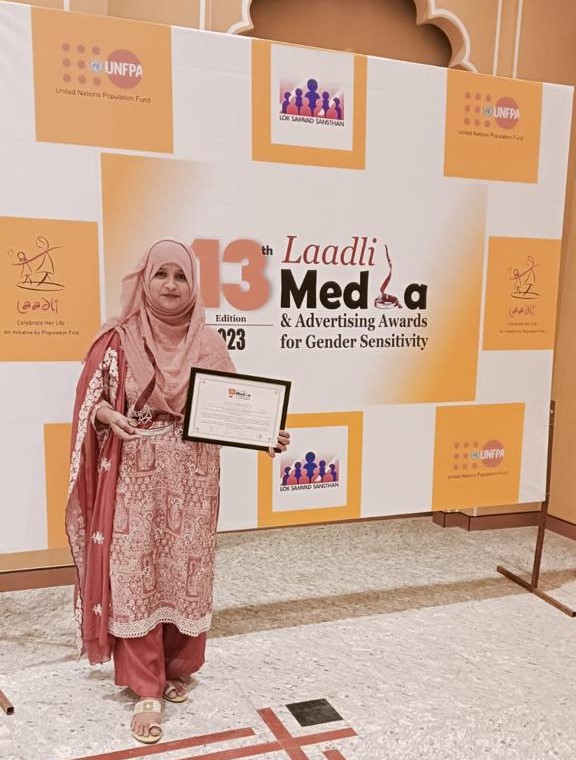
We are happy to announce that TCN’s SEED Fellow Sufi Parween has won the 13th Laadli Media Award for her exceptional contribution to gender-sensitive reporting.
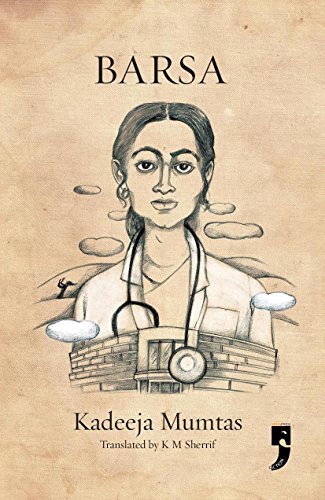
Barsa, written by Kadeeja Mumtas, is the first Malayalam novel to be set in Saudi Arabia and as its introduction states, is a record of “a woman’s scrutiny of Islamic scriptures and Muslim life”.
Barsa, as its introduction states, is the first Malayalam novel to be set in Saudi Arabia. Written by Kadeeja Mumtas and translated into English by K M Sherrif, the book acts as a record of “a woman’s scrutiny of Islamic scriptures and Muslim life”.
Sabitha, the protagonist of the novel, after moving to Saudi Arabia, starts questioning every aspect of her every day life – including religion.
The novel traces her personal journey as she is caught amidst culture, religion, and personal agency, and struggles to assert her own identity.
One hot afternoon, Rasheed and Sabitha first stepped out like refugees on the large expanse of land surrounding the grand mosque which housed the holy Ka’aba. Other travellers who knew their way hurriedly moved on while the two of them stood hesitantly at the crossroads, unsure of their next step. The coppery glare of the sun sat on their heads like the legs of a giant spider.
Rasheed glanced at Sabitha. He could sense her discomfort in the headscarf and the abaya, looking like a lawyer’s coat, which the Malayali workers at the airport had helped her buy. But he thought that even in those uncomfortable clothes, Doctor Prabhakaran’s niece, with her wheatish complexion, had a particular charm. He wanted to tell her this with a little smile, but with his tongue stuck to the roof of his dry mouth. He just couldn’t do it, which was a pity. If he had, maybe the wrinkles on her forehead would have lost at least one crease.
A yellow taxi backed up and stopped near them. Th e face of a man with a shabby headdress clamped down by a black ring came into view, and an arm jerked out of the window at the driver’s seat. “Fain aabga ruh?” Rasheed guessed he was asking where they wanted to go and replied, “Mudeeriya Musthashfa”—the Health Directorate. He had gleaned the Arabic expression from the conversation he had had in halting English with the Palestinian doctor they had met at the airport emergency service. He had seen Sabitha too write it down in her diary.
“Ta’al ”—come. Th e driver opened the car doors and invited them in. As he could not understand the driver’s sarcastic remark, directed obviously at his fairly large suitcase, Rasheed, with some embarrassment, chose to put it on his lap as he sat down and leaned back comfortably.
As the car sped at breakneck speed, Sabitha felt a tremor run through her, but she suppressed it immediately. She felt helpless at having to depend on a complete stranger, an Arab driver whose language she did not know. But she was also reassured by Rasheed’s presence. They had reached this far, trusting strangers, many of whose languages they did not know.
As they boarded the Saudi Airlines flight to Riyadh from Mumbai, Thambi, the man from their ticketing agents Ajanta Travels, had said reassuringly, “The flight will take about four and a half hours. Someone from the Ministry will be waiting to receive you. There is nothing to worry about, Riyadh is a nice city. Okay then, happy journey!”
From the moment Thambi, with that characteristic city dweller’s way of waving goodbye had raised his hands and walked away, Rasheed and Sabitha had taken comfort in each other’s presence. They could make this journey together only because of their decision to stick to each other, come what may. At the interview in Mumbai, it was Sabitha who was selected first, as a lady gynaecologist. The interview for ophthalmologists had not yet been conducted and, as there were a large number of applicants, Rasheed was not too hopeful of getting in. When she was asked to sign the contract, Sabitha hesitated, “I will sign only if my husband too is selected.” She had by then realised that lady gynaecologists were much in demand. “You sign; even if he is not selected, he can come with you on a family visa and then try for a job there.”
The man at Ajanta Travels, a go-getter, tried to hustle her. “No, I am not that keen to go to the Gulf to work. I will go only if he also gets a job there.” Her stubbornness paid off . An interview was fixed for Rasheed as a special case.
Excerpted with permission from Barsa, by Kadeeja Mumtas, Yoda Press. You can buy this book at 20% off at the FII-Yoda Press Winter Book Sale on 21st and 22nd December 2018 in New Delhi. For more details, check out the sale page.
source: http://www.feminisminindia.com / Feminism In India – FII / Home> Culture> Books / by FII Team / December 21st, 2018
H.S. Madhurani, working as a lecturer in city, has been selected for Eee Hottige poetry award given by Bengaluru-based Eee Hottige Readers Forum. The award carries a cash prize of Rs.10,000 and a citation.
Madhurani has bagged this award for Neeli Chukkiya Neralu, a collection of her poems.
The other winner is Dr. K. Sharifa of Kalaburagi, for her Neerolagana Kichhu, a collection of poems.
Madhurani and Dr. Sharifa will be conferred the awards during Hottigeya Honalu event at Kappanna auditorium in J.P. Nagar, Bengaluru, on Mar. 27.
source: http://www.starofmysore.com / Star of Mysore / Home> News / February 23 rd, 2022
Karnataka government has awarded the Rajyotsava award to 68 people including ISRO Chairman S Somanath and golfer Aditi Ashok.
S Somanath, Chairman, ISRO
Here’s the complete list:
The Karnataka government’s Rajyotsava Award will be given to 68 people this year, including ISRO Chairman S Somanath and golfer Aditi Ashok, for their excellent service in their fields.
The Rajyotsava Award is the state’s second-highest civilian award given by the Karnataka government annually. The 68th Karnataka Rajyotsava Awards will be conferred on the occasion of the state’s formation day on November 1. This year is the golden jubilee of renaming Mysore state as Karnataka.
Chief Minister Siddaramaiah is the head of the Award committee, who has selected the winners.
The government also decided to give 10 awards to organisations along with 68 Rajyotsava awards on the occasion of ‘Karnataka Sambhrama’.
Minister for Kannada and Culture Shivaraj Tangadagi said that it is ensured that every district has been given representation while selecting the awardees. The awardees also include 54 men, 13 women and one transgender. The list also has two centenarians.
The Rajyotsava Awardee will get cash rewards of Rs 5 lakh, a 25-gram gold medal and a plaque.
Here’s the complete list of Rajyotsava Awardees
Music/Dance
Nayana S. More (Bengaluru)
Neela M. Kodli (Dharwad)
Shabbir Ahmed (Bengaluru)
Balesh Bhajantri (Belagavi)
Sculptures/Art/Handicraft
T. Shivashankar (Davangere)
Kalappa Vishwakarma (Raichur)
Martha Jakimovich (Bengaluru)
P. Gowraiah (Mysuru)
Yakshagana
Agrodu Mohandas Pai (Udupi)
K. Leelavathi Baipadithaya (Dakshina Kannada)
Keshappa Shillikyathara (Koppal)
Dalawai Siddappa (Vijayanagara)
Folk Art
Husenabi Buden Sab Siddi (Uttara Kannada)
Shivangi Shanmari (Davangere)
Mahadev (Mysuru)
Narasappa (Bidar)
Shankuntala Devala Naik (Kalaburagi)
H.K. Karamanchappa (Ballari)
Shambu Baligara (Gadag)
Vibhuti Gundappa (Koppal)
Chowdamma (Chikkamagaluru)
Social Service
Huchchamma Chowdri (Koppal)
Charmadi Hasanabba (Dakshina Kannada)
Roopa Naik (Davangere)
Nijagunanda Mahaswami (Belagavi)
Nagaraju G. (Bengaluru)
Administration
G.V. Balaram (Tumakuru)
Film/Cinema
‘Dingri’ Nagaraj and B. Janardhana (both Bengaluru)
Theatre
A.G. Chidambara Rao Jambe (Shivamogga)
P. Gangadhara Swami (Mysuru)
H.B. Sarojamma (Dharwad)
Thaiyabkhan M. Inamdar (Bagalkot)
Vishwanath Vamshakrutha Mata (Bagalkot),
P. Thippeswamy (Chitradurga)
Medical
C. Ramachandra (Bengaluru)
Prashanta Shetty (Dakshina Kannada)
Literature
C. Naganna (Chamarajanagar)
Subbu Holeyar (Hassan)
Satish Kulkarni (Haveri)
Lakshmipathi Kolara (Kolar)
Parappa Gurupadappa Siddapura (Vijayapura)
K. Sharifa (Bengaluru)
Education
Ramanna Havele (Raichur)
K. Chandrashekar (Kolar)
K.T. Chandru (Mandya)
Sports
Divya T.S. (Kolar)
Aditi Ashok (Bengaluru)
Ashok Gagigeppa Yenagi (Dharwad)
Judiciary
V. Gopala Gowda
Agriculture/Environment
Somanatha Reddy Poorva (Kalaburagi)
Dhyavanagouda T. Patil (Dharwad)
Shivareddy Hanuma Reddy Vasana (Bagalkot)
Miscellaneous
A.M. Madari (Vijayapura)
Haji Abdulla, Parkala (Udupi)
‘Mimikri’ Dayananda (Mysuru)
Kabbinale Vasanth Bharadwaj (Mysuru)
Lieutenant General Codanda Poovaiah Cariappa (Kodagu)
Media
Dinesh Amin Mattu (Dakshina Kannada)
Javarappa (newspaper distributor from Mysuru)
Maya Sharma (Bengaluru), and Rafi Bhandari (Vijayapura)
Science/Technology
S. Somanath (Bengaluru)
Gopalan Jagadish (Chamarajangar)
NRI Kannadigas
Seetharam Iyengar
Deepak Shetty
Shashikiran Shetty
Freedom fighter
Puttaswamy Gowda (Ramangara)
Organisations receiving the Rajyotsav Award
Here’s the list of organisations which received the award.
Karnataka Sangha (Shivamogga)
B.N. Shivarama Pustaka Prakashana (Mysuru)
Mythic Society (Bengaluru)
Karnataka Sahitya Sangha (Yadgiri)
Moulana Azad Shikshana and Samaja Kalyana Sanskrithika Sangha (Davangere)
Muslim Education Institutions Federation (Dakshina Kannada)
Sneharanga Havyasi Kala Samsthe (Bagalkot)
Chinnara Bimba (Mumbai)
Maruthi Janaseva Sangha (Dakshina Kannada)
Vidyadana Samithi (Gadag)
source: http://www.business-standard.com / Business Standard / Home> India> News / by Sudeep Singh Rawat, New Delhi / November 01st, 2023
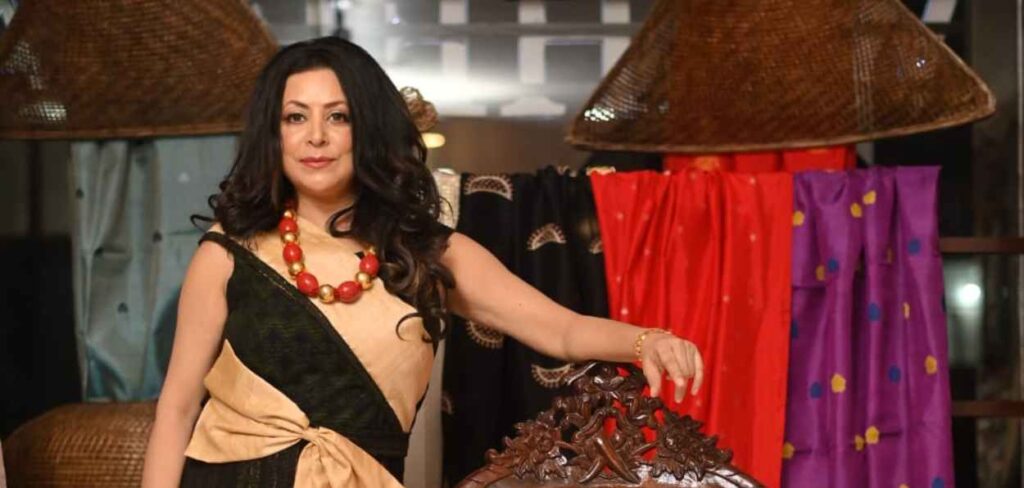
Jewellery designer and enterpreneur Waheeda Rahman
National award-winning Waheeda Rahman not only sells traditional Assamese jewellery she also extricated the traditional jewelry from the brink of extinction by designing the same.
Today Waheeda is a brand of traditional jewellery and her creations glitter in national and international markets.
Traditional jewellery is the pride of Assamese culture as it has its unique features and values. Unfortunately, many traditional pieces were about to be lost to posterity – some have already vanished – when Waheeda intervened.
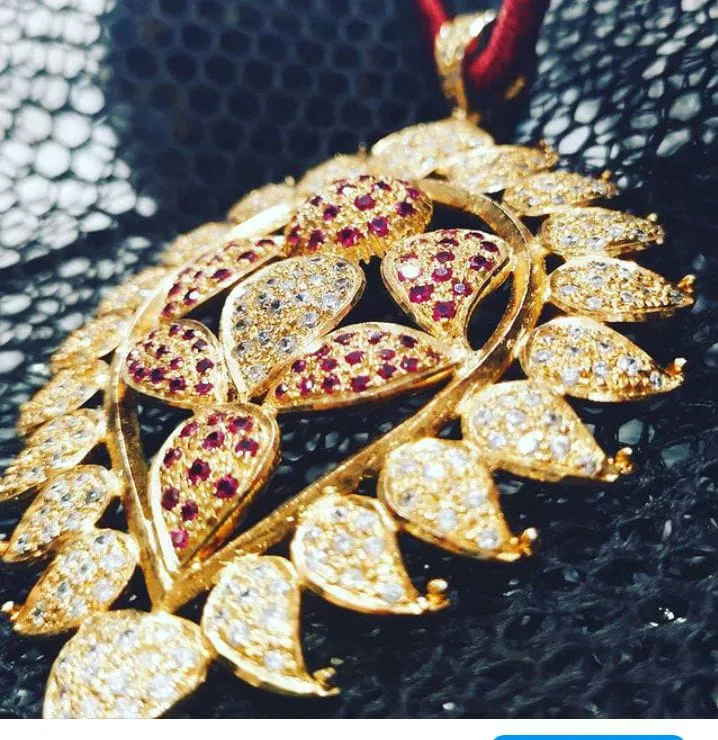
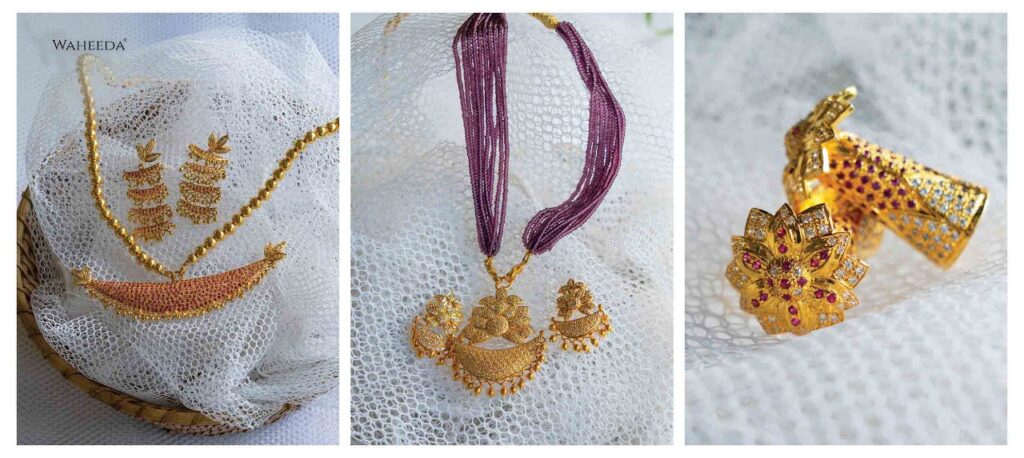
One of the jewellery pieces designed by Waheeda Rahman
Made of gold and lac, many traditional jewellery items were somewhat heavier and lacked resale value, so people reduced their use. Instead, they resorted to imported jewellery.
As a result, the popularity of Assamese jewellery gradually declined.
Nearly three decades ago Waheeda Rahman started her journey of looking for the lost and extinct ornament designs of Assam.
She travelled across Assam and collected the designs from Satras, manuscripts/ Sanchipaat, and Tai-Phake museum.
She was shocked to find that most of them had become extinct from the market. Only 12 designs were still prevalent which included Motalukaporia, Kornoxingho, and Nogortul.
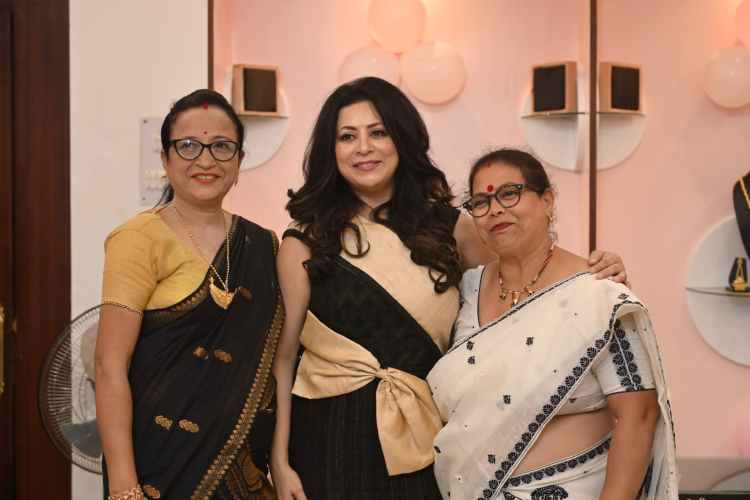
Waheeda Rahman with eminent personalities of Assam
“Since my childhood, I had a fascination for designs. I used to draw patterns on my Mathematics copy and later got caught by my teacher. Even though Mathematics was never my favourite subject, the teacher was my favorite. I used to admire the designs that I saw on the saris that my teacher wore. Then, I wasn’t quite sure that I would step into designing. But I was confident of doing something big for my Assam. Such confidence and determination have made me what I am today,” Waheeda Rahman told Awaz-The Voice.
Waheeda did in-depth research on Assamese traditional ornaments, their preparative techniques, and the causes that led to their disappearance.
She later brought all the traditional jewellery pieces to the market. Waheeda applied a new technique for quality and yet never compromised with the original design.
“The processing makes a lot of difference. Diverting from the conventional technique of using gold or silver over lac, I make ornaments of pure gold or silver because lac degrades the quality of the minerals. My jewellery with innovative designs might be a little expensive, but it is an investment for a lifetime,” Waheeda said.
Waheeda not only revived traditional Assamese jewelry but also created more than 500 new designs. Some of her original designs include the Nangol, Jakoi, and Khaloi, designs made out of motifs of different tribes, buds of tea leaves, the mist in Sohra (Cherapunjee), and the Kopou Ful among many others.
Waheeda now runs a boutique “Waheeda Lifestyle Studio” where she not only sells traditional Assamese jewellery but also traditional dresses.
She exports her jewellery to all major cities in India as well as New York, London, Australia, Germany, and several other European and Southeast Asian countries. She has created employment for many young boys and girls in the field of jewellery business.
Jewellery crafted by Waheeda Rahman
Waheeda’s journey from being a rescuer of Assamese jewellery, designer, and entrepreneur was not easy but full of challenges.
“Initially the people did not accept my jewellery saying that it are not traditional. For the initial years, I had no buyers and faced severe financial difficulties to pay my craftsmen. Moreover, many people have a prejudiced mindset that girls cannot be in the jewellery business. It is a male bastion,” the President’s medal winner Waheeda said.
But Waheeda’s work was appreciated and she was able to bring a revolution in the market of traditional Assamese jewellery.
“Jewellery designing is like miniature sculpture. It is not only about making one look good. It should bring forth the personality of a particular individual,” Waheeda said. “And for doing that, a lot of creativity goes into the metals.”
Waheeda is now planning to set up a school to train the younger generation to design and preserve traditional Assamese jewellery for the future.
source: http://www.awazthevoice.in / Awaz, The Voice / Home> Story / by Daulat Rahman & Munni Begum, Guwahati / October 28th, 2023
Siddiqui Masroor Azar and his family have lived in their Dh85,000 apartment for two years.
Siddiqui Azar and wife Nikhar Khan live in a two-bedroom apartment in Jumeirah Garden City with their two-year-old daughter. All photos: Chris Whiteoak / The National
My Dubai Rent takes you inside a reader’s home to have a look at what they get for their money, how much they pay and asks them what they like and don’t like.
Two years ago tourism boss Siddiqui Masroor Azar decided to swap his Abu Dhabi apartment for Dubai life.
The Indian citizen, who works as a lead data scientist at a bank, pays Dh85,000 ($23,140) for a two-bedroom apartment in Jumeirah Garden City, which he shares with his wife, Nikhar Khan, who owns a tourism company, and their two-year-old daughter.
The couple also run a YouTube channel, Indians Abroad, which they launched during the Covid-19 pandemic, that shares guides to Dubai with their followers.
They speak openly about the cost of living in the emirate, as well as the rules and regulations around visa applications.
One of their videos, in which they share a six-day itinerary for Dubai, as well as the most affordable places to eat and visit, has already garnered more than 1.2 million reviews.
Here, the 36-year-olds invited The National to take a tour of their property to show us why Dubai is the city for them.
What can you tell us about your apartment?
It’s a two-bedroom apartment that has a living room and a kitchen.
It’s around 1,500 square feet.
The building also has a rooftop pool, where we have great views of the Burj Khalifa.
Where did you live before?
This is our fourth apartment since we moved to the UAE in 2016.
Our first apartment was in the Al Nahda area in Dubai.
Then we moved to Abu Dhabi for work and rented an apartment in Al Nahyan.
Two years ago, we returned to Dubai.
Why did you choose this district?
We came back to Dubai because my office moved from Abu Dhabi to Dubai.
The best thing about Jumeirah Garden City is that I don’t get stuck in traffic.
My office is in Jaddaf, so it’s only a 10-minute drive from our apartment.
What kind of facilities do you have around you? We are in the middle of everything.
It takes us around 10 minutes to reach several places including the Dubai Mall, Old Dubai where they have all the restaurants we love, and La Mer Beach.
The Museum of the Future is also two minutes away.
The best thing about Jumeirah is that during winter time we can take our two-year-old daughter to Satwa Park, and it’s about a 10-minute walk.
We also have a pharmacy and supermarket nearby.
The couple brought their blue sofa to Dubai from their Abu Dhabi apartment. Chris Whiteoak / The National
Is it a sociable neighbourhood? It’s a bit difficult to make friends since we live in a city and everyone is busy with their own lives.
We do have a few friends but it’s hard to catch up. If you have time, you can make friends.
How have you made your house a home and personalised it? Before furnishing our apartment, we watched a lot of YouTube videos and explored many websites to find what suited us best.
We brought our blue sofa from our previous apartment as we love how bright and joyful it looks.
We also bought a wooden dining table, as well as plants to put in the living room as it adds a sense of cosiness to the apartment.
Any features you would change? The view from our balcony could have been better. Unfortunately it’s obstructed by surrounding buildings.
Do you think living here delivers good value for money? The rent is high everywhere in Dubai.
Location-wise it’s great because it’s close to all the places that we like to visit, so it makes it worth it.
If you compare our apartment to others that are older, you’ll understand that it’s completely reasonable for its price.
Do you plan to stay in the property?
We’ve been paying rent for years and we wanted to have our own apartment.
So last year we bought a two-bedroom apartment in Jumeirah Village Circle and we will be moving next year.
It took us around three years to save to buy the property but we’re excited.
source: http://www.thenationalnews.com / Th National / Home> Living in the UAE / by Eiman Alblooshi / October 08th, 2023
.webp)


)
:quality(70)/cloudfront-eu-central-1.images.arcpublishing.com/thenational/ZIX32OMOXFAGHBMOQZBRIABAWM.JPG)
:quality(70)/cloudfront-eu-central-1.images.arcpublishing.com/thenational/ITDY7EFQXVBYVJKHSACRJ73EIE.JPG)