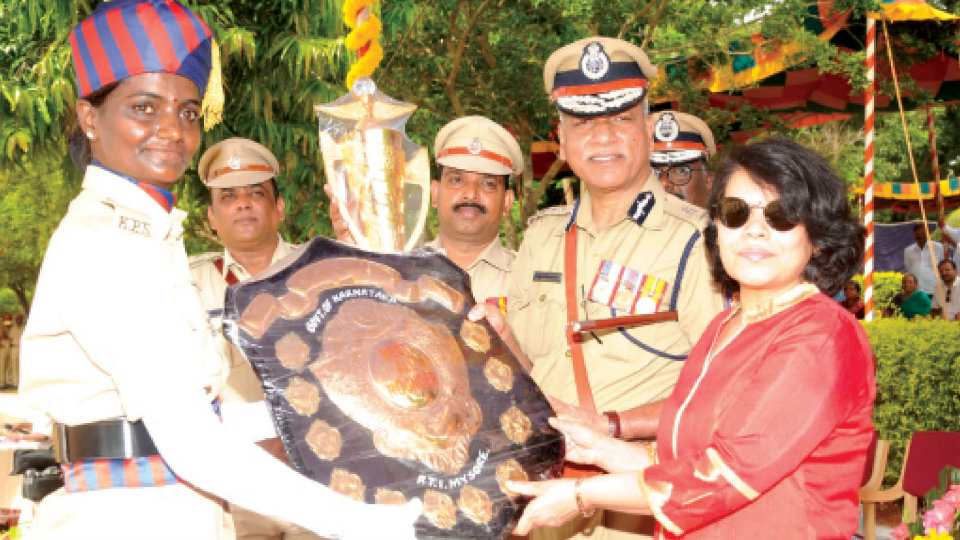
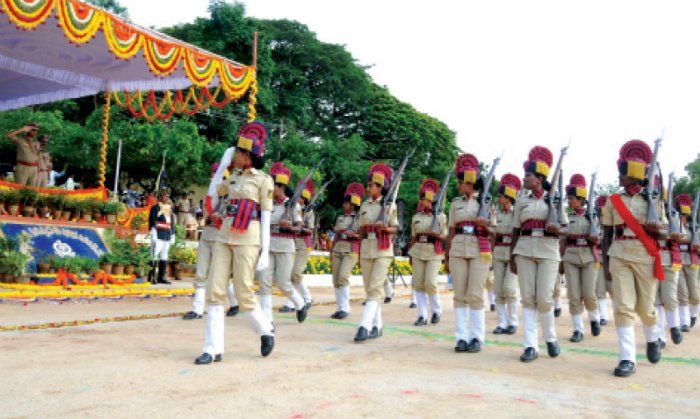
The passing out parade of the 45th batch of Women Jail Warders was held at the Parade Grounds of Jail Staff Training Institute in Central Prison premises here this morning.
Speaking after receiving the Guard of Honour, ADGP (Prisons) N.S. Megharikh said that Warders should first try to understand the mentality, body language and attitude of the inmates, as it is vital in reforming them.
Highlighting the importance of getting well versed in prison administration, he said that most of the prisoners may be victims of circumstances and as such it is important to assess their mindset.
Pointing out that it was important for jail staff to ensure their own safety while dealing with prisoners, Megharikh said that every prisoner should be given immediate medical attention when he/she falls sick.
Stressing on the need for the jail staff to be always alert, he said that although there may be a negative perception about the Police and prison staff in general, the new recruits should try to overcome this perception by working in a positive manner.
Underlining the role of prison staff in reforming prisoners, the ADGP said that the staff should ensure that the guidelines in the jail manual are properly adhered to. Calling upon the newly recruited women Jail Warders to uphold the dignity of the Prisons Department, he wished them the best in their career.
Noting that 1,070 Warders and 32 Jailors have been appointed recently, he said that the ‘Government was ready to extend any sort of support that would uphold the name of the department.
DIG (Prisons) H.S. Revanna, AIGP (Prisons) G. Veerabhadraswamy, Deputy Commissioner Abhiram G. Sankar, KPA Director (In-charge) Vamsi Krishna, IGP (Southern Range) Soumendu Murkherjee, City Police Commissioner Dr. A.S. Rao, SP Amit Singh, Mysuru Jail Chief Superintendent P.V. Ananda Reddy, Jail Staff Training Institute Principal V. Seshumurthy and others were present.
A total of 38 Women Warders passed out. Most of them were highly qualified, with one recruit Swathi of Udupi being a BE (Electrical and Electronics) Graduate, while three are Diploma holders, 4 B.Com Graduates, 2 B.Com and D.Ed Graduates, 1 M.Com, 2 MA, 1 B.Sc, 2 B.Sc and B.Ed and 22 BA degree holders. Out of the 88 trainees, only three were SSLC, the minimum qualification that was required for the appointment to the post.
Deepa Idgal of Central Prison, Belagavi was adjudge the Best Trainee in Indoor Section, while Lilofer Guttedar of Central Prison, Kalaburagi the Best in Outdoor Section, Bhagyashri Yalagi of District Prison, Chikkaballapur came first and M.R. Bindu of District Prison, Madikeri came second in Firing Section and M.N. Mamatha of Central Prison Bengaluru for Good Conduct.
Shakina Begum Nadaf of Central Prison, Bengaluru bagged ADGP and IGP Cup, while Rudravva Kurubara of District Prison, Udupi was declared as the Best All Round Performer.
The trainees had undergone a 9-month basic training that started from Aug 16, 2017 at Jail Staff Training Institute here.
source: http://www.starofmysore.com / Star of Mysore / Home> News / June 01st, 2018
Tolanur Village (Akalkot Taluk, Solapur District) ,MAHARASHTRA :
Unfovourable conditions were my inspiration, which pumped me to achieve something and bring positive and healthy change in family’s financial status, said Ayesha.
It is an inspiring story of 24 years Old Village girl Ayesha Aziz pasha Peerzade who defeated all odds and cracked the MPSC exam on her first attempt and became judge .
After four years of legal education, she has passed the first class examination of the Civil Judge Junior Division and the Judicial Magistrate. About 15,000 students from across the state sat for the exam. However, only 190 students have passed the exam and grab in the final list. Ayesha Rank is 99.
The girl who is eldest among five sisters from Tolanur, a small village in Akalkot taluka in Solapur district, has achieved a tremendous success which has brought smile on faces of her relatives and village people.
She is claimed to be the first girl in the district to be a judge at such a young age.
Tolanur is about 40 km from Akkalkot town and 70 km from Solapur city . Due to the difficulty of language in the village, Karnataka border is within walking distance of the village. Only up to 10 education facilities is available in the village.
Hence Ayesha along with her three sisters had to shift to Solapur city for higher education and she joined Dayanand Vidhi College.
During Conversation with Millattimes.com Ayesha shared, those days were challenging for us, we, four sisters used to live in small rented room for years. During stay we faced financial crunch several times.
Ayesha’s father, Azizpasha is a small landholding farmer. Agriculture is the only means of livelihood in the village. They have five daughters. But despite the circumstances, they did not allow their daughters to go away from education. Four out of five girls are highly educated. Their fifth daughter is also attending school.
He also taught Ayesha with the same amount of hard work. The family is happy after this success. Aisha also had tears of joy.
According to Ayesha in some Muslim families, girls are usually not motivated for education. But we are fortunate enough.
Credit of this success goes to my father and mother who always encourage us and take pains for our educational purposes , ”Aisha told Millattimes.com
Competitive exam guide Asif Yatnal commented that, Ayesha’s performances is encouraging. She has become a role model for Muslim community girls. We should try to create awareness among Muslim youngsters to join judiciary, Asif added further.
Adv. Asim Bangi lauded Ayesha’s success and congratulated her. He said that cracking such an important exam in a young age is really appreciable.Hope that more and more girls will take inspiration from this rural area girl’s remarkable success, added Adv. Asim.
source: http://www.millattimes.com / Millat Times / Home> Education> Muslim World / by Imran Inamdar / January 16th, 2020
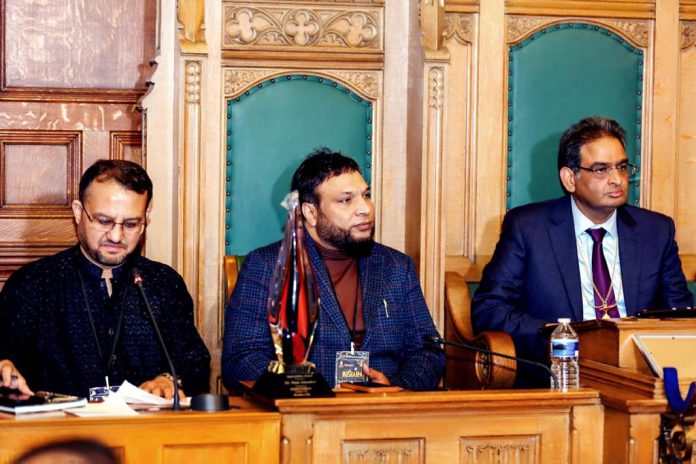
The evening of 4th November 2022 became immortal for the lovers of Urdu and Dr. Noor Amrohvi. For the first time in British history, the first ever international conference and celebration of Dr. Noor Amrohvi regarding Urdu was held at the prestigious, magnificent, and historic Ealing Town Hall in London.
Ealing Town Hall was inaugurated on 15 December 1888 by the then Prince of Wales Edward. It was Prince Edward who went on to be called King Edward VII.
For the first time in this historic town hall, hosted and chaired by the Honorable Munir Ahmed, Mayor of Ealing London, fans of Shama Urdu gathered here from all over the world
For the first time in this historic town hall, hosted and chaired by the Honorable Munir Ahmed, Mayor of Ealing London, fans of Shama Urdu gathered here from all over the world.
The mayors, councillors, literary and social journalist personalities of different boroughs of London as well as precious personalities who love Urdu participated in this celebration.
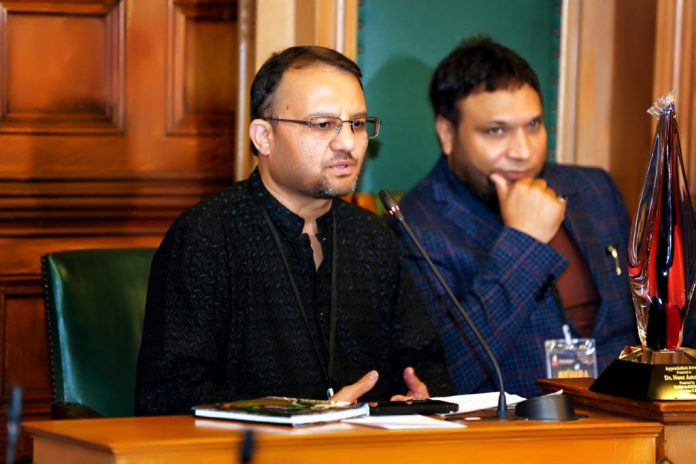
Professor Aqeel Danish, patron of Bazm-e-Sukhan Britain, thanked the guests and explained the history and achievements of Bazm-e-Sukhan, and the Mayor of Ealing London, Muneer Ahmed gave the welcome speech, while Ehsan Shahid, the leader of Bazm-e-Sukhan, recited his poems for the participants. Welcoming the guests who came to join the celebration.
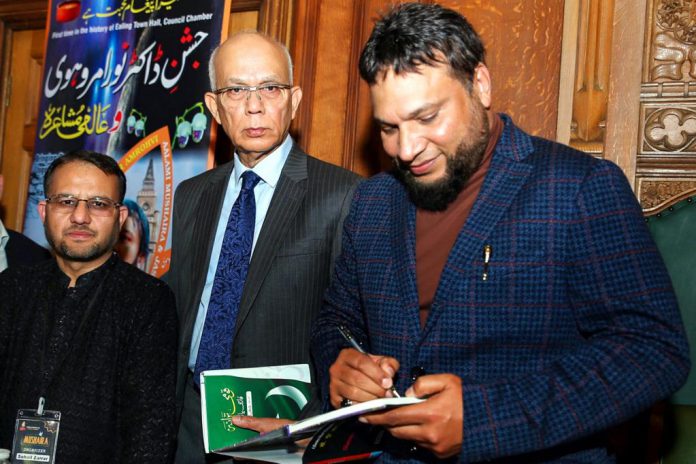
Dr Noor Giving Autograph
Ms. Shazia Khan, General Secretary of Al Noor International and founder of Stardom, came specially from America, highlighted Dr. Noor Amrohvi’s services to Urdu literature and his community. Dr. Shamsa Qureshi, the managing director of Al-Noor International and a well-known poet, could not come from America, but she expressed her good wishes over the phone from there and said that this honor can only be given to Dr. Noor Amrohvi. He is the most celebrated person for whom we Americans are proud.
Dr. Gabriela, a special representative of the Romanian Embassy and a literary figure, also participated in this speech ceremony for the first time and expressed his views.
Dr. Noor Amrohvi was awarded a certificate by the Mayor of Ealing London for his social and literary services and an award from Bizm-e-Sukhan Great Britain and it was acknowledged that the name of Dr. Noor Amrohvi is also London. It will also be written in golden letters in the literary history that he became the first representative of Urdu who took Urdu and his culture to such a high position and reached the London Parliament which was unimaginable. That’s why he was welcomed not only by all the audience, but also by all the assembly workers and mayors, and a standing ovation was given to Dr. Noor Amrohvi.
Chief organizer Mr Sohail Zarrar- Dr Noor Amrohvi
The program was moderated by Sohail Zarar Khalish, a spirited person from Great Britain. And thanked all the friends for organizing this wonderful event
The great poets of the Urdu world Syed Salman Geelani, Qaiser Wajdi, Aftab Alam Qureshi, Irfana Amar Ambrin Qureshi and Syed Shan Kanpuri captivated the hearts of the participants with their words.
In the end, the celebrant Dr. Noor Amrohvi took the seat and thanked Bazm for organizing the event. He said that Muneer Ahmed Sahib and Bazm-e-Sukhan may have made history today, after that there may be thousands of mushairas here, but whenever there is an event related to Urdu, this mushaira will always be remembered as the first mushaira. He will always be remembered.
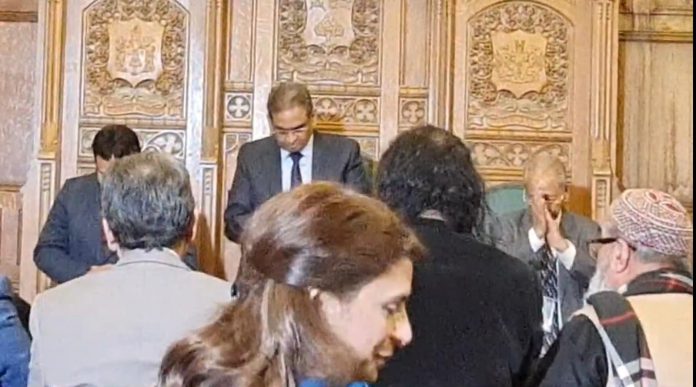
Standing ovation to Dr Noor Amrohvi
Dr. Noor Amrohvi lit up the gathering with his wonderful words and beautiful speech and won the hearts of Londoners. A sumptuous dinner was given at the end of this long-remembered event.
source: http://www.millattimes.com / Millat Times / Home> World / by Millat Times Staff / November 13th, 2022
Mirza Salma Baig is India’s first woman to man the Railway crossing. She is stationed at Malhore Railway Crossing, one of the busiest intersections of railway and road traffic, located a few kilometers from Lucknow, the capital of Uttar Pradesh.
Salma Baig, 29, a mother of a toddler, has been working at this crossing for the past 10 years.
Seeing a hijab-clad woman turn a heavy wheel to shut the gate when the train is about to arrive at that point and then open it for pedestrians and other road traffic, the onlookers often stop to take selfies with her.
People show respect to Salma Baig for her job. Seeing her for the first time, many people stop to just look at how she works.
Mirza Salma Baig was appointed as the country’s first Gate Woman in 2013 at the age of 19. She hails from Lucknow, Uttar pradesh.
Malhore crossing is a busy intersection between railway track and the city road and it’s challenging to control and direct the traffic. She has to frequently close the gate for the vehicular traffic as many trains cross this point all through the day. Salma turns a heavy wheel with a lever to close the gate and then unwinds it to open it.
The gates open as soon as the train passes. Salma says that while closing and opening the gate, she has to take care not to hurt anyone. She stands with a red and green flag in hand until the train has crossed the gate.
Interestingly, many people had questioned Salma’s appointment in 2013 as the newspaper reports of 2013 suggest.
Mirza Salma Baig opening the railway gate
The railway authorities had to clarify that this job was always open to women but not many serious contenders for this job had ever applied.
Salma’s father Mirza Salim Baig was also a gateman at the Railway crossing. Due to hearing impairment and other ailments, he had to take voluntary retirement much earlier than it was due. Salma’s mother had suffered a stroke and after father’s retirement, there was no bread winner in the family.
At this stage the Indian Railways offered Salma a job. Salma quit her studies and accepted it. Her relatives were angry but she chose what was best for her and the family under the given circumstances.
She credits her parents for her success.
Salma is proud of her 10-year career and smiles when asked about the snide comments made by many when she first joined.
When she started working at the crossing, the staff told her that being a girl she would not be able to open the crossing gate. They told her that a train passes this crossing every one minute and many predicted she would leave the job in four days. Salma worked hard and never gave up.
She has been standing here for the last 10 years. Salma says, everyone in the staff has become her supporter.”
She performs her 12-hour long duty with full responsibility and competence. Salma says that girls should have the same freedom as housewives.
source: http://www.awazthevoice.in / Awaz, The Voice / Home> Women / by M Mishra, Lucknow / November 07th, 2022
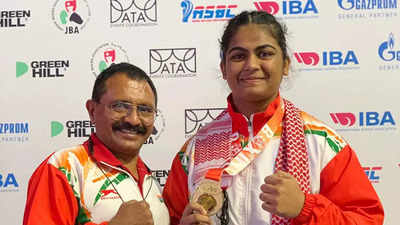
City’s Alfiya Khan Pathan became the first-ever Maharashtra woman boxer to win a medal at the ASBC Asian Elite Boxing Championships. On Friday, Alfiya won the gold medal in 81+kg category and is among the four Indian gold medal winners in the women’s section in Amman, Jordan.
Apart from Alifya, Saweety (81kg), Lovlina (75kg) and Parveen (63kg) won the yellow medals for India, 1 silver and 2 bronze. This is Indian women’s third-best performance at the prestigious tournament in terms of winning gold medals, after seven gold medals in 2005 and five in 2003.
The 19-year-old Nagpur girl was declared winner against Islam Husaili when the Jordan boxer was disqualfied by the referee for biting Alfiya on shoulder. Alfiya, the Youth World Champion, went all out from the word go and planted aggressive left-hand punches. The gold medal bout did not last even the full 3 minutes of the first round.
Southpaw Alfiya was so fierce that the Jordan boxer looked clueless in the first 1.5 minutes itself. After a series of punches, Husaili came close to ensure Alfiya could not charge, and in the process bit Alfiya’s shoulder. She was immediately disqualified.
“I am super excited with the result. This is the result of efforts taken by Bhaskar Bhatt sir and his team in the national camp. We had prepared well and it turned out well,” said Afliya while talking to TOI from Jordan.
This result in the final was expected after Alfiya cruised past 2016 world champion Lazzat Kungeibayeva of Kazakhstan in a 5-0 win in the semis. This was the second time this year that Alfiya has defeated Lazzat, having stunned the Kazakh on her own turf in the Elorda Cup in July this year, in what was her senior international debut competition.
“It is an amazing performance by Indian women boxers. Winning four gold medals is a big achievement. It is a result of the hard work put in by Indian boxers, support staff and team in the camp,” chief coach Bhaskar Bhatt told TOI from Jordan. He added, “We got very good support at every juncture from BFI and SAI. We will continue similar practice pattern as we keep our eyes on the 2023 World Championship”.
Alfiya’s feat is a result of her rigorous training at the national camp under Bhatt. After winning the maiden senior category medal in July, Alfiya was called for the senior national camp considering her consistent show in junior, youth and senior international events.
Generally, a player is selected in the national camp on the basis of performance in the senior national championship. On very few occasions, boxers are included in the camp on other criteria, like it happened with Alfiya due to her Kazakhstan success.
Alfiya, who is a daughter of Akram Pathan, ASI at Nagpur Police Headquarters, is yet to play senior nationals but has two international gold medals including the Asian gold won on Friday.
source: http://www.timesofindia.indiatimes.com / Times of India / Home> News> Sports News> Boxing News (headline edited) / by Pratik Siddharth / TNN / November 12th, 2022
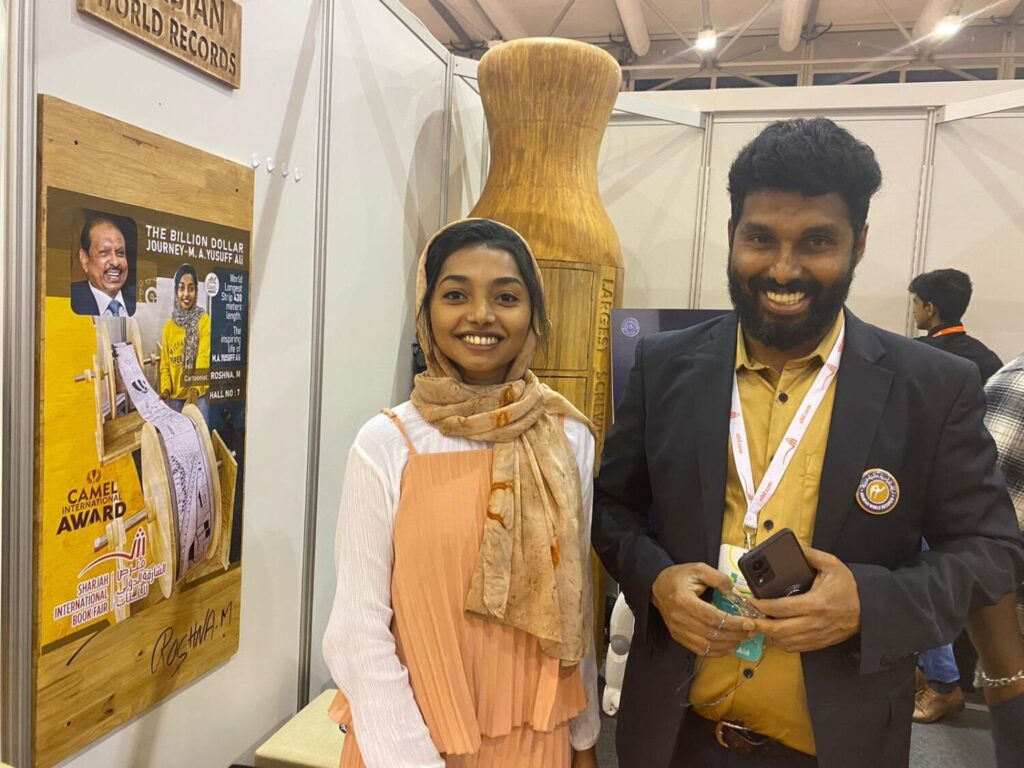
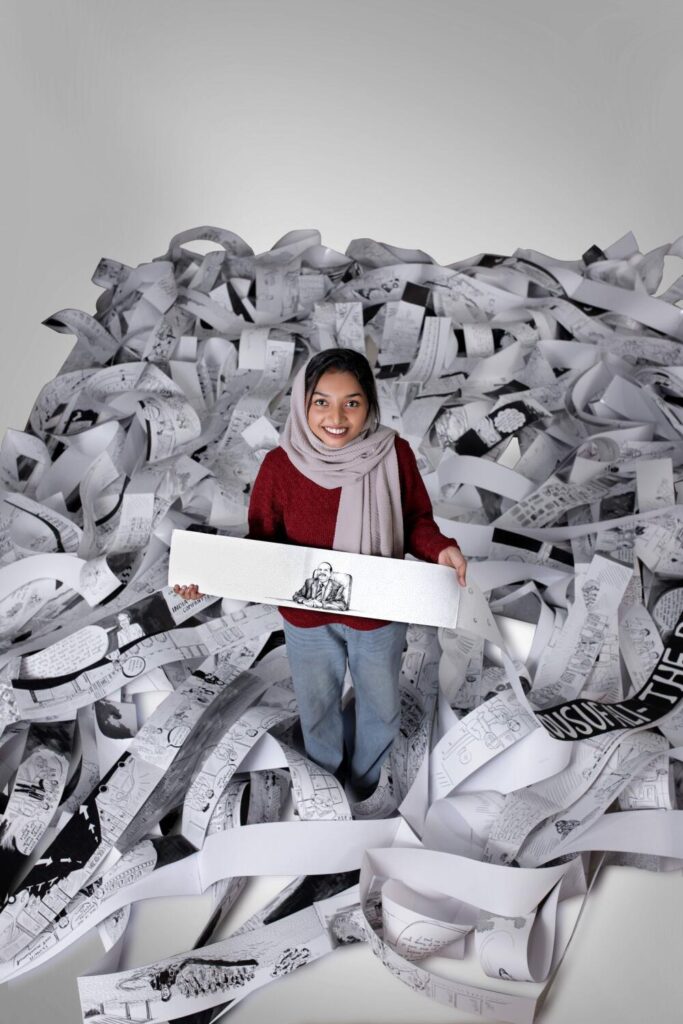
20-year-old Roshna created the longest cartoon strip measuring 430m, titled ‘The Billion Dollar Journey’ honouring businessman MA Yusuff Ali
Father and daughter duo M Dileef and Roshna M. Photo: Nasreen Abdulla
The ongoing Sharjah International Book Fair (SIBF) houses two record-breaking installations — tucked away in Hall 7, the world’s largest screwdriver is displayed and right next to it is the world’s longest cartoon strip depicting the inspirational story of UAE-based businessman MA Yusuff Ali.
Both of these Guinness world record-holding creations have been made by Indian expat father-daughter duo M Dileef and Roshna M. “It feels great to be exhibiting here,” said 20-year-old Roshna, who broke her own record for the longest cartoon strip established in 2021 with her latest creation. Measuring 430m, the new strip titled ‘The Billion Dollar Journey’ is stretched across two wheels and can be read by rotating the hand.
On Sunday, the illustrious Indian businessman from Kerala, MA Yusuff Ali, visited the stall and commended Roshan’s efforts.
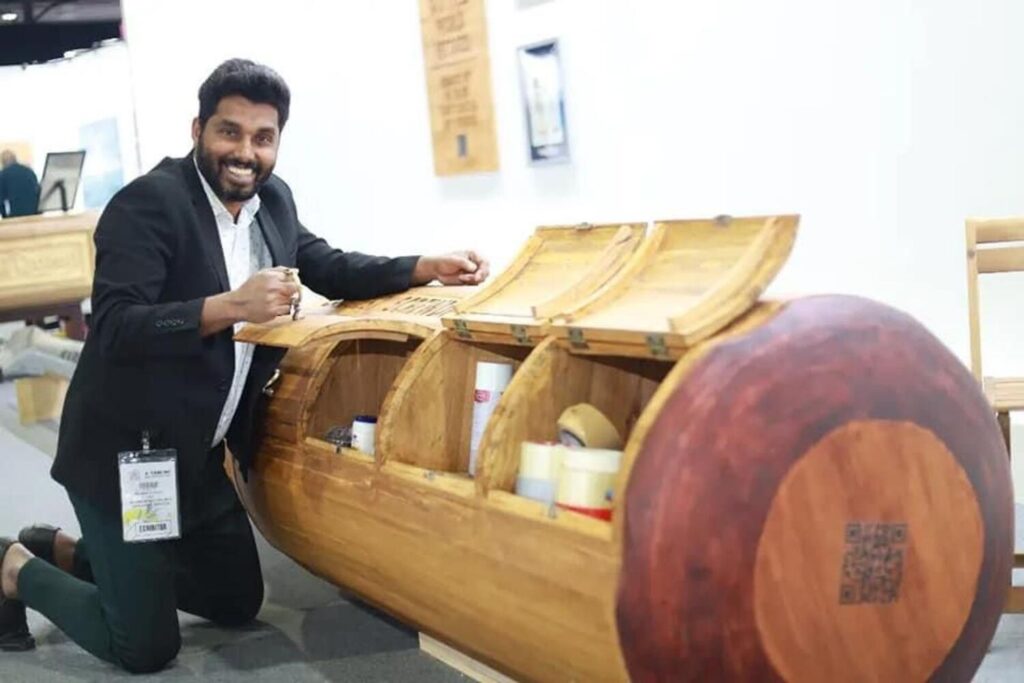
Roshna’s father, M Dileef, a seasoned record-setter, said this is his third Guinness World Record. “Due to space constraints, I could only put the head of the screwdriver on display,” he said. Completed in March, the tool measures a whooping 6.6m in length. The artist was recently granted a Golden Visa in the UAE.
The longest cartoon strip
The cartoon strip charts the journey of businessman MA Yusuff Ali, from his childhood in a village in Kerala to his meteoric rise as one of the most influential businessmen in the world.
“I have always looked up to him,” she said. “I want to be an entrepreneur; he is my role model, so I wanted to make something to honour him.”
It was in 2021 that Roshna set her first world record with a cartoon strip measuring 404 metres in collaboration with Global Village. This year, she has broken that record. According to the youngster, who recently graduated with a bachelor’s in fine arts, making this strip took her 8 months, five months of which was just for research.
“I had a team of six classmates,” she said. “We had decided that we wanted to do something to make our mark, and this is the idea we came up with. They helped me in the entire research process and aided me when drawing the cartoon strip as well.”
The graduate now dreams of pursuing a master’s degree in Europe and hopes to raise funds for her education with her artwork.
Largest screwdriver
The masterpiece by Dileef was first displayed at World Art Dubai in March of this year. “I wanted to pay tribute to the working-class population in the city,” he said. “No other country has honoured and valued the contribution of the working class like the UAE has. So many lives were transformed because of Dubai. This piece was a homage to that.”
Made out of mahagony wood and mild steel, the screwdriver was constructed in Dubai. The handle, which has a diameter of 70cm, also has storage space for knickknacks.
Dileef has earlier set two world records- one for curating the world’s longest Quran and another for the largest badminton racket.
www.dileefartgallery.com
source: http://www.khaleejtimes.com / Khaleej Times / Home> UAE / by Nasreen Abdulla / November 06th, 2022
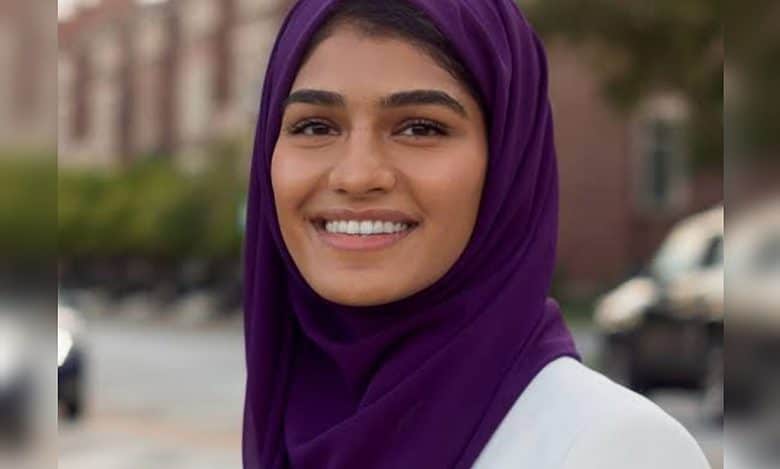
“My name is Nabeela Syed. I’m a 23-year old Muslim, Indian-American woman. We just flipped a Republican-held suburban district,” she tweeted.
Nabeela Syed (Photo: Instagram)
A 23-year-old Indian-American Muslim woman Nabeela Syed, the candidate of the Democratic Party, has won a significant victory in the United States (US) mid-term elections.
Nabeela has written history as the youngest representative to have won the election for the 51st House district of the Illinois state legislature in US.
On Wednesday, Nabeela took to Twitter and shared her happiness of being elected to the General Assembly as a representative of the Democratic party.
“My name is Nabeela Syed. I’m a 23-year old Muslim, Indian-American woman. We just flipped a Republican-held suburban district,” she tweeted.
She further wrote, I will be the youngest member of the Illinois General Assembly.
Nabeela took to Instagram and wrote, “When I announced for State Representative, I made it a mission to genuinely engage in conversation with people – to give them a reason to get involved in our democracy and hope for better leadership that represents their values. We won this race because we engaged in that conversation.”
“We talked to seniors about the rising cost of prescription drugs. We talked to working families about the growing burden of property taxes. We talked to women, pledging that I would protect their right to reproductive healthcare. We spoke with parents about their desire to strengthen commonsense gun safety laws,” she adds.
Nabeela continues, “We won this race because the people of the 51st District want a representative who is ready to fight for them and their families.”
“I knocked every door in this district. Tomorrow, I start knocking them again to thank them for placing their trust in me. I’m ready to get to work,” she added.
In June 2022, Nabeela Syed had won the Democratic primary and has now flipped a Republican district against incumbent Chris Bos.
Syed, who becomes the first South Asian in the Illinois state legislature, will also be the youngest member of the state assembly.
Born and raised in Illinois, Nabeela Syed graduated from the University of California with a degree in Political Science.
In her election manifesto, Nabeela Syed has promised to consider and address public issues such as equal rights, health care, education and taxation.
According to her website, Syed is running “to build a better Illinois for residents today and tomorrow – an Illinois with a strong economy, sustainable infrastructure, and affordable healthcare, and higher education.”
Syed currently works for a non-profit, helping them in digital strategy and supporting a myriad of civic engagement initiatives, for example, mobilising voters, curbing sexual assault on college campuses, and enhancing gender equity, according to her official website.
Having graduated from the University of California, Berkeley, with a degree in Political Science and Business, she served as the president of a pro-bono consulting organisation that helped local businesses.
Syed is active in her religious community at the Islamic Society of Northwest Suburbs and advocates interfaith dialogue and aims to empower young Muslim women to lead.
source: http://www.siasat.com / The Siasat Daily / Home> News> India / by Sakina Fatima / November 10th, 2022
Nellore, ANDHRA PRADESH / Kozhikode, KERALA / SAUDI ARABIA:
Mehad performed Umrah along with his parents immediately after winning the Gold Medal.
Mohammed Mehad Shah
Jeddah:
The juvenile Andhra badminton player made a strong impact at the ongoing Saudi Games, the prestigious national games of oil rich Saudi Arabia known for its passion for football.
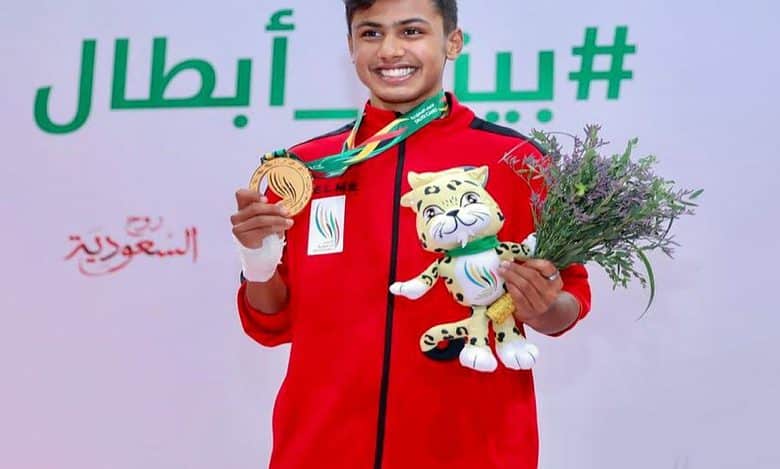
Mohammed Mehad Shah, a native of Nellore in Andhra Pradesh has won a gold medal and one million Riyals in the men’s single category in badminton competition as part of the first edition of the Saudi Games, the largest national sports event of its kind, took place on Friday at King Fahd Stadium in Riyadh in the presence of Prince Faisal bin Bandar bin Abdulaziz, Governor of the Riyadh region, as well as the Saudi public in a grand ceremony filled with lights, fire, and music.
Mehad Sha along with other winners were honored by Prince Fahd bin Jalawi bin Abdulaziz bin Musaed, vice president of the Saudi Olympic Committee and director of the Saudi Games. He was also greeted by Muqrin Al-Muqrin, chairman of the Saudi Badminton Federation, and Mai Obaid Al-Rasheed, vice president of the Saudi Badminton Federation.
Participants competing for a grand total of more than SR200 million: Gold-medal winners to receive SR1 million, and silver-medal winners awarded SR300,000 and SR100,000 respectively. This is the highest prize money dedicated to the sports sector in the history of the region.
The 17-years old native of Nellore district in Andhra Pradesh, who was born and brought up in Riyadh and a student of 11th class at New Middle East International School, has told this correspondent that his aim is to win medals for Saudi Arabia in Olympics and other international tournaments.
Mehad Shah said that the coaching which he takes at Gopichand Badminton Academy in Hyderabad is helpful to achieve success. Gopichand is known as Dronacharya of Indian Badminton. He also expressed his gratitude towards his school principal and PT and Tah, Ralf –both Philippine nationals- coaches who trained him.
Excited Mehad who performed Umrah along with his parents immediately after winning the Gold Medal also thanked his school sports director and trainers.
“When I was receiving the gold medal from Prince Fahd, I remember the days when I was struggling to find a partner to play with me in the badminton court”, he said.
He has been playing the game from 5th standard and his elder brother Faisal Sha also used to play the sport in Riyadh. Faisal is now pursuing medicine in India. Mehad’s sister Khateeja is also studying medicine back home in India. Mehad Sha’s parents, Shahid and Shakera Begum both are engineers.
Muzzamil Shaikh, coordinator of APNRT, AP state government body to look after NRI affairs in Saudi Arabia and noted social worker, has congratulated Mehad.
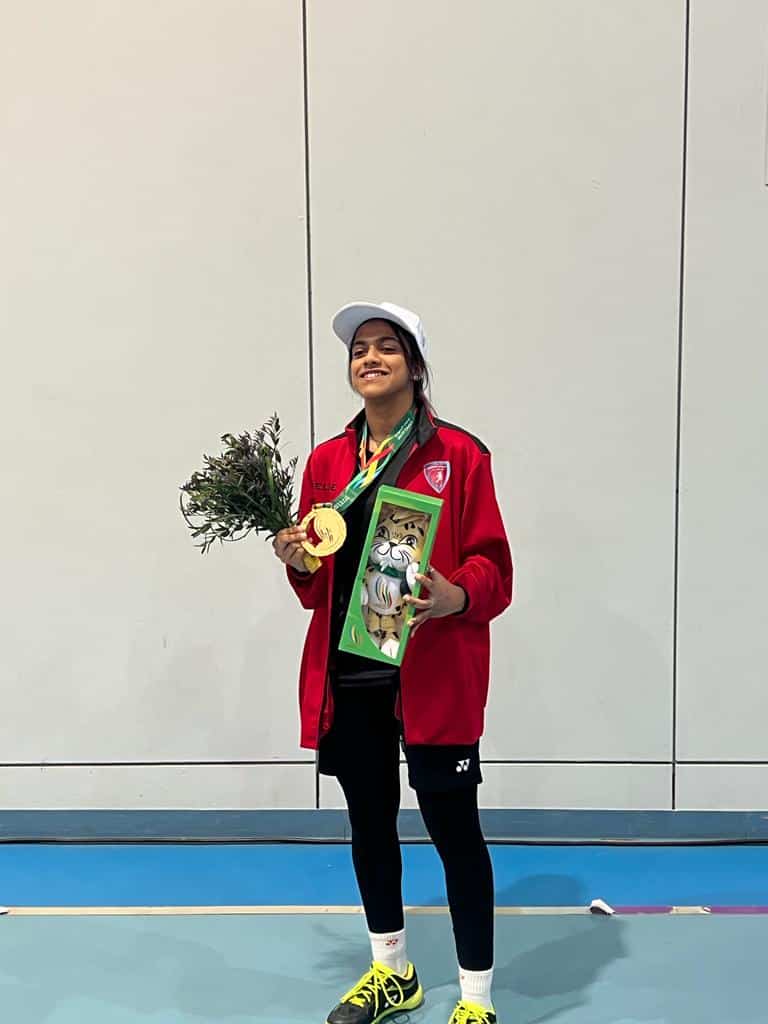
The only other Indian winner is Kadeeja Kothoor, who also won the gold medal and a million-riyal prize money in women’s single category of badminton. She is also 17 years old and studying in the same school as Mehad.
Kadeeja, native of Calicut in Kerala also born and brought up in Riyadh in a family of full badminton athletes. Sinmar Badminton Academy and Indian Academy- set up by a group of NRIs including her father Latheef – trained her. Coaches Sanjay, Shahin and Wahid shaped her gaming skills.
When she started playing at the age of eight years everyone was expecting that she would make a difference in the game one day which she did, said Latheef, father, who himself is a badminton player. Kadeeja’s other siblings are also badminton players. Her brother Mohammed Nzami is Kerala champion and 6th ranker in All India rating under 13 category; while sister Raya Fatima is Calicut’s St. Joseph Devagiri college team member of badminton team.
“My wife, Shanitha, has encouraged all children into sports” said Latheef.
source: http://www.siasat.com / The Siasat Daily / Home> News> Andhra Pradesh / by Irfan Mohammed / posted by Sameer Khan / November 07th, 2022
At a time when little is known about one of India’s greatest social reformers and educators, widely believed to be India’s first woman Muslim teacher, the Andhra Pradesh Government introduced a lesson on the contribution of Fatima Sheikh in the text-books of eighth class.
The reformer is known to have given shelter to Jyotirao Phule and Savitribai Phule, the well-known social reformer couple, when they were shunted out from their families.
It was in 1848 that Phule couple had taken initiative against caste system and male chauvinism. Fatima Sheikh is credited with allowing the Phule couple to start the first all-girls school at the former’s house in erstwhile Poona in Bombay Presidency.
Fatima Sheikh taught at all the five schools which were run by Phules.
At the same time she founded two schools on her own in 1851 in Mumbai.
Fatima Sheikh underwent teacher’s training along with Savitribai Phule at an institute run by Cynthia Farrar, an American missionary.
Born on January 9, 1831, she has not received the recognition she deserved. She remains a little known activist in various parts of the country. Prior to Andhra Pradesh, Maharashtra had introduced a brief lesson on her in school curriculum.
On the other hand, Google had honoured her with a Doodle on its homepage in connection with her 191st birth anniversary.
“We believe the children, who are the future of the country, should know about the reformers, freedom fighters and others who contributed significantly for building the nation. We are very happy that a lesson has been introduced in eighth class book. More awareness is required on the contribution of Fatima Sheikh,” Kaki Prakash Rao, State general secretary of AP Primary Teachers’ Association, told Siasat.com on Monday.
AP United Teachers’ Federation leader D. Ramu hailed the initiative of the AP Government and said that time, moving out of home by women was considered a big sin. Still, Fatima Sheikh along with Phules was instrumental in teaching Dalit and Muslim girls ignoring threats by many conservative, casteist and fanatic outfits and individuals.
source: http://www.siasat.com / The Siasat Daily / Home> News> Andhra Pradesh / by Santosh Patnaik / November 04th, 2022
When Nobles became non-entities, Princes became paupers and Begums were reduced to beggars…
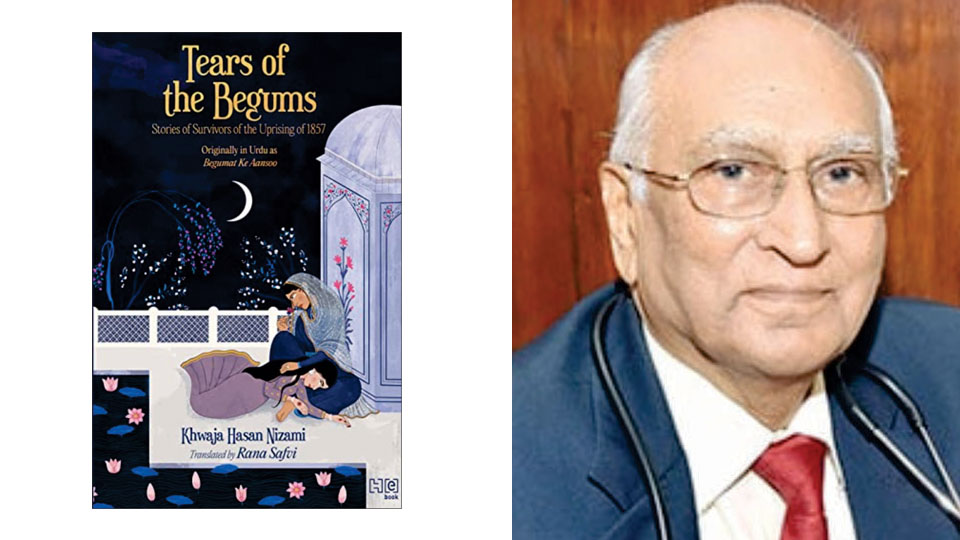
Title: Tears of the Begums: Stories of Survivors of the Uprising of 1857 (Originally in Urdu as ‘Begumat Ke Aansoo’)
Author: Khwaja Hasan Nizami
Publisher: Hachette India
Year of Publication : 1922
Translator : Ms. Rana Safvi (2022)
Pages: 212+xii
Price: Rs. 499
The Sepoy Mutiny (or the First War of Independence as we call it) started in 1857, over the issue of the greasing of the cartridges used in the guns of Indian soldiers of the East India Company army. It was known by the Urdu word “Ghadar” meaning rebellion or revolt.
The rebellion spread rapidly in North India particularly around Lucknow and Delhi. The rebellious soldiers killed a large number of British officers, women and children. They adopted as their leader the surviving Mughal emperor Bahadur Shah Zafar without his consent. He was only a namesake Emperor who was on a generous pension given by the East India Company, and did not have any power beyond the precincts of the Red Fort, nor had the money to help the soldiers. He was reluctant to take on the British army but was helpless and had to go with the demands of rebellious soldiers.
Though initially the British had a setback, they quickly regrouped and took over Delhi. The Red Fort had about 3,000 royal families all of whom were descendants of the present and past emperors. The emperor’s court life was filled with pomp and grandeur, though he had no real authority.
Bahadur Shah himself was a refined and gentle soul and a poet. Delhi was ruled by the English Resident. The lives of the royals living in the “Lal Qila” was lavish with big mansions, large number of servants and slaves. Ghadar was a watershed moment in Indian history and the grand and elegant Mughal culture ended suddenly and dramatically.
Kulsum Zamani Begum was the beloved daughter of the last emperor Bahadur Shah. On the night he left the fort, he sent her and her family away entrusting them to the care of Khuda (God). Within a few days of leaving the Red Fort they were looted of all their money, jewels and even their expensive clothes. Finally on the way some villagers give them shelter in a thatched hut. The company soldiers were looking for the emperor’s descendants to arrest and punish. They escaped to Hyderabad, where they were given shelter by Nawab Lashkar Jung, who had given shelter to many Mughal royals who had escaped from Delhi.
In a few years the British had their way and the Princess was advised to leave Hyderabad. Some of the well-wishers of the Mughals arranged for her to travel to Mecca. One of the slaves she had freed while she was the Princess in Delhi had migrated to Mecca and had become an extremely wealthy merchant there. He looked after her very well and made her family stay comfortable.
The Ambassador of Turkey learnt that the Emperor’s daughter had taken refuge in Mecca and arranged a pension for her from the Sultan of Turkey. She lived comfortably in Mecca for a number of years. Ultimately she longed to return to her beloved Delhi. When she went back to Delhi, the English Governor out of compassion, arranged a pension for her family. The British who had taken away her dad’s empire, gave her in return a grand compensation of ten rupees a month.
Sakina Khanum was the daughter-in-law of Nawab Faulad Khan. Nawab died while fighting the company soldiers during the Ghadar. When his body was brought home by the soldiers, Sakina was writhing in severe labour pains. The Nawabs’ son had died four days earlier in the war, and his wife had passed away two years ago. Sakina delivered a boy with the help of the servants, while the corpse of the Nawab was lying in the front yard, without even a shroud. She had to run away from their mansion at midnight, taking a few jewels, some cash which was in the house and her new-born baby. The four maids who were in the house went with her.
After a few days, the maids stole all the money and jewels and deserted her. They even took away the new-born son of the Princess. She tried to eke out a living by working as a maid in households. Unfortunately for her, she had no skills needed for domestic help. After all she was the daughter-in-law of a Nawab and had lived in luxury with many servants and slaves at her command. She was frequently thrown out of many homes where she worked, as she could not work hard enough.
Finally, the Princess became a beggar for her living. After a few years, one afternoon she was begging in front of a wedding house. She was exhausted due to the hot summer sun. She had not eaten for many days and was extremely hungry. As she was begging, one young handsome boy came out of the wedding hall. Hearing her wails, he sat in front of her and gave her the food he was carrying for himself. The boy spoke to the beggar and consoled her and told that his mother was a maid in the wedding house.
As he was speaking with her, his mother came out and Sakina immediately recognised her as her maid who had deserted her and realised that the boy who fed her was her own son. After many years Sakina the beggar Princess had been reunited with her long lost son.
Qismat Baig worked as a chef at the palatial Taj Mahal hotel in Bombay. He was a recluse and an irascible and difficult man. None knew his antecedents. Whenever asked about himself he would answer that he was a Badshah and walk away. The Maharaja of Bhavnagar would frequently stay at the Taj Mahal Hotel whenever he was in Bombay, and he immensely enjoyed the food cooked by Qismat Baig.
One day the Maharaja expressed his desire to meet the chef. Qismat Baig, who never liked to meet anyone, was persuaded to visit him. When the king asked Qismat Baig as to who he was, Baig gave a long philosophical discourse. Surprised at the erudition of the chef, the king persuaded him to tell his story. Baig started recounting his long sad story. He was the son of the last Mughal Emperor Bahadur Shah born to a slave girl. He was named Timur Shah after the great ancestor of the Mughals. The emperor had provided well for him and his mother and they lived comfortably in luxury with servants and maids. As a young boy he was well educated and would often visit a Dargah near his home in the evenings and had imbibed Sufi mysticism and Dervish practices.
When Ghadar started, his mother lost everything. He worked as an assistant to a cook and learnt the culinary art. Misfortune always haunted him. He lost his mother, wife and children to illnesses and became alone in the world. Living in Delhi made him very sad and migrated to Bombay where Timur Shah changed his name to Qismat Baig, a man of destiny. The son of the Mughal Emperor had become a Bawarchi (chef) in a hotel.
These are some of the poignant real-life stories in the book “Tears of the Begums”. Khwaja Hasan Nizami was a young man at the time of Mutiny. In later years he became a writer. He personally interviewed many survivors of nobility and recorded their tragic stories. It was published as a book “Begumat Ke Aansoo” in 1922. Ghadar was a cataclysmic event in the narrative of India. It ended the centuries of pomp of the Mughal Court and the wealthy refined and elegant lives of the aristocracy. Nobles became non-entities, Princes became paupers and Begums were reduced to beggars. The sad stories in the book bring “Aansoo” to the eyes of the readers.
source: http://www.starofmysore.com / Star of Mysore / Home> Feature Articles / by Dr. C.D. Sreenivasa Murthy / October 11th, 2022

.webp)