Oman’s cricket team, led by Rahil Habibulla and coached by Aamir Kaleem, clinches a significant win, eyeing greater successes in Division 1 competitions.
Oman Triumphs in Cricket: Rahil Habibulla’s Leadership and Aamir Kaleem’s Coaching Celebrated
Oman’s cricket team, under the stellar leadership of captain Rahil Habibulla and the strategic coaching of Aamir Kaleem, recently clinched a significant victory, marking a triumphant moment in their cricketing journey. This win not only celebrates the team’s collective effort but also highlights individual accolades such as Malaysia’s Mohammad Akram being named Batter of the Tournament and Kuwait’s Janath Herathliyanage winning Bowler of the Tournament.
Strategic Leadership and Team Dynamics
The victory was a result of meticulous planning, unwavering dedication, and the seamless execution of strategies developed over months of hard work. Rahil Habibulla, reflecting on the journey, emphasized the blend of youth and experience within the team. Leading a team with a majority of players facing their first international tournament, Habibulla’s leadership was pivotal in navigating through the challenges and steering the team towards victory. The support from the Oman Cricket Board was instrumental, providing the necessary resources and belief in the team’s potential.
Coaching Excellence and Team Performance
Aamir Kaleem, expressing pride in the team’s achievement, highlighted the adverse conditions under which the tournament was played. The hot and humid conditions posed a significant challenge, yet the team’s character and resilience shone through. Kaleem’s commendation of the team’s unbeaten streak underscores the comprehensive preparation and the adaptability of the players across all departments. The acknowledgment of Rahil Habibulla’s decisive leadership on the field further illustrates the symbiotic relationship between the captain and the coach, enhancing the team’s performance.
Looking Ahead: Ambitions and Gratitude
With this victory, Oman sets its sights on future glories, aiming to replicate and surpass their current achievements in Division 1 competitions. The team’s ambition is fueled by the support from the Oman Cricket Board and the guidance of Head Coach Duleep Mendis. The gratitude expressed by both Rahil Habibulla and Aamir Kaleem towards the board, the coaching staff, and the management underscores the collective effort and the supportive ecosystem that has been pivotal in reaching this milestone.
As Oman cricket celebrates this remarkable achievement, the journey ahead promises even greater challenges and opportunities. The dedication, talent, and spirit displayed by the team signify their readiness to face future competitions with the same zeal and determination. This victory not only marks a significant milestone in Oman cricket’s history but also lays the foundation for aspiring to greater heights in the international cricket arena.
source: http://www.bnnbreaking.com / BNN / Home / by BNN Newsroom / by Salman Akhtar / March 05th, 2024
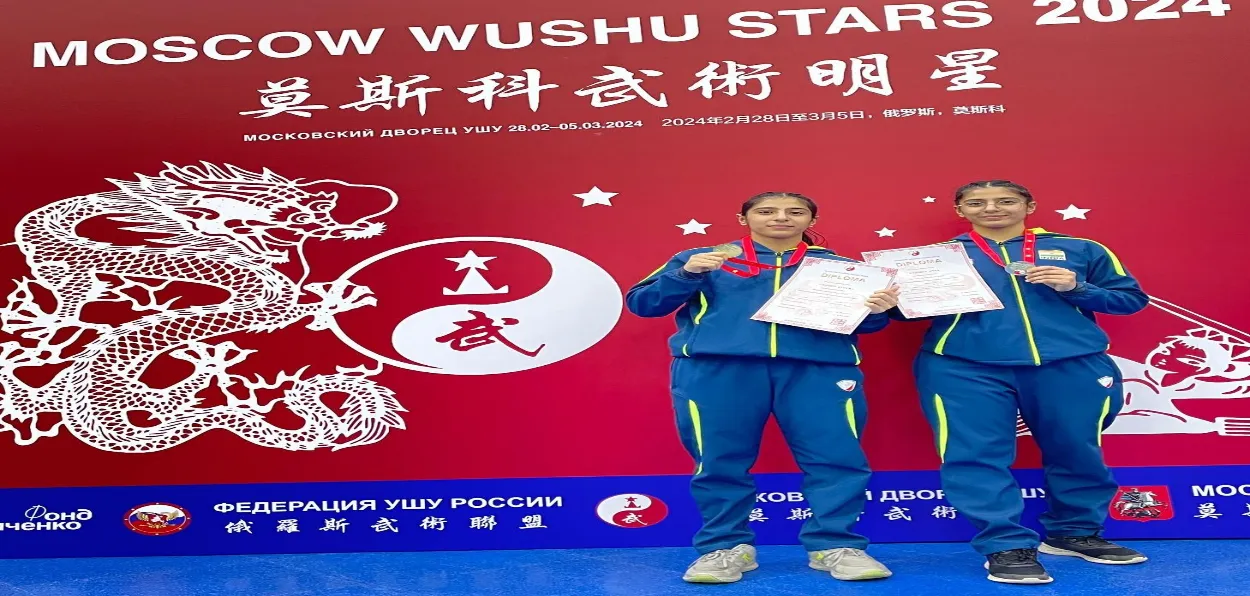
Kashmir’s Wushu Sisters, Ansa Chishti and Ayeera Chishti brought laurels to India by clinching Gold medals in the Russian Moscow Stars Wushu International Championship.
The ongoing championship started in Moscow on 28 February and will conclude on March 5, 2024.
Both players performed exceptionally in their respective weight categories of 52 and 56. They beat their Russian opponents in the finals and made their fans proud as well as the entire sports fraternity of J&K.
J&K Sports Council Chief Nuzhat Gull asked people to cheer the two bright women sportspersons fromthe Valley on X:
Both players performed exceptionally in their respective weight categories of 52 and 56. They beat their Russian opponents in the finals and made their fans proud as well as the entire sports fraternity of J&K.
This is the 3rd International medal for Ayeera as she won Gold in Georgia and Bronze in the World championship in Indonesia earlier. Now it’s 3rd consecutive medal in the international Wushu Championship and last year she was also shortlisted for the State Award.
Ayeera is the 1st Wushu Female Athlete who was shortlisted for this prestigious award. Similarly, Ansa, who won the 2nd Medal in the international Wushu Championship, had won Silver in the Georgia International Wushu Championship.
With today’s medal, she has won her 1st Gold medal in an international championship. Notably, both players are National Champions in their weight category as they won many medals in National championships.
source: http://www.awazthevoice.in / Awaz, The Voice / Home> Story / by ATV / March 04th, 2024
The Myanmar Chess Federation organized the Asian Seniors Championship 2016 from 27 October to 04 November at Hotel Hazel, Mandalay, Myanmar.
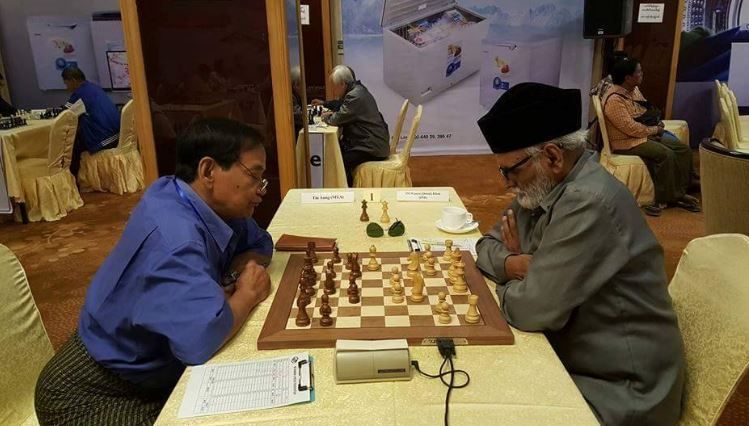
The tournament was held in two categories — for players aged above 50 and 65. India’s 69-year-old IM Wazeer Ahmad Khan won the gold in the 65+ category where 18 players competed.
The tournament had 56 players from 12 countries competing for the medals. We have a quick report.
Wazeer Ahmad Khan is Asian Seniors 65+ Champion
69-years-old IM Wazeer Ahmad Khan of Rampur in Uttar Pradesh is the Asian Seniors 65+ Champion. He began the event as the fifth seed…
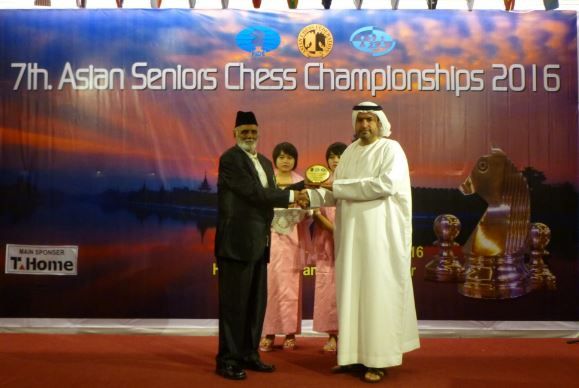
…but rampaged to a perfect 9.0/9 to claim the title.Khan receiving his trophy from the Asian Chess Federation Secretary General Hisham Al Taher.New Zealand’s CM Helen Milligan (2053; extreme left) was declared the women’s champion — she was the only woman competing in the entire 56-player event — while Myanmar’s Myint Han (2281; second from right) won the Asian Seniors 50+ Championship with 8.0/9.
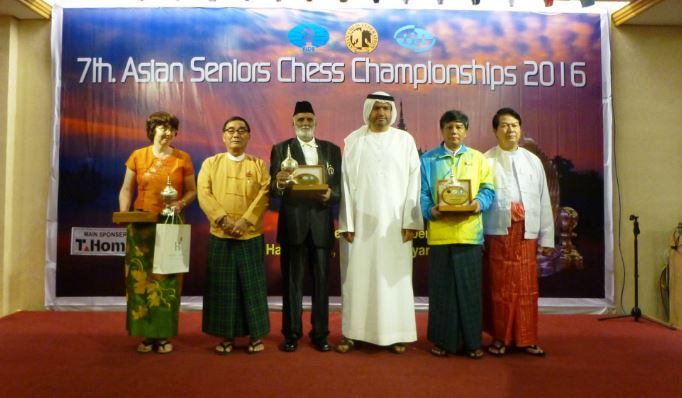
New Zealand’s CM Helen Milligan (2053; extreme left) was declared the women’s champion — she was the only woman competing in the entire 56-player event — while Myanmar’s Myint Han (2281; second from right) won the Asian Seniors 50+ Championship with 8.0/9.
Uttar Pradesh’s highest honour Yash Bharti award was given to 46 personalities on Monday. Among them, nine Muslims were conferred the award by Chief Minister Akhilesh Yadav in presence of Mulayam Singh Yadav. The award is given annually by Culture Department of UP government.
Yash Bharti comes with a cash prize of Rs 11 lakh, citation and a shawl. The awardees are also eligible for a monthly pension of Rs 50,000 for their life.
Yash Bharti award were constituted in 1994 by the then CM Mulayam Singh Yadav but were discontinued between 2007 and 2012 by Mayawati. It has since been revived by CM Akhilesh Yadav.
1. Ustad Ghulam Mustafa Khan Classical singing Born- 3 march 1931, Badaun
Belong to Rampur Sahaswa Gharana in classical singing. Conferred honorary citizenship of Baltimore and Maryland in 1986. Padamshri in 1991, Sangeet Natak Academy Award in 2003, Padam Bhushan in 2006 and Rashtriya Tansen Award in 2008.
2. Professor Irfan Habib Historian Born-12, August 1931 in Baroda. D.Phil from Oxford
Chairman, Indian Council of Historical Research 1987-93, 1993-96. Jawaharlal Nehru Fellowship in 1968-70, D.Lit from BHU (2008), Vishwa Bharti (2008), Kalyani Vishwavidyalaya (2009), North Bengal University (1990) and Ravindra Bharti University (1989). Padam Shree in 2005.
3. Dr Nahid Abedi Sanskrit literature and philoshophy Born—12 February 1961, Mirzapur D. Lit from Lucknow University in 2009. Padam Shree awardee. Several books and papers published in Sanskrit.
4. Iqbal Ahmed Siddiqui Ghazal singer Born—November 9, Allahabad
Performed at All India Radio and Doordarshan. Released 17 cassettes. Sang one song in film Rama O Rama.
5. Anwar Jalalpuri Urdu poetry and writing Born—6 July 1947
Several awards on Urdu poetry like UP Gaurav Samman, Mati Ratan Samman, Iftikhar-e-Meer Samman etc.
6. Dr Nawaz Deobandi Poet and educationist Born—16 July 1956, Saharanpur
Chairman, UP State Urdu Academy. Established Rafiqul Mulk Mulayam Singh Yadav Urdu IAS Study Center in Lucknow. Several awards like Kaifi Azmi award, Dushyant award, Rotary award etc.
7. Aleemullah Siddiqui Artist Born—10 June 1953, Lucknow
Artist using stem of wheat plant, painting on cloth etc. Acted in play Dilli Ka Akhirir Mushaira and Main Urdu Hoon.
8. Imran Khan alias Imran Pratapgarhi Literature Born—6 August 1987 Pratapgarh.
Internationally acclaimed poet and attended Mushairas in Oman, Bahrain, Dubai, Sharjah etc. Received Urdu Academy award in Saudi Arab, Red Cross Society Orissa’s Vishist Vidyarthi award and Sadbhavna award by Maharashtra Municipal Corporation.
9. Wazeer Ahmed Khan Chess Born—4 February 1947, Rampur
Participated in Chess National B competition in 1972, 1980, 1995, 1999, 2004 and 2008. UP Champion in 2004-2005. First prize in Asian Senior competition in Iran in 2015.
source: http://www.twocircles.net / TwoCircles.net / Home> Arts-Culture / by TCN Staff Reporter / March 22nd, 2016
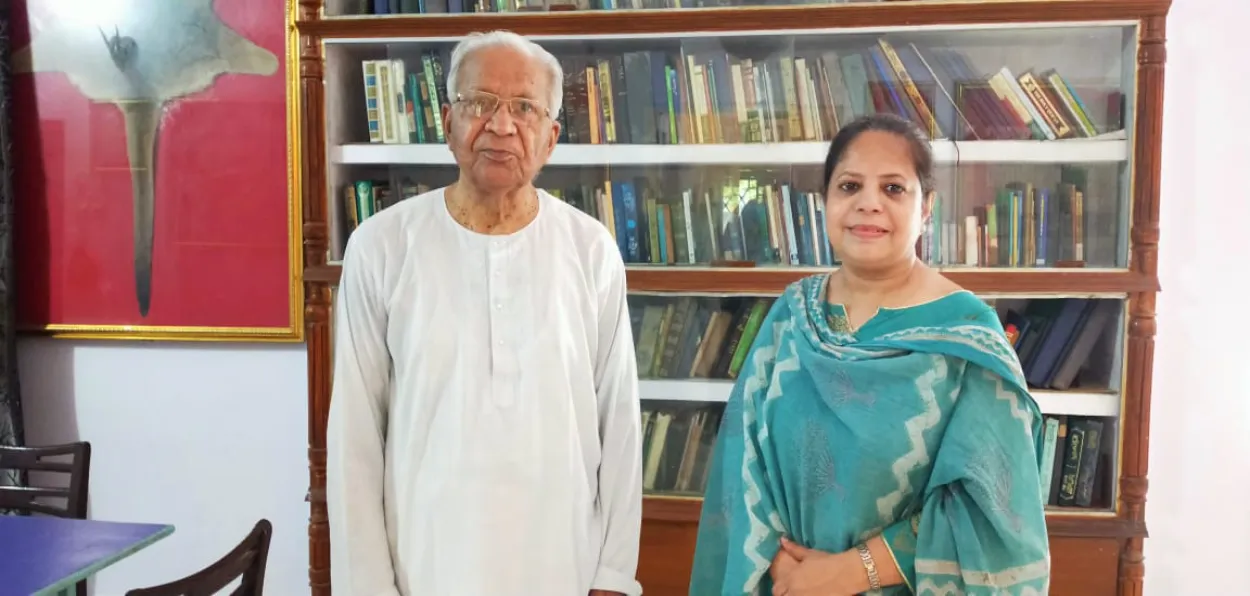
Professor Syed Zillur Rahman, founder,Ibn Sina Academy of Medieval Medicines and Sciences with the author
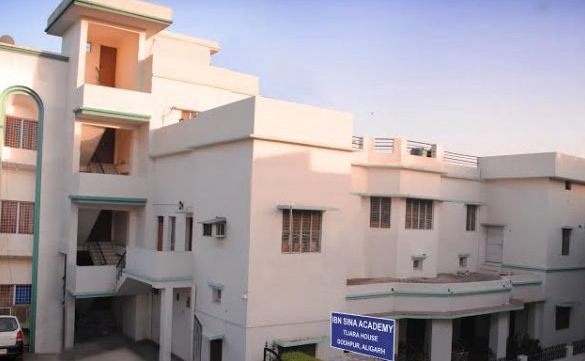
Known for its locks, Aligarh, a city in Uttar Pradesh, has also locked a legacy in its reserve – for generations to benefit from it. It houses a rare academy and museum called Ibn Sina Academy of Medieval Medicines and Sciences.
Located at Tijara House, amid a vibrant market place and residential area, Ibn Sina is hailed as the rarest house of legacies in arts and sciences combined under one roof. Named after the legendary scholar of philosophy and medicine Abu Ali Ibn Sina (980 -1037), this academy was accredited to the Ministry of Ayush in 2004 and promoted to Centre of Excellence in 2008.
The institution was established for encouraging and promoting research and studies in medieval sciences, especially Ibn-Sina’s as well as arts, culture, poetry, and other sciences.
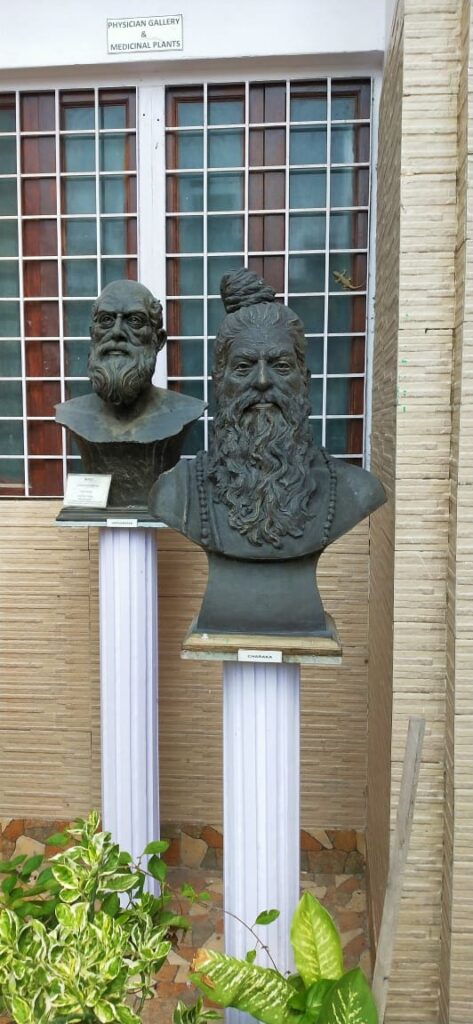
The bust of Ibn Sina with Charak inside the museum
Of Ibn Sina’s four stories, a major attraction is on its second floor which houses the Fazlur Rahman Museum of Orientalism, Art, and Culture.
It has four main galleries; the crockery gallery has a large collection of oriental and British Indian utensils, hammami plates, bowls, tea sets that belong to prominent personalities such as Hakim Ajmal Khan, Nawab Sultan Jahan, Nawab Shahjahan Begum of Bhopal, Nawab Yusuf Ali Khan of Rampur and many others.
The textile gallery is ornate with attires, garments with gold and silver calicos studded with precious stones, one of which has entire Quranic surah Yaseen embroiled in gold zardozi on it, turbans worn in battles, among many other oriental attires. The picture gallery has prominent personalities of AMU’s pictures, drawings, photography, prints, etc.
Its miscellaneous gallery has coins, postage stamps, clocks, busts, pens, memes, and relics of prominent personalities.
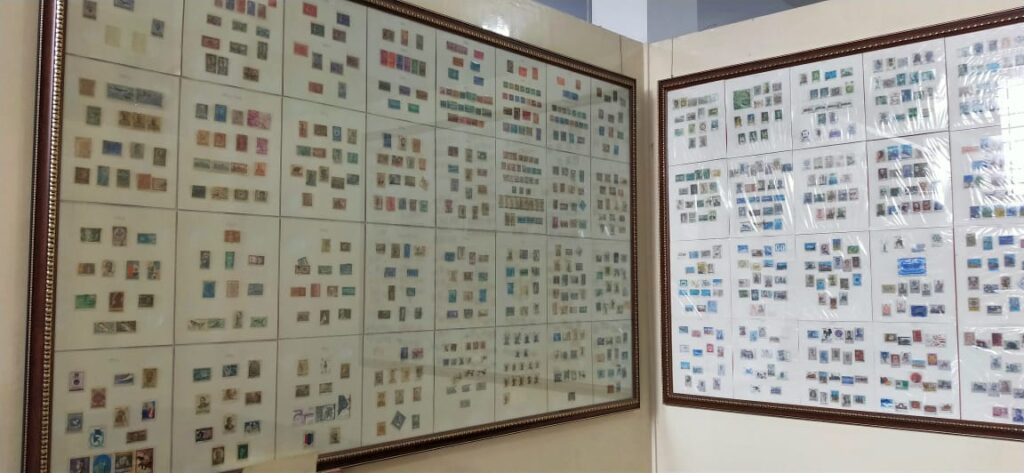
“We have over 2 Lakh stamps beginning from ever since the stamps started, from all countries and India. People who were pioneers in the world of arts and culture, education, and freedom fighters on whose names, and stamps were released, we have a collection of the same. shares Dr. Aftab who is a convenor at Ibn Sina.
In addition medical manuscripts, medical philately, medical souvenirs memories of physicians especially those of Nobel laureates are well preserved here.
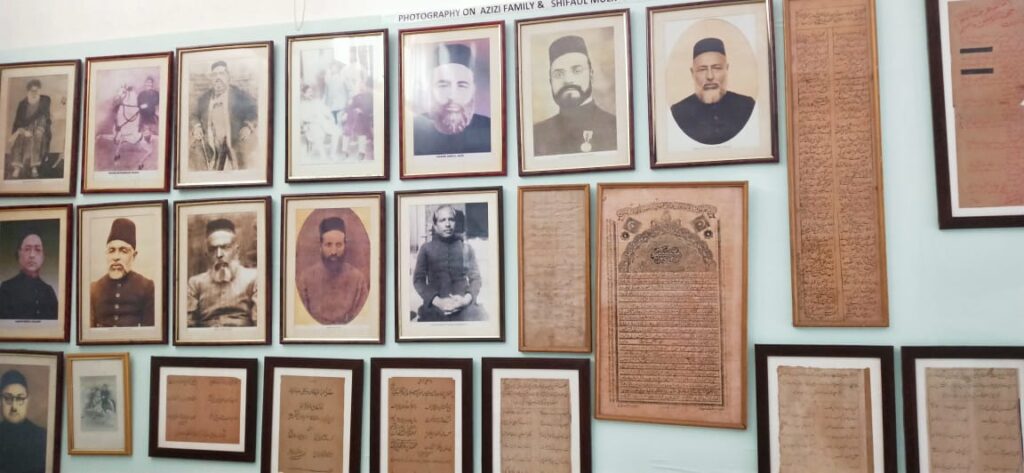
The wall of fame (Pictorial history of some important Muslim families)
The connecting rooms of the galleries welcome you with a sofa of Raja Jai Kishan, a mirror of the times when they were made of iron sheets. The iron sheets called ‘aaina’ were rubbed so many times that they would become sparkling clear and shining to become a mirror. That’s how the mirror got its name ‘aaina’ Later it got a new name –sheesha – with the change of the material..
The academy is rare for numerous reasons. For avid readers of medicine, science, Urdu, Persian, Arabic, literature, poetry, oriental studies, researchers, students preparing for competitions, and scholars IbnSina is a heaven. It boasts of a rare collection of 32000 books, 17000 magazines, 1100 manuscripts, (makhtootaat), 21 rare Qurans including one pocket size in gold, and much more is in store.
Built by professor Syed Zillur Rahman, a medical academic and passionate Urdu litterateur from Aligarh, Ibn Sina was an extension of his colossal library that he had established in 1960 which soon extended into the world’s rare academy and museum of its kind in the year 2000.
Collection of stamps
“Hamare yahn Aurangzeb ke hath ka likha, aur uske bete ke hath ka, likha hua Quran hai,” gleams the professor, sharing the information.
Apart from a separate collection of Muslim women achievers, Ibn Sina boasts of the world’s best collection of Islamic sciences, Islamic medicines, and Islamic philosophy being published across countries such as Iran, Central Asia, Syria, Iraq Turkey, etc. Scholars from across the globe come here to refer to books in this section.
For Ghalib devotees, the academy has a separate section called Ghalib Study Centre. It “Ghalibka collection joh mare paas hai vo duniya mein kisike paas nahi hai,” claims the professor.
Delhi finds a special place here boasting of 7500 books, some as old as 1893, dictionaries as old as 150 years, authentic diwaan on Ameer Khusrau, books on and by the last Mughal Bahadur Shah Zafar, British period –Victorian Era with pictures in Lithographs and much more.
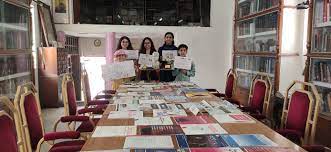
Children using the library
The academy has a library for students especially those preparing for competitive exams. The 100-seater library has the best of books from literature, agriculture, science, math, medicine, etc.
“There is no fee to sit in this library. It opens every day from 10 to 10. This section has over 28000 books including 56 of Professor Rehman on Tibbi and Unnani medicines. there are separate sections for Unani medicine and Sir Syed Movement, biographies,” Dr Aftab Alam, the coordinator of Ghalib Study Centre informed.
There is a reason why the library has most books in Urdu and Persian on Indian history, culture, language, society, education, politics, medicine, etc. “Not much work in English has been done on Muslims. Most work has been done in Urdu and Persian. So this is our helplessness. Our focus is on India – the Hindustan. Indian scholars have done immense work in any domain, philosophy, travelogues, and medicines, especially in Islamic history, the Quran, and hadith that is comparable to anyone in the world, especially the Arabic and Persian world. The problem is we don’t read because we don’t read Urdu,” rues the professor.
Why Ibn Sina was built has an interesting story. As a young man, Professor Rahman used to watch a bird who had made a nest and would bring food for her newborn, just as the routine was with a cat who had given birth to kittens – at his home. After some months, the birds flew, and the kittens grew and went away with their mothers.
“I thought to myself, ‘Is this the life God has created mankind for? Just be born, eat, sleep, and die like animals? God has created a man to not only take care of his family but also society, language, culture, community, and world.”
Ibn Sina Academy of Medieval Medicines and Sciences
So, he decided to create a legacy that he says would be useful for a generation after 80 years! “We are away from civilization by 80 years. A standard time to develop any civilization is 150 years. So, now people are not able to understand the legacy I have created but the students who read it 80 years later will know what it is. By then we would be a civilization.”
People get worried that the graph of Muslim development is going down. But the Professor feels it is nothing to be worried about. “Every civilization has to go through it. Our graph has risen. We were 10 crores in 1947. After Partition, 7 crore left for Pakistan had 3 crore stayed in India. We were nothing in 1947 but our buzurgs worked very hard to study and became scholars. Now we are making educational institutions, universities, hospitals, media houses, and so on. Most important is that girls are getting higher education and they will change the face of the nation,” he says, satisfied while emphasizing reading Urdu to know a legacy called India and the contribution of Muslims to it.
Rana Siddiqui Zaman is a Delhi-based senior columnist and art reviewer
source: http://www.awazthevoice.in / Awaz, The Voice / Home> Stories / by Rana Siddiqui Zaman / January 10th, 2024
For gender-responsive law-making, it is imperative to have a clear definition of consent.
An advocate at the High Court in Delhi, Aaliya Waziri lives with the horrors of the 2012 Delhi gangrape. In the aftermath of the Nirbhaya case, the J.S. Verma committee’s recommendations led to amendments in Indian criminal law. But why do women still live in fear? Waziri’s collection of essays, In the Body of a Woman, takes stock of the progress that has been made and the long road left to cover, even as she pushes for gender-responsive law-making. Excerpts from an interview.
Aaliya Waziri | Photo Credit: special arrangement
A majority of women and girls live in some sort of fear — they fear for their safety in buses and trains and sometimes even at home. After the Nirbhaya case, a stringent law was put in place. What more needs to be done to make women feel safe?
As women, we carry pain and fear for our safety. Ask any woman walking the street after sunset how many times she looks over her shoulder. Nirbhaya was the tipping point for our insecurities related to our safety. It was also a watershed moment in terms of pointing out the lacunae in the legal framework. It would be false to state that things haven’t changed since Nirbhaya. For example, we now have vulnerable witness deposition complexes in district courts, victim compensation schemes etc. but there is much more to be done. We can do more to strengthen our laws and have a robust system in place that does not allow for procedural lapses. We must have a judicial gender-sensitisation training system that ensures victims are not subjected to re-victimisation. We need to allocate more resources and personnel to fast track courts and precipitate the specialised redressal mechanism in place. We can expand the definition of consent to make it more gender responsive by affirming what consent is.
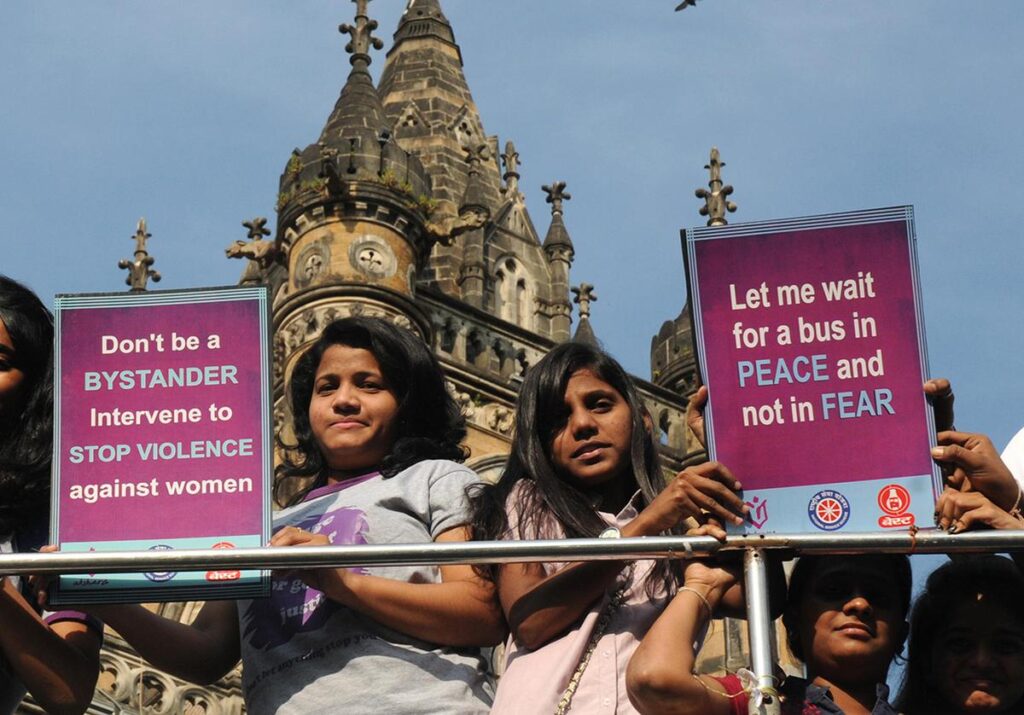
Students with placards emphasising the need for women’s safety at the ‘Freedom from fear’ rally organised in Mumbai. | Photo Credit: Vivek Bendre
Why should consent be at the centre of all discussions on gender sensitivity?
Talking about consent is perhaps the most important conversation when it comes to gender responsive law-making. Right now there is a grey area of offences that are not punishable by law because deciphering consent is tricky. Marital rape is one such example. The law defines consent in negative terms. At the same time, we have a statutory definition that talks about how consent must not be tainted with fear or duress or coercion. But this definition talks about all that consent is not instead of a definition that affirmatively defines what consent is, which is where the problem lies. Without a definition of what consent is, we are all shooting in the dark.
In a poor country like ours, why is it important for women to be equal beneficiaries in every sphere of life?
The answer is parity. Women are not a homogenous group. We are unevenly and disproportionately placed on the starting line. To give women a fair chance at competing with men, we have to first put them on an equal footing with men. Only then can we hope to ensure women are equal beneficiaries of the Indian success story. Unless women are equal recipients of state welfare mechanisms that form a conducive environment for women to participate freely in the open market, how can we expect women to enter, re-enter and exist in the work space? There is no one-step-panacea to put women on an equal footing with men but what is important is to identify and plug operational loopholes with affirmative action, no matter how much some of us might dislike the phrase.
Why do you want the focus to shift from a gender-neutral approach to a gender-responsive one if society and mindsets have to be transformed?
A gender-neutral approach might seek to bridge the differences between different genders. But what we need is an approach that acknowledges and addresses differences between genders and works towards parity and inclusion as opposed to homogenising them. I am not sure if the collective mindset of our society can be changed, that’s a pipedream, but we can take concrete steps towards smaller goals. Law is a mirror to our societal fabric and by inculcating a gender-responsive approach, we recognise that within the subcategory of women, we are not an analogous group, we differ in terms of our access to welfare services, the impact our geographical and marital status has on our socio-economic identities, and so forth. The goal is to target disadvantages that women face, simply by virtue of their gender, and equip them to better respond to these challenges.
In the light of the ‘sulli deals’, what should be done to prevent such cyber bullying?
The anonymous non-confrontational form of violence against women and girls, devoid of physical contact, in cyber space, must be viewed as an impeding factor to gender justice in the 21st century. Essentially, if women are at the receiving end of systemic gender-based violence in real life then the same will translate into an inequitable cyberspace.
With that in mind, we have to first understand the fact that the landscape of violence against women and girls has changed with the advent of technology. To counter this, what we need is targeted legislation that criminalises cyber violence against women and girls. In the absence of any special legislation, both the IT Act and the Indian Penal Code are interim solutions inadequate to contain the magnitude of problems brought on by digital technology.
In The Body of a Woman; Aaliya Waziri, Simon & Schuster India, ₹499.
sudipta.datta@thehindu.co.in
source: http://www.thehindu.com / The Hindu / Home> Books> Author / by Sudipta Datta / October 20th, 2023
Bangalore, Mangalore, KARNATAKA / New York, U.S.A :
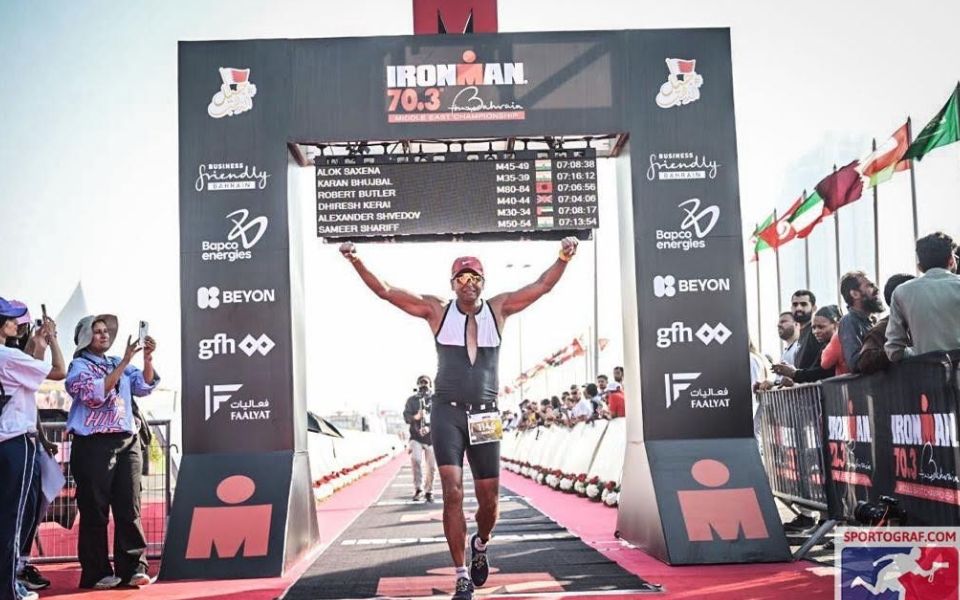
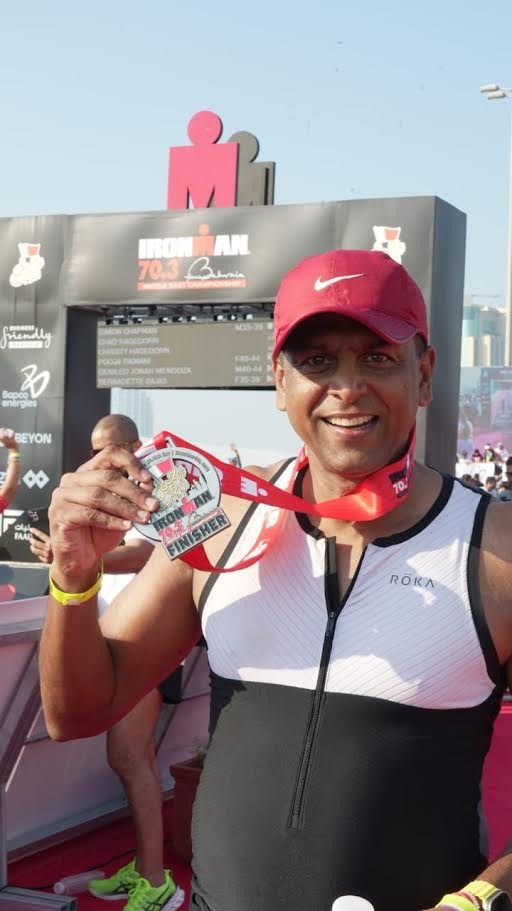
Sameer Shariff, the CEO of Impelsys, a prominent IT company with global offices, including one in Mangalore, successfully completed the IRONMAN 70.3 Bahrain triathlon on December 8, 2023. The challenging event, held at Reef Island, witnessed the participation of over 1500 individuals, with more than 1000 successfully completing it.
By accomplishing the IRONMAN 70.3 course, which comprises a 1.9 KM swim, 90 KM cycling, and a 21.1 KM run, Sameer Shariff joined an exclusive club of global business leaders who have conquered this grueling challenge. Beyond personal achievement, Shariff aims to inspire others to adopt a healthy and active lifestyle. He expressed, “Completing the IRONMAN triathlon pushed my endurance limits, and I believe it sets an example for others. We are making strides with the CEO Fitness Challenge for associates at Impelsys.”
Shariff’s achievement has motivated many colleagues at Impelsys to pursue their fitness goals. Sripad, heading cloud services, shared, “Sameer’s dedication motivated me to run a half marathon in 2023.” Prachi, a project manager, added, “After seeing Sameer’s preparations, I decided to participate in a half marathon. I completed my first half marathon on November 5, 2023, in Mangalore.”
These accomplishments mark the beginning of a broader wellness initiative envisioned by Sameer Shariff. In 2024, Impelsys aims to encourage more participants, extend the challenge to partner organizations and customers, and promote overall well-being. The ‘CEO Fitness Challenge’ is a voluntary program that has seen over a hundred associates engaging in specific health and fitness activities, collectively achieving impressive milestones.
source: http://www.english.varthabharati.in / Vartha Bharati / Home> Gulf / by Vartha Bharati / January 12th, 2024
In a momentous stride towards recognition, Kamran Khan, a distinguished Kashmiri currently based in Chennai, has been honoured with the Australian Government’s prestigious Australia Day Achievement Medallion.
Bestowed on January 26, 2024, this accolade is a recognition for exceptional performance in government projects or core duties, by Australian Government departments and agencies.
Presently Kamran serves as Senior Director for South Asia for Australian Trade and Investment Commission, Australian Government.
He has been a diligent student at the revered Burn Hall School in Srinagar.
In 1992, he left Kashmir to pursue his remaining education and graduated in Automotive Engineering at the University of Madras, where he ranked 3rd across the state of Tamil Nadu, showcasing his academic prowess.
Since 2010, his strategic acumen has been pivotal in shaping the infrastructure industry and fostering foreign direct investment into Australia as part of the Australian Trade and Investment Commission, under the Australian Federal Ministry of Trade and Investment, exemplifying his commitment to economic growth and global collaboration.
As the first Kashmiri to receive the Australia Day Achievement Medallion, Kamran stands as a symbol of pride for Jammu and Kashmir, showcasing the immense talent emerging from the region.
Beyond the accolades and titles, Kamran Khan embodies the spirit of a reformer, committed to ushering in positive change for his community and country.
His recognition by the Australian government not only celebrates Kamran’s achievement but also serves as an inspiration for the entire Jammu and Kashmir community and symbolizes the possibilities that arise when perseverance meets opportunity.
source: http://www.risingkashmir.com / Rising Kashmir / Home / by RK News / February 02nd, 2024
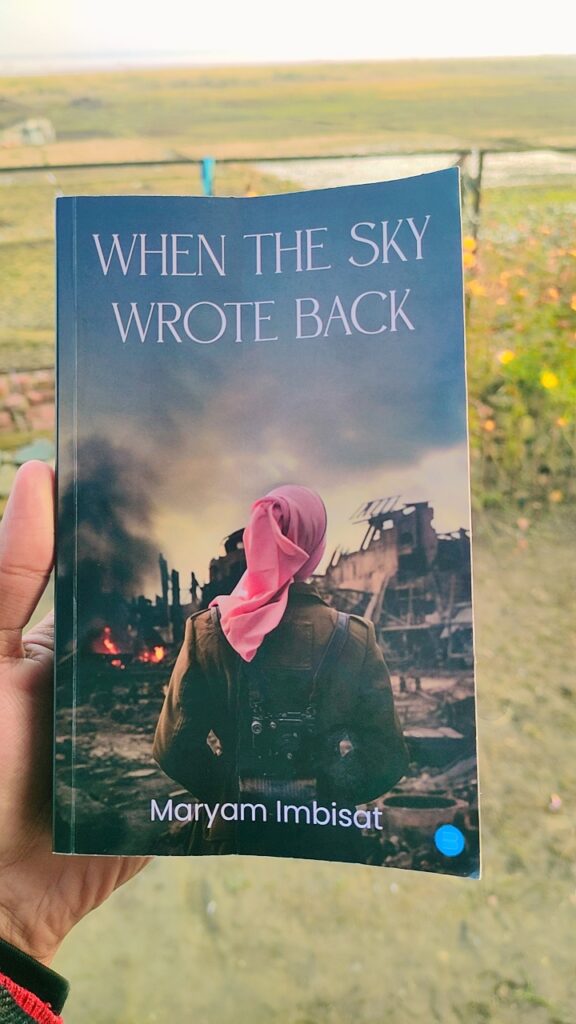
A class 11 student from India hopes to bring a new level of awareness to the Syrian Civil War with her debut novel, ‘When the Sky Wrote Back’. The book has been published by Delhi-based Bluerose Publishers and is 341 pages long.
The author, Mariyam Imbisat, is a 16-year-old student at Azaan International School in the Indian city of Hyderabad. The teenage writer created the character of Noor Ahmar, a young female journalism student from Egypt who travels to Syria undercover to report for a news organisation. The novel depicts the horrors of war, including bombardment, starvation, and fear, as well as the character’s range of emotions.
The Syrian Civil War is an ongoing conflict that started in the Middle Eastern state in March 2011. The United Nations Human Rights Office estimated in 2022 that 306,887 civilians – 1.5% of the total pre-war population – were killed between March 2011 and March 2021 due to the conflict. Since then, the number of dead has just gone up.
In addition to the bloodshed, more than half of Syria’s pre-war population of 22 million have had to flee their homes.
Imbisat says she chose the character of a journalist because she believes in the power of journalism. “The journalists have the power to express the voice of voiceless people, especially in times of conflicts,” Imbisat told Two Circles.
According to Imbisat, the late Al Jazeera correspondent Shireen Abu Aklah inspired the choice of a young Muslim woman journalist as the main character. Aklah was slain in 2022, allegedly by the Israeli Defence Forces (IDF).
Imbisat states that through Ahmar’s journey, she hopes to spread “the message of humanity” to people all across the world. The novel raises awareness of human rights violations and killings through the character’s accounts, as well as advocates for change.
“The story was made for Syria but it has a lesson for the whole world,” she said.
Imbisat began writing the novel four years ago, when she was just twelve years old, as a diary in which she documented Ahmar’s daily life.
“It was difficult to write about something so sensitive like the Syrian war. I used to spend hours reading about conflicts in the world. I was imagining all the scenes in my head,” she added.
Imbisat says she had unwavering support from her parents while she was writing the novel and her mother who is a school teacher helped her regularly with the novel and even helped finding a publisher. The book took more than a month to be edited and published.
The novel concludes with the killing of the young journalist, as Imbisat writes, ‘the young journalist was silent but was not blind’, and all of Ahmar’s recordings and images were released to the world days after her death.
The novel is available online and priced at INR 340.
Tauseef Ahmad is an independent reporter based in Kashmir, India.
source: http://www.twocircles.net / TwoCircles.net / Home> Indian Muslim / by Tauseef Ahmed / January 23rd, 2024
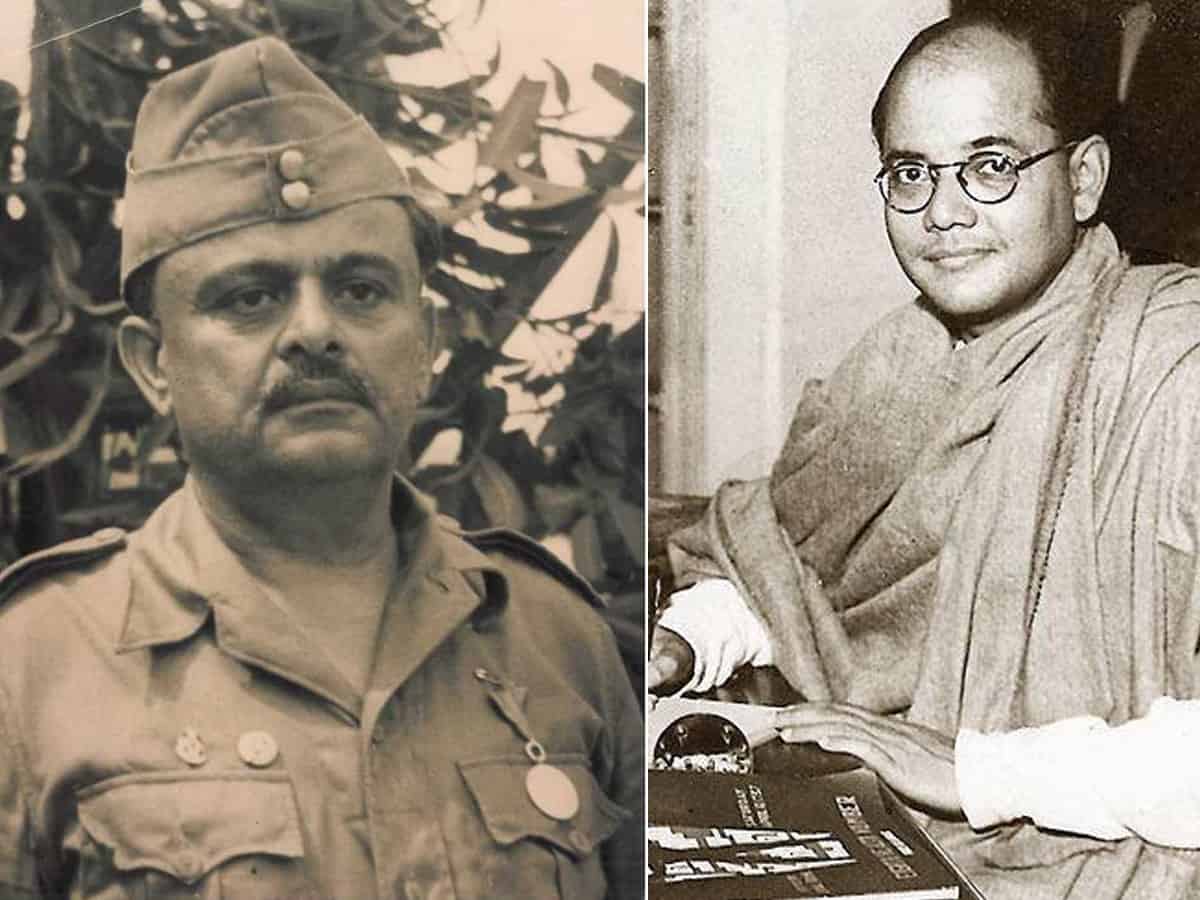
(Left) Habeeb Yusuf Marfani (Right) Subhas Chandra Bose
When Netaji Subhash Chandra Bose launched his fight for the freedom of India from British rule, several likeminded people offered him their whole hearted support and help. But these people and their sacrifices have now been largely forgotten. One such man was Abdul Habeeb Yusuf Marfani, a wealthy businessman who donated all of his fortune totalling one crore and three lakh rupees, to the Indian National Army (INA). Back then it was a princely sum and it helped the INA immensely.
Marfani hailed from the town of Dhoraji in Saurashtra but later the family settled in Rangoon where they set up a flourishing and diverse range of businesses. During the Second World War, When Netaji took charge of the Indian National Army and revived its flagging strength Marfani was the first to come forward to donate a massive amount to the leader for strengthening his army. Netaji honoured him by awarding the Sevak-e Hind medal.
He was the first person who was presented with this medal by Netaji himself. Marfani’s donation was in the form of cash as well as jewellery and property deeds. Reportedly Netaji was very moved by the patriotism and generosity displayed by Marfani. He declared: “I feel very happy about what Seth Marfani has done for the liberation movement. It is extremely commendable.”
Later Netaji realised that after the donation Marfani had become a pauper. So he asked Marfani what he wanted in return for donating his entire property. Marfani replied: “Give me the uniform of a soldier of the INA. I have donated my valuables. Now allow me to give my blood. I only want freedom for India and nothing else.”
His grand gesture inspired many others to come forward with donations. Several of the donations came from poor people like farmers, daily wage earners and coolies too. They donated whatever they could even if it was a few meagre rupees. In fact, Netaji was caught in two minds about whether it was right to take away the small earnings of these poor people. But at that stage one of his aides told him that he should not reject their sentiment or they will feel hurt and therefore Netaji obliged.
The qualities of generosity and sacrifice are held in high esteem in all cultures throughout the world. All people recognise that it takes a big heart and a great soul to be so generous. Whenever Netaji and his deeds are remembered, it is important to also remember the deeds of the men who stood behind the scenes and supported the freedom struggle with everything that they had.
source: http://www.siasat.com / The Siasat Daily / Home> Featured News> by Abhijit Sen Gupta / January 22nd, 2024
/bnn/media/media_files/46f7aae70243fbb91bc74b6729a7365e0d667de7cc0f260ec9eb359f6b73722f.jpg)