Hamied has successfully steered Cipla on an accelerated growth path with a focus on boosting margins, without diluting the core values it stood for.
Synopsis
“I am humbled and honoured to receive the ET’s Businesswoman of the Year Award. This recognition belongs to each and every one of our 25,000 employees who stand with Cipla, putting patients’ interests before their own and upholding our purpose of Caring for Life,” Hamied, executive vice-chairperson, Cipla, told ET.
Samina Hamied represents a rich legacy. Her grandfather, KA Hamied, a freedom fighter and nationalist, founded Cipla in 1935, making it one of India’s oldest pharmaceutical companies. Her uncle Yusuf Hamied is the doyen of Indian pharma known globally for making affordable generic AIDS drugs accessible to millions of patients in Africa and other low- and middle-income countries.
“I am humbled and honoured to receive the ET’s Businesswoman of the Year Award. This recognition belongs to each and every one of our 25,000 employees who stand with Cipla, putting patients’ interests before their own and upholding our purpose of Caring for Life,” Hamied, executive vice-chairperson, Cipla, told ET.
Hamied has successfully steered Cipla on an accelerated growth path with a focus on boosting margins, without diluting the core values it stood for.
Both as executive director from July 2015 and as executive vice-chairperson from September 2016, Hamied has been instrumental in driving the company’s transformation from a traditional low-cost drug manufacturer to one with a young professional management and an aggressive approach towards inorganic expansion. Under her, Cipla also restructured its business and has also initiated cost-optimisation measures.
She spearheaded Cipla’s entry into the US market with strategic acquisitions of two generic companies, InvaGen Pharma and Exelan Pharma, for $550 million in 2015.
From FY15 to FY21, Cipla’s US revenue grew close to five times. US business contributed one-fifth of the total revenue in FY21.
Cipla’s revenue from operations grew at a compounded annual growth rate of 7% in the last 5 years to Rs 19,160 crore in FY21. Ebitda margin and net profit rose 12% CAGR in the last 5 years to 22.5% and Rs 2,405 crore, respectively, in FY21.
During Covid, Cipla launched antivirals, antibody cocktails, testing kits, masks and sanitizers. Cipla’s India business grew 15% year-on-year to Rs 7,736 crore.
Hamied focuses on board and governance issues, furthering Cipla’s global partnerships, shaping its corporate culture and hiring the right talent.
source: http://www.economictimes.indiatimes.com / The Economic Times / Home> English edition> Business News> Industry> Healthcare-Biotech> Healthcare / by ET Bureau / March 28th, 2022
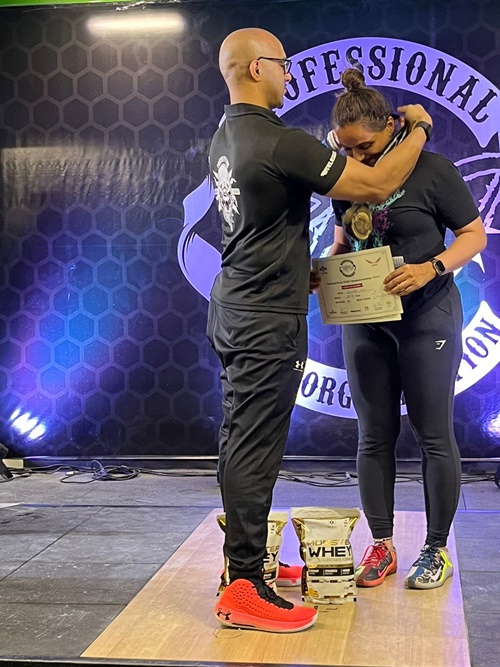
Powerlifter Gulshan Banu Kazi has not only made her native Udupi, India proud but also Dubai proud by securing a world record among the master category athletes in the Professional Raw Organisations Push-Pull Championship 2022, a national level event held in Bengaluru recently.
This sporting event held at Onyx Fitness was one of the most popular internationally sanctioned national powerlifting championships, consisting of three main events -Bench Press, Deadlifts and Push-Pull.
Record holder Gulshan Banu Kazi is a 43-year-old mother of three, working six days a week at a corporate office in Dubai.
A native of Udupi, she is from Udupi and an alumnus of St Cecily’s and PPC College here .
She is a competitive Powerlifter. Powerlifting is a form of competitive weightlifting in which the contestants attempt three types of lifts in a set sequence, squat, bench press, and deadlift.
Gulshan started powerlifting training in the year 2019.
The training is tough. She trains at least four times a week for about 90 minutes each time and keeps a watch on her nutrition intake and sleep pattern.
She has been participating in a powerlifting competition in UAE and did well there. One of her latest has been the Pro-League National Championship-2022 where she hit five personal records and registered a World Record in Deadlifts (U82.5kg Masters and Open Category) by pulling 180 kgs. She becomes the first woman of India in her age and her weight category to pull off this deadlift.
Last April, she participated in the WPC National Powerlifting Championship securing four gold medals in Bengaluru. Gulshan Kazi won the Best Lifter Award in the Masters’ category.
Gulshan used to be above 100 kgs till 2016 when she suffered from Rheumatoid Arthritis.
Resistance training and tracking her food intake enabled her to start losing weight and gaining muscle. Soon after, she was introduced to powerlifting and has been consistent at it ever since.
She is grateful to Raju Pal, her first coach who introduced her to powerlifting and taught her all the basics.
Now she is training under Mohammad Azmat who is a multiple-time national and international medalist in powerlifting, having won medals for India in different federations. He has been coaching her since 2020.
Gulshan Kazi is looking forward to her representation at World Championships and working hard to make India proud.
source: http://www.daijiworld.com / Daijiworld.com / Home> Middle East / by Daijiworld Media Network – DRD / March 22nd, 2022
The Thin Edge | Revisiting the restored, resplendent Humayun’s tomb
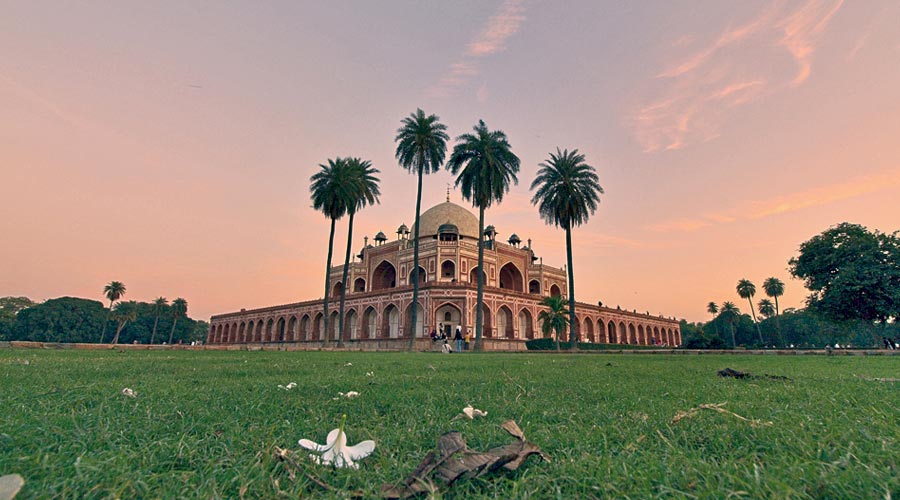
Humayun’s tomb / File picture
I have visited Humayun’s tomb several times, seeing it transform from its earlier decrepitude to the beautiful, sensitively restored monument-space it is today.
The tomb was one of my favourite old buildings even before the restoration — something about its clean lines, its proportions that manage to effortlessly mix intimacy with graceful grandeur, the restrained colour scheme of red sandstone interrupted by sparely deployed white marble, all of it has always nourished me more than the overwhelming, in-your-face beauty of many other Indian mausoleums and temples.
With the restoration now complete, the tomb itself and the ancillary buildings have also been given a context of green, well-tended gardens, which allow the other venerable monuments on the site — the trees and foliage — their own presence, their own visual Kabuki with the man-made masonry.
Recently, I went to see the tomb again, but this time with architect friends who were visiting the city. Like me, this couple had also visited earlier but they had not seen the finished restoration. Walking around the space with two pairs of somewhat differently-trained eyes was a lesson. Things I’d never noticed were pointed out: the exact alignment between the succeeding gateways; the ‘reveal’ as you cross the final threshold and can actually see the whole structure; and how different it was from what happens at, say, the Taj Mahal.
One of the friends spoke about how the white dome interacts with the sky, glowing sharply in the chiaroscuro of dawn and dusk, almost disappearing in muted top light, coming back into round vividity against dark clouds. Examined minutely were the almost invisible rain channels worked into the stone as well as the slope of the platform to coax away the monsoon water, none of which I’d noticed before. Explained was the way the sandstone slabs were placed with minimum mortar and the fact that they fronted a stuffing of lime and stone rubble.
To the east of the tomb stretched a tumult of trees, almost hiding the nearby gurdwara, with the railway line faint in the distance, while the north side had the view of the attendant water aqueducts and the lines of the water channels that must have inspired Louis Kahn and Luis Barragán in their design of the Salk Institute in California.
The spring morning light changed around us as groups of youngsters pranced up and down the stairs and sashayed across the flagstone, moving in unspoken group-selfie choreography, freezing from time to time without tangible signal into Instagram-mudras. Inside the shadowy central chamber, boisterous groups of young men yelled and blew klaxon whistles, bathing in the amazing acoustics before guards chased them away. On the grounds, on the benches under the quartet of pilkhan trees, a couple sat in chaste-canoodle mode while schoolgirls prowled around politely, looking for victims to interview for their class assignment. The austere beauty of the building, the lush, basant authority of the trees and the celebratory clusters of young people together made a whole that transcended architecture, arbour and holiday ardour.
The friends I accompanied are part of a loose movement of Indian architects drawing notice and accolades because of their alternative approach to building for our times.
This approach is defined by several things; a deep study of local grammar and traditions that inform any new design; a rigorous examination of the environmental impact of any new building, with innovative solutions to cooling and energy consumption becoming central to a project from the very beginning of conceptualization; an aim for genuine, non-grandiose beauty in the final design, all of this entirely subservient to who will use the building and how they will experience it in daily use. This movement is not confined just to India or to the subcontinent. A few days after my friends’ visit, came the welcome news that Diébédo Francis Kéré of Burkina Faso and Germany had won the Pritzker Prize, the most prestigious international recognition for architectural work.
This is not the place to detail Kéré’s work but what is important to note is that the architect has consistently built across some of the most deprived areas of Africa, working with local people, using the simplest local materials in the most inventive ways to produce buildings and projects which pair stunning design with amazing utility. Thus, a local school building may be made from compacted clay, with its ceiling and walls designed to cool the classrooms without any air-conditioning or glass cladding; a lighting scheme in another building may involve embedding into a ceiling traditional pots sliced into half; a Parliament building for Benin may echo a palaver tree under which people traditionally gather for meetings, while a proposed Parliament for Burkina Faso may be in the form of a ziggurat where the assembly is underground below a terraced public park, where the people are literally above the legislators. “I want people to take ownership over the parliament building,” Kéré has said and in that one sentence perhaps lies the core of his philosophy.
A few minutes drive from Humayun’s tomb brings you to the tin-sheet canyons that enclose the biggest heist of urban commons in the history of independent India. Here, at the Central Vista, the most pompously authoritarian, most ecologically damaging, most backward-looking glass and concrete office blocks, the prime minister’s mansion and the fortress-like new Parliament building are being constructed for a huge amount of public money at a time of grim scarcity. This area, for decades one of the few places where even the poorest of the city could walk in greenery, will now become a high-security showpiece for the bloated egos of those in power. In a city full of beautiful mausoleums, these future tombs for those ruling over us today will not stand any test or comparison. But meanwhile, whether in Kutch or Koudougou, in Dakar or Dhaka, human ingenuity, generosity and aesthetic grace will continue to produce architecture that re-affirms life and joy.
source: http://www.telegraphindia.com / The Telegraph Online / by Ruchir Joshi / March 22nd, 2022
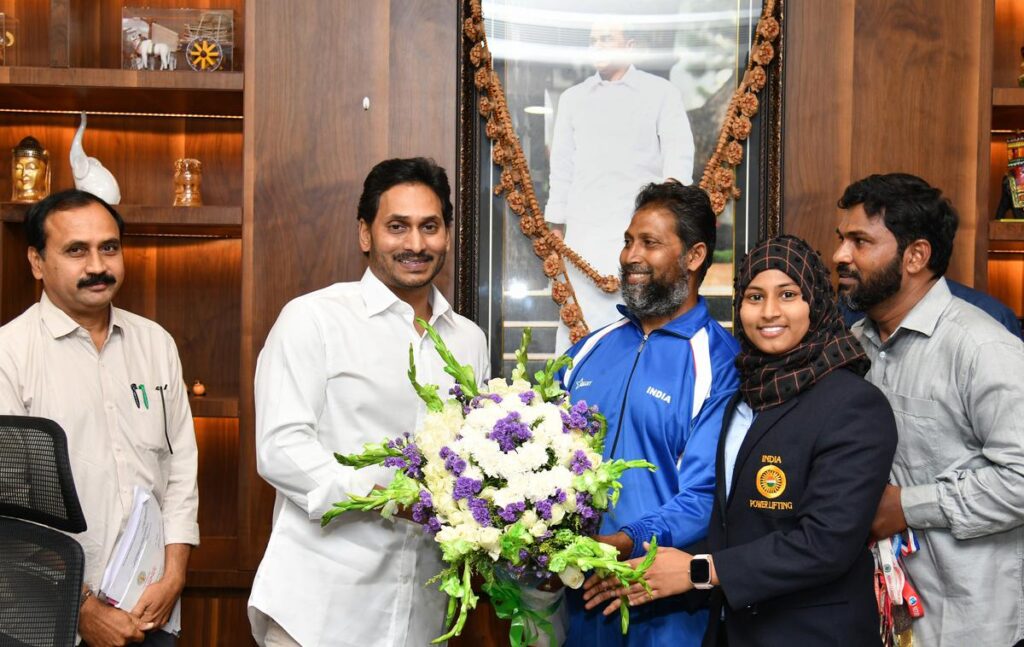
Powerlifting champion Sk. Sadia Almas presenting a bouquet to Chief Minister Y.S. Jagan Mohan Reddy at Tadepalli on Tuesday.
Proposal for setting up a powerlifting academy at Mangalagiri approved
Chief Minister Y.S. Jagan Mohan Reddy has announced a final assistance of ₹5 lakh on behalf of the Andhra Pradesh government for international powerlifting champion Shaik Sadia Almas.
Ms. Sadia, along with her father Samdhani, met Mr. Jagan Mohan Reddy at his chamber in the Assembly . She won three gold medals and a bronze medal at the Asian Powerlifting Championships held at Istanbul in Turkey in December 2021.
Mr. Jagan Mohan Reddy appreciated Ms. Sadia and approved the proposal of establishing a powerlifting academy in her hometown of Mangalagiri. He said that the government would make all efforts to encourage athletes in the State.
Sports Minister M. Srinivasa Rao, Mangalagiri MLA Alla Ramakrishna Reddy, Special Chief Secretary Rajat Bhargava and others were present on the occasion.
source: http://www.thehindu.com / The Hindu / Home> News> National> Andhra Pradesh / by Tharun Boda / Vijayawada – March 22nd, 2022
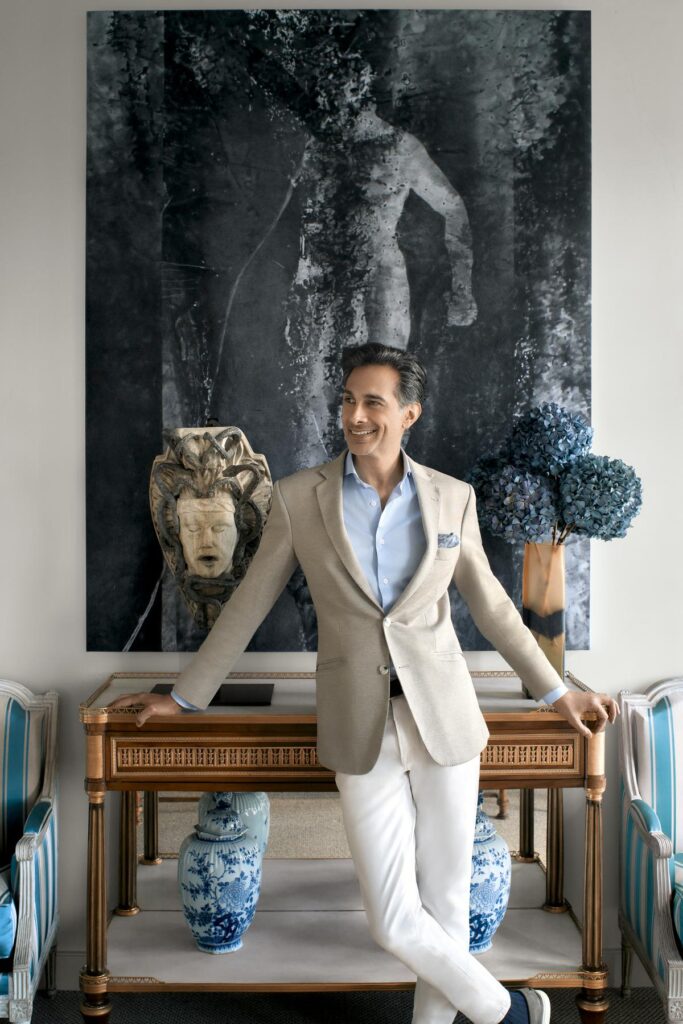
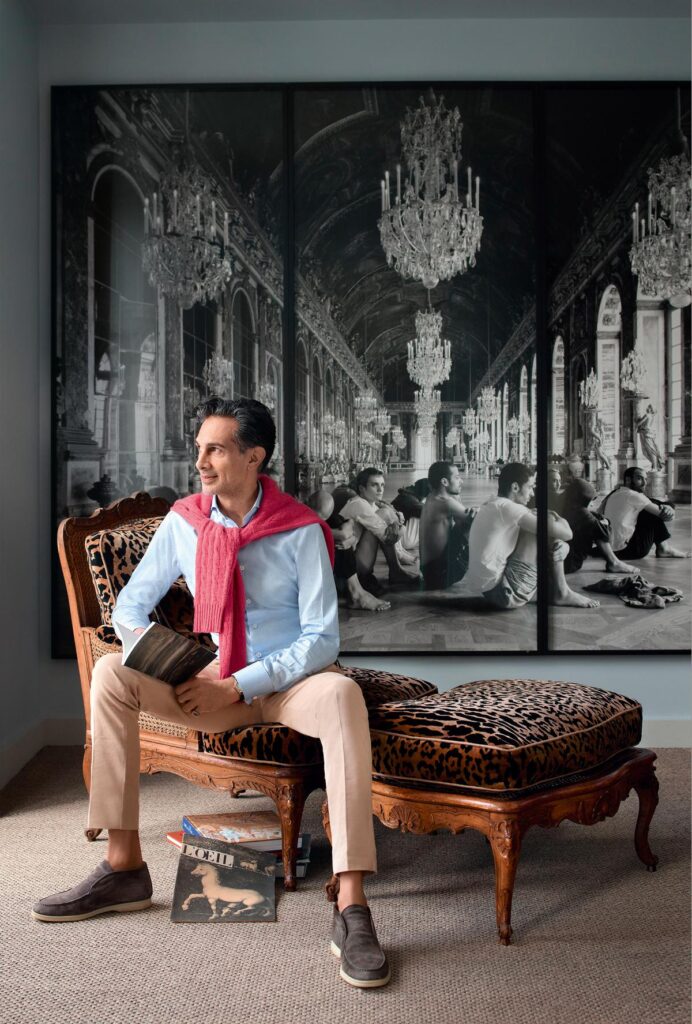
Amin Jaffer in his library dining room, standing in front of Yuntao Zhang’s painting of Cellini’s Medusa | Photo Credit: Architectural Digest / Antonio Martinelli
The Rwanda-born Indian curator, who has made the French capital his home, on the Al Thani collection’s first museum, his new book, and the importance of private collections
Writer, curator, collaborator, colonial furniture specialist: Amin Jaffer wears his titles effortlessly. And in the last couple of years, he’s added another one — that of Paris denizen — after he uprooted his English life of 25 years to move into a hôtel particulier (a grand townhouse) on Quai Voltaire along the Seine.
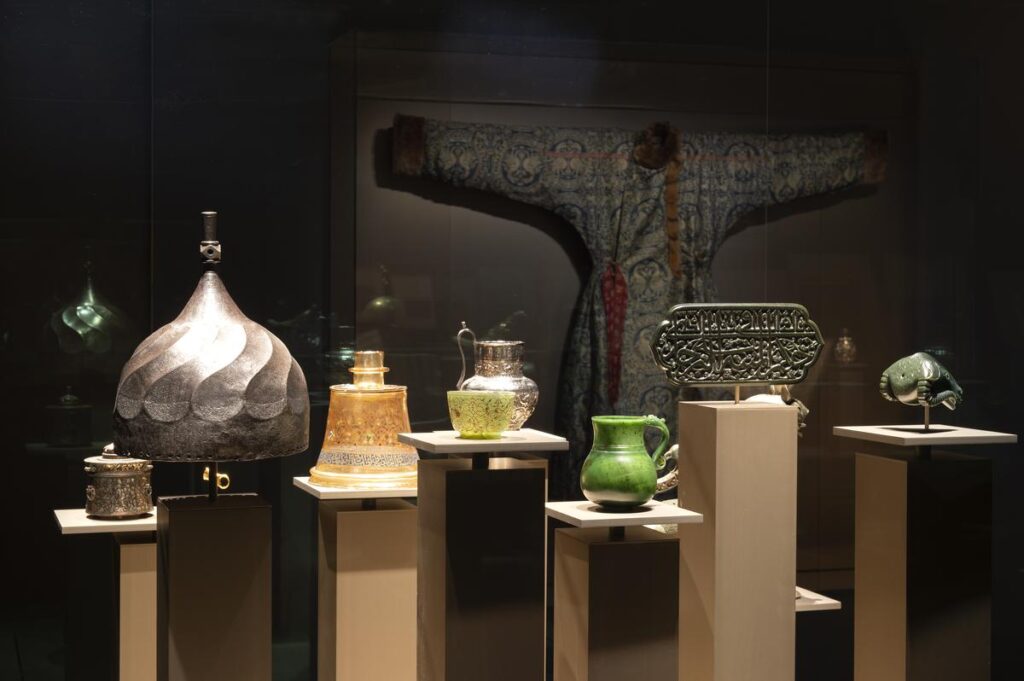
The move made sense. An “éminence grise of the international art world”, as an Architectural Digest article calls him (Jaffer is on the cover of the magazine’s 10th anniversary issue this month), he was “spending a lot of time in Venice, and the commute to London was becoming taxing”. But more importantly, his newest project, a private museum for the Al Thani Collection, is in the city, at Place de la Concorde’s Hôtel de la Marine.
“Sheikh Hamad bin Abdullah Al Thani was looking for a more permanent place to house the treasures of his collection,” says Jaffer, recalling how at the time, the French government body Centre des Monuments Nationaux was thinking of converting the former storage space for royal tapestries at the Hôtel — a four-year, €132 million restoration project. “They proposed that the Al Thani Collection could exhibit its masterpieces there.” With a 20-year agreement in place, acquiring a Parisian pin code thus gave him a twofold advantage, both with work and keeping up his continental way of life. (The last few weeks alone have seen Jaffer travel to Seville and Carmona in Spain and Parma and Venice in Italy.)
The Al Thani Collection at Hôtel de la Marine | Photo Credit: Marc Domage
Polaroid and a passion for art
The view of the Louvre from his third floor flat definitely tipped the scales in its favour. (The photos he shares on his Instagram, @aminjaffer_curator, are proof enough.) And the fact that Vivant Denon, the first director of the museum, had once been a resident in the 17th century building. Moreover, as he explains in an email that he squeezes in between flights, he’s always had a special connection with the Louvre. As a six-year-old, he had visited the museum with his mum, spending an entire day exploring its rooms, a Polaroid camera clutched tightly in his hands. He still has the photographs. “The adrenalin rush of seeing a great work of art inspired me then — as it does now,” he says, adding how by the time he turned 10 he had visited most of the major museums in Europe. “Other seminal moments include an early visit to the Musée des Beaux-Arts in Brussels and a trip to Rome to see the Vatican collections.”
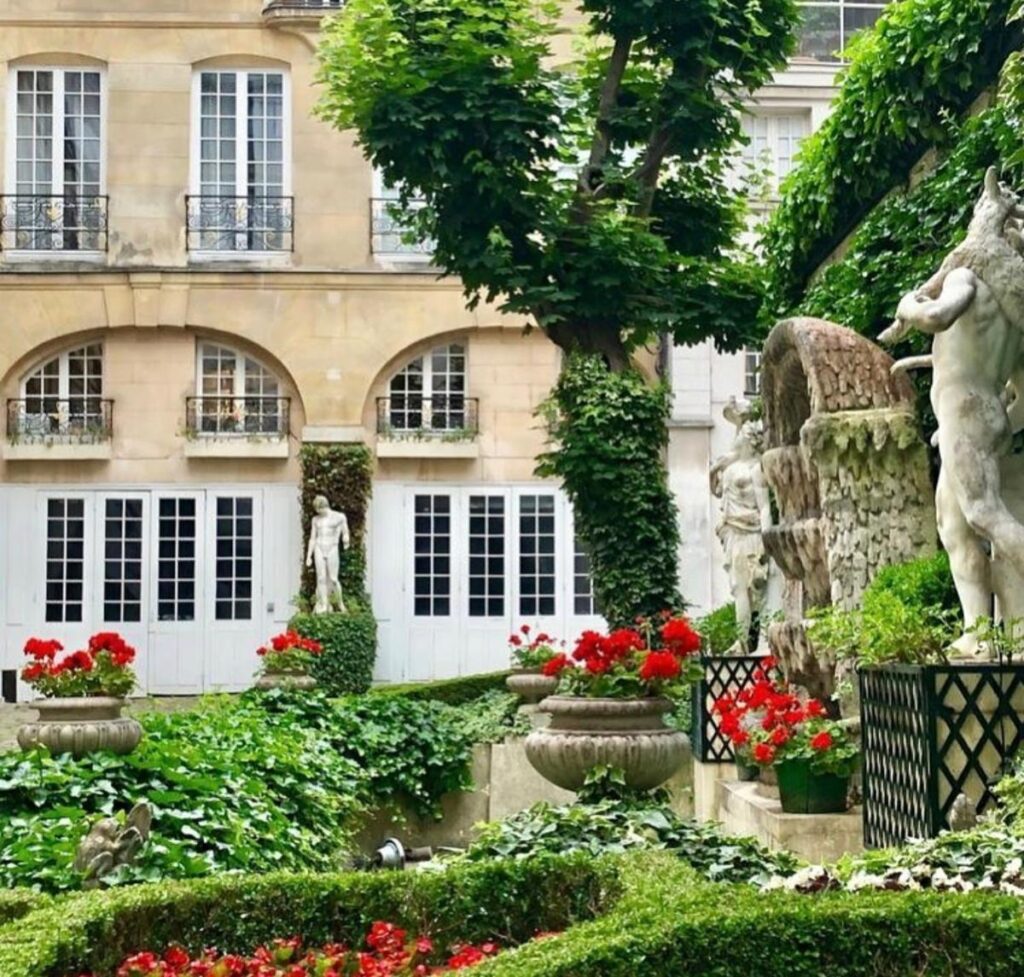
The courtyard at L’Hôtel de Beuvron with its Rococo fountain | Photo Credit: @aminjaffer_curato
But he nearly missed his calling. Born into an Indian business family in Kigali, Rwanda, a career in art wasn’t an option growing up. His subjects in university were economics and commerce! That is, until he chose the history of French opera and French Renaissance châteaux as his first year electives and reignited his love affair with the arts.
Today, Jaffer, who is in his early 50s, is not only the chief curator of the Al Thani Collection, but also works with leading museums around the world in a “curatorial role, focussed on public projects, exhibition programming and producing catalogues”. His resume includes long stints at the V&A Museum in London as curator and as the International Director of Asian Art at Christie’s.
Amin Jaffer in his home office, sitting in front of a triptych by Reza Aramesh | Photo Credit: Architectural Digest / Antonio Martinelli
The perks of a private collection
“Born in central Africa, educated in Europe and America, I do feel something of a hybrid and I am drawn by works of art that are born from the encounter of two — or more — civilisations,” says Jaffer, who has recently “been fascinated by the fusion of Spanish and Amerindian culture, particularly in the domain of painting”. This ties in beautifully with the Al Thani Collection and its catalogue of more than 5,000 works of art drawn from across world civilisations.
It makes us wonder, how important are such private collections in the art world? “Pioneer collectors have vision and resources that compliment the public art offering,” he says, explaining how such collections play a significant role in the programming of national institutions. “Recent examples in Paris [besides the Al Thani Collection] includes the Bourse de Commerce and the Fondation Louis Vuitton. In India, Kiran Nadar has developed a programme of exhibitions around her collection that makes an essential contribution to the art scene,” adds the Indian art expert who played a key part in launching Christie’s first auction in Mumbai in 2013.
At Hôtel de la Marine | Photo Credit: Marc Domage
On board with digital
Jaffer’s personal collection is equally varied. A triptych by Iranian photographer Raza Aramesh, of Afghan refugees sitting in the Versailles’ Hall of Mirrors, takes pride of place in his home office, while a painting of Italian sculptor Benvenuto Cellini’s Medusa by Chinese contemporary artist Yuntao Zhang hangs in the library dining room. Elsewhere, Qing period armchairs, Louis XVI commodes, and Bouke De Vries’ Memory Jars are tucked into corners and under tables. “My most recent passions are French 18th century silver and hardstones from late Antiquity, especially objects in porphyry. I am learning more about Symbolist painting, too,” he says.
His days of confinement (as the French called the lockdown) helped broaden his base. When not watching life on the river, he was visiting digital museums and “researching parallel institutions” around the world. “What’s certain,” he says, “is that technology will play a greater role in the way we enjoy works of art — whether through the presence of more immersive, digitally-led exhibitions [such as the RMN Grand Palais’ immersive Venice show opening in autumn] or the sharing of information about works of art through digital platforms [like the one for the Palazzo Pilotta collection in Parma, which he experienced last weekend].” Does this mean he’s also on board with NFTs? “Of course, the phenomenon interests me,” he says, “but I do not yet have sufficient expertise to comment on anything in this new domain.”
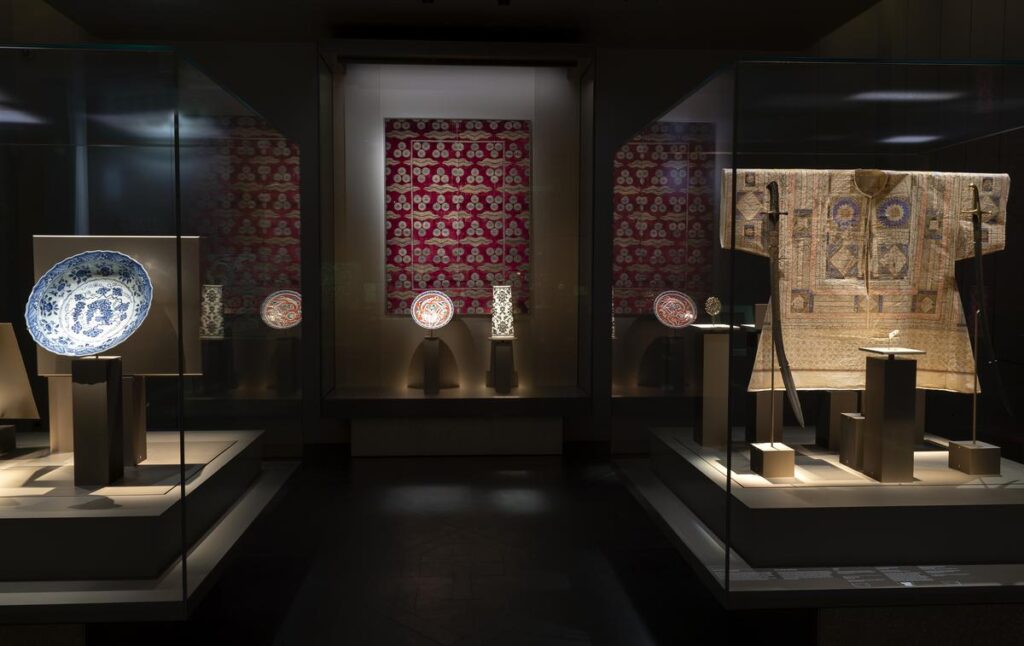
The Al Thani Collection | Photo Credit: Marc Domage
Left Bank to the Concorde
For now, he’s back at his home at L’Hôtel de Beuvron, listening to Wagner and Mahler, and updating his Instagram. V&A’s new exhibition, Fashioning masculinities — on the male dress and its influences — has caught his eye, though he admits his personal wardrobe is rather formulaic. Tailored clothes in a limited palette of colours is the ‘uniform’, accented by pocket squares and ties that reflect the season or his mood. “Cufflinks are a weakness,” he shares, “and the best ones are by [Indian jeweller] Viren Bhagat, without doubt.”
Even as Jaffer immerses himself in life on the Left Bank, work at the museum is keeping up its momentum. “Some substantial pieces have been added to the collection in the past two years, which reflect the diversity of interests [of Sheikh Al Thani]. These will be shared with the public through displays at the Hôtel de la Marine,” he concludes.
source: http://www.thehindu.com / The Hindu / Home> Entertainment> Art / by Surya Praphulla Kumar / March 19th, 2022
At Falak in Bengaluru, a custodian of the old Urdu-speaking culture and culinary traditions brings storytelling to the table
While the lights of Dubai-esque skyscrapers speak of a new Bangalore and its ambition, the salubrious weather on the terrace is a testament to an old city — pleasant and genteel, never mind traffic, chaos or climate change!
This convergence of the old and the new is a theme, as I sit down to a meal at Falak, the new restaurant at Leela Bhartiya City. The meal is to flow like a quintessential 19th century Lucknowi dastaan (story), hyperbolic and stylised, to mimic the oral storytelling tradition, dastaan-e-goi.
In my bookcase, I have a copy of Tilism-i-Hoshruba, the truly first Indo-Islamic romance epic, an extension of the dastans of Amir Hamza, of the Persian tradition, albeit in translation. When it was first published, in a serialised form, between 1881-93, by the iconic Naval Kishore Press in Lucknow, it marked an important moment for the Urdu-speaking-and listening audience of northern India, long familiar with the Persian romance tradition — with fantasy, adventure and the implausible built in. But I turn to Hamza, to also dive into the inherent syncreticism on the pages, as the mores of a Persian world collide and merge with those of local Braj Bhasha-speaking cultures of the Indo-Gangetic plain.
Finding nuanced Avadhi in Bengaluru
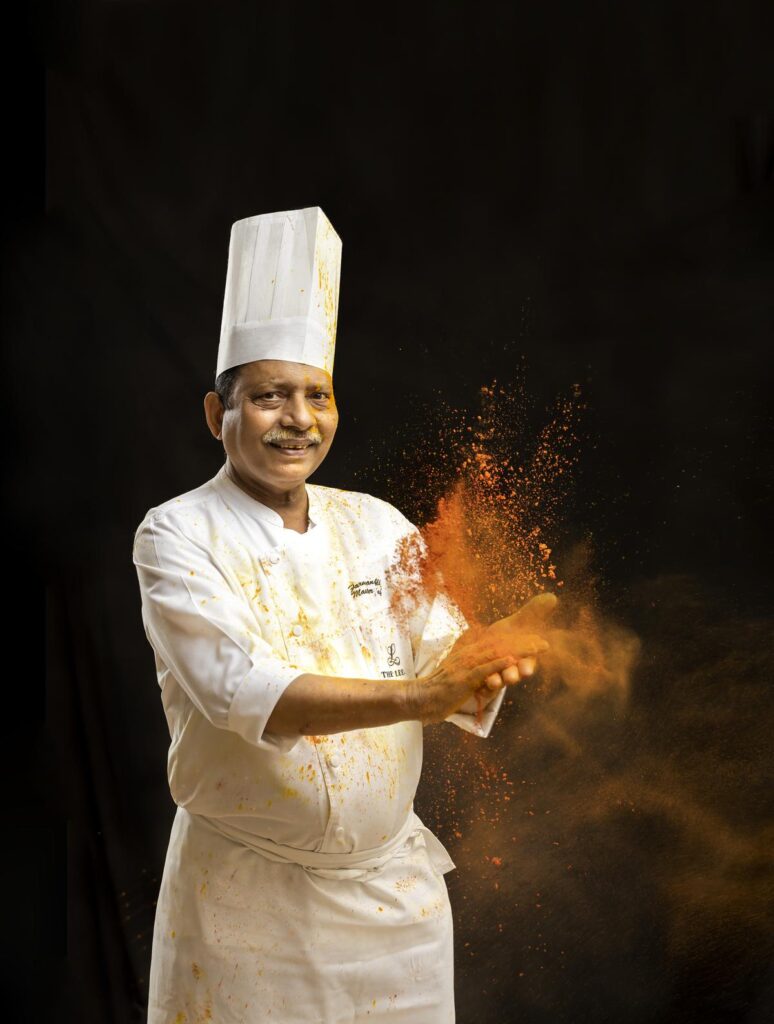
It’s a surprise to find a restaurant referencing this art form, to present Lucknowi (as also other Mughalai) dishes. Used to so much pastiche when it comes to Avadhi, the detailing in the menu is also unexpected. The food that arrives confirms that this perhaps is one of the most nuanced Avadhi/Mughalai restaurant opening in recent times — here in Bengaluru, rather implausibly, rather than Delhi, Mumbai or even London! Everything falls into place, however, when Farman Ali, all of 70, a chef who cooks behind the fiery range and sigri himself, and presides over the kitchens of Falak, makes his appearance.
When he hears about of my own Lucknowi antecedents, Ali abandons the idea of narrating food lore. With an extreme politeness that marks old Nawabi etiquette, he asks me, “ Ab aap ko kya dastan sunaye? [what possible tales can I tell you?].” And bursts into poetry, instead!
The rest of the evening goes by with the chef dropping verses from Daag or Ghalib or the other few who made 19th century Delhi one of the most literary cities in the world, even if we have forgotten that genre of poetry of lament created almost exactly at the time as Shelley, Wordsworth and the Romantics.
pix
Parts of an ancient story
For Ali, I realise, this is not performance — though it is quite in sync with modern chefs expected to be performative as they spend time building brands ‘front of the house’. Instead, this is a way of life, a culture that has all but completely faded. As the meal progresses — the nihari (pepper-laced stew of old Delhi’s spice market, concocted, according to lore, to ward off cold and flu thought to emanate from the Yamuna canal in Chandni Chowk) being replaced by the qorma ( nihari evolved into the subtle Avadhi qorma, catering to aristocrats who thought it ill-mannered to be smelling of spices after a meal) being replaced by the ‘ balai’ka tukda for dessert (not dubbed ‘ shahi’ royal bread pudding here; balai being the correct term for clotted cream) — we talk not food but art.
One of the dishes served at Falak | Photo Credit: Special arrangement
“After 1857, so many artisans and poets fled Delhi for the Deccan,” says Ali. “Culture spreads like this.” He is right, of course. But the ghazal or qasidas aside, it’s also the biryani that has diffused. Farman Ali’s is the old Delhi/Lucknowi style (he grew up in old Delhi and still has a house there) where rice is cooked in stock, and the ‘ pulao’ is not the layered and overtly spiced dish that its Hyderabadi cousin is. Old ‘Nakhlauwallas’ — such as yours truly — contend there was no Avadhi biryani at all, before the restaurants took over, just many fanciful and well-documented pulaos such as the ‘ moti’ (pearls) or the ‘cuckoo’, served with fried onions and thin yoghurt, no chutney or gravy.
The man behind Jamavar
Ali worked in restaurants in Delhi and Dubai before being handpicked by The Leela’s Capt CP Krishnan Nair to create the food of Jamavar nationally, to cook and serve pan-Indian food. Based in Bengaluru, he curiously escaped much national attention, retiring just before the pandemic, but was called back by the owners of Bhartiya City, foodies themselves, to cook food closer to his roots.
If cuisine is an expression of a culture, at a particular point in history, its custodians and storytellers are as important as the taste of dishes.
In India, at this moment in time, it is perhaps important to look back on the custodians of the old Urdu-speaking cultures and their culinary expressions. What kind of a society produced these stylised dishes? Farman Ali, in many ways, is the last of the great chefs, many of whom were feted much more and earlier in their careers than him — such as Imtiaz Qureshi of ITC Hotels (and his family, such as son-in-law Ghulam Qureshi of Dumpukht), and chef Ghulam Rasool of Taj Hotels.
source: http://www.thehindu.com / The Hindu / Home> Life & Style> Food / by Anoothi Vishal / March 19th, 2022
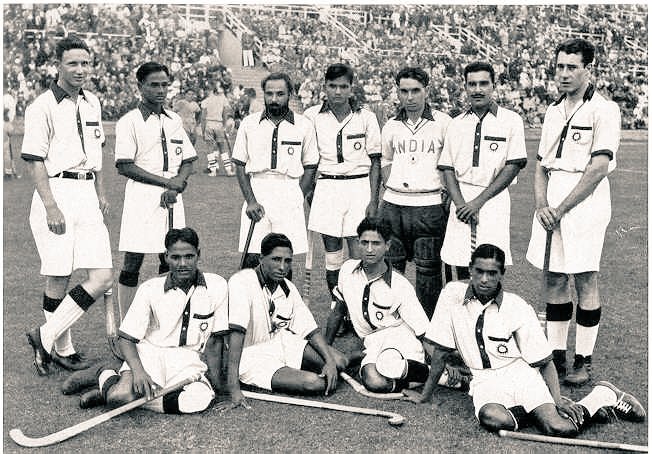
SM Jaffar was one of India’s finest hockey players in an era when the country reached near invincibility in the sport.
In the warm southern California summer of 1932, a group of young and colourfully-dressed athletes caught the attention of the residents of the Olympic host city. Angeleños, as the residents of Los Angeles were called at that time, had been expecting to see exotic looking foreigners, but even so, it would have been hard for many of them to not take a second look at turbaned Sikhs, Muslims and Hindus from faraway India.
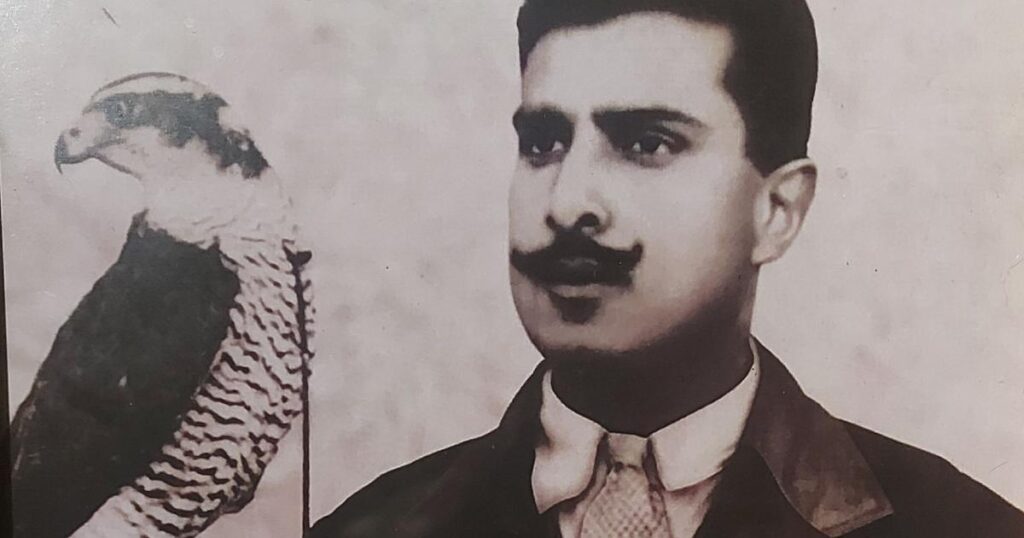
Accounts from diaries from the 1930s suggest that one 20-year-old with his trademark moustache and turban caught the attention of both athletes and fans. This hockey player from Shergarh, in what was then the Montgomery district of western Punjab, was one of the rising stars of the Indian hockey team: Sayed Mohammed Jaffar Shah (SM Jaffar), who played the left-out (forward) position.
Like his teammates, who undertook the 42-day journey by ship from Colombo to California, SM Jaffar could have easily been distracted by the attractions that Hollywood offered, but his focus on the hockey was unwavering. “This charming athlete from India, this sheikh from the deserts of Montgomery, this man who carried with him something of an atmosphere of vast extensive plains and cornfields and open air wherever he went, attracted many admirers,” writer Syed Ahmed Shah, better known as Patras Bokhari, wrote in an essay in the 1930s. “But this stranger with a manly moustache had the modesty of a village virgin that was both fascinating and forbidding.” SM Jaffar was Bokhari’s student at the Government College in Lahore.
Jaffar had a reputation of being a disciplinarian to the core. He even eschewed coffee, as his only attempt at drinking the beverage resulted in the loss of an entire night of sleep. “Myriads were the temptations in the way of a young man so far away from his mother and his father and his friends and dear ones at home,” Jaffar was quoted as saying by Bokhari.
The hockey player, who was a hawking and hunting enthusiast and a regular patron of Amritsar’s hawk sellers, chose to spend his free time in Los Angeles visiting the zoo and the city’s lion farm.
It was a foregone conclusion that the Indian team, which won the gold medal in the 1928 Amsterdam Olympics, would crush the only two opponents – the Unites States and Japan. Like the ongoing Tokyo Olympics, which have lost their sheen because of the global pandemic, the Los Angeles games had reduced participation on account of the Great Depression. Only 37 nations participated in the 1932 Olympics, compared to 46 in Amsterdam four years earlier. The Indian team, divided by groupism between Anglo-Indians and others (the captaincy went to Lal Shah Bokhari), beat the United States 24-1 and Japan 11-1 to win the gold.
“I have had the privilege of seeing many cuttings from American newspapers and I can say without the least fear of contradiction that no other player was more popular, more skilful and more highly praised than Jaffar, with perhaps the solitary exception of Dhyan Chand,” Syed Zulfiqar Ali Shah, who was Jaffar’s teacher at Lahore’s Aitchison College, wrote in 1937.
Shah, who would later become the principal of the prestigious Lahore institution, added, “…and what was true at Los Angeles, was equally true at the time of the Olympic Games in Berlin.”
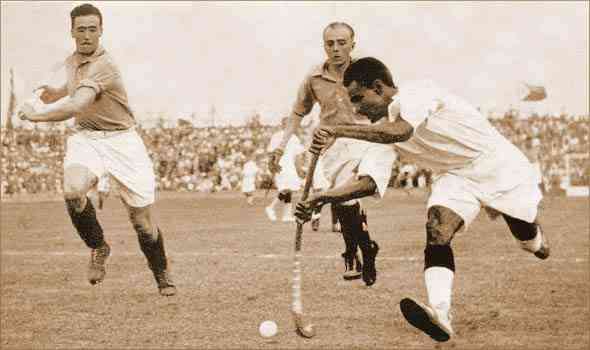
Dhyan Chand runs away with the ball in an Olympic contest. Credit: Wikimedia Commons [Public Domain]
Road To Berlin
After returning to Lahore, Jaffar immersed himself in his studies. He completed his degree and was appointed Extra Assistant Commissioner of Lahore and even took the Indian Police Competitive Examination. His hockey career also continued to flourish. By 1936, he was the captain of the Punjab hockey team at the inter-provincial hockey tournament in Calcutta.
The tournament, won by host Bengal, was used as a selection criterion for the 1936 Berlin Olympics. In a country which had several strong hockey sides such as Bengal, Bombay, Bhopal and Manavdar, just two players from Punjab were selected – Jaffar and Gurcharan Singh. Despite a request from the hockey authorities, the Indian Army initially refused to grant superstar Ali Iqtidar Shah Dara leave to play for the national side.
When it was time to select the captain of the Indian team, there were three candidates: Dhyan Chand, Jaffar and Manavdar’s MN Masood. “The IHF [Indian Hockey Federation] met at Delhi sometime in April to select the captain and officials of the tour,” Dhyan Chand wrote in his 1952 autobiography. “For the office of the captain, three names were put up – Jaffar, MN Masood and myself. Jaffar subsequently withdrew in my favour.”
It is widely accepted that the 1936 Indian team was the greatest to ever take the field in the history of the sport. Two-time defending champions, they were the favourites to win the gold, but the German side was a formidable opponent.
1936 :: Indian Hockey Team That Won Gold Medal In Berlin Olympics .
In Final, India Defeated Germany 8-1
In Tournament India Scored 38 Goals , Dhyan Chand Scored 13 Goals and His Younger Brother Roop Singh Scored 9 Goals
9:49 PM – Aug 1, 2021
_______
Panic seized the Indian team when they lost a warm-up game to the Germans by a score of 4 to 1. Dhyan Chand and Jaffar requested the army to release Dara for the tournament, and the legend was flown in to Germany a day before the semi-final. Till that point, India had little trouble in the tournament, easily defeating Japan, Hungary and the United States. The champions then crushed France 10-0 in the semis.
The final between India and Germany was witnessed by 40,000 spectators , most of them cheering for the home side.
India had some supporters in the stand too, including members of the Baroda and Bhopal royal families as well as some Indians who lived on the continent. The clinical performance of the Indian team, which won 8-1, threw the theory of Aryan Supremacy to the bottom of the Spree River that runs through the centre of Berlin. In a match where Dhyan Chand scored three goals, Dara added two and Jaffar contributed to the tally with a solitary goal. India could have easily scored more, but Dhyan Chand decided to give the “rough” Germans a “lesson in ball control” and the Indian team toyed with their opponents, moving the ball around endlessly.
“During the tour, he was a very great asset to the team, both on and off the field, and was highly praised by the German press,” Syed Zulfiqar Ali Shah wrote about Jaffar. “…He was Dhyan Chand’s right hand man and extremely useful in maintaining the morale of the team.”
The Olympic gold in hockey would stay in the subcontinent until 1972, with India winning gold in 1948, 1952, 1956 and 1964 and Pakistan doing so in 1960 and 1968.
A Tragic End
Unlike Olympic legends, Dhyan Chand and Ali Dara, SM Jaffar, who was at the peak of his athletic abilities in the mid-1930s, would not live to see the departure of the British from the subcontinent.
On the morning of March 21, 1937, Jaffar, an avid hunting enthusiast, went on a duck shoot with his friends on the banks of the Ravi River, near Lahore. The Olympian waded into the river to retrieve a duck that his dog was unable to get. Unknown to the party, the duck fell near a whirlpool in waist-deep water. Jaffar was sucked in, and his boots got caught in the reeds in the water. Despite being a skilled swimmer, he could not set himself free. The two-time Olympic gold medallist drowned in front of his friends in the Ravi. He was 25.
“It is too painful for me to recall here the incident of his most tragic death, which has deprived us of a brilliant ‘Old Boy’ of whom we were all unreservedly proud; no institution will mourn the death of Jaffar more than Aitchison College, of whose products he was the finest example,” Syed Zulfiqar Ali Shah wrote.
SM Jaffar is remembered as an all-time hockey great in Pakistan. As a tribute to his contribution to hockey, Aitchison College constructed a hockey pavilion in 1939. The Ali Institute of Education in Lahore organises an annual hockey tournament in his name. In India, however, his name is known only among the diehard hockey fans of a much older and dying generation. Perhaps a celebration of the legacy of such common heroes of the subcontinent would act as a catalyst for better relations between the South Asian countries?
Ajay Kamalakaran is a writer and independent journalist, based in Mumbai. He is a Kalpalata Fellow for History & Heritage Writings for 2021.
source: http://www.scroll.in / Scroll.in / Home> Remembering History / by Ajay Kamalakaran / August 06th, 2021
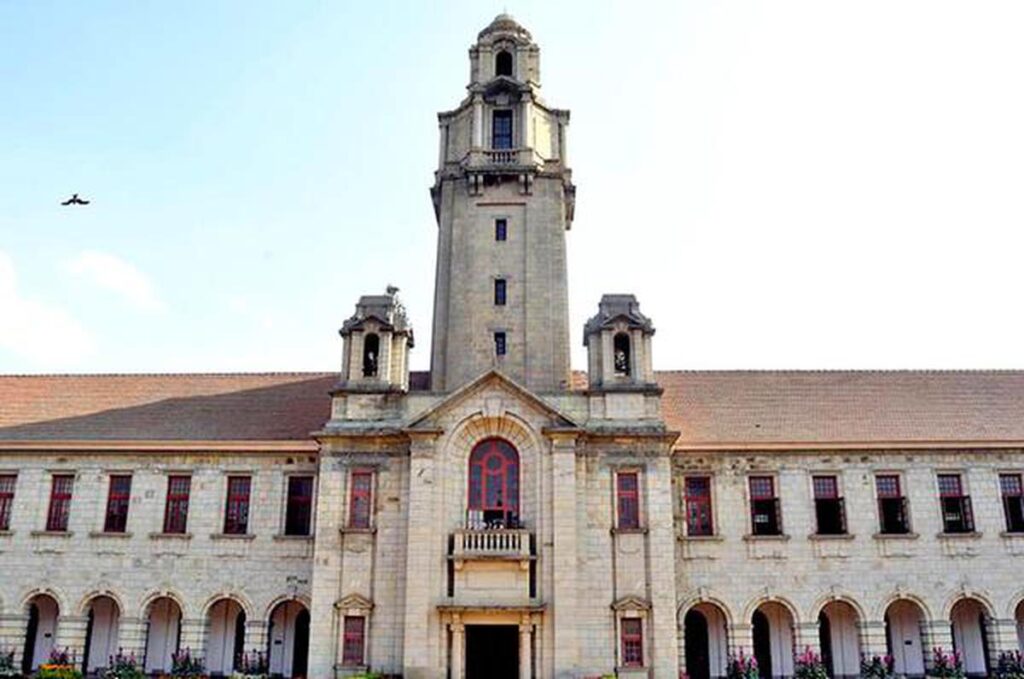
Indian Institute of Science, Bengaluru | Photo Credit: The Hindu
The lab has been set up to build cutting edge AI products in the healthcare domain, and bridge the gap between clinical medicine and technology by training healthcare professionals in AI
To understand disease patterns and improve treatment outcomes using artificial intelligence (AI) tools, Aster CMI Hospital has joined hands with the Indian Institute of Science (IISc.) to launch an AI lab.
The lab has been set up to build cutting edge AI products in the healthcare domain, and bridge the gap between clinical medicine and technology by training healthcare professionals in AI.
The lab was launched by Azad Moopen, founder Chairman and Managing Director, Aster DM Healthcare; Lokesh B., Consultant Neurology at the hospital; and Phaneendra K Yalavarthy, Professor of Medical Imaging, Department of Computational and Data Sciences, IISc.
Aster CMI will work with Prof. Phaneendra K Yalavarthy and his team on ‘Development of Deep Learning Methods for Automated Tracking and Segmentation of Nerves in Ultrasound Images’.
Sriram Ganapathy, Associate Professor, Department of Electrical Engineering, IISc. has been collaborating on ‘Automatic Acute Stroke Symptom Detection Using Mobile Health Technologies’ and also on audio analytics in neurological disorders. Aster CMI believes that these initial projects have a direct impact on the current clinical practice in neurosciences.
At the launch, Dr Moopen said, “With the use of AI, doctors and medical providers will now be able to deliver more accurate diagnosis in the fastest possible time, which can aid the treatment journey. Also, AI would be a big leap towards predictive and proactive data analytics, which will improve preventive care recommendations for patients. We are glad to partner with IISc.”
Prof. Phaneendra K Yalavarthy, who has been instrumental in setting up the lab by providing the computational infrastructure and expertise, said, “AI-powered medical technologies have been rapidly evolving and have become powerful adjunct tools in clinical practice. The broad spectrum of digital medicine, especially to enable the 4P model of medicine (Predictive, Preventive, Personalised, and Participatory) involves natural collaboration between academic institutions and medical institutions.”
He said this artificial intelligence lab is a collaborative effort to develop these AI technologies in the hospital settings such that the translation to clinic will be seamless. “The initial focus of this collaborative lab will be in neurology and will later be expanded to other clinical specialities. We are thankful to Aster CMI for providing space to establish this lab in their hospital to enable co-development of some of these AI technologies for healthcare. This collaborative lab will enable the development of highly impactful research and technologies with a focus on translation to the bedside,” he said.
source: http://www.thehindu.com / The Hindu / Home> News> National> Karnataka / by The Hindu Bureau / Bengaluru – March 19th, 2022
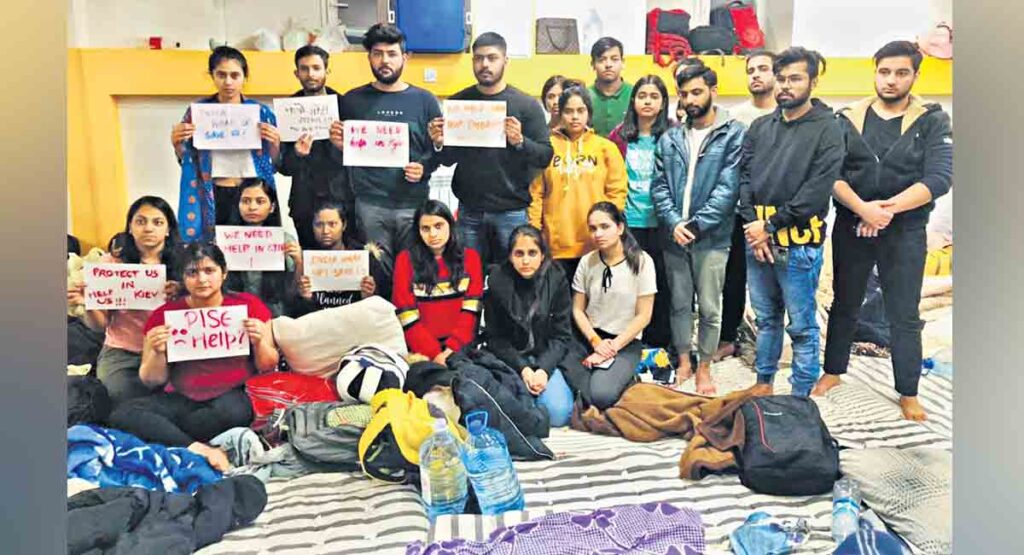
Indian students who are in Kyiv appeal for their evacuation.
Hyderabad:
Cook food in the confines of house in the morning and take refuge in the nearby bunkers all through the day. This has become routine for several Telugu students who are caught in the war-torn Ukraine for the past a few days. Worst is the situation for students who are staying in Kyiv, the capital of Ukraine, which has been witnessing heavy bombardment from the Russian forces.
“On February 23 at 3.30 am, we heard the first heavy explosion nearby our house that was deafening. The bombing was followed thereafter. Last night, an oil factory was bombed and fire could be seen from far of places. We are really scared for our lives. We are cooking in the house and staying in bunker,” says Sai Naik, a Warangal native who is staying in Kyiv with seven other students.
As the war-torn Ukraine announced martial law which includes curfew, all establishments have shut their shops. While some students had managed to stock-up, but needless to say, they do not last long.
“We bought groceries and other edibles for five days and we are already into the fourth day the food stock for one-day left. We have no idea what we will do now as all stores are closed since February 24.|
There is a shortage of water as well,” said Naik, who is a student of Bogomolets National Medical University, Kyiv.
Another student from Hyderabad, Gulam Ahmed Mohiuddin Salman who is currently taking shelter in Kyiv Medical University hostel said there were no responses from the Indian Embassy officials regarding their evacuation.
“There are 200 Indian students presently in the hostel basement. We are running short of groceries and other provisions. Given the situation with no transportation facility, it is impossible for us to travel to the Ukraine border which is 800 kms away from the hostel,” Salman said.
Naik, Salman and several other Indian students have made desperate appeals to the Indian government to at least transport them to the nearest border post.
Shoot at sight orders
“Shoot at sight orders was issued by the Ukraine government, so we cannot move out. We want the Indian government to help us reach the Ukraine border so that we can board a flight from neighbouring country,” Naik appealed.
source: http://www.telanganatoday.com / Telangana Today / Home / by Yuvraj Akula / February 27th, 2022
Students are hoping for rehabilitation in India or admission in similar universities in European countries like Poland as a special case for Indian students
Uncertainty looms large over the fate of students who safely returned to India from Ukraine as some of them feel that continuing medical education in the war-ravaged country would be tougher, challenging and unreliable and parents may refuse to send them back in the present circumstances.
In Mysuru, Kodagu and Chamarajnagar, several students have returned safely and a few more are on their way. What has been bothering the returnees is “what next”.
Though discussions are ongoing in various circles on whether to permit the affected students to continue their education in Indian colleges, a clear picture on their future may emerge once all safely return to the country with the Centre’s ‘Operation Ganga’ in the final stages of evacuation in Ukraine.
“I’m worried about my future. I don’t know whether my parents will send me back to Ukraine if the situation returns to normal though it appears to be highly uncertain with Russian militia advancing. I am keeping my fingers crossed. I have put in three years and I was about to be promoted to fourth year. I am hopeful something will emerge as India will work out a solution in students’ interests,” said Likith, who returned from Kharkiv.
Like Likith, his friends and classmates in Kodagu and Mysuru are hoping that the medical colleges or universities in Europe may also consider admitting the affected students from Ukraine since the education system is almost similar in many European countries. In solidarity with Ukraine, the European institutions, as a special case, may admit the students, after fulfilling the formalities. Poland, Hungary and Slovakia and other countries may consider admission, they hope.
“I and my friends and I have decided to wait and watch the developments. We cannot say what happens in the days ahead. We are hoping that our interests will be protected,” said Likith, a student of Kharkiv National Medical University, who spent a harrowing time with eight others in a bunker in Kharkiv after the Russian invasion.
Sharukh M.Y., who returned to his hometown in Virajpet taluk in Kodagu on Sunday, is hoping that the government of India will come up with a plan to address the returnees’ plight.
“I am hoping that my university in Ukraine will start online classes at the earliest. It has told us it will update us by March 15. With the war on, everything appears uncertain. I’m in the sixth semester. I would have been promoted to fourth year but the crisis forced us to vacate. I am open to all options,” said Shah Rukh, who is a student of V.N. Karazin Kharkiv National University in Kharkiv.
source: http://www.thehindu.com / The Hindu / Home> News> National >Karnataka / by Special Correspondent / Myusru – March 07th, 2022