NEW DELHI :
New Delhi :
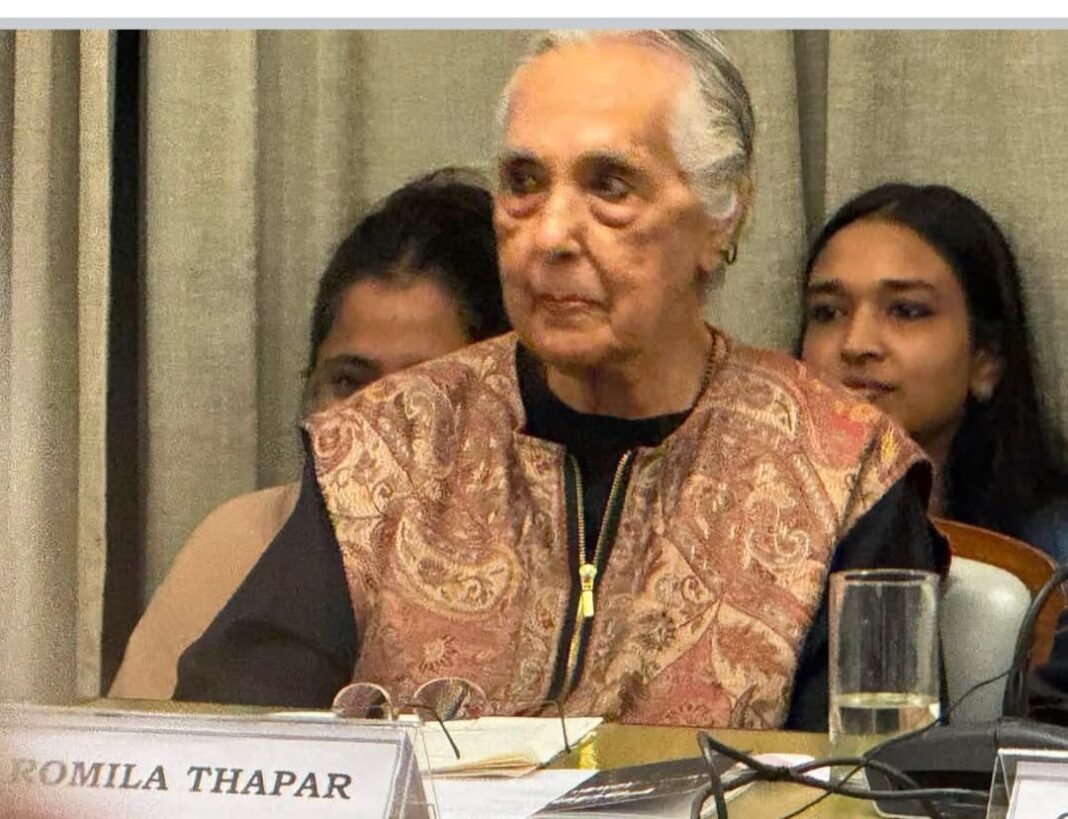
Renowned historian Romila Thapar, speaking at the launch of her memoir “Just Being: A Memoir” at the India International Centre on Sunday evening, drew attention to the rich tradition of memoirs and biographies associated with the Mughal period, describing them as important sources for understanding not only rulers but also the political, social and cultural environment in which they lived.
Rather than speaking extensively about her own memoir, Thapar used the occasion to discuss memoir as a genre of writing and its value to historians. She explained that memoirs and biographies provide more than accounts of individual lives. They also reveal how authors viewed their societies, political surroundings and the people with whom they interacted.
In this context, Thapar highlighted the writings produced during the Mughal period, particularly those associated with Mughal rulers and members of the imperial court. She said these writings were a lively form of historical and literary expression and offered insights into both the public and private worlds of the Mughal elite.
Thapar pointed to the memoir of Babur as one of the most notable examples. Babur recorded his experiences in Ferghana and Kabul, as well as his battles and efforts to establish a kingdom in the frontier region between north-western India and Afghanistan. According to Thapar, Babur’s writing style was remarkably comfortable and informal, with descriptions of major political and military events interspersed with observations about everyday life.
One of the characteristics that makes Babur’s memoir particularly engaging, she noted, is the way serious accounts of warfare and state-building are accompanied by apparently ordinary personal observations. She referred to Babur’s well-known comment that melons in India were not as sweet as those in Ferghana. Such details, Thapar suggested, make the memoir more than a record of battles and political achievements. They provide glimpses into the personality and preferences of the ruler himself.
Thapar also discussed the memoir associated with Humayun, which differs from Babur’s account because it was compiled by his sister, Gulbadan Begum. She described the work as having a stronger biographical character while still containing valuable observations about Mughal court life.
The memoir, according to Thapar, provides glimpses into both the public and private dimensions of the court. It records aspects of the relatively hidden or “surreptitious” life of the court alongside its more visible political activities. This makes such writings particularly valuable to historians attempting to understand how the Mughal court functioned beyond formal descriptions of imperial power.
Thapar also referred to Abul Fazl’s Akbar Nama, describing it as almost a combination of biography and history. The work chronicles the activities of Emperor Akbar while simultaneously providing an account of the wider historical circumstances of his reign. She noted that subsequent Mughal rulers either wrote memoirs themselves or had their lives recorded, producing accounts associated with Jahangir and Shah Jahan.
One of the most striking features of these writings, Thapar said, was the cultural change visible between the period before Akbar and the writing produced during and after his reign. The writings reflected considerable interaction between the author and the surrounding cultural environment, as well as a growing sense of inquiry into the world around them.
Thapar stressed that this cultural interaction is significant because historians need to understand the world as it was perceived by individuals living in a particular period. Mughal writings, she argued, provide evidence not only of how rulers viewed themselves but also of their relationships with the people over whom they ruled and the communities with whom they lived in close proximity.
Such interactions, she suggested, could alter aspects of the lives and cultural patterns on both sides. The memoirs and biographies, therefore, should not simply be read as official records of imperial achievements. They can also be examined as accounts of encounters between different groups and cultures.
Thapar gave particular importance to the writings of Mughal women, observing that some women’s memoirs were highly political. She referred to Jahanara Begum, the daughter of Shah Jahan and sister of Aurangzeb, who wrote about life and politics within the Mughal court.
The importance of such writings, she suggested, lies in the way they bring together ordinary concerns and political observations. Everyday experiences could appear alongside reflections on society, court personalities and political developments. The narration of political activities gave these memoirs a distinct political edge, allowing them to capture the historical moment from perspectives that might otherwise remain underrepresented.
Thapar said these writings also reflected the “mixed identity” of the Mughal elite. The court was not an isolated political institution; it was a space where different cultural influences, social relationships and political interests came together. Memoirs and biographies provide evidence of these interactions and help historians understand how individuals negotiated their identities within that environment.
Her discussion also drew attention to what is missing from historical sources. Thapar expressed disappointment at the absence of comparable reflections on the emerging elite in Sanskrit sources, particularly because some high-caste officials had written about court politics. The contrast demonstrates how the survival and nature of historical sources can influence modern understanding of a particular period.
Thapar’s larger argument was that memoirs should be read critically rather than treated as straightforward factual records. The value of a memoir lies not only in whether every event has been recorded accurately but also in what the author chose to observe, emphasise or ignore.
This approach is particularly relevant when reading Mughal memoirs. A ruler writing about his own battles, a court historian describing an emperor, or a woman writing about life within the imperial household each presents a different perspective. Their accounts reveal their individual experiences and assumptions as much as they reveal the historical events themselves.
She emphasised that biographies and memoirs are therefore commentaries on both the individuals being described and the contexts in which they lived. The author, even when writing about another person, inevitably reveals something about himself or herself through the selection of events and the interpretation of personalities.
Thapar’s discussion placed Mughal memoirs within a much longer tradition of biographical writing in India. She noted that biographies existed well before the Mughal period, citing works such as Banabhatta’s seventh-century biography of King Harshavardhana and the Ramacharitam of Sandhyakar Nandi. However, Mughal-era writings developed within a distinctive cultural and political environment and offer particularly valuable evidence of interactions between rulers, court elites and wider society.
Her comments ultimately suggested that Mughal memoirs should be viewed as more than chronicles of emperors and their achievements. They are records of personalities, political relationships, cultural encounters and changing perceptions. Babur’s observations of his homeland and India, Gulbadan Begum’s account of Humayun and the Mughal household, Abul Fazl’s expansive portrayal of Akbar, and the political observations of women such as Jahanara Begum collectively demonstrate the diversity of voices connected to the Mughal court.
For historians, Thapar argued, these texts are significant precisely because they allow the past to be viewed through the eyes of people who experienced it. Their subjective nature does not diminish their historical value; instead, it provides another layer of evidence about how individuals understood their world.
In her remarks, Thapar ultimately presented Mughal memoirs as a bridge between personal experience and history. By reading them alongside other historical evidence, historians can move beyond the conventional story of kings and battles and gain a deeper understanding of the society, politics and cultural interactions that shaped the Mughal era.
Professor Kumkum Roy, professor of History, formerly of JNU; Professor Neeladri Bhattacharya, professor of History, formerly of JNU; and Ambassador TCA Raghavan, former High Commissioner to Pakistan, also shared their views. At the same time, Professor Kunal Chakravarti moderated the event.