“Kaiser-saheb is joining us after a meeting with party president Lalu Prasad-ji. We stand to gain from his experience. It is a development that will send across a strong message in favour of our fight to protect the Constitution, which is facing threat from the ruling dispensation,” said Tejashwi Yadav.
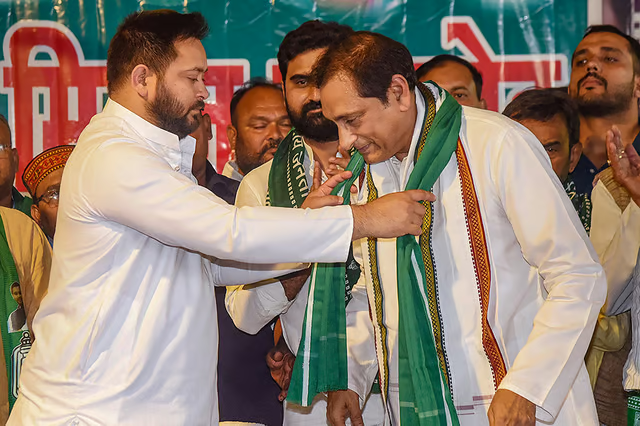
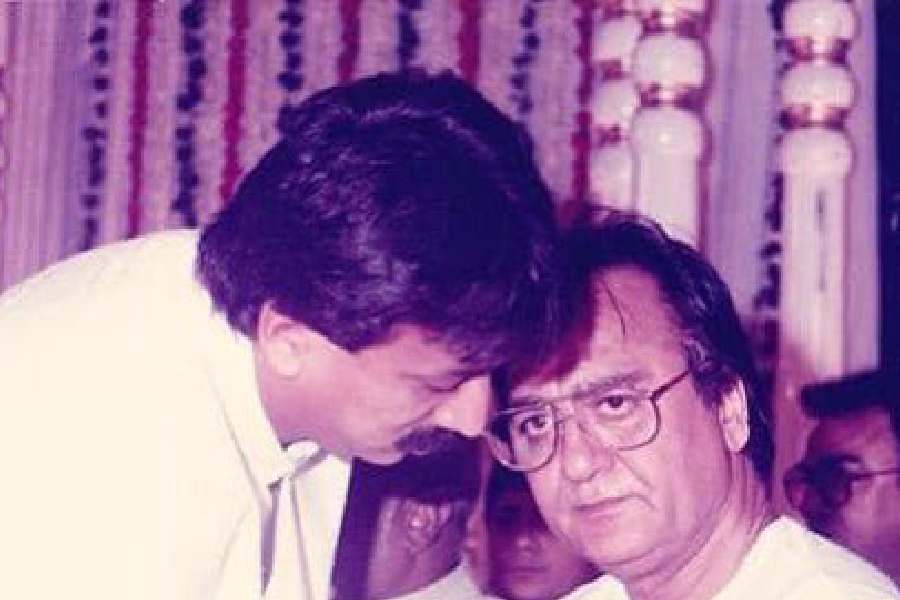
Mehboob Ali Kaiser joins RJD / Photo: PT
LJP MP Mehboob Ali Kaiser, the lone Muslim to have been elected to the Lok Sabha from the BJP-led NDA in Bihar, joined the RJD on Sunday, in a shot in the arm for the opposition party amid the elections.
Kaiser, who sided with former Union minister Pashupati Kumar Paras when the latter split the LJP, and was denied a ticket this time by Chirag Paswan despite efforts to seek rapprochement, joined the RJD in the presence of its leader Tejashwi Yadav.
“Kaiser-saheb is joining us after a meeting with party president Lalu Prasad-ji. We stand to gain from his experience. It is a development that will send across a strong message in favour of our fight to protect the Constitution, which is facing threat from the ruling dispensation,” said Yadav.
Born into the family that ruled the erstwhile princely state of Simri Bakhtiyarpur in Saharsa district, Kaiser started his political career with the Congress and headed the party’s state unit till 2013.
He joined the LJP in 2014 and won the Khagaria seat, which he retained five years later.
His relations with Chirag Paswan, the then LJP president, began to sour when the party denied a ticket to his son Yusuf Salahuddin in the 2020 assembly polls.
Salahuddin went on to contest and win the Simri Bakhtiyarpur seat on an RJD ticket.
It was not immediately known whether the RJD, which has announced candidates for all but one of the 23 Lok Sabha seats it is contesting, will be fielding Kaiser in the ongoing elections.
source: http://www.outlookindia.com / Outlook / Home> Elections / by PTI / August 21st, 2024
The cemetery and those who lie buried in the soil of time and fate are the witness to the the lost romance, their epitaphs bear a testimony to a history of prose and poetry.
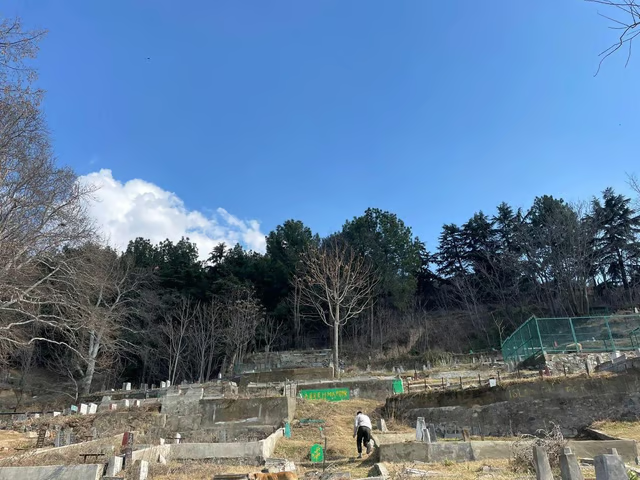
The forgotten poet cemetery of Kashmir / Photo: Shakir Mir / Internet
خاک میں کیا صورتیں ہوں گی کہ پنہاں ہو گئیں
(In the soil- what faces must be hidden)
Beauty finds its way at odd places; away from the flamboyant commotion of Boulevard, far from the amorous colours of Zabarwan and distant from the prospects, perspectives and spectre of present. Beauty finds its way at odd places: along the sombre shores of the lifelessness, in the weed, litter and rubbish of a graveyard, the withered tombstones of a cemetery,
The Cemetery of the Poets
The cemetery and those who lie buried in the soil of time and fate are the witness to the the lost romance, their epitaphs bear a testimony to a history of prose and poetry.
Laala tooram, na humchoon ghuncha gulboo zadaem
Shaula jae bakhya bar chaak-e-gereban meezenam
(I am the Tulip of Sinai and not the bud borne of a rose
To my torn collar, I apply the needle of my fire to stitch it)
Cries out poet Mazhari, having penned down 6000 Persian verses throughout his travels from Iran, Khorasan, Hindustan to Kashmir, but now lost in graves and indifference of another necropolis, Malkhah.
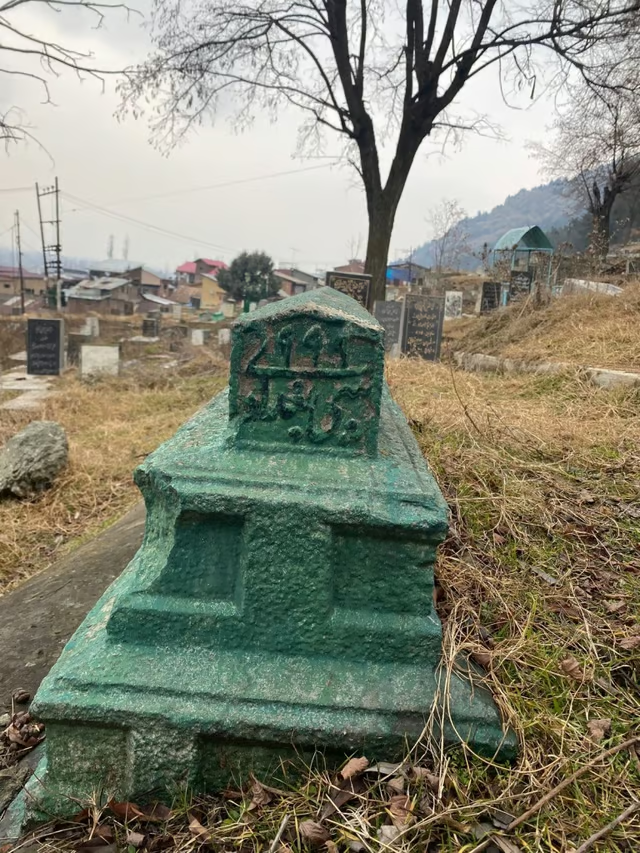
Founded in year 1587 C.E during by the Mughal emperor Akbar, the cemetery of poets, also called Mazar-e-Shoara is situated along the banks of Dal Lake. The burial ground for the once eminent poets seems to have been selected carefully to give the dead souls a serene eternal sleep. The historical records show that there were five poets and men of letters buried in the cemetery, all of them the eminent avant grade of Iran, associated with the literary upper class of Mughal court. However, as of today only three of the tombstones can be located in the mazar, rest covered in debris of time and apathy.
There seems to be some confusion regarding the first grave in the cemetery, largely appearing due to the mistakes in copying the previous historical accounts. In this regard the first reference comes from the great historian and author, Mohammad Azam Dedmari in his Waqiat-e-Kashmir. Dedmari was a scholar, researcher, and also a poet of his time and was born during Aurangzeb’s era when Abu Nasr was performing the duties of sobedar (Governor) of Kashmir. Therefore, due to his temporal proximity to the rule of Akbar and his other meticulous documentations, his record can be taken as more authentic.
According to him the great Iranian savant and scholar of his time, Shah Fatehullah had come from Iran to Deccan. According to M. A Alvi and Abdur Rahman’s seminal work, “Fathullah Shirazi: The great Indian scientist of 16th century” and Mohammad Akmal Makhdum’s, “A Great Man: Shah Fateh Ullah Shirazi”, Fatehullah was brought up in Shiraz and learnt under great teachers like Kamal-ud-din Masood Sherwani and Khwajah Jamaluddin Mahmud, a disciple of the logician Jalal-al-din-Davani. Shirazi furthered his knowledge in medicine, mathematics, and science under the instruction of Mir Ghayasuddin Mansur. After completing his education, Shirazi embarked on a career in education in Shiraz. Among his notable students was Abdul Rahim Khan-i-Khanan, who served as the close confidant of the Mughal Emperor Akbar. In 1583, Shirazi received an invitation from Mughal Emperor Akbar and subsequently joined the imperial court in Agra.He soon earned the title of Amir and a rank (mansab) of 3000. Two years later, in 1584, Akbar appointed him as the Amin-ul-Mulk, also known as the Trustee of the State.Shirazi’s first task was to reexamine and rectify the Mughal Empire’s vast transaction records, which he accomplished with diligence and success. Along with his administrative work, Shirazi also undertook the task of regulating the intrinsic and bullion values of coins. He identified and corrected discrepancies in the currency, ensuring its reliability and trustworthiness. Shirazi’s skills and talents also earned him various honors and titles. In 1585 and 1587, the emperor selected him to lead diplomatic missions to the Deccan, where he was recognized for his efforts with the title of Azud-ud-Dawlah, or the Arm of the Emperor. He also received a horse, 5000 rupees, a robe of honor, and the office of the Chief Sadr of Hindustan.
A great poet, he also made significant contributions to the fields of philosophy and logic, particularly in his work, Takmilah-i-Hashiyah. Additionally, he played a crucial role in compiling the Tarikh-i-Alfi, a thousand-year history of Islam, demonstrating his vast knowledge in the field of history.
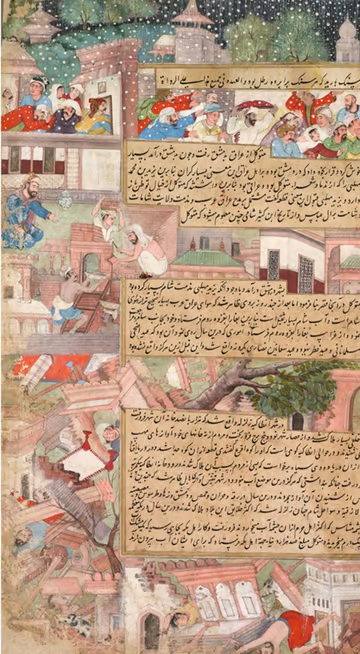
Page of disasters, from Tarikh-i-Alf
One can try to estimate the scholarship of Shah Fatehullah by the brief introduction Abul Fazal (Grand Vizier of Emperor Akbar the Great) writes about him. Abul Fazal being a royal minister and himself a great scholar did not recognise anybody at par with his own scholarship, but about Shah Fatehullah he writes:
“if all the books of all the subjects and sciences and crafts are destroyed then Shah Fatehullah, with his scholarship and knowledge, and with his memory, will create a parallel new library of books.”
Emperor Akbar mourns his death in following words:
“Had he fallen in the hands of Franks and had they they demanded all my treasures for him, I would gladly have entered such profitable traffic and brought the jewel cheap”
Shirazi was a great inventor and is credited with numerous innovations like improved cannons and guns, wagon mllls, mirrors that would make far things appear closer, travelling baths etc.
Two references are made to the death of Shah Fatehullah by Kashmiri scholars, one by Dedmari who says that he developed Typhoid and self treated it by over-eating Harisa. Another reference is made by Hassan Kuehami in his Tareekh-e-Hassan in which he refers to him (probably mistakenly) as Shah Abu Fateh and cites tuberculosis as his cause of death. The mistake (viz a viz name) seems an error while copying from Waqiat-e-Kashmir, where a poet called Mir Abu Fateh is mentioned immediately after Fatehullah, whom Kuehami seems to have skipped and probably mixed with the former. The location of his burial is mentioned atop Takht-e-Sulaiman, in Mazar-e-Shoara.
M.A Alvi and Abdur Rahman refer to Abdul Qadir Badaoni’s, Muntakhab-ut-Tawarikh, which narrates a story similar to that of Dedmari in which Fathullah Shirazi dies because of over-eating porridge made of meat while having an episode of febrile illness. But there is a very important historical fact that is referred to in this version. According to them Fathullah was buried on koh-e-sulaiman, in the monastery of Sayyid Ali Hamadani. However, today we do not know any such monastery that exists on koh-e-sulaiman (or takht-e–sulaiman). So could this be reference to the lost monastery of Sayyid Ali Hamadani’s student Mohammad Ismael Kubravi which is historically known to exist around the same place. It was a matter of reverence to teachers that the students would name their schools and shrines after them. The great scholars would be buried in graveyards adjacent to these monasteries. So, is the location of the Mazar-e-Shoara the place where the monastery of Mohammad Ismail Kubravi actually stood?
(The lost monastery has a history of its own, allegedly destroyed by Chak rulers, the location where it stood has been a centre of academic debate in archaeological and academic circles.)
Cemetery
Second grave in the cemetery is of Haji Jan Muhammad Qudsi Mashadi popularly called Qudsi Mashadi. He was a native of the Mashhad in Iran. He joined the court of the Mughal emperor Shah Jahan where he rose to become Malik-al-Shura (poet laureate). It is said that Mughal empire had Qudsi weighed in gold, which was then presented to him as a reward for his poetic excellence. On the occasion of the installation of the famous Peacock Throne in 1635, for example, Qudsi composed a dedicatory chronogram that was cast in glazed tile and inserted inside the throne canopy. Qudsi wrote several topographical poems as well, the most famous of which is his description of the journey to Kashmir.
When his son Mohammed Baqir died in the prime of his youth in Mashhad, Qudsi was heartbroken and decided not to go back to his native land but remain in India. Later he settled permanently in Kashmir. His works includes the poetical composition Zafarnama-yi Shahjahani, devoted to the king’s conquests, containing some 7000 rhymed couplets, and covering the first fourteen years of Shah Jahan’s reign and is by far Qudsi’s longest work, though it remained incomplete at the time of his death it was later completed posthumously by Kalim Kashani; a mathnawi entitled Wasf-I Kashmir. The poet remains buried in the Mazar-e-Shoara.
The third poet lying at rest in the graveyard is Abu Talib Kaleem. A native of the Persian city of Hamadan when Abu Talib Kaleem heard about Qudsi’s reception at the court of Shah Jahan, he was perturbed and said, “The man who was to be held by neck, it is strange, was weighed in gold”. He travelled Deccan and other Indian cities and later became a courtier of the Emperor at Shahjehani Darbar. Kaleem soon attained fame as a poet. The great Urdu poets Sauda and Mir Taqi Mir have written Tazmeens (poems formed by inserting verses from another’s poem) of his ghazals. Kaleem was assigned the task of writing a history of the Mughals, Padshah Nama or Shahnama Shaham Chugtia, in poetic form and sent to Kashmir so that he could do his work undisturbed. Hw wrote qasidas and mathnawis about every important event of his time, be it the fight of young Aurangzeb with an infuriated elephant, the famine in Deccan or his visit to a paper mill in Kashmir. He also composed a poetic chronicle sahgihannama Like Qudsi, he was a great admirer and friend of Ghani Kashmiri who wrote an elegy on his death (in 1650 C.E) in which he also remembered Qudsi and Saleem as great and noble poets. In the elegy he compared his friend to Moses ‘Kalimullah”, the pen being his miraculous rod, and gives chronograph of his death in the line:
The Sinai of inner meaning became radiant by Kalim
The fourth poet, another native of Iran, Mohammed Quli Saleem went to India in the reign of Shah Jahan. He joined the court of the prime minister Nawab Islam Khan. He was a man of high poetic calibre and is famous for his works ‘mathnawi-qadha-wa-qadar’ and another mathnawi in praise of Kashmir. Saleem was accused by the Iranian poet Sa’ib of plagiarising his poetry. During his stay in Kashmir he fell ill and passed away to be buried in the cemetery of the poets.
The last poet buried in the graveyard is Tughra Mashadi. Nothing is known of Tughra’s childhood and youth, other than that he probably was born in Mashad. Tughra moved to Mughal India and the court of Jahangir towards the end of the latter’s reign. During the reign of Jahangir’s successor, Shah Jahan, Tughra joined the court of one of Shah Jahan’s sons, Murad Bakhsh, and accompanied him on the Mughal campaign in Balkh (1646). Although unsuccessful, this campaign is nonetheless commemorated by the poet as a victory in his panegyric to Murad Bakhsh, Mir’āt al-futūḥ (Mirror of victories), which appears near the end of the present collection. Tughra subsequently settled in Kashmir, where he lived in a shop at Rainawari on the banks of Nayidyar canal, where he died in solitude. Tughra composed verse in all the popular forms of Persian poetry, but he is most famous for his prose works known as risālahs (epistles) which include Risālah-ʼi Firdawsīya and Mir’āt al-futūḥ.
Every grave in the cemetery has thousands tales to tell. Every epitaph bears signs of a glorious past. However, today the cemetery, just like our past, lies in shambles, withered and perishing.
References:
Waqiat-e Kashmir by Muhammad Azad Dedmari
Tareekh-e-Hassan by GH Khuehami
Muntakhab-ut-Tawarikh by AQ Badyuni
The Islamc literature of India by Annemarie Shimmel
Haji Jan Muhammad Qudsi by Prof. Zia-i-Ahmad
Fathullah Shirazi: A Sixteenth Century Indian Scientist by MA Alvi
A Great Man: Shah Fateh Ullah Shirazi by MA Makhdum
Encylcopedia Iranica
source: http://www.outlookindia.com / Outlook / Home> Culture & Society / by Khawar Khan / October 06th, 2024
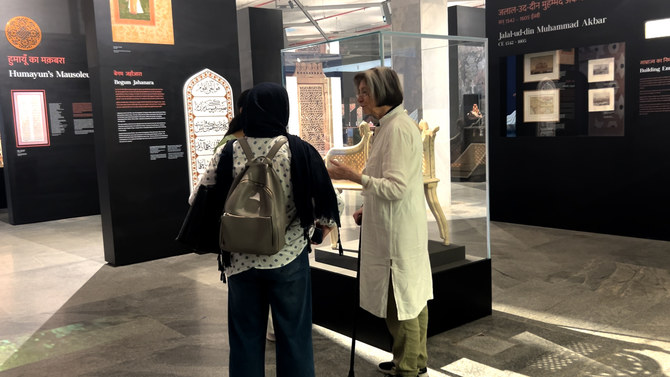
Humayun World Heritage Site Museum in New Delhi opened for visitors on Tuesday
Latest addition to 16th-century tomb complex ‘brings alive 700 years of heritage’
Visitors look at artifacts at the Humayun World Heritage Site Museum — the newest addition in Humayun’s Tomb complex — in New Delhi on July 29, 2024. (AN Photo)
The second Mughal emperor Humayun was widely known as an avid reader fond of journeys, architecture, and storytelling. Almost half a millennium after his death, a new museum in the heart of New Delhi highlights his role in shaping India’s cultural heritage.
Opened for visitors on Tuesday, the Humayun World Heritage Site Museum is the newest addition in Humayun’s Tomb complex — a landmark 300-acre area in New Delhi’s Nizamuddin that features dozens of historical monuments and includes Sunder Nursery, a 16th-century heritage park.
The advent of the Mughal dynasty, which ruled the Indian subcontinent between the 16th and 19th centuries, marked the global revival of Islamic architecture, with works that until today are examples of the highest quality and refinement.
Originally from Central Asia, the Mughals carried cultural elements borrowed from Arabs, Persians and Ottomans. As they settled in India, they fused these with the various local styles found in their new domains.
Humayun was the son and successor of Babur, founder of the dynasty, and ruled the empire from 1530 to 1540 and again from 1555 until his death the following year.
The new museum, established by the Agha Khan Trust for Culture and the Archaeological Survey of India, traces Humayun and his descendants’ lives, as well as the 700-year-old history of the whole Nizamuddin locality and its influence on Indian culture.
“There are hundreds of stories to be told, which the stones don’t speak,” Ratish Nanda, conservation architect and projects director at the AKTC, told Arab News. “The idea is to bring alive 700 years of heritage.”
The museum is located in Humayun’s Tomb, a UNESCO World Heritage Site, and the first of the grand mausoleums that became synonymous with Mughal architectural innovations and, three generations later, culminated in the construction of India’s most iconic monument, the Taj Mahal. About 7 million tourists from across India and abroad visit the complex every year.
“The idea is that people who now visit the World Heritage Site come with a deep understanding of the site,” Nanda said.
“We’ve been able to … combine architectural elements with incredible manuscripts, miniature paintings, calligraphy, textiles, coins, metalware, architectural elements — one is two one scale — with lots of films and digital technology, and models and so on.”
Spanning five galleries, the underground museum has over 500 artefacts sourced from the collections of the National Museum in New Delhi, ASI and AKTC.
“It captures the 700 years of history that is associated with the region of Nizamuddin and the World Heritage site of Humayun’s Tomb …This museum really captures the history,” said Ujwala Menon, AKTC conservation architect.
“The principal gallery talks about Humayun. There’s very little known about this emperor, and one of the things with this museum is to really address that … Then we have a second section of this gallery which talks about the personalities that are associated with Nizamuddin.”
Among the famed figures featured in the second gallery are Nizamuddin Auliya and Amir Khusro. Auliya was an 13th-century Indian Sunni Muslim scholar, Sufi saint of the Chishti Order, and is one of the most famous Sufis from the Indian subcontinent. His shrine and tomb are located near Humayun’s complex.
Khusro was a 13th-century poet and scholar who remains an iconic figure in the culture of the subcontinent.
Both Auliya and Khusro lived during the period of the Delhi Sultanate, which Humayun’s father conquered, leading to its succession by the Mughal empire. The museum shows how the empire did not come to its bloom in a cultural vacuum, but drew from and incorporated the culture of its predecessors.
“There was this idea of pluralism that existed during the Mughal period,” Menon said. “And this (museum) really captures all of that.”
source: http://www.arabnews.com / Arab News / Home> World / by Sanjay Kumar / July 31st, 2024
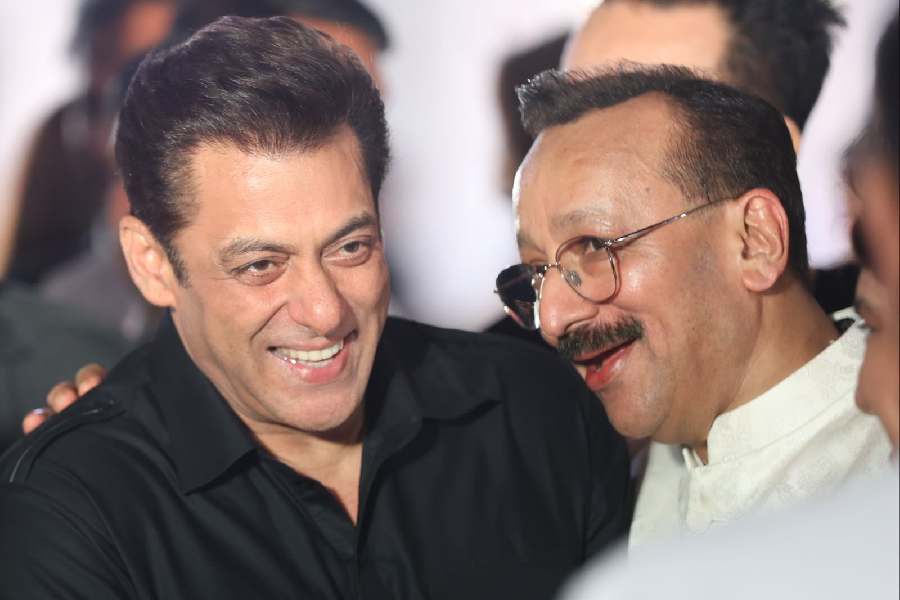
Bollywood and politics unite in grief after Baba Siddique’s tragic murder in Mumbai.
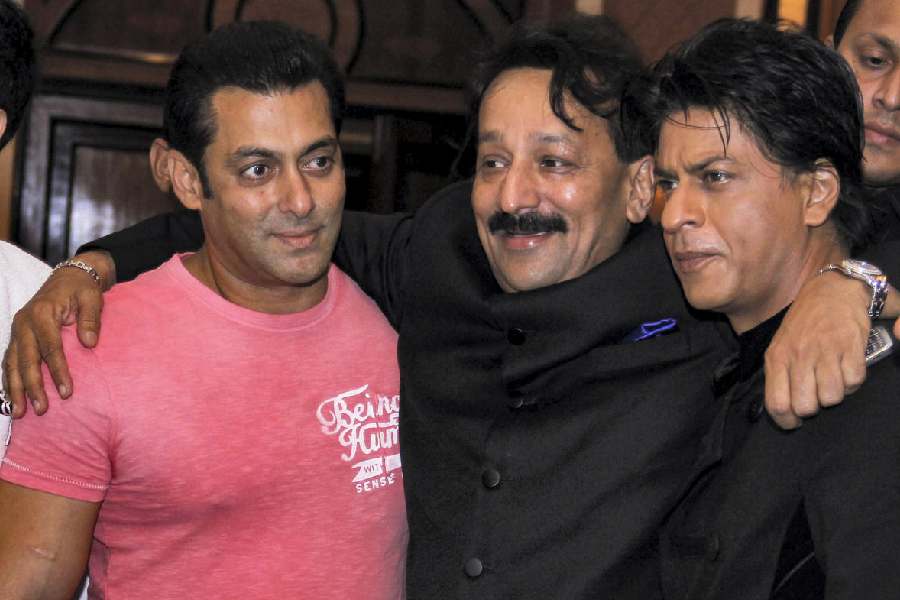
He played peacemaker between one-time warring superstars Salman Khan and Shah Rukh Khan at what was one of the most viral moments of 2013 before the social media rage kicked in and was a protege, even a second son, to cinema veteran Sunil Dutt.
NCP leader and former Maharashtra minister Baba Siddique, who was shot dead on Saturday night, epitomised the symbiotic relationship between politics and the Hindi film industry.
Baba Siddique with Salman Khan X/@BabaSiddique
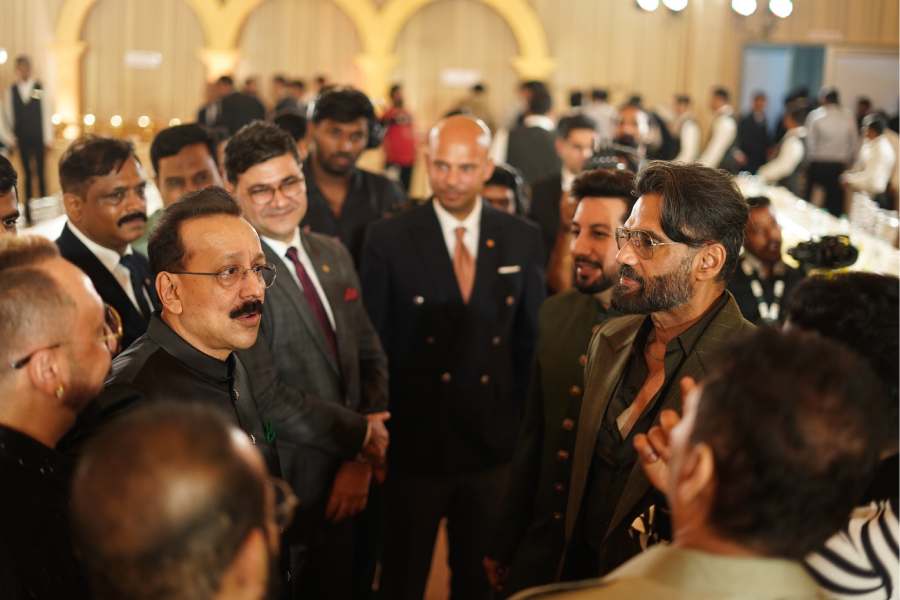
His grand iftar parties were a starry affair attended by right from the Khans to filmmaker Kabir Khan, celebrity designer Manish Malhotra, and actors Urmila Matondkar, Katrina Kaif, Huma Qureshi, Sonu Sood, Sushant Singh Rajput, Ankita Lokhande, Kiara Advani, R Madhavan, and Aditi Rao Hydari.
Dutt’s daughter and Congress leader Priya Dutt said she is “shocked” by Siddique’s death.
“Baba was more than a political associate; he was family. To my father, Baba Siddique was like a son, and to me, he was a brother and a dear friend,” she wrote in an X post.
With Suniel Shetty/ X/@BabaSiddique
Siddique, a popular figure in Bollywood circles who earned praise for supplying life-saving medicines to patients during the COVID-19 pandemic, was waylaid by three men at Kher Nagar in Mumbai’s Bandra area just outside his MLA son Zeeshan Siddique’s office and shot at on Saturday night.
He was taken to the Lilavati Hospital where he was declared dead.
Siddique, 66, was brought into politics by the late Congress MP Dutt, who represented Mumbai North West for five consecutive terms.
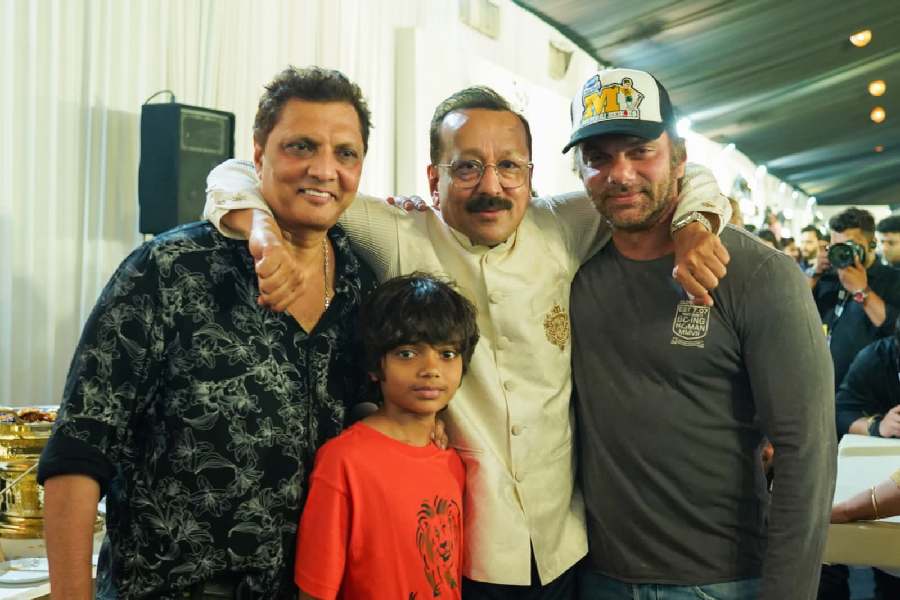
With Sohail Khan/ X/@BabaSiddique
Siddique joined the Indian National Congress (INC) as a teenager back in 1977. Even when he became a part of the Ajit Pawar-led National Congress Party (NCP) in February, he acknowledged the role of Dutt in his political career.
Priya Dutt said Siddique stood “steadfast” by her father throughout his political journey and beyond.
“When I entered politics, he guided me through its ups and downs, offering his unwavering support. His loss feels like the departure of a family member. My heart bleeds for Bhabhi, Zeeshan, and Arshia.
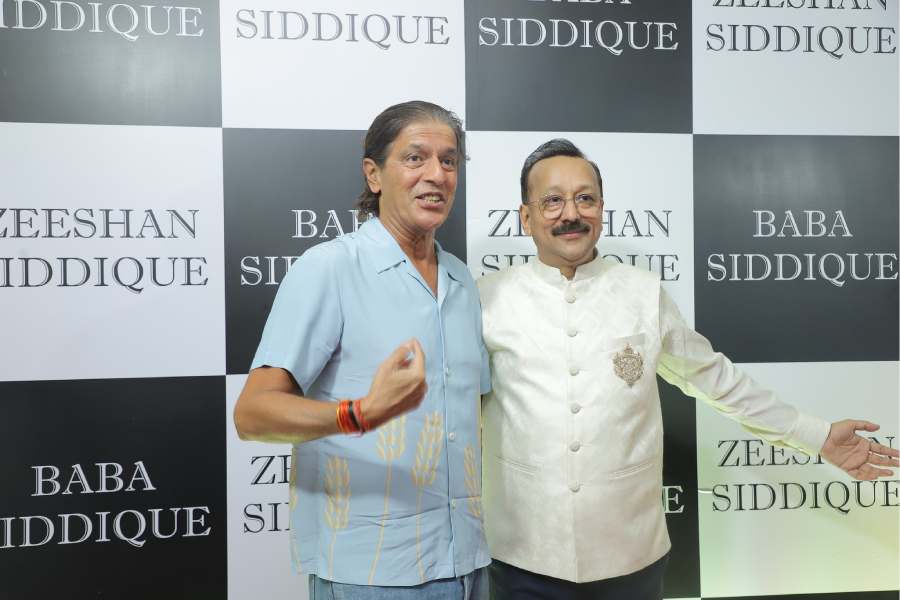
With Chunky Pandey X/@BabaSiddique
“May God grant them the resilience to bear this immense sorrow. May his soul rest in eternal peace. Farewell, dear brother. #BabaSiddiqui,” she wrote on the microblogging site.
It was his connection to Dutt that helped Siddique secure an MLA ticket in 1999 from Bandra West, a seat he retained for three back-to-back terms. Not only politics, former actor Dutt also introduced the political leader to the world of Bollywood.
After the news of Siddique’s death broke, Dutt’s son, actor Sanjay Dutt was one of the first celebrities to visit the late politician at the Lilavati Hospital where he was declared dead on Saturday night.
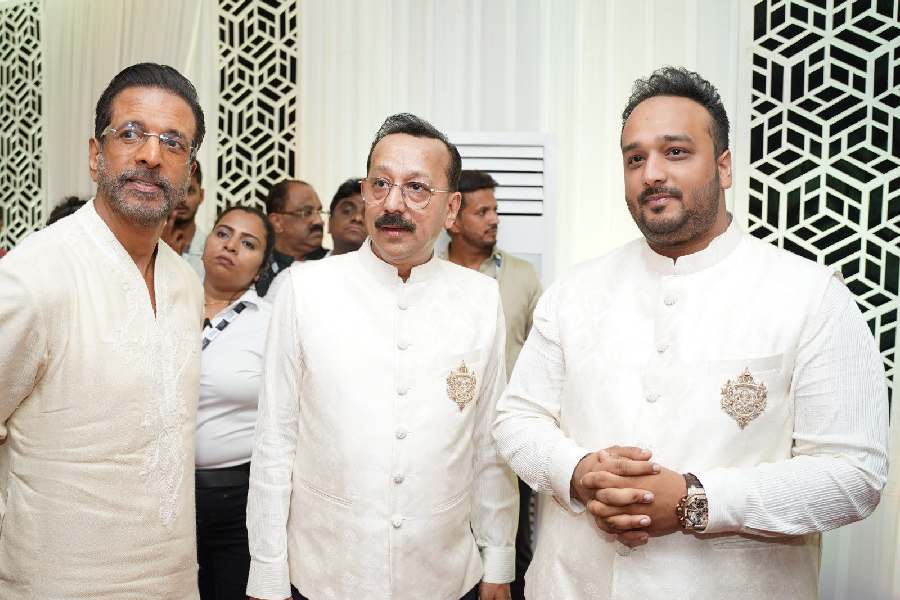
With Javed Jaffrey/ X/@BabaSiddique
Salman and Shilpa Shetty, along with her businessman-husband Raj Kundra, were also photographed reaching the hospital to meet Siddique’s family.
It was at Siddique’s 2013 iftar party, hosted at a five-star hotel in Mumbai, that Salman and Shah Rukh buried the hatchet.
The two Khans were on unfriendly terms since their spat at Katrina’s birthday party in 2008. The feud was so bitter that they avoided each other not only at private parties but also at public events.
There are several videos on the Internet capturing one of the highlights for the fans of the duo hugging it out back in 2013.
With Salman and Shahrukh Khan/ PTI
The iftar was on when Salman patted Shah Rukh on his shoulder, who was sitting next to his screenwriter-father Salim Khan, to embrace his “Karan-Arjun” co-star, thus ending their infamous rivalry.
A year later, Salman also endorsed Congress’ Siddique when he spent an afternoon in Ahmedabad with the then BJP’s prime ministerial candidate Narendra Modi on the kite-flying festival of Uttarayan.
“In our constituency Bandra, where it’s my responsibility to cast a vote, the best people there are Baba Siddiqui and Priya Dutt. You have to give Modi sahab the vote, I have to give my people the vote,” the superstar said.
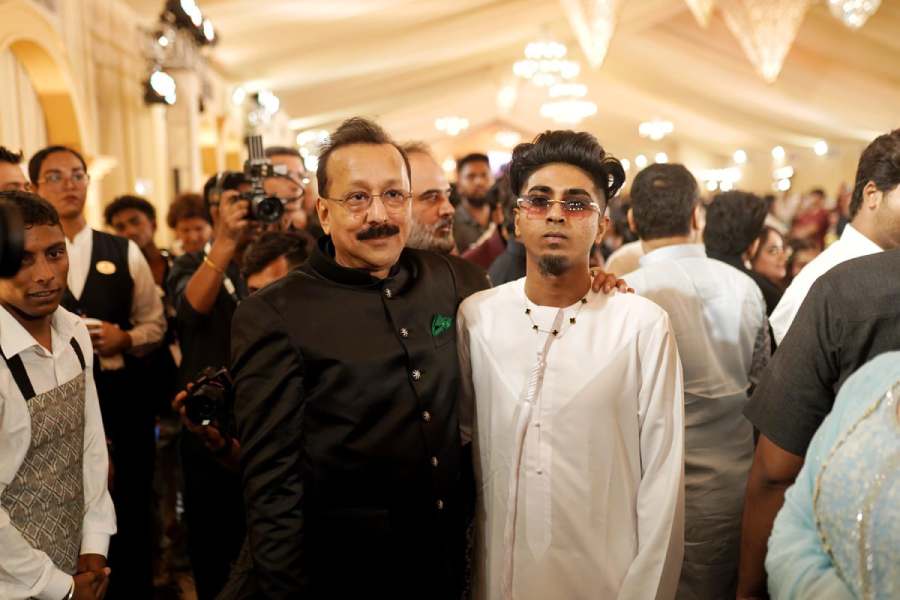
With Rapper MC Stan X/@BabaSiddique
Matondkar, a Shiv Sena member, said she was “extremely saddened” to learn about Siddique’s death.
“May God grant strength to @zeeshan_iyc and his family in this tragic time. Prayers for the soul departed,” the former Congress leader said.
“My heart goes out to @zeeshan_iyc and the entire family- May god give them strength to brave this difficult time. The perpetrators of this horrific crime must be brought to justice,” actor Riteish Deshmukh wrote on X.
With Sunil Dutt X/@BabaSiddique
Two of the accused have been arrested — Gurmail Baljit Singh (23), a resident of Haryana, and Dharmaraj Rajesh Kashyap (19), a native of Uttar Pradesh. Some teams have also been sent out of Maharashtra to nab the third accused who is still at large, police said.
The accused have been booked under relevant Bharatiya Nyaya Sanhita sections, including for murder, as well as provisions of the Arms Act and the Maharashtra Police Act, they said.
source: http://www.telegraphindia.com / The Telegraph Online / Home / October 13th, 2024
Altaf could not send his son to school because of poverty and they both worked in their garage.
Altaf Pasha (File Photo)
Mandya :
A bike mechanic from Pandavapura town has won Kerala government’s Rs 25-crore Thiruvonam bumper lottery. Altaf Pasha, 45, bought a lottery ticket (TG 434222) for Rs 500 a few days ago.
The results were declared on Wednesday. Altaf runs a small bike garage on Pandavapura-Mandya Road. He lives with his wife Seema in a rented house at Basavanagudi Layout.
They have a 21-year-old son and a 19-year-old daughter. His friend Samiulla told reporters that a few days ago Altaf visited Wayanad in Kerala where he purchased the lottery ticket.
After returning home, he tried to sell the ticket to his friend, who owns a welding shop adjacent to his garage, when he ran out of money. But the shop owner refused to buy the ticket.
Altaf could not send his son to school because of poverty and they both worked in their garage.
“After I came to know that I won the bumper prize, I rushed home and informed my wife and daughter. Initially, they did not believe me. But when I showed my ticket and the winning number on my mobile phone, they rejoiced,” Altaf told reporters.
“I will receive Rs 12.8 crore after all deductions. I will buy a house first and start a business. I can now get my daughter married happily. I will also help the poor as I know what poverty is,” he said.
source: http://www.newindianexpress.com / The New Indian Express / Home> Karnataka / by Express News Service (headline edited) / October 11th, 2024
Over the past few years, some organisations have a part of their savings during the holy month set aside for charity, to free prisoners who cannot afford bail, thereby helping them and their families.
Movement for Peace and Justice secretary Shaik Kasim Sahah with Khammam district jail authorities. Photo: Special Arrangement
It is in the month of Ramzan that most Muslims busy themselves in calculating zakaat, a prominent manifestation of charity in Islam. Usually given to those in abject poverty, over the past few years, zakaat funds, calculated at 2.5% of an individual’s annual savings, are being used to free inmates of jails who have served their prison sentences but have no support systems to pay fines associated with their convictions.
Moin Pasha, an octogenarian, says, “It was two years ago that I got to know of an organisation that uses zakaat money to pay those who cannot afford bail. Some of these prisoners are sole breadwinners and everything depends on them,” she says, adding that the consequences of imprisonment for the person’s wife and children are often disastrous.
The Movement for Peace and Justice (MPJ), a non-profit, is one such organisation that has been gathering zakaat from donors and channelling these funds to secure prisoner release. “Since last year we have paid 130 fines that are associated with prison sentences. Additionally, we have paid bail money for 35 prisoners and have got them all released,” Ahmed Hameeduddin Shakeel, finance secretary, MPJ, says.
The MPJ, an affiliate of the Jamaat-e-Islami Hind, a socio-religious organisation, after due diligence, identifies prisoners who are first-time offenders involved in small crimes, and who have no family or friends to pay bail or fines. “We have been active since 2007-08 and have seen cases in which family members have no idea of the whereabouts of the prison inmate. It is only much later, maybe after weeks or months, that they get to know that they were in jail. The situation is so bad that families cannot even afford to pay ₹500. The aim and object of our organisation is to help everyone. Of our varied activities, we also work as facilitators for prisoner release,” he says.
Like Ms. Pasha, Ghazala Ahmed (name changed upon request), an entrepreneur, too has been earmarking a part of her zakaat funds for this cause. She says that Islam prescribes the freeing of prisoners within the legal system, and it is considered an important act. “Usually, people give zakaat to madrasas and those in need, especially poor relatives. But the goodness here is two-fold: a religious injunction is being fulfilled, and we help a family in dire need. Some organisations have networks and an understanding of how prisoner releases are done,” she says.
The All India Milli Council, another socio-religious group, has secured the release of 68 inmates lodged in prisons in and around Hyderabad, since last year, according to its office-bearer Mufti Omar Abedeen Qasmi Madani. Explaining the issue from an Islamic jurisprudential perspective, he says, “Before slavery came to an end, zakaat money was used to free slaves. The expression used to describe this in the scriptures was to “free necks of slaves”, an act that was greatly encouraged. Fines paid to secure releases were between ₹500 and ₹5,000. “This may seem like a small amount, but for the poor, they are unfortunately unaffordable,” he says.
source: http://www.thehindu.com / The Hindu / Home> News> India> Telangana / by Syed Mohammed / March 31st, 2024
Abdul Salaam Chittoor from Kundapura taluk in Udupi district has been appointed as the state director of the Karnataka State School Development and Management Committees (SDMC) Coordination Centre.
The appointment order was issued by Moiddin Kutti, the director of the Karnataka SDMC Coordination Centre, and will be effective until further notice. This role underscores Abdul Salaam’s commitment to advancing educational initiatives across the region.
source: http://www.daijiworld.com / Daijiworld / Home> Karnataka / by Silvester D’Souza / Daijiworld Media Network-Kundapur / October 07th, 2024
A phrase in Kannada “murthi chikkadaru keerti doddadu” meaning icon looks short but performance is enormous, goes well with M. Sadulla, a great personality of Islamic literature in Kannada.
One of the pioneers of the popular Kannada weekly Sanmarga published from 1978, Sadulla was its manager and publisher till he breathed his last on 22nd August 2022.
Around 5 feet tall, M. Sadulla was born in 1945 in the Kandak area of coastal city Mangalore. He was the third son of Abdul Jabbar Ibrahim and Mariyamma. He lost his father at a young age.
He had his primary education at Badriya Educational Institution and matriculation from Rosario Educational Institution with distinction.
Sadulla began his professional career as an Accountant. He was a student of Moulana Syed Yusuf, the Imam of Kachi Masjid in Bundar area. Under his guidance, he learnt Quranic studies, Islamic jurisprudence, Arabic, and Urdu.
In Kandaka area, his father Abdul Jabbar was popularly known as Ijjabaka; he was a great admirer of Syed Abul Ala Maududi, the founder of Jamaat-e-Islami. Ijjabaka was the first person to translate Fatiha, the first chapter of the Holy Quran from Urdu into Kannada. Sadulla resolved to follow in his father’s footsteps.
During that time, there was a noticeable lack of Islamic literature in Kannada. To fill this gap, Sadulla not only translated works from Urdu and Malayalam into simple Kannada but also contributed original articles. Unlike his peers, he did not take much interest in public debates or speeches. However, anyone met him personally was impressed with his simplicity, integrity and depth of knowledge in various fields.
He contributed significantly to the translation of the extensive Urdu commentary Tafhim-ul-Quran and Sahih Bukhari, and other hadith collections like Dari Deepa (Guiding Light). Two of his original works, Namaz Shafi’i Krama and Kannada Kaliyiri (Learn Kannada) are very popular and published multiple times. He translated around 30 works into Kannada. Dari Deepa, the hadith collection, has reached thousands of people, transforming many lives of Muslims and non-Muslims alike.
Sadulla was known for his simplicity, discipline, minimal talk, and high productivity, always wearing a gentle smile. His special qualities included excellent office management, patience, courage, generosity, and keeping calm even under pressure. He never let anything bother him and always remained content with what he had.
Despite being a profound scholar of the Quran and Hadith, he used to attend the Quran and Hadith classes of other scholars seriously, listening attentively.
Sadulla was very meticulous about the Quranic knowledge. Even when he was unwell, he would listen carefully as family members read it, correcting their mistakes if any. He couldn’t tolerate even minor mistakes in Quran recitation or references, and was keen on immediate corrections.
He was like a ready reckoner of the Quran. Anyone could call him to inquire about any issue related to the Quran, and he would promptly provide the answer, satisfactorily.
source: http://www.radiancenews.com / Radiance News / Home> Features > Latest News / by Radiance News Bureau / September 24th, 2024
Bearys Group, Mangalore has been awarded the “Outstanding Performance in Construction OHS&E Excellence Award” by the World Safety Organization (WSO), India. The recognition was given for the group’s work on the “Microsoft Data Centre-HYD01” project in Hyderabad.
Syed Mohamed Beary, Founder and CMD of Bearys Group, expressed pride in the recognition and reaffirmed the group’s commitment to prioritizing safety and quality in all their projects.
“Today we have walked the talk and demonstrated our unwavering commitment to ‘Safety First – Project Best’ – ‘Quality First – Project Best’. We remain dedicated to promoting safety, health, and environmental stewardship across all our projects. This is a proud moment for Bearys and we rededicate ourselves to raise the bar further and make Safety & Quality the sine qua non of all our endeavors,” Syed Mohamed Beary said.
The award was presented at the 5th World Safety Organization OHS&E Professional Development Symposium held at Feathers A Radha Hotel, Chennai, on September 27.
source: http://www.radiancenews.com / Radiance News / Home> Awards> Latest News / by Radiance News Bureau / October 01st, 2024
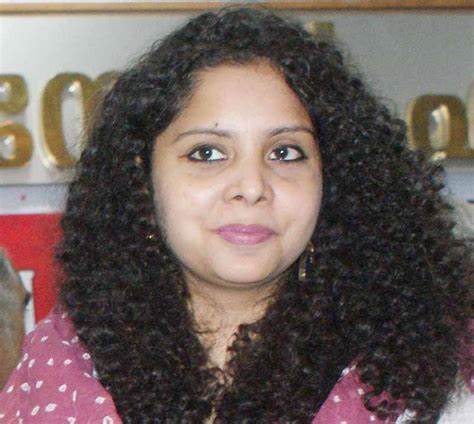
Rana Ayyub, an Indian investigative journalist and Global Opinion Writer at The Washington Post, is the recipient of one of the two coveted 2024 International Press Freedom Awards, as announced by Canadian Journalists for Free Expression (CJFE). She has been named for this award for her reporting that tenaciously upholds press freedom while holding governments accountable.
Ayyub will attend the CJFE Gala: A Night to Celebrate Courage in Journalism, where she will accept the award in Toronto on October 23.
When Ayyub went undercover in 2010 to look into the government’s role in communal violence – which is defined as violence based on race or religion – she established her reputation for fearless reporting. Since then, she has provided news and investigative reports about the persecution of minorities, state-sanctioned violence, and communal politics for a variety of Indian and international publications, such as The Washington Post, The New York Times, The Guardian, The Atlantic, and Foreign Policy. Her best-selling book, Gujarat Files: Anatomy of a Cover-up was released in 2016.
The Modi administration has reacted angrily to Ayyub’s political exposés. Ayyub is one of India’s most harassed and abused reporters, according to the International Centre for Journalists, and the UN special rapporteur has urged Indian government to stop the “relentless misogynistic and sectarian attacks” against her.
source: http://www.radiancenews.com / Radiance News / Home> Pride of the Nation> Awards / by Radiance News Bureau / October 04th, 2024