Tag Archives: Abul Kalam Azad

Historian revisits Maulana Azad: A secular nationalist and nation-builder

Mecca, (Ottoman-SAUDI ARABIA / Kolkata, WEST BENGAL / DELHI :

Abul Kalam Ghulam Muhiyuddin (November 11, 1888-February 22, 1958), better known as Maulana Azad, was a writer-activist-statesman.

Historian S Irfan Habib speaks on Maulana Azad on his birth anniversary at an event organised by the Maulana Azad College alumni association in Calcutta on Tuesday / The Telegraph

Historian S. Irfan Habib, while delivering his Maulana Abul Kalam Azad memorial lecture titled “Revisiting Maulana Azad in Contemporary India” on Tuesday, rued how in today’s India, anytime he posts anything on social media on the freedom fighter, 80 per cent of the comments comprise hateful abuse.

“Full of abuse… 80 per cent of the comments. And from people who have no idea of who he was, what he stood for, and what he did for India,” said Habib, whose lecture on the Maulana on the icon’s 137th birth anniversary was organised by the Maulana Azad College alumni association to mark the college’s centennial.

Abul Kalam Ghulam Muhiyuddin (November 11, 1888-February 22, 1958), better known as Maulana Azad, was a writer-activist-statesman.

One of Mahatma Gandhi’s most trusted lieutenants and the youngest president of the Indian National Congress, he made crucial contributions to the freedom movement. He was also Independent India’s first education minister.

“I will speak about those issues relevant for today’s India. What he did for education, how he defined nationalism — today all those who have no idea of what nationalism is are nationalists — and how he defined Islam…. Islam too is in danger when we see what we believers have done to our own faith,” said Habib, former Maulana Azad Chair at the National University of Educational Planning and Administration, New Delhi.

Maulana Azad’s family moved from Mecca to Calcutta when he was two. He spent several decades of his life in this city, his residence on 5 Ashraf Mistry Lane of Ballygunge now a museum.

November 11 is celebrated as National Education Day to recognise his contribution in establishing the education foundations of India — from the Indian Institutes of Technology, the University Grants Commission, the All India Council for Technical Education, the Council of Scientific and Industrial Research, the Indian Institute of Science, and the Sahitya Akademi, the Sangeet Natak Akademi and the Lalit Kala Akademi, besides the Indian Council for Cultural Relations.

“Patriotism, nationalism and humanism, the difference between them Maulana tried to look at. In this (the belief in the culmination in humanism) he was very close to Gurudev Rabindranath Tagore, and he actually writes about it, that he believes in the idea of nationalism which was pitched by the idea of Tagore’s humanism and universalism,” said Habib.

“True relationship is only one, where the entire earth is one’s native land. This is necessary is today’s India, where we indulge in othering among own citizens, in the name of religion, caste, language, all sorts of issues, all sorts of divisive tools we use to divide Indians, while Maulana says mankind is one family and all humans are brothers, this is the idea of humanity of nationalism which Maulana left behind,” he added.

Habib underscored how the Maulana began as a pan-Islamist, speaking against the subjugation of Muslim nations by imperialist powers — a sentiment expressed strongly in his papers Al-Hilal and Al-Balagh, and it was because of his role as a fiercely upright journalist that the British Raj viewed him as one of the most dangerous persons in India.

Habib stated that after the Maulana was released from exile in Ranchi in 1920, he was torn between reading and writing in seclusion, or public life and the freedom struggle. It was soon after coming out of exile that the Maulana met Gandhi on January 18, 1920, for the first time.

“The meeting seemed to have had a profound impact on both… and they remained inseparable for the rest of his (Gandhi’s) life,” he said.

According to Habib, the Maulana fought on multiple fronts, not only against the British, but also Hindu and Muslim communalists.

“Maulana stressed on indivisible or composite nationalism, where he went back to early Islamic history, when the Prophet (Muhammad) created the first Muslim nation in Medina by aligning with the Yehudis (Jews). He saw no reason why Muslims could not join hands with Hindus and others in nation-forming…. He was appalled with communalists busy with sectarian campaigns when the need was to fight the British as a composite nationalist group,” Habib said.

“Maulana stood for a united India and remained steadfast in this resolve till the end. We are amid polarising politics where religion has become a distinct marker of identity…. The majoritarian nationalism being flaunted today runs contrary to the idea of composite nationalism espoused by Maulana all his life,” he added. “Maulana found the demand for Pakistan absurd as he was conscious of the fact that religion cannot be a binding factor for a nation.”

source: http://www.telegraphindia.com / The Telegraph Online / Home> West Bengal / by Meghdeep Bhattacharyya / November 12h, 2025
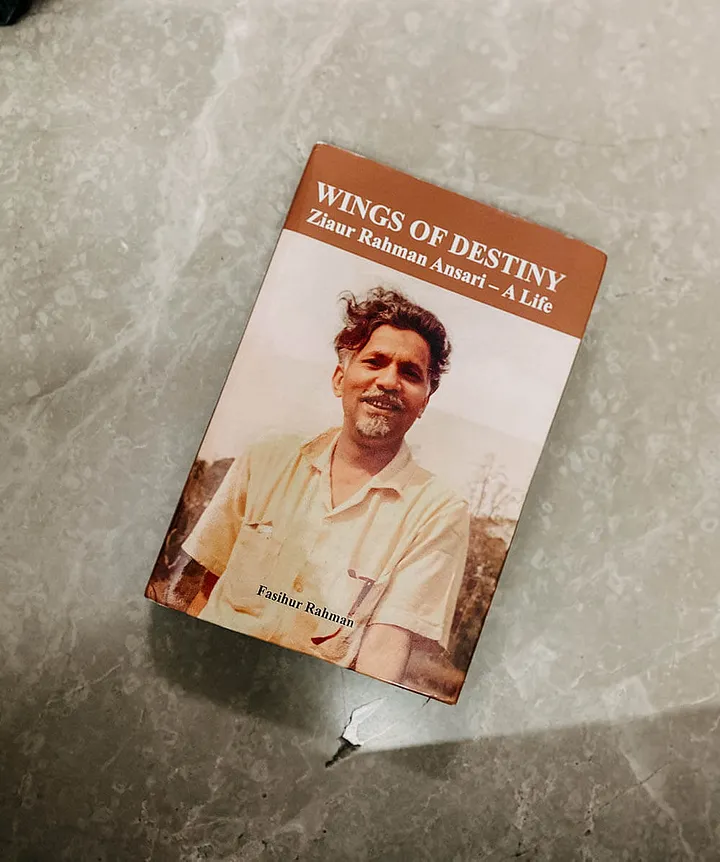
Book Review of ‘Wings of Destiny — Ziaur Rahman Ansari — A life’ by Fasihur Rahman

UTTAR PRADESH / NEW DELHI :

Ziaur Ansari was a prominent political figure, having served as the Union minister in the council of 2 Prime ministers Indira and Rajiv Gandhi. Wings of Destiny written by his son Fasihur Rahman is an ode to his entire political career spanning more than three decades and highlights the stalwart’s remarkable, inspirational life as well as clears the air around the controversies surrounding him.

When the truth stands coy in a corner, visible and yet under the pretence of being unknown and unacknowledged, you know that something somewhere is unfair.

Indeed, many times in life, there comes a threshold where one needs to understand and realize that truth which is the most supreme of all, can be an eye opener, as well as a beautiful and also a terrible thing, many a time. Terrible because there may be more to the situation than what meets the eye.

Yes, we all know and have read about the countless hardships that all of us underwent during the Indian freedom struggle. But, surely not all has come to light as far as the involvement of all parties, be it left or right is concerned. Yes, Muslims too were an integral part of the struggle towards Independence, their contribution being extremely indispensable. A prominent figure among them is Ziaur Rahman Ansari who served as Union minister from 1973 to 1977 and from 1980 to 1989 during the council of two Prime Ministers -Indira Gandhi and Rajiv Gandhi, this book which is written by his nephew Fasihur Rahman is a memoir cum biographical sketch of Ziaur Ansari’s life.

Ziaur Ansari was primarily in the spotlight in the year 1985, when he participated in a debate on a private Member Bill related to the SC judgement on the Shah Bano case, which to date remains one of the most debated issues in India as well as abroad. Having been often misquoted, misinterpreted and improperly perceived, Fasihur has taken it upon himself to finally take the opportunity to tell the world the true story behind Ziaur’s life.

The book which began with giving an ancestral account of Ansari primarily spoke about his father Habibur Rahman Ansari’s invaluable contribution to the freedom movement. What followed was the journey through Ziaur Rahman’s pursuit of politics which was turbulent and spanned a period of almost three decades, showing how he contested 9 elections.

Ziaur, not only being a man of strong ethics and politics, nevertheless was a man with a passion for fine arts, poetry, literature and music too. Ziaur was also inspired by Abul Kalam Azad’s legacy which was one of the cores of Rahman’s life. The hardships suffered by the Ulamas aka the religious scholars after the Mutiny of 1857 have also been explored by Fasihur here highlighting the true role of Darul Uloom Deoband in the Indian freedom struggle. I, for once, was amazed by this one since like mentioned earlier, I realized that many religious scholars, many freedom fighters have remained unsung, unacknowledged in their role in the struggle against the British rule for reasons which were, are and perhaps will always be something we shall never be able to comprehend fully. Racism, unfortunately, in the most erred way possible, nevertheless, Fasihur has brought forth a lot of undeciphered and unknown details forward.

Have you ever known or read about the famous Shah Bano case and the subsequent judgement of 1985? Well, the book explores the same in its entirety giving us Ziaur’s intervention in the Parliamentary debate on the SC judgement.

Ziaur Rahman was the president for a tenure of almost three decades at the All India Momin conference. The book provides a complete walk through the evolution, historical significance, mandate, and contribution of the conference in the complete socio-economic upliftment of the Muslim artisans. It also highlights their contribution to the freedom movement in India.

The last two years of Ziaur’s life were traumatic as Amyotrophic Lateral Sclerosis, an incurable neurological disorder, marked them. Characterized by loss of speech this is one of the most painful possible diseases and indeed Ziaur’s pain and anguish must have been sheer agony.

Lagate ho jigar pe teer par hum kuch nahi kehte. Zabaan hote hue ye bezabaani dekhte jao…

This Urdu couplet which was used by Ziaur himself to express the trauma of the condition he was reduced to was something that shook me personally, making me fathom and realize the kind of inability and pain the disease might have led him to. It was heartbreaking to read the complete scenario, especially since Fasihur has revealed how even being the prominent voice he had been, Ziaur was unable to speed track the path to going abroad and procuring the treatment which would have cured him.

A brilliantly written book, this one is a memoir you surely should not miss. Fasihur Rahman is impeccable in detail, immaculate in expression, not shying away from portraying facts as well as refraining from giving any kind of a judgmental tonality to any of the data he has provided. A crisp narration, this one will give you a lot of detail especially as it delves into pre as well as post-independence happenings and thus will be of interest as well as use to readers and historians too alike.

source: http://www.booxoul.medium.com / Medium.com / Home> Booxoul / December 14th, 2022

Quran, Coding and Community: Inside India’s Most Unique Educational Center

Munger, BIHAR :

The long history of social change at Khanqah Rahmani. Where freedom fighters and future leaders meet. Rahmani30 has sent 513 students to different IITs and 838 students to the National Institutes of Technology (NITs)

Munger:

When you reach Khanqah Rahmani during the last asra (phase) of Ramadan, you will find hundreds of people doing itikaf – a ritual, in which faithful reside inside the mosque from the night of the 21st Ramzan till the sighting of the Eid Moon. They pray and fast and reside there only. Mohammed Salauddin, is a regular for itikaf for three decades.

The 64-year-old man remained associated with Khanqah for the last 32 years.

And the obvious question arises, what does he get by giving so many years of his life in the Khanqah?

“Everything,” the tall man gives a single-word answer. And adds, “I am an angutha chap (an illiterate person). For employment, I got a driving license in 1982, and since then I started working for the Rahmani Saheb family. And did other jobs as well but remained attached to the Khanqah.

“Later Salauddin got married and became the father of two sons. Both of his children studied in Jamia Rahmani.

“I became hafiz from Jamia and then did an initial study of Alimiat from here. And went to Deoband for the completion of Alimiat. And took a graduation degree from Munger, MA from CCU Meerat, BEd from Haryana, Mass communication from Jamia Millia Islamia. I cleared state and centre level teacher’s eligibility tests. Then sat in the examination of Bihar Public Service Commission’s TRE2 and became a teacher in February this year,” informs Mohammed Najmuddin, Salauddin’s son. Najmuddin is also pursuing a PhD from Munger University.

Najmuddin is not alone. Along with him, Mohammed Mudassar Usmani (MA, MEd), Akbar (MA, BEd) and Mohammed Hassan (BA, BEd) all are huffaz of Khanqah Rahmani who cleared the BPSC TRE 1 and 2 and have become teachers in 2023 and 2024.

Najmuddin’s elder brother Shahabuddin also a hafiz from Jamia is now an officer in the National Council For Promotion Of Urdu Language, has done a BA from Jamia Millia Islamia, MA from Maulana Azad Hyderabad, qualified NET and done an MPhil from Delhi University before joining NCPUL, Delhi.

“All these were possible for a person like me because of Khanqah Rahmani and its educational centres,” claimed Salauddin, the father.

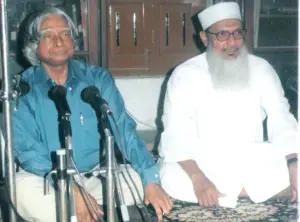
APJ Kalam and Mohammed Wali Rahmani in Khanqah Rahmani in 2003 | Arranged

The history of Khanqah Rahmani

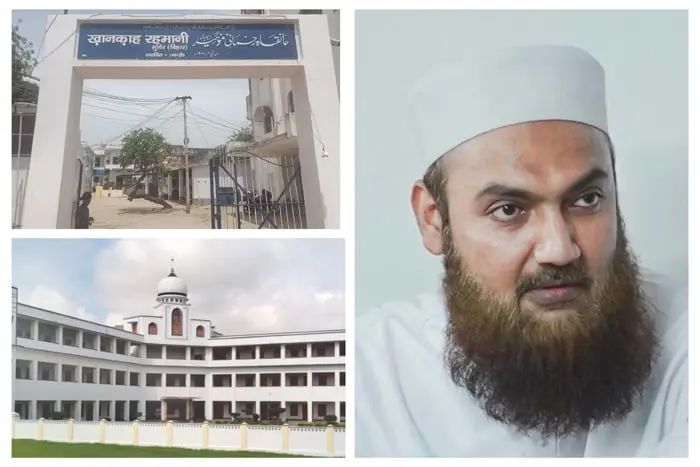
It was established in 1901 by Maulana Mohammed Ali Mungeri. Since then the Khanqah not only remained as a center for societal reform and purification of souls but also helped freedom fighters during the freedom struggle. Freedom fighters like Mahatma Gandhi, Jawahar Lal Nehru, Abul Kalam Azad and Dr Rajendra Prasad among others stayed at this centre. Former Prime Minister Rajiv Gandhi also visited the Khanqah.

After Ali Mungeri, Maulana Syed Shah Lutfullah Rahmani, his nephew ran the centre. And thereafter Minnatullah Rahmani and then his son Mohammed Wali Rahmani and now his son Ahmad Wali Faisal Rahmani is taking care of it. His brother Fahad Rahmani is the CEO of Rahmani Programmes of Excellence under which Rahmani30 functions.

Khanqah was also been instrumental in establishing the All India Muslim Personal Law Board, which safeguards Muslims in protecting their personal laws and identities.

Who is Ahmad Wali Faisal Rahmani, the present head?

The chief of Imarat-e-sharia and the secretary of All India Muslim Personal Law Board, Ahmad Wali Faisal Rahmani, is also head of the Khanqah. He has studied Information Technology from the University of California and worked as a teacher there. His professional career also includes working for Adobe and British Petroleum. However, Faisal Rahmani got his early education in Khanqah Rahmani as he got his elementary education in Arabic, Quran, Deeniyat and Mathematics in the Khanqah. He started looking after the activities of the Khanqah after the demise of his father Mohammed Wali Rahmani.

Whenever he gets time from the activities of Imarat Shariah and AIMPLB, he spends time in the Khanqah. He does not let anyone chide even a screaming child. There are a large number of women who come to listen to him. He prefers to eat along with the students and members as well as the faculty of the centre.

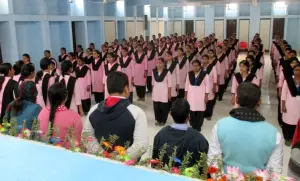
Students of Rahmani BEd College | Arranged

Jamia students hold the Quran on one hand and tablets on other

Jamia Rahmani, which came into existence in 1927 is one of the several centres run by the Rahmani Foundation , a charity body of Khanqah Rahmani. Jamia’s students not just memorize the Qur’an, but also understand it by learning Arabic.

Here, every student also learns science, English and Mathematics as well and gets tablets for their study. They have smart classes too.

But this is just the beginning for the students. The Khanqah has Rahmani30, to prepare for JEE Advanced (IIT), JEE Mains. It has branches in several cities across India. There is also a centre for Medical (NEET) entrance and for the preparations for Chartered Accountant and Company Secretary entrances. It has a BEd College, which has a large number of female students. Jamia Rahmani has added several new courses after 2011.

“When Ahmad Wali Faisal Rahmani became head here, the first thing he did was, start a one-year Diploma in Mass Communication in journalism course in Jamia. Later started two years of Master in Islamic Jurisprudence Study and last year, a two-year course, Diploma in English Language in Professional Skills also began,” said Fazle Rahma Rahmani, head of the Department of Journalism and Mass Communication.

The Khanqah also provides residential facilities to the families of its faculties as well as the cooks. It provides meals to almost 1200 people three times a day. Most of the beneficiaries are the Jamia students and people associated with the Khanqah.

Then there is the Rahmani School of Excellence (where students can get enrolled in a Nursery and study up to standard twelve). In the School Management Committee, Muslims as well as non-Muslims teachers are present, it has females too. And it has a diverse background of students.

“While Jamia Rahmani and Rahmani30’s study is completely free, BEd, school education and other studies have some fee structure. But where there are fees, Khanqah authorities give scholarships to needy students and have a liberal approach to such cases where parents approach the centre. Money never became a hurdle in getting an education from the educational centres related to Khanqah,” points out Fazle Rahma.

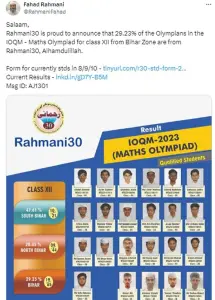
Since the inception of Rahmani30, 513 students have been admitted to different IITs in the country. While 838 students reached JEE Advanced to get admission to the National Institute of Technologies (NIT) during the same period.

“Several students of School of Excellence have become IITians so far,” claims Fazle Rahma.

Whereas, many students of different centers of Rahmani30 also take part in the Olympiad, every year.

The Jamia Rahmani’s Taleemgah building was inaugurated by Former President of India APJ Abdul Kalam. Kalam, who wanted to be known as a Professor rather than a former President, in 2003 itself, says a lot about Khanqan’s educational work.

From the stage of Khanqah, the scientist claimed that he was also a student of the Madrasa Board.

However, neither before the visit of the President of India nor after it, did Khanqah Rahmani’s educational works got the attention that it should have got the mainstream media.

source: http://www.enewsroom.in / eNewsRoom India / Home> Education / by Shahnawaz Akhtar / April 09th, 2024

Chandrayaan-3 success: Assam scientists Nazneen Yasmin, Baharul Islam shine

ASSAM:

Scientists Yasmin Nazneen and  Baharul Islam
Scientists Yasmin Nazneen and Baharul Islam

Guwahati

 Assam’s Nazneen Yasmin and Dr. Baharul Islam Barbhuyan are among the scientists who contributed to making the ISRO’s Chandrayaan-3 land on the South Pole of the Moon.

Nazneen Yasmin, who is from a middle-class family of central Assam’s Nagaon district joined the ISRO after cracking the toughest selection test two years ago. The young scientist has been involved in radar tracking in the launch department of ISRO for more than a year.

But the journey was not easy for Nazeen Yasmin. While she was on maternity leave for her firstborn about six months ago, she was recalled for crucial operations at least twice and she took her child along.

Despite facing the challenges of married life and the post-pregnancy phase Nazeen was very passionate about the Chandrayyan-3. Many a time, Nazeen worked from home by keeping her baby in her lap.

Naznin Yasmin, daughter of Abul Kalam Azad and Manzila Begum of Maherpar near Juria in the remote Nagaon district received her appointment letter as a scientist at the ISRO headquarters in Swar Sriharikotha, Andhra Pradesh around two years back.

Naznin Yasmin received her primary education at Nuruddin Furkania JB School, Juria in Nagaon district in central Assam. She performed brilliant results in the matriculation or Class X final exam from Kadamani Town High School in 2007. She passed the Class XII exam from Alphabita Science Junior College in 2009 with letter marks in several subjects in the science stream. She later obtained her B.Tech in Electronics from NITS Mirza College, Guwahati in 2013 and her M.Tech in First Division from Tezpur University.

Along with working in various private scientific institutions, Nazneen passed the National Eligibility Examination under the University Grants Commission in 2018 and also qualified for the Junior Research Fellowship of the Government of India.

Nazneen Yasmin, who had dreamed of becoming a scientist since childhood, said she was inspired by the success of India’s first female astronaut Kalpana Chawla. She urges the younger generation not to think of themselves as weak and prepare themselves to get a place in the leading institutions of the country through hard work.

Also, Nazneen was inspired by the life and work of former President Dr. APJ Abbul Kalam, who came from a family with modest means, a family source said.

On the other hand, Dr. Baharul Islam Barbhuiyan of south Assam’s Hailakandi has proved that all dreams come true if a person chases them and works hard.

Baharul, 45 is a resident of Syedband II Khand village situated about 5 km from Hailakandi town. He is the pride of the Hailakandi district.

Baharul Islam’s name came into the spotlight after India’s Chandrayaan-3 spacecraft made history by landing on the south pole of the moon on Wednesday evening. He is a prominent scientist at ISRO. He is one of the scientists who played an important role in the success of Chandrayaan-3

Speaking to Awaz-the Voice Assam from ISRO headquarters in Bangalore, Baharul Islam said he was proud to be involved in a historic work that set a record in the space world. He said students have always been interested in space and after the successful landing of Vikram on the South Pole of the Moon. “Success of Charayaan-3 will result in an increase of interest and curiosity about space science among the younger generation,” he said.

He earned his B.Sc from SS College, a Masters in Mathematics from Aligarh Muslim University, PhD from Gujarat University before joining the ISRO.

Baharul’s parents were teachers and they created an environment of science at their home from the very early stage of their son. His father, Moinul Haque Barbhuiyan, has passed away. Mother Rehana is old yet she is excited about her son’s achievement.

“There are no words to express my joy at the moment. I never thought such a day of success would come. People have been calling us since Wednesday,” said Baharul’s brother Enamul Haque.

source: http://www.awazthevoice.in / Awaz, The Voice/ Home> Story by ATV / posted by Aasha Khosa / August 26th, 2023

Maulana Azad: The Voice Behind the Dream for a Unified India

NEW DELHI  :

(This story was first published on 10 November 2017. It has been republished from The Quint’s archives to mark Maulana Azad’s death anniversary.)

“I am an essential element, which has gone into building India. I can never surrender this claim.”

These were the famous words uttered by Maulana Abul Kalam Azad, when he stared at the daunting prospect of Partition. On his birth anniversary, we remember his contribution to the country.

source: http://www.youtube.com / The Quint

Azad was among the many Muslim leaders in India who opposed the Partition of Unified India into Pakistan and Hindustan. As the leader of the All India Congress Committee in 1946, he put forth a Cabinet Mission proposal that advocated a federal structure of government, with autonomy for states. Though the proposal did face a great deal of skepticism, the Working Committee passed it, with even Jinnah agreeing to it for ‘the greater good of Indian Muslims’.

This proposal was certainly considered a breakthrough, as Jinnah and Azad had never enjoyed very good relations, predominantly owing to their opposing stances on Partition. Where one batted for Hindu-Muslim unity under a larger India, the other was vehement on the creation of two separate states. But their souring relations never stopped Azad from attempting to convince Jinnah to consider a ‘unified India’.

For instance, when Jinnah’s clamour for Pakistan grew louder, Azad is known to have sent a telegram insisting on the perils of a two-state ideology. Jinnah is said to have insulted Azad in his response, calling him Congress’ ‘show boy President’.

Don’t you feel that the Congress has made you a show boy President to hoodwink non-Congress parties and other countries of the world? You represent neither Muslims nor Hindus.

Having failed at getting Jinnah to reconsider, Azad then unsuccessfully tried to convince the Congress leaders to wait till a solution could be found. But even Patel, who earlier backed Azad’s proposal, was now vehemently pro-partition. Azad in his autobiography later writes that the party agreed to the Partition as “blindness of Congress leaders to facts, and their anger and frustration clouded their vision.”

According to Azad, as he writes in his autobiography, Nehru too contributed to angering the Muslims, by committing two mistakes which ultimately drove Jinnah to lose faith in the proposal and go through with partition.

The first was when Nehru refused to take two Muslim League leaders as Cabinet Ministers in the UP elections of 1937. The second mistake was when after taking over as the President of the Congress in 1946, he indicated that the earlier Cabinet Mission proposal could be changed, which culminated in Jinnah insisting on the formation of Pakistan.

Maulana had not only opposed Partition as an Indian leader, but also as a Muslim. He was, in fact, of the opinion, that the two-state policy will only “create more problems than solve”.

And true to his word, even today the relations between the two countries are strained at best, despite their shared history.

source: http://www.thequint.com / The Quint / Home> News Videos / November 10th, 2017 / and February 22nd, 2020

The glorious contradictions of Qazi Abdus Sattar

Machreta (Sitapur) –  Aligarh,  UTTAR PRADESH   :

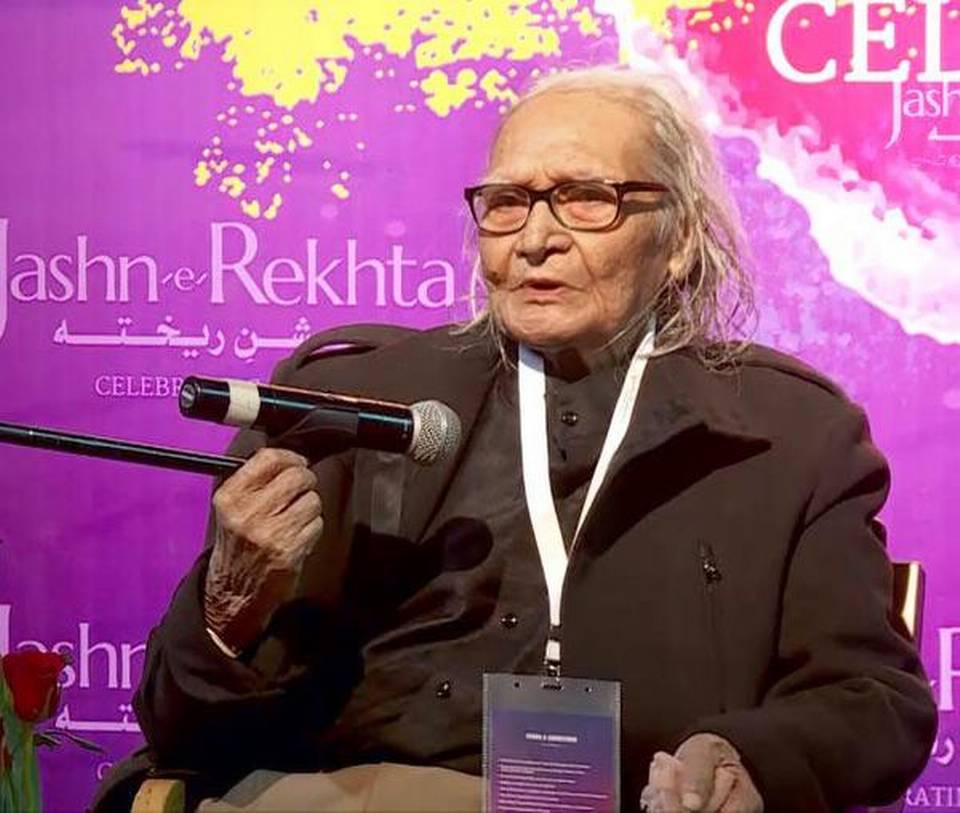
Master of brevity: Qazi Abdus Sattar at Jashn-e-Rekhta

A votary of India’s syncretic culture, the novelist will be remembered for his sketches of Awadh aristocracy and his prose style which has touches of grandeur

‘Do I contradict myself? Very well, then I contradict myself; I am large, I contain multitudes’, wrote Walt Whitman in his famous “Song of Myself”. Qazi Abdus Sattar (1933-2018), a novelist, a literary polemist and a master raconteur, who died last week after a long illness, contained multitudes in his fiction and conversation. If grand historical figures jostle with ordinary folks in his fiction, in his conversation he used his right to offend to the maximum. His fiction always touched crests and his conversation knew no troughs.

Beautiful metaphors

A proper assessment of a writer begins after his death, more so in the relatively limited circle of Urdu criticism where everyone knows everyone else. However, most critics and readers of Qazi Abdus Sattar credit him for writing remarkable historical novels, for his sketches of Awadh aristocracy, and above all for his prose style which has touches of grandeur. Among his historical novels “Dara Shikoh” (1968) gives an account of the war of succession among Emperor Shah Jahan’s four sons and Dara’s defeat at the hands of Aurangzeb, using beautiful metaphors and turn of phrases. His epic style characterises the novel. A votary of harmony and India’s syncretic culture, Qazi Abdus Sattar’s sympathies with Dara Shikoh are unmistakable. A scholar of Sanskrit texts, his Dara is often dressed in traditional Hindu attire and he prevails upon his father Emperor Shah Jahan to exempt the Hindu devotees from paying tax for taking bath in river Ganges.

Delineating the bard

His novel “Ghalib”(1976) captures not only the vignettes of Ghalib’s life – his devotion to poetry, his economic worries, his travels, his wit, his love life – but also the ethos and the milieu of the 19th Century.

Qazi Abdus Sattar is equally comfortable in delineating characters from distant Islamic history in novels like “Salahuddin Ayubi” (1968) and “Khalid Bin Waleed”. His novel “Salahuddin Ayubi” takes the reader into the 12th century period of the crusades in which Salahuddin Ayubi distinguished himself for his bravery, his excellent detective work and his love of human beings. Paradoxically the novel also shows that oppression of the weak and the marginalized groups has been an ugly fact of history.

Qazi is both an heir to and critic of landed aristocracy. The taluqdars of Awadh, who are also the concerns of Qurratul Ain Hyder and Attia Hosain, hold some inexplicable fascination for him. They represented a past that he kept living both in his fiction and life. He appeared to welcome the end of Zamindari but he refused to free himself from its sinister charm. He always aligned himself with progressive causes and was a key figure in Janvadi Lekhak Sangh, but he did not see any contradiction in his celebration of the lifestyle associated with an unjust system.

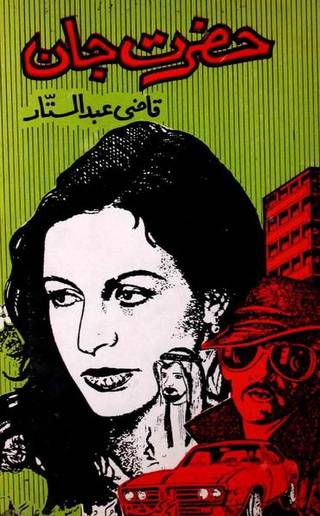
As a fiction writer he is spot on in his treatment of the landed gentry of Awadh. His novel “Shab Guzida”(1966) gives an inside view of the life of zamindars and taluqdars of Awadh. The unjust debauch Bade Sarkar and his virtuous son Jimmy represent different sets of values in the novel. His “Pahla aur Akhiri Khat” (1968) charts a life away from the framework provided by Progressive Writers’ Movement. Through the depiction of the life of Chaudhri Nemat Rasool of Lalpur, the novelist shows zamindars in the grip of economic and social problems after the end of Zamindari. “Hazrat Jaan” and “Tajam Sultan” are his other remarkable works. Unlike many other writers in the past who have made Awadh the subject matter of their work, Qazi’s distinction lies in focusing on the rural life in Awadh in his fiction.

He was equally successful in his novelettes and short stories with Awadh again very much providing the backdrop of many of his narratives. “Peetal ka Ghanta” , a collection of his short fiction, includes ‘Peetal ka Ghanta’, ‘Malkin’, ‘Azu Baji’, and ‘Majju Bhaiya’. “Ghubar-e-Shab”, also set in a village around the period of the Partition, treats the subject of communal disharmony and communal politics with irony.

A Padma Shri awardee, apart from numerous other prestigious awards, Qazi Abdus Sattar worked as professor of Urdu at Aligarh Muslim University and was great friends with scholars and critics of Hindi. He greatly valued his readers in Hindi and stressed the closeness of Hindi and Urdu (even Punjabi). But he was very strongly against changing the script of Urdu. He also strongly believed that literature should be ‘beautiful and wholesome’.

A great fan of Flaubert, he could achieve a lot in very little, thanks to his felicity with language. No wonder he has not written door stoppers and “Ghalib”, all of less than 300 pages, is his longest work.

A raconteur par excellence and not known for mincing his words, he was an interviewer’s dream and an event manager’s guarantee for the success of a literary gathering. Prem Kumar’s remarkable book of his interviews is a blessing for Hindi readers as is Rashid Anwar’s for Urdu readers. Possessed with Oscar Wilde like ability to produce witty (often gossipy) quotes, Qazi Abdus Sattar’s sentences, as Urdu poet Shahryar once said, drew the applause generally reserved for Urdu poets.

QaziAbdusSattar02MPOs14nov2018

The grace and grandeur of his prose style rubbed off on his life. Tariq Chatari, a prominent Urdu short story writer, who believes that Qazi took Urdu afsana to a different level, says that he carried himself very much like a character from his fiction. Qazi Afzal Husain (no relative) considers Qazi a master prose stylist in line with Muhammad Husain Azad and Abul Kalam Azad. Time will tell.

source: http://www.thehindu.com / The Hindu / Home> Books> Authors> Obituary / by Mohammad Asin Siddiqui / November 09th, 2018

Photography as art

TAMIL NADU / Mattancherry, KERALA :

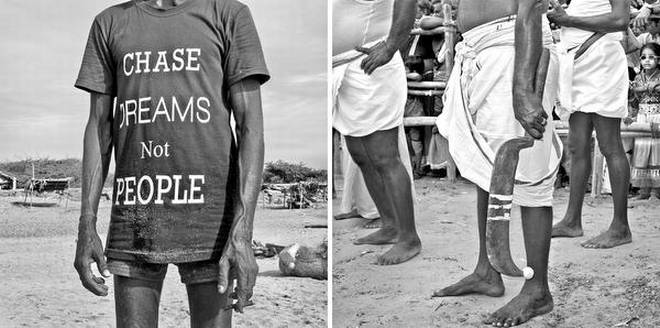
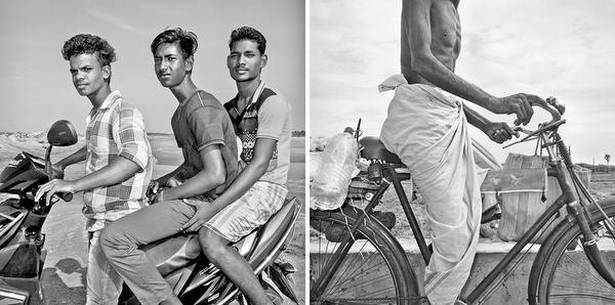
Images from ‘Men of Pukar’ | Photo Credit: Abul Kalam Azad

Soumya Sankar Bose and Abul Kalam Azad situate the traditional within the contemporary in their works

Two India Foundation for the Arts (IFA) grantees, Soumya Sarkar Bose and Abul Kalam Azad, have interpreted tradition through an artistic and sociological lens in their works, which was recently displayed in an event, at the Park Hotel in Bengaluru.

In 16th Century Bengal, Jatra was a popular performance art. Soumya, who studied at Pathshala Media Institute, Dhaka, and was awarded the Emerging Photographer Of The Year Award in 2015, presented by Tasveer-Toto Funds the Arts, has captured the lives of Jatra artistes in their present context. “Jatra artistes now work in other jobs, in factories, in garages, as farmers. So in my photographs I have them portray their characters in the place they are in now,” says Soumya, who began work on this project in 2013.

“My uncle Dhirendranath Dhirde was a Jatra artiste. I recently met him before he passed away,” says Soumya, explaining how the idea for his Jatra series came about. “In the 16th and 17th centuries Jatra was famous. The common people would immediately identify a Jatra artiste from the mythological characters they portrayed. But from the 1980s and 1990s the art form declined with competition from other modes of entertainment.”

Another reason for the decline of Jatra, Soumya says, is the Partition of Bengal. “Artistes in Bangladesh stopped playing Hindu mythological characters and in West Bengal they stopped essaying Muslim characters like Akbar and Siraj-Ud-Daula.” With his second grant from IFA, Soumya says he organised a street exhibition in Bengal. “Crowds gathered around and people recognised a prominent Jatra personality — Bela Sarkar from the pictures.”

Images from ‘Men of Pukar’ | Photo Credit: Abul Kalam Azad

Jatra today, says Soumya, portrays stories from Bollywood or serials. “It has lost its former glory.” Asked why he chose to create black-and-white images, Soumya says: “I don’t believe in distinctions of black-and-white and colour. But I did want my pictures to give a feel of the past.”

Soumya says his photographs are hyper realistic. “I staged and framed my work with the Jatra artistes. We decided on where the picture will be taken and how. It was a 50-50 per cent effort from both the artistes’ and my side.”

Abul Kalam Azad’s work, on the other hand, is inspired from the Tamil epic Silappadikaram (The story of the anklet). Abul, a former photo journalist, says the epic was written by Ilango Adigal. “It was written in the Sangam era. An astrologer had predicted that Prince Ilango would die an early death so he became a Jain monk.”

Abul was raised in Mattancherry, Kerala and says that his interest in Silappadikaram developed as a child. “I wanted to return to my roots. My grandfather and father are Tamilians. Silappadikaram was in our library. I found it interesting because it was the only text that talked about the local people and their customs.”

His black-and-white photographs place the epic within contemporary times. The photographs he displayed at the event was of the men of Poompuhar or Pukar, a village in Tamil Nadu, the third part of Abul’s ongoing series titled Song of love, desire, agony. “Since Ilango explained the lifestyle of the people during the Sangam era, I wanted to explore what they look like today.”

The result is a stunning series of photographs, comprising statues and places of the era that still stand and portraitures of men from different backgrounds, castes, communities and classes.

“I am not the kind of photographer who will take a picture of a person without any thought. I approached each of my subjects, took their permission to photograph them and developed personal bonds with them.”

source: http://www.thehindu.com / The Hindu / Home> Entertainment> Art / by Sravasti Datta / March 06th, 2018

Sify columnist releases book on Indian Muslim freedom fighters

NEW DELHI :

FreedomFightersMPOs22dec2017

Patna:

In a glittering ceremony, two books on the Muslim community’s contribution to the Indian freedom movement were launched in Patna last week. The function was presided over by Harsh Mander, former IAS officer and human rights activist.

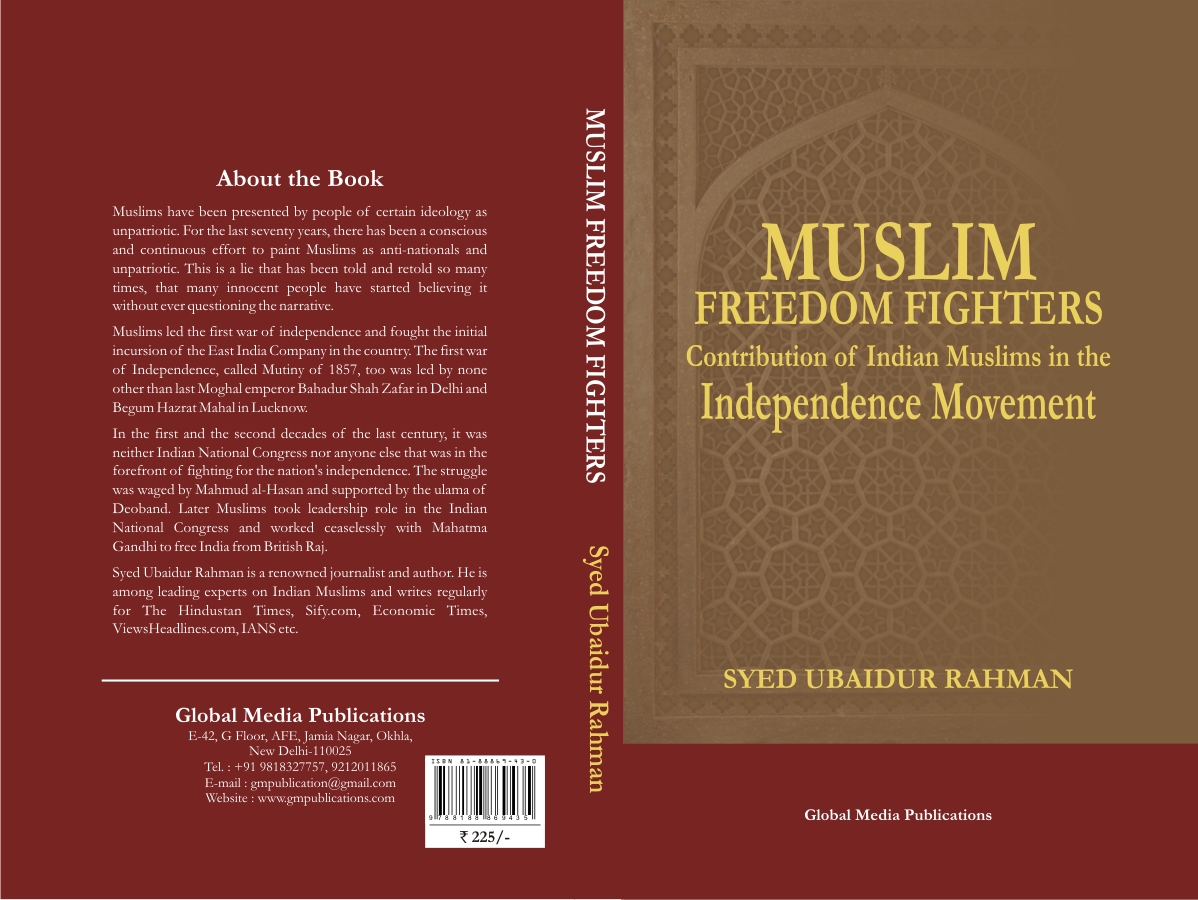
The books ‘Muslim Freedom Fighters: Contribution of Indian Muslims in the Independence Movement’ and its Urdu version ‘Muslim Mujahideen-e-Azadi aur Tehrik-e-Azadi Mein Unki Khidmat’ have been authored by well-known Delhi based author and journalist Syed Ubaidur Rahman.

The two books try to fight the oft-repeated allegations that Muslims are anti-national and have not contributed for the freedom of the nation. The books nail the lie and prove that Muslims not just participated in the freedom movement, they went on to lead the freedom struggle for a long time. The first war of Independence or Mutiny of 1857 was led by Mughal emperor Bahadur Shah Zafar in Delhi and Begum Hazrat Mahal in Lucknow.

The Independence Movement in the first two decades of the twentieth century was led by Mahmud Hasan and ulama of Deoband and they had respect and support of everyone including Hindus and Muslims.

If anyone has any doubt about the Muslim contribution in the freedom movement, the fact that the Indian National Congress had as many as nine Muslims as its president till the year 1947 will remove such doubts.

While speaking on the occasion, Harsh Mander said that the divisive forces in the country are trying to divide the nation on the basis of religion and faith. He said that the danger from such forces for the national fabric and its unity has become grave.

Mander added that the threat to the communal amity in the country was never so high as is today as divisive forces are doing every thing to pit one community against the other and create a fear psychosis among the majority community prompting it to turn it against minorities.

Khursheed Mallick, a Chicago based urologist, philanthropist and director of IMEFNA said that the book is a timely reminder to the nation that Muslims and Hindus both sacrificed for the nation and this fact must be clearly told to our young generation. He said Muslims sacrificed heavily for the cause of the freedom of the nation and efforts must be made to tell the history.

Syed Ubaidur Rahman, the author of the two books, while speaking on the occasion said Muslims have been rather loath to write about the sacrifices they have made for the cause of the Independence and freedom. He said Muslims suffered badly throughout the freedom movement. They were the worst suffers in the wake of the mutiny of 1857 and its aftermath when Muslims were hounded across North India and beyond. Tens of thousands of Muslims lost their lives for the freedom.

Syed added that ulama of Deoband played a stellar role in the freedom movement. Unlike the common perception, they were secular to the core and when they established a government in exile in Kabul in 1915, they appointed Raja Mahendra Pratap as its President and Maulana Barkatullah Bhopali as its Prime Minister.

The book documents the lives of forty renowned Muslim freedom fighters including, Shaikhul Hind Maulana Mahmud al-Hasan, Maulana Barkatullah Bhopali, Hakim Ajmal Khan, Maulana Ubaidullah Sindhi, Maulana Abul Kalam Azad, Maulana Mohammad Ali Jauhar, Dr Maghfoor Ahmad Ajazi, Dr Mukhtar Ahmad Ansari, Ashfaqulla Khan, Maulana Hasrat Mohani, Maulana Muhammad Mian Mansoor Ansari, Asaf Ali, Husain Ahmad Madani, Aruna Asaf Ali (Kulsum Zamani), Peer Ali Khan, Saifuddin Kitchlew, Mohammed Abdur Rahiman, Captain Abbas Ali, Abdul Qaiyum Ansari, Prof. Abdul Bari, Moulvi Abdul Rasul, Nawab Syed Mohammed Bahadur, Rahimtulla Mahomed Sayani, Syed Hasan Imam, Sir Syed Ali Imam, M.C. Chagla, Yusuf Meherally, Justice Fazal Ali, General Shah Nawaz Khan, Allama Fazle Haq Khairabadi, Maulana Shaukat Ali, Syed Mahmud, Maulana Mazharul Haque, Badruddin Tyabji, Col Mehboob Ahmed, Begum Hazrat Mahal, Maulana Shafi Daudi, Rafi Ahmed Kidwai, Syed Mohammad Sharfuddin Quadri, Batak Mian .

The book launch function was organized at Anjuman Taraqqi Urdu and was presided over by Abdul Qaiyum Ansari, chairman of Anjuman Taraqqi Urdu Bihar.

Syed Ubaidur Rahman is a New Delhi based writer and commentator. He has written several books on Muslims and Islam in India including Understanding Muslim Leadership in India.

source: http://www.sify.com / Sify.com / Home> SifyNews> National / by SIFY.com / Friday – December 22nd, 2017