Bengaluru, KARNATAKA :
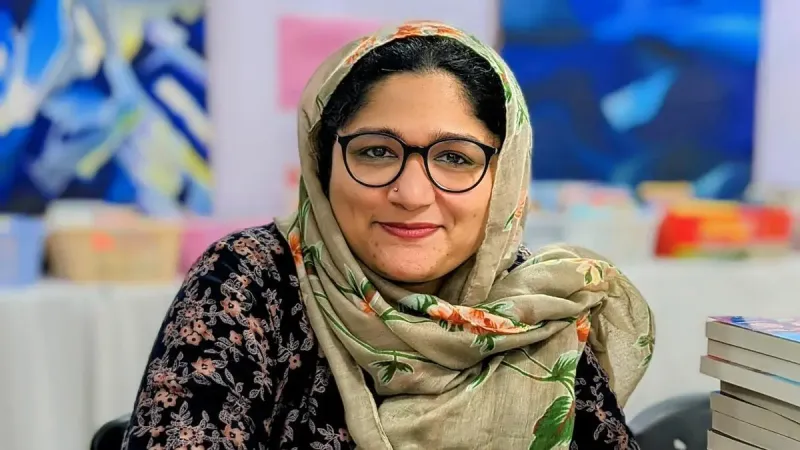
In an interview with Maktoob, author Andaleeb Wajid reflects on writing young lives, Muslim women and ordinary Muslim worlds, while discussing her latest novel Have You Met Me?, her memoir on grief and a writing career spanning more than 50 books.
In an interview with Ashikha N for Maktoob, writer Andaleeb Wajid discusses her latest novel Have You Met Me?, her enduring engagement with young adult fiction, writing across genres, the experience of writing her memoir Learning to Make Tea for One, and the complexities of writing Muslim women and ordinary Muslim lives.
Andaleeb Wajid has built a distinctive place for herself in Indian popular fiction by writing stories that find drama the familiar — in families, friendships, love, food, growing up and the small negotiations of everyday life. A prolific writer, she has published nearly 50 novels across genres, with young adult fiction and romance forming an important part of her body of work. Her books have found a devoted readership for their accessible, warm and deeply relatable characters. Her YA novel The Henna Start-Up won the Neev Literature Festival Award and the Crossword Book Award in 2024, while Asmara’s Summer was adapted into the Amazon Prime series Dil, Dosti, Dilemma. She has also written about grief and loss in her memoir Learning to Make Tea for One. Her latest book, Have You Met Me?, returns to young readers with a story of family, memory and belonging. Across her work, Wajid has remained interested in the lives women and young people lead beyond the usual binaries of rebellion and conformity — and in giving ordinary lives the space to become stories worth reading.
Andaleeb Wajid’s latest novel, Have You Met Me?, is also her 52nd novel. For Wajid, the book carries a strong connection to her childhood, particularly the summers she spent with her cousins at her grandmother’s home in Vellore. Recalling what made the book special to her, she says, “It’s special in many ways. Growing up, my siblings and I met my cousins in my grandmother’s home in Vellore. We actually had an old jhoola, like the one you see on the cover, and those summer holidays were some of the best times of my life. Time had a different quality to it, there was no homework or tuition and the day could just be spent doing nothing, lazing around on the jhoola, playing card games with my cousins. I wanted to relive that, recapture that but also focus on what it means to grow up and become distant. And I wanted to put that in a contemporary context and see how that story would flow.”
The book adds to a body of work that spans romance, YA, horror, mystery and children’s fiction. Asked about moving between genres, Wajid acknowledges the variety is intentional: “I don’t like to be boxed into just one genre, and that’s why I write across them. I also get bored if I have to write in the same genre over and over again. Switching genres is a way for me to keep my writing exciting and fresh, especially because every genre has its own rules and I have to be alert enough to know what I’m working on.”
Young adult fiction, however, remains particularly important to her. Explaining what draws her to the genre, Wajid tells us, “It’s not so much young readers but the themes that I like exploring in YA novels. It’s a different level of seriousness when you look at a young adult book. What might seem ordinary to an adult might be a life-changing moment for someone younger and I like to focus on those moments and draw them out. A good YA book for me is one that gets the young generation without trying too hard, but is also not preachy and trying to tell them how to live. A good YA novel is a good book, and it’s just the characters who are younger.”
Her approach to fiction is markedly different from the experience of writing Learning to Make Tea for One, her memoir about grief. Speaking about the difficulty of turning her own experience into a book, Wajid notes, “Writing this was one of the most difficult things I’ve done but I felt like it was something I needed to do. Grief fades over time and changes as we grow older, which is a good thing. But I also wanted to hold on to it and remember how it felt, which is a bit strange since I haven’t read it from start to finish even once, after it was published. I think it was a way of catharsis for me, and as a writer, writing is how I process everything, including my wounds. Fiction always comes easily. Creating imaginary lives where everything works out for everyone in the end is fun. Writing about my life felt starkly different in comparison.”
Wajid also writes romance under the pen name Inaara Sheikh. Explaining the decision behind the pseudonym, she says it was not primarily about artistic freedom. “The pen name is very new, just a year old, and I’ve written plenty of romances under my own name already and will also continue to do so in future. Inaara was more of an experiment to see how things would work on Amazon KDP where I self-publish these books. The reason for moving to Inaara wasn’t about creative freedom, but more a marketing move. When I self-publish more and more books under my name, I feel it gives a certain message to publishers which probably deters them from wanting to take my books. This is the main reason why I decided to self-publish on Amazon with a pen name.”
The sheer scale of her bibliography has also brought with it labels such as “prolific woman writer” and “Muslim woman writer”. Wajid points out that her response to these descriptions has changed over time. “Well, it used to irritate me at first but now I don’t bother myself with it. I can’t help the way others think about me, but what I can do is be consistent in writing and publishing. Eventually, I think people will see me as just a writer and not a Muslim writer. In any case, I don’t mind any longer. All women writers face this in different ways because they’re already being called ‘women’ writers. You don’t hear of any male writers being called ‘men writers’, do you?”
At the same time, her Muslim identity has inevitably shaped the way readers encounter her work. Her Muslim characters are often allowed to exist beyond their religious identity, and Wajid elaborates this was not initially a deliberate representational strategy. “I didn’t think so deeply about it at first. I was writing stories about people like me, people I knew, the kind of life I was familiar with, if a little fantastical. However, readers felt like this was such a refreshing change to read about ‘normal’ Muslim lives and it really made me wonder, how much things have changed that a depiction of normalcy seems so out of the ordinary.”
Family is similarly central to her fiction, something Wajid connects directly to her own upbringing. “While families are supposed to be a safe space, this isn’t something that always happens and I like to see how characters evolve inside families that are not regular, that are fractured in their own ways.” Her female characters, meanwhile, have become increasingly assertive over the course of her career. Reflecting on that evolution, Wajid observes, “It probably has to do with my own evolution as a person, not just a woman. Also, I have this understanding that women are conditioned from a young age to settle, to adjust and to make do with whatever they are given. I think writing characters with more agency than women might have in real life is my way of making them aspirational.”
That agency does not necessarily require her female characters to reject their families. In Everything Sucks, for instance, the women negotiate family expectations without necessarily turning away from family itself. Wajid sees this less as rebellion than as a process of finding one’s place. “I think women are beginning to understand which battles to fight and which to not waste their time with. It isn’t so much as rebellion as finding one’s place in the world. Many women see themselves in relation to others and I think it’s important that they see themselves on their own too.” She sees a similar gendered distinction in the way ambition is perceived. Speaking about Abir, the protagonist of The Henna Start-Up, Wajid observes, “Ambition in women is considered unbecoming, no matter the context. There’s always a hushed sense of ‘oh, that one’s a hustler’, but this doesn’t apply to men. If a man hustles, he’s considered worldly-wise. For a woman, she’s considered to be aiming too high. Abir’s ambition in The Henna Start-up doesn’t care about how she is perceived, which is something I find inspiring.”
When asked which stereotype about Muslim women she would most like to see disappear, Wajid does not hesitate. “Just one? Sorry. It has to be the whole hijab/abaya perception as being oppressed and that we need someone who doesn’t subscribe to these so they can ‘come and save us” Her understanding of Muslim womanhood has also been part of her development as a writer. Looking back at the early stages of her career, Wajid recalls, “I think early on, I focused on my identity as a Muslim woman in India and I did not shy away from it in my writing. Understanding who I am goes a huge way in making my books the way they are.”
Even after 52 novels, Wajid is already working on what comes next. She adds, “I’m currently working on a Young Adult novel, as that’s one of my favourite genres. I would love to write crime fiction but I feel that it’s too realistic and also requires the sort of research I might not be able to do.”
With more than five decades of writing still ahead of her in spirit, Wajid’s work continues to find significance in lives that are often considered too ordinary to become stories. For Wajid, perhaps, there will always be another ordinary life, another relationship or another moment of growing up waiting to be turned into a story.
source: http://www.maktoobmedia.com / Maktooob Media / Home> Literature> Bookshelf / by Ashikha N / September 06th, 2026