Aligarh, UTTAR PRADESH :
Atif Syed tells Booked how his new book recovers Aligarh’s overlooked past. The account places AMU within a longer history of battles, migration and heritage.
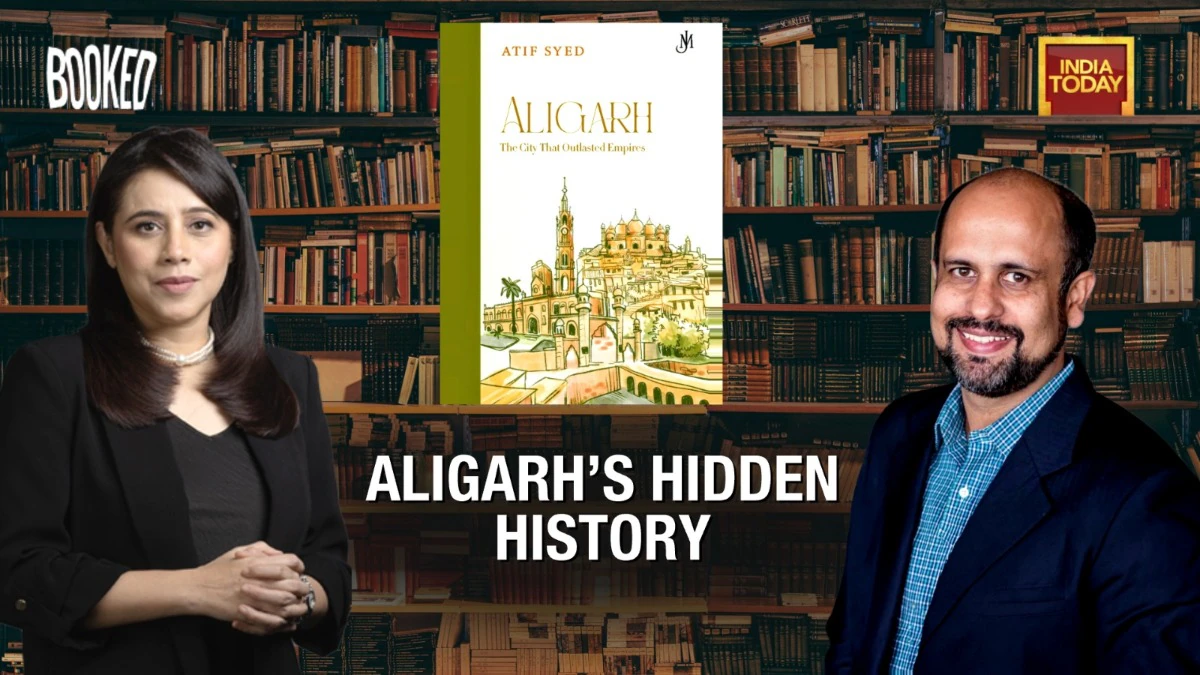
Aligarh Beyond AMU: Atif Syed on the Forgotten History of a City That Outlasted Empires
For many people, Aligarh is inseparable from Aligarh Muslim University and the Aligarh movement led by Sir Syed Ahmad Khan. But the city’s history stretches across centuries, encompassing successive rulers, military campaigns, French families, forgotten neighbourhoods and monuments that remain largely outside the public imagination.
In a conversation with Marya on Booked, Atif Syed, author of Aligarh: The City That Outlasted Empires, discusses his attempt to recover these overlooked narratives and place them within a larger account of the city.
The project began as a personal curiosity. Born in Aligarh but having left relatively early, Syed wanted to understand more about the city beyond its familiar identity. As he researched, he found that much of the existing narrative concentrated on the more recent past, leaving earlier chapters comparatively unexplored.
Among the discoveries that surprised him were the French families who lived in Aligarh for generations. One of them, George Peche, learnt Persian and Urdu and became an Urdu poet. Syed also describes the historical accounts of visitors, residences, gardens and neighbourhoods that reveal a more cosmopolitan and layered past than is commonly associated with the city.
The story reaches back much further. Syed discusses the settlement’s earlier identity as Koil or Kol, the conquest associated with Qutb al-Din Aibak, and the detailed accounts preserved by Persian historians. He also examines the 1857 uprising in Aligarh and the Battle of 1803, when British forces fought the Marathas and their French allies.
For Syed, the city’s geography is central to understanding its history. Located along routes connecting larger centres such as Agra and Delhi, Aligarh repeatedly became entangled in wider struggles for power. Its older town played a significant role long before the development of the Civil Lines area and the expansion of the institution that would become Aligarh Muslim University.
This does not mean diminishing the university’s importance. Syed describes the Aligarh movement as transformative, but argues that focusing exclusively on it risks losing the centuries of people, personalities and events that came before. He compares the movement to the finale of a story: the ending makes more sense when the audience knows the entire plot.
The author also explains his approach to historical research. He says he relied on primary accounts, academic sources, historical journals and documentation, distinguishing traditional accounts from claims grounded in historical evidence. His aim was to make the book readable as a narrative while remaining careful about the sources behind it.
Preserving the city’s physical heritage is another part of the project. Syed says that some historical sites, including tombs and monuments hidden in narrow lanes, are difficult to locate. His book therefore includes a map linked to QR codes that direct readers to the sites. He hopes greater awareness will encourage efforts to conserve monuments that are in poor condition.
Aligarh: The City That Outlasted Empires is thus both a historical exploration and a tribute to the author’s birthplace. Its central proposition is that a city cannot be understood through a single institution, period or identity. To see Aligarh more fully, its lesser-known stories must be brought back into view.
source: http://www.indiatoday.in / India Today / Home> Books / by India Today Web Desk / October 16th, 2026