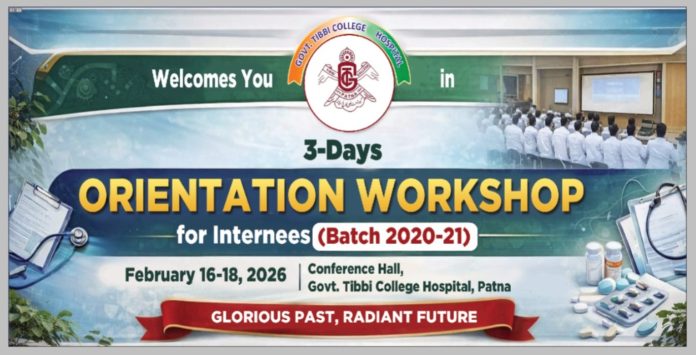
Government Tibbi College Hospital, Patna, will host a three-day special orientation workshop from February 16 to 18, 2026, for the trainee doctors of Batch 2020. The objective of this workshop is to practically acquaint incoming doctors with professional demands, medical laws, administrative principles, and ethical values to ensure they can fulfill their responsibilities effectively.
Under the vision of “A Glorious Past, A Bright Future,” the institution has designed this comprehensive training program.
On the first day, Dr. Mohammad Tanweer Alam will provide a detailed briefing on internship rules and regulations. Dr. Mohammad Razi Ahmad will highlight the importance of vital signs and correct examination methods, while Dr. Khesal Ahmad will explain X-ray diagnosis and study techniques in the ENT (Ear, Nose, and Throat) department.
This will be followed by a detailed discussion on modern diagnostic equipment and its effective use.The second and third days of the workshop will feature experts speaking on various medical topics. Dr. Mohammad Nizamuddin will provide guidance on the principles and rules of prescription writing. Dr. Shoeba Feroz Ahmad will share insights on prenatal and postnatal care, while Dr. Rizwan Ahmad will present practical tips on prenatal and postnatal emergency management. Dr. Raj Kumar Chandan will deliver a lecture on the practical use of anesthesia.
Dr. Amresh Kumar and Dr. Javed Ahmad will deliver a special address on the integration of Physiotherapy and Unani medicine in treating musculoskeletal and joint disorders.
To promote high ethical values alongside professional expertise, a special session on “Medical Ethics” will be conducted by Dr. Mohammad Nafees Iqbal.
On the final day, Dr. Aliya Parveen will hold a detailed discussion on clinical protocols related to infertility management.
The workshop will conclude with an inspiring address by Dr. Shailesh Kumar Pankaj, aimed at instilling new energy and professional commitment in the trainee doctors.
In his message, the Hospital Superintendent, Professor Dr. Shahnawaz Akhtar, stated that this workshop would prove to be a milestone for future doctors. He remarked that the institution’s goal is not merely to award degrees but to prepare physicians who are both technically skilled and ethically sound. He urged all interns to make the most of this opportunity and further refine their skills.
source: http://www.radiancenews.com / Radiance News / Home> Education> Latest News / by Sami Ahmad / February 16th, 2026
The newly elected assembly in Bihar will have 11 Muslim MLAs, down by 8 as compared to their tally in the last assembly, the final results of the 2025 state elections announced Friday showed.
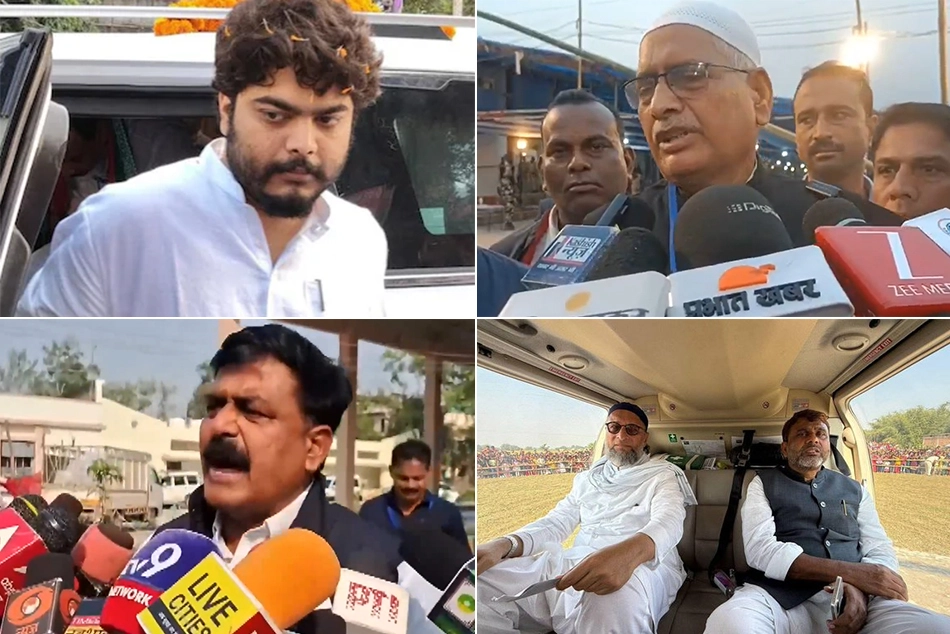
(Clockwise from left) Osama Shahab (RJD), Qamrul Hoda (Congress), Akhatrul Iman (Seen with AIMIM Chief Asaduddin Owaisi) and Zama Khan (Janata Dal United)
List of Muslim MLAs in Bihar 2025:
The newly elected assembly in Bihar will have 11 Muslim MLAs, down by 8 as compared to their tally in the last assembly, the final results of the 2025 state elections announced Friday showed.
A total of 24 Muslims belonging to different political parties were elected in the 2015 election whereas 19 Muslims were elected to the Bihar Assembly Elections in 2020.
The representation of Muslims went further down after the 2025 Bihar Assembly Elections the results of which were announced after counting of votes held on Friday November 14, 2025.
How Many Muslims Contested Bihar Vidhan Sabha Elections 2025?
The All India Majlis e Ittehadul Muslimeen (AIMIM) of Asaduddin Owaisi had fielded a maximum 23 Muslim candidates from as many constituencies of Bihar in the 2025 state assembly polls. Of them 05 Muslims have won.
On the other hand, Rashtriya Janata Dal (RJD) had fielded 18 Muslim candidates, Congress had given the party tickets to 10 Muslims, Janata Dal (United) had nominated 04 Muslims, and 02 Muslims contested as CPI (M) candidates.
Of these candidates 03 from RJD, 02 from Congress and just 01 from Janata Dal (U) won the 2025 Bihar elections.
Kumari Mayawati’s Bahujan Samaj Party (BSP), Prashant Kishor’s Jan Suraaj Party (JSP) and Lok JanShakti Party (Ram Vilas Paswan) had also given their party tickets to some Muslims. No Muslim fielded by these parties could win the 2025 Bihar elections.
The Bhartiya Janata Party (BJP) has not given the party symbol to any Muslim.
7. Mohammad Murshid Aalam (Jokihat) 8. Md Tauseef Alam (Bahadurganj) 9. Md. Sarwar Alam (Kochadhaman) 10. Akhtarul Iman (Amour) 11. Ghulam Sarwar (Baisi)
The most shocking defeat of a Muslim candidate was in Balrampur where AIMIM candidate Advocate Adil Hasan lost the seat to the BJP by just 389 votes.
2025 Bihar Election Final Results
Assembly or Vidhan Sabha elections in Bihar were held in two phases. Polling for the first phase was held on November 06, 2025 which ended with a voter turnout of 65.08%.
On the other hand, Polling for the second phase was held on November 11, 2025 which saw the voter turnout of 68.76%.
The overall poll percent, as per the Election Commission of India, was 66.91% – highest since 1951 when the first assembly election was held.
The counting of votes was held today, and as per the final result announced by the Poll Panel, the NDA alliance has won 202 seats whereas the RJD-Cong INDIA bloc could win just 35 seats.
The Election Commission final results show, the BJP has won 89 seats and emerged as the single largest party in Bihar for the first time in the state’s history.
The JD (U) has won 85 seats. Lok Janshakti Party Ram Vilas Paswan candidates won 19 seats.
On ther hand, the RJD candidates could win just 25 assembly seats and Congress 06. Owaisi’s AIMIM won 05 seats.
source: http://www.ummid.com / Ummid.com / Home / by ummid.com news network / November 14th, 2025
Adhakparia Village (East Champaran District), BIHAR :
Motihari:
A village in East Champaran which was infamous for guns being pulled out on trivial matters and for fights, the village where last year a sarpanch was not only strangled by fearless criminals but also shot dead, now this same village will be known for the stories of Shafqat Amna becoming an IAS.
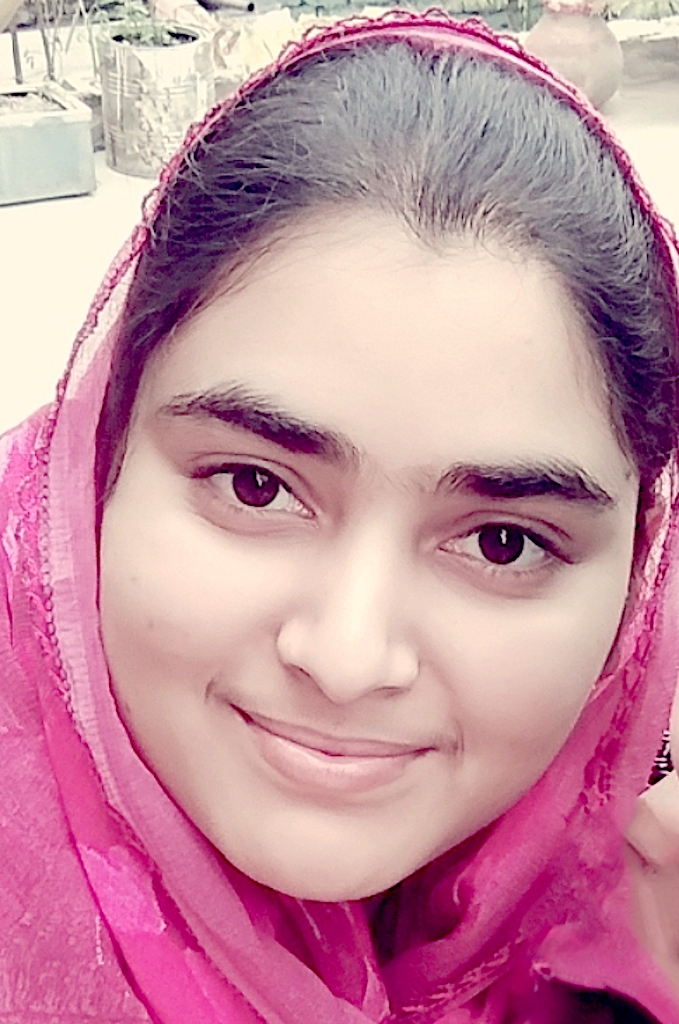
Shafqat Amna, daughter of retired teacher Mohammad Zafir Alam of Adhakparia village of East Champaran, has not only brought glory to her family by securing 186th rank in the UPSC Civil Services exam, but has also shown a path to lakhs of Muslim girls with the light of education.
The whole village is rejoicing at Shafqat’s success. 65-year-old Zafir is not tired of thanking people for this success.
In an exclusive conversation with BeyondHeadlines, Zafir Alam says, ‘We would like my daughter to work as an honest servant. She should strive for peace and prosperity in the society. And most importantly, she should take today’s new generation forward in the field of education.’
Let us tell you that Zafir Alam has retired as a teacher from an Urdu middle school in Agarwa village near Motihari.
24-year-old Shafqat Amna says in an exclusive interview with BeyondHeadlines that the backwardness of the village and the lack of infrastructure always bothered me. That is why since childhood I wanted to live among the people and do something for them so that I could change their thinking and circumstances. My father, sensing this desire of mine, inspired me to join the civil service.
Aamna says that my first choice is IAS and I am hopeful that I will definitely get IAS Insha Allah.
When asked what will you do first after becoming an IAS?
In response to this question, Aamna says that my first effort will be that whichever district I go to, I will first try to focus on education in the village. Since my father was a teacher, I understand the politics of teachers very well. I will inspire them to teach children honestly, away from that politics.
What if I get IPS instead of IAS?
On this question, Aamna pauses for a while and then after thinking says – I am hopeful that I will get IAS and I have not thought of anything else apart from this. But still if I get IPS instead of IAS then first of all I will pay special attention to law and order. I will try to maintain communal harmony in my district at all costs. I will try my best that there is never any fight or quarrel in my district, there is always mutual harmony.
When asked about preparing for civil services, Aamna says that, I would definitely like to tell those who want to join civil services that they should not start preparing for it suddenly, but first understand the syllabus well. If possible, try to take guidance from an IAS or IPS. Then start preparing for it thoughtfully with full courage and passion. Try to study smartly instead of studying like donkeys.
However, she also says that everyone’s way of preparing is different. The positive thing for me was that I had read NCERT books properly in school itself. So all the concepts were clear. I studied Geography very well in graduation as well. And yes, during my entire studies, I always had the habit of making short notes. These notes were very useful in my preparation. I paid full attention to its revision. Apart from that, I participated a lot in test series.
Let us tell you that Shafqat Amna passed 10th from Jawahar Navodaya Vidyalaya in Bettiah, West Champaran. Then she went to Bokaro for 12th, passed 12th from DPS there. After that, circumstances became such that she had to return to the village. Here she got a BA Honors degree in Geography from a college of Bhimrao Ambedkar University in Motihari. After that, she came to Delhi in 2016 to prepare for civil services. Here she prepared by staying in the residential coaching of Jamia Millia Islamia and after failing twice, she succeeded this time in the third attempt.
Apart from her parents, Shafqat Amna’s family also has three sisters and a brother. Her younger sister is pursuing BA LLB from Jamia Millia Islamia. Her two elder sisters have completed B.Ed and are currently living with their mother in the village.
Aamna says that the situation at home was never good. My father was the only breadwinner in the house. But he never neglected our education. Whatever I am today is because of my father.
What would you like to say to the girls of the country?
On this question, Aamna says that I would like to say that it is very important for you to get educated. And never underestimate yourself. Your hard work, your efforts can change your fate. But yes, for success you will have to make your own policy and your own routing. You will have to decide for yourself what things matter in your life…
source: http://www.beyondheadlines.in / Beyond Headlines / Home> India> Real Heroes / by Afroz Alam Sahil, Beyond Headlines / April 06th, 2019
While working on my two books (soon to come: one on Muslim Politics in Bihar and another on Muzaffarpur Muslims, 1857-2011), while looking into primary and secondary sources I came across many personalities and institutions. One such person was Sir Fakhruddin whose contributions towards public life may interest many people. Hence I crave the readers’ indulgence.
[Sir] Syed Mohammad Fakhruddin [Khan Bahadur, 1868-1933] of Patna is credited to have the distinction of being the first Muslim Minister of Bihar and Orissa.
His father Md. Ali of the village Dumri, near Patna, took special care of his quality education. Having imparted elementary education in Arabic, Persian, and Urdu in the village Maktab, Fakhruddin was put under the tutelage of Md. Yahya, advocate, a big rais of Patna, with deep interest in music and literature. Yahya was the husband of Rasheedun Nesa (1855-1926, the author of the Urdu novel, Islahun Nesa, 1881/94, and a pioneer of modern education to women in Patna).
Fakhruddin did his BA from the Patna College in 1891, and B.L. in 1893, and started court practice under the guidance of Yahya in the district court of Patna. He was also associated with the Bihar Provincial Association.
Having earned good reputation as advocate he was elected member Bengal Council in 1910, which Fakhruddin quit after becoming the government pleader (1917-20) in the High Court of Patna, established in 1916-7. In 1921 he was elected member of the Bihar and Orissa Legislative Council, and he kept winning the elections till his death in 1933.
Thus, during 1921-33 he also served as minister of education besides few other significant departments. His contribution as minister in pushing the cause of education is distinctive. His efforts towards promoting primary and secondary education are noteworthy.
The Deputy Directors of Public Instruction were made to undertake tours of Bihar and open schools. Fakhruddin worked hard towards enhancing the budgetary allocation for education. He also made efforts towards charkha operation in the government schools but remained largely unsuccessful in that. He mobilized funds for construction of college buildings and hostels. He was passionate about it.
Reconstruction of Patna’s BN College building and its three storeyed hostel, the imposing building of the Science College (Patna), two storyed hostel for the Science College, the Patna College Hostel (later became famous as Iqbal Hostel), two storeyed PostGraduate Hostel of Ranighat (Patna), Patna Training College are his creations.
Besides, he also allocated fund for the buildings and hostels of the Muzaffarpur’s GBB (LS) College, Cuttack’s Ravenshaw College, Bhagalpur’s TNB Colllege, two big buildings for the Madrasa Shams-ul-Hoda, which was taken over by the government, and eight professors’ quarters in Ranighat (Patna) are also his creations. For the cause of Urdu, he set up a Madrasa Board in 1922.
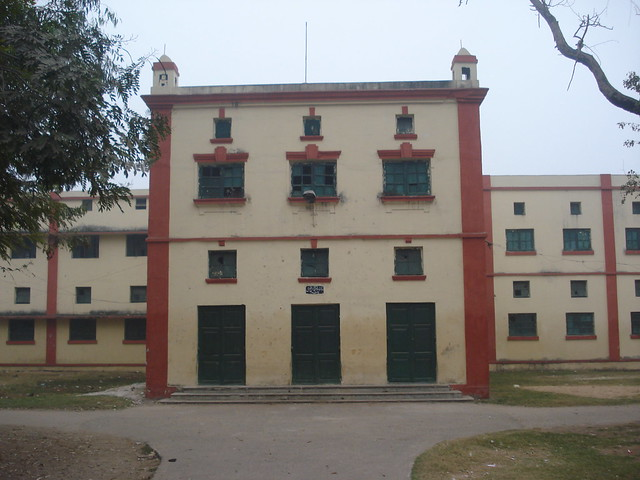
Madrasa Shams-ul-Hoda
Fakhruddin had also prepared an ambitious plan of converting the Patna University in a big residential university for which he also influenced the Nathan Committee to make favourable recommendations. This was to be established in the Phulwari Sharif. But it did not see the light of the day as a large number of the members of the Bihar and Orissa Legislative Council opposed it on the arguments that the campus will go far beyond the city; a member went on to allege that Fakhruddin was taking the University to the doors of his Pir. The Searchlight is said to have regretted this myopic opposition as the Bihar’s capital city was deprived of quality residential university.
He created and institutionalized Bihar Educational Service Class I, and went on talent hunt to recruit meritorious teachers for the Patna University.
With these efforts he brought in Dr Gyan Chand as professor of Economics, Prof. Taraporewala (History), Prof. Jamuna Prasad (Psychology), Prof. Hill (English), Prof. Shiv Parvati Prasad (Physics). They were posted on handsome salaries.
There used to be an insistence by the colonial regime to recruit only those candidates as Class I teachers who had obtained degrees from Europe.
Prof. Nayyar Laeeq Ahmad (who later became Principal, Andheri College, Bombay), and Prof. Jadunath Sarkar were also recruited. Sir Fakhruddin resisted this racism, without much success at the time, even though it was diluted subsequently in 1940s when Prof. K K Datta (History, 1944) was taken in.
Sir Fakhruddin brought a bright professor of Law from BHU to make him Principal, Law College, and Prof. Boman Sanjana of Bombay was brought in the Civil Engineering.
In order to overcome the dearth of talented teachers he also instituted State Scholarship programme on which promising students of BA and MA were sent oxford and Cambridge for higher degrees and they had to return back to teach in the colleges of Patna University.
Kishori Prasad Sinha, Fazlur Rahman, and Kalimuddin Ahmad for English literature; Ghanshyam Das for History, Balbhadra Prasad and Qamruddoja for Chemistry, Bhairavnath Rohtagi for Economics were few such luminaries. Sadly, with the death of Sir Fakhruddin this bright scheme also died.
The Bihar School of Engineering was upgraded to ‘College’ by him. He also established the Veterinary College of Patna and recruited many teachers from outside.
Besides education, he also held the portfolio of cooperative and he made it a movement of sorts, more particularly in Tirhut. He convened a conference of Cooperatives in Hajipur when Ahmad Husain (1886-1948), an Aligarh graduate of Muzaffarpur, was posted as SDO in Hajipur.
For all these unforgettable contributions, Dr Rajendra Prasad held him in very high esteem.
Sir Fakhruddin, a bearded, fair-skinned fellow was a devout practicing Muslim with punctualities of namaz. Sherwani, pajama, Turkish cap was his preferred dress. The masjid near the Patna Railway Junction was reconstructed by him by investing around Rs. 20-25 thousand, which is now the Jama Masjid of Patna; for long it was called ‘Sir Fakhruddin Masjid’.
As a minister, he never used government quarters; rather he preferred to work from his own house in Patna, nor did he accept police protection. He was a good orator in both English and Urdu.
His sons- Azizul Haq was a renowned advocate of Patna High Court, Anisul Haq was Deputy Collector, Habibul Haq was in judicial services.
(Mohammad Sajjad, Assistant Professor at Centre of Advanced Study in History, AMU, Aligarh)
source: http://www.twocircles.net / TwoCircles.net / Home / by Mohammad Sajjad / October 13th, 2025
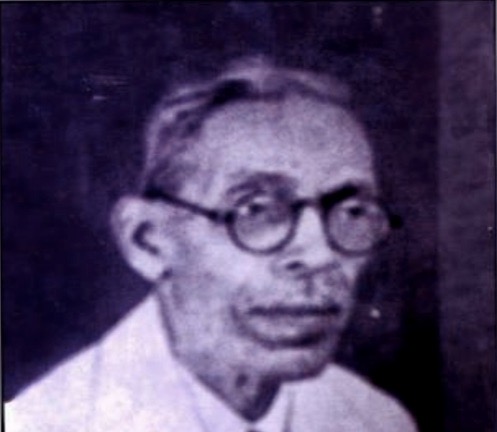
Fasihuddin Balkhi was born in 1885 in Bakshi Mohalla of Patna city. | Picture: Rekhta
Born in Patna, Bihar during the British era, Fasihuddin Balkhi made a tremendous contribution to history-writing in Urdu. Despite this feat, he remains largely unknown to this day.
Many historians have written about the history of Bihar. After taking a cursory overview of the works written by different scholars, one finds that history writing on Bihar, especially in the Urdu language has not yet received due attention in academic circles. Among many others who have written on Bihar and its history, the notable ones include Fasihuddin Balkhi (1885-1962); Taqi Rahim (1921-99); and Shad Azimabadi (1901-1978).
This piece is an attempt to highlight the life and works of Fasihuddin Balkhi. His work has received scant attention from those working in the Bihar region. His contribution remains largely under-acknowledged and under-explored in the existing literature of the Bihar province.
Balkhi was born in 1885, the same year that the Indian National Congress (INC) was founded, in Bakshi Mohalla of Patna city. After receiving his early education at home, he went to Calcutta where he completed his higher education. He became a teacher and initially taught at Poona Military School and later in Calcutta Fort William. Later on, he passed the law examination and was employed in the Bihar government. In 1914, he opted for military service which enabled him to visit different parts of the world like Palestine, Egypt, Iraq and Lebanon.
As India’s independence movement was drawing more followers, Balkhi too joined the movement. In 1921, he became part of the non-cooperation movement. After refusing to accept the post of deputy in Jaunpur, he had to face many hardships. Between 1926-27 he worked as the revenue officer and magistrate in Sarai Kela state.
After retirement, he left his ancestral home and lived the rest of his life till 1962 in his new house in Guzri Bazar Patna city (just behind the present Mohammedan Anglo Arabic school). In the last two years of his life, he worked at Patna University in the department of manuscripts. His hardworking and organizational abilities infused a new spirit in the department.
Although Balkhi was known as a good teacher and a successful officer, he was primarily a historian and researcher, as he stepped into some areas of research that were hitherto almost invisible. Even the noted Bihar-based historian, Syed Hasan Askari (1901-1990) has acknowledged Balkhi’s scholarly and literary abilities. Unfortunately, most of the works of Balkhi could not reach their desired audience. Some of his works remain unpublished even now.
Balkhi’s first book Tarikh-e-Magadh was published by Anjuman-e-Taraqqi-Urdu-Hind (Delhi) in 1944. The second book, Tazkira, was published as Tazkira-e-Niswane Hind (1956).
According to one source, he wrote his first work at the age of 25 in 1910 in Urdu on astrology, a rare case in Urdu, titled as Ilmi-e-Najoom. This work is not easily available or accessible to the readers. A pamphlet on the poetry of Shad Azimabadi titled as Inshad-e-Shad (Qaumi Press Bankipore, Patna, 1939) is his signature piece. The pamphlet demonstrates his power of critique.
Balkhi’s work only gained wider attention after his death. Well-known Urdu publisher Nadeem Bhatti published one of Balkhi’s works Tazkira-e-Hindu Shora-e-Bihar (Poets in Bihar/Urdu) in 1962. Some of Balkhi’s unpublished works such as Dastur-e-Sukhan, a collection of his works on historical places of Bihar province, Aasar-e-Balkhiya, are collected in the book. Several of his scholarly, literary and historical articles are also available in different magazines and journals. A well-researched article on Balkhi’s personality and research guidance was written by Qayyum Khazar for ‘All India Radio Patna.’ Khazar states that “Fasihuddin Balkhi was a great historian and researcher as well as a good poet.”
Balkhi’s work as historian Tarikh-e-Magadh is the first book that earned Balkhi fame as a historian. This seminal work in Urdu was published in 1944 by Anjuman Taraqqi Urdu (Delhi), which was then under the supervision of Maulvi Abdul Haq (Baab-e-Urdu). The book chronicles the history of Bihar province from the earliest times (642 BC) up to the second World War in 1943. The book contains as many as twenty chapters. The book is considered one of the most reliable accounts of the history of Bihar in the Urdu language. The work was constructed from authentic historical sources.
Patna-based historian Imtiaz Ahmad, commenting on the significance of Tarikh-e-Magadh, has said, “It is written authentically and professionally, with proper references from sources (Persian texts).”
Balkhi also wrote another significant work entitled Wahabi Movement, posthumouslypublished in 1983. This book along with Qeyamuddin Ahmad’s seminal work The Wahhabi Movement in India (1966, reprinted 1994) are the most cited works on the history and role of the Wahhabi movement in India.
Balki’s slim book, despite being confined to the Bihar region, is distinctive in many new ways. The sources he cited are primary and useful, such as letters of Syed Ahmad Shah, Calcutta Review, Indian Muslim by Wilson Hunter, Tazkira-e Sadiqa and biographies of Syed Ismail and Syed Ahmad, the founding fathers of the movement in India.
Emphasizing the legacy left behind by the Wahhabi movement, Balkhi writes, “It is highly interesting to note that the use of three great weapons, namely, non-cooperation, passive resistance and establishing of parallel Govt. which the Congress leaders adopted in their fight against the bureaucracy, was originally advocated and preached by the Wahhabis in 1854.” (p. 16).
Apart from these historical accounts, Balkhi wrote another path-breaking book Tazkirah Niswan-e-Hind (1956) in which he documents the short biographical accounts of the notable women of India. He starts his book with Raziya Sultan of the early 13th century and covers the women from various fields across India such as Askari Begum ‘Hijab’ (Lucknow), Chander Mukhi Bose (Bengal), Lal Ded (Kashmir), Raziya Sajjad Zahir (Rajasthan/Bombay), Bibi ‘Tahira’ (Bihar), etc. This book serves as an important source of information on Indian women and their role in different times of history.
Balkhi has also written about the lesser-known aspects of Bihar. This can be gauged from his book Patna Ke Katbe in Urdu, published by Khuda Bakhsh Library, Patna in 1993. This book is a unique study of inscriptions found on graves, mosques, and tombs located in Patna.
Balkhi has made a tremendous contribution to writing the history of Bihar in Urdu. His work serves as a guiding light on the lesser known and under-explored aspects of Bihar. His work needs to be revisited and re-assessed to throw light on many ignored dimensions of Bihar history.
Mohd Hussain Ganie is a PhD student at Aligarh Muslim University (AMU). He tweets at @GanaiHussain1
source: http://www.twocircles.net / TwoCircles.net / Home> Art-Culture / by Mohd Hussain Ganie, TwoCircles.net / August 12th, 2022
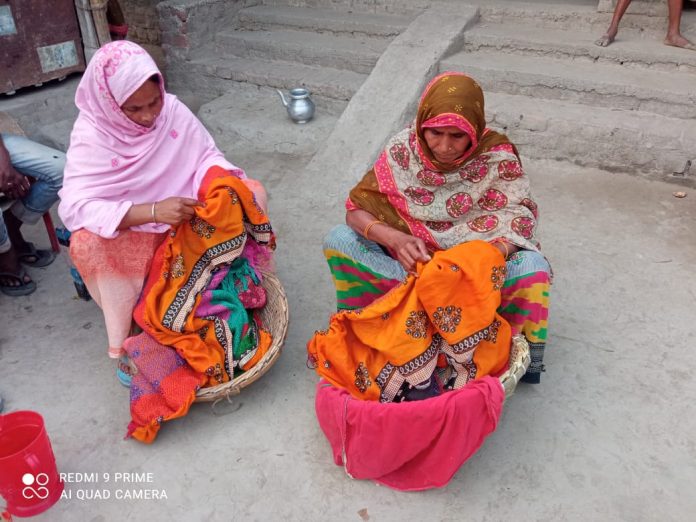
Rural women of Bihar engaged in doing Kheta embroidery work. | Picture by author arrangement
Kheta is said to be a 500-year-old quilting heirloom practised exclusively by Shershahabdi women. Today, Kheta embroidery work is getting popular among non-Shershahabdi people with many women formerly associated with making Beedis taking to Kheta work to earn a decent livelihood.
Bihar :
Razia Khatoon of Kishanganj district of Bihar is getting 45 days of training in Kheta embroidery work. The training will be completed on May 14 and is done under Project Samarth, a scheme for capacity building in the textile sector carried out by the government of India. Earlier, she would make Beedi (plant leaf cigarettes) as a livelihood. She said Kheta has given her a chance to get rid of the health hazards that making Beedi brings on.
For several workers like Razia, the Kheta embroidery work, after acquiring proper training, is expected to be an alternate livelihood instead of the hazardous Beedi rolling job.
Believed to be a 500-year-old quilting heirloom practised exclusively by Shershahabdi women, today the Kheta embroidery work is getting popular among non-Shershahabdi people. Earlier, the intricate embroidery work was done on the layers of pre-used print Sarees and chequered Lungis etc, however, today the use of new clothes for making Khetas is widely done.
“Shershahabdi is a term used for Muslims of the Seemanchal area of Bihar who were settled in the region by emperor Shershah Suri. They are said to be ethnic Pashtuns mixed with local Surjapuris,” Ashraful Haque, a Shershahabdi, who co-ordinates with the Kheta weavers, told TwoCircles.net.
“Kheta is so intricate and organised that officials from Delhi first refused to believe it as a handcraft. When a live demo was done, they were immensely impressed. After the efforts of the local member of parliament Dr Mohammad Jawed, who raised this question of Kheta in the Parliament, we have got this opportunity to train our women not only in making more vibrant Khetas but also make them aware of its marketability,” he said.
To make Kheta embroidery work as a source of income, the artwork is being introduced in new forms with the use of new clothes. This embroidery work is now done on bedsheets, notebook covers, bags, pillow covers, mufflers, table clothes and handkerchiefs etc.
As of now, seventy thousand workers are believed to be associated with this artwork.
Noticeably, unlike other embroidery works, Kheta avoids figurative depictions which are considered to be forbidden in Muslim culture. The colours used for Kheta are generally bright like red, green, yellow, blue, and purple.
Razia, 24, is a Shershabadi woman, and like every other Shershahabadi female, she knew a bit of Kheta.
She expressed her happiness in learning new designs and colour patterns of Kheta. She used to earn around 1$ per day by Beedi making. She now hopes to double her income by part-time Kheta making.
More than the money she is happy as she considers Kheta work as “Izzat wala kam (a respectful job.)”
Another trainee Rulekha Khatoon’s husband is a migrant labourer. Khatoon is 25-years-old and is doing Kheta work regularly for the last six years. She learnt the technique from her mother and grandmothers. “Earlier we used to make Kheta only for family purposes like dowry and gifts etc. This training showed us that we can sell our work too. I hope to earn Rs. 3000-4000 per month with the work of 3-4 hours,” she said.
47-year-old Tajgara Khatoon is a top trainer of Kheta. She told TwoCircles.net, “A needle and some threads are required to do wonders in Kheta embroidery but not without great painstaking concentration. Shershahabdi women learnt it naturally but this training is giving them a wider range of patterns.”
Inderjit De and Saumya Pande of Zameen Astar Foundation write in their paper on Kheta embroidery, “The term Kheta stands for straight running stitches in the local dialect and refers to both embroidery and the product. In its similarity to the word, Khet meaning farm, the term Kheta may resemble the meticulous lines of the paddy fields.”
According to the website involved in the promotion and marketing of Kheta, “the array of designs offered by Kheta resonates with ripples of water, materials used in building make-shift huts, flowers, dry fruits, leaves, among many more.”
Yuman Hussain is the executive director of Azad India Foundation which is actively involved in promoting Kheta and arranging training for workers.
Yuman told TwoCirles.net that the “training helps in benchmarking the skill level and understanding the quality control. It formalizes the knowledge transfer and helps in keeping the next generation interested in continuing the quilting practice.”
The training also provides the trainees with an artisan card with benefits like insurance and access to participate in different exhibitions.
“On average, a Kheta artisan can make 4 to 6 quilts (96″ x 60″ size) in a year. They can earn anything between Rs 10000 to Rs 30000 per year depending on how many quilts they are making, sizes of quilts, the skill level of quilting etc,” she said.
Yuman rued that even though most Shershabadi women know how to make Kheta, the supply of skilled artisans is less. “The work needs to be done on both sides to build awareness in the market and a supply chain base for these quality quilted Khetas,” she added.
Sami Ahmad is a journalist based in Patna, Bihar. He tweets at @samipkb
source: http://www.twocircles.net / TwoCircles.net / Home> Lead Story / by Sami Ahmad, TwoCircles.net / May 05th, 2022
Kapoorpoor Village (Gopalgang District),Bihar, INDIA / UKRAINE :
Rashid was one of the countless students stuck in Ukraine, without any government aid, when the war broke out.
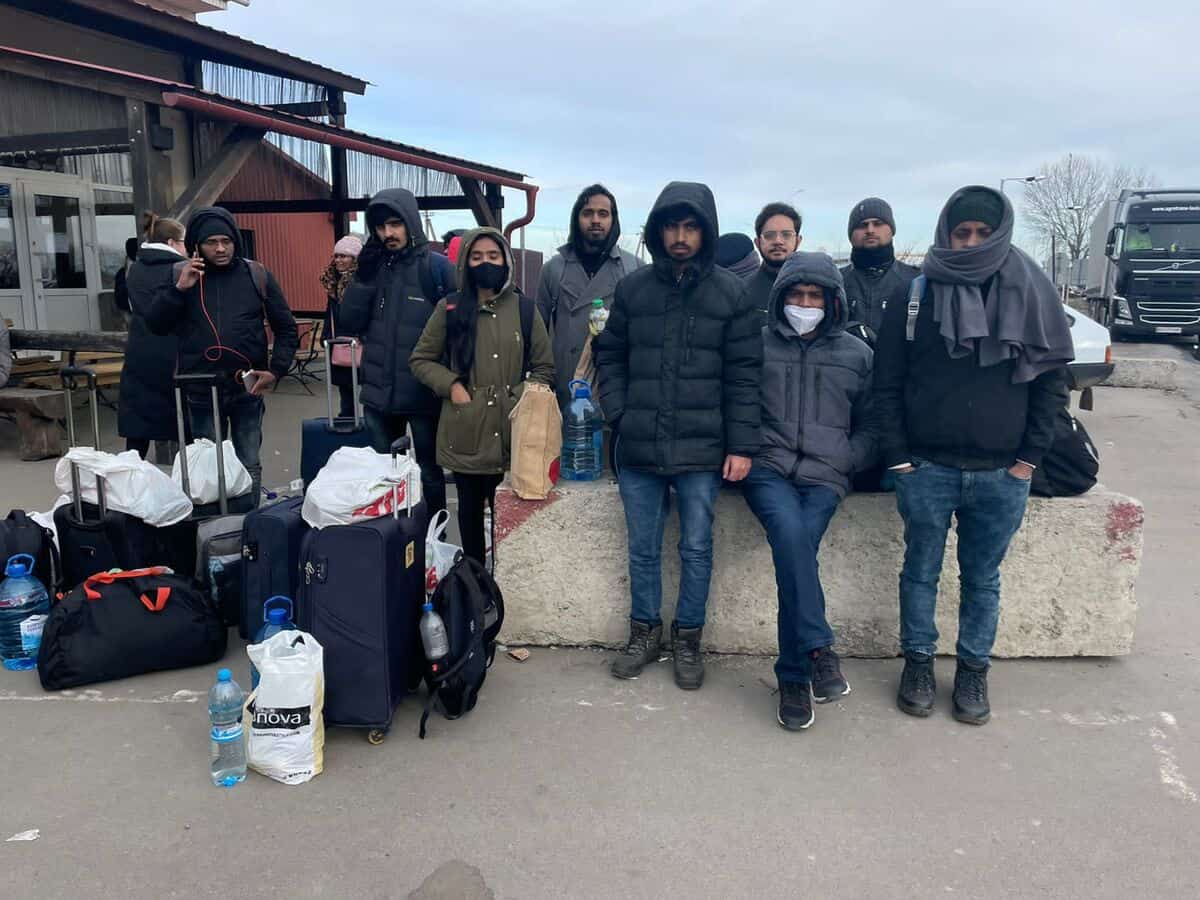
Rashid Rizwan and other Indian students at the Ukraine-Hungary border. (Special arrangement)
Over the last few weeks, users of social media have sifted through, cross-checked and reshared posts and videos of Indian students stuck in Ukraine. However, one video, in particular, stood out. The subject of the video, Rashid Rizwan, a student of medicine in Ukraine’s Ivano-Frankivsk national medical university, can be seen remarking in a video posted a few days ago, “Isse acha toh mar hi jaate,” (We might as well have died instead of suffering this way.)
Even a superficial viewing of the video makes it clear that Rashid was distraught. His eyes, still glassy with leftover tears speak volumes. He asks how long he can cope. (Kitna sambhale khud ko?) As the video progresses, Rashid says, in a shaky, fearful tone that “yahan par puchne wala koi nahi hain. (There is no one here to enquire after our well-being)”
Rashid, who is a native of Gopalganj district of Bihar, was critical of the Citizenship Amendment Act introduced by the Union government in 2019 and in fact protested against it in his university in Ukraine. He also stood in solidarity with the countless victims of the 2020 northeast Delhi riots.
Further, Rashid clarified that he was open to the Citizenship Amendment Act but was uneasy with one community alone being sidelined. “Constitution toh WE the people se shuru hota hain na ma’am? Ab woh WE main Muslims nahi aate kya? (The Constitution starts with We the people no? Does that not include Muslims?)” he asks.
Victim-blaming students stuck in Ukraine
When asked about why he stayed put in Ukraine, when the advisory asked them to leave, Rashid stated that universities in Ukraine demand 100% attendance. If they left without coordinating with the universities, they would lose out on an entire year of education and further waste a huge sum of money.
This was made worse by the fact that Turkish visas were not readily available and the students could not book tickets to India directly. “The flight ticket prices kept soaring. At a point it was between 80,000 and 1,20,000 INR,” says Rashid.
After countless hours of debilitating panic (nearly two days), embassy officials approached Rashid and his companions at the Hungary border, to aid their return to India.
“We were asked to go to the nearest west Ukrainian border and so we obeyed. I, along with a few others was at the Ukraine-Hungary border. Then a new advisory stated that only students who could arrange for cars or buses should move towards the borders of the country. If we knew this in advance, we would have stayed put. Why are we being judged and maligned?” asks Rashid.
Rashid also tried to coordinate with the embassy and the university from February 14 but was met with either a tepid response or no response at all. He also wrote letters to the District Magistrate of Gopalganj and MP Alok Kumar Suman for aid the day Ivano-Frankivsk city was attacked.
A Doctor’s dream:
Towards the end of his narration, this reporter asked Rashid why he chose to become a doctor. He said that there was no doctor in his village for a very long time. “In Kapoorpur village (in Gopalganj district of Bihar), we don’t have a readily accessible doctor. Anyone seeking treatment has to travel 12 kilometres to the nearest dispensary. I wanted to relieve some of the distress caused by poverty,” he simply remarked.
At the time of writing this article, only 3,352 Indian students have returned to India from Ukraine as per government estimates.
source: http://www.siasat.com / The Siasat Daily / Home> News> India / by Anjana Meenakshi/ March 04th, 2022 (edited )