Tag Archives: Ghulam Nabi Azad

Muslim Mirror Releases List of 100 Most Influential Indian Muslims 2025; Young Faces Gain Prominence

INDIA :

Muslim Mirror’s 100 Most Influential Muslims of 2025

New Delhi: 

Muslim Mirror has released its much-anticipated annual list of the “100 Most Influential Indian Muslims of 2025,” spotlighting individuals who have made significant contributions to India’s public life across a wide spectrum of fields including politics, culture, education, business, media, religion, sports, and social service. Now in its second edition, the list aims to document influence not merely as power or popularity, but as sustained impact, leadership, and the ability to shape public discourse.

A defining feature of the 2025 edition is the growing prominence of younger achievers, signalling a visible generational shift within Indian Muslim leadership. Alongside established national figures, the list includes emerging voices who have built influence through grassroots activism, professional excellence, digital platforms, legal advocacy, education, and community engagement. Editors associated with the project said this was a deliberate attempt to recognise new centres of influence beyond traditional hierarchies.

The list reflects the diversity and plural character of Indian Muslim society, cutting across geography, ideology, profession, and language. From seasoned politicians and religious scholars to artists, entrepreneurs, academics, and social reformers, the compilation offers a broad snapshot of leadership trends at a time when issues of representation, constitutional values, and social justice remain central to national debate.

Representation Across Sectors

The 2025 list features several eminent academicians and intellectuals who have shaped higher education, policy discourse, and social research. Among them are Abul Qasim Nomani, Ameerullah Khan, Furqan Qamar, Shahid Jamil, and Ubaid-ur-Rahman, recognised for their contributions to education, public policy, and academic leadership.

In the business and entrepreneurship category, the list includes influential names such as Azad Moopan, Azim Hashim Premji, Farah Malik, Irfan Razack, M. P. Ahammed, Mecca Rafiq Ahmed, Meraj Manal, Syed Mohamed Beary, P. Mohammed Ali, Shahnaz Hussain, Tausif Ahmad Mirza, Yusuff Ali, and Ziaullah Sharif. Their inclusion underlines the growing economic footprint of Indian Muslim entrepreneurs, both domestically and globally, spanning sectors from retail and healthcare to infrastructure and consumer goods.

Community leadership remains a strong pillar of the list, with figures such as Arshad Madani, Mahmood Madani, Malik Motasim Khan, Mehmood Pracha, Syedna Mufaddal Saifuddin, Navaid Hamid, Pirzada Md Abbas Siddiqui, Qasim Rasool Ilyas, Sadatullah Husaini, Umer Ahmed Ilyasi, and Yusuf Mohamed Abrahani recognised for their roles in religious guidance, legal advocacy, social mobilisation, and institutional leadership.

Culture, Media, and Public Discourse

In arts and entertainment, globally recognised names such as A. R. Rahman, Aamir Khan, Mammootty, Munawar Faruqui, and Shah Rukh Khan continue to command immense cultural influence, shaping narratives that extend well beyond cinema and music into social consciousness.

The list also acknowledges the growing importance of media and journalism in shaping opinion and challenging dominant narratives. Journalists and commentators such as Arfa Khanam, Irfan Meraj, and Seema Mustafa are recognised for their consistent engagement with issues of democracy, minority rights, and constitutional values.

Religious and Intellectual Scholarship

A significant section of the list is devoted to Islamic scholars and religious thinkers, reflecting their continued influence on moral leadership and intellectual discourse. Names such as A. P. Aboobacker Musliyar, Qasim Nomani, Prof. Akhtarul Wase, Asghar Ali Imam Mahdi Salafi, Asjad Raza Khan, Ibraheem Khaleel Al-Bukhari, Javed Jamil, Khalid Saifullah Rahmani, Khaleelur Rahman Sajjad Nomani, Qamaruzzaman Azmi, Rashid Shaz, Shakir Ali Noori, Shamail Nadvi, and Yasoob Abbas find place for their scholarly work, writings, and public engagement.

Politics and Governance

The political category features leaders cutting across party lines and regions, including Asaduddin Owaisi, Ghulam Nabi Azad, Hamid Ansari, Mehbooba Mufti, Omar Abdullah, Salman Khurshid, Najeeb Jung, Syed Naseer Hussain, Engineer Rashid, Akhtarul Iman, Iqra Hasan, Zameer Ahmed Khan, Rakibul Hasan, K. Rahman Khan, Kadir Mohideen, Mohibullah Nadvi, Md Shafi, Agha Mahadi, Asim Waqar, and Sadiq Ali Shihab Thangal. Their inclusion reflects influence exercised through electoral politics, governance, diplomacy, and legislative advocacy.

Changemakers and Social Reformers

One of the most dynamic sections of the 2025 list is that of changemakers and social reformers, featuring individuals such as Safeena Husain, Shahabuddin Yaqoob Quraishi, Syeda Hameed, Zameer Uddin Shah, Mahbubul Hoque, Sabahat S. Azim, Mehmood Pracha, Faiz Syed, and Zahir Ishaq Kazi, among others. Many of these figures have earned recognition through long-term grassroots work rather than formal authority.

International Booker Prize 2025 winner Banu Mushtaq for Heart Lamp, along with renowned poet Wasim Barelvi, has been placed in the category of Literary Figures.

In sports, iconic names Sania Mirza and Irfan Pathan continue to inspire younger generations through excellence and public engagement beyond the playing field.

Beyond Rankings

The editors emphasised that the list does not claim to be exhaustive, nor does it measure influence solely through fame, wealth, or official position. Instead, it seeks to capture real-world impact, moral authority, intellectual contribution, and the ability to shape conversations within and outside the community.

The annual list has increasingly become a reference point for understanding evolving leadership patterns among Indian Muslims. By foregrounding both established figures and rising talents, the 2025 edition reflects continuity as well as change, underscoring how Indian Muslims continue to contribute meaningfully to India’s democratic, cultural, and social field.

source: http://www.muslimmirror.com / Muslim Mirror / Home> Indian Muslim / by Muslim Mirror / January 15th, 2026
Obituary: Maulana Muhammad Salim Qasmi, an ocean of knowledge

Deoband, UTTAR PRADESH :

With scarcity of good ulama, the passing away of Maulana Muhammad Salim Qasmi, rector of Al-Jamia Al-Islamia Darul Uloom Waqf, Deoband, has sent a sense of gloom across India.

People have written obituaries describing his death as the loss of the last chain in the golden series of Khanwada-e-Qasmiyat, a metaphor used to describe the great legacy whose history got prominence with establishment of Darul Uloom in Deoband in 1867 against the backdrop of persistent British onslaught on Indians on the one hand and its ugly design to kill ulama in large numbers on the other hand, to mitigate the impact of resistance against the Colonial power.

Maulana Salim Qasmi was a witness to the British cruelty on Indians and the Indian ulama during the eventful years if Independence. He had lived those times as a young student of India’s most prominent madrasa that had been a great centre of anti-British movements like the Silk Letter Movement.

Being the great-grandson of Maulana Muhammad Qasim Nanautwi, Salim Qasmi knew well the role he had to play to live up to the reputation and expectations both of his family and its followers and admirers spread over countries and continents. He rightly did so. His demise thus has rightly been described as the end of that golden chain. However, as there are others from the same family trying to carry forward both the academic and social and historical legacy, will they be able to do justice with that, only time will tell.

Muhammad Salim was born on 8 January, 1926 at Deoband and received primary education from many teachers. He completed his studies in 1948 from Darul Uloom Deoband where his teachers included great luminaries like Maulana Hussain Ahmad Madani, Maulana Aizaz Ali, Allama Ibrahim Balyawi, Maulana Syed Fakhrul Hasan Moradabadi.

He is said to be the last surviving disciple of Maulana Ashraf Ali Thanwi from whom he studied Mizan, an important book of Arabic grammar. Soon after passing out, he was appointed a teacher there. However, later, due to a serious conflict and crisis then in Darul Uloom, he along with some other colleagues, decided to stay away from it and established Darul Uloom Waqf which he nurtured till his last breath. Besides looking after its administrative affairs as a rector, he also taught Bukhari Sharif, the well-known book of hadith. Earlier, he had taught Muslim Sharif, another important book of hadith.

Some of the key positions he held at the time of his death are as follows:

Chief Rector, Al-Jamia Al-Islamia Darul Uloom Waqf, Deoband,

Vice-President, All India Muslim Personal Law Board,

Member, Aligarh Muslim University Court,

Member of Advisory Board and Managing Committee, Darul Uloom Nadwatul Ulama,

Member of Advisory Board, Mazahir Uloom Waqf, Saharanpur,

Permanent Member of the Fiqh Council, Al-Azhar,Cairo,

President, All India Muslim Majlis-e-Mushawarat (before two fractions of it finally united),

Patron, Kul Hind Rabta-e-Masajid,

Patron, Islamic Fiqh Academy, India.

About his written contribution to the domain of knowledge, the website of Darul Uloom Waqf Deoband mentions that besides being:

… one of the top speakers of ulama, his articles and writings are also much admired. Some of the books are worthy to be mentioned here like (1) Mabaadi al-Tarbiyat al-Islami (Arabic), (2) Jaiza Tarjama Quran Karim, (3) Taajdar-e-Arz-e-Haram ka Paigham, (4) Mardaan-e-Ghaazi, (5) Ek Azeem Tarikhi Khidmat, (6) Safar Nama-e-Burma.

(7) The book Khutbat-e-Khatibul Islam (a collection of his speeches) has been published in 5 volumes. Moreover, there are many articles and scripts awaiting publication.

Formally, Maulana received bai’at (a reformative and self-actualization method historically in vogue for quite long as an Islamic tradition in certain schools of thought) at the hand of Maulana Shah Abdul Qadir Raipuri. However, he received much of the training from his glorious father, Qari Muhammad Tayyib (d. 17 July, 1983)

A remarkable trait of his personality was to maintain the dignity of a true aalim (religious scholar) by not partaking in sectarian lines as is the wont of some Ulama. He was therefore respected among all sections of Muslims and his views were very well received. Maulana Salim did not create the binary division of education between religious and modern. He believed that ‘the source of all streams of knowledge is one’.

In recognition of his services to the domain of knowledge and ideas Maulana Salim was honoured with many awards, some of which are as follows:

Nishan-e-Imtiyaz (Mark of Distinction) from the Government of Egypt for being a distinguished aalim of the Indian Sub-Continent,

Imam Muhammad Qasim Nanotwi Award,

Shah Waliullah Award.

Prominent leaders and ulama from different countries have expressed grief over the demise of Maulana Salim Qasmi. In her telephonic message, External Affairs Minister Sushma Swaraj said that Maulana Salim’s love for education was amazing. Outside the country he worked as an exemplary ambassador of education. Congress President Rahul Gandhi said Maulana Salim Qasmi illuminated the world through education and he would touch people through simplicity. Samajwadi Party chief, Mulayam Singh Yadav said that Maulana never asked anything for himself. He was a crown prince of education whose absence would be felt long.

Former Justice of Pakistan’s Shariah Court, Mufti Taqi Usmani described Maulana Salim Qasmi as an ocean of knowledge. His death is a huge loss to the Islamic world. The simplicity with which he lived is rare, he said adding, “His service in the field of education is a golden chapter”.

Member of Parliament and AIUDF President Maulana Badruddin Ajmal Qasmi termed the demise of Maulana Salim Qasmi as ‘end of an era’ whose enumerable services are worth to be written in golden words. Senior leaders Ahmad Patel, Ghulam Nabi Azad, Syed Shahnawaz Hussain and others also sent their condolence messages.

Maulana Syed Rabey Hasani Nadwi, President of All India Muslim Personal Law Board, who had closely worked with Maulana Salim Qasmi and had also been his classmate at Darul Uloom Deoaband, wrote an article in which he stated that Maulana Salim Sahab had acquired many of the qualities of his father Qari Tayyib Sahab and his great grandfather Maulana Qasim Nanautwi. He worked in a similar way from whom different sections of ummah benefitted. His death therefore has caused concerns about the void in the ummah and in religious circles.

Maulana Arshad Madani described Maulana Salim Qasmi’s death as a loss which does not seem to be filled in near future. “Whenever there is a crisis he would be remembered’ he said. The responsibility to protect the institution that he established falls on all of us.

Prof Humayun Murad said that Maulana knew well how to avoid confrontation and find peaceful and constructive ways. Darul Uloom Waqf Deoband is its living example.

Maulana Muhammad Sayeedi, nazim, Mazahir Uloom Waqf said, “In the passing away of Maulana Salim Qasmi, Mazahir Uloom has been deprived of one of its true guide and patron”. He was its member since 1988. Mufti Muzaffar Husain would trust him a lot and his suggestions were highly helpful.

As against the commonly held opinion of ulama who do not tire of speaking about the division of knowledge between religious and modern or worldly, Maulana Salim Qasmi, in June 2013, had in a public programme, very categorically said that all the available forms of knowledge are from Allah. There is nothing as religious and worldly knowledge.

Maulana Qasmi said that the division of knowledge (between religious and worldly) is a political creation because all streams of knowledge flow from God. He then asked heads of madrasas to invite people of other faiths to their madrasas and exchange views and, share their problems with them also.

As I write this obituary, his soft-spoken words remind me of the sincerity with which he would draw the attention of the people to real issues and to the approaches that need to be adopted to find their solution.

Maulana Salim Qasmi was among the important personalities who had set up the Darul Uloom Waqf. His colleagues Maulana Muhammad Nayeem Deobandi died a little over a decade ago on 23 August, 2007, Shaikhul Hadith Maulana Syed Anzar Shah Kashmiri died 10 years ago on 26 April, 2008, Mufti Khursheed Alam died on 7 February, 2012, while Maulana Salim’s younger brother Maulana Muhammad Aslam Qasmi, an outstanding orator, died about five months ago on 13 November, 2017. Finally, this great son of the great Khanwada-e-Qasmiyat passed away on 14 April, 2018. He is survived by four sons and two daughters.

May the Almighty grant him an exalted place in Jannah!

The author is a PhD Fellow at the Academy of International Studies, Jamia Millia Islamia and is also doing an online program “Contending Modernities” of the University of Notre Dame, USA.

source: http://www.twocircles.net / TwoCircles.net / Home> Articles> Indian Muslim> Lead Story / by Manzar Imam for TwoCircles.net / April 28th, 2018

Congress veteran Ghulam Nabi Azad named among Padma Bhushan recipients

JAMMU & KASHMIR :

Ghulam Nabi Azad, one of the top politicians of Jammu & Kashmir, has served as the chief minister of the erstwhile state between 2005 and 2008.

He was the Union health minister from 2009 and 2014, and subsequently served as the Leader of Opposition in Rajya Sabha till February 2021.

Senior Congress leader Ghulam Nabi Azad (PTI)

Former Jammu & Kashmir chief minister and veteran politician of the Congress party, Ghulam Nabi Azad, was included in the list of Padma Bhushan awardees released by the Ministry of Home Affairs (MHA) on January 25.

Azad, 72, will be conferred with Padma Bhushan by President Ram Nath Kovind for his contribution in the field of “public affairs”.

A total of 17 names were approved by the President for the conferment of Padma Bhushan — which is awarded for “distinguished service of high order”.

Apart from Azad, the list also includes another top politician – former West Bengal chief minister and senior CPI(M) leader Buddhadeb Bhattacharjee.

Azad, who served as the Leader of Opposition in Rajya Sabha between June 2014 and February 2021, was lauded by the prime minister at the conclusion of his tenure in the Parliament’s Upper House.

“Azad has distinguished himself in Parliament. He not only worries about his Party but also had a similar passion towards the smooth running of the House and towards India’s development,” he had said.

Azad, a member of the Congress’ G-23 – an informal reference to 23 Congress veterans who had marked dissent against the party’s style of functioning, had apparently reciprocated the gesture last year by praising Modi for ‘not hiding his true self”.

Notably, Azad, before serving as the Leader of Opposition in Rajya Sabha for close to seven years, was the Union Minister for Health and Family Welfare in the second UPA government between 2009 and 2014.

He had served as the seventh chief minister of Jammu & Kashmir between November 2005 and July 2008.

The Padma awards, whose recipients are announced on the eve of Republic Day, are conferred by the President of India at ceremonial functions which are held at Rashtrapati Bhawan usually around March-April every year.

This year, the President has approved the conferment of 128 Padma awards. The list comprises 4 Padma Vibhushan, 17 Padma Bhushan and 107 Padma Shri awards.

source: http://www.moneycontrol.com / MoneyControl.com / Home> News> India / January 25th, 2022

Pedalling for children’s safety

Kazhakkoottam (Thiruvananthapuram), KERALA  :

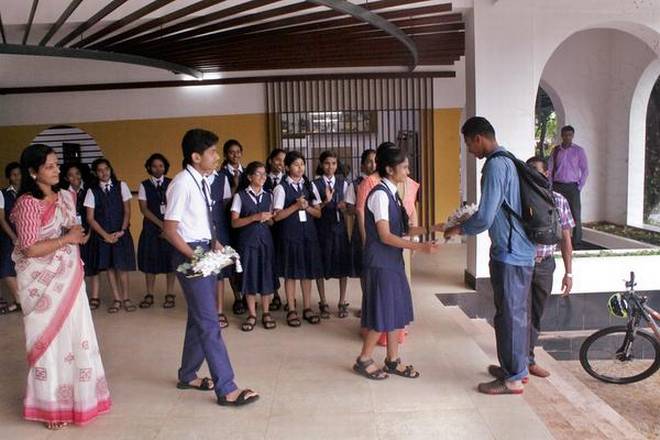
Students welcome Al Ameen at Rajagiri Public School.

Al Ameen is on a Kashmir-to-Kanyakumari bicycle campaign against child abuse

Kochi :

Heavy rain accompanied by strong wind was what received 19-year-old Al Ameen in the city on Monday long before he could pedal his way to Rajagiri Public School for his formal reception.

The two receptions, the other being at Al-Ameen Public School, were among the five stopovers in the city over two days for the second-year sociology student from the Jamia Millia Central University, who is on a Kashmir-to-Kanyakumari bicycle campaign against child abuse.

Having popped antibiotics after getting beset with stomach upset and vomiting, the lashing rain further took its toll on the weakened body of the youngster who is originally from Kazhakkoottam in Thiruvananthapuram.

In fact, he was admitted at a hospital in Karnataka for a day before entering Kerala.

However, that didn’t douse the spirit of Al Ameen who mounted the cycle from Srinagar on June 2 with the noble intention of creating awareness among students about the need to stand up against abuse of varied hues against them.

“I also wanted to encourage students to actively participate in finding solutions to the problems faced by the community around them,” said Al Ameen who had been clocking around 80 kilometres a day.

He was briefly joined by his college mate Shigraf Zahbi in the Delhi-Rajasthan stretch before giving it up owing to hostile climatic conditions.

Asked why he opted for cycling to propagate his cause, the youngster said that the nobility of the cause alone would not win the attention it deserves unless combined with some extraordinary act. “For me, cycle is just the tool to attract attention to my larger goal,” he said.

Before his stopovers at five schools in the city, he had been accorded receptions at schools in Thiruvananthapuram, Kollam and Alappuzha.

The receptions were organised by district child protection officers of the Women and Child Development Department.

He will now meet students of more schools in Malappuram, Kozhikode, Vadakara, Kasaragod and Manjeshwaram before wrapping up his campaign in Kanyakumari on July 23. by which time he would have covered around 4,250 kilometres.

source: http://www.thehindu.com / The Hindu / Home> News> Cities> Kochi / by M.P. Praveen / Kochi – July 10th, 2018

Rajya Sabha bids farewell to three Congress MPs

NEW DELHI :

Karan Singh, Janaradhan Diwedi and Parvez Hashmi will retire on January 27

Debates were becoming rare and disruptions more frequent, four time Rajya Sabha MP Karan Singh, rued even as he bade farewell to the upper house along with two other Congress MPs Janaradhan Diwedi and Parvez Hashmi.

In a speech peppered with Sanskrit shlokas and Urdu verses, Mr. Singh said, “Parliament has evolved over these 50 years but not all the changes have been positive I must say. I used to remember when I went to the Lok Sabha for the first time. There were brilliant debates by Hiren Mukherjee, Madhu Limaye, Nath Pai, Atalji and here Bhupesh Gupta. Those were the debates now seem to me becoming rare, and disruptions are becoming more frequent.”

He called upon the members to introspect. He said he had come to Delhi as an idealistic young man of 36 and was retiring as an ‘idealistic old man’’. “I have implicit faith that the county will overcome all its challenges as long as we remain faithful to our Constitution and civilisational values,” Mr Singh said.

Speakers from both sides showered praise on them for their contributions. All the three retiring MPs were elected from Delhi. The farewell was held today, the last day of the Winter Session. Their actual retirement date of January 27 would fall in the inter-session period.

Ghulam Nabi’s praise

Leader of the Opposition and senior Congress leader Ghulam Nabi Azad said his veteran party colleague Karan Singh had become the head of Jammu and Kashmir at the age of 18 and was probably world’s youngest person to hold such a post.

Mr. Dwivedi, who completed three terms as the Rajya Sabha MP, said generally farewell became like an “obituary reference” but today [Friday] was different.

Mr. Hashmi was not present in the house.

source: http://www.thehindu.com / The Hindu / Home> News> National / by Special Correspondent / New Delhi – January 05th, 2018

Manipur Governor Syed Ahmed laid to rest with full state honours

Mumbai, MAHARASHTRA :

The Maharashtra government has declared a day’s mourning today.

Image credit : Twitter

Mumbai:

Manipur Governor Syed Ahmed was laid to rest here today with full state honours. 73-year-old Ahmed was suffering from cancer and admitted to Lilavati hospital in suburban Bandra last week where he breathed his last yesterday. The funeral took place at Rehmatabad, Shahi Kabrastan in Anjeerwadi, Mazgaon this afternoon. The last rites were conducted by his son Syed Zeeshan.

Maharashtra Governor Ch Vidyasagar Rao, Chief Minister Devendra Fadnavis, Union Transport Minister Nitin Gadkari, Leader of Opposition in the Rajya Sabha Ghulam Nabi Azad, Senior Congress leader Mukul Wasnik were present on the funeral. Ghulam Nabi Azad laid a wreath on behalf of Congress President Sonia Gandhi.

Manipur Labour minister Hemo Chandra Singh, former Union Minister Subodh Kant Sahay, who hails from Jharkhand, Maharashtra Congress chief Ashok Chavan, Mumbai Congress president Sanjay Nirupam and Mumbai Congress Minority department chairman Nizamuddin Rayeen also attended the funeral.

The Maharashtra government has declared a day’s mourning today. Ahmed was sworn in as the Governor of Manipur on May 16, 2015. Ahmed, a former Congress leader from Maharashtra, was shifted to the north-eastern State from Jharkhand, where he was appointed Governor on August 26, 2011 when the UPA Government was in power at the Centre.

He joined the Congress party in 1977. He was elected to the Maharashtra Assembly five times from the Nagpada constituency in Mumbai. He also served as a Minister in Maharashtra, where he held portfolios like Housing. Besides dabbling in politics, where he started his career in Congress, Ahmed also had a flair for writing, especially in Urdu. President Pranab Mukherjee and Vice President Hamid Ansari, Prime Minister Narendra Modi were among others who had condoled Ahmed’s demise.

source: http://www.india.com / India.com / Home> News> India / by Press Trust of India / September 28th, 2015

JK Govt should enhance retirement age of doctors: Azad

Union Health and Family Welfare Minister Ghulam Nabi Azad today asked the Jammu and Kashmir  government to raise the retirement age of doctors so that the health sector did not suffer for want of adequate staff.

Azad said this after inaugurating a 220-bed Super Speciality Hospital besides launching Rashtriya Bal Swasthya Karyakaram (RBSK), Project Swasthya Slate and 102-J&K Referral Service under National Rural Health Mission here.

Regarding 102 referral service, he asked the state health minister to bring the remaining sanctioned 200 ambulances at the earliest.

Accompanied by Union Minister Farooq Abdullah, Azad said Jammu and Kashmir was the first state to get the Project Swasthya Slate to cover most difficult areas.

Spelling out achievements of the Centre and state governments, Azad said, “We have not only given new dimensions to health sector but all the development fields have witnessed a discernible change during the past 4 to 5 years.”

Azad said one more medical college has been sanctioned for Rajouri, thus raising the total number of newly sanctioned medical colleges to five.

He said the government has given nod to establish 75 cancer institutions in the country compared to only one such centre in the last 65 years.

He said the UPA government extended massive financial and moral support to all the states without any political, social or religious consideration.

Speaking on the occasion, Abdullah extended gratitude to the Centre for giving special consideration to development of J&K in view of its tough terrain and hoped it will continue to do so in future also.

He also thanked Azad for transforming the healthcare profile of the state.

source: http://www.business-standard.com / Business Standard / Home> PTI Stories> National> News / by Press Trust of India / Jammu- March 03rd, 2014