Tag Archives: Indian Muslim Martyrs

History of 1921 Malabar revolt is being decolonised. British reduced it to Hindu-Muslim clash

KERALA :

The Malabar Resistance of 1921 is a deeply contested historical event that was born out of the crackdown against the Khilafat movement. The book ‘Musaliar King’ has tried to decolonise it.
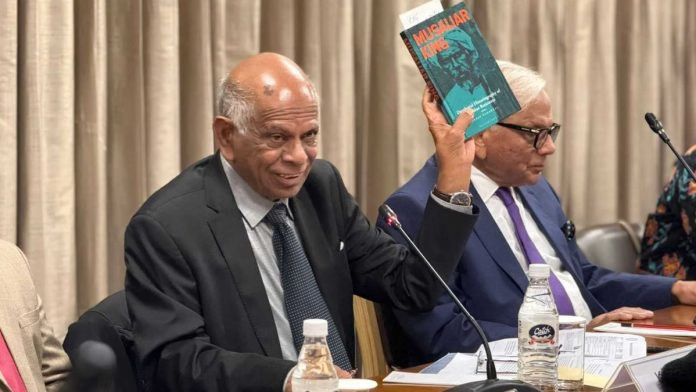
KP Fabian with Abbas Panakkal’s book Musaliar King | Special arrangement

New Delhi: 

On a mission to decolonise the narrative around the Malabar resistance of 1921, author Abbas Panakkal has relied on oral histories, and other accounts in Ottoman, French, Australian, and Indian libraries. A recent gathering of academics at the India International Centre saw a passionate discussion on the book Musaliar King: Decolonial Historiography of Malabar’s Resistance

Star-studded panelists of academics and scholars, including former diplomat KP Fabian, Padma Shri Syed Iqbal Hasnain, dean of Jamia Hamdard, Saleena Basheer, Pallavi Raghavan, professor at Ashoka University and professor Syed Jaffri Hussain of Delhi University critiqued and added layers of historical context to Panakkal’s work. 

The Malabar Resistance of 1921 is a deeply contested historical event that was born out of the crackdown against the Khilafat movement, and saw an uprising of peasants against the landlords who were primarily Hindus and enjoyed British support. The British historiography reduces the rebellion to a Hindu-Muslim clash, and the resistance hasn’t found a place in the national conversation of revolts against the British colonists.

The author maintains that the peasantry contained both Hindus as well as Muslims and that Muslim houses were also targeted.

In 2021, RSS National Executive Committee member Ram Madhav had said that the Malabar Rebellion was the first manifestation of the ‘Talibani’ thought in India. In the same year, there were also Right-wing protests against celebrating the centenary anniversary of the revolt.

The Hindu Right maintains that the ‘uprising’ or ‘revolt’ was a communal incident, and takes offence to declare one of the leaders of the rebellion Variyamkunnath Kunjahammed Haji as a martyr. 

“Historians rely on repositories to provide evidence for accounts. In this project, my repository was also my family, neighbours, and village. When I grew up and learned English, I understood that the British version of the history of the Malabar rebellion was very different from what I had grown up hearing. The popular history was very different from the personal story of the people of this region,” Panakkal said, addressing an audience of academics, students, and historians.

“This book is not just research of 3-4 years, these are stories that I grew up hearing. I have to tell the story of my native place. It is my obligation,” he said. 
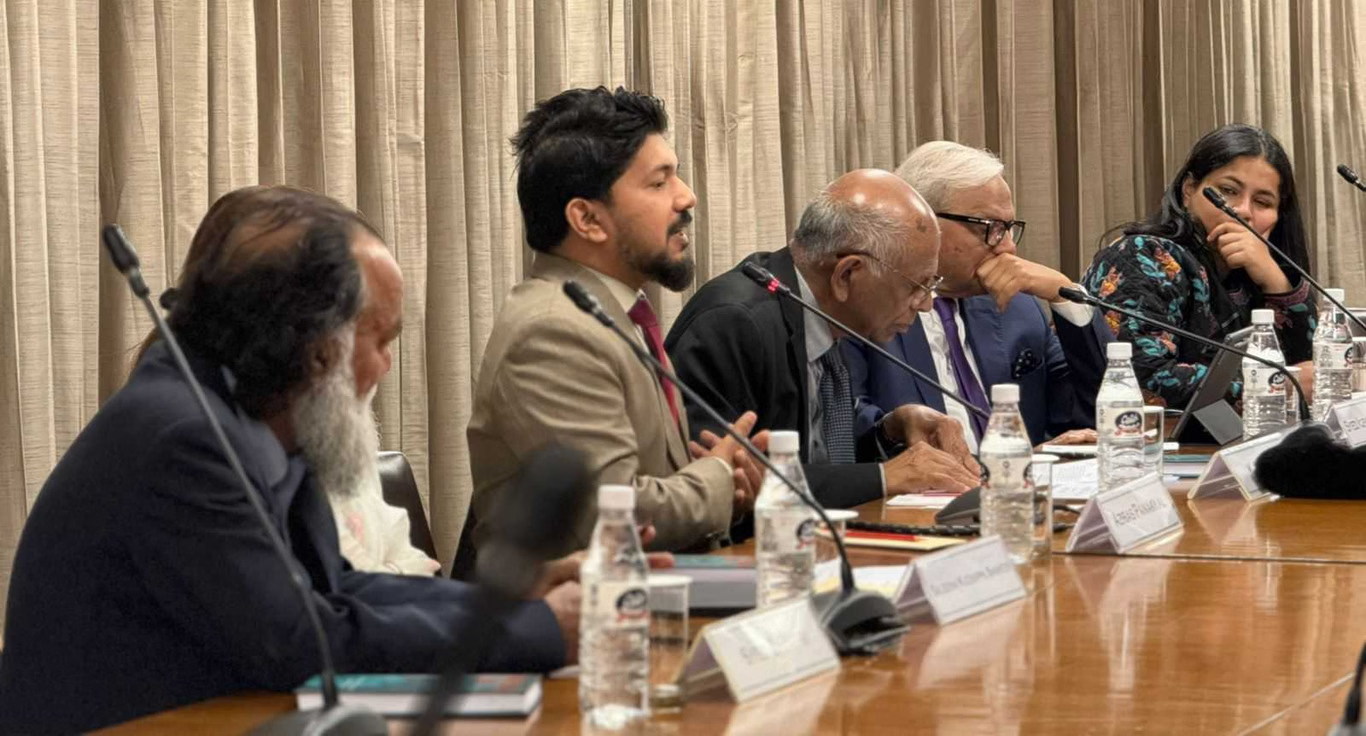
Panelists discussing Malabar rebellion of 1921 | Special arrangement

Oral history or nationalistic take? 

Growing up,  Panakkal said he had met and acquainted himself with Hindu and Muslim families who maintained an oral history of how Muslims and Hindus both rescued each other during the uprising. He added that the Malabar region, especially Tirurangadi, has a lot of communal peace.

Dr Syed Iqbal Hasnain said that the Malabar or Moplah revolt was an uprising against the British that was “woven with the threads of unity binding Hindu and Muslim to safeguard the throne of Hindu king Zamorin of Calicut.” 

“Muslim communities thrived under the patronage of Hindu kings, who they considered protectors who ensured the preservation of Islamic law and culture,” Hasnain said. 

Saleena Basheer, while commending Panakkal’s work, didn’t hold back on her critique of the book, which she said could be non-accessible to people who don’t have a lot of awareness about the revolt. She also questioned if the book was over-reliant on oral histories. 

“Does the book deconstruct colonial narratives or does it ignore them in favour of nationalistic storytelling,” Basheer asked.

The academics also wondered how radical the decolonial approach could be, as British versions of history are sometimes the only version of historical accounts available in the pre-Partition era, and have to be relied on by historians while writing about history.

Syed Jaffri Hussain, who has written extensively on the revolt of 1857, said the British version of events has to be challenged. He also praised Panakkal’s work. “Indian rebels like Bahadur Shah Zafar, Jhansi ki rani, Rana Beni Madho Singh are described as badmash, this needs to be read between the lines,” Hussain said about British repositories, adding that such language was never used for Australian rebels or Irish convicts.

The British left but their mentality has stayed with us,” he added. 

Hussain maintained that Moplah rebellion oral history needed to be urgently recorded. 

“What is accepted by us as an oral history in the realm of Dalit history, women’s history, should also be accepted in terms of Moplah history,” said Hussain.

(Edited by Ratan Priya)

source: http://www.theprint.in / The Print / Home> Features> Around Town / by Shubhangi Misra / February 19th, 2025
Martyr Mohd Imteyaj gets Vir Chakra for Op Sindoor

Narayanpur Village (Chhapra), BIHAR :

New Delhi :

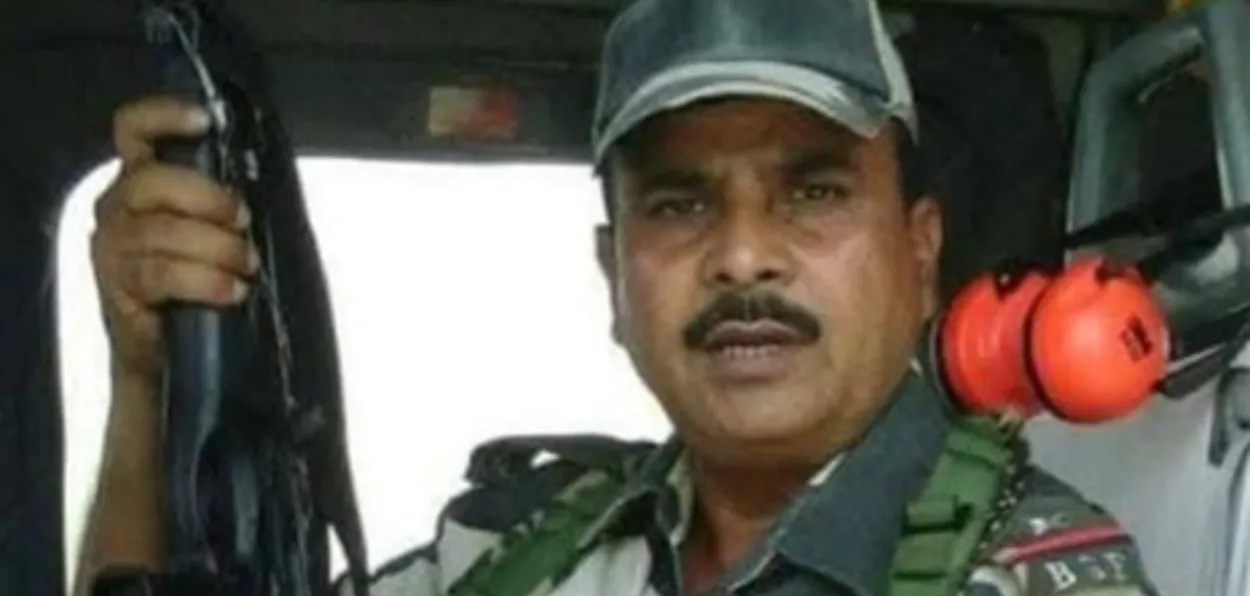
Border Security Force’s Sub-Inspector Mohd Imteyaj and Constable Deepak Chingakham were posthumously awarded Vir Chakra, the third highest war-time gallantry award – in recognition of their exceptional courage and self-less leadership in the face of adverse situation

Sub Inspector Mohammad Imteyaj was martyred on May 10, during cross-border firing along the International Border in RS Pura sector, Jammu and Kashmir.  

Constable  Deepak Chingakham hailed from Manipur. He sustained grave injuries during the exchange of fire with Pakistanis on the international border in RS Pura and laid down his life for the nation,

Imteyaj hailed from Narayanpur in Garkha, in Saran district of Bihar.

BSF posted the list of awardees on X:

He was posted on the international border in Ranbirsinh Pura sector in Jammu. According to a Border Security Force (BSF) official, Sub-Inspector Mohammad Imtiyaz led the front bravely and made the supreme sacrifice. 

He was buried with military honours in the cemetery located in Narayanpur village of Gadkha block of Saran district amid chanting of “Bharat Mata ki Jai” (Hail, mother India!). People showered their floral tributes on Imtiyaz’s body.

Mohammad Imtiyaz is survived by his wife, two sons, and two daughters. BSF said Mohammad Imtiyaz led from the front.

As soon as the news of Mohammad Imtiyaz’s martyrdom reached his home, initially his village and later the entire district went into mourning. A large crowd gathered outside his house; people were trying to show their sympathy to the family and gratitude to the brave son of the soil.

source: http://www.awazthevoice.in / Awaz, The Voice / Home> Stories / by Aasha Khosa, ATV / August 16th, 2025

Karnataka govt organises ‘Jai Hind Sabha’ in honour of armed forces

Mysuru, KARNATAKA :

Bengaluru :  

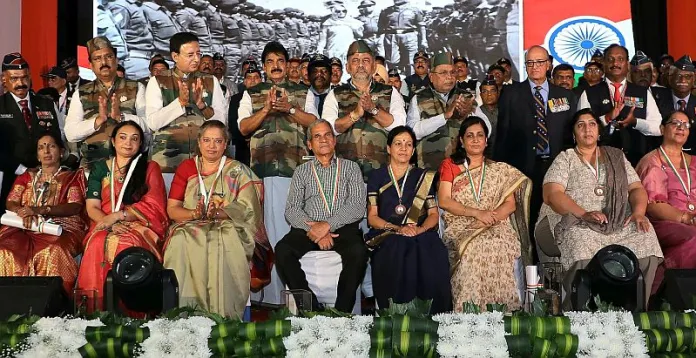
The Karnataka government organised a special event, ‘Jai Hind Sabha’, in honour of the Indian armed forces and facilitated retired military personnel in Bengaluru on Wednesday.

The programme was held at the Town Hall in Bengaluru, and it was given the tagline, ‘Jai Hind Jai Sena’.

During the event, senior officers who served in the Indian Army and ex-servicemen were felicitated. The families of brave soldiers who laid down their lives in service to the nation were also honoured.

Among those felicitated were the family members of late Major Sandeep Unnikrishnan (Ashoka Chakra awardee), Colonel Jojan Thomas (Ashoka Chakra awardee), Major M.C. Muthanna (Shaurya Chakra awardee), Major Ganesh Maddappa (Shaurya Chakra awardee), Captain M.V. Panjal (Shaurya Chakra awardee), Major Mohan Gangadharan (Shaurya Chakra awardee), Major Shafiq Mohammad Khan, and Colonel Ramamurthy (Sena Medal awardee).

More than a thousand senior army officers and ex-servicemen participated in the event. The Karnataka government had issued directions to organise such events across the country to salute the selfless service of Indian soldiers and stand in solidarity with them.

Addressing the “Jai Hind Sabha” programme, Chief Minister Siddaramaiah stated that soldiers, farmers, doctors, and teachers are as revered and memorable as one’s own parents.

He praised the legacy of Indian soldiers. “Soldiers dedicate themselves to national defence with a spirit of sacrifice. The responsibility of protecting the country does not lie with the army alone, but with all 1.4 billion Indians,” he said.

He emphasised that India has never compromised on the principle of protecting the righteous and eliminating evil, and it never will.

“This is the commitment of every Indian,” Siddaramaiah underlined.

The Chief Minister made a significant declaration that no excise duty will be levied on army canteens by the state. He also assured that all necessary steps would be taken for the welfare of retired soldiers.

Speaking after felicitating senior army officers, ex-servicemen, and the families of martyred soldiers, Deputy Chief Minister Shivakumar said, “To support all ex-servicemen in the state, the government is considering the establishment of a separate corporation. This proposal will be discussed in the state cabinet meeting before a decision is made.”=

“We are thinking of forming this corporation based on the suggestion of Mallikarjun, President of the Congress Party’s Sainik Cell. We are committed to the welfare of soldiers who have served our nation,” Shivakumar stated.

“It is a matter of pride to be part of such a significant event. On behalf of the Congress party and the nation, I extend my gratitude to all of you who have served our country with strength and dedication. The Congress party has always stood by the nation and our armed forces. This programme is a testimony to the fact that your sacrifices will always be remembered,” he added.

source: http://www.mangalorean.com / Mangalorean / Home> Mangalorean News> Local News / by IANS / May 28th, 2025

BSF sub-inspector killed in line of duty laid to rest

Narayanpur Village (Chhapra), BIHAR :

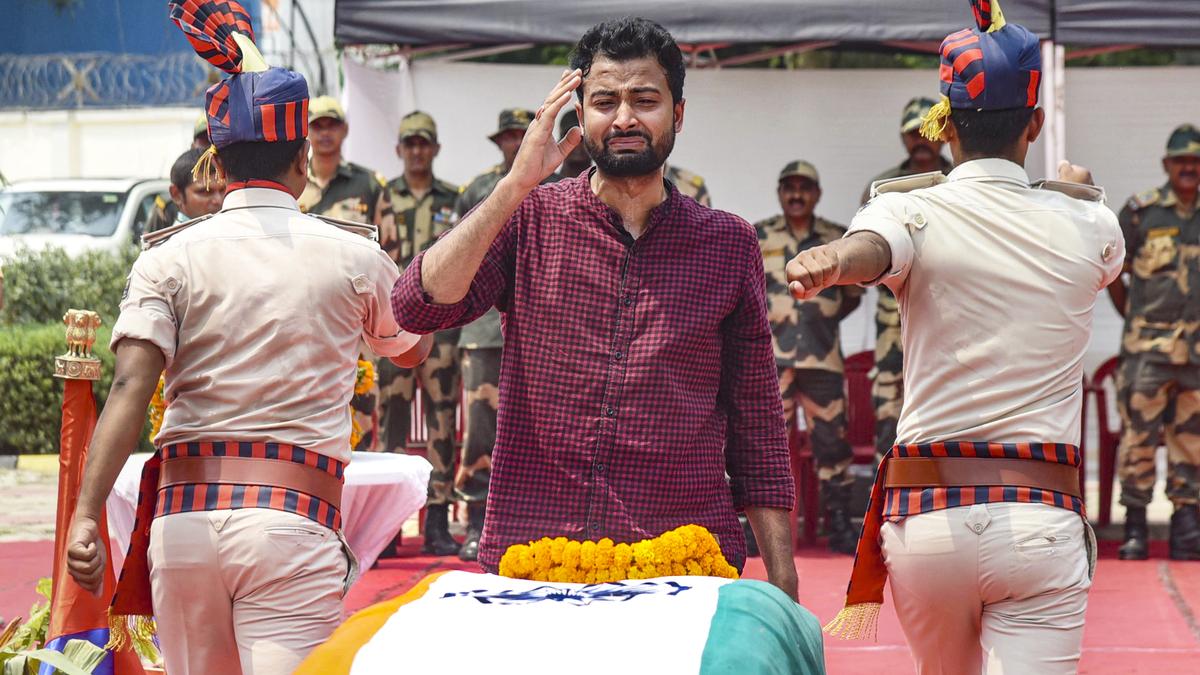
Imtiaz’s last rites were performed in the presence of a large crowd who shouted slogans in solidarity. Tearful, his son Imran Raza says his father sacrificed his life for the country and that he is proud of him.

Imran Raza pays tribute to his father, BSF Sub-Inspector Mohammad Imtiaz, in Patna on May 12, 2025. Imtiaz lost his life in the line of duty in J&K’s Jammu district. | Photo Credit: PTI

Mortal remains of Border Security Force (BSF) Sub-Inspector Mohammad Imtiaz from Chhapra, who was martyred in Operation Sindoor in the R S Pura section of Jammu border, reached Patna on Monday (May 12, 2025).

He was given a guard of honour by the security personnel, and a wreath-laying ceremony was held at Patna airport. Mr. Imtiaz’s son Imran Raza was also present at the airport to receive his body.

Several politicians, including Leader of the Opposition in the Bihar Legislative Assembly Tejashwi Yadav and Shravan Kumar, a Minister in the Cabinet of Chief Minister Nitish Kumar, were present to pay tributes to the martyred Sub-Inspector.

Speaking to the media at the airport, with tears in his eyes, Mr. Raza said, “I am really proud of my father who did not give up till his last breath and sacrificed his life for the country. Last time papa called me at 5:30 a.m. (May 10) saying that terrorists had attacked and his right leg was damaged. I told my father not to lose hope as I was coming to meet him.”

He said, “I boarded the flight for Delhi but when I reached there, I was informed that there was no flight for Jammu. Then I travelled by train. Till 3 p.m., the situation was under control and he was out of danger. I received a call from one assistant commandant at 6 p.m. who informed me that my father was no more. I could not get the chance to even speak to my father in his final moments.”

Mr. Raza broke down while speaking to the media and said that his father last visited the village to celebrate Eid with his family and resumed duty 18 days ago.

‘Army’s befitting reply’1

Mr. Yadav, in his address to the Press, said that the country and Bihar took pride in Mr. Imtiaz’s sacrifice and martyrdom.

“It is because of such brave martyrs that we are all safe today. The nation will always remember their sacrifice. We all should be proud of the Indian army and soldiers the way they gave the befitting reply to Pakistan. This is not for the first time the Indian army has boldly replied to Pakistan, It has happened before as well,” Mr. Yadav said.

Accompanied by RJD Rajya Sabha member Sanjay Yadav, the former Deputy Chief Minister asserted that the Sub-Inspector’s sacrifice also proved that there is unity in diversity in the country.

“Martyr Imtiazji was from Chhapra and we all are proud of him. He has made a big sacrifice as well as given a message that there is unity in diversity in our country. There are different languages, states, religion and caste, but when it comes to the matter of our country, everyone gets united against the enemy, be it Pakistan or terrorists, to win the battle,” Mr. Yadav said.

Minister Shravan said that through Operation Sindoor, the Indian government had ended terrorism and the army had played an important role.

“Mohammad Imtiaz has sacrificed his life while saving the entire nation. Along with Chief Minister Nitish Kumar, the people of the entire country are with his family in this hour of grief,” Mr. Shravan said.

Bharatiya Janata Party (BJP) state president Dilip Jaiswal was also present to pay the floral tributes to the Sub-Inspector.

Later, his body was taken to his native village Narayanpur in Chhapra, where last rites were performed in the presence of a large crowd. People shouted slogans in support while holding the national flag.

source: http://www.thehindu.com / The Hindu / Home> News> India / by Amit Bhelarii, Patna / May 12th, 2025

Soldier Abdul Javed Laid to Rest with State Honors in Jhunjhunu

Jabasar Village (Jhunjhunu District) , RAJASTHAN :

Jhunjhunu :

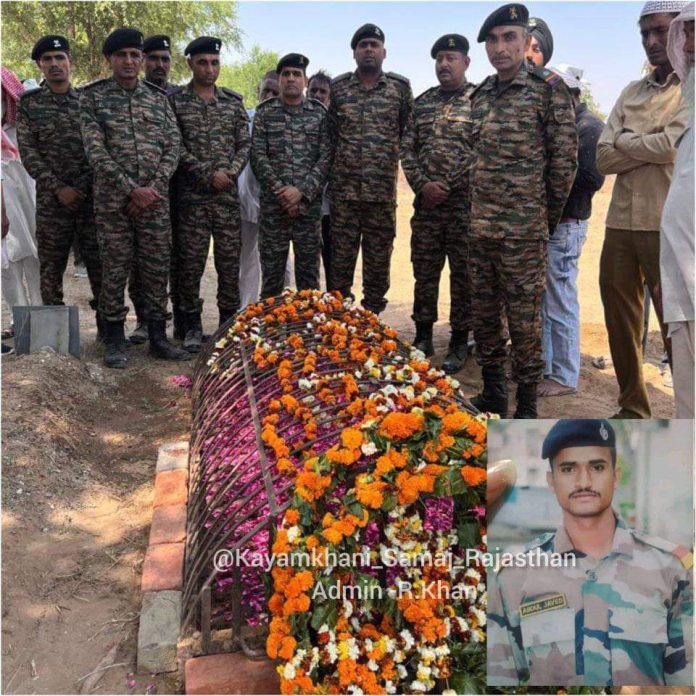
Abdul Javed, a soldier from the 73 Armored Unit of the Army, was laid to rest with full state honors in his native village of Jabasar, Jhunjhunu district. He tragically lost his life in a road accident near Malsisar Alsisar while on his way to Jhunjhunu.

Abdul Javed had returned home on a month’s leave for Eid on April 2, but his visit was cut short by the unfortunate accident. The Rajputana Rifles contingent from Jaipur paid a heartfelt guard of honor to their fallen comrade during the burial ceremony.

The soldier’s funeral procession was preceded by a solemn tricolor rally organized by local youth as a mark of respect. Villagers, along with Abdul Javed’s father and elder brother, gathered to offer floral tributes and bid farewell to the departed soul.

The Army contingent that attended the funeral included Major Aziz Khan, Risaldar Asrar Ahmed, Risaldar Nasrat Hussain, Naib Risaldar Zakir Khan, and several other dignitaries. Additionally, local officials such as Naib Tehsildar Chhaganlal and Sarpanch Irshad Ahmed, along with community leaders and members, paid their respects during the ceremony.

The heartfelt turnout and gestures of respect from the community and the armed forces reflect the deep gratitude and reverence for Abdul Javed’s service and sacrifice. His memory will forever remain cherished in the hearts of his fellow soldiers and his village.

source: http://www.radiancenews.com / Radiance News / Home> Latest News> Report / by Radiance News Bureau / April 08th, 2024

Wreath laying ceremony to commemorate death anniversary of Brigadier M. Usman, MVC (P), July 03rd

INDIA:

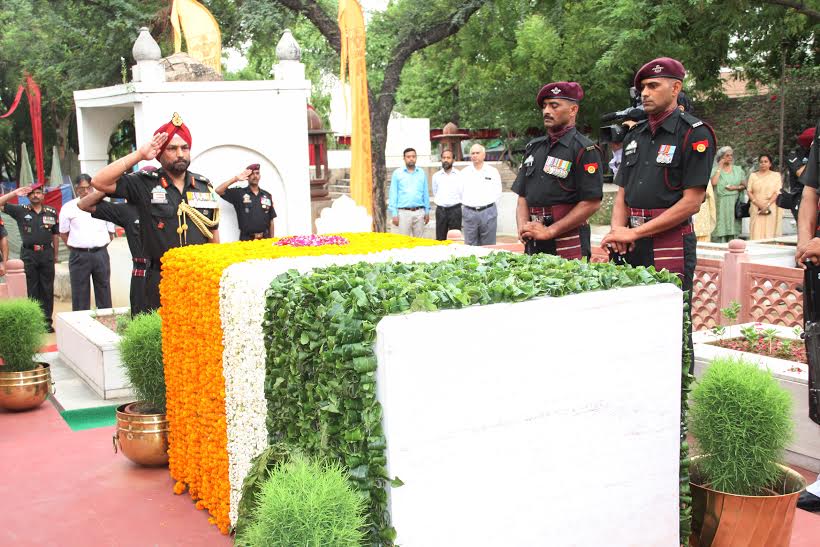
A Wreath Laying Ceremony to commemorate the death anniversary of Brigadier Mohammad Usman, MVC (P) was organised at his Memorial in Jamia Millia Islamia (JMI) Cemetery on 03rd July 2023.

 Wreath laying ceremony of late Brig Mohd Usman held


Several Retired and Serving officers including Lt Gen Pushpendra Singh, SM** Col of the PARA Regiment and DG OL & SM, Brig. Rajneesh Mohan Cdr 50 (I) PARA Bde, Lt. Gen Gurbir Pal Singh, AVSM, VSM, DG NCC Delhi, Lt. Gen Velayudhan Sreehari, AVSM, SC, SM, AG’s BR DG (MP&PS), Lt Gen Subriti S Dahiya, SM VSM, Comdt NDC and Maj Gen Prashant Srivastava, AVSM, SM, Addl MS (B) attended the function and paid their
tributes by laying a wreath at the Memorial of Brig. M. Usman, MVC (P).


A wreath was also placed at the Memorial of Brig. M. Usman PVC (P) on behalf of JMI Vice Chancellor Prof. Najma Akhtar (Padma Shri), as her tribute to the memory of the gallant officer. NCC cadets and officers were also present to witness the solemn occasion and pay their respects.

Jamia Millia Islamia (NAAC A++ Grade Central Univ) on Twitter: "A wreath  laying ceremony to commemorate the death anniversary of Late Brigadier M.  Usman, MVC was organised today by a contingent from


Under Brig. Mohammad Usman, MVC (P) Para Brigade successfully defended the city of Naushera against Pakistani Tribal forces, and then valiantly recaptured the city of Jhangar.

Late Brigadier Mohammad Usman, also known as the savior of Naushera, was responsible for the recapture of Jhangar & Naushera (Jammu & Kashmir) during 1947- 48 war with Pakistan.

The gallant officer attained martyrdom on 03rd July 1948 when an
enemy artillery shell landed close to him in Naushera.

source: http://www.jmi.ac.in / Jamia Millia Islamia – JMI / Home / by Public Relations Office / July 03rd, 2023

Martyr Maj Mustafa Bohra’s family being looked after by locals

Kheroda Village / Udaipur, RAJASTHAN :

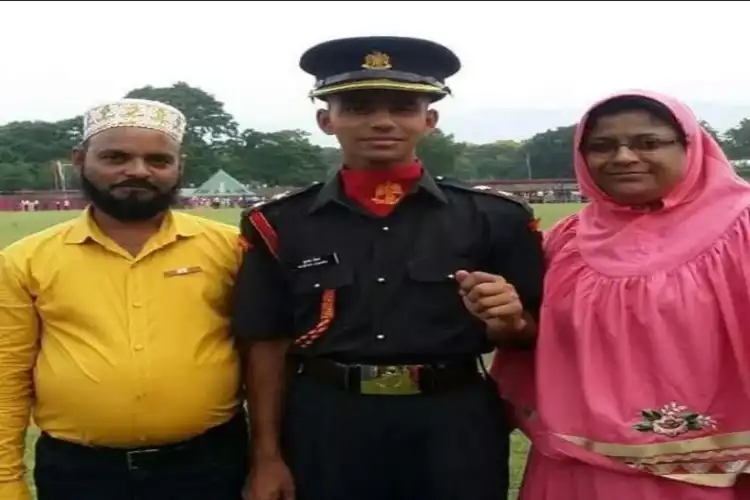
Martyr Mustafa Bohra with his parent at his passing out parade (Twitter)

Delhi:

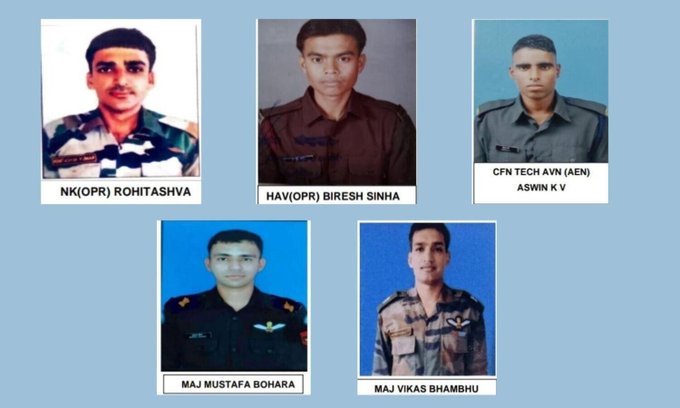
A pall of gloom has descended on the house of Major Mustafa Bohra, co-pilots of the Indian Army Helicopter Cheetah that crashed at Siang, close to Tawan on the China border in Arunachal Pradesh on Friday killing five people onboard.

People from all walks of life, leaders, and Army officials have been visiting the family of Major Bohra in Udaipur, Rajasthan.

Local media said Major Bohra is survived by his parents Fatima and Jallaludin Bohra, and sister Alfia Bohra.

His father works in Kuwait and was away when the sad news came, Both the women at home are inconsolable and mostly in an unconscious state.

Major Mustafa Bohra was the only son of his parents.

Martyrs of Arunachal Pradesh Helicopter crash (Indian Army Twitter)

When the last report was filed Jallaudin Bohra was trying to fly home to be with his family in this hour of grief.

Hitesh Kumar, a resident of Udaipur, who knew the Bohra family, and who spoke to local media said that Major Bohra’s mother and sister are in bad condition and in a state of deep shock.

The family hails from Kheroda village and currently lives in the street of Ajanta Hotel in Udaipur city.

Vallabhnagar MLA Preeti Shaktawat visited the family on Saturday and spent time with the women and their relatives.

Major Bohra completed his primary education at Uday Shiksha Mandir Higher Secondary School, Kheroda. Later the family shifted to Udaipur city and he joined St. Paul’s School. He joined the Indian Army after his higher secondary.

Major Bohra’s body is expected to reach by Sunday evening. Besides Bohra, Major Vikas Bhambhu, CFN Tech AVN (AEN) Ashwin KV, Havaldar (OPR) Biresh Sinha, and NK (PPR) Rohitashv Kumar also died in the accident.

The Advanced Light Helicopter (ALH) carrying five soldiers, including two pilots, was on a routine flight when it crashed at 10.43 am on Friday, October 21, near Miging, about 25 km south of Tuting.

Defense spokesman Lt Col AS Walia said the bodies of four other personnel were recovered from the crash site in the densely forested mountainous area, about 35 km from the Chinese border, on the evening of Friday, October 21.

source: http:/www.awazthevoice.in / Awaz The Voice / Home> India / by awazthevoice.in / October 23rd, 2022

Pir of Pagaro of Sindh sacrificed for India’s Freedom

SIND, BRITISH INDIA :

Pir Pagaro of Sindh
Pir Pagaro of Sindh

Indians and other historians have either tried to whitewash the revolutionary movements for freedom or presented these as disjointed localised efforts.

Even the largest movement of Azad Hind Fauj led by Netaji Subhas Chandra Bose has been narrated in a staggered manner and an episodial manner like the battle of Burma (Mayanmar) and the battle of Imphal. The picture thus presented is of an army fighting at a frontier with no support elsewhere. This history needs to be revisited.

In 1930, Sayyid Sibghatullah Shah Al-Rashidi called Pir of Pagaro, a Muslim Saint from Sindh with a huge following, was arrested by the British Government for ‘creating disturbances’. He was accused of instigating anti-colonial feelings among his followers known as ‘Hurs’ (literally meaning free). The decision to send him to a prison away from Sindh rather shaped this anti-colonial Muslim saint into a nationalist revolutionary. 

In the Bengal hail, he met several revolutionaries and realised that what he had experienced in his area was the same being experienced by others. He understood that British colonialism was destroying the nation and Hindu-Muslim unity was the only weapon to fight them.

From the prison, he started preaching nationalist messages. Sarah F. D. Ansari of the University of London in her book Sufi Saints and State Power: The Pirs of Sind, 1843 – 1947, writes, “messages strongly coloured with a radical nationalist tinge were smuggled out in the form of notes written in the margins and between the lines of books and magazines. They condemned the British for treating ‘Indians like donkeys’, loading them down with ‘England’s burdens’, and pointed out that the only reason why the British were able to rule over 300,000,000 people was that Indians were ‘cowards’.”

In 1936, when he returned to his seat at Khairpur in Sindh, Pir of Pagaro had turned a revolutionary.

He started establishing links with revolutionary leaders of Bengal as well as those living in Europe, especially Germany. He started inviting Congress leadership to his area and organise Hindu-Muslim unity meetings. We must keep in mind that it was 1938 and Subhas Chandra Bose was the President of Congress. Unsurprisingly when Subhas formed Forward Bloc after his famous differences with Mahatma Gandhi, Pir of Pagaro asked his followers to back Forward Bloc and denounced the stand of Congress. 

In 1939, the centuries-old Hindu-Muslim unity of Sindh was severely shattered over the Manzilgah mosque dispute and the riots that followed. Pir of Pagaro ordered his large following of armed followers known as ‘ghazis’ to save Hindus from the Muslim fanatics. Sarah F. D. Ansari writes, “In his newspaper, the Pir-jo-Goth Gazette, he (Pir of Pagaro) called for Hindu-Muslim unity: ‘My forefathers’, he wrote, ‘treated Hindus and Muslims alike as a sacred trust. The same is my principle . .. Allah is the same as Parmatma, though with different names. I will be happy when I see temples and mosques together with only a wall dividing them and everyone [worshipping] according to their rights so that no one may have a grievance against the other’. In a similar vein, he denounced the Hindu Sabha and the Muslim League as divisive communal movements. Only when Hindus and Muslims combined would ‘peace . . . be achieved and satanic deeds . . . stopped’: Indians had to be ‘national minded’ and regard India as a country which belonged to all its inhabitants.”

An intelligence report dated October 1940 says, “Pir of Bharchundi is not liked by the Pir Pagaro, who disrespected the Pir of Bharchundi and sent him away from his ‘Kot’ when the Pir of Bharchundi last visited the Pir Pagaro… the reason for such treatment of the Pir to the Pir of Bharchundi was that the Pir of Bharchundi would not assist in getting the murderers of Hindus arrested.” 

It further says, “Pir Pagaro has won great sympathy of the Hindus.” Sarah also points out how the Pir came out in support of a Muslim man’s right, who had earlier converted into Islam from Hinduism, to reconvert into Hinduism. “

Another intelligence report noted that Pir of Pagaro has enlisted at least 6,000 militants to fight with an oath to die for the cause. These militants were called ghazis. Ghazis had paraded and displayed their military skills in front of him during his visits to Jaisalmer and Jodhpur as well. The nationwide presence was a threat for the British. The report further noted, “the Pir was renewing his contacts with terrorists (terrorists was a term used by the English for revolutionaries) who had been in prison along with him in Bengal. His visits to Calcutta (Kolkata) were, it is said, performed for no other reason.”

The British apprehension was not wrong. Pir Pagaro had contacts with Bengali revolutionaries and Subhas. If Subhas raised an army on Eastern Front, Pir of Pagaro raised another on the Western Front. An intelligence report from 1941 noted, “He (Pir of Pagaro) has got his electric plant and radio set at which he and his followers hear Hindustani programs from Germany and then spread the German news in the villages which has a disquieting effect on the local people.” The report also pointed out that “the villainous activities of the Pir and his growing contempt of authority are becoming a byword throughout India”.

Pir of Pagaro was running an independent government in that region of Sindh with the help of his militia. The British Government arrested him in Karachi on the pretext of holding talks with him. His ghazis would not stop and kept attacking the British infrastructure. They were so much feared that the Legislative Assembly members did not want their names to become public for voting in favour of an act against Hurs (followers of Pir of Pagaro).

Sarah notes, “The level of fear which existed in Sind at the time even inside the Legislature was reflected in the session being held in camera. Members of the Assembly were not prepared to vote openly in favour of the act ‘lest they were marked down for the Pir’s future vengeance’.” The fear was not unfounded as soon after Ghazis killed the son of Hidayatullah, one of the tallest Sindh leaders in that Legislative Assembly, by derailing a train. 

It did not take much time and within weeks Martial Law was declared. The British had to open a war front at the time of World War II. Sarah writes, “The area north of Sanghar and the Thar desert (Rajasthan) were thoroughly reconnoitered from the air; paratroopers and bombs were used against bands of armed men. Hur villages were raided, wells stopped up and their cattle herded into other districts.” On the other hand, the Pir was being tortured to ask his followers to put down their weapons. 

Did the nationalists concede defeat? No. The Pir of Pagaro, Sibghatullah, embraced martyrdom at the gallows on 20 March 1943, after a sham of a court trial. Hurs kept fighting the British till 1946 even after their Pir was gone. 

source: http://www.awazthevoice.in / Awaz, The Voice / Home> Culture / by Saquib Alim / July 23rd, 2022

The Muslim Martyrs of Royal Indian Naval Mutiny of 1946

BRITISH INDIA :

After the Second World War, soldiers of the Azad Hind Fauj (Indian National Army) were captured by the British forces. They were charged with treason and tried by tribunals as war criminals. Indians protested against this treatment given to the freedom fighters of Azad Hind Fauj.

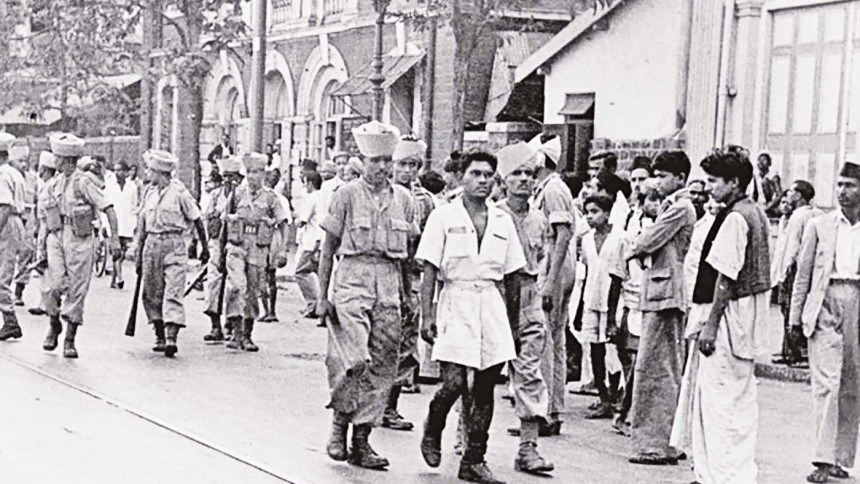
In February, 1945, soldiers and officers of the Royal Indian Navy mutinied in Mumbai and Karachi. English officials including the Viceroy took this mutiny as a sign of leaving India. The British forces killed many to quell the mutiny, many of which were Muslims.

Here, we are sharing names of the few Muslims we know, who attained martyrdom for taking part in the mutiny or supporting it.

Abdul, Ali, Din Mohammad: born 1929, took part in the popular demonstrations in support of the revolt by ratings of the Royal Indian Navy, received a bullet wound in firing by the police at Nagpada, Bombay, on 23 February 1946, died the same day.

Abdul Aziz: born 1921, domestic servant, hit by bullet in the premises of his employers as a result of firing by the police at Bombay on people demonstrating in support of the revolt by ratings of the Royal Indian Navy on 22 February 1946, died the same day.

Abdul Razak: born 1916, took part in the popular demonstrations in support of the revolt by ratings of the Royal Indian Navy, received a bullet wound on 22 February 1946 in firing by the police near Crawford market, Bombay, died on 24.2.46.

Abdul Rehman: born 1911, employee of private firm, hit by a bullet as a result of firing by the police at Doctor’s Street, Bombay, on people demonstrating in support of the revolt by rating of the Royal Indian Navy on 22 February 1946, died the same day.

Abdul Gani: born 1901, took part in the popular demonstrations in support of the revolt by ratings of the Royal Indian Navy, received a bullet wound in firing by police at Bombay on 22 February 1946, died the same day.

Abdul Karim: born 1926, took part in the popular demonstrations in support of the revolt by ratings of the Royal Indian Navy, received a bullet wound in firing by the police near Crawford Market, Bombay, on 22 February 1946, died the same day.

Abdul Sattar, Mohmmad Umar: born 1924, took part in the popular demonstrations in support of the revolt by ratings of the Royal Indian Navy, received a bullet wound in firing by the police on 22 February 1946 at Bombay, died the same day.

Abdulla, Abdul Kadar: born 1921, took part in the popular demonstrations in support of the revolt by ratings of the Royal Indian Navy, received a bullet wound in firing by the police at Bern- bay on 22 February 1946, died the same day.

Abdulla, Safi: born 1933, took part in the popular demonstrations in support of the revolt by ratings of the Royal Indian Navy, received a bullet wound on 22 February 1946 in firing by the police at Fort, Bombay, died in hospital the same day.

Adamji, Mohamed Hussain: born 1924, son of Allauddin Adamji, took part in the popular demonstrations in support of the revolt by ratings of the Royal Indian Navy, received a bullet wound on 22 February 1946, in firing by the police at Bombay, died in hospital.

Ali Mohammad: born 1906, hit by bullet in firing by the police at Dadar, Bombay, on people demonstrating in favour of the revolt by ratings of the RIN on 22 February 1946, died the same day.

Anwar Hossain: a student of Lahore College, hoisted the flags of revolt in the rating vessel Bahadur in Karachi, died with flags in hand on 23 February 1946.

Asgar Ismail: born 1934, received a bullet wound in firing by the police on people demonstrating in support of the revolt by ratings of the Hoyal Indian Navy on 23 February 1946, near the Paxsi Statue, at Byculla, Bombay, died on the spot.

Asghar Miya, Nawsati: born 1916, took part in the popular demonstrations in support of the revolt by ratings of the Royal Indian Navy, received a bullet wound in firing by the police near the J. J. Hospital, Bombay, on 23 February 1946, died in hospital.

Aziz, Chhotu: born 1921, took part in the popular demonstrations in support of the revolt by ratings of the Royal Indian Navy, received a bullet wound in firing by the police at Bombay on 23 February 1946, died in hospital the same day.

Dilawar, Abdul Malik: born 1931, son of Dilawar Muzawar, student, hit by bullet in firing by the police at Dongri, Bombay, on people demonstrating in support of the revolt by ratings of the Royal Indian Navy on 22 February 1946, died the same day.

Fida Ali, Kayam Ali: born 1933, received a bullet wound in firing by the police near J. J. Hospital, Bombay, on people demonstrating in favour of the revolt by ratings of the Royal Indian Navy on 23 February 1946, died the same day.

Gulam Hussain, Ali Mohammad: born 1906, took part in the popular demonstrations in support of the revolt by ratings of the Royal Indian Navy, received a bullet wound in firing by the police’ at Bombay on 22 February 1946, died the same day.

Haroon, Hamid: born 1931, took part in the popular demonstrations in support of the revolt by ratings of the Royal Indian Navy, received a bullet wound in firing by the police at Bombay, on 23 February 1946, died the same day.

Ibrahimji, Yusufali: born 1910, received a bullet wound in firing by the police at Bombay on people’s demonstrations in support of the revolt by ratings of the Royal Indian Navy on 22 February 1946, died the same day. 

Ismail Hussain: born 1932, hit by bullet as a result of firing by the police at Bombay on people demonstrating in support of the revolt by ratings of the Royal Indian Navy on 22 February 1946.

Ismail, Rahimtulla: bom 1911, took part in the popular demonstrations in support of the revolt by ratings of the Royal Indian Navy, received a bullet wound in firing by the police near the Imperial Bank, Abdul Rehman Street, Bombay, on 22 February 1946, died the same day.

Jamal Mohammed: born 1926, took part in the popular demonstrations in support of the revolt by ratings of the Royal Indian Navy, received a bullet wound in firing by the police at Bombay on 22 February 1946, died the same day.

Khuda Bakhsh, Pyare: born 1876, hit by bullet as a result of firing by the police at Bombay on people demonstrating in support of the revolt by ratings of the Royal Indian Navy on 23 February 1946, died the same day.

Manzoor Ahmed: born 1906, took part in the popular demonstrations in support of the revolt by ratings of the Royal Indian Navy, received a bullet wound; in firing by the police at Bombay on 22 February 1946, died in hospital the same day.

Mohammed, Aboobakar: born 1928, took part in the popular demonstrations in support of the revolt by ratings of the RIN, received a bullet wound in firing by the police near Crawford Market, Bombay on 22 February 1946, died in hospital the same day.

Mohammed Aziz: born 1911, took part in the popular demonstra- lions in support of the revolt by ratings of the Royal Indian Navy, received a bullet wound in firing by the police at Bombay on 22 February 1946, died in hospital the same day.

Mohammed Hussain: born 1931, son of Mulla Gulam Ali Abdul Hussain, took part in the popular demonstrations in support of the revolt by ratings of the Royal Indian Navy, received a bullet wound in firing by the police near J. J. Hospital, Bombay, on 22 February 1946, died the same day.

Mohammed Sheik, Sayed Hassan: born 1921, took part in the popular demonstrations in support of the revolt by ratings of the Royal Indian Navy, received a bullet wound in firing by the police near Null Bazar police station, Bombay, on 22 February 1946, died the same day.

Mohiddin, Sheik Ghulam: born 1928, took part in the popular demonstrations in support of the revolt by ratings of the Royal Indian Navy, received a bullet wound in firing by the police at Parel, Bombay, on 22 February 1916, died the same day.

Mohmed Samikh, Taja-Urkh: born 1920, hit by bullet as a result of firing by the police at Kamathipura, Bombay, on people’s demonstration in support of the revolt by ratings of the Royal Indian Navy on 23 February 1946, died the same day.

Moula Bakhsh, Abdul Aziz: born 1906, took part in the popular demonstrations in support of the revolt by ratings of the Royal Indian Navy, received a bullet wound in firing by the police at Kamathipura, Bombay, on 22 February 1946, died the same day.

Siddik Mohamed: born 1921, son of Isak Mohamed, took part in the popular demonstrations in support of the revolt by ratings of Royal Indian Navy, received a bullet wound in firing by the police at Kamathipura, Bombay, on 23 February 1946, died the same day.

Sulemanji, Zakiuddin: took part in the popular demonstrations in support of the revolt by ratings of the Royal Indian Navy, received a bullet wound in firing by the police at Bombay on 22 February 1946, died in the hospital the same day.

Taj Mohamed, Fazal Mohamed: born 1930, took part in the popular demonstrations in support of the revolt by ratings of the Royal Indian Navy, received a bullet wound in firing by the police near the Salvation Army office at Bombay, on 22 February 1946, died the same day.

Vazir, Mohamed: born 1891, took part in the popular demonstrations in favour of the revolt by ratings of the Royal Indian Navy, received a bullet wound in firing by the police near Hindmata Cinema, Bombay, on 22 February 1946, died the same day.

source: http://www.heritagetimes.in / Heritage Times / Home> Featured Posts> Freedom Movements / by Mahino Fatima / August 14th, 2021

J-K: One constable killed in Srinagar encounter

Kupwara, JAMMU & KASHMIR:

A constable Amir Hussain was killed in a brief encounter between police and militants in the Soura area of Srinagar on Tuesday, informed Vijay Kumar, Jammu and Kashmir IGP.

During the shootout, one militant  who belonged to the LeT group was also injured. “In a brief encounter one militant  and one jawan were injured. The jawan succumbed to injuries and attained martyrdom.

Soon we will neutralize all three militants , they belong to the LeT group,” Jammu and Kashmir IGP told media persons here. 

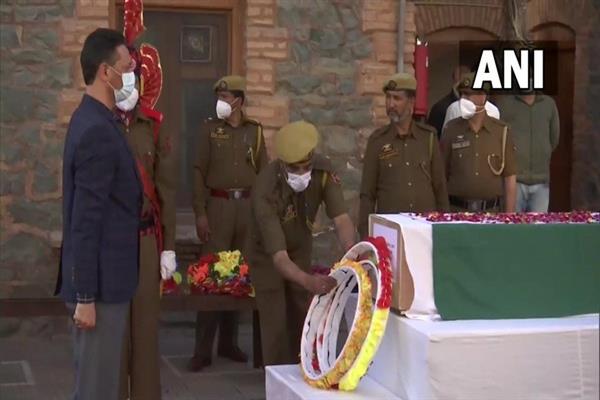
A wreath-laying ceremony of SgCT Amir Hussain was also held by the police personnel today. (ANI)

source: http://www.risingkashmir.com / Rising Kashmir / Home / by ANI / March 22nd, 2022