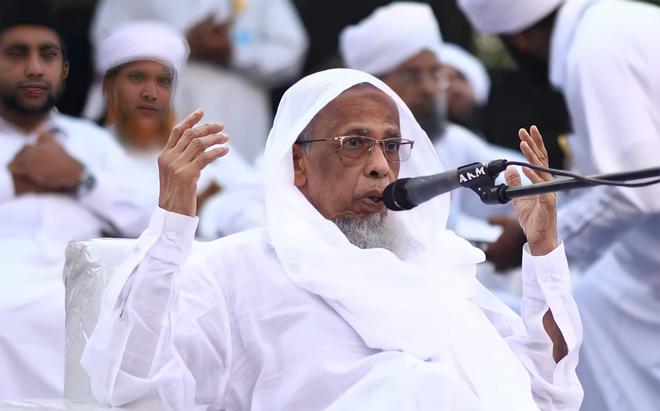
Grand Mufti Kanthapuram A P Aboobacker Muslyar with politician Ramesh Chennithala during the Kerala Yatra
New Delhi :
Kanthapuram A.P. Abubacker Musliyar, the Grand Mufti of Sunni Muslims of India, received the first Sree Narayana Guru Brotherhood Award, instituted by Swami Saswathikananda Cultural Centre, during the ongoing Kerala Yatra.
The 16-day Paamjam Insaniyat Kerala Yatra, is an ongoing state-wide campaign by the Kerala Muslim Jamaat to mark the centenary of the Sunni Jamiat Ulema.
The award was presented by SNDP Yogam former president Gokulam Gopalan, Yogam former board member Adv. S. Chandrasenan, and Saswathikananda Cultural Center director Adv. V.R. Anoop at the reception venue of Kerala Yatra at Kayamkulam.
— Sheikh Abubakr Ahmad الشيخ أبوبكر أحمد (@shkaboobacker) January 15, 2026
Advocate V. R. Anup is the director of Swami Saswatikananda Cultural Centre.
Addressing the ceremony, Gokulam Gopalan said that Sheikh Abubakar Ahmed is a leader who has promoted a specific development model. This model enables the empowerment of all communities and social progress. He said that Sheikh Abubakar Ahmed has rendered valuable services for the promotion of human values, brotherhood, peace and a prosperous society in the state.
CK Vidyasagar, Jury Chairman, said that Sheikh Abubakar Ahmed promoted fraternal coexistence with other communities in the light of the moral and jurisprudential principles of Islam.
He said that this role has strengthened Kerala’s tradition of social harmony.
Ramesh Chennithala posted images of Kerala Yatra by Jamaat on X:
Participated in the concluding ceremony of the Kerala Yatra led by the Indian Grand Mufti, the revered Kanthapuram A P Aboobacker Muslyar as part of the centenary celebrations of Samastha Kerala Jamyathul Ulama.
Advocate V. R. Anoop said that the lofty ideals of Sree Narayan Guru’s philosophy are prominent in various communities. He said that constructive social engagement can bring about a meaningful change in Kerala.
Sheikh Abubakar Ahmed regretted that the boundary between communal identity and sectarianism was rapidly weakening. He said that sectarianism arises when religion is used for political gain.
He added that receiving the award named after Sree Narayan Guru further strengthens his sense of responsibility.
source: http://www.awazthevoice.in / Awaz, The Voice / Home / by Aasha Khosa / January 17th, 2026
Muslim Mirror’s 100 Most Influential Muslims of 2025
New Delhi:
Muslim Mirror has released its much-anticipated annual list of the “100 Most Influential Indian Muslims of 2025,” spotlighting individuals who have made significant contributions to India’s public life across a wide spectrum of fields including politics, culture, education, business, media, religion, sports, and social service. Now in its second edition, the list aims to document influence not merely as power or popularity, but as sustained impact, leadership, and the ability to shape public discourse.
A defining feature of the 2025 edition is the growing prominence of younger achievers, signalling a visible generational shift within Indian Muslim leadership. Alongside established national figures, the list includes emerging voices who have built influence through grassroots activism, professional excellence, digital platforms, legal advocacy, education, and community engagement. Editors associated with the project said this was a deliberate attempt to recognise new centres of influence beyond traditional hierarchies.
The list reflects the diversity and plural character of Indian Muslim society, cutting across geography, ideology, profession, and language. From seasoned politicians and religious scholars to artists, entrepreneurs, academics, and social reformers, the compilation offers a broad snapshot of leadership trends at a time when issues of representation, constitutional values, and social justice remain central to national debate.
Representation Across Sectors
The 2025 list features several eminent academicians and intellectuals who have shaped higher education, policy discourse, and social research. Among them are Abul Qasim Nomani, Ameerullah Khan, Furqan Qamar, Shahid Jamil, and Ubaid-ur-Rahman, recognised for their contributions to education, public policy, and academic leadership.
In the business and entrepreneurship category, the list includes influential names such as Azad Moopan, Azim Hashim Premji, Farah Malik, Irfan Razack, M. P. Ahammed, Mecca Rafiq Ahmed, Meraj Manal, Syed Mohamed Beary, P. Mohammed Ali, Shahnaz Hussain, Tausif Ahmad Mirza, Yusuff Ali, and Ziaullah Sharif. Their inclusion underlines the growing economic footprint of Indian Muslim entrepreneurs, both domestically and globally, spanning sectors from retail and healthcare to infrastructure and consumer goods.
Community leadership remains a strong pillar of the list, with figures such as Arshad Madani, Mahmood Madani, Malik Motasim Khan, Mehmood Pracha, Syedna Mufaddal Saifuddin, Navaid Hamid, Pirzada Md Abbas Siddiqui, Qasim Rasool Ilyas, Sadatullah Husaini, Umer Ahmed Ilyasi, and Yusuf Mohamed Abrahani recognised for their roles in religious guidance, legal advocacy, social mobilisation, and institutional leadership.
Culture, Media, and Public Discourse
In arts and entertainment, globally recognised names such as A. R. Rahman, Aamir Khan, Mammootty, Munawar Faruqui, and Shah Rukh Khan continue to command immense cultural influence, shaping narratives that extend well beyond cinema and music into social consciousness.
The list also acknowledges the growing importance of media and journalism in shaping opinion and challenging dominant narratives. Journalists and commentators such as Arfa Khanam, Irfan Meraj, and Seema Mustafa are recognised for their consistent engagement with issues of democracy, minority rights, and constitutional values.
Religious and Intellectual Scholarship
A significant section of the list is devoted to Islamic scholars and religious thinkers, reflecting their continued influence on moral leadership and intellectual discourse. Names such as A. P. Aboobacker Musliyar, Qasim Nomani, Prof. Akhtarul Wase, Asghar Ali Imam Mahdi Salafi, Asjad Raza Khan, Ibraheem Khaleel Al-Bukhari, Javed Jamil, Khalid Saifullah Rahmani, Khaleelur Rahman Sajjad Nomani, Qamaruzzaman Azmi, Rashid Shaz, Shakir Ali Noori, Shamail Nadvi, and Yasoob Abbas find place for their scholarly work, writings, and public engagement.
Politics and Governance
The political category features leaders cutting across party lines and regions, including Asaduddin Owaisi, Ghulam Nabi Azad, Hamid Ansari, Mehbooba Mufti, Omar Abdullah, Salman Khurshid, Najeeb Jung, Syed Naseer Hussain, Engineer Rashid, Akhtarul Iman, Iqra Hasan, Zameer Ahmed Khan, Rakibul Hasan, K. Rahman Khan, Kadir Mohideen, Mohibullah Nadvi, Md Shafi, Agha Mahadi, Asim Waqar, and Sadiq Ali Shihab Thangal. Their inclusion reflects influence exercised through electoral politics, governance, diplomacy, and legislative advocacy.
Changemakers and Social Reformers
One of the most dynamic sections of the 2025 list is that of changemakers and social reformers, featuring individuals such as Safeena Husain, Shahabuddin Yaqoob Quraishi, Syeda Hameed, Zameer Uddin Shah, Mahbubul Hoque, Sabahat S. Azim, Mehmood Pracha, Faiz Syed, and Zahir Ishaq Kazi, among others. Many of these figures have earned recognition through long-term grassroots work rather than formal authority.
International Booker Prize 2025 winner Banu Mushtaq for Heart Lamp, along with renowned poet Wasim Barelvi, has been placed in the category of Literary Figures.
In sports, iconic names Sania Mirza and Irfan Pathan continue to inspire younger generations through excellence and public engagement beyond the playing field.
Beyond Rankings
The editors emphasised that the list does not claim to be exhaustive, nor does it measure influence solely through fame, wealth, or official position. Instead, it seeks to capture real-world impact, moral authority, intellectual contribution, and the ability to shape conversations within and outside the community.
The annual list has increasingly become a reference point for understanding evolving leadership patterns among Indian Muslims. By foregrounding both established figures and rising talents, the 2025 edition reflects continuity as well as change, underscoring how Indian Muslims continue to contribute meaningfully to India’s democratic, cultural, and social field.
source: http://www.muslimmirror.com / Muslim Mirror / Home> Indian Muslim / by Muslim Mirror / January 15th, 2026
Kerala Muslim Jamat president Kanthapuram A.P. Aboobacker Musliar (right) releasing the autobiography of Madin Academy chairman Syed Ibrahim Khaleel Bukhari (middle) by giving a copy to Yemeni scholar Habib Umar bin Hafiz at Markaz, Karanthoor, on Monday. | Photo Credit: SPECIAL ARRANGEMENT
Sunni spiritual leader and Madin Academy chairman Syed Ibrahim Khaleel Bukhari has published his autobiography, The life so far.
Releasing the book, Kerala Muslim Jamat president Kanthapuram A.P. Aboobacker Musliar said on Monday that the life story of Mr. Bukhari embodied a significant lesson on how an individual could transform crises into opportunities and turn despair into hope.
According to Mr. Kanthapuram, the experiences Mr. Bukhari gained through his extensive travels and intense trials would ultimately benefit society at large.
Renowned Islamic scholar Habib Umar bin Hafiz from Yemen received the first copy of the book.
Mr. Kanthapuram said that the story of Mr. Bukhari’s growth from Kadalundi coastal village to a respected Muslim leader was, in many ways, a reflection of the history and development of the Sunni movement he led.
“His [Mr. Bukhari’s] growth has been distinct from other Muslim leaders of Kerala. There are many things that set him apart from the rest,” said Mr. Kanthapuram, attributing his swift rise to prominence within the community to his ability to innovate and implement projects that benefitted marginalised groups.
Umar Mahmood Hussain Samrai from Baghdad, Sheikh Rahmatullah Tirmidhi from Tashkent, Sheikh Bilal Halakh from California, Sheikh Rilwan Ibrahim from Russia, Habib Jindal bin Noufal from Indonesia, Markaz director C. Mohammed Faizy, Haj Committee chairman Husain Saqafi Chullikkode, and Markaz Knowledge City managing director Abdul Hakeem Azhari were present.
source: http://www.thehindu.com / The Hindu / Home> News> India> Kerala / by The Hindu Bureau, Malappuram / February 18th, 2025
P.T. Kunhammu Musliar, popularly known as Kottur Ustad, leading the opening prayer at a function held to celebrate the 60th year of his teaching career at Kottur near Kottakkal on Monday. | Photo Credit: SAKEER HUSSAIN
Educational institution will be set up to mark 60th year of Kottur Ustad’s teaching career, says Kanthapuram
Veteran Islamic scholar P.T. Kunhammu Musliar, popularly known as Kottur Ustad, was felicitated at a function held to mark the 60 th year of his dars or teaching career at Kottur near Kottakkal on Monday.
His disciples from across the State, many of them veterans including leading fiqh (jurisprudence) scholar Ponmala Abdul Khadir Musliar, attended the function and prayed for their teacher whom they endearingly called Tajul Muhaqqiqin.
Sunni leader and Grand Mufti Kanthapuram A.P. Aboobacker Musliar led a special prayer for Samastha Kerala Jamiyyathul Ulama vice president Syed Hyderali Shihab Thangal, who died on Sunday.
Delivering the keynote address, Mr. Kanthapuram announced that an educational institution named Masalik Attariqa Al Muhammadiyya would be set up at Kottur to mark the 60 th year of Kottur Ustad’s dars.
Kanthapuram A.P. Mohammed Musliar, head of the Department of Fiqh at Markaz Sharia College, inaugurated the function. Samastha Kerala Jamiyyathul Ulama (AP group) president E. Sulaiman Musliar presided over the function. Fiqh scholar Ponmala Abdul Khadir Musliar, Haj Committee chairman C. Mohammed Faizi, and Kerala State Sunni Students Federation general secretary Nizamuddin Faizi spoke.
E. Sulaiman Musliar and Markaz president Syed Ali Bafaqi were also felicitated at the function.
Kottur Ustad, who has been a member of the Samastha Mushawara, the highest body of Islamic scholars, since 1989, led the opening prayer. He is estimated to have more than 20,000 students spread across the country.
He won the Imam Bukhari Award given by the Bukhari Institutions, Kondotty, in 2019. In 2018, he won Madin Academy’s Syed Ahmed Al Bukhari Award for his contributions to the Arabic language. He was the winner of the Imam Gazzali Award instituted by the Darul Ma’arif, Kodampuzha, in 2010.
source: http://www.thehindu.com / The Hindu / Home> News> National> Kerala / by Staff Reporter / Malappuram – March 09th, 2022
Kanthapuram says most of Waqf properties in Kerala belonged to Sunnis, and most of them were donated to Waqf with the purpose of conducting prayers for the dead and for ‘dars’ in mosques
Kerala Muslim Jamaat (KMJ) president Kanthapuram A.P. Aboobacker Musliyar has demanded that the government initiate a move to salvage the dispossessed Waqf properties in the State.
“As per the Waqf rules, a Waqf property can be used or managed only as per the will of the person who has bequeathed the property for Waqf. Many dispossessions and encroachments have taken place in violation of the Waqf rules,” said Mr. Kanthapuram, who also holds the title of the Grand Mufti of India.
He was inaugurating a State-level campaign by the Jamaat called ‘Vigil is the Strength’ in Thiruvananthapuram on Tuesday.
Mr. Kanthapuram said that most of the Waqf properties in the State belonged to Sunnis, and most of them were donated to Waqf with the purpose of conducting prayers for the dead and for ‘dars’ in mosques.
“Many such properties are now being used against their donors’ will. Many mosques and Waqf properties have been appropriated and encroached upon,” he said.
Pressure exerted
Although Sunnis used to bring the matter to the attention of the authorities, those in the Waqf Board were found to have been exerting pressure on the authorities to take biased decisions, he said, adding that “this cannot be allowed any longer.”
The Waqf Board and its ancillary systems should help retrieve the lost Waqf properties in the State, he said. “At the same time, the board should carry out programmes meant for the development of the Muslim community in the State,” he added.
Senior KMJ functionary Sayyid Thwaha Thangal presided over the function. Minister for Road Transport Antony Raju delivered the keynote address. N. Ali Abdullah presented the subject. Congress leader K.S. Sabarinathan, KMJ secretary A. Saifuddin Haji, Rahmatullah Saqafi, P.A. Mohammed Kunhu Saqafi and Devarshola Abdussalam Musliyar spoke.
source: http://www.thehindu.com / The Hindu / Home> News> States> Kerala / by Staff Reporter / Malappuram – December 15th, 2021
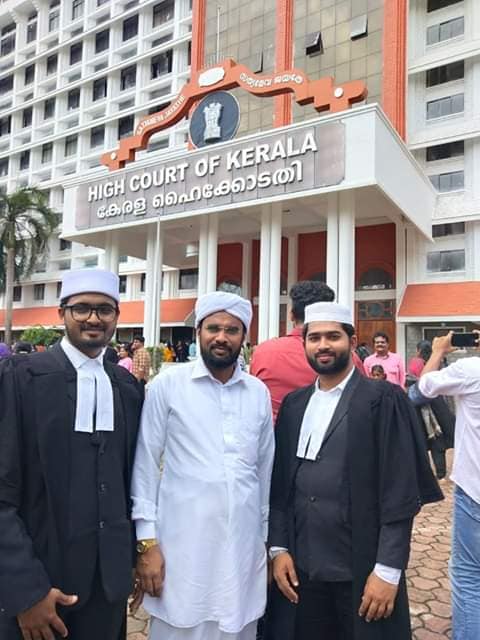
Jamia Markaz at Karanthur in Kozhikode is on a roll as the first batch of 20 Muslim religious scholars from Markaz Law College turned lawyers. Thanks to the mission of Kanthapuram A P Aboobacker Musliyar alias Sheik Abubakr Ahmad, the founder and chancellor of Jamia Markaz in ensuring students overall growth– Intellectual, Spiritual and Social.
And rightly the Governor of Kerala Arif Mohammed Khan during an event at Jamia Markaz a week ago had eulogised the services of Aboobacker Musliyar by saying– Kerala Muslims are blessed as they have visionary religious leadership. Not just imparting education, the Markaz hones the skills of students in different spheres thereby making them face the challenges in life after their course.
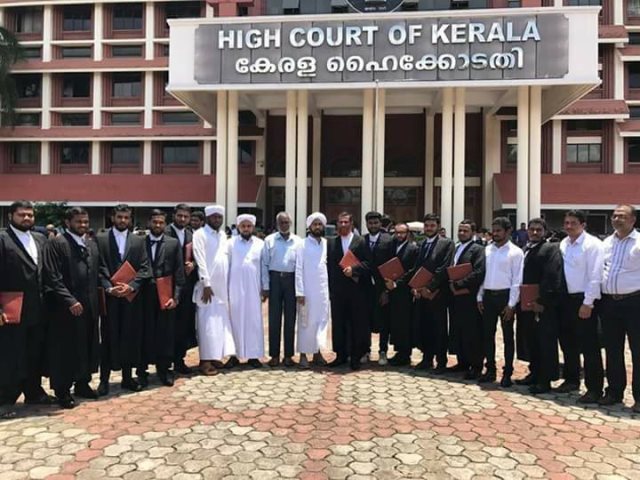
Joy knew no bounds for the Musliyars turned lawyers clad in black pants and white shirts with the advocate gowns after they got enrolled at the Kerala State Bar Council in Kochi. Interestingly, the enrolment event was like a festival with family members, college management and scores of friends and relatives accompanying them. Markaz Law College is the first project launched under the Knowledge City of Markazu Saquafathi Sunniyya which is affiliated to the University of Calicut and is recognised by the Bar Council of India. The law college started in October 2014 at the markaz campus offers three year LLB course.
Notably, the religious scholars after completing their post-graduation in Islamic theology took up law course. Quite interestingly, fifty year-old Dr Hussain Saquafi C S,the vice chancellor of Jamia Markaz was one among the first batch of students to get enrolled as advocate at the bar council in Kochi. Enthusiam was writ large on the face of newly enrolled advocates, who are all set to begin their legal practice. Meanwhile, a few are preparing for governemnt postings as munsif cum magistrate while a major chunk of them are keen to specialise in criminology, human rights, corporate law and constitutional law.
Jamia Markaz (Islamic University) was established in 1978 in a sprawling campus at Karanthur in Kozhikode grew from strength to strength to emerge as a centre of social, cultural progress as well as educational excellence for the entire communities across the country as a whole Muslims in particular. Sheikh Abubakr Ahmad is the grand Mufti of India, who is also the General Secretary of the All India Sunni Jamiyyathul Ulama besides Chancellor of the Jamia Markaz and Chairman of the Siraj Daily and President of Islamic Educational Board of India.
source: http://www.muslimmirror.com / Muslim Mirror / Home> Education> Indian Muslim / by M Rafi Ahmed, Muslim Mirror / November 01st, 2019
Markazu Saqafathi Sunniyya (Sunni Cultural Centre) led by Kanthapuram A P Aboobacker Musaliyar has decided to adopt 100 villages in the country as part of the 41st anniversary of the institution.
Dr Wael Albattrekhi, deputy head of Palestine embassy in India, inaugurated the programme held at Markaz on Wednesday. He stated that Markaz’s activities have been incredible as the institution carefully engages the marginalised communities in the country.
Kanthapuram handed over a cheque of Rs 1.5 crore to orphans at the function. In his address, the Sunni leader said Markaz had spread its activities to 22 states decades before to improve the living conditions of poor people. Now, Markaz has extended its activities by adopting 100 villages as part of as part of the mission’s focus on educational and humanitarian activities, he said.
Sayyid Zainul Abideen Bafakhi Thangal launched ‘One Million Notebooks’ project and Chennai district judge Zakkir Hussain inaugurated the smart village project during the occasion. C Muhammed Faizy, the general manager of Markaz, delivered the keynote address.
Besides providing food and shelter to the residents, Markaz will impart education and training in the 100 villages with the intention of changing the status of villages. Markaz also will supply one million notebooks and other educational equipment to underprivileged students. As part of Markaz Orphan Care Project, 5000 orphans are being given financial aid.
source: http://www.timesofindia.indiatimes.com / The Times of India / Home> News> City News> Kozhikode News / TNN / April 19th, 2018