Tag Archives: Kerala Muslims

Kerala schoolboy’s bravery brings three back from the brink of death

Mankada Village (Malappuram District), KERALA :
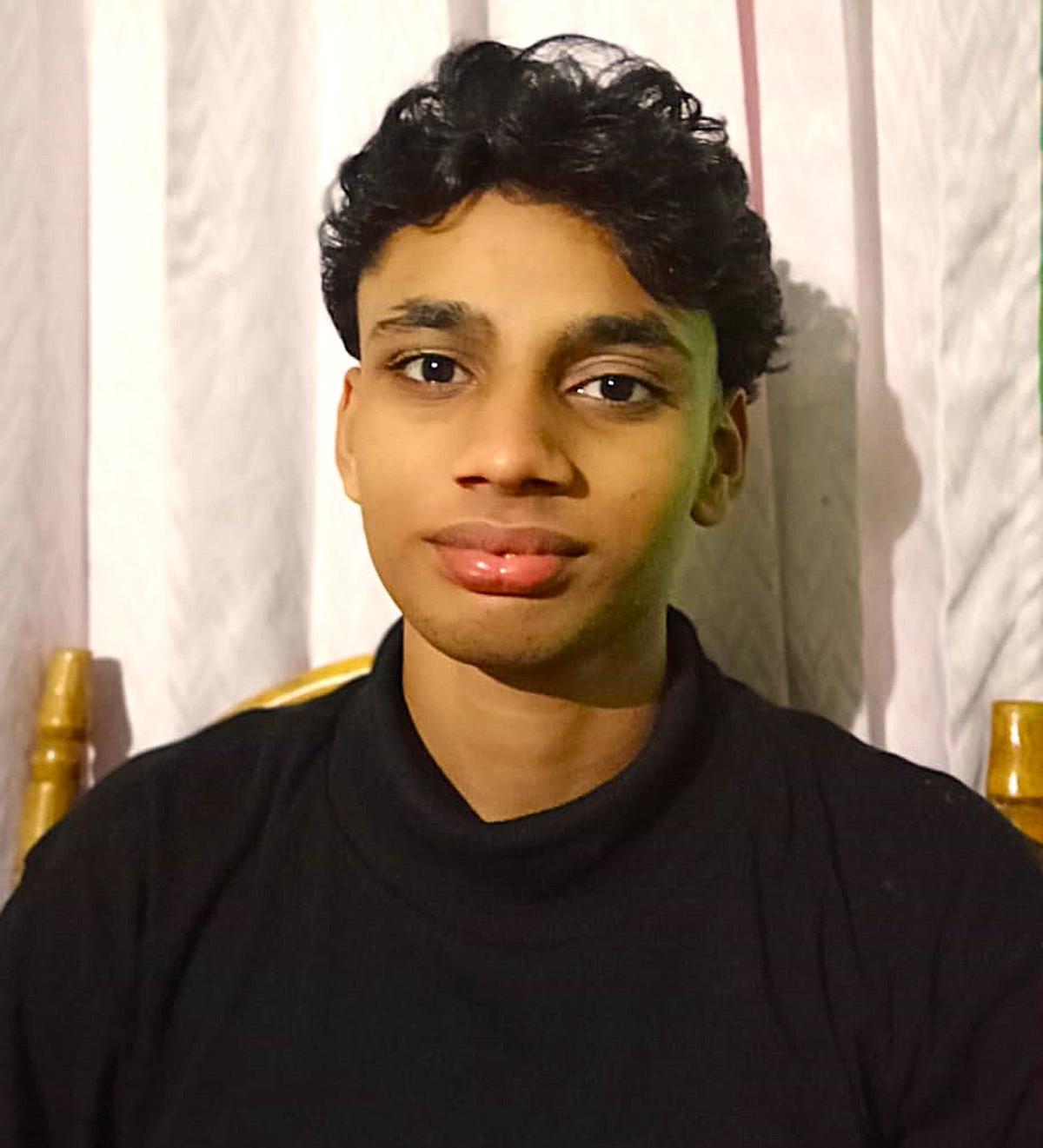
Mohammed Shamil C

That Sunday afternoon still lingers in Mohammed Shamil’s mind: the loud cries for help and the rush to save lives. Without hesitation, he dived into a murky village pond and brought three girls back to life from the brink.

One of them needed CPR, and he gave her the breath of life with the little knowledge he learned from school. Now, Shamil is hailed as a hero and showered with felicitations, trophies and mementoes – more than three dozen in less than two weeks.

Schools and clubs invite him to share his story, inspiring others to act in moments of crisis. For the Class 12 boy, it is about saving lives and not seeking praise.
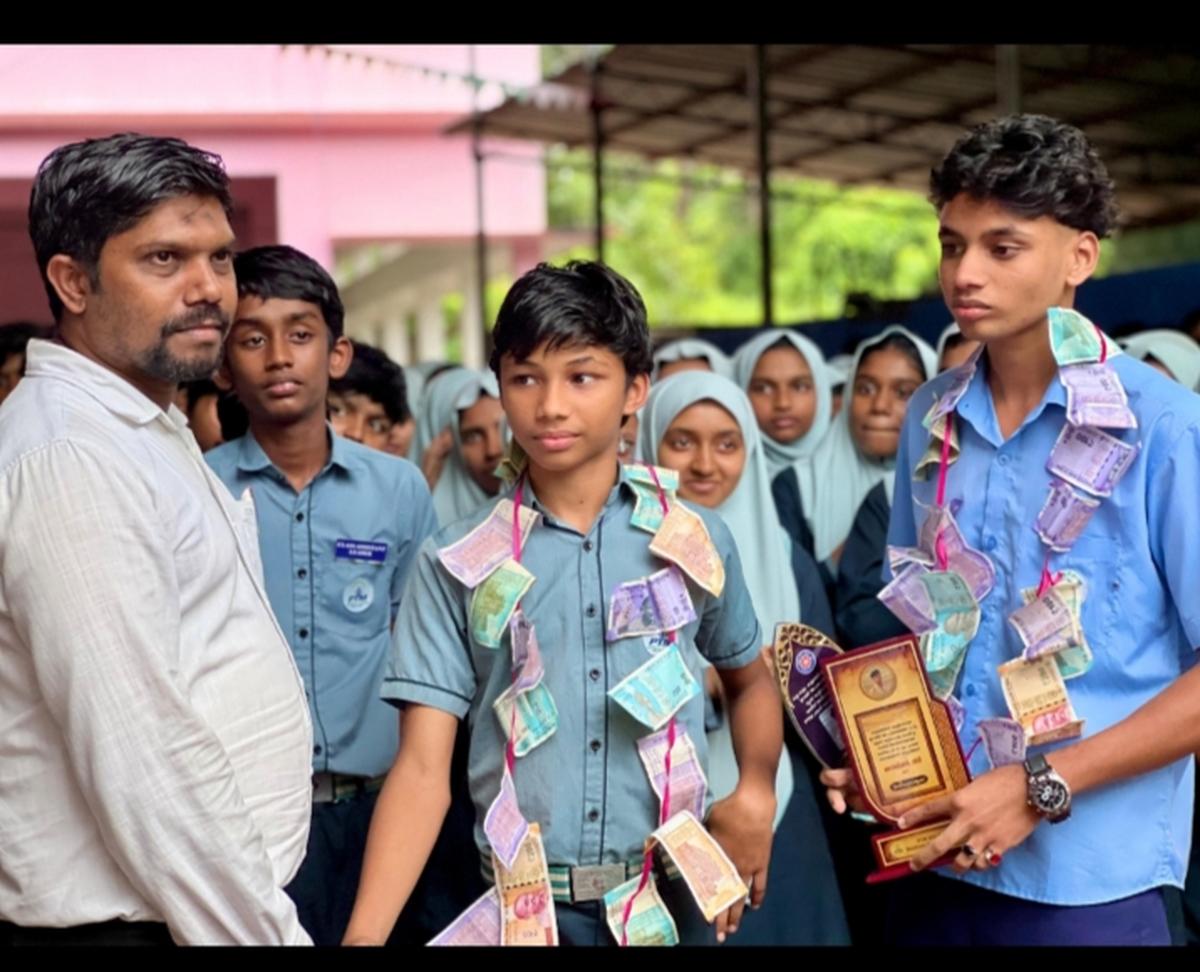
Mohammed Shamil (right) and his younger brother Mohammed Shehin being felicitated with currency garlands at their school. | Photo Credit: SAKEER HUSSAIN

On July 13, around 2 p.m., Shamil’s peaceful afternoon at his Puthanveedu home at Mankada near Manjeri was disrupted. His mother Shahida had just received a distressing alert from ASHA worker Hafsath Palliyalthodi that three girls were drowning in a nearby pond.

Shahida’s frantic cry propelled Shamil into action. He sprinted 200 meters to the pond and plunged into the muddy waters, where two girls were desperately struggling to stay afloat while the third had already slipped underwater.
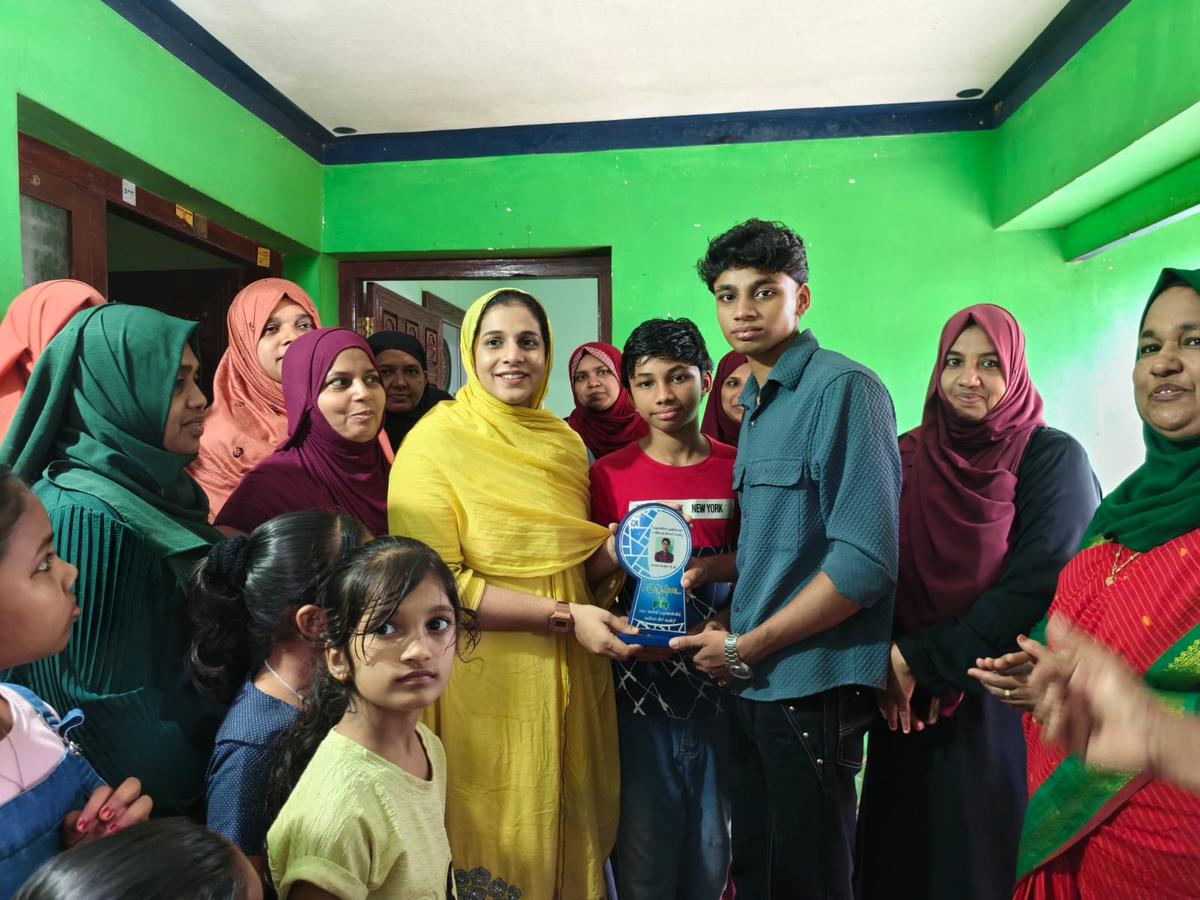
Muslim Youth League national secretary Najma Thabsheera felicitating Mohammed Shamil. | Photo Credit: SAKEER HUSSAIN

With careful precision, Shamil rescued the two girls. He was mindful of not putting himself in danger. “When one girl raised her hand, I did not grab it,” he said. “Instead, I caught her dress from behind and pulled her to safety.”

Just as Shamil thought it was over, the rescued girls broke down in tears, revealing that one more person was still submerged underwater. “That moment sent shivers down my spine,” Shamil recalled. “Initially, I was unsure what to do, but I took a few deep breaths and dived multiple times in a desperate attempt to rescue the last one.”

Fire and Rescue Services officers felicitating Mohammed Shamil. | Photo Credit: SAKEER HUSSAIN

The pond was over two meters deep, with murky water, making it difficult to locate the missing girl. As more people arrived, Shamil dove in three times before finally pulling out the 12-year-old girl with the help of his younger brother, Mohammed Shehin, who is a class 8 student.

She was not breathing, and her face was pale. Shamil used his school biology knowledge to do chest compressions. When she showed signs of life, he gave her mouth-to-mouth resuscitation. Within minutes, she started breathing again. The girl was then rushed to the hospital.

Shamil’s parents, Shahina and Ashraf, beamed with pride as they looked at the table filled with trophies and mementoes. The recognition came from all corners – the Fire and Rescue Services, local clubs, the MLA, the district, block, and grama panchayats.

Shamil, once just a student, has become a symbol of hope and bravery for the people of Mankada. “I just did what needed to be done,” he humbly said.

source: htttp://www.thehindu.com / The Hindu / Home> News> India> Kerala / by Abdul Latheef Naha / July 25th, 2025

Muslim Man Keeps Century Old Jewish Store Alive in Kochi

Kochi, KERALA :

Kochi:

A video by American author Aija Mayrock has drawn global attention to a small embroidery shop in Jew Town, Mattancherry. The store stands as one of the last working links to the once thriving Cochin Jewish community of Kerala.

The shop belonged to Sarah Cohen, born in 1925. She was among the last Jews who lived permanently in Jew Town. Her store sold hand embroidery and souvenirs and became a known landmark in the area. After large scale emigration in the mid twentieth century, many Jewish homes and businesses shut down. This shop stayed open.

Thaha Ibrahim, a Muslim man, now runs the store. As a child, he sold goods on the street near Cohen’s shop. She later hired him and taught him embroidery and shop management. He assisted her for decades, handling customers, production, and daily operations.

Before her death in 2019, Cohen asked Ibrahim to continue the shop and preserve its character. He agreed. Today, the store functions under the same name and layout. It closes on Saturdays in respect of the Jewish Sabbath. Candles are lit on Friday evenings. Cohen’s photographs and belongings remain displayed inside.

Ibrahim has stated he remains Muslim. He sees his role as protecting the legacy entrusted to him.

Historians note that Jews lived in Kerala for over two thousand years. Although the community declined sharply after 1948, synagogues and heritage sites in Kochi still reflect that history. This small embroidery shop now stands as a living record of shared trust and continuity.

source: http://www.radiancenews.com / Radiance News / Home> Latest News> Report / by Radiance News Bureau / February 21st, 2026

Visiting Lord Ayyappa’s Muslim friend Vavar during the Sabrimala pilgrimage

Sabarimala (Pathanamthitta District), KERALA :

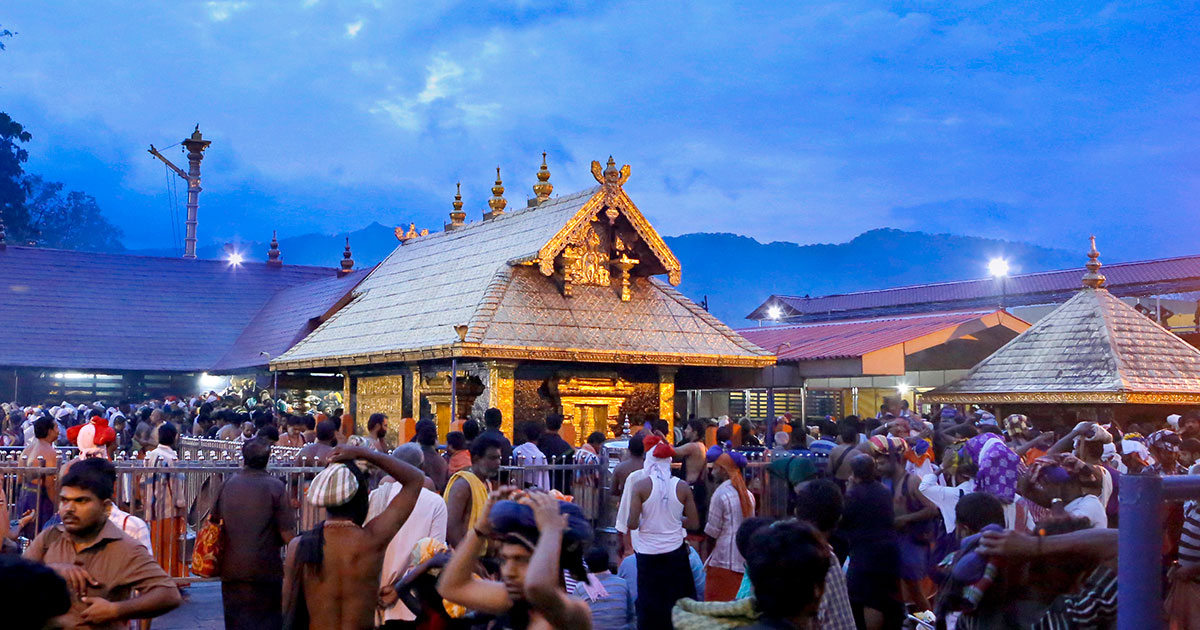
Pilgrims on way to Ayyappa shrine in Sabrimala at Vavar mosque, Erumeli, Kerala

I had waited to go to Sabarimala, a hilltop shrine dedicated to Lord Ayyappa in Kerala’s Pathanamthitta district, for a long time. Lord Ayyappa, the deity of truth and righteousness, is described as the son of Shiva and Mohini (the female avatar of Vishnu). He was said to have been adopted by the local king of Pandalam.

Ungorgettable Experiences

As a youngman, Ayyappa abdicated the crown and renounced the palace to vanish into the forests of Sabarimala to live a celibate and ascetic life. It’s in deference to Ayyapa’s celibacy that women are not allowed there till they turn 55.

After a 41-day mandatory fast, I joined my sister and her husband for the pilgrimage. The pilgrims wear black clothes and carry a bundle containing a couple of coconuts filled with ghee and other offerings for the deity.

We carried the bundle on our heads at the start of the four-kilometre uphill trek. We were not supposed to remove it before reaching the shrine.

At the crack of dawn, after breaking coconuts at the local shrine to ward off all obstacles, we left for the shrine.I was thrilled at the thought of visiting some of my favourite temples and shrines on the route, some of which I had only heard of but never visited.

Lord Ayyapa temple at Sabrimala

Holding our heavy bundles (kettu) on our heads, we stopped at Chottanikakara, Vaikom, and Ettumanoor shrines.

Soon we were at Erumeli. According to legend, Ayyappa defeated the demoness Mahishi (sister of Mahishasura) here. The name Erumeli is comes from Eruma-kolli—“the place where the buffalo-demon was slain.”

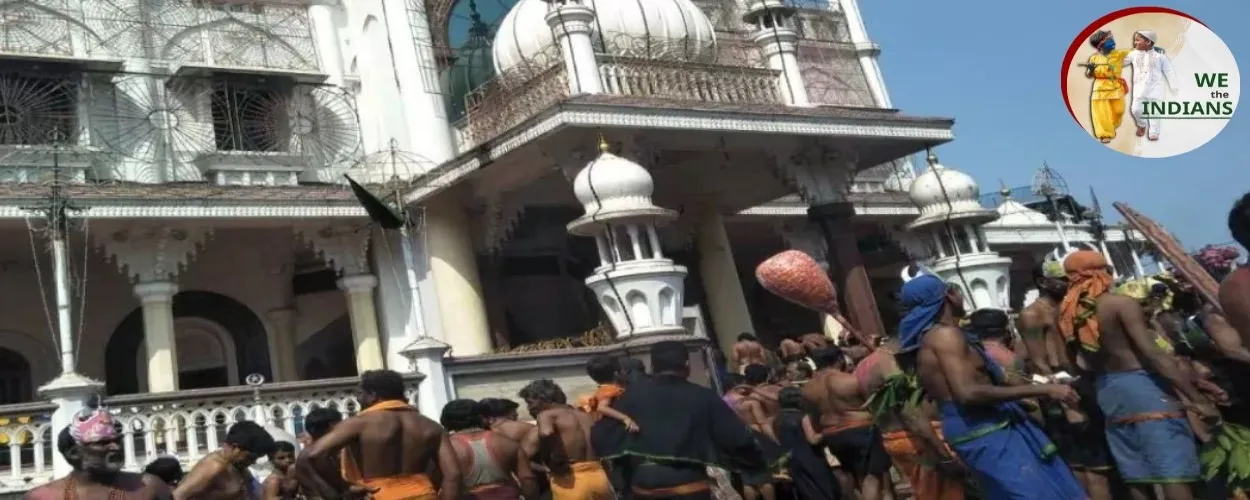
At Erumeli, the road streamed with pilgrims, mostly men and children, all clad in black. They had bright colours smeared on their faces, held colourful feather arrows, and danced to drum beats as part of a ceremonial dance called Petta thullal to mark the victory of the warrior Ayyappa over enemies and bandits. 

We too swayed lightly, trying to shake off our inhibition-clad egos.   

Holding arrows, wild leaves, and smeared in bright colours, we walked towards a temple there dedicated to a deity called Shastha. Shastha is an ancient protective warrior deity worshipped in Kerala even before the incarnation of Ayyappa. Ayyappa is considered a modern avatar of Sastha and is now almost synonymous with Sastha.

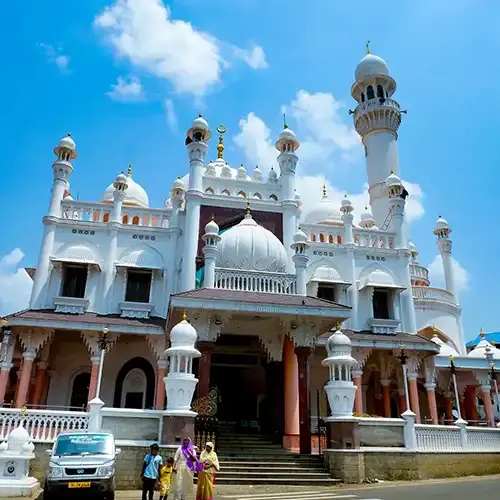
Vavar Juma Mosque, Erumeli

As we walked towards the temple, I was surprised. Were we at the threshold of a temple or a mosque? I saw taps for the ritual cleansing ceremony (wuzu) and a handful of Muslims saying namaz through the glass windows. It was a mosque.

We lined up respectfully outside the mosque. It was Vavar Palli (Vavar mosque), my brother-in-law explained. 

Vavar was a close associate of Ayyappa. Their friendship is celebrated in folklore and devotional movies. Vavar was a Muslim, and thus the story gets significant.

“Vavar Swami may have worshipped at the mosque. That is why he is associated with the mosque,” Nasruddin Musaliyar, who traces his lineage from Vavar, explained to me when I spoke to him a few days later.

I felt pure joy at seeing Hindus offering respect outside a mosque and making offerings before worshipping the Shastha temple. After breaking a coconut at the Shastha temple, we began our long trek towards the Ayyappa shrine on Sabarimala.

It took us four or five hours, followed by a long five-hour wait in the crowd. Anyway, we had darshan in the morning. When we came out of the temple, another surprise awaited.

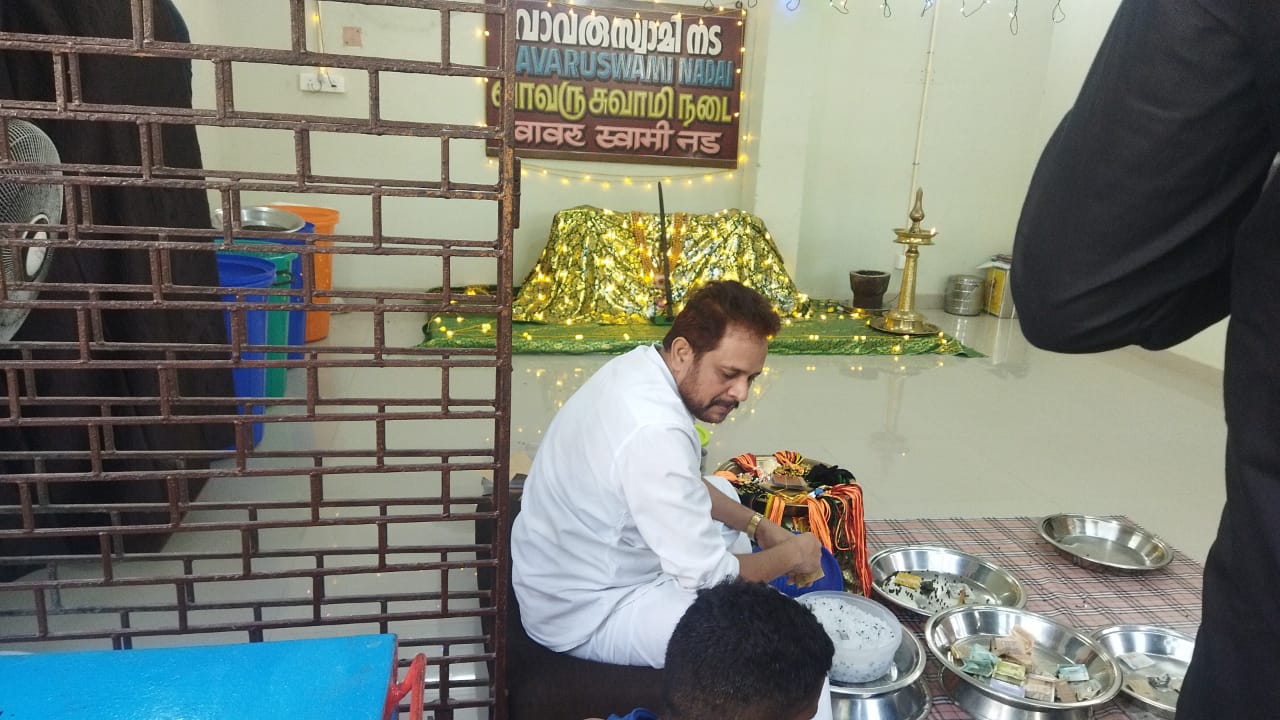
The shrine dedicated to Vavar Swamy

I found myself standing outside a small shrine just outside the Ayyappa temple. It was like a dargah, but I was told that it was called Vavarpadi, or the threshold of Vavar, a memorial to Ayyappa’s friend.

Pilgrims stopped to offer prayers and accept prasad of sugar candy and pepper. The man giving the prasadam said he was a descendant of Vavar and managed his tomb. He gave me his father’s number and asked me to speak to him for details about the shrine.

Nasruddin Musaliyar said that Vavar was part of a group of Arab settlers who were close to Lord Ayyappa.”This shows that the highest authority at that time accepted Vavar despite his different faith or origin,” Musaliyar said.

“Vavar Swami’s tomb and a mosque at Erumeli, where Vavar is said to have prayed, just cry out loud to us today that two faiths can co-exist and respect each other. All religions believe that there is one God. And that almighty wants to tell us that Hindus, Christians, and Muslims can co-exist in harmony,” he added.

Emotions well up as Mursliyar says that neither Ayyappa nor Vavar had asked anyone to build shrines and pray to them. These shrines represent the principle that they did not see any difference between man and man.

Author (left) with her sister and brother-in-law on the way to Sabrimala

Shrines and differences are man-made. “The Muslims don’t worship at Vavars shrine as they believe only in Allah,” he said.

There is no evidence that Vavar was buried there, though the royal records claim so. This shrine is symbolic, he says.

Ayyappa is believed to have renounced the throne, family, and palace to live as an ascetic in Sabarimala’s forests and merged with Sastha. He loved and honoured Vavar, expecting his devotees to do the same. In these times of religious tensions, such traditions continue thanks to a deity who rejected differences of caste and religion and loved everyone as human beings.

After darshan at Sabarimala, pilgrims feel lightheaded as they have all offered their heavy burdens at the shrine.

Perhaps they have removed something else also besides the kettu —the thought of differences itself.

They go as Hindus to worship a Hindu god but return feeling more than just a Hindu…a more complete human being, who embraces all differences.

source: http://www.awazthevoice.in / Awaz, The Voice / Home> Stories / by Sreelatha Menon / December 29th, 2025

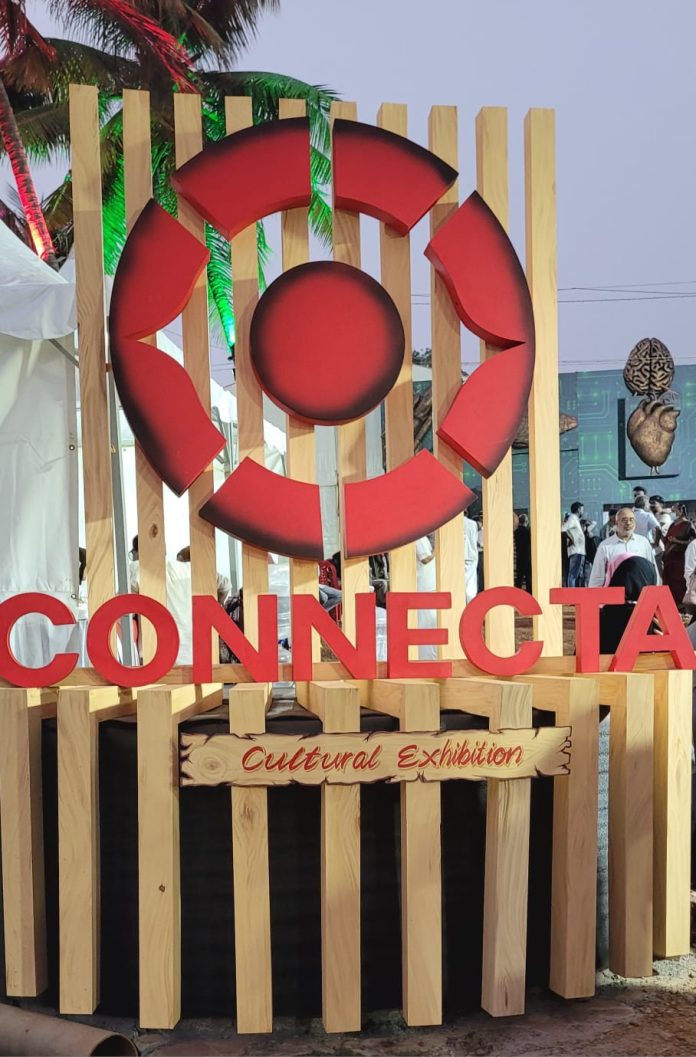
CONNECTA Cultural Exhibition: Reclaiming Human Bonds in an Age of Separation

Kannur, KERALA :

Kannur:

On a January evening, the busy town square of Kannur changed in a big way.  Usually, the square is crowded with people rushing about their daily work. But on this day, it became a calm and welcoming space. People slowed down, reflected, and spoke with one another. They discussed daily habits, shared ideas, learned about different cultures, and understood what others believe in.

This transformation happened because the CONNECTA Cultural Exhibition was inaugurated. The event was organised by the Dialogue Centre Kerala.

A Call to Kindness and Togetherness

The inauguration was not a routine ceremony. It was a strong message inviting people to show kindness and build unity. CONNECTA reminded everyone that all human beings are connected in many ways. This message is especially important today, when people often focus more on differences than shared values.

CONNECTA highlighted common issues, lifestyles, and moral values that unite people, regardless of faith, culture, or background.

CONNECTA is built on three key ideas: Faith, Culture, and Dialogue. These elements can help heal divisions in society. The organisers carefully selected displays that encouraged visitors to reflect and engage in meaningful conversations. Alongside this, the exhibition included many cultural activities that brought people together.

Every display in CONNECTA carried a clear message: faith and culture should unite people, not separate them. The exhibition emphasised that belief systems and traditions are meant to build understanding and harmony.

We live in a world where disagreements are common and often lead to conflict. CONNECTA offers a hopeful vision. It encourages people to recognise differences, respect them, and even celebrate them. According to CONNECTA, diversity is not a weakness; it is what makes us truly human and is something to value.

Message from Ms. A. Rahmathunnissa

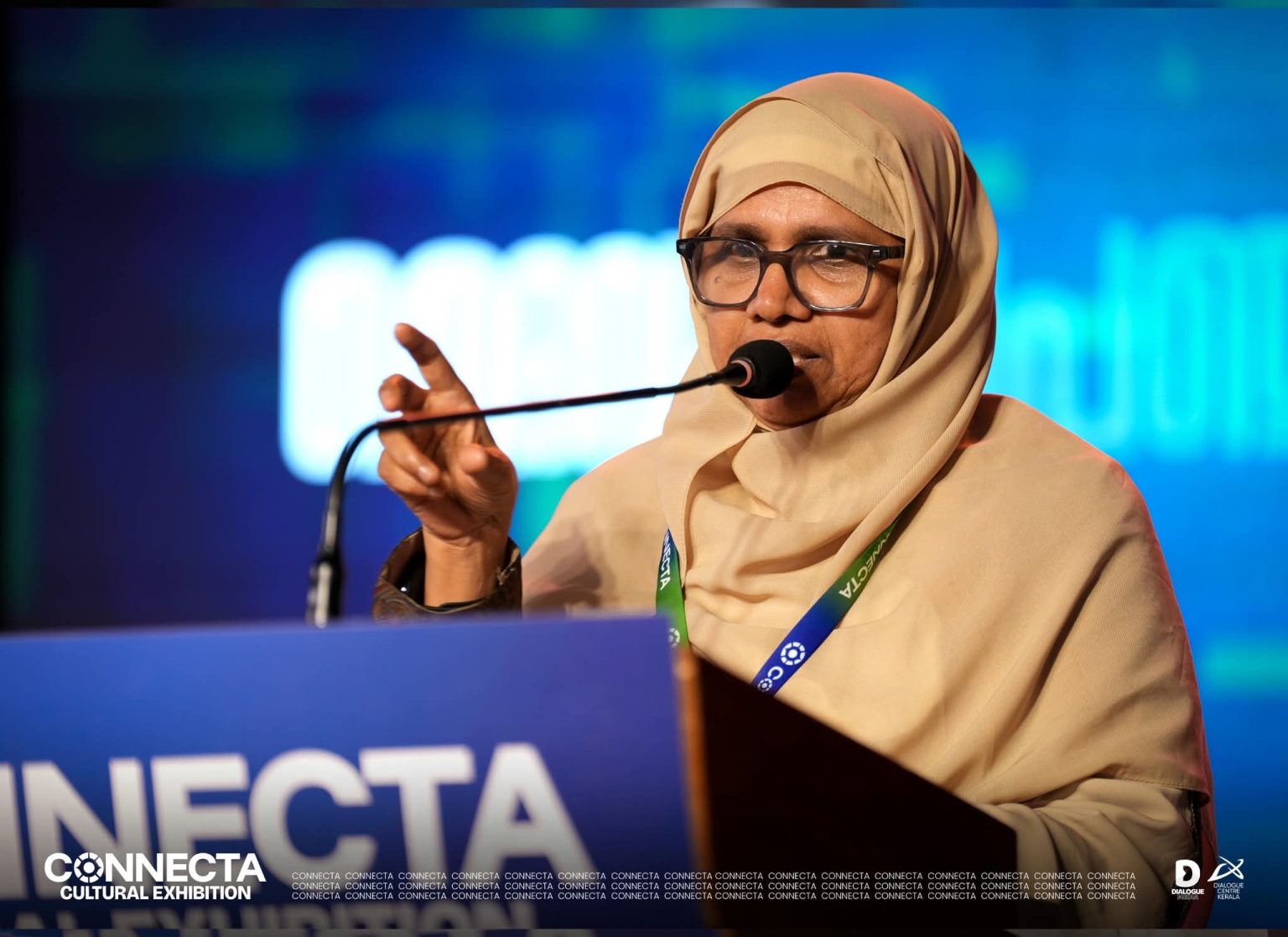
Ms. A. Rahmathunnissa, National Secretary of Jamaat-e-Islami Hind and Executive Member of All India Muslim Personal Law Board, addressed the gathering. She spoke about the deep importance of the exhibition’s theme and thanked everyone who worked together to make CONNECTA possible.

She began by highlighting the disturbing patterns that exist in today’s society. She noted that messages of disconnection, isolation, and separation are being heard again and again, shaping attitudes in ways that lead people to demonise one another, push others to the margins, and cut themselves off from the collective. In such a context, the call to connect people becomes not just relevant, but essential. Rebuilding bonds, restoring trust, and bringing people together is the urgent need of our time.

She pointed out that people today are growing increasingly distant from one another. In such times, exhibitions like CONNECTA are deeply needed, as they help rebuild human connections and strengthen relationships. CONNECTA, she said, reminds us to care for one another and to restore lost bonds.

CONNECTA as a Way of Life

Ms. Rahmathunnissa explained that CONNECTA represents a way of living. It encourages personal responsibility, peaceful coexistence, and moral awareness. CONNECTA serves as a guide for ethical and spiritual living, teaching people how to act with integrity and live in harmony with others.

She described CONNECTA as a path rooted in responsibility, social balance, and moral consciousness – principles that can help people lead meaningful lives.

Ms. Rahmathunnissa expanded CONNECTA as an acronym and explained its meaning as

C – Contemplate the signs of God in the universe

She encouraged people to reflect on nature, culture, and humanity. The variety we see in the world is a sign of God’s wisdom. Diversity is not accidental; it is part of the Creator’s design. Differences in creation reflect God’s intention and should be appreciated.

O – Open hearts to compassion and empathy

True faith, she said, softens the heart. It helps people feel compassion for others. Compassion allows us to see others not as strangers, but as fellow travellers sharing the same journey of life.

N – Nurture relationships with all creatures

Human beings have a duty to care for everyone, not just those close to them. Every person, animal, and living being deserves kindness and respect. Caring for the Earth and its creatures is a core human responsibility.

N – Navigate the path of balance and harmony

Extremes can damage communities. Balance creates unity. Harmony grows when justice, mercy, and wisdom work together. This balance strengthens society and brings people closer.

E – Embrace the interconnectedness of all things

No one lives in isolation. Each person’s life is linked to others. Communities thrive because of these connections, even when we are not always aware of them.

C – Cultivate gratitude and mindfulness

Gratitude keeps people aware of what truly matters. Mindfulness reminds us that our words and actions have consequences. Together, gratitude and awareness help people act responsibly and thoughtfully.

T – Transmit love, peace, and kindness

These values are not just beliefs; they must be practised. People must actively live these values and share them through their actions every day.

A – Awaken to our role as ambassadors of God on Earth.

Being ambassadors of Allah, it is our duty to consider everyone and take everyone together.

A Timely and Lasting Message

Ms. Rahamathunnisa expressed hope that CONNECTA would inspire people to practise kindness and responsibility. The exhibition encourages gratitude toward the Creator and care for one another.

CONNECTA promotes dialogue, shared values, empathy, and understanding – qualities essential for harmony in a diverse society. By encouraging connection over isolation and compassion over fear, CONNECTA calls on humanity to honour one another and the Creator who gave life to all.

[The writer is Assistant Secretary, Jamaat-e-Islami Hind, Media In-Charge Women’s Department]

source: http://www.radiancenews.com / Radiance News / Home> Latest News> Report / by Rabia Basri / February 06th, 2026

‘Nothing greater than the country honouring one’: Mammootty on being conferred Padma Bhushan

KERALA :

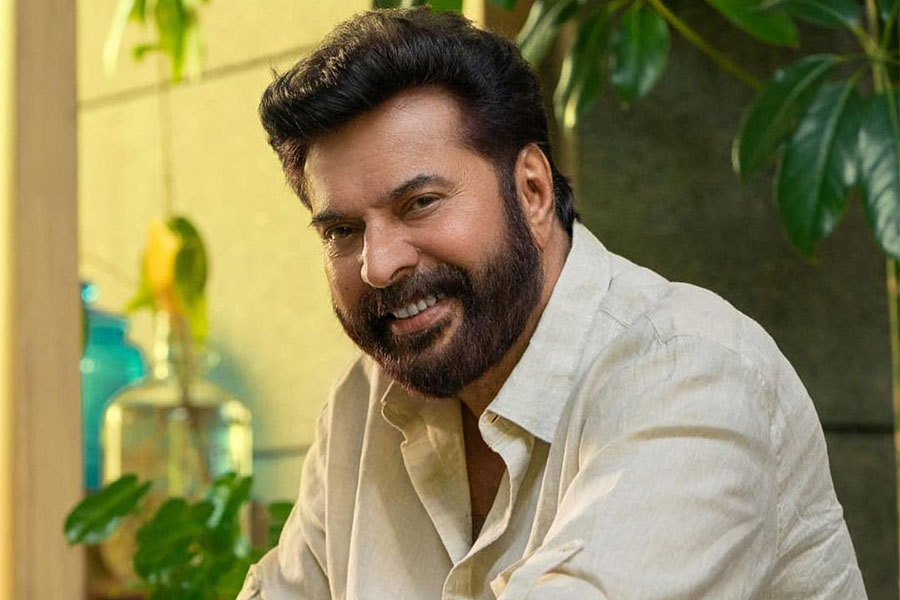
Fondly called ‘Mammukka’ by his fans and those close to him, the 74-year-old actor described the award as ‘unexpected’.

Malayalam superstar Mammootty, who was conferred the Padma Bhushan on Sunday, said he was “very happy” and that there was “nothing greater than the country honouring one”.

Fondly called ‘Mammukka’ by his fans and those close to him, the 74-year-old actor described the award as “unexpected” while speaking to a TV channel.

Wishes poured in on social media as news spread about the honour, which was conferred on Mammootty for his contributions to the field of art. “My friend Mammootty has now become Padma Bhushan Mammootty. Congratulations to my friend,” actor-politician Kamal Haasan wrote on X.

“Congratulations, Mammukka! And thank you for showing us how boundaries are broken, and challenges are taken up with a smile! You’re our pride and one of a kind,” actress Manju Warrier wrote in a Facebook post.

Later, at the Kerala State Film Awards ceremony, Mammootty was congratulated by Chief Minister Pinarayi Vijayan and Culture Minister Saji Cherian. In his address at the event, Vijayan said Mammootty had been honoured by the country with the Padma Bhushan.

“The Kerala cabinet is happy it could take part in this joyous development, as we have been recommending him for the award for the past several years. Everything has its time. Heartfelt congratulations to him. No one in the history of Indian cinema has performed such diverse characters as he has,” the Chief Minister said.

Mammootty has acted in over 400 films across languages including Malayalam, Tamil, Telugu, Kannada, Hindi and English, in a career spanning more than five decades.

He is a recipient of three National Awards, several state awards, and two honorary doctorates, apart from Padma Shri.

Mammootty made his film debut in 1971 with Anubhavangal Paalichakal. His most recent big-screen outing was Kalamkaval.

source: http://www.telegraphindia.com / The Telegraph Online / Home / by The Telegraph, Entertainment Web Desk / January 26th, 2026

History of 1921 Malabar revolt is being decolonised. British reduced it to Hindu-Muslim clash

KERALA :

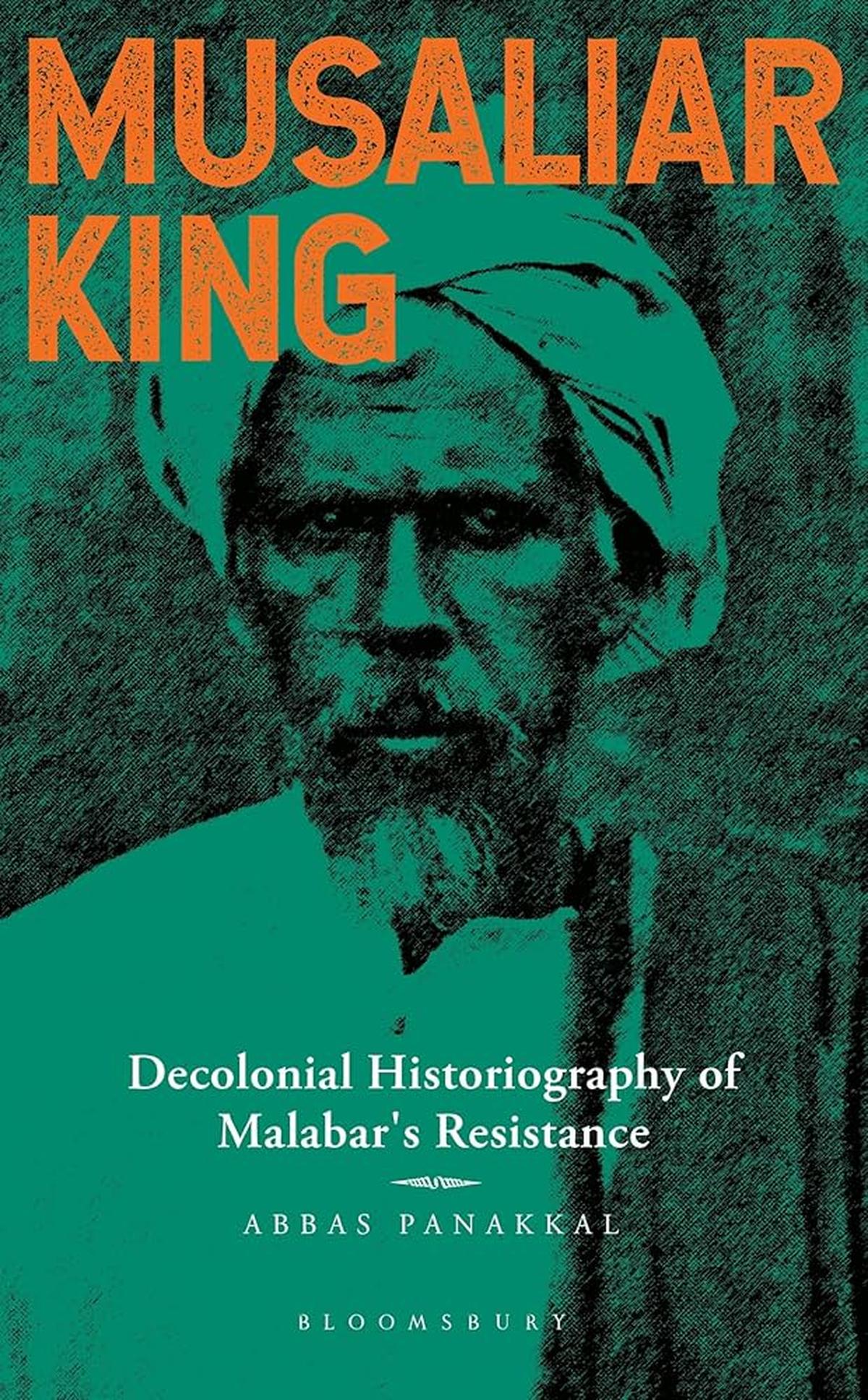
The Malabar Resistance of 1921 is a deeply contested historical event that was born out of the crackdown against the Khilafat movement. The book ‘Musaliar King’ has tried to decolonise it.

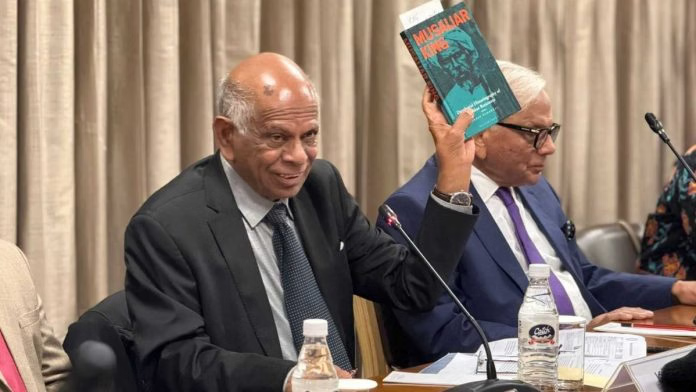
KP Fabian with Abbas Panakkal’s book Musaliar King | Special arrangement

New Delhi: 

On a mission to decolonise the narrative around the Malabar resistance of 1921, author Abbas Panakkal has relied on oral histories, and other accounts in Ottoman, French, Australian, and Indian libraries. A recent gathering of academics at the India International Centre saw a passionate discussion on the book Musaliar King: Decolonial Historiography of Malabar’s Resistance

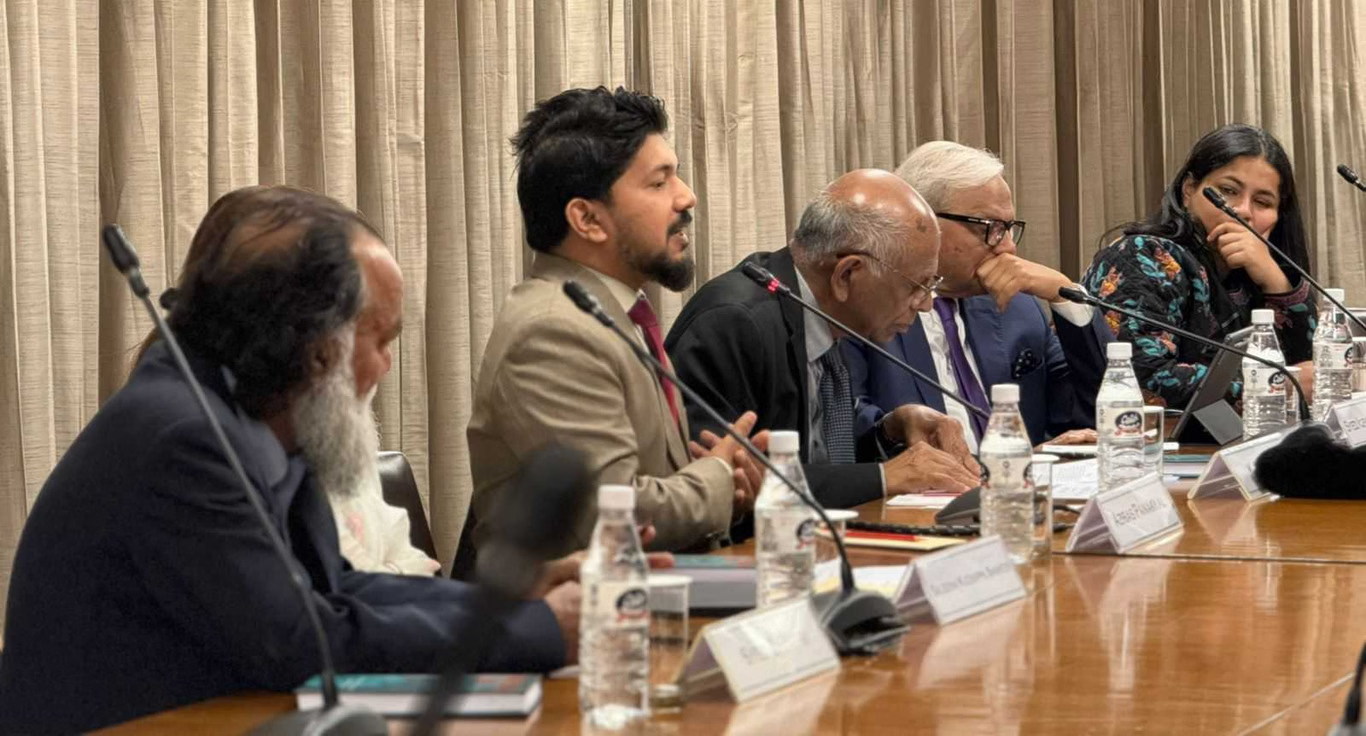
Star-studded panelists of academics and scholars, including former diplomat KP Fabian, Padma Shri Syed Iqbal Hasnain, dean of Jamia Hamdard, Saleena Basheer, Pallavi Raghavan, professor at Ashoka University and professor Syed Jaffri Hussain of Delhi University critiqued and added layers of historical context to Panakkal’s work. 

The Malabar Resistance of 1921 is a deeply contested historical event that was born out of the crackdown against the Khilafat movement, and saw an uprising of peasants against the landlords who were primarily Hindus and enjoyed British support. The British historiography reduces the rebellion to a Hindu-Muslim clash, and the resistance hasn’t found a place in the national conversation of revolts against the British colonists.

The author maintains that the peasantry contained both Hindus as well as Muslims and that Muslim houses were also targeted.

In 2021, RSS National Executive Committee member Ram Madhav had said that the Malabar Rebellion was the first manifestation of the ‘Talibani’ thought in India. In the same year, there were also Right-wing protests against celebrating the centenary anniversary of the revolt.

The Hindu Right maintains that the ‘uprising’ or ‘revolt’ was a communal incident, and takes offence to declare one of the leaders of the rebellion Variyamkunnath Kunjahammed Haji as a martyr. 

“Historians rely on repositories to provide evidence for accounts. In this project, my repository was also my family, neighbours, and village. When I grew up and learned English, I understood that the British version of the history of the Malabar rebellion was very different from what I had grown up hearing. The popular history was very different from the personal story of the people of this region,” Panakkal said, addressing an audience of academics, students, and historians.

“This book is not just research of 3-4 years, these are stories that I grew up hearing. I have to tell the story of my native place. It is my obligation,” he said. 

Panelists discussing Malabar rebellion of 1921 | Special arrangement

Oral history or nationalistic take? 

Growing up,  Panakkal said he had met and acquainted himself with Hindu and Muslim families who maintained an oral history of how Muslims and Hindus both rescued each other during the uprising. He added that the Malabar region, especially Tirurangadi, has a lot of communal peace.

Dr Syed Iqbal Hasnain said that the Malabar or Moplah revolt was an uprising against the British that was “woven with the threads of unity binding Hindu and Muslim to safeguard the throne of Hindu king Zamorin of Calicut.” 

“Muslim communities thrived under the patronage of Hindu kings, who they considered protectors who ensured the preservation of Islamic law and culture,” Hasnain said. 

Saleena Basheer, while commending Panakkal’s work, didn’t hold back on her critique of the book, which she said could be non-accessible to people who don’t have a lot of awareness about the revolt. She also questioned if the book was over-reliant on oral histories. 

“Does the book deconstruct colonial narratives or does it ignore them in favour of nationalistic storytelling,” Basheer asked.

The academics also wondered how radical the decolonial approach could be, as British versions of history are sometimes the only version of historical accounts available in the pre-Partition era, and have to be relied on by historians while writing about history.

Syed Jaffri Hussain, who has written extensively on the revolt of 1857, said the British version of events has to be challenged. He also praised Panakkal’s work. “Indian rebels like Bahadur Shah Zafar, Jhansi ki rani, Rana Beni Madho Singh are described as badmash, this needs to be read between the lines,” Hussain said about British repositories, adding that such language was never used for Australian rebels or Irish convicts.

The British left but their mentality has stayed with us,” he added. 

Hussain maintained that Moplah rebellion oral history needed to be urgently recorded. 

“What is accepted by us as an oral history in the realm of Dalit history, women’s history, should also be accepted in terms of Moplah history,” said Hussain.

(Edited by Ratan Priya)

source: http://www.theprint.in / The Print / Home> Features> Around Town / by Shubhangi Misra / February 19th, 2025

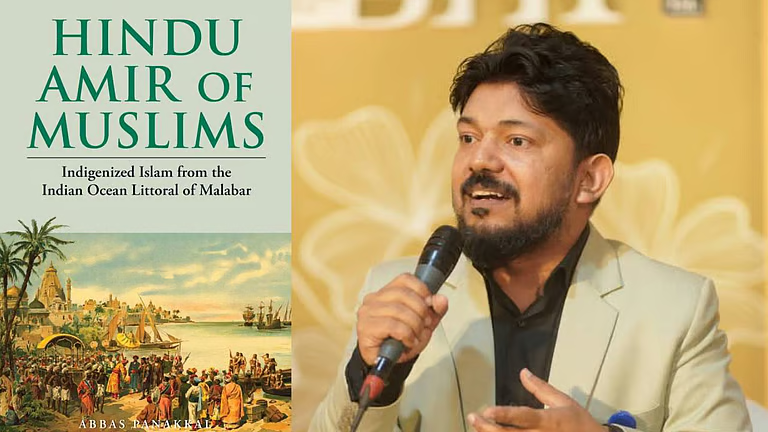
Historian Abbas Panakkal’s latest book redefines Jihad

KERALA :

In the Western view, Jihad is depicted within a framework of communal hostility and destruction, but in the documents of Malabar it is a word of interfaith harmony and peaceful coexistence, Abbas said.

Author of the book ‘Hindu Amir of Muslims: Indigenised Islam from the Indian Ocean Littoral of Malabar’ Abbas Panakkal.Photo | Special Arrangement

Kozhikode :

Contradicting popular narratives put forth by extremist Islamic organisations and the West that portray Jihad as a violent aggression on non-Muslims to establish the supremacy of Islam, is a one originating in Kerala that describes the unified efforts of Muslims and non-Muslims to protect a Hindu king.

Historian Abbas Panakkal’s intriguingly titled book Hindu Amir of Muslims: Indigenised Islam from the Indian Ocean Littoral of Malabar counters the argument that a non-Muslim cannot be the Amir of Muslims, quoting the works of Islamic scholars such as Sheikh Zainuddin Makhdoom and Qazi Muhammad. Some Muslim organisations assert that a true believer should at least strive mentally to establish an Islamic rule, otherwise his/her Islam will remain incomplete.

Abbas argues that Islamic scholars around the sixteenth century had called for Jihad against the Portuguese when the intruders locked horns with the Zamorins. In the Western view, Jihad is depicted within a framework of communal hostility and destruction, but in the documents of Malabar it is a word of interfaith harmony and peaceful coexistence, Abbas said.

“Qazi Muhammad’s poem Fat’hul Mubin narrates an incident during the attack on Chaliyam fort, built by the Portuguese. Zamorin was the ruler and the Muslims had taken a vow to sacrifice their life in the fight for the king. On hearing this, the Hindus felt sad and said that Muslims should not let Muslims die as they are the minority. Finally, they decided to fight together,” Abbas said.

The Qazi conducted prayers for the king and requested all Muslims to pray for the non-Muslim sovereign. He criticised Muslim kings, who signed treaties with the Portuguese and supported their cruelties, the book says.

“Here, jihad was declared to support the local ruler, irrespective of his religion. It was not to crown a Muslim ruler or to turn a Darul Harb into a Darul Islam. Within the Kingdom of Zamorin the Jihad became a tool of accord and interreligious cohabitation,” the book says.

Abbas quotes an incident narrated in Fat’hul Mubin to show the camaraderie between Hindus and Muslims during the siege of the Chaliyam fort.

Zamorin’s mother wrote a letter to the Muslim leaders seeking their intervention and important warriors of the times including Kunjali Marakkar, Umar Anthabi and Abdul Azeez gathered at a mosque in Kozhikode along with the officials of Zamorin to discuss the war strategies.

Tufat al-Mujahidin by Sheikh Zainuddin Makhdoom II, written in the sixteenth century, narrates the privileges enjoyed by Muslims under the rule of Zamorin. Proper burial was given to the bodies of Muslim offenders as per the Islamic custom while the bodies of non-Muslim criminals were left to be consumed by wild animals, says the book.

“Non-Muslim rulers actively supported the construction of mosques and the organization of religious observances, and the state provided funding for the salaries of qazis (judges) and other religious officials, such as mu’addins (callers to prayer). In this pluralistic context, where Muslims enjoyed considerable freedom and leniency,” the book said.

source: http://www.newindianexpress.com / The New Indian Express / Home> Kerala / by MP Prashanth /August 06th, 2025

In the run-up to Independence, a little-known resistance in the Malabar region

KERALA :

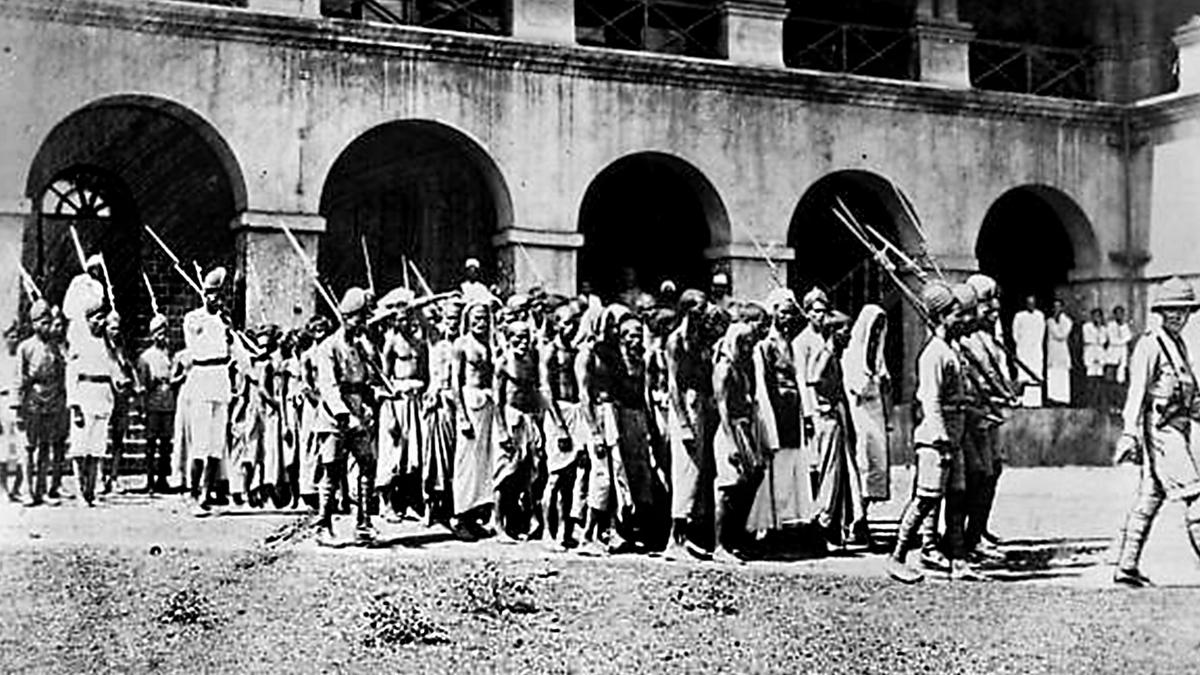
A new book sheds light on the ‘Malabar Revolt’ in a region which had a history of Muslims and Hindus collaboratively persevering in their resistance against colonial forces. Other books explore its links to the Khilafat movement and why it is more than a peasant uprising.

Moplah prisoners go on trial in Calicut | Photo Credit: Getty Images

Growing up in Delhi, one had only a limited idea about the resistance movement in the Malabar region. The popular history books tended to treat it at best as a little outpost of the freedom movement. Noted historian Bipan Chandra in India’s Struggle for Independence (Penguin) dubbed it as a peasant movement.

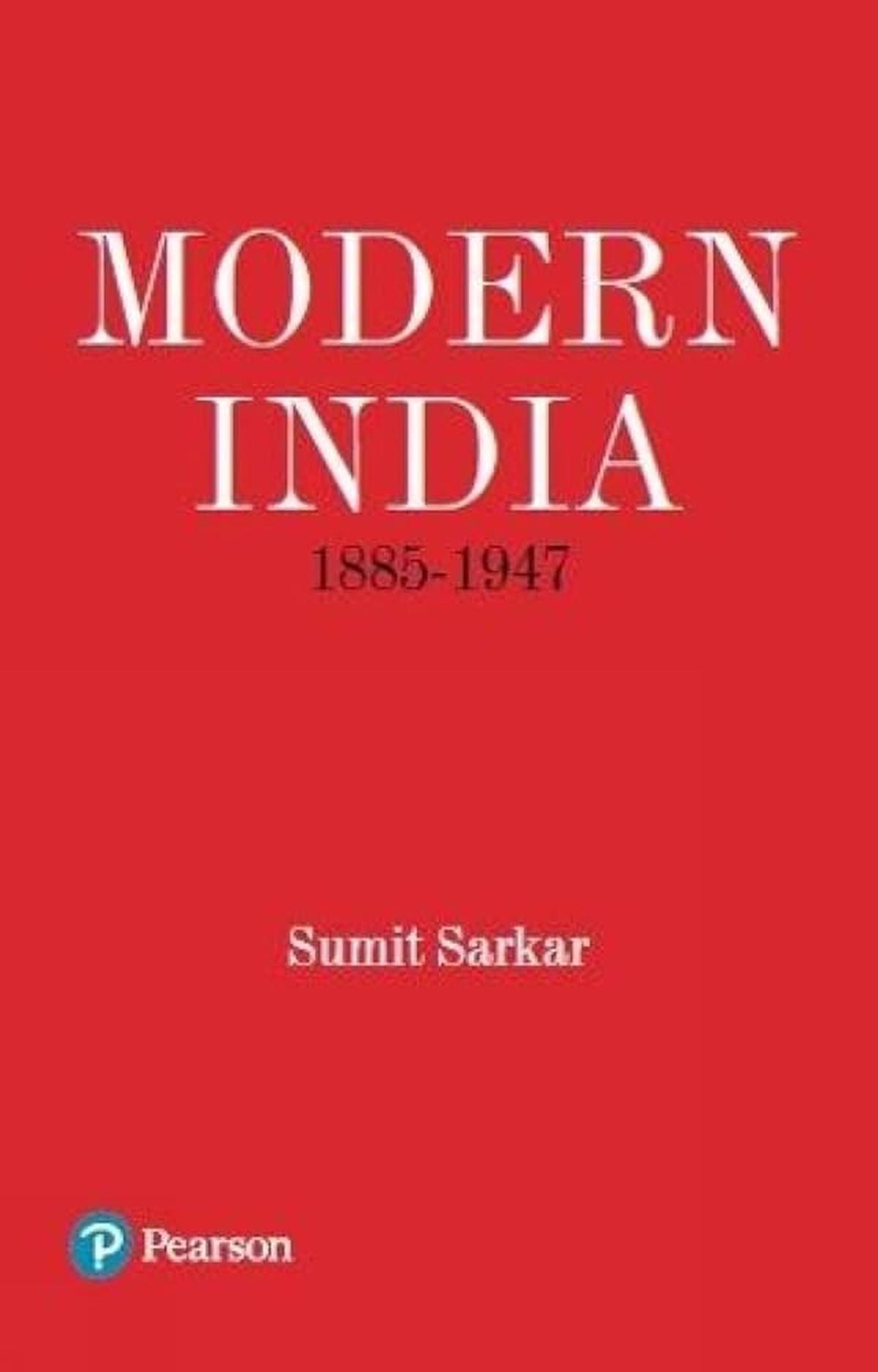
“In August 1921, peasant discontent erupted in the Malabar district of Kerala. Here, Mappila tenants rebelled. Their grievances related to lack of any security of tenure, renewal fees, high rents…the impetus for resistance had first come from the Malabar District Congress Conference at Manjeri in April 1920,” Chandra writes. Sumit Sarkar too, confined himself to calling it an “anti-landlord revolt” in his book, Modern India (1885-1947), published by Pearson. There have been noises about the association with the Khilafat movement in academic circles, though. Just as there are historians who see it merely from a communal prism. A holistic picture had failed to emerge.

Enlightening exploration

Some belated but well-deserved attention on the resistance movement has come courtesy Abbas Panakkal’s Musaliar King: Decolonial Historiography of Malabar’s Resistance (Bloomsbury). Starting off as an exploratory exercise on the 75th anniversary of the movement, Panakkal’s venture transforms into an enlightening journey.

Early in the book, the author writes, “The socio-geographical landscape of our community underwent profound transformations in the wake of the cataclysmic events of 1921-22. This epoch witnessed a staggering loss of lives, the forced displacement of families… The old mosque of Tirurangadi emerged as a veritable repository of memories and narratives, a historical bastion of ideological resistance against the British colonial apparatus.” Fittingly, it was on the commemoration of the 75th anniversary of the 1921 resistance that Panakkal started his exploration, speaking to the family members of those directly involved.

Among them was Muhammed Ali Musaliar, grandson of Ali Musaliar, a luminary of the 1921 struggle. The British referred to Ali Musaliar as a king; the locals regarded him as a community and spiritual leader, calling him Musaliar Uppapa. Indeed, if Musaliar was a ‘king’, Malabar was his ‘kingdom’.

Incidentally, the term Malabar is derived from the vernacular Mala, signifying hill, and the affix originating from the Arabic word barr, which means the source of all goodness. The region had a long tradition of anti-colonial resistance dating back to the 16th century. “Muslims and Hindus collaboratively persevered in their resistance against colonial forces,” writes Panakkal.

This strong anti-colonial stance had unforeseen consequences. The British, with not a little help from some Indian officials, sought to undermine the movement. Among them was C. Gopalan Nair, Malabar district deputy collector, who “unabashedly deployed his literary prowess in favour of the British cause”. Observes Panakkal: “The usage of terms such as Malabar Revolt and Moplah Rebellion to delineate these struggles is emblematic of this issue. Revolt itself is a term crafted by colonial administration, characterising violent actions against a recognised government or ruler.”

‘Peaceful coexistence’

There were others, though, whose hearts beat for the locals, luminaries who either linked the resistance to the Khilafat movement or, in isolation, read it as an agrarian struggle. Among them were Saumyendranath Tagore, who regarded it as “an organic and spontaneous ‘uprising’ of the Malabar peasantry against British imperial rule” and E.M.S. Namboodiripad, who too “didn’t discount the role played by agrarian discontent”. There was a common thread: the oppression and exploitation meted out by colonial officials and landlords was no less severe upon the Hindu peasants as they were on their Muslim counterparts. Writes Panakkal, “The Malabar narrative heralded a rare phenomenon: the harmonious convergence of Hindus and Muslims. This coalition was underpinned by a shared objective — to oust the oppressor — and a collective aspiration for a peaceful coexistence in the region.”

It is something with which even R.N. Hitchcock, police superintendent of Malabar, agreed. As written by N.P. Chekkutty in Mappila and Comrades: A Century of Communist-Muslim Relations (Other Books). “Hitchcock also reveals that Hindus were involved in the rebellion, at least in some parts of the affected areas. ‘The Hindus took an active part only in the extreme south-eastern area of the Valluvanad taluk and in small numbers for a concise time. They were then responsible for much property damage’.” In his persuasively argued book, with much of the focus on the post-resistance time in the late 1930s and 40s, Chekkutty also talks of the rebels not harming any substantial section of the local population before going on to document the failure of the Congress to retain local Muslim support after the resistance movement. It was a vacuum which both the Communist Party of India and the All India Muslim League attempted to fill.

The Khilafat angle

Interestingly, against this background of common cause transcending the confines of faith came the pan-Islamist Khilafat movement. Things became even more ironic as Malabar’s historical tapestry of anti-colonial resistance “had been woven with threads of unity binding Muslims and non-Muslims in a shared ‘jihad’ to safeguard the throne of the Hindu king, the Zamorin of Calicut,” as analysed by Panakkal. Khilafat, Non-Cooperation, Mappila, with seemingly disparate social elements, all fused to bring about a strong anti-colonial movement.

Indeed, here both the communities enjoyed a rare camaraderie, and there was a happy collective involvement even in religiously significant events like the nercha and utsavam. During the latter, Muslim families returned with bags full of jaggery candies, much like Ali Musaliar used to do for Amina, his daughter. Sums up Panakkal: “The experience of Muslims and Islam in South India is different from the experience in North India, and this is not trivial.”

source: http://www.thehindu.com / The Hindu / Home> Books> Bibliography / by Ziya Us Salam / September 18th, 2025

IUML Sets Up National Headquarters in Delhi, Eyes Expansion Beyond South

KERALA / NEW DELHI :

New Delhi:

The Indian Union Muslim League (IUML) formally opened its first national headquarters in Daryaganj, marking a major step in expanding its role in Indian politics. The five-storey building, named after party founder Qaid-e-Millat Mohammed Ismail Saheb, was inaugurated by National Affairs Committee Chairman Panakkad Syed Sadik Ali Shihab Thangal in the presence of MPs, MLAs, and leaders from across the country.

The IUML, founded in 1948, has until now confined its activities largely to Kerala and Tamil Nadu. In Kerala, it has played an influential role for decades, partnering with both Congress-led and Left-led coalitions. Its participation in government helped secure significant progress for Muslims in education, business, and social development.

To introduce itself in North India, IUML will hold a public meeting at Jawaharlal Nehru Stadium with senior leaders of the INDIA bloc, including Sonia Gandhi, Priyanka Gandhi, and Akhilesh Yadav. Senior advocate and MP Kapil Sibal will deliver a keynote address on “Election Fraud: Death of Democracy.”

IUML leaders said the party plans to engage OBC, Dalit, and minority communities while tackling the challenge of operating in a more polarized political environment. They stressed that the IUML is open to all communities and already has non-Muslims in leadership roles in Kerala.

Analysts believe the Delhi headquarters signals a long-term strategy to counter the influence of AIMIM and provide an alternative Muslim-led voice within the INDIA alliance framework. The move is expected to amplify IUML’s national presence and influence in the coming years.

source: http://www.radiancenews.com / Radiance News / Home> Latest News> Report / by Radiance News Bureau / August 24th, 2025

17-year-old feted for sterling show at aquatic tourney

KERALA :

Liyana is the holder of 15 Kerala state aquatic championship records and five CBSE national records.

Kochi :

Liyana Fathima Umer Nizar, 17, who made history winning gold in all the five events she competed at the Kerala Games Aquatic Championships, was felicitated by Global Public School chairman P Jacob on Wednesday.

The GPS International Thiruvaniyoor student, currently pursuing her A levels (Grade 12), was adjudged the fastest woman of aquatic championships held at Dr Ambedkar International Aquatic Complex, Thiruvananthapuram from May 6 to 8. She had contested in the 100-metre freestyle, 50-metre freestyle, 50-metre butterfly, 100-metre butterfly and 200-metre butterfly events.

Liyana is the holder of 15 Kerala state aquatic championship records and five CBSE national records.

In 2016, her gold medal in 50-m freestyle at the state meet in Bengaluru finally ended the medal drought for Kerala. The 17-year-old started swimming when she was in Grade 1. Ever since Liyana began training under the watchful eyes of her school coach Santhosh Kumar in 2012, she has been creating waves at the state and national-level.

source: http://www.newindianexpress.com / The New Indian Express / Home> Kochi / by Express News Service / May 12th, 2022