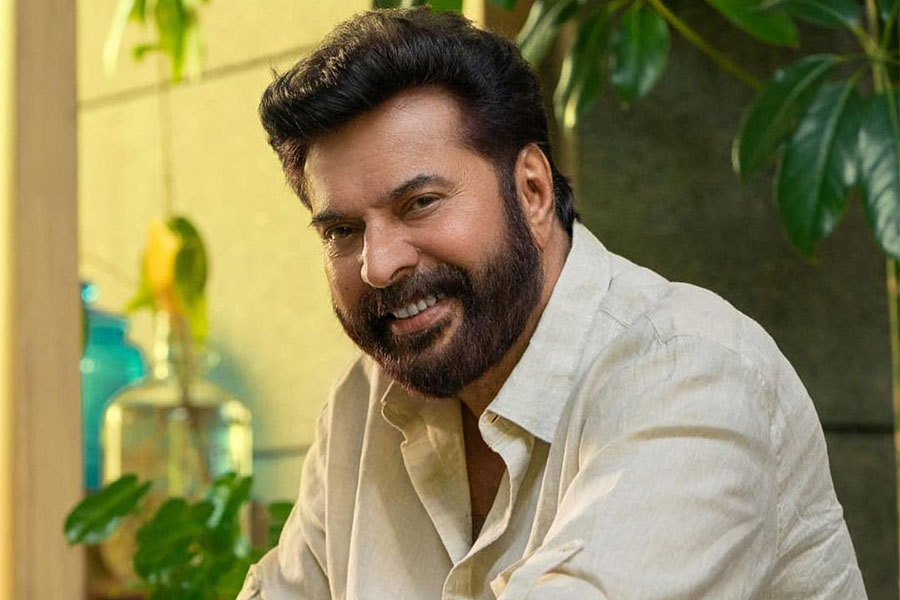
Fondly called ‘Mammukka’ by his fans and those close to him, the 74-year-old actor described the award as ‘unexpected’.
Malayalam superstar Mammootty, who was conferred the Padma Bhushan on Sunday, said he was “very happy” and that there was “nothing greater than the country honouring one”.
Fondly called ‘Mammukka’ by his fans and those close to him, the 74-year-old actor described the award as “unexpected” while speaking to a TV channel.
Wishes poured in on social media as news spread about the honour, which was conferred on Mammootty for his contributions to the field of art. “My friend Mammootty has now become Padma Bhushan Mammootty. Congratulations to my friend,” actor-politician Kamal Haasan wrote on X.
“Congratulations, Mammukka! And thank you for showing us how boundaries are broken, and challenges are taken up with a smile! You’re our pride and one of a kind,” actress Manju Warrier wrote in a Facebook post.
Later, at the Kerala State Film Awards ceremony, Mammootty was congratulated by Chief Minister Pinarayi Vijayan and Culture Minister Saji Cherian. In his address at the event, Vijayan said Mammootty had been honoured by the country with the Padma Bhushan.
“The Kerala cabinet is happy it could take part in this joyous development, as we have been recommending him for the award for the past several years. Everything has its time. Heartfelt congratulations to him. No one in the history of Indian cinema has performed such diverse characters as he has,” the Chief Minister said.
Mammootty has acted in over 400 films across languages including Malayalam, Tamil, Telugu, Kannada, Hindi and English, in a career spanning more than five decades.
He is a recipient of three National Awards, several state awards, and two honorary doctorates, apart from Padma Shri.
Mammootty made his film debut in 1971 with Anubhavangal Paalichakal. His most recent big-screen outing was Kalamkaval.
source: http://www.telegraphindia.com / The Telegraph Online / Home / by The Telegraph, Entertainment Web Desk / January 26th, 2026
The Malabar Resistance of 1921 is a deeply contested historical event that was born out of the crackdown against the Khilafat movement. The book ‘Musaliar King’ has tried to decolonise it.
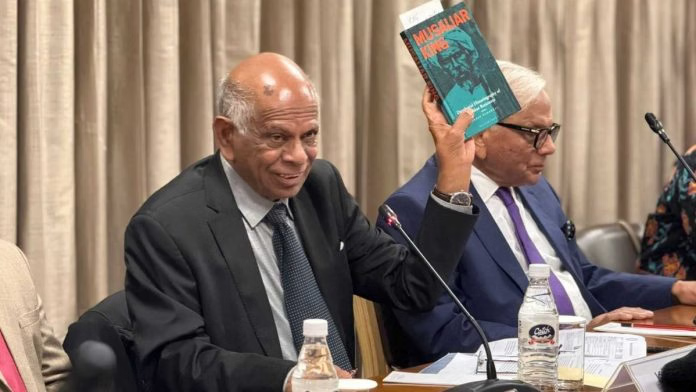
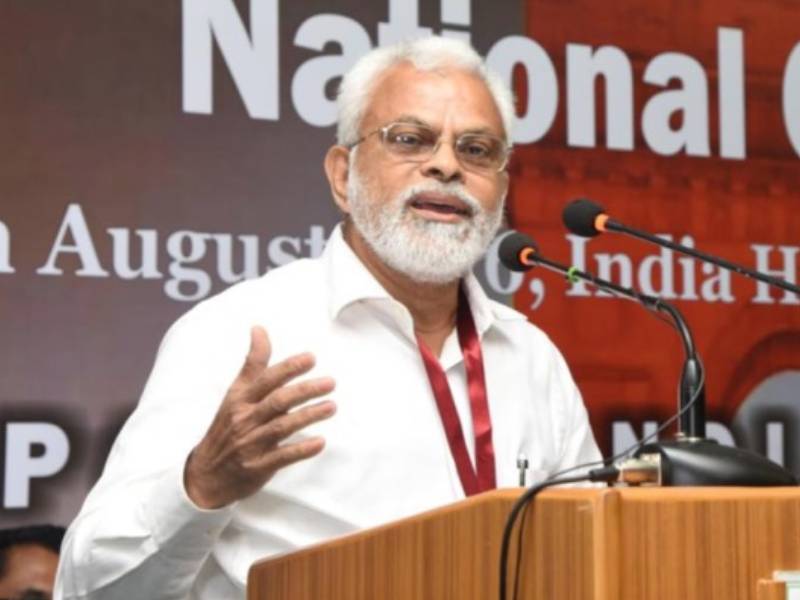
KP Fabian with Abbas Panakkal’s book Musaliar King | Special arrangement
New Delhi:
On a mission to decolonise the narrative around the Malabar resistance of 1921, author Abbas Panakkal has relied on oral histories, and other accounts in Ottoman, French, Australian, and Indian libraries. A recent gathering of academics at the India International Centre saw a passionate discussion on the book Musaliar King: Decolonial Historiography of Malabar’s Resistance.
Star-studded panelists of academics and scholars, including former diplomat KP Fabian, Padma Shri Syed Iqbal Hasnain, dean of Jamia Hamdard, Saleena Basheer, Pallavi Raghavan, professor at Ashoka University and professor Syed Jaffri Hussain of Delhi University critiqued and added layers of historical context to Panakkal’s work.
The Malabar Resistance of 1921 is a deeply contested historical event that was born out of the crackdown against the Khilafat movement, and saw an uprising of peasants against the landlords who were primarily Hindus and enjoyed British support. The British historiography reduces the rebellion to a Hindu-Muslim clash, and the resistance hasn’t found a place in the national conversation of revolts against the British colonists.
The author maintains that the peasantry contained both Hindus as well as Muslims and that Muslim houses were also targeted.
In 2021, RSS National Executive Committee member Ram Madhav had said that the Malabar Rebellion was the first manifestation of the ‘Talibani’ thought in India. In the same year, there were also Right-wing protests against celebrating the centenary anniversary of the revolt.
The Hindu Right maintains that the ‘uprising’ or ‘revolt’ was a communal incident, and takes offence to declare one of the leaders of the rebellion Variyamkunnath Kunjahammed Haji as a martyr.
“Historians rely on repositories to provide evidence for accounts. In this project, my repository was also my family, neighbours, and village. When I grew up and learned English, I understood that the British version of the history of the Malabar rebellion was very different from what I had grown up hearing. The popular history was very different from the personal story of the people of this region,” Panakkal said, addressing an audience of academics, students, and historians.
“This book is not just research of 3-4 years, these are stories that I grew up hearing. I have to tell the story of my native place. It is my obligation,” he said.
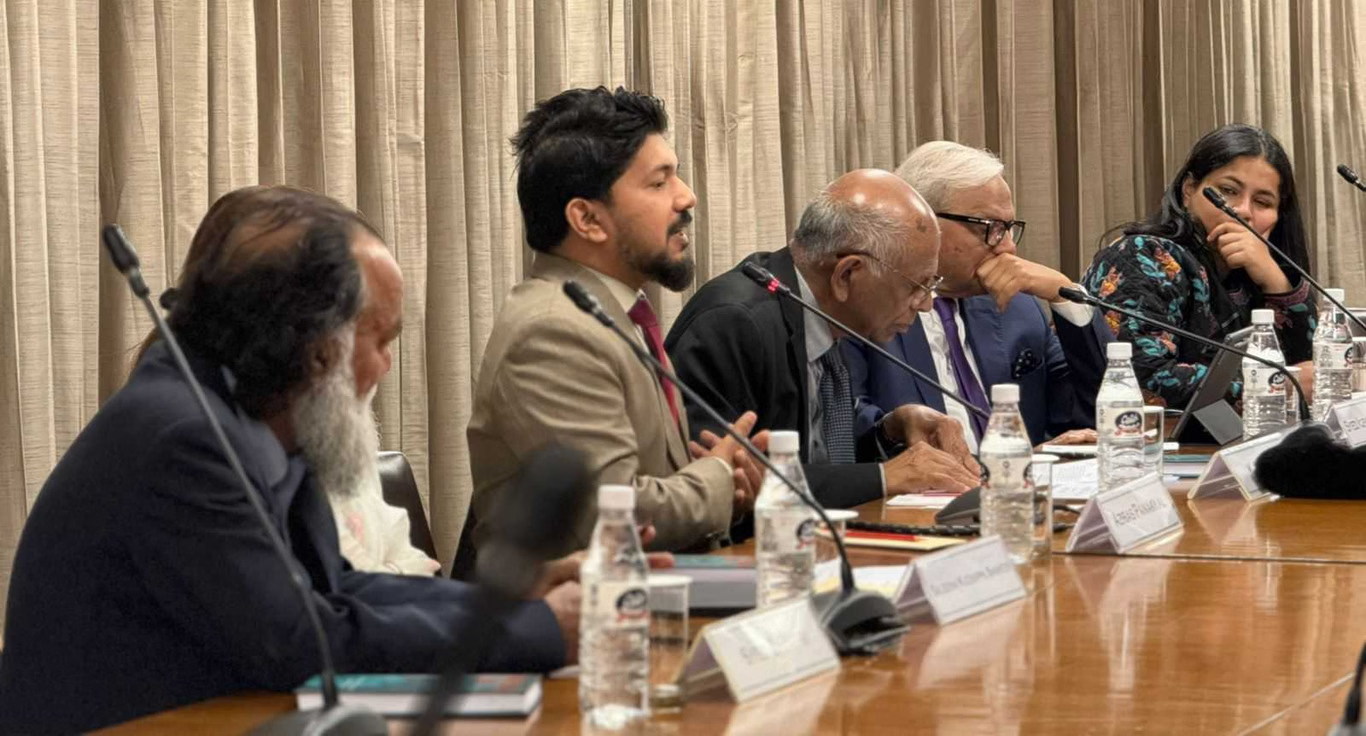
Panelists discussing Malabar rebellion of 1921 | Special arrangement
Oral history or nationalistic take?
Growing up, Panakkal said he had met and acquainted himself with Hindu and Muslim families who maintained an oral history of how Muslims and Hindus both rescued each other during the uprising. He added that the Malabar region, especially Tirurangadi, has a lot of communal peace.
Dr Syed Iqbal Hasnain said that the Malabar or Moplah revolt was an uprising against the British that was “woven with the threads of unity binding Hindu and Muslim to safeguard the throne of Hindu king Zamorin of Calicut.”
“Muslim communities thrived under the patronage of Hindu kings, who they considered protectors who ensured the preservation of Islamic law and culture,” Hasnain said.
Saleena Basheer, while commending Panakkal’s work, didn’t hold back on her critique of the book, which she said could be non-accessible to people who don’t have a lot of awareness about the revolt. She also questioned if the book was over-reliant on oral histories.
“Does the book deconstruct colonial narratives or does it ignore them in favour of nationalistic storytelling,” Basheer asked.
The academics also wondered how radical the decolonial approach could be, as British versions of history are sometimes the only version of historical accounts available in the pre-Partition era, and have to be relied on by historians while writing about history.
Syed Jaffri Hussain, who has written extensively on the revolt of 1857, said the British version of events has to be challenged. He also praised Panakkal’s work. “Indian rebels like Bahadur Shah Zafar, Jhansi ki rani, Rana Beni Madho Singh are described as badmash, this needs to be read between the lines,” Hussain said about British repositories, adding that such language was never used for Australian rebels or Irish convicts.
The British left but their mentality has stayed with us,” he added.
Hussain maintained that Moplah rebellion oral history needed to be urgently recorded.
“What is accepted by us as an oral history in the realm of Dalit history, women’s history, should also be accepted in terms of Moplah history,” said Hussain.
(Edited by Ratan Priya)
source: http://www.theprint.in / The Print / Home> Features> Around Town / by Shubhangi Misra / February 19th, 2025
In the Western view, Jihad is depicted within a framework of communal hostility and destruction, but in the documents of Malabar it is a word of interfaith harmony and peaceful coexistence, Abbas said.
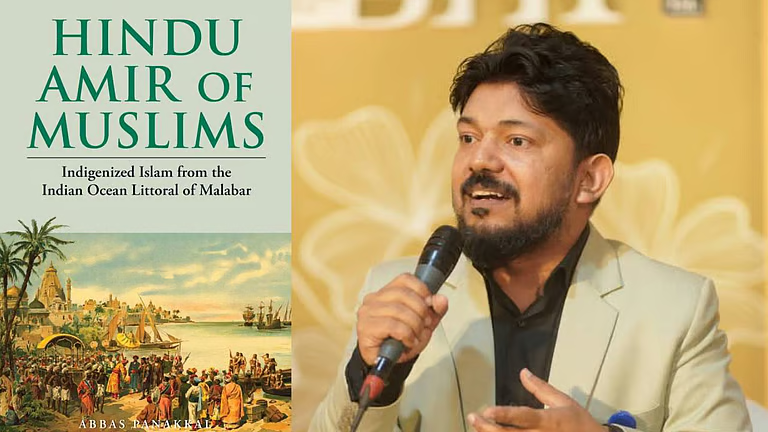
Author of the book ‘Hindu Amir of Muslims: Indigenised Islam from the Indian Ocean Littoral of Malabar’ Abbas Panakkal.Photo | Special Arrangement
Kozhikode :
Contradicting popular narratives put forth by extremist Islamic organisations and the West that portray Jihad as a violent aggression on non-Muslims to establish the supremacy of Islam, is a one originating in Kerala that describes the unified efforts of Muslims and non-Muslims to protect a Hindu king.
Historian Abbas Panakkal’s intriguingly titled book Hindu Amir of Muslims: Indigenised Islam from the Indian Ocean Littoral of Malabar counters the argument that a non-Muslim cannot be the Amir of Muslims, quoting the works of Islamic scholars such as Sheikh Zainuddin Makhdoom and Qazi Muhammad. Some Muslim organisations assert that a true believer should at least strive mentally to establish an Islamic rule, otherwise his/her Islam will remain incomplete.
Abbas argues that Islamic scholars around the sixteenth century had called for Jihad against the Portuguese when the intruders locked horns with the Zamorins. In the Western view, Jihad is depicted within a framework of communal hostility and destruction, but in the documents of Malabar it is a word of interfaith harmony and peaceful coexistence, Abbas said.
“Qazi Muhammad’s poem Fat’hul Mubin narrates an incident during the attack on Chaliyam fort, built by the Portuguese. Zamorin was the ruler and the Muslims had taken a vow to sacrifice their life in the fight for the king. On hearing this, the Hindus felt sad and said that Muslims should not let Muslims die as they are the minority. Finally, they decided to fight together,” Abbas said.
The Qazi conducted prayers for the king and requested all Muslims to pray for the non-Muslim sovereign. He criticised Muslim kings, who signed treaties with the Portuguese and supported their cruelties, the book says.
“Here, jihad was declared to support the local ruler, irrespective of his religion. It was not to crown a Muslim ruler or to turn a Darul Harb into a Darul Islam. Within the Kingdom of Zamorin the Jihad became a tool of accord and interreligious cohabitation,” the book says.
Abbas quotes an incident narrated in Fat’hul Mubin to show the camaraderie between Hindus and Muslims during the siege of the Chaliyam fort.
Zamorin’s mother wrote a letter to the Muslim leaders seeking their intervention and important warriors of the times including Kunjali Marakkar, Umar Anthabi and Abdul Azeez gathered at a mosque in Kozhikode along with the officials of Zamorin to discuss the war strategies.
Tufat al-Mujahidin by Sheikh Zainuddin Makhdoom II, written in the sixteenth century, narrates the privileges enjoyed by Muslims under the rule of Zamorin. Proper burial was given to the bodies of Muslim offenders as per the Islamic custom while the bodies of non-Muslim criminals were left to be consumed by wild animals, says the book.
“Non-Muslim rulers actively supported the construction of mosques and the organization of religious observances, and the state provided funding for the salaries of qazis (judges) and other religious officials, such as mu’addins (callers to prayer). In this pluralistic context, where Muslims enjoyed considerable freedom and leniency,” the book said.
source: http://www.newindianexpress.com / The New Indian Express / Home> Kerala / by MP Prashanth /August 06th, 2025
A new book sheds light on the ‘Malabar Revolt’ in a region which had a history of Muslims and Hindus collaboratively persevering in their resistance against colonial forces. Other books explore its links to the Khilafat movement and why it is more than a peasant uprising.
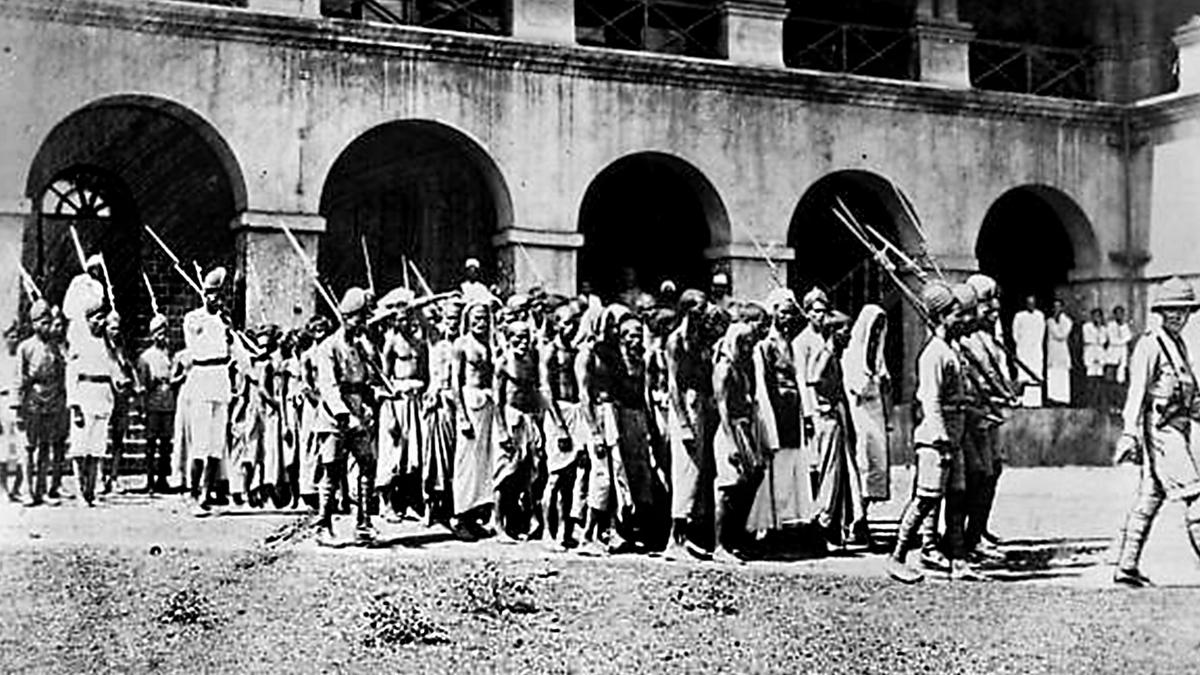
Moplah prisoners go on trial in Calicut | Photo Credit: Getty Images
Growing up in Delhi, one had only a limited idea about the resistance movement in the Malabar region. The popular history books tended to treat it at best as a little outpost of the freedom movement. Noted historian Bipan Chandra in India’s Struggle for Independence (Penguin) dubbed it as a peasant movement.
“In August 1921, peasant discontent erupted in the Malabar district of Kerala. Here, Mappila tenants rebelled. Their grievances related to lack of any security of tenure, renewal fees, high rents…the impetus for resistance had first come from the Malabar District Congress Conference at Manjeri in April 1920,” Chandra writes. Sumit Sarkar too, confined himself to calling it an “anti-landlord revolt” in his book, Modern India (1885-1947), published by Pearson. There have been noises about the association with the Khilafat movement in academic circles, though. Just as there are historians who see it merely from a communal prism. A holistic picture had failed to emerge.
Enlightening exploration
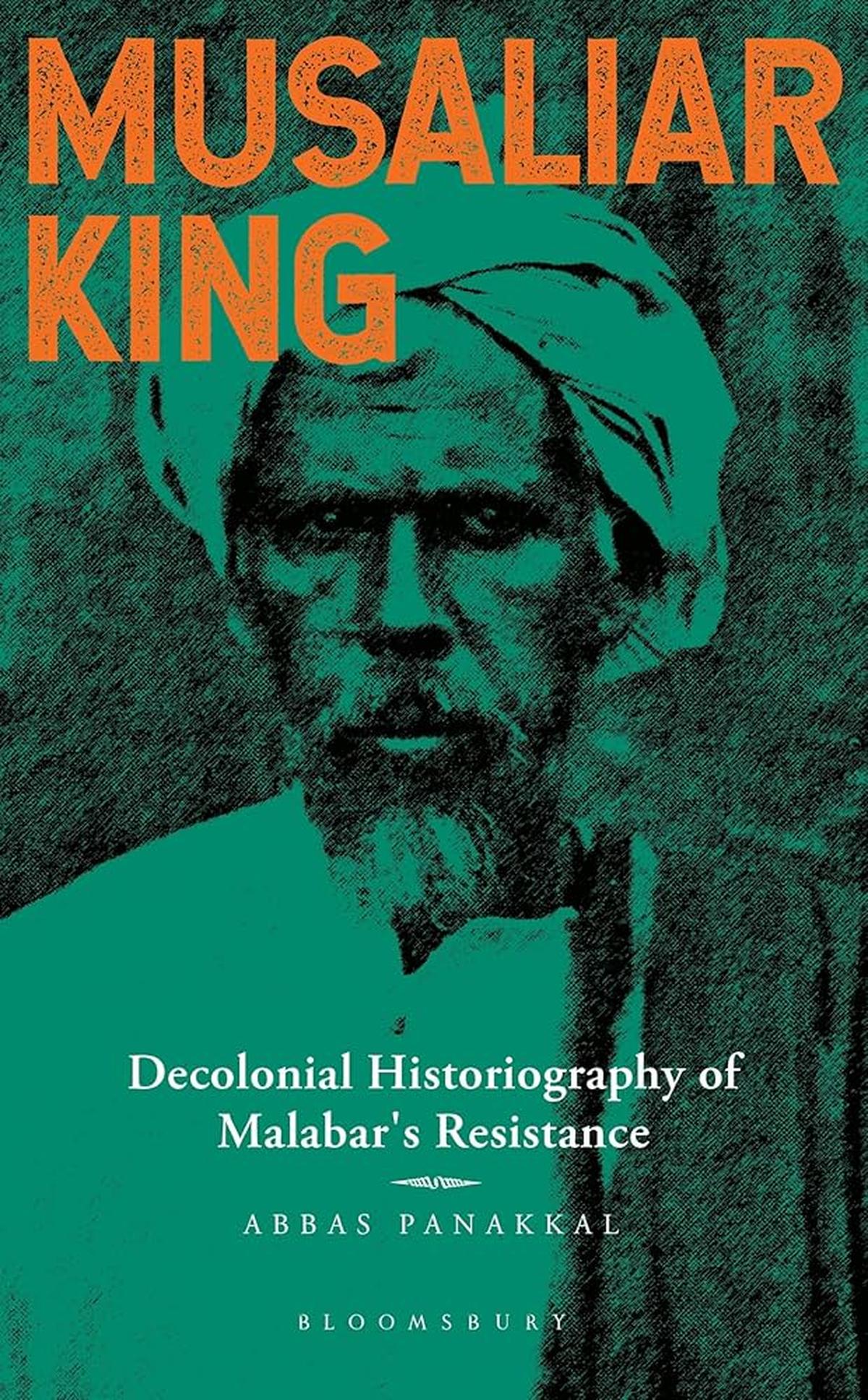
Some belated but well-deserved attention on the resistance movement has come courtesy Abbas Panakkal’s Musaliar King: Decolonial Historiography of Malabar’s Resistance (Bloomsbury). Starting off as an exploratory exercise on the 75th anniversary of the movement, Panakkal’s venture transforms into an enlightening journey.
Early in the book, the author writes, “The socio-geographical landscape of our community underwent profound transformations in the wake of the cataclysmic events of 1921-22. This epoch witnessed a staggering loss of lives, the forced displacement of families… The old mosque of Tirurangadi emerged as a veritable repository of memories and narratives, a historical bastion of ideological resistance against the British colonial apparatus.” Fittingly, it was on the commemoration of the 75th anniversary of the 1921 resistance that Panakkal started his exploration, speaking to the family members of those directly involved.
Among them was Muhammed Ali Musaliar, grandson of Ali Musaliar, a luminary of the 1921 struggle. The British referred to Ali Musaliar as a king; the locals regarded him as a community and spiritual leader, calling him Musaliar Uppapa. Indeed, if Musaliar was a ‘king’, Malabar was his ‘kingdom’.
Incidentally, the term Malabar is derived from the vernacular Mala, signifying hill, and the affix originating from the Arabic word barr, which means the source of all goodness. The region had a long tradition of anti-colonial resistance dating back to the 16th century. “Muslims and Hindus collaboratively persevered in their resistance against colonial forces,” writes Panakkal.
This strong anti-colonial stance had unforeseen consequences. The British, with not a little help from some Indian officials, sought to undermine the movement. Among them was C. Gopalan Nair, Malabar district deputy collector, who “unabashedly deployed his literary prowess in favour of the British cause”. Observes Panakkal: “The usage of terms such as Malabar Revolt and Moplah Rebellion to delineate these struggles is emblematic of this issue. Revolt itself is a term crafted by colonial administration, characterising violent actions against a recognised government or ruler.”
‘Peaceful coexistence’
There were others, though, whose hearts beat for the locals, luminaries who either linked the resistance to the Khilafat movement or, in isolation, read it as an agrarian struggle. Among them were Saumyendranath Tagore, who regarded it as “an organic and spontaneous ‘uprising’ of the Malabar peasantry against British imperial rule” and E.M.S. Namboodiripad, who too “didn’t discount the role played by agrarian discontent”. There was a common thread: the oppression and exploitation meted out by colonial officials and landlords was no less severe upon the Hindu peasants as they were on their Muslim counterparts. Writes Panakkal, “The Malabar narrative heralded a rare phenomenon: the harmonious convergence of Hindus and Muslims. This coalition was underpinned by a shared objective — to oust the oppressor — and a collective aspiration for a peaceful coexistence in the region.”
It is something with which even R.N. Hitchcock, police superintendent of Malabar, agreed. As written by N.P. Chekkutty in Mappila and Comrades: A Century of Communist-Muslim Relations (Other Books). “Hitchcock also reveals that Hindus were involved in the rebellion, at least in some parts of the affected areas. ‘The Hindus took an active part only in the extreme south-eastern area of the Valluvanad taluk and in small numbers for a concise time. They were then responsible for much property damage’.” In his persuasively argued book, with much of the focus on the post-resistance time in the late 1930s and 40s, Chekkutty also talks of the rebels not harming any substantial section of the local population before going on to document the failure of the Congress to retain local Muslim support after the resistance movement. It was a vacuum which both the Communist Party of India and the All India Muslim League attempted to fill.
The Khilafat angle
Interestingly, against this background of common cause transcending the confines of faith came the pan-Islamist Khilafat movement. Things became even more ironic as Malabar’s historical tapestry of anti-colonial resistance “had been woven with threads of unity binding Muslims and non-Muslims in a shared ‘jihad’ to safeguard the throne of the Hindu king, the Zamorin of Calicut,” as analysed by Panakkal. Khilafat, Non-Cooperation, Mappila, with seemingly disparate social elements, all fused to bring about a strong anti-colonial movement.
Indeed, here both the communities enjoyed a rare camaraderie, and there was a happy collective involvement even in religiously significant events like the nercha and utsavam. During the latter, Muslim families returned with bags full of jaggery candies, much like Ali Musaliar used to do for Amina, his daughter. Sums up Panakkal: “The experience of Muslims and Islam in South India is different from the experience in North India, and this is not trivial.”
source: http://www.thehindu.com / The Hindu / Home> Books> Bibliography / by Ziya Us Salam / September 18th, 2025
The Indian Union Muslim League (IUML) formally opened its first national headquarters in Daryaganj, marking a major step in expanding its role in Indian politics. The five-storey building, named after party founder Qaid-e-Millat Mohammed Ismail Saheb, was inaugurated by National Affairs Committee Chairman Panakkad Syed Sadik Ali Shihab Thangal in the presence of MPs, MLAs, and leaders from across the country.
The IUML, founded in 1948, has until now confined its activities largely to Kerala and Tamil Nadu. In Kerala, it has played an influential role for decades, partnering with both Congress-led and Left-led coalitions. Its participation in government helped secure significant progress for Muslims in education, business, and social development.
To introduce itself in North India, IUML will hold a public meeting at Jawaharlal Nehru Stadium with senior leaders of the INDIA bloc, including Sonia Gandhi, Priyanka Gandhi, and Akhilesh Yadav. Senior advocate and MP Kapil Sibal will deliver a keynote address on “Election Fraud: Death of Democracy.”
IUML leaders said the party plans to engage OBC, Dalit, and minority communities while tackling the challenge of operating in a more polarized political environment. They stressed that the IUML is open to all communities and already has non-Muslims in leadership roles in Kerala.
Analysts believe the Delhi headquarters signals a long-term strategy to counter the influence of AIMIM and provide an alternative Muslim-led voice within the INDIA alliance framework. The move is expected to amplify IUML’s national presence and influence in the coming years.
source: http://www.radiancenews.com / Radiance News / Home> Latest News> Report / by Radiance News Bureau / August 24th, 2025
Liyana is the holder of 15 Kerala state aquatic championship records and five CBSE national records.
Kochi :
Liyana Fathima Umer Nizar, 17, who made history winning gold in all the five events she competed at the Kerala Games Aquatic Championships, was felicitated by Global Public School chairman P Jacob on Wednesday.
The GPS International Thiruvaniyoor student, currently pursuing her A levels (Grade 12), was adjudged the fastest woman of aquatic championships held at Dr Ambedkar International Aquatic Complex, Thiruvananthapuram from May 6 to 8. She had contested in the 100-metre freestyle, 50-metre freestyle, 50-metre butterfly, 100-metre butterfly and 200-metre butterfly events.
Liyana is the holder of 15 Kerala state aquatic championship records and five CBSE national records.
In 2016, her gold medal in 50-m freestyle at the state meet in Bengaluru finally ended the medal drought for Kerala. The 17-year-old started swimming when she was in Grade 1. Ever since Liyana began training under the watchful eyes of her school coach Santhosh Kumar in 2012, she has been creating waves at the state and national-level.
source: http://www.newindianexpress.com / The New Indian Express / Home> Kochi / by Express News Service / May 12th, 2022
Valanchery Munnakkal (Malappuram District), KERALA /Aligarh, UTTAR PRADESH :
Dr Munawar Hanih, an ICSSR post-doctoral researcher under the mentorship of Professor T.N. Satheesan, Dean, Faculty of Arts, Aligarh Muslim University, has been selected for the 2023 Mahakavi Moinkutty Vaidyar Mappila Kala Akademi Literary Award
Aligarh:
Dr Munawar Hanih, an ICSSR post-doctoral researcher under the mentorship of Professor T.N. Satheesan, Dean, Faculty of Arts, Aligarh Muslim University, has been selected for the 2023 Mahakavi Moinkutty Vaidyar Mappila Kala Akademi Literary Award, instituted by the Mahakavi Moinkutty Vaidyar Smarakam under the Department of Culture, Government of Kerala.
He is being honoured for his scholarly work Malayala Sufi Kavitha, a significant contribution to the study of Mappila literature and arts.
The award will be presented at a ceremony in September 2025.
Dr Hanih holds an MA and PhD in Malayalam from AMU’s Department of Modern Indian Languages and has served as Assistant Professor of Malayalam at Sir Syed College, Taliparamba, Kerala.
source: http://www.radiancenews.com / Radiance News / Home> Pride of the Nation> Awards / by Radiance News Bureau / August 14th, 2025
E. Abu Bakar (born in 1952) is a significant figure in the socio-political landscape of India, particularly known for his role as a leader in the banned Popular Front of India (PFI). He is also a founder member of All India Muslim Personal Law Board,
Born and raised in Kerala, Abu Bakar became actively involved in social and political activism early in his life, driven by a deep sense of commitment to the rights and empowerment of marginalized communities, especially Muslims.
Abu Bakar’s leadership in PFI has been marked by his efforts to address issues related to social justice, communal harmony, and the upliftment of the downtrodden. Under his guidance, PFI has focused on various initiatives aimed at improving the socio-economic conditions of underprivileged communities. These initiatives include educational programs, legal aid, and awareness campaigns about constitutional rights and social justice.
A charismatic and articulate leader, E. Abu Bakar has been vocal about the challenges faced by Muslims in India, advocating for their rights in a democratic framework. He has been actively involved in organizing campaigns and movements that highlight issues of discrimination, police brutality, and state excesses. His approach often emphasizes the need for community unity and strategic action to address these challenges.
However, Abu Bakar’s leadership has also been contentious. PFI has faced criticism and legal scrutiny over its activities, with allegations of involvement in extremist activities and incitement of violence. Despite these controversies, Abu Bakar has maintained that PFI is committed to lawful activism and peaceful advocacy for the rights of marginalized groups.
Throughout his career, E. Abu Bakar has remained a polarizing figure, admired by many for his unwavering commitment to social justice, while also facing criticism from those who view his methods as provocative.
He has been in custody for two years following his arrest on September 22, 2022, under UAPA from his residence in Kozhikode.
At the time of his arrest, Abubacker, had no prior criminal record. He has been bedridden since January 2020 due to severe health conditions. He underwent extensive treatment for cancer, including chemotherapy and surgery, which involved the surgical removal of 80% of his abdominal and intestinal area. This has left his digestive system severely compromised. He also suffers from Parkinson’s disease, diabetes, vision loss, and hypertension, further deteriorating his overall health.
source: http://www.the100indianmuslims.com / The100 Indian Muslims / Home / 2024
She calls upon council and the people for concerted efforts to take district forward
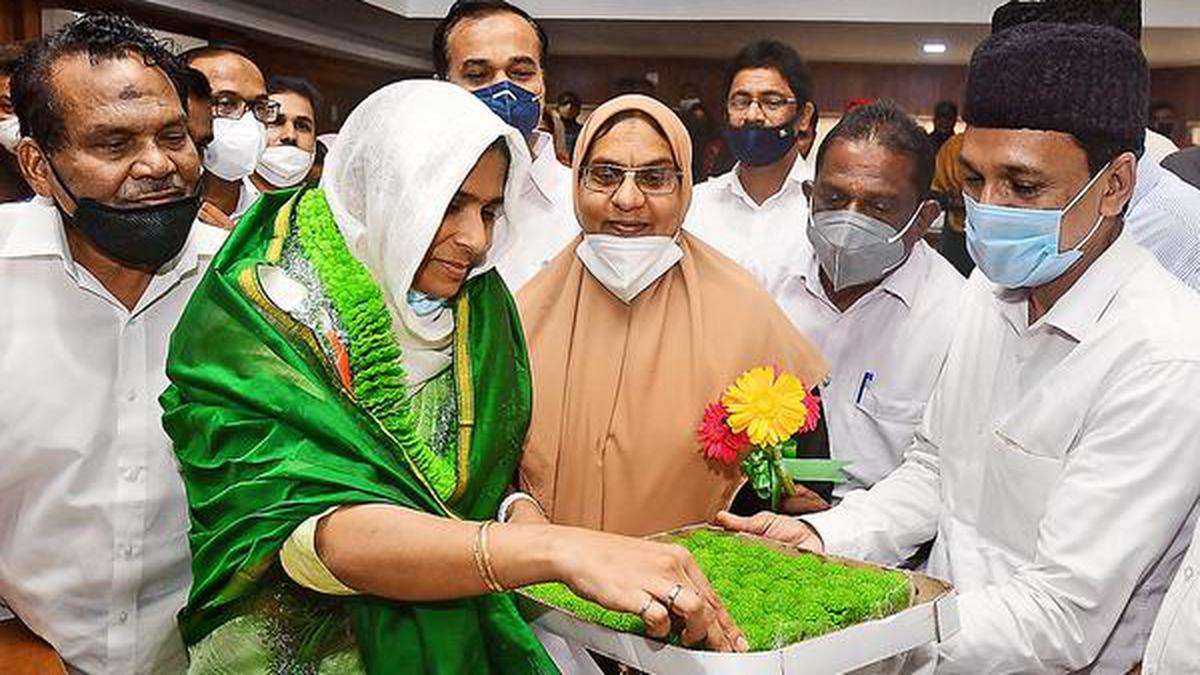
IUML Malappuram district president Sayed Sadikali Shihab Thangal offering sweets to newly elected District Panchayat President M.K. Rafeeka in Malappuram on Wednesday.
Indian Union Muslim League (IUML)’s M.K. Rafeeka was elected president of the Malappuram District Panchayat here on Wednesday. IUML’s Ismail Moothedam was elected vice president.
Ms. Rafeeka became President by winning 26 of the 32 votes. She defeated Left Democratic Front (LDF)’s Arifa Nasar, who got five votes. One vote was declared invalid.
Congress’s N.A. Kareem proposed Ms. Rafeeka for the president’s post, and P. Manaf backed her. Ms. Rafeeka represents Anakkayam division of the District Panchayat.
Ismail Moothedam was elected Vice President by winning 27 votes against LDF’s A.K. Subair. K.T. Ajmal proposed Mr. Moothedam’s name and P.K.C. Abdurahman seconded it. Mr. Moothedam represents Chokad division of the District Panchayat.
District Collector K. Gopalakrishnan administered the oath of office to Ms. Rafeeka.
IUML district president Sayed Sadikali Shihab Thangal; Sayed Basheerali Shihab Thangal; IUML district general secretary U.A. Latheef; P. Ubaidullah, MLA; former District Panchayat presidents K.P. Mariyumma, Arimbra Mohammed, Suhara Mampad and A.P. Unnikrishnan; senior IUML leaders Umer Arakkal, Salim Kuruvambalam, Kurukkoli Moideen, Noushad Mannisseri, and Congress leaders V.A. Kareem and K. Mohandas addressed a meeting that followed the oath taking ceremony. A commerce postgraduate, Ms. Rafeeka said that she would look upon the responsible position with due respect.
She called upon the entire council and the people for concerted efforts to take the district forward in comprehensive development.
Former president of Pulamanthol grama panchayat, Ms. Rafeeka was elected from Anakkayam division with 11,449 votes majority. She was instrumental in winning many accolades for Pulamanthol grama panchayat between 2010 and 2015. In 2011, the panchayat won the State Swaraj Trophy, the Central Vayo Sreshta Samman, and Gaurav Grama Sabha award. In 2013, she won a Central award for panchayat empowerment. In 2014, Pulamanthol won Rajiv Gandhi Best Grama Panchayat award.
source: http://www.thehindu.com / The Hindu / Home> News> India> Kerala / by Staff Reporter / December 30th, 2020
Pallikkere (Kasargod District) / Kozhikode, KERALA / Dubai, U.A.E :
Kozhikode:
PA Ibrahim Haji, one of the most prominent businessmen, educational entrepreneurs, and philanthropists of India and the Middle East, passed away on Tuesday in Kozhikode aged 78.
According to the reports, Ibrahim Haji was first hospitalized on December 11 in Dubai Healthcare City on December 11 after he suffered a major cardiac arrest. He was later shifted to MIMS Hospital in Kozhikode on December 20. He breathed his last on Tuesday afternoon at the hospital.
Ibrahim Haji was the founder vice-chairman of Malabar Gold and Diamonds. He also served as the director of Chandrika newspaper, vice-chairman of Indus Motors, and founder chairman of PACE Group of Institutions.
Born in Pallikkara in Kasaragod district on September 6, 1943, Ibrahim Haji migrated to the Gulf in 1966 where he set up the successful textile, garment, and jewelry businesses. He ventured into the education sector with the launch of Pace Group of Institutions in 1999. At present, 20,000 students from 25 countries pursue many courses in various PACE institutions in India, United Arab Emirates, and Kuwait. In Kerala, the group owns RIMS International School in Kannur, PACE Residential School, and Blossom Public School, both in Manjeri. The group also owns the PA College of Engineering, PA College of Pharmacy, PA Institute of Physiotherapy, PA Polytechnic, and PA First Grade College in Mangaluru in Karnataka.
His mortal remains will be kept for public viewing at his house in Kuttikkattoor in Kozhikode till 3 pm.
Burial will take place at Vettekkad Juma Masjid in Manjeri after 4pm.
source: http://www.english.varthabharati.in / Vartha Bharati / Home> Karavali / by Vartha Bharati / December 12th, 2021