Tag Archives: Madhya Pradesh Muslims

What It Takes To Be The Keeper of A City’s Lore

Indore, MADHYA PRADESH :

There are individuals in smaller cities who have taken upon themselves the task of archiving, preserving, narrating, and circulating historical narratives — all for the love of the place and history. Indore-based Zafar Ansari is one such person who has been painstakingly collecting historical artefacts on Indore since three decades.
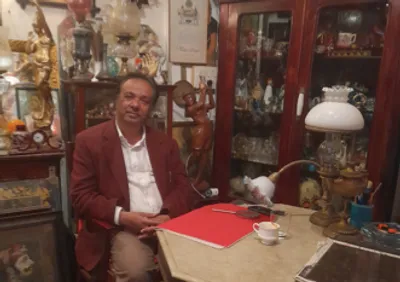
Zafar Ansari in his Museum Office. Photo: C. Yamini Krishna

As I was preparing for my research visit to Indore for a study on the princely state of Indore, all I found online were a few articles from Free Press Journal on the city. It was just a glimpse of how much of the ‘national’ media coverage and public history writing is focussed on the metropolitan cities.

Absence, inaccessibility, decay of archives and historical artefacts are constant challenges faced by history scholars in India. The lack of historical consciousness, poor funding, disinterest, discrimination, and destruction of the archives based on the ideology of the ruling disposition are some of the known reasons why such problems exist. These challenges are acute as one moves beyond the metropolitan cities, into the smaller cities and towns.

History in India, has mostly been studied from the perspective of the nation and to such endeavour small places are often insignificant. Also due to the policy of housing all the state archives in capital cities and the absence of efforts to do neighbourhood or local/regional histories, smaller cities almost feel ‘history less.’

However, inspite of the institutional gap, voices from the smaller cities are not silent. Each time I have ventured into these cities in search of archives, I have always met individuals who have taken upon themselves the task of archiving, preserving, narrating, and circulating historical narratives — all for the love of the place and history.

Indore-based Zafar Ansari is one such person who has been painstakingly collecting historical artefacts on Indore since three decades. “It all started when I received the National Youth Award for my social activities in 1994. The then President Dr Shankar Dayal Sharma said, do something great, and then I decided I will build a museum for Indore,”Ansari says with a sparkle in his eye as he narrated his dream to make a museum for his beloved city Indore.

“This will be one of its kind museum, dedicated to the city, telling the story of the city,” he mentioned. His office in Barwani Plaza in Old Palasia, bustling with artefacts, feels like a portal into another time. As one spends time with these objects, they start speaking through the voice of Ansari.

A miniature maker for industries by profession, Ansari spends more than 60% of his income towards the museum. He never lets any historical object pertaining to Indore pass, without acquiring it, sometimes this means he has had to pay very high price. “It is almost like an addiction,” he says, “It has its flip sides. I have never been able to pay my daughter’s education fee before the last date.”

The history walks, myth-busting artefacts and rare photographs 

Ansari is also committed towards sharing his collection. He conducts history walks in the city and curates specific objects from his collection to tell stories of the city. Ansari has recently conducted one such walk for some of the dignitaries who had visited India during the G20 summit. He regularly runs a history column in Dainik Bhaskar where he reintroduces stories of the past to Indore’s citizens.

“I don’t just write about Kings, but also about common people, their lives,” he says, what a historian would call the social history of the place.

Through his consistent effort of writing more than 300 essays on history, Ansari has built a cannon of public history for Indore. Sitting among those objects, he narrated how Indore (state) became a commercial centre due to its close connection with opium trade, “Opium would come from Mansur to Indore and then to Bombay. Many traders and merchants from Rajputana and Gujarat settled here to do opium trade with China. After the ban on opium, the trade was converted to cotton industry.”

Ansari is hopeful that his museum will be a pedagogic intervention. “History is not something to be taught in a classroom, it has to be taught in an archive or a monument or on field using objects and artefacts,” he notes. His work with the artefacts also helps him dispel certain myths and false narratives in circulation.

Ansari’s collection has helped writers like Geraldin Lenain to write books such as The Last Maharaja of Indore by providing access to many rare photographs.

A historian or an antiquarian

After meeting Ansari, I was wondering, if there is a term to describe this love for history, something like a cinephile in case of film.

A historian is often a tag used to describe someone who engages in the work associated with history making, professionally, i.e. as a main vocation. A history buff, focusses more on consumption of history and fails to capture the commitment shown by these keepers of a city’s lore. A collector, is often differentiated from an archivist as someone who is more involved in the process of acquiring artefacts, and is not primarily oriented towards providing access. Someone like Ansari, however, who harbours a hope to build a museum, would fall somewhere in between these two.

Cambridge Dictionary offers a word antiquarian, “a person who studies or collects old and valuable or rare objects.” Antiquarianism historically has often had a negative connotation, as someone in an almost ‘mindless’ pursuit of collecting objects and committed to the minute details of it. Historian, on the other hand, is someone who narrativised the past, with the focus on writing.

Historian Rosemary Sweet notes that history writing could be done for political or polemical purposes while antiquarians prided themselves to be impartial and staying true to the material. Antiquarians are often interested even in objects of everyday life which was not of interest to historians. Interestingly, Sweet points out that the contemporary practice of history, associated with archival study, which relies on the details presented by historical artefacts is very close to antiquarianism.

After searching for these variety of terms, I am still left with no word to capture the affective engagement with history which I experienced in the office of Ansari, where history is not just a vocation or a profession, where there is a lot at stake in telling stories of the past, a significant portion of one’s earnings. This voice of history is not a dispassionate, distant evaluation of the past, but is an expression of belongingness.

Deeply personal work like this has larger social implications, it is about communities taking the ownership of their own history, and inculcating historical consciousness among themselves. Such efforts go a long way in forming the first line of defence against vilification of history and weaponisation of history for political gains, of which we are seeing increasing incidence.

C. Yamini Krishna works on film history, urban history and Deccan history. She is a part of the Khidki collective. She currently teaches at FLAME University. 

This work was done as a part of the Foundation Project is implemented by India Foundation for the Arts (IFA) under the Arts Research programme, made possible with support from BNP Paribas India.

source: http://www.m.thewire.in / The Wire / Home> Culture / by C Yamini Krishna / May 16th, 2024
‘Mini Brazil of India’ Was Once Infamous for Illegal Liquor: How One Man Transformed a Village

Bicharpur Village (Shahdol District), MADHYA PRADESH :

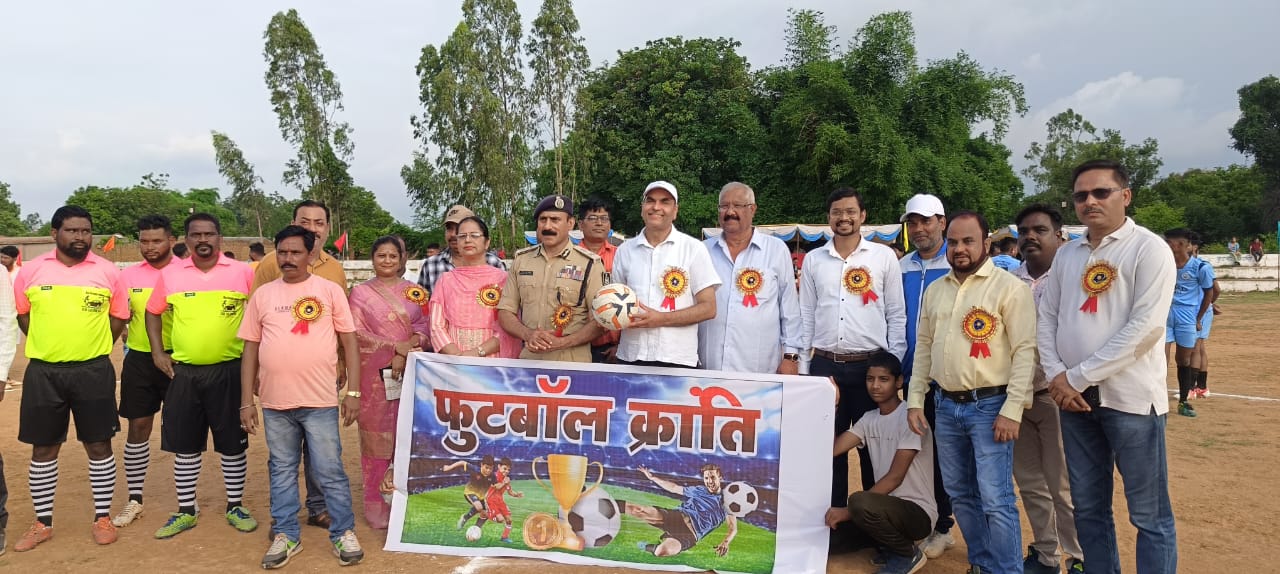
Once known for illegal liquor, Bicharpur village in Madhya Pradesh is now a football hub, producing around 45 national players.

Learn how coach Raees Ahmed’s efforts kickstarted this transformation.

Almost a decade ago, Bicharpur — a village in the tribal-dominated Shahdol district of Madhya Pradesh — was notorious for its rampant production of illicit liquor and narcotics. The primary source of income for many families was the production of liquor from the locally available mahua fruit.

“In this village, every house has been making kachhi shat (mahua liquor) for generations. They did not consider it wrong or illegal since it was deeply ingrained in their culture for a long time. Even children, regardless of their ages, were involved in this work. In fact, the villagers, including children, consumed liquor regularly; it was like their everyday tea and the medicine for any disease,” Raees Ahmed tells The Better India.

However, today the village has undergone a remarkable transformation, emerging as a hub for the rising stars of football . It has produced around 45 state and national-level football players — including Sanya Kunde, Rajni Singh, Laxmi Sahis, Anil Singh Gond, and Hanuman Singh.

Because every household in the village has a football player, it has come to be known as the ‘Mini Brazil’ of Madhya Pradesh. The journey of Bicharpur village from its miserable state to ‘Mini Brazil’ was orchestrated by former footballer and coach Raees Ahmed.

An unlikely football hub

Raees says that the Shahdol division has been a football hub for nearly three generations. The tribal children grew up playing football but without any formal training. Raaes, who has been playing football since the age of 10, was one of them.

“We used to learn football by seeing players in tournaments. But we did not have any formal training or guidance in the sport,” says the 53-year-old who grew up following Diego Armando Maradona — a professional football player from Argentina.

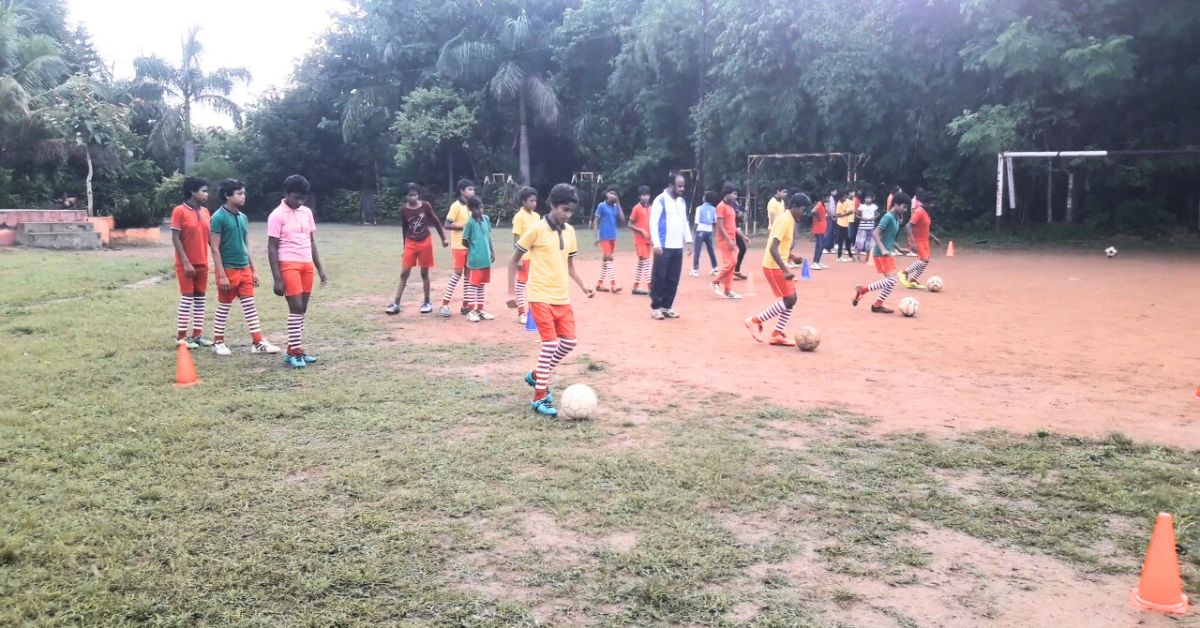
Earlier, the tribal children grew up playing football but without any formal training.

When Raees was in Class 8, he recalls, he played in the ‘under 19’ category at the national level. He went on to play football professionally at the national level seven times during his career. After graduating with a Bachelor of Arts in 1995, he secured a job as a sports teacher at a higher secondary school in Shahdol.

Then in 1997, he took formal training from the National Institute of Sports (NIS) in Kolkata. “To be a player and to be a coach are two different things. Since I was a national-level player, I thought I was an expert, but I was under the wrong impression. There [at NIS], I realised I had very limited knowledge. I realised if I had known these professional techniques, I could have played at the international level,” he says.

Coming back home, Raees went back to his old job. A couple of years later in 2001, he visited the nondescript village of Bicharpur, roughly three kilometres from his workplace.

“I saw many children in this village playing football. They had the fitness of an athlete but lacked training and techniques. They did not know how to pass the football and when to hit the ball to score a goal. After speaking to them, I realised that they did not know much about the outside world, and suddenly, I remembered my childhood!” he adds.

That day, Raees decided to be the support he desired when he was a child.

Where there’s a will…

Every evening, post his office hours, Raees would set out for the village on his bicycle. He started training children in the age group of 8–12 years. But there was no formal set up for the ground and tribal children lacked basic amenities like shoes and jerseys. “Initially, I would dedicate half of my salary to arrange basics for them,” he says.

Raees says, Shahdol divisional commissioner Rajeev Sharma established at least 1,200 clubs in all villages across the Shahdol division.

Seeing a good response from the children, the coach also encouraged them to quit the mahua work if they wanted to seriously dedicate themselves to building a career in sports. “These children helped their families quit nasha khori (alcoholism) and switch to other works like labour jobs,” he informs.

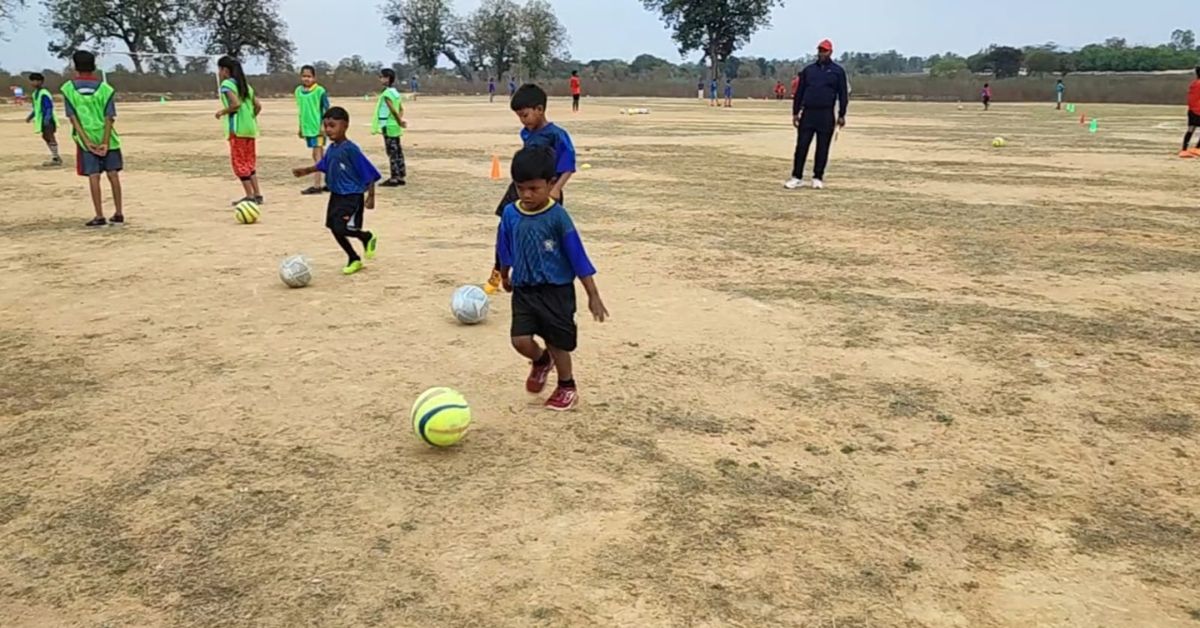
Raees adds that by 2003, these children started playing in the ‘under 14’ category at the state and national level, and by 2004, girls also started participating in the sport. So far, the coach has trained at least 1,500 children, and of these, 45 have made it to the state and national level competitions.

One of his students, Laxmi Sahees, has been playing football since she was 12. She would tag along with her brothers to the football ground after school. She tells The Better India, “Initially, we went out of curiosity and for fun, but soon, we became so interested that we would rush to the ground for daily practice after finishing all household work.”

She continues, “Raees Sir told us about the tournaments for the women’s team. And within a year, in 2007, I participated in the national level competition and was selected in the first round. We competed with Kerala, Tamil Nadu, and UP and reached the quarter-finals.”

“Football has given me an opportunity to learn about the outside world. If I had not been into football, I guess I would have been married off at an early age and had a few kids like my elder sisters,” adds the 27-year-old who, so far, has played at nine national level competitions.

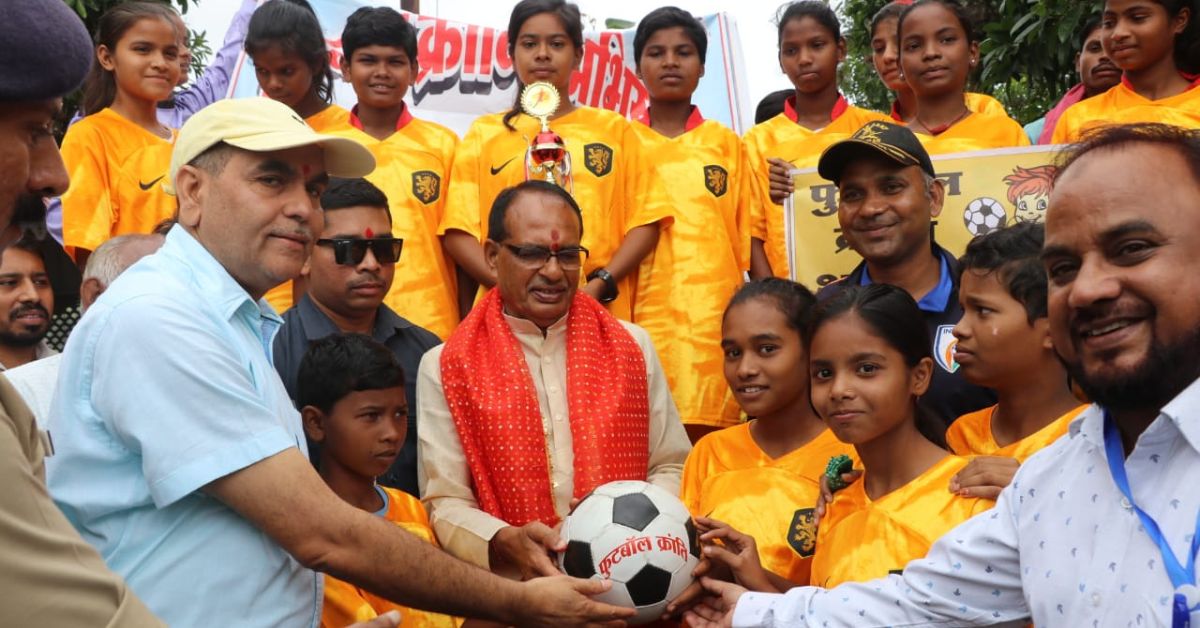
Raees and his students with Chief Minister Shivraj Singh Chouhan.

Currently, Laxmi coaches 40 students from Bicharpur and nearby villages. In the recent Khelo MP Youth Games 2023, her students bagged gold.

Laxmi’s coach sir is extremely proud of her and her students. “It is a matter of extreme pride to be able to compete and be a state champion coming from a small village,” remarks Raees.

Over the years, Raees says, Shahdol divisional commissioner Rajeev Sharma also recognised the talent in Bicharpur and established at least 1,200 clubs in all villages across the Shahdol division. “Today, 80 to 85 football tournaments are organised in the division every year. By 2022, there had been a noticeable improvement in the local people’s quality of life. They now enjoy facilities like electricity, a professional ground, and an open gym. Additionally, the government provides a dedicated budget for the sport in the area,” he adds.

Recently, Prime Minister Narendra Modi also highlighted the budding footballing talent of Bicharpur on Mann Ki Baat. “Just imagine — a tribal area, which was known for illicit liquor and was infamous for drug addiction, has now become the ‘football nursery’ of the country. That is why it is said, ‘Where there is a will, there is a way’. There is no dearth of talent in our country, but there is certainly a need to find and nurture them,” said the PM.

Raees still coaches students in the division, and now he’s joined by national players from Bicharpur who are mentoring new talent in the Shahdol division. For him, the village’s transformative journey has been emotionally inspiring.

“Whenever I watch my students on TV, competing against other skilled players, I feel nervous throughout the match. When our students win, it is not just their victory but also a win for me as their coach. It brings happy tears to my eyes. Now, my students are also training other children, and the happiness cannot be expressed in words. Over the past few years, the entire village’s atmosphere has transformed. We hope to produce many more national players from the entire Shahdol division,” says Raees.

Edited by Pranita BhatAll photos: Raees Ahmed.

source: http://www.thebetterindia.com / The Better India / Home> English> Stories> Football> Rural India / by Shivani Gupta / October 09th, 2023

Sohail Khan Clinches Historic Silver Medal At Kudo World Cup 2025

Sagar, MADHYA PRADESH :

Burgas, Bulgaria :

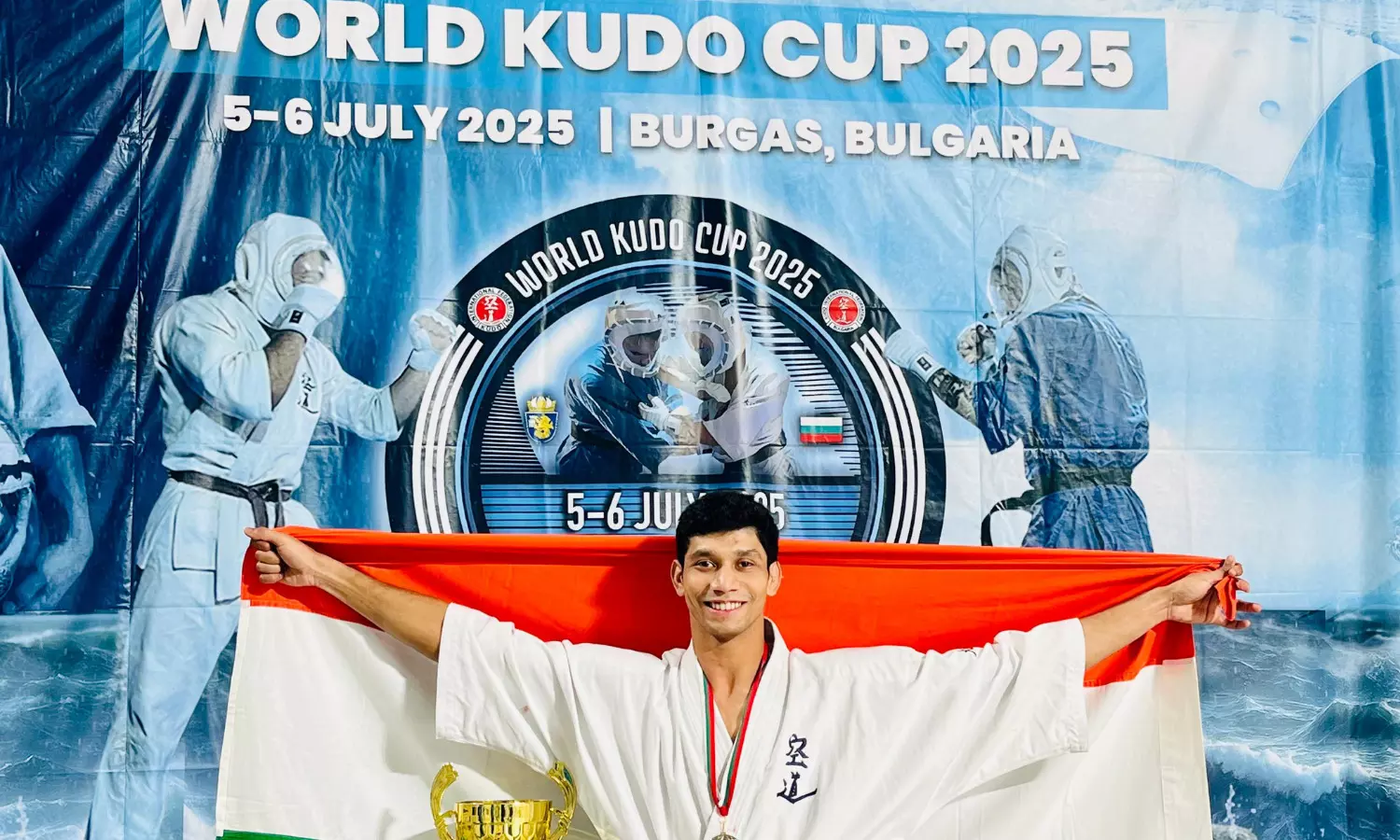
India’s Sohail Khan scripted history at the Kudo World Cup 2025 by securing a silver medal in the Men’s -250 P category, registering the nation’s best-ever finish in the senior men’s division at the global event. The prestigious tournament was held in Burgas, Bulgaria and featured participation from top Kudo athletes from around the world.

Hailing from Sagar, Madhya Pradesh, Sohail, also known as the “Golden Boy of MP,” performed exceptionally well to earn his place on the podium.

Sohail began his campaign in the Round of 16 against Pakistan’s Abdulla, but advanced via walkover after the opponent failed to meet the weight requirement. In the quarterfinal, Sohail battled hard to secure a narrow 1-0 win over Bulgaria’s Rusev Radoslav.

In the semifinal, Sohail delivered one of his most dominant performances of the tournament, defeating Andzej Voinius of Lithuania by a commanding 4-0 margin. With this win, he secured his spot in the final and guaranteed India at least a silver medal, a first for the country in this category.

In the gold medal bout, Sohail faced a tough challenge against France’s Quentin Miramont. The contest was intense and evenly matched, with neither fighter managing to score a definitive point in the standard two rounds.

As a result, the referee decided to extend the bout to a rare third round, the first time in the entire World Cup that any fight had gone that far. Despite Sohail’s spirited and resilient performance, he eventually fell short by just two points, settling for silver in a historic finale.

Sohail’s success is also a reflection of the strong support system behind him. He is coached by Mohammad Aijaz Khan, with Harikant Tiwari serving as his conditioning coach, Deepak Tiwari as his strength and nutrition coach, and Bhabajeet Choudhary as his striking coach.

This silver medal is the latest addition to Sohail’s decorated career. A former Junior World Cup gold medallist (2017) and a four-time gold medallist in the Akshay Kumar International Kudo Tournament, Sohail had finished as a quarterfinalist at the 2023 Senior World Championship.

He entered the 2025 World Cup as the 12th seed following his bronze at the Eurasian Cup earlier this year, and has now exceeded expectations by becoming India’s top senior performer at the global level. — IANS

source: http://www.clarionindia.net / Clarion India / Home> Indian Muslims> Sports / by Clarion India / July 08th, 2025

MP 10th Result 2025: Fatima, Sumbul, Tarannum, Ashhad in Top 10 List

MADHYA PRADESH :

Shezah Fatima, Sumbul Khan, Tarannum Rangrez and Mohammed Ashhad are four Muslims who have figured in the MPBSE Madhya Pradesh 10th List of Top 10 for the year 2025 released along with the result Tuesday.

[Representative image by Grok 3]

MP Class 10 Result 2025: 

Madhya Pradesh SSC 2025 Toppers List: Shezah Fatima, Sumbul Khan, Tarannum Rangrez and Mohammed Ashhad are four Muslims who have figured in the MPBSE Madhya Pradesh 10th List of Top 10 for the year 2025 released along with the result Tuesday.

Shezah Fatima from Jabalpur bagged a total of 498/500 marks and secured the 3rd rank in Madhya Pradesh.

On the other hand, Sumbul Khan of Sagar district and Tarannum Rangrez of Damoh district bagged a total of 496/500 and secured the 5th rank in the MPBSE 10th Toppers List 2025.

Also in the Madhya Pradesh SSC Merit List 2025 is Mohammed Ashhad. Ashhad bagged 495 out of the total 500 marks and stood 6th in whole of Madhya Pradesh.

The state topper in the MPBSE SSC 2025 board exam is Pragya Jaiswal of Singrauli district. She has scored 500 out of 500 marks i.e. 100% marks to secure the top rank in the MP Class 10 board exams 2025 held from February 27 to March 19, 2025.

MPBSE 10th Toppers 2025

The top three students in the Madhya Pradesh board SSC Merit List 2025 are:

  • Rank 1: Pragya Jaiswal from Singrauli (500 marks)
  • Rank 2: Ayush Dwivedi from Rewa (499 marks)
  • Rank 3: Shezah Fatima from Jabalpur (498 marks)

Girls have preformed excellently well across the board.

According to the 10th result announced today, a total of 212 students have featured in the Madhya Pradesh SSC Merit List 2025. Notably, 144 of them are girls.

MP 10th Result 2025 – Top 10 Districts

Narsinghpur district has topped in terms of pass percentage in both MP 10th exam, followed by Mandla district. The list of top 10 districts are:

  1. Narsingpur 92.73% of regular students pass
  2. Mandla 89.83%
  3. Balaghat 88.07%
  4. Anooppur 87.66%
  5. Neemuch 87.29%
  6. Shajapur 86.22%
  7. Sehore 85.54%
  8. Hoshangabad 84.08%
  9. Dewas 84.05%
  10. Jhabua 83.88%

MPBSE 10th 2025: Division wise Result

Over 4 lakh students have passed MP 10th SSC 2025 exam with 1st division.

  • First division: 4,290,42 students
  • Second division: 1,821,72
  • Third division: 2,200
  • Pass division: 0

Details of Regular Students

  • Registered: 8,100,19
  • Absent: 5,087
  • Appeared: 8,049,32
  • Cancelled: 125
  • Withheld: 39
  • Result declared for: 8,047,68
  • Pass: 6,134,14
  • Failed: 1,91,354
  • Pass percentage: 76.22 per cent

The state has registered an overall pass percentage of 76.22%. It is the best result in the past 15 years, the MP board said.

Steps to Check MP board Class 10 HSC Result 2025

  1. Click here to go official MPBSE official website: “mpresults.nic.in“.
  2. Click on “HSC (Class 10th) Exam Result 2025”.
  3. Enter roll number and name.
  4. Click on “Submit”.
  5. The results will be displayed on the screen.
  6. Save the results and take a print out for further reference.

The students can check their MPBSE Class 10 or HSC results 2025 along with Class 12th HSSC Vocational Exam 2025 on the official website www.mpresults.nic.in, mpbse.mponline.gov.in, mpbse.nic.in, ExamResults.net, MPEducation.net indiaresults.com results.mpeducation.net, knowyourresult.com.

MP Board Previous Year Toppers

In 2024, the MP board Class 10 exam, the state had registered an overall pass percentage of 58.10%.

In 2023, the MP Board Class 12 Exams were held from March 2 to April 01, 2023, at various test centers across the state.

A total of 7,29,426 students had registered for the Class 12 MP Board exams. Out of them 7,27,044 appeared in the exam and 4,01,366 (55.20%) were declared passed. The pass percentage of boys in 2023 was 51.91% and that of the girls stood at 58.69%.

Narayan Sharma (488 marks), Gaurav Mourya (486 marks), Ritin Lodhi (486 marks) and Prachi Patel (485 marks) were toppers in Science stream.

On the other hand, the MP Board Class 10 Exams last year were held from March 1 to March 27, 2023, at various test centers across the state.

A total of 8,20,014 students had registered for the Class 10 MP Board exams. Out of them 8,15,364 appeared in the exam and 5,15,955 (63.29%) were declared passed. The pass percentage of boys in 2023 was 60.26% and that of the girls stood at 66.47%.

source: http://www.ummid.com / Ummid.com / Home> Education & Career / by ummid.com news network / May 06th, 2025

Farkhanda Qureshi: Small town woman achieves big success by securing 67th rank in UPSC

Balaghat, MADHYA PRADESH :

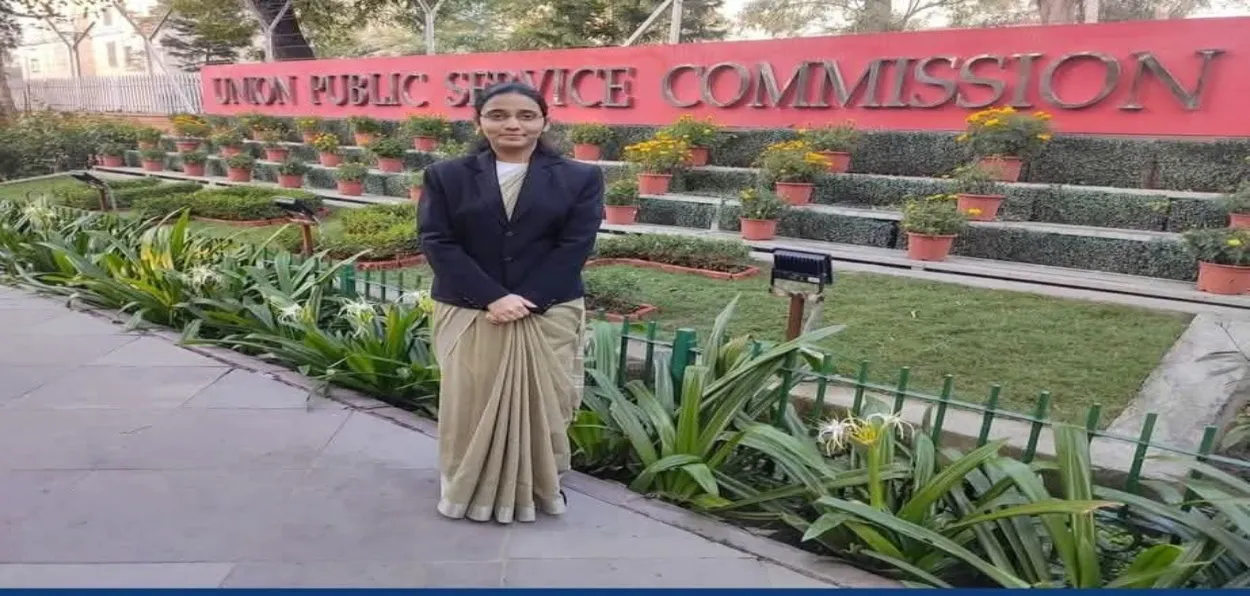
Farkhanda Qureshi of Balaghat, Madya Pradesh, outside UPSC office in Delhi

Farkhanda Qureshi was in her eighth grade when she saw district Collector B. Chandrasekharan son a local Television channel. This visual ignited a dream in her mind; she too wanted to become a civil servant. Today this Muslim woman from from Balaghat, a small town of Madhya Pradesh, has realized her dream which she nurtured over the years with passion, hard work, overcoming failures and perseverance.

Farkhanda Qureshi has secured 67th rank in the UPSC 2024 Civil Services Examination and would soon join the Lal Bahadur Shashtri National Academy for Administration, Dehradun, for training to become an Indian civil servant.

“I had decided that one day I will also become a collector and work for society.” She credits her success in her fourth attempt to her family’s support.

She started preparing for UPSC in 2021. Despite failures, she did not give up. She says, “My parents did not let me break down; they motivated me and told me that I will get success one day. Had they not supported me, I would have probably given up in the first or second attempt,” she told the told media persons.

Farkhanda believes that for a tough exam like UPSC, studying for 18 hours is not necessary, but consistency and strategy are. “I studied for 6 to 8 hours every day, but I studied every day. Old year papers, standard books, current affairs and newspapers were an important part of my preparation.”

Farkhanda Qureshi flanked by her parents Nikhat Anjum and Abdul Malik Qureshi

Farkhanda, who completed her 10th from St. Mary’s School and 12th from Methodist Mission, says, “Being from a small town like Balaghat has never been my weakness. I believe that if the youth here get the right direction and resources, they can make a name for themselves across the country.”

Farkhanda considers her father Abdul Malik Qureshi, who is a lawyer, and her mother Nikhat Anjum Qureshi, a homemaker, her heroes and credits her success to them.

Her father said, “Today people recognize me by my daughter’s name, nothing can give me greater happiness than this.”

There is a festive atmosphere in the area, the collector congratulated Farkhanda and and wished her a bright future. The local mosque committee (Anjuman( also felicitated her and called her inspiration for the Muslim youth.

Out of the 1,009 candidates recommended by UPSC this year, 26 are Muslims, though none made it to the Top 25. 

Iram Choudhary (Rank 40) and Farkhanda Qureshi (Rank 67) are the highest-ranking Muslim candidates in the merit list. A total of 97 Muslim candidates were selected for the interview stage, and the success rate stands at 2.57%, lower than previous years.

source: http://www.awazthevoice.in / Awaz, The Voice / Home> Stories / by Abdul Wasim Ansari, Balaghat, Bhopal (name error edited) / April 26th, 2025

Wajid Khan: An artist’s unique obsession with Mahatma Gandhi

MADHYA PRADESH :

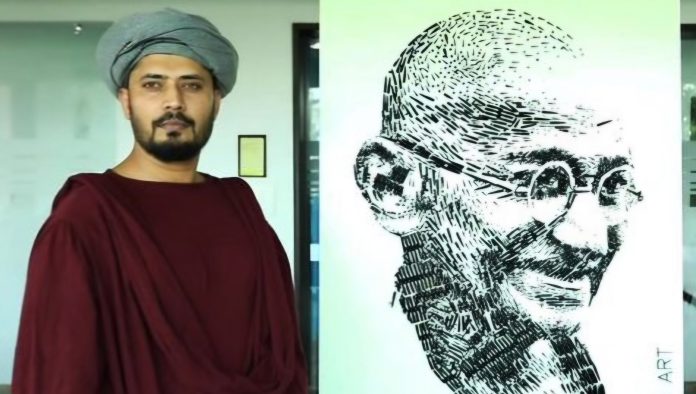
Wajid Khan Artist with the portrait of Mahatma Gandhi he made with nails.

Few artists are as passionately obsessed with Mahatma Gandhi as Wajid Khan, whose love and reverence for Gandhi manifest in extraordinary ways through his art. Wajid’s devotion to the Father of the Nation is evident not only in the subjects of his artwork but also in the innovative techniques he uses to create them. Whether by assembling nails, arranging goggles, or using other unconventional materials, Wajid Khan’s portrayal of Gandhi is a testament to his deep admiration.

Gandhi ji art by Wajid Khan #shorts

Wajid Khan  a multifaceted artist—a portraitist, sculptor, inventor, and patent holder—known for pushing the boundaries of traditional art. He specializes in creating intricate works of art using unconventional materials such as iron nails, bullets, metal, stones, automobile parts, medical equipment, iron rods, and more. His passion for creativity is boundless, and his art often reflects his deep emotions and thoughts about the world and the figures who have shaped it.

Among his many talents, Wajid’s ability to carve canvases using iron nails has garnered international acclaim. His work has earned him places in prestigious records such as the Guinness Book of World Records, Limca Book of Records, and Asia Book of Records. His artistic prowess is admired from Mumbai to Dubai, captivating both art connoisseurs and the general public with his exceptional nail art.

Although Wajid has made portraits of numerous iconic personalities, including Indira Gandhi, Jawaharlal Nehru, Sardar Patel, Dhirubhai Ambani, and Nelson Mandela, his fascination with Mahatma Gandhi stands out. His first portrait, fittingly, was of Gandhi—a powerful expression of his love and passion for the man who led India to independence. Wajid meticulously used thousands of iron nails to craft this portrait, each nail symbolizing the unwavering dedication and perseverance Gandhi embodied throughout his life.

Wajid’s connection to Gandhi goes beyond artistic inspiration. His admiration for Gandhi stems from the values of patience and truth that Gandhi represented. “There are many qualities in Gandhiji that impressed me deeply,” Wajid shared in an interview. “His power of patience and his commitment to truth are what stand out the most. For me, those who hold onto patience and never lie are truly great individuals.”

One of the moments that left an indelible mark on Wajid was when he visited a museum and saw letters written by Gandhi in which the leader openly admitted his mistakes. “It takes a big heart to admit one’s mistakes in public,” Wajid reflected. “I greatly admire Gandhi’s patience and steadfastness.”

Wajid’s connection to Gandhi also has personal roots. He fondly recalls stories from his grandfather, who would attend Gandhi’s meetings during the freedom movement in India. “My grandfather used to tell us about the time when he was very young and would participate in Gandhi’s meetings. Enthusiastic crowds would gather to listen to Gandhi, and when they returned, they were always calm and composed,” Wajid recounted. The calm demeanor Gandhi inspired in his followers left a profound impact on Wajid, influencing both his life and his art.

In one of his most ambitious projects, Wajid demonstrated the extent of his dedication to honoring Gandhi. He organized an event where 6,000 people were gathered in a stadium, carefully arranged in a formation that created a massive portrait of Gandhi. This live depiction showcased not only Wajid’s artistic genius but also his ability to bring people together to celebrate Gandhi’s legacy.

Wajid Khan’s artistic journey is a remarkable blend of creativity, innovation, and an unyielding devotion to Gandhi’s principles. Through his portraits, sculptures, and inventive techniques, he continues to keep the spirit of Gandhi alive, inspiring others with the same values of patience, truth, and perseverance that Gandhi embodied.

source: http://www.muslimmirror.com / Muslim Mirror / Home> Indian Muslim> Positive Story / by Syed Zubair Ahmad / October 02nd, 2024

After halt of 2 years, country’s largest Islamic congregation commences in Bhopal

Bhopal, MADHYA PRADESH :

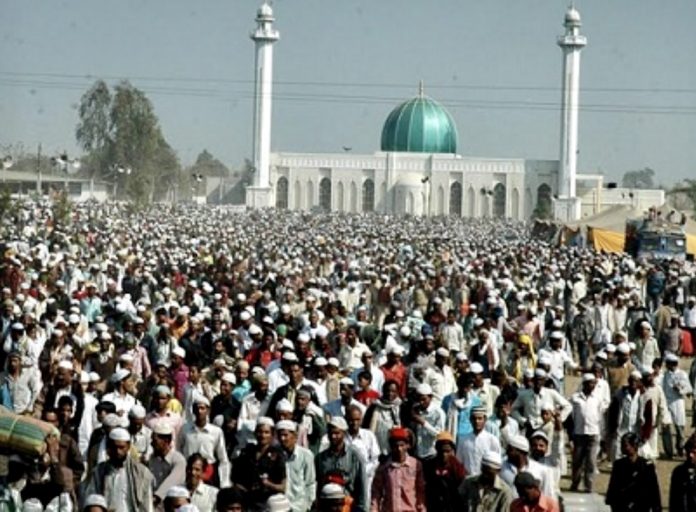
Picture of the Alami Tablighi Ijmeta held in 2019. | Picture: Tablighi News 365

Held for the first time in 1948, the Bhopal Ijtema is known for its massive participation of people and for promotion of peace and inclusivity.

Bhopal (Madhya Pradesh) :

The Alami Tabhligi Ijtema, an annual Islamic congregation held every year in Madhya Pradesh commenced today in the outskirts of the capital Bhopal. The four-day religious event is the third-largest Islamic congregation globally. The first such congregation was held 73 years ago. The event is taking place after two years of halt caused by the Covid-19 pandemic. 

The congregation is not only popular for being the largest religious gathering in India but is also well known for the promotion of peace and inclusivity. 

For the first time, international participants will not be in attendance at the congregation. 

According to a report in Dainik Bhaskar, the congregation will be held on 300 acres of land. “20,000 volunteers will handle management. More than 17,000 taps are installed for ablution only. 7 crore litres of water will be consumed every day for drinking, ablution, and cleansing. Non-veg food is banned due to Lumpi Virus. There will be 45 parking slots and 7000 dustbins. 5000 volunteers will take care of the cleaning. 5 fire brigades and 6 fire bullets will be present there. 2000 policemen will manage security and 500 will handle the traffic management. There will be 3 hospitals of 10 beds each as well,” the report said. 

History of the congregation
Shams Ur Rehman Alavi, a prominent journalist and former editor with Hindustan Times told TwoCircles.net that even though this grand congregation of Muslims is a purely religious event but in Bhopal, it means much more. “It has a unique relationship with the city and its inhabitants irrespective of their beliefs. Come winter and there is a buzz about the dates of Ijtima. Though such gatherings are now held in different cities across the country, the Ijtima here has an altogether different ‘connect’ with the people,” he said. 

Shams Ur Rehman Alavi said that after the independence of the country, the first congregation was held in Bhopal in 1948 at Masjid Shakoor Khan. 

It is said that the first congregation was a small gathering. Later, it was shifted to Taajul Masajid and became a big event. In 2002, it was shifted to outside the city in Eintkhedi as the gathering had become too big by then with a participation of 5 lakh people. Today, nearly 1.5 people congregate at the event. “People still get nostalgic when it was held in Tajul Masajid for over half a century. In those days, the temporary market that came to be associated with the gathering gave the congregation another meaning for Bhopalites,” Shams Ur Rehman Alavi said. 

Preparations run for months
The preparations for the congregation began several months ago. Many youths from the nearby areas volunteer to help with the preparations. “This is farmland. It is very difficult to clean it and make it suitable for the congregation. We made drainage to discharge water from the farms with the help of a generator to dry the land sooner,” Abuzer, a volunteer, told TwoCircles.net. 

Abuzer said all volunteer work is done by Muslims. “People willingly come here and do labour without demanding charges. We do it for the sake of Allah,” he said. 

Atiq Ul Islam is a member of the organizing team that is looking after the preparations. He told TwoCircles.net that the 300 acres of farmland where the congregation is taking place is lent free by locals, which include both Muslims and non-Muslims. 

“Non-Muslims have never refused to lend their lands to this congregation. We organize this Ijtima to please God and send a message to the world to follow God’s commandments which is to do good and refrain from evil,” Atiq Ul Islam said. 

He said that the congregation is held to send a message of peace. “Every faithful attends this Ijtima,” he said. 

Atiq Ul Islam informed that Muslim volunteers also take responsibility for security and traffic management. “The administration plays a supporting role by keeping an overall eye on things. Rest everything is managed by our volunteers,” he said. 

Akram Ahmed Khan is a resident of Bhopal who has been attending the congregation since childhood. For many years, he has volunteered at the event.  

Akram said that the congregation has a cross-functional team that has a dedicated system including a security team, transportation and commute team, road management (traffic management) team, parking team, and emergency and procurement (medical team). “The management skills I learned here have helped me in my professional life as well,” Akram Ahmed said. 

For effective disposal of waste, the management collaborates with Bhopal Municipal Corporation (BMC). For its zero-waste, the congregation has earned laurels.

Huneza Khan is a student and a budding journalist from Bhopal, Madhya Pradesh. She tweets  @KhanHuneza

source: http://www.twocircles.net / TwoCircles.net / Home> Lead Story / by Huneza Khan, TwoCircles.net / November 18th, 2022

Avesh Khan most expensive uncapped Indian ever after Lucknow Super Giants gets him for Rs 10 crore

Indore, MADHYA PRADESH :

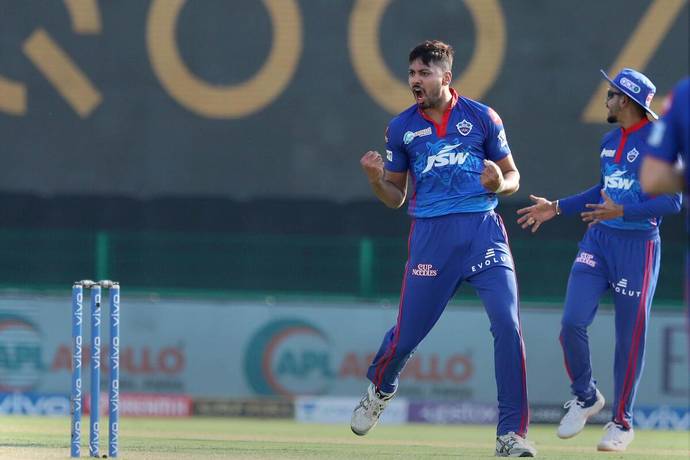
Avesh Khan became the most expensive uncapped Indian player after Lucknow Super Giants signed him for Rs 10 crore.

Avesh Khan was released by Delhi Capitals.   –  IPL/SPORTZPICS

Chennai Super Kings and Lucknow Super Giants were locked in a bidding war initially before Mumbai Indians came in as the bid jumped past Rs 4 crore.

Mumbai and Lucknow were then locked in a bidding war, with Sunrisers Hyderabad entering the fray as the bid reached Rs 9.75 crore.

Lucknow then held the bid at Rs 10 crore and acquired Avesh’s services.

source: http://www.sportstar.thehindu.com / Sport Star / Home> IPL Auction> Auction / by Team Sportstar / February 12th, 2022