Tag Archives: Mahmood A Madani

Muslim Mirror Releases List of 100 Most Influential Indian Muslims 2025; Young Faces Gain Prominence

INDIA :

Muslim Mirror’s 100 Most Influential Muslims of 2025

New Delhi: 

Muslim Mirror has released its much-anticipated annual list of the “100 Most Influential Indian Muslims of 2025,” spotlighting individuals who have made significant contributions to India’s public life across a wide spectrum of fields including politics, culture, education, business, media, religion, sports, and social service. Now in its second edition, the list aims to document influence not merely as power or popularity, but as sustained impact, leadership, and the ability to shape public discourse.

A defining feature of the 2025 edition is the growing prominence of younger achievers, signalling a visible generational shift within Indian Muslim leadership. Alongside established national figures, the list includes emerging voices who have built influence through grassroots activism, professional excellence, digital platforms, legal advocacy, education, and community engagement. Editors associated with the project said this was a deliberate attempt to recognise new centres of influence beyond traditional hierarchies.

The list reflects the diversity and plural character of Indian Muslim society, cutting across geography, ideology, profession, and language. From seasoned politicians and religious scholars to artists, entrepreneurs, academics, and social reformers, the compilation offers a broad snapshot of leadership trends at a time when issues of representation, constitutional values, and social justice remain central to national debate.

Representation Across Sectors

The 2025 list features several eminent academicians and intellectuals who have shaped higher education, policy discourse, and social research. Among them are Abul Qasim Nomani, Ameerullah Khan, Furqan Qamar, Shahid Jamil, and Ubaid-ur-Rahman, recognised for their contributions to education, public policy, and academic leadership.

In the business and entrepreneurship category, the list includes influential names such as Azad Moopan, Azim Hashim Premji, Farah Malik, Irfan Razack, M. P. Ahammed, Mecca Rafiq Ahmed, Meraj Manal, Syed Mohamed Beary, P. Mohammed Ali, Shahnaz Hussain, Tausif Ahmad Mirza, Yusuff Ali, and Ziaullah Sharif. Their inclusion underlines the growing economic footprint of Indian Muslim entrepreneurs, both domestically and globally, spanning sectors from retail and healthcare to infrastructure and consumer goods.

Community leadership remains a strong pillar of the list, with figures such as Arshad Madani, Mahmood Madani, Malik Motasim Khan, Mehmood Pracha, Syedna Mufaddal Saifuddin, Navaid Hamid, Pirzada Md Abbas Siddiqui, Qasim Rasool Ilyas, Sadatullah Husaini, Umer Ahmed Ilyasi, and Yusuf Mohamed Abrahani recognised for their roles in religious guidance, legal advocacy, social mobilisation, and institutional leadership.

Culture, Media, and Public Discourse

In arts and entertainment, globally recognised names such as A. R. Rahman, Aamir Khan, Mammootty, Munawar Faruqui, and Shah Rukh Khan continue to command immense cultural influence, shaping narratives that extend well beyond cinema and music into social consciousness.

The list also acknowledges the growing importance of media and journalism in shaping opinion and challenging dominant narratives. Journalists and commentators such as Arfa Khanam, Irfan Meraj, and Seema Mustafa are recognised for their consistent engagement with issues of democracy, minority rights, and constitutional values.

Religious and Intellectual Scholarship

A significant section of the list is devoted to Islamic scholars and religious thinkers, reflecting their continued influence on moral leadership and intellectual discourse. Names such as A. P. Aboobacker Musliyar, Qasim Nomani, Prof. Akhtarul Wase, Asghar Ali Imam Mahdi Salafi, Asjad Raza Khan, Ibraheem Khaleel Al-Bukhari, Javed Jamil, Khalid Saifullah Rahmani, Khaleelur Rahman Sajjad Nomani, Qamaruzzaman Azmi, Rashid Shaz, Shakir Ali Noori, Shamail Nadvi, and Yasoob Abbas find place for their scholarly work, writings, and public engagement.

Politics and Governance

The political category features leaders cutting across party lines and regions, including Asaduddin Owaisi, Ghulam Nabi Azad, Hamid Ansari, Mehbooba Mufti, Omar Abdullah, Salman Khurshid, Najeeb Jung, Syed Naseer Hussain, Engineer Rashid, Akhtarul Iman, Iqra Hasan, Zameer Ahmed Khan, Rakibul Hasan, K. Rahman Khan, Kadir Mohideen, Mohibullah Nadvi, Md Shafi, Agha Mahadi, Asim Waqar, and Sadiq Ali Shihab Thangal. Their inclusion reflects influence exercised through electoral politics, governance, diplomacy, and legislative advocacy.

Changemakers and Social Reformers

One of the most dynamic sections of the 2025 list is that of changemakers and social reformers, featuring individuals such as Safeena Husain, Shahabuddin Yaqoob Quraishi, Syeda Hameed, Zameer Uddin Shah, Mahbubul Hoque, Sabahat S. Azim, Mehmood Pracha, Faiz Syed, and Zahir Ishaq Kazi, among others. Many of these figures have earned recognition through long-term grassroots work rather than formal authority.

International Booker Prize 2025 winner Banu Mushtaq for Heart Lamp, along with renowned poet Wasim Barelvi, has been placed in the category of Literary Figures.

In sports, iconic names Sania Mirza and Irfan Pathan continue to inspire younger generations through excellence and public engagement beyond the playing field.

Beyond Rankings

The editors emphasised that the list does not claim to be exhaustive, nor does it measure influence solely through fame, wealth, or official position. Instead, it seeks to capture real-world impact, moral authority, intellectual contribution, and the ability to shape conversations within and outside the community.

The annual list has increasingly become a reference point for understanding evolving leadership patterns among Indian Muslims. By foregrounding both established figures and rising talents, the 2025 edition reflects continuity as well as change, underscoring how Indian Muslims continue to contribute meaningfully to India’s democratic, cultural, and social field.

source: http://www.muslimmirror.com / Muslim Mirror / Home> Indian Muslim / by Muslim Mirror / January 15th, 2026
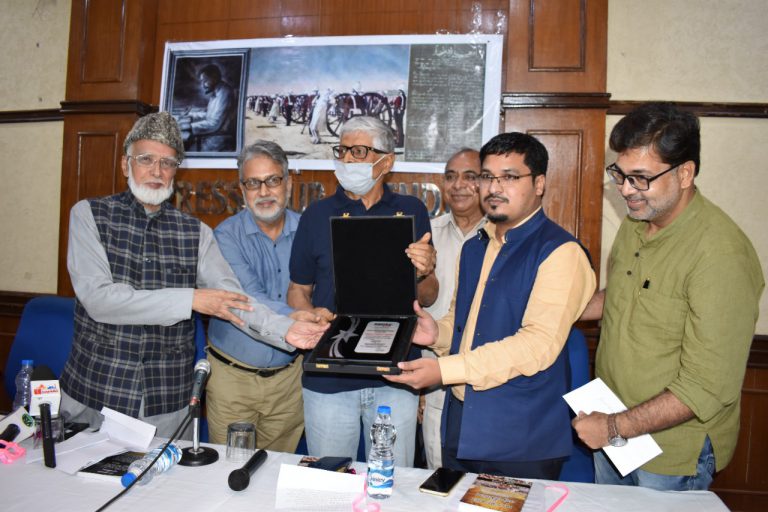
Shams Tabrez Qasmi is Felicitated with Amar Shaheed Molvi Baqar Award 2021

NEW DELHI :

Shams Tabrez Qasmi, the CEO and the chief editor of Millattimes, has been honoured with “Amar Shaheed Molvi Baqar Award 2021”.

The award is in the memory of the martyr and celebrated Urdu journalist Molvi Muhammad Baqar (1780-1857). The award was conferred upon him on 16th September 2021 in a programme held at the premises of the Press Club of India (PCI), 1 Raisina Road, Near Kirshi Bhawan, New Delhi-1 in the presence of the office bearers of the PCI and a good number of the journalists.

The award was presented to Mr. Qasmi in the recognition and appreciation of his commitment, dedication and continuous efforts in the field of journalism.

Millattimes, from its day one, had been covering the issues ignored by the mainstream media, specially the issues of the minority communities and the other weaker sections of the society.

The Award was sponsored by Media 24×7 and Abdul Sattar Memorial Educational Society.

The programme, wherein the award was presented, was held from the Press Club of India (PCI) to commemorate the 164th death anniversary of the Martyr of the first War of Independence 1857 and the famous Urdu journalist Maulvi Muhammad Baqar.

It was addressed by a galaxy of journalists like Mr. Jai Shankar Gupta, Member of Press Club of India, Satish Jacob, former BBC journalist, Meem Afzal, ex-MP, Ismail Zafar Khan, SK Pande, Arvind Kumar Singh, Qurban Ali, Maroof Raza, Masoom Moradabadi and others, besides chief guest Prof. Azra Mosavi, a direct descendant of Maulvi Muhammad Baqar’s grand family from AMU, Aligarh.

The Press Club of India resolved in its meeting held on 6th September 2021, in the presence of its President, Mr. Umakant Lakhera, Secretary General Mr. Vinay Kumar and other members, like Mr. A. U. Asif, Press Club of India’s executive member, to commemorate the death anniversary of the Martyr of the first War of Independence 1857 and the famous Urdu journalist Maulvi Muhammad Baqar.

It was also decided that an award after his name will be presented to two journalists every year along with an amount of 21,000-00 Indian Rupees.

According to the resolution, this programme was held on 16th September 2021 and two dynamic, youth, budding and promising journalists: Maulvi Shams Tabrez Qasmi, a Darul Uloom Deoband Alumnus and the Chief Editor of Millattimes and Swati Mathur, a JNU Alumnus and a reporter with The Times of India were felicitated with the award named after him.

The Press Club of India (PCI), as stated at its website, is basically a meeting point for the journalists. The idea to set up the Press Club of India was first conceived by eminent journalist and editor Mr Durga Das in the early 1930s. When he had visited London as the editor of the Associated Press of India, he had chance to visit the London Press Club as well. It became a motivator for him to replicate the model in Delhi.

Eventually the Press Club of India was founded on December 20, 1957 and incorporated as a company on March 10, 1958. Mr Durga  Dass, the then Editor of The Hindustan Times was elected its first president and Mr D R Mankekar, a veteran journalist, became the first secretary general of the Club.

Now, it is an important and oldest body of the Indian journalists which is run by the elected President, Secretary general and members.

Moulvi Muhammad Baqar, a scholar, a journalist and an Indian independence activist, was born in 1780 in Delhi. He received his basic education from his father. For further studies, he got admission in Delhi College. Following his graduation, he was appointed as a teacher in Delhi College in 1828. He served as a teacher for six years.

Along with being one of the best editors, he was a successful reporter as well.

He launched a weekly newspaper namely “Dehli Urdu Akhbar” in 1835. It survived for almost 21 years and proved to be a milestone in the field of the Urdu Journalism. With the help of this weekly, he played a significant role in social issues. The weekly brought political awakening in masses and united them against the tyrant British rulers.

It is a fact that Maulavi Muhammad Baqar always advocated for the unity among the Muslims and Hindus as he thought that it is necessary to get rid of British rule.

He was arrested on 14th September 1857 for revolt. On 16th September 1857, he was tied to the mouth of a cannon. Then he was fired mercilessly by Major William SR Hudson.

Thus he became the first journalist to be executed following rebellion in 1857 by the then tyrant British government ruling over India.

Mr. Qasmi, who was felicitated with Amar Shaheed Molvi Baqar Award, is fond of learning, reading and writing from his early age. He has penned more than one thousand articles and essays on religious, social and political issues. He is one amongst the few journalist of the new generation taken seriously in India. He is known as a courageous, bold and fearless journalist.

Being a student in the DUD, he wrote columns for Weekly “Aalmi Sahara” and Daily “Azizul Hind”. It was an honour for him that on 6th December 2014, Dr. Aziz Burney published his article on Babri Masjid in his daily newspaper Azizul Hind as editorial.

When he reached capital city Delhi, he started his career as the editor of known New Agency: “INS”. In 2015, he was offered to write a column for the daily newspaper “Khabren”, New Delhi.

Mr. Qasmi launched a News Portal namely “Millattimes.com” in January 2016.

Officially it was inaugurated by Maulana Sayyid Muhammad Rabey Hasani Nadavi, President: All India Muslim Personal Law Board in Mumbai. Currently it is most read and visited Urdu news portal from India. Along with Urdu language, Millat Times is also providing its services in English and Hindi languages. Its YouTube Channel is also available, where the ignored issues by mainstream media are discussed.

He has interviewed several towering personalities like Mr. Iqbal Ahmad Ansari, ex-Chief Justice of Patna High Court and General Zamiruddin Shah, ex-VC of Aligarh Muslim University to let the viewers know their lives, services and views on several topics.

The area of his main interest is issues of Indian Muslims, current affairs of the Muslim World and the Middle East.

On this auspicious occasion, I congratulate Mr. Qasmi from the bottom of my heart! Congratulations! I hope Millattimes, as a media house, will continue offering its services and covering the issues, under Mr. Qasmi’s able leadership, which are commonly ignored by the mainstream media houses. ****

Email: qasmikhursheed@yahoo.co.in

source: http://www.millattimes.com / Millat Times / Home> Opinion / by Khursheed Alam Dawood Qasmi / Millat Times Staff / September 19th, 2021