Tag Archives: MAO College – now – Aligarh Muslim University – AMU

Celebrating a Century of Educational Book House: An Enduring Legacy of Literature and Learning in Aligarh

Meerut / Aligarh, UTTAR PRADESH :

Responding to this need, Abdul Shaheed Khan, an alumnus of MAO College Aligarh from Meerut, opened a small stationery shop in 1925, named this establishment “Educational Book House”, marking the beginning of a new chapter in Aligarh’s literary landscape.

Aligarh Muslim University, renowned as a beacon of knowledge and service to the nation, has nurtured multiple institutions dedicated to education and culture since its inception. Among these, the Educational Book House (EBH) stands out as a distinguished establishment, symbolizing a century of dedication to the dissemination of literature and learning.
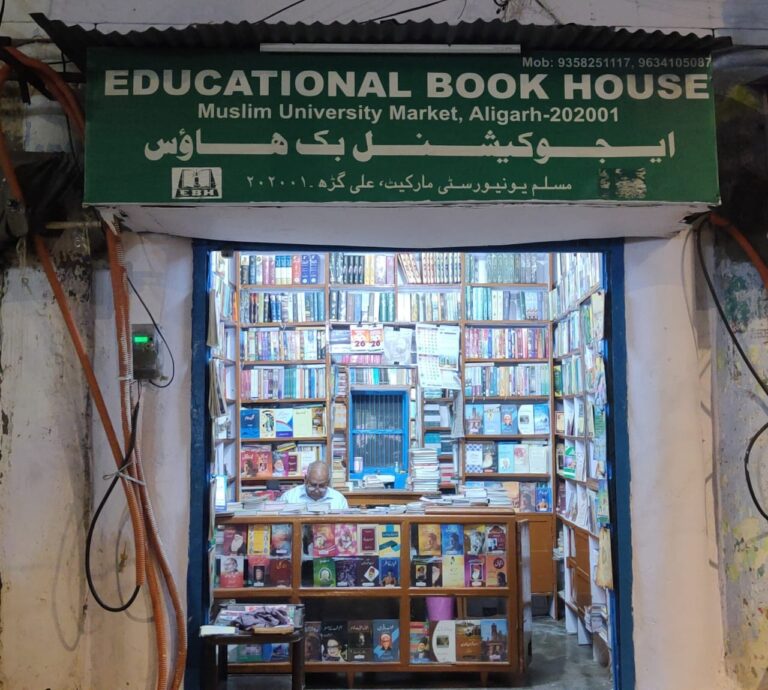
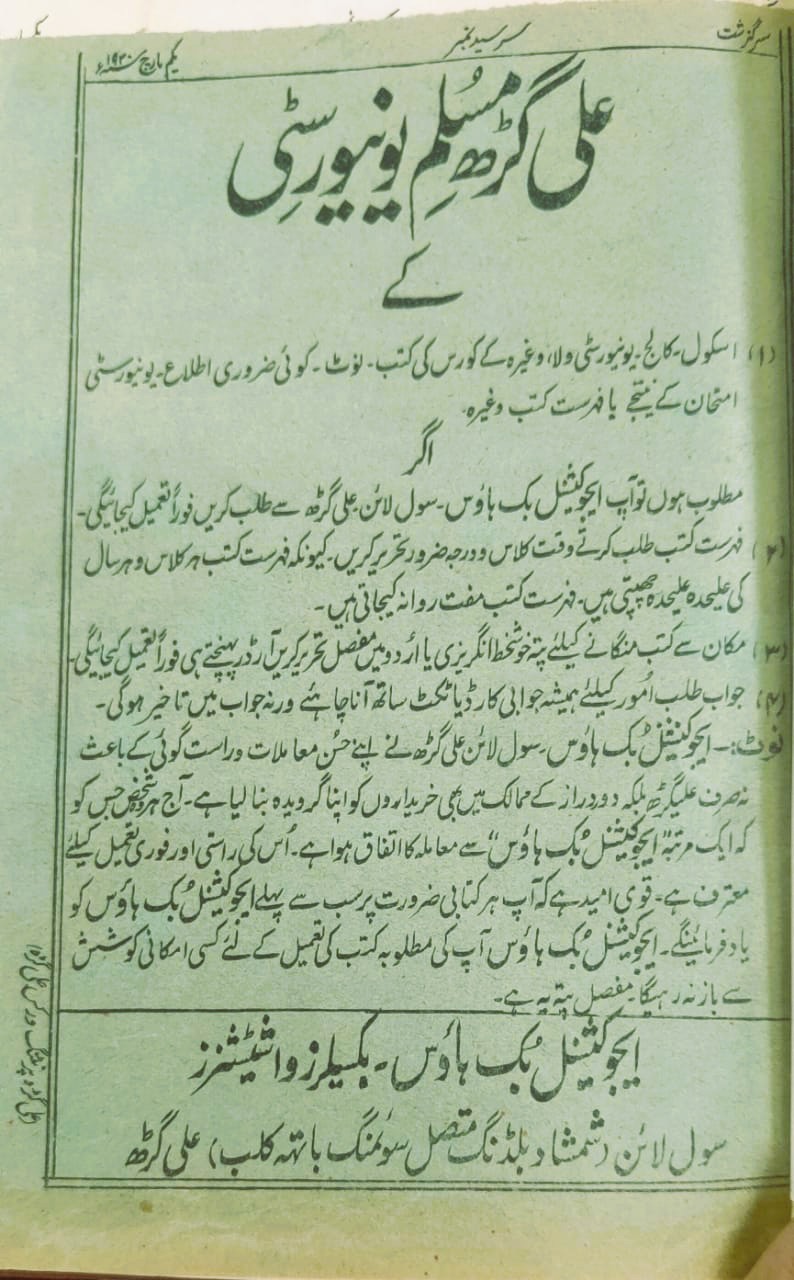
Established in 1925, EBH is more than an ordinary bookstore; it holds a revered position among bibliophiles, scholars, and literary circles both nationally and internationally. Over the past hundred years, EBH has played a pivotal role in spreading the literary and academic works of Aligarh across a broad audience, ensuring its legacy endures today. Its contribution to the development and promotion of Urdu language and literature is of profound importance in the history of book publishing

Historical Roots of Book House at Aligarh:

The story of Book house in Aligarh is intertwined with the visionary efforts of Sir Syed Ahmad Khan (1817-1898) and his pioneering movement to elevate Muslim education in India. As early as 1888, Sir Syed aimed to establish a bookstore in Aligarh to serve the students and teachers of his educational institutions.  He launched a campaign to establish a bookstore in Aligarh and even raised funds for this purpose.  An advertisement in the Aligarh Institute Gazette dated 7th July 1888 announced the opening of a bookshop: “Aik Tijarti Dukan Kitabon aur Stationary yani Saman Nosht wa Khwand Kay Farokht Ke Aligarh Mein” – a commercial shop for books and stationery in Aligarh. (see AIG, 7th July 1888)

This initial venture was called the “College Book Depot” which quickly became a vital hub for literature, academic materials, and stationary. It functioned as a bridge connecting scholars, students, and the wider community, fostering a culture of learning and intellectual curiosity in Aligarh. The original depot thrived under the stewardship of Mir Wilayat Hussain (1862-1949) but faced decline after his retirement in 1920, eventually closing down. (see Aap Beeti ya MAO College Ke Kahani, Mir Wilayat Hussain Ki Zubani, Sir Syed Academy, Aligarh, 2024, p.126).

The Birth of EBH

The establishment of Aligarh Muslim University in 1920 created a renewed demand for a dedicated bookstore that could cater to the needs of students and faculty alike. Responding to this need, Abdul Shaheed Khan (1898-1968), an alumnus of MAO College Aligarh from Meerut, opened a small stationery shop in 1925 near Fuller Road, close to Tasweer Mahal. He named this establishment “Educational Book House”, marking the beginning of a new chapter in Aligarh’s literary landscape. His vision was to provide affordable and accessible academic books and stationery, supporting the educational aspirations of students and teachers.

Abdul Shaheed Khan, Founder EBH

Moving to Shamshad Market:

In 1928, Sahibzada Shamshad Ahmed Khan (1888-1954), son of eminent educationist and vice-chancellor of AMU, Sahibzada Aftab Ahmed Khan (1867-1930), built a bustling commercial complex known as “Shamshad Building” in civil line Aligarh near AMU. This market was designed to serve the needs of the university community and local residents, housing shops for tailoring, groceries, milk, bread, bicycle repairs, and more. A mosque was also constructed within the complex, serving as a spiritual and community center.

Recognizing the importance of proximity and accessibility, Sahibzada Shamshad Ahmed Khan requested Abdul Shaheed Khan to relocate EBH to this new marketplace. The bookstore shifted there in 1929, anchoring itself within a vibrant hub of activity. This move significantly increased EBH’s visibility and accessibility, making it a central point for students and scholars seeking academic and literary materials.

The Aligarh Magazine (1929-30) praised Shamshad Market as a vital institution, emphasizing how it simplified the lives of students by providing essential books and stationery close to their place of study. In an editorial note, editor write:

“The Shamshad building has undoubtedly rendered an invaluable service to the student community of the University, for all the requirements of the students are to be found in the shops contained in the building and they have no more to worry themselves by running down to the city to fetch even the most ordinary things of everyday use. Sahibzada Shamshad Ahmad Khan deserves the thanks of all those whose life has been made easy and pleasant by the erection of this splendid building and we most cordially congratulate him on this.” (see Editorial Notes, Aligarh Magazine, 1929-30, p.11)
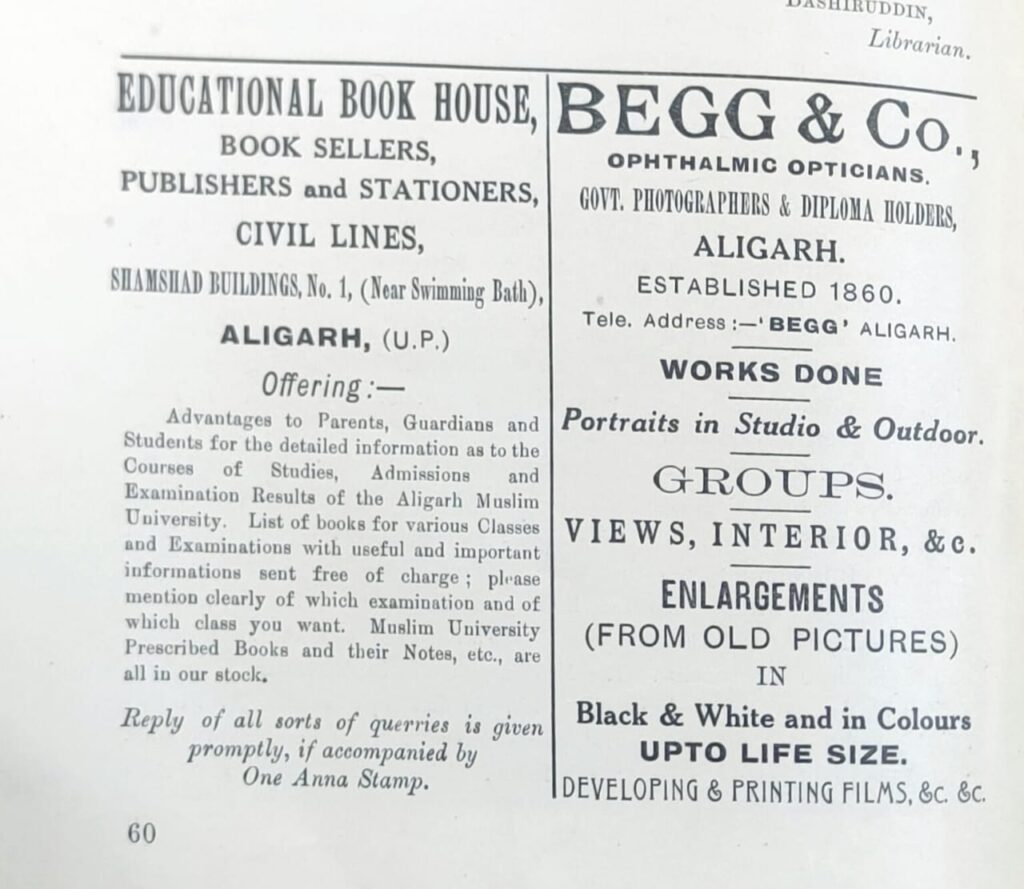
According to renowned historian Prof. Iftikhar Alam Khan, in his authoritative work “Muslim University Ki Kahani, Imarton Ke Zubani 1920 to 1947”, the Shamshad Building was constructed in 1929 at a cost of Rs. 30,000, financed by Sahibzada Shamshad Ahmed Khan’s mother. The building housed 18 shops, including EBH, and was a bustling center of commercial and cultural activity.

EBH’s shop within this complex charged the highest rent—Rs. 31—indicating its prominence and importance in the market. Its strategic location made it an essential resource for students, teachers, and literary enthusiasts, solidifying its reputation as a hub of education and culture. (See “Muslim University Ki Kahani, Imarton Ke Zubani 1920 to 1947”, EBH, Aligarh, 2006, pp. 161-165)

Early Contributions to Literature and Publishing:

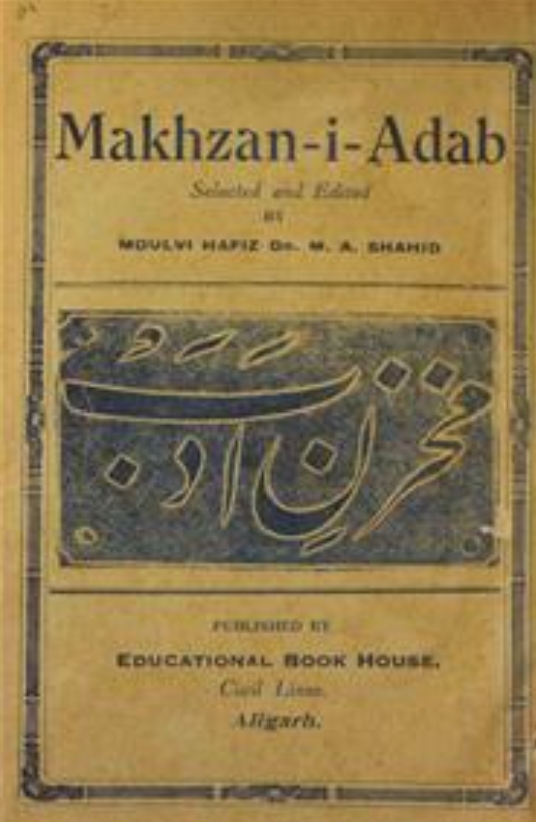
Even before India’s independence, EBH distinguished itself as a publisher committed to a broad spectrum of subjects. Unlike many publishers focused solely on literature or religion, EBH ventured into publishing works on children’s psychology, social sciences, philosophy, history, linguistics, and sciences. Its publications catered to the academic community and the general public, fostering a culture of knowledge dissemination. Notable early publications included: “Kainat Adab” by M. A. Hameed Alig (1935) editor Nazara Meerut,  “Ahsan-ul-Intikhab’’ by Ahsan Marehrawi, “Makhzan Adab” by M. A. Shahid, “Sukhna Nau”“Husn-e-Intikhab’’ by Abdul Jaleel Kidwai,  “Delhi Ka Ek Madar Akhiri Mushaira” by Mirza Farhatullah Beg, “Dastan Rani Ketki Aur Kanwar Uday Bhan Ki” by Syed Inshallah Khan Insha, “Bachhon Ki Tarbiyyah” by Musarrat Zamani, “Al-Aqeedah Al-Hasna” by Molvi Sham and Maulana Abdussalam etc.
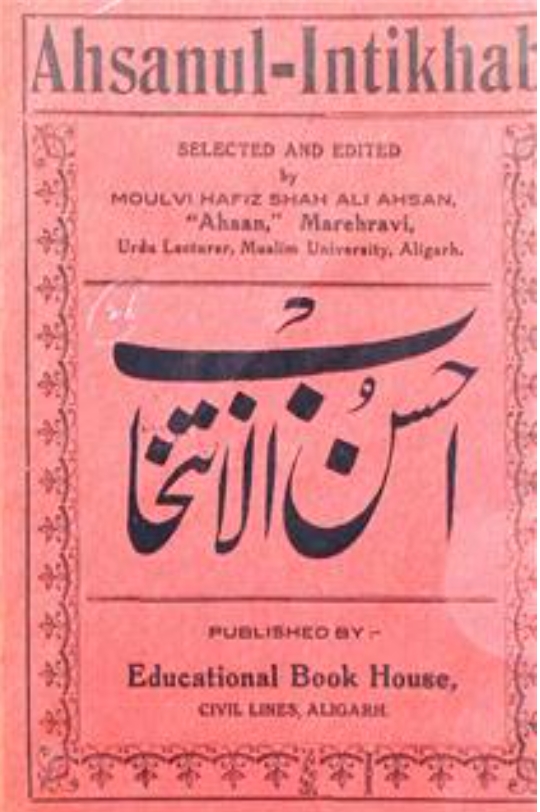
These works reflected EBH’s commitment to educational and literary growth, providing resources that supported scholarly pursuits and cultural development.

Post-Independence Challenges and Resilience:

The partition of India in 1947 was a tumultuous period that resulted in massive migrations and upheavals. Many families left their ancestral homes, but Abdul Shaheed Khan chose to remain in Aligarh. His son Asad Yar Khan says that just after independence many of his father’s relatives and friends asked him, he also migrate to Pakistan, but Professor Rashid Ahmed Siddiqui and Dr. Aale Ahmad Suroor advised him to continue his work from here, thus his father put this idea out of his mind.

His dedication ensured that EBH continued serving the community, moving from Shamshad Market to the Conference Market in 1951 to accommodate expanding operations.

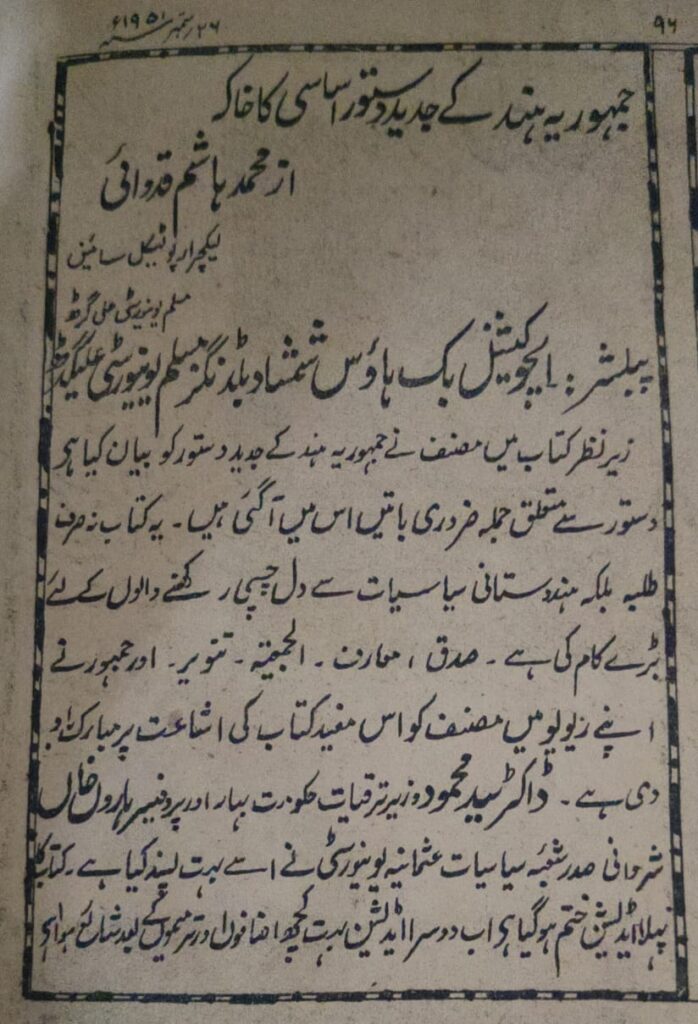
In this period, EBH expanded its publishing activities further. It published influential titles on Indian politics and governance, including Dr. Hashim Kidwai’s “Jhamooriya Hind” (1951), which analyzed India’s political system and constitution. Apart from Jhamooriya Hind, some of his titles are: Mubadiat Ilm Madniat (1951), Duniya Ke Hukoomatain(1961), Mubadi Siyasiyat (1971), Tareekh-e-Afkar siyasi (1982), Usool-e-Tammaddun, Usool-e-Siyasiyat (1988).
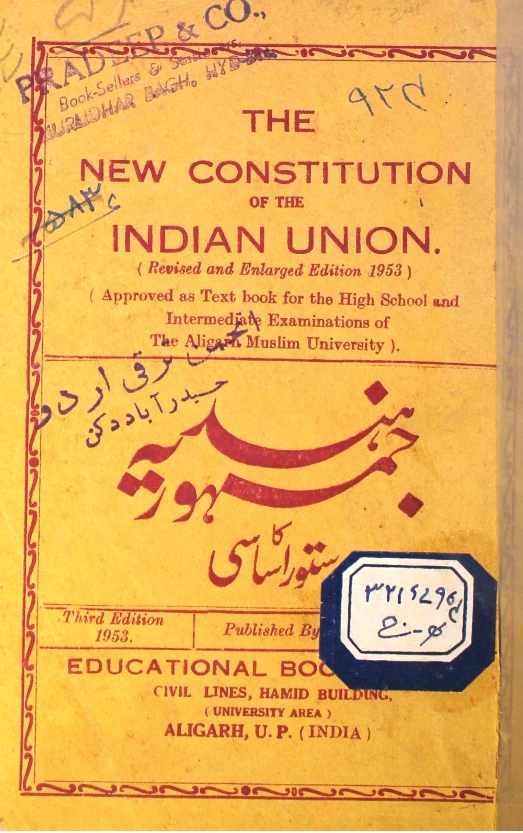
An Advertisements of book highlighted the importance of such works for students, scholars, and policymakers appeared in Weekly Jhamoor Aligarh dated 26th December 1955 states:

“In the book under consideration, the author has described the modern constitution of the Republic of India, all the essential things related to the constitution have been included in it. This book has done a great job not only for students but also for those interested in Indian political science. Sadq, Maarif, Jamiyat, Tanveer and Jamhur in their reviews congratulated the author for publishing this useful book.  Dr. Syed Mahmood, Minister for Development, Government of Bihar, and Professor Haroon Khan Sherwani, Head of the Department of Political Science, Osmania University, have liked it very much.”

Supporting Urdu Education and Literature:

A vital aspect of EBH’s mission was promoting Urdu language and education. The bookstore provided textbooks for institutions such as Jamia Osmania, Hyderabad, Aligarh Muslim University and Jamia Urdu, Aligarh and collaborated with teachers from Aligarh Muslim University to develop curricula that emphasized Urdu literature and linguistics.

This support helped to sustain and foster Urdu’s growth as a language of scholarship and culture across the region.
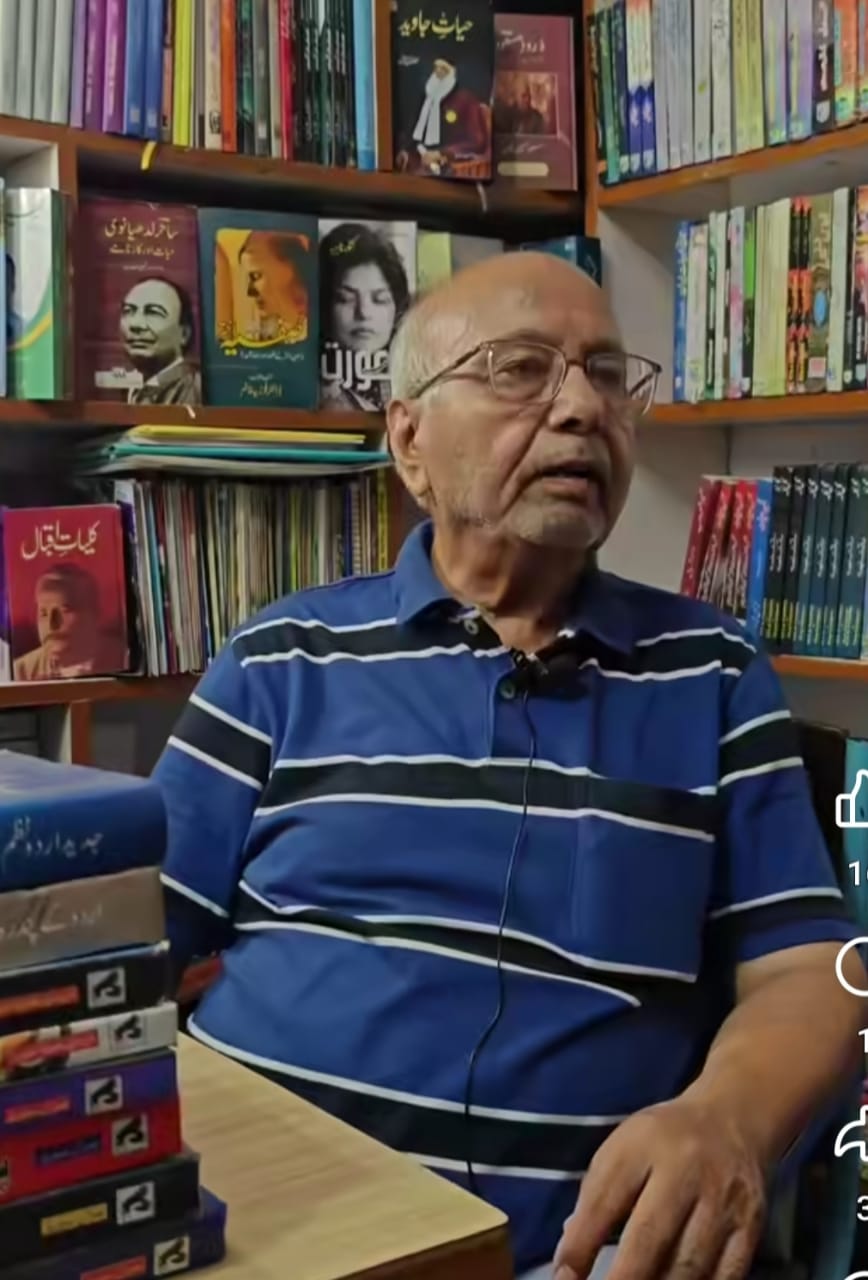
Asad Yar Khan

Following the death of Abdul Shaheed Khan in 1968, his sons, Asad Yar Khan (b. 1941, famously known as Kaptan Sb. as he served the Captain of Horse Riding in AMU several years) and Ahmed Saeed Khan (b.1948, affectionately Bhayya of all known people), inherited the legacy. Under their leadership, EBH grew into one of the most respected Urdu publishing houses in the subcontinent. They enhanced the quality of printing, expanded their catalog to include works of eminent poets, scholars, and political thinkers.
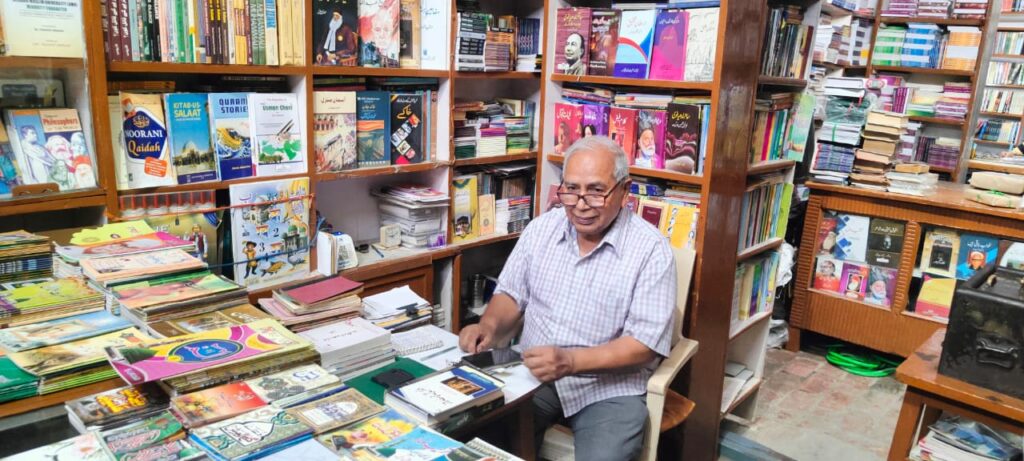
Ahmed Saeed Khan

Works of Prominent literary figures such as Iqbal, Faiz Ahmed Faiz, Khalifa Abdul Hakeem, and Ghulam Sarwar published and promoted through EBH, significantly contributing to the Urdu literary renaissance.

It also published works of  Wazir Agha, Abu Lais Siddiqui, Hassan Askari, Masood Hussain Khan, Akhtar Ansari, Syed Abdullah, Khaliq Ahmed Nizami, Muhammad Hashim Kidwai, Vaqar Azeem,  Majnoon Gorakhpur,  Ateeq Ahmad Siddiqui, Ibadat Barelvi, Raza Ali Abidi, Qurratul ain Haidar, Aal-e-Ahmad Suroor, Khurshid-ul-Islam,  Abdul Qadir Sarwari, Waheed Quraishi, Athar Parvez, Zaheer Ahmad Siddiqui, Khadeeja Mastoor, Ziauddin Alvi, Abdul Mughni, A.A. Hashmi, Rasheed Hasan Khan, Masood Hasan Khan, Masood Hassan Rizvi, Shaharyar,  Manzar Abbass Naqvi,  Mirza Khalil Beg, Abul Kalam Qasmi, Iftikhar Alam Khan, Asghar Abbas, Surraya Hussain, Sagheer Afrahim etc.

The Literary Magazine “Alfaaz”: A Cultural Milestone:

In 1975, Asad Yar Khan launched “Alfaaz”, a literary magazine dedicated to Urdu literature. Edited initially by Abul Kalam QasmiAlfaaz became a vital platform for poetry, literary criticism, and cultural dialogue. It provided a space for emerging writers and established intellectuals to exchange ideas, debate, and showcase their work.    
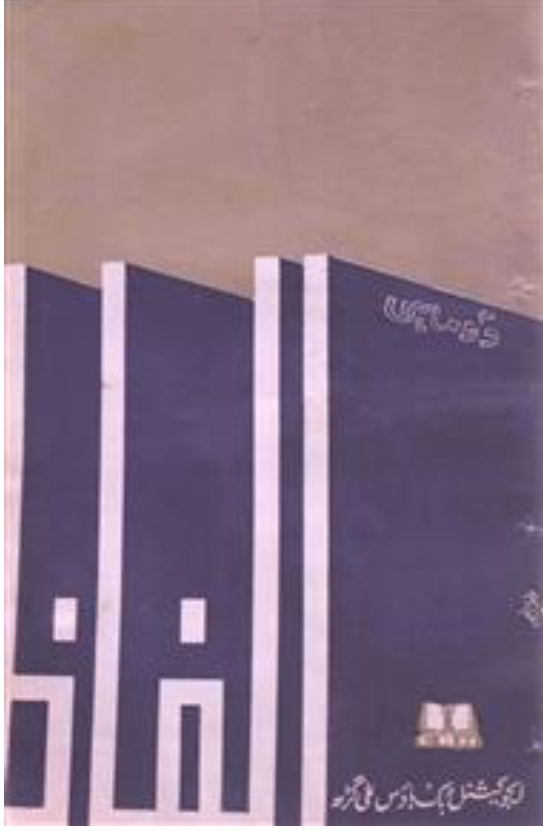
The magazine’s editorial board included notable scholars such as Khurshid-ul-Islam, Khalil-ur-Rehman Azmi, and Naseem Qureshi. Over nearly two decades, Alfaaz played an essential role in nurturing Urdu literature, fostering new talent, and preserving the cultural heritage of Urdu language and thought.

Personal Reflections:

The author’s personal association with EBH began in 1995, when as a seventh-grade student, he first visited the bookstore to buy storybooks and magazines. Over the years, this relationship deepened, leading to interactions with notable scholars, poets, and literary figures, including Professor Hashim Kidwai, Professor Mushir-ul-Hasan, Professor Qazi Abdul Sattar, Manzoor Hashmi, Professor Abul Kalam Qasmi, Qurban Ali (BBC Hindi), Tariq Hasan (Prominent Journalist), Mirza Masood Beg (Prominent Linguists) and many others.

In 2016, EBH published the author’s book on Aligarh’s journalism, “Aligarh Ke Urdu Sahafat”, a testament to their ongoing support for young writers and scholars.

Celebrating a Century of Service:

Today, as EBH celebrates its hundred years of existence, it stands as an integral part of Aligarh’s intellectual and cultural heritage. The dedication and honesty of Late Abdul Shaheed Khan and later his sons have made EBH a symbol of Urdu literature’s resilience and growth. Their efforts to promote Urdu, support education, and foster literary excellence have left an indelible mark on the Urdu circle.

A Legacy for the Future:

It is hoped that EBH continues to serve as a beacon of literary and educational excellence, nurturing new talents, publishing significant works, and promoting the Urdu language. As it celebrates a century of remarkable service, the entire community extends heartfelt congratulations and best wishes for its future endeavours.

The Educational Book House’s journey over the past hundred years stands as a shining example of dedication to knowledge, culture, and language. Its legacy is a reflection of the enduring power of literature to unite, educate, and inspire. May EBH continue to flourish and illuminate the path of learning for many more generations to come.

source: http://www.heritagetimes.in / Heritage Times / Home / by Dr Asad Faisal Farooqui / July 27th, 2025
AMU alumni association organises annual Sir Syed Day celebrations

Aligarh, UTTAR PRADESH / Doha, QATAR :

Indian envoy and AMU vice chancellor grace the occasion

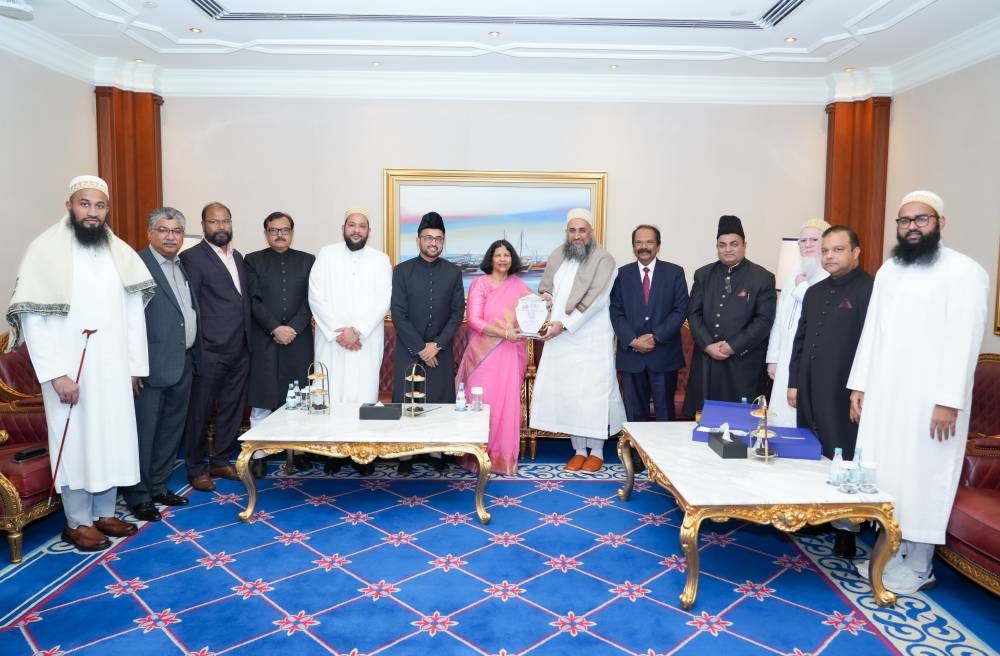
The Aligarh Muslim University (AMU) alumni in Qatar, under the banner of AMUAAQ, celebrated the annual Sir Syed Day on December 27, 2024 at the Sheraton Grand Doha Resort & Convention Hotel.

Prof Naima Khatoon, the first female Vice-Chancellor of AMU, graced the occasion as the chief guest, while the Indian Ambassador to Qatar HE Vipul presided over the gala ceremony.

Other guests of honour included former Vice-Chancellor of AMU Prof Mohammad Gulrez, Moez Wajihuddin and Patron of AMUAAQ Sophia Bukhari. Mustafa M Hariyanawala, Yashir Nainar, Haroon Sataj Khan and Anwar Karim were special guests.

The programme began with the recitation of the Holy Quran, followed by a two-minute silence to mourn the passing of the former prime minister of India Dr Manmohan Singh.

Ghazala Yasmeen welcomed the guests, while Dr Ashna Nusrat and Dr Nayeem Aman conducted the programme as Masters of Ceremony. Dr Ashna Nusrat read a message of appreciation from the former Chancellor of AMU, Syedna Mufaddal Saifuddin, addressed to the members of the AMU Alumni Association Qatar.

President of AMUAAQ Dr Nadeem Zafar Jilani, in his address, paid rich tributes to Sir Syed Ahmed Khan. He recalled how Sir Syed travelled to England to study the British education system and established the MAO College based on the models of Oxford and Cambridge universities.

Prof Naima Khatoon spoke on the selected theme of the event, ‘One Team, One Dream’. She praised the unwavering love of alumni worldwide for their alma mater and its founder, Sir Syed Ahmed Khan.

Former Vice-Chancellor Prof Mohammad Gulrez delivered the keynote address on ‘Jobs and Career Opportunities in the 21st Century’.

HE Vipul congratulated Aligarians on the Founder’s Day celebrations and acknowledged the contribution of great visionary Sir Syed Ahmed Khan in nation building.

Other dignitaries who spoke on the occasion included Sophia Bukhari and Anwar Karim.

As in previous years, AMUAAQ presented five achievement awards to eminent personalities. The first award, for lifetime achievement in the field of education, was presented to Prof Naima Khatoon. The award for outstanding community service was given to Safeerurahman, while Haroon Sartaj Khan, President of the AMU Alumni Association Oman, was named Aligarian of the Year. The Media Personality of the Year award was presented to RJ Aafrin of Radio Mirchi. Additionally, Akhtar Mehdi of the renowned Mehdi Hasan Tailors received a lifetime achievement award for his sartorial excellence in crafting traditional sherwanis, which have attracted many celebrities and former heads of state to his shop in Aligarh.

Er Jawed Ahmad, chairman of AMUAAQ, announced the formation of a pan-GCC Federation of AMU Alumni Associations to unite and bring together all Aligarians residing in the GCC countries—Bahrain, Kuwait, Oman, Qatar, Saudi Arabia and the UAE.

Vice-President of AMUAAQ Faisal Naseem presented a vote of thanks to the sponsors, as well as the executive and advisory committee members of AMUAAQ.

Jawed Ahmad, chairman of AMUAAQ, proposed that the Vice-Chancellor Prof Naima Khatoon become the ex-officio patron of AMU alumni to strengthen AMUAAQ.

Another proposal regarding the establishment of an offshore AMU campus in Doha was also revisited. He further informed the audience that the AMUAAQ will sign MoUs with several companies to provide students with training and job opportunities.

AMU alumni from all walks of life attended the function with their families in large numbers. Many prominent residents of Doha were also present, including literary personalities such as Ateeq Anzer, Aziz Nabeel, Ahmad Ashfaq, Ashfaq Deshmukh, Wasi ul Haq Wasi, and Obaid Tahir, to name a few.

A raffle draw, sponsored by Malabar Gold, was held and won by Farhana, Imran, Kainat and Shoyeb.

An MoU was signed between AMUAAQ and Hind Guru Academy to support and guide NRI students during their stay in India.

In addition to thought-provoking speeches, the programme also featured an interactive ‘Kahoot Quiz’ on AMU and the Aligarh Movement.

Prizes were awarded to the top three winners, with Faisal Abdullah securing first place, Ayan as the first runner-up, and Ashfaque Deshmukh as the second runner-up. The quiz and IT support were expertly managed by Almas Ahmad.

Mementos and certificates were presented on behalf of AMUAAQ to the guests and notable achievers.

source: http://www.qatar-tribune.com / Qatar Tribune / Home> Nation / by Tribune News Network, Doha / January 02nd, 2025

Why India Must Remember its First Muslim Jurist

Delhi, Mughal Period / Sitapur, British India:

The first Muslim judge of a high court in colonial times, Syed Mahmood’s professional conduct offers a counterpoint to the declining standards in Indian judiciary.

WHEN Justice Abdul Nazeer addressed the 16th national council meeting of the RSS-affiliated Akhil Bharatiya Adhivakta Parishad at Hyderabad last December, he said, “Great lawyers and judges are not born but made by proper education and great legal traditions, as were Manu, Kautilya, Katyayana, Brihaspati, Narada, Parashar, Yajnavalkya, and other legal giants of ancient India.” In the symposium on “Decolonisation of the Indian Legal System”, Justice Nazeer also said the “continued neglect of their great knowledge and adherence to the alien colonial legal system is detrimental to the goals of our Constitution and against our national interests…”.

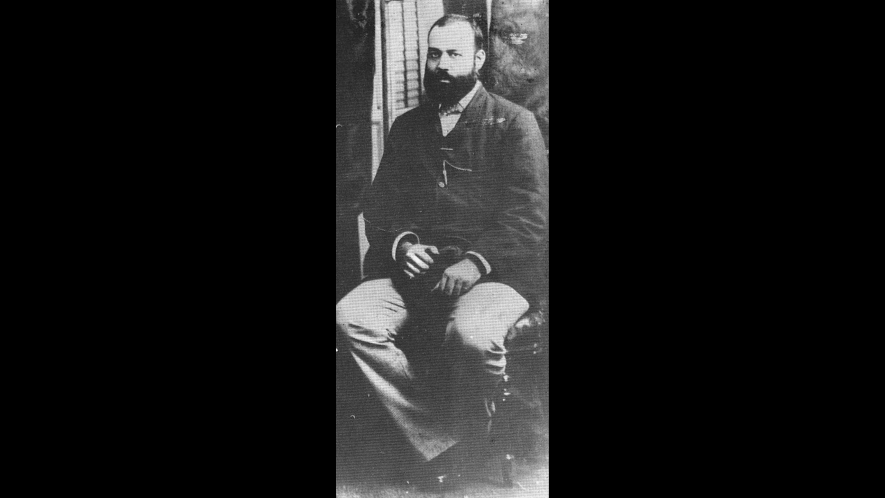
Perhaps Justice Nazeer should have also recalled 19th-century jurist Justice Syed Mahmood (1850-1903). A pioneer in bold assertions against the colonial judiciary, he produced incisive legal commentaries that reflect an audacious dissenter’s point of view. Writing in an Urdu newspaper, his father, Sir Syed Ahmed Khan, narrates Mahmood’s resignation from the Allahabad High Court in 1893 to “protect the self-respect of Indians against the racism of British judges”.

In that era, conceptions of nationhood were still evolving in India. Indian judges would not muster the courage to contest the racism of the imperial power or fellow European judges. But Mahmood did, in intrepid ways. Khan founded the Mohammedan Anglo-Oriental (MAO) College at Aligarh in 1877 and figures prominently but contentiously, stereotyped as a British loyalist and separatist in debates on contemporary nationalism. Mahmood supported his father’s modern education project, but unfortunately, his contributions are largely ignored by historians and the legal fraternity.

By 1920, MAO College, now Aligarh Muslim University, was the most prominent residential university in the country. Its history department has been a premier centre for advanced studies for a half-century. In 1889, primarily on Syed Mahmood’s initiative and his gifts in terms of books, journals and cash, AMU established a law department. Yet, he was neglected in its research. Only in 1973, seven years after the centenary of the Allahabad High Court, the Aligarh Law Journal brought out Mahmood’s contributions, and legal scholars reflected on his high calibre as a lawyer and judge.

The good news is, in 2004, Alan M. Guenther did his doctoral thesis on Mahmood at McGill University, Canada, which is available online for the public to access. His meticulous and well-researched account touches almost every aspect of Mahmood’s public life. Guenther also published an extended essay in 2011on Mahmood’s views on English education in 19th-century India. (In 1895, Mahmood had written a book on the theme for his speeches at the Educational Conference.)

In 1965, Asaf Ali Asghar Fyzee (1899-1981) complained, “Syed Mahmood’s contributions to the transformation of Muslim law in India have been largely neglected by historians and survive primarily as footnotes in legal texts on Muslim law.” Guenther, too, observes, “…overshadowed by the life and writings of his illustrious father, Ahmad Khan, his legacy has not received the attention it deserves. A large part of his father’s achievements in the reform of education, in fact, would not have been possible without the assistance of Syed Mahmood. But when he reached the age at which his father had made his most significant achievements, [Mahmood] had his life cut short.”

Mahmood had laid out his life plans clearly. S. Khalid Rashid, writing in 1973, reports that Mahmood decided early on that, like his ancestors, he would devote the first third of his life to educating himself, the second to earn a living, and the last to “retired study, authorship and devotion to matters of public utility”. But Guenther writes about how Mahmood’s health had deteriorated through alcohol abuse and disease. He died before he turned 53, broken by forced retirement, estranged from his father (who had died five years previously), stripped of responsibilities at the college he had helped found, separated from wife and son, and in poverty. He was selling personal items to repay debts. “His father’s numerous writings and letters are still republished, but Syed Mahmood’s contributions to Muslim thought are hidden in bound volumes of the Indian Law Reports and brittle files of government correspondence,” Guenther writes.

One aspect of Mahmood’s last years is captured by Prof. Iftikhar Alam Khan’s Urdu books, Sir Syed: Daroon-e-Khana (2006, 2020) and the recent Rufaqa-e-Sir Syed: Rafaqat, Raqabat wa Iqtidar Ki Kashmakash. These accounts expose the smear campaigns of the three companion successors of Sir Syed—Samiullah, Mohsin-ul-Mulk and Viqar-ul-Mulk—against Syed Mahmood as they vied for the secretary’s post at MAO College. Often European members of MAO College conspired with them. Exploiting his weaknesses and eccentricities, they ousted him to get a hold over college affairs, compounding his hurt during his tragic final years.

SYED MAHMOOD’S ROLE IN SIR SYED’S EDUCATIONAL ENTERPRISE

Having returned to India in 1872 after studying in England, Mahmood took time out of his budding legal career to assist his father’s reform work, particularly setting up MAO College. He prepared a detailed plan along the lines of his experiences in Cambridge. His specific aim, explained in February 1872, was to produce future leaders of India through an educational institution whose residential nature would be “as indispensable an education as the course of study itself”. The aim was to create a society of students and teachers quite different from the rest of society.

He travelled with his father to Punjab in 1873 and spoke at a rally to promote the project. In 1889, Sir Syed introduced a motion to nominate Mahmood as joint secretary of the board of trustees of MAO College by highlighting his assistance despite the opposition he faced. In particular, he considered his son’s influence the primary factor that persuaded European professors to come to India and teach there.

European staff members confirmed this around six years later when there was renewed opposition to Mahmood continuing as joint secretary. The principal, Theodore Beck (1859-1899), testified, “Syed Ahmad….acknowledged his reliance on Syed Mahmood for advice in all matters, and his imprint could be noted in the correspondence relating to the school. He declared his firm conviction that Syed Mahmood was the one person who shared his vision for the college, and apart from him, no one would be able to administer the school in keeping with that vision.” However, Samiullah (1834-1908) disagreed with Sir Syed on this count. As a result, a tussle for power began in the college management. The power-play could explain why AMU felt inhibited in bringing out a biography of Mahmood, a research gap that Guenther’s doctoral thesis fills. He has extensively relied on important correspondences of Mahmood preserved in the London India Office (British) Library.

SYED MAHMOOD’S TRYST WITH MUSLIM LAW

Mahmood is a forgotten pioneer of the transformation of Muslim law in modern South Asia. In 1882, at just 32, he became the first Muslim judge of the high courts in British India. He delivered numerous landmark decisions that shaped Muslim law, the law in general, and its administration.

Earlier, he blazed a trail his younger contemporaries followed in their judicial roles in British India. He was one of the first Indian Muslims to study in England and train in the English system of jurisprudence, the first Indian to enrol as a barrister in the High Court of Judicature at Allahabad in 1872, the first appointed as a district judge in the restructured judicial system of Awadh in 1879 and the first Indian assigned as a puisne judge to the High Court at Allahabad. He was the first Muslim in any High Court of India. He cleared a path for Indian Muslims to participate in administering justice in India. But his contribution is not limited to creamy career opportunities for Muslim youngsters. His lasting legacy is how Muslim law is perceived and administered in South Asia today.

CHAMPION OF ACCESSIBLE JUSTICE

An abiding concern of Mahmood was the cost of administration of justice. Court procedures were lengthy and expensive, and the “mass of law” was complicated. Distance from courts was another concern, for which he proposed a network of village courts for “on-the-spot” adjudication. He sought to make justice accessible through unpaid tribunals and honorary munsifs. He prepared a comprehensive draft for this, Guenther informs.

Furthermore, he attacked the [racial] mindset and court fees and stamp duties on legal documents. He ruled in August 1884 and February 1885 that “…if justice costs the same amount [to the] rich and poor, it follows that the rich man will be able to purchase it, whilst the poor man will not.” He declared, more than once, that British judges in India were too quick to find fraud.

In a speech at the Allahabad Bar in April 1885, Mahmood raised the language issue in judicial transactions, saying laws should be in languages intelligible to the masses. He insisted on the vernacular in arguments, pleadings and justice delivery and translated verdicts so that people unfamiliar with English could rest assured that judgments are reasoned. Of course, the issue of judicial language continues to be debated, and for this, acknowledgement is due to Mahmood.

AN INDIAN DISSENTER IN THE HIGH NOON OF BRITISH COLONIALISM

Mahmood is known most for outstanding dissenting judgements. In volume 2 of his 2021 book, Discordant Notes, Justice (retd.) Rohinton F. Nariman writes that Mahmood was known for detailed judgments, some of which stand out for thoroughness and fearless language. Mahmood would refer to the original Sanskrit versions when ruling on Hindu laws and the Arabic texts for Muslim laws, rather than using interpretations of the relevant texts.

From the 1860s to 1880s, during the codification of laws, he sought limits on importing British laws and protested that the local context was getting overlooked. His concern was not just the laws but their efficacy and adaptability within India’s cultural diversity.

Guenther observes, “…throughout his life, he identified himself as a Muslim as well as an Indian and a subject of the British crown, and that he was actively involved in the education and improvement of the Indian Muslim community. At the same time, Mahmood… [made] efforts to promote harmony between people of diverse backgrounds, and…[supported] initiatives that improved the situation of all Indians, regardless of religious affiliation…”

An anecdote from Altaf Hali’s Hayat-e-Javed (1901), cited by Shamsur Rahman Faruqi (2006), is worth sharing. “Contrary to the culture of sycophancy and genuflecting before the English colonial authority….Syed Ahmad Khan and his high-profile and brilliant son Syed Mahmud strived to conduct themselves as if they were equal to the English….Syed Ahmad Khan had stayed away from the [1867 Agra] Durbar because Indians had been given seats inferior to the English. A medal was to be conferred on Syed Ahmad Khan at that Durbar. Williams, the then Commissioner of Meerut, was later deputed to present the award to Syed Ahmad Khan at Aligarh railway station. Willams broke protocol and showed his anger at having to do the task under duress and said that government orders bound him, or he wouldn’t be presenting the medal to Syed Ahmad Khan. Syed Ahmad Khan accepted the medal, saying he wouldn’t have taken the award, except that he too was bound by government orders.”

Indian democracy is an outcome of anti-colonial nationalism, and dissent is its core component: Mahmood’s dissent contributed to nationalism in his time. In 2022, the V-Dem Institute described India as an electoral autocracy where dissent is being criminalised, and the judiciary is failing to contain the majoritarian upsurge. Mahmood’s professional conduct is an encouraging counterpoint to the degeneration in the Indian judiciary.

WHAT DID MAHMOOD THINK OF THE INDIAN NATIONAL CONGRESS?

According to Guenther, though Mahmood never joined the Congress, he was “equally aloof” from the anti-Congress propaganda his father indulged in. “…a rare catholicity characterised his views on most of the controversial questions,” he writes. He adds, “His acceptance among the Hindus [elites] generally was demonstrated by the fact that they tried to send him as their representative to the Imperial Legislative Council, though he never received that appointment.”

Nonetheless, like his father, Mahmood harboured class and regional prejudices. Guenther reveals an article Mahmood wrote in The Pioneer on 4 September 1875, suggesting the government must strive to with the sympathies of the “higher classes of natives”. When challenged to defend his position by “Another Native” in the same newspaper two weeks later, Mahmood responded that people in Punjab and the North-western Provinces [now Uttar Pradesh] were, historically speaking, of “much greater political significance” than those of Lower Bengal. Gunther cites his write-up: “…any educational system that succeeded in ‘attracting the Bengalee and fail(ed) to exercise any influence upon the higher classes of the Rajpoot, the Sikh, and the Mussulman’ must be regarded as a failure.”

Considering the socio-regional composition of top functionaries of AMU, even impartial insiders would testify that it still harbours regional and sub-regional prejudices. The Sir Syed Academy is releasing many publications during the ongoing centenary celebration of AMU. Publishing Guenther’s dissertation may be a fitting tribute to Mahmood, who must be regarded as a prominent co-founder of MAO College.

Mohammad Sajjad teaches modern and contemporary Indian History at Aligarh Muslim University. Md. Zeeshan Ahmad is a lawyer based in Delhi. The views are personal.

First published by Newsclick.

source: http://www.theleaflet.in / The Leaflet / Home> History / by Mohammad Sajjad and Zeeshan Ahmad / April 01st, 2022