Tag Archives: Maulana Khalid Saifullah Rahmani

Muslim Mirror Releases List of 100 Most Influential Indian Muslims 2025; Young Faces Gain Prominence

INDIA :

Muslim Mirror’s 100 Most Influential Muslims of 2025

New Delhi: 

Muslim Mirror has released its much-anticipated annual list of the “100 Most Influential Indian Muslims of 2025,” spotlighting individuals who have made significant contributions to India’s public life across a wide spectrum of fields including politics, culture, education, business, media, religion, sports, and social service. Now in its second edition, the list aims to document influence not merely as power or popularity, but as sustained impact, leadership, and the ability to shape public discourse.

A defining feature of the 2025 edition is the growing prominence of younger achievers, signalling a visible generational shift within Indian Muslim leadership. Alongside established national figures, the list includes emerging voices who have built influence through grassroots activism, professional excellence, digital platforms, legal advocacy, education, and community engagement. Editors associated with the project said this was a deliberate attempt to recognise new centres of influence beyond traditional hierarchies.

The list reflects the diversity and plural character of Indian Muslim society, cutting across geography, ideology, profession, and language. From seasoned politicians and religious scholars to artists, entrepreneurs, academics, and social reformers, the compilation offers a broad snapshot of leadership trends at a time when issues of representation, constitutional values, and social justice remain central to national debate.

Representation Across Sectors

The 2025 list features several eminent academicians and intellectuals who have shaped higher education, policy discourse, and social research. Among them are Abul Qasim Nomani, Ameerullah Khan, Furqan Qamar, Shahid Jamil, and Ubaid-ur-Rahman, recognised for their contributions to education, public policy, and academic leadership.

In the business and entrepreneurship category, the list includes influential names such as Azad Moopan, Azim Hashim Premji, Farah Malik, Irfan Razack, M. P. Ahammed, Mecca Rafiq Ahmed, Meraj Manal, Syed Mohamed Beary, P. Mohammed Ali, Shahnaz Hussain, Tausif Ahmad Mirza, Yusuff Ali, and Ziaullah Sharif. Their inclusion underlines the growing economic footprint of Indian Muslim entrepreneurs, both domestically and globally, spanning sectors from retail and healthcare to infrastructure and consumer goods.

Community leadership remains a strong pillar of the list, with figures such as Arshad Madani, Mahmood Madani, Malik Motasim Khan, Mehmood Pracha, Syedna Mufaddal Saifuddin, Navaid Hamid, Pirzada Md Abbas Siddiqui, Qasim Rasool Ilyas, Sadatullah Husaini, Umer Ahmed Ilyasi, and Yusuf Mohamed Abrahani recognised for their roles in religious guidance, legal advocacy, social mobilisation, and institutional leadership.

Culture, Media, and Public Discourse

In arts and entertainment, globally recognised names such as A. R. Rahman, Aamir Khan, Mammootty, Munawar Faruqui, and Shah Rukh Khan continue to command immense cultural influence, shaping narratives that extend well beyond cinema and music into social consciousness.

The list also acknowledges the growing importance of media and journalism in shaping opinion and challenging dominant narratives. Journalists and commentators such as Arfa Khanam, Irfan Meraj, and Seema Mustafa are recognised for their consistent engagement with issues of democracy, minority rights, and constitutional values.

Religious and Intellectual Scholarship

A significant section of the list is devoted to Islamic scholars and religious thinkers, reflecting their continued influence on moral leadership and intellectual discourse. Names such as A. P. Aboobacker Musliyar, Qasim Nomani, Prof. Akhtarul Wase, Asghar Ali Imam Mahdi Salafi, Asjad Raza Khan, Ibraheem Khaleel Al-Bukhari, Javed Jamil, Khalid Saifullah Rahmani, Khaleelur Rahman Sajjad Nomani, Qamaruzzaman Azmi, Rashid Shaz, Shakir Ali Noori, Shamail Nadvi, and Yasoob Abbas find place for their scholarly work, writings, and public engagement.

Politics and Governance

The political category features leaders cutting across party lines and regions, including Asaduddin Owaisi, Ghulam Nabi Azad, Hamid Ansari, Mehbooba Mufti, Omar Abdullah, Salman Khurshid, Najeeb Jung, Syed Naseer Hussain, Engineer Rashid, Akhtarul Iman, Iqra Hasan, Zameer Ahmed Khan, Rakibul Hasan, K. Rahman Khan, Kadir Mohideen, Mohibullah Nadvi, Md Shafi, Agha Mahadi, Asim Waqar, and Sadiq Ali Shihab Thangal. Their inclusion reflects influence exercised through electoral politics, governance, diplomacy, and legislative advocacy.

Changemakers and Social Reformers

One of the most dynamic sections of the 2025 list is that of changemakers and social reformers, featuring individuals such as Safeena Husain, Shahabuddin Yaqoob Quraishi, Syeda Hameed, Zameer Uddin Shah, Mahbubul Hoque, Sabahat S. Azim, Mehmood Pracha, Faiz Syed, and Zahir Ishaq Kazi, among others. Many of these figures have earned recognition through long-term grassroots work rather than formal authority.

International Booker Prize 2025 winner Banu Mushtaq for Heart Lamp, along with renowned poet Wasim Barelvi, has been placed in the category of Literary Figures.

In sports, iconic names Sania Mirza and Irfan Pathan continue to inspire younger generations through excellence and public engagement beyond the playing field.

Beyond Rankings

The editors emphasised that the list does not claim to be exhaustive, nor does it measure influence solely through fame, wealth, or official position. Instead, it seeks to capture real-world impact, moral authority, intellectual contribution, and the ability to shape conversations within and outside the community.

The annual list has increasingly become a reference point for understanding evolving leadership patterns among Indian Muslims. By foregrounding both established figures and rising talents, the 2025 edition reflects continuity as well as change, underscoring how Indian Muslims continue to contribute meaningfully to India’s democratic, cultural, and social field.

source: http://www.muslimmirror.com / Muslim Mirror / Home> Indian Muslim / by Muslim Mirror / January 15th, 2026
Ayesha Sultana’s Ayat Foundation Wins Best NGO Award at AMP’s National Awards 2025

Kothagudem, TELANGANA :

Hyderabad: 

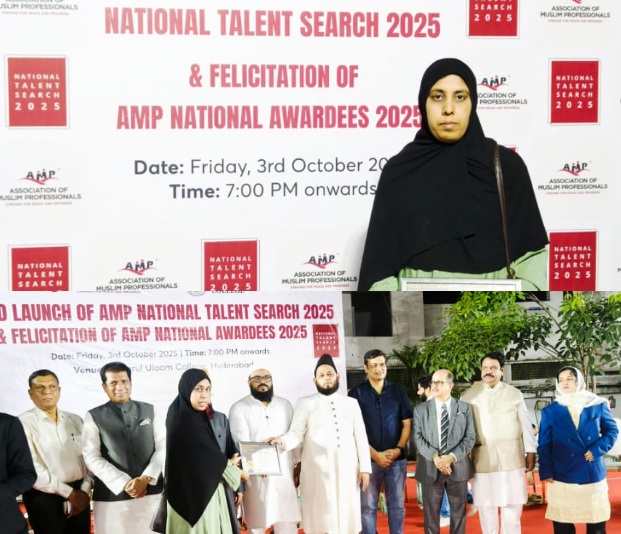
The Association of Muslim Professionals (AMP) hosted its 5th National Awards for Social Excellence (NASE) 2025 at Anwar-ul-Uloom College, Hyderabad, celebrating changemakers and institutions shaping social progress across India. The event, attended by more than 300 participants, honoured outstanding contributions in education, social welfare, and humanitarian service.

Ayat Education and Welfare Foundation from Kothagudem, Telangana, led by Dr Ayesha Sultana, won the Best NGO Award of the Year (State). In a short span, the foundation has impacted over 7,500 lives through education, women empowerment, and welfare programs. It offers academic and Qur’anic education, youth training in soft skills, and guidance for careers and personal growth. The foundation also provides medical aid, food relief, and disaster assistance. Its women’s online education program, which reached 1,500 learners in one year, was highlighted as a model of empowerment.

Maulana Khalid Saifullah Rahmani, Chairman of the All India Muslim Personal Law Board (AIMPLB), graced the ceremony as Chief Guest and felicitated awardees for their service to society. Prominent figures from academia, government, and civil society, including officials from the Telangana Waqf Board and retired IPS officers, attended the event.

AMP also recognized 10 national awardees such as Human Welfare Foundation, Jamiat Ulama-i-Hind Public Trust, and Sahayata Trust.

Lifetime Achievement Awards were presented to philanthropist Ghiasuddin Babukhan, educationist Dr P. A. Inamdar, and retired IPS officer Mohammad Wazir Ansari.

The event also marked the launch of AMP’s National Talent Search (NTS) 2025, expected to engage over two lakh students nationwide.

Ayesha Sultana is a regular contributor to radiancenews.com and former editor of AURA emagazine.

source: http://www.radiancenews.com / Radiance News / Home> Latest News> Markers of Excellence> Report / by Radiance News Bureau / October 04th, 2025

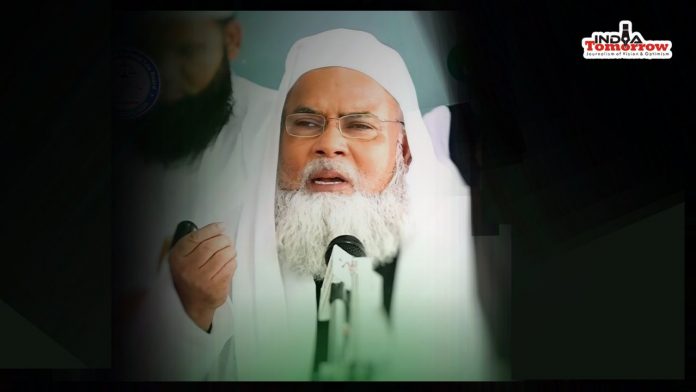
Khalid Saifullah Rahmani re-elected president of the AIMPLB

Darbhanga, BIHAR / Hyderabad, TELANGANA :

Maulana Khalid Saifullah Rahmani as

Maulana Khalid Saifullah Rahmani was re-elected president of the All India Muslim Personal Law Board (AIMPLB) today evening in the two-day 29th session of the Board which began today in the campus of Darul Uloom Sabeel-ur-Rashad Arabic College, the largest religious seminary of Karnataka.

Rahmani, a prominent Islamic scholar and leader, has held the presidency of the AIMPLB for several years and is known for his work in advocating for the protection of Muslim traditions and religious practices in the country. His re-election reflects the broad support he enjoys within the board and the larger Muslim community in India, which looks to the AIMPLB for guidance on issues related to marriage, inheritance, and religious freedom.

Along with Maulana Khalid Saifullah Rahmani’s re-election 40-member executive committee of AIMPLB were also elected. Now, the Maulana in consultation with the executive members will pick his team of office-bearers.

Maulana Rahmani is a close relative of Maulana Mujahid ul Islam Qasmi, the third president of the AIMPLB.

Born in November 1956, Maulana Rahmani received his primary education at home and studied at Madrasa Qasimul Uloom Hussainia for two years. He graduated from Jamia Rahmani in Munger and studied “Dawra-e-Hadith” again at Darul Uloom Deoband, and graduated from there. He later specialised in Islamic law and jurisprudence at Imarat Sharia, Patna.

Maulana Fazlur Rahim Mujaddidi was born on 22nd June 1957. He is the son and successor of the renowned scholar and educationist Maulana Shah Mohammad Abdur Rahim Mujaddidi and the successor of another Maulana Shah Hidayat Ali Mujaddidi.

He is an author and jurist He has authored books including The Islamic Jurisprudence: Introduction and Codification and Kitāb-ul-Fatāwa. While he is from the Deobandi School, he is respected by those from other schools as well, given his vast knowledge of various disciplines of Islamic education. He is also the general secretary of Islamic Fiqh Academy of India. (With Agencies Inputs)

source: http://www.muslimmirror.com / Muslim Mirror / Home> Indian Muslim> Religion / by Muslim Mirror Desk / November 24th, 2024

AIMPLB Poll: Maulana Rahmani Elected President, Maulana Mujaddidi as Secretary-General

NEW DELHI :

New Delhi:

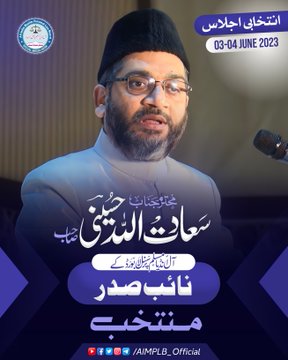
A top Islamic scholar – Maulana Khalid Saifullah Rahmani – was elected fifth president of the All India Muslim Personal Law Board (AIMPLB), with Jamaat-e-Islami Hind president Syed Sadatullah Husaini and Gulbarga-based Maulana Khusro Hussaini as vice-presidents.

Maulana Khalid Saifullah replaced Maulana Rabey Hasani Nadawi who passed away in April this year.

Image
Image

Maulana Fadl al-Rahim Mujaddidi has been elected as the General Secretary. He will be supported by secretaries – Maulana Umrain Mahfouz Rahmani, Maulana Syed Bilal Hussaini Sahib, Maulana Yasin Ali Usmani Sahib, and Maulana Ahmed Faisal Rahmani.

The board elections took place in the town of Mhow near Indore during the board’s executive committee meeting on June 3 and 4.

Maulana Khalid Saifullah was elected unanimously. There are 251 members of the board, including 51 executive members.

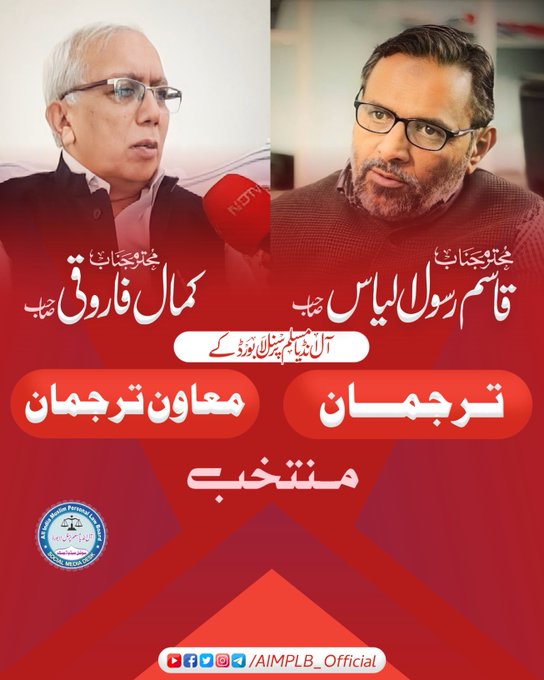
Welfare Party of India (WPI) president Dr. Syed Qasim Rasool Ilyas  has been elected as the spokesperson and Kamal Farooqui, a practicing chartered accountant and former chairman of Delhi Minorities Commission, has been elected as deputy spokesperson.

Image

Maulana Khalid Saifullah Rahmani was elected through consensus. A proposal was mooted by Hazrat Maulana Muhammad Sufyan Qasmi Sahib of Darul Uloom, Deoband, and subsequently supported by Maulana Shahid Hosni and Maulana Syed Mahmood Madani. All members unanimously voted for Moulana Rahmani.

After Wali Rahmani’s death, Moulana Khalid Rahmani was appointed as the interim general secretary of the All India Muslim Personal Law Board. He is also a member of the Legal Council of the All India Muslim Personal Law Board and serves as the general secretary of the Islamic Fiqh Academy in New Delhi.

He regularly contributes as a columnist for the Friday edition of Munsif and holds the position of editor for the Islamic juristic quarterly journal – Behs-o-Nazar – which was originally founded by Mujahidul Islam Qasmi.

Born in 1956 in Darbhanga district in Bihar, he has a rich educational background in Islamic studies and is renowned for his insightful teachings on various aspects of Sharia law. He began his education at home and then spent two years at Madrasa Qasimul Uloom Hussainia. He pursued further studies at Jamia Rahmani in Munger, where he earned his degree.

He was enrolled in the Dawra-e-Hadith program at Darul Uloom Deoband where he focused on the study of Hadith within the Dars-e-Nizami curriculum. He successfully completed his studies and graduated from Darul Uloom Deoband in the year 1395 AH (according to the Islamic calendar) or 1975 as per Gregorian calendar. Later, he specialized in Islamic law and jurisprudence at Amarat-e-Sharia in Patna.

He has been a student of Anzar Shah Kashmiri, Mahmud Hasan Gangohi, and Muhammad Salim Qasmi, and also benefited from the guidance of his uncle Mujahidul Islam Qasmi.

Established in 1973, AIMPLB serves as an authoritative body responsible for interpreting and implementing Muslim personal law in India. It comprises distinguished scholars, jurists, and community leaders who work collectively to uphold and protect the rights of Muslims in matters pertaining to marriage, divorce, inheritance, and other aspects of personal and family law.

source: http://www.indiatomorrow.net / India Tomorrow / Home> Breaking News / by admin india tomorrow / June 06th, 2023

Hyderabad: Exhibition of Muslim women achievers at Salar Jung Museum

Hyderabad, TELANGANA:

 Dr Lateef of ILM Foundation

Hyderabad: 

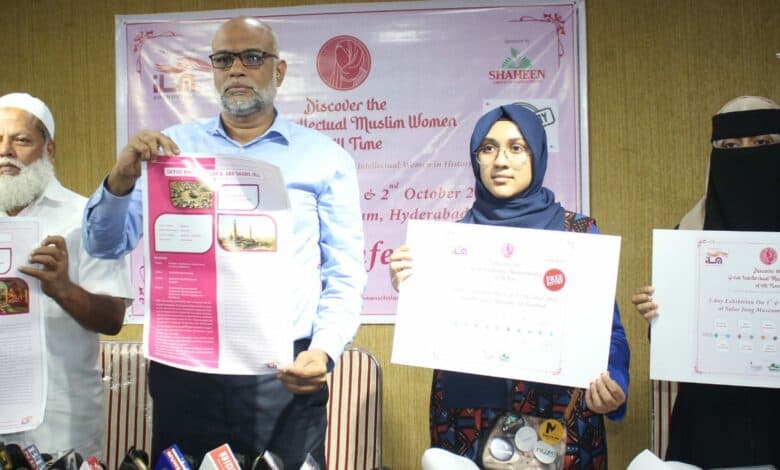
Women are the largest untapped reservoir of talent in the world. There is no limit to what they can accomplish. Now, one can learn all about the achievements of Muslim women at a two-day exhibition being organised at the Salar Jung Museum on October 1 and 2 by the Intellectual Learning Methodologies (ILM) Foundation in association with the Shaheen Group of Educational Institutions, Islah and Asli Talbina.

Maulana Khalid Saifullah Rahmani, general secretary, All India Muslim Personal Law Board, will inaugurate the exhibition which showcases the achievements of 40 women in different fields. Details of their accomplishment will be explained through posters, said Dr Lateef of ILM Foundation.

The main objective of holding the exhibition is to inform the common man about the achievements of women, particularly Muslim women.

A study of early Islamic history showed that women enjoyed the freedom of movement and took an active part in all walks of life. They excelled as rulers, warriors, nurses, scholars, jurists, teachers, traders and companions of the Prophet (Sahabiat).

In fact, they defined success on their own terms and proved that they are the real architects of society. When he started working on the subject some one-and-half years ago, Dr Lateef said, he stumbled upon the names of at least 10,000 women who had made immense contributions in their chosen field of activity.

These details he accessed through four books. They are  Al Muhaddthat written by Oxford scholar of Indian origin, Dr Akram Nadvi, Muslim Women Biography Dictionary of Aisha Bewley, Great Women of Islam written by Mehmood Ahmed Ghazanfar and Achievements of Muslim Women in Religious and Scholarly Field by Maulana Qazi Athar Mubarakpuri.

Some of the well-known names whose exploits and achievements are being showcased include Hazrath Aisha, wife of the Prophet Muhammed, who made an enormous contribution to the cause of Islam through her intelligence and scholarship. Besides being an important narrator of Prophetic traditions (Hadith), she proved to be more learned than many men of her period.

Many male companions of the Prophet used to approach her for clarification of Hadith. Similarly, Hazrath Zainab, daughter of Hazrath Ali, was also a great scholar. Eminent Islamic scholar, Ibn Hajar, is stated to have studied under 53 women while Al Suyuti is under 33 women. All this is history now. Other prominent women are Queen Zubaida, Princess Razia Sultana, Durru Shehvar, and Princess Niloufer.

These women could leave their indelible marks as Muslim society gave them their fundamental rights to education and self-development.

“Lives of early Muslim women represent exemplary models, transcending time and boundaries. And they are a great source of inspiration,” Lateef said.

Organisers plan to take the exhibition to other parts of the country after Hyderabad. The exhibition on the inspiring women achievers is the result of the hard work put in by two talented girls -Juveria Sabir and Zoha Ansari. The latter is working at Edventure Park, a start-up incubator.

The two-day exhibition is being held in the eastern block of the Salar Jung Museum from 11 am to 5 pm. Entry is free.

source: http://www.siasat.com / The Siasat Daily / Home> Featured News / by J S Ifthekhar / September 27th, 2022