Tag Archives: Maulana Mazharul Haque Arabic & Persian University – Bihar

Bihar Collective to Release Booklet “Remembering Muslim Makers of Modern Bihar” in Patna on Feb 23

Patna, BIHAR :

Patna :

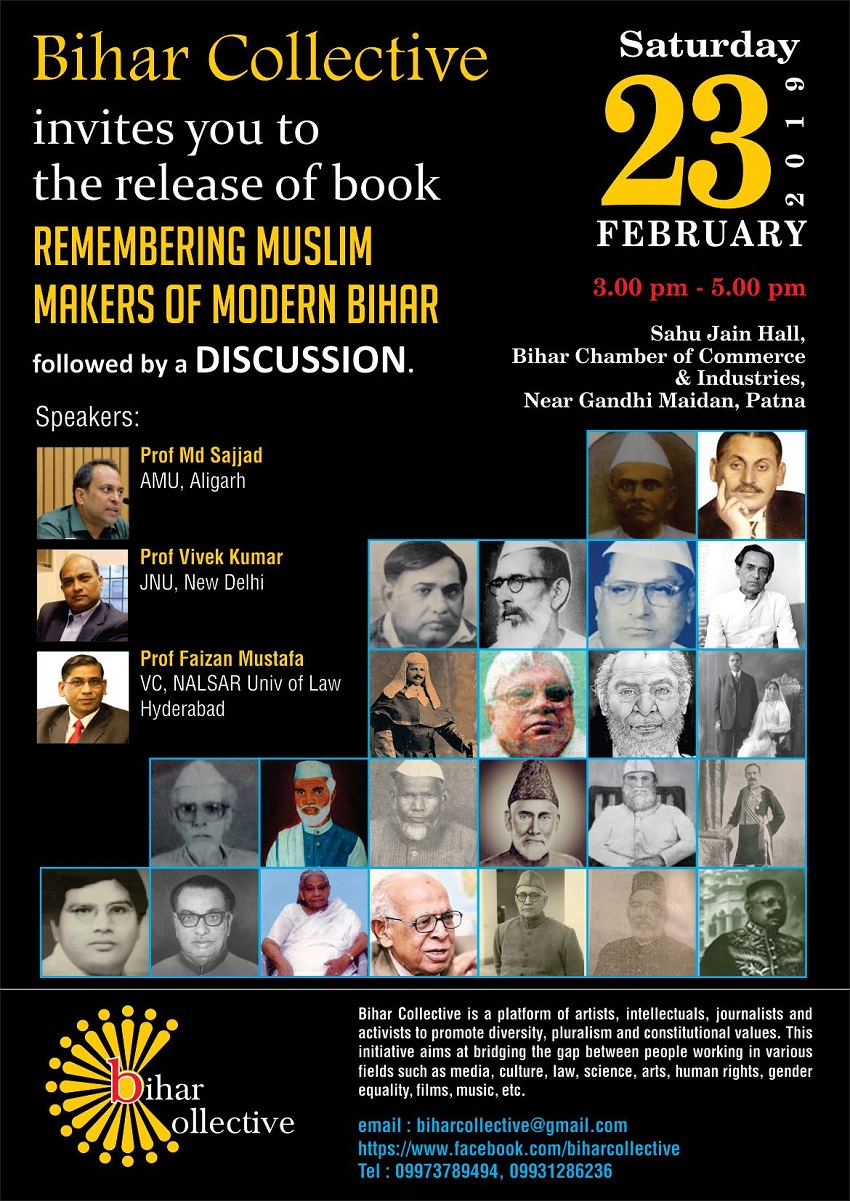
In an era of unprecedented majoritarian ascendance and anti-Muslim hatred, Bihar Collective, a platform of intellectuals and activists, has brought out a booklet highlighting the contribution of eminent Muslims in making the modern Bihar in the last 200 years.

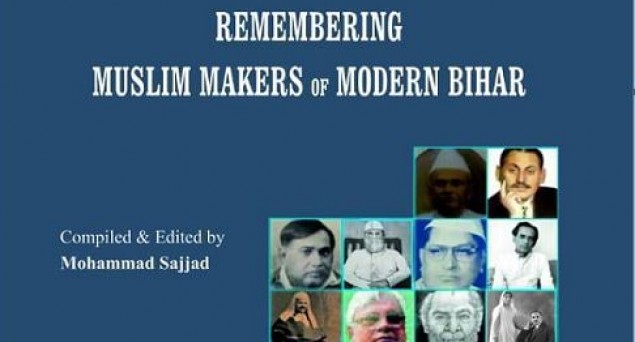
The booklet titled Remembering Muslim Makers of Modern Bihar has been compiled and edited by renowned academician and writer Prof. Mohammad Sajjad on the initiative of Bihar Collective.

The booklet will be released at an event in Patna on Saturday (February 23).

On the occasion, a discussion will also be held with Prof Faizan Mustafa, Vice Chancellor, NALSAR University of Law, Hyderabad; Prof Vivek Kumar, JNU, New Delhi; and Prof Mohammad Sajjad, AMU, Aligarh as panelists.

A Brief about Booklet:


Pre-empting a reasonable question about the title of the booklet, Prof Sajjad, who has compiled and edited it, writes in its preface: “A simple and obvious question that may readily arise is: why only Muslim makers of modern Bihar? Why not others too? This is indeed a valid and pertinent question.”

Responding to the question, he further says: “Candidly put, this is because of an unprecedentedly menacing rise of majoritarianism, bigotry, and anti-Muslim hatred, with open support of the state.

The Muslim identities are ominously threatened. There are also unabated attempts to dilute (or even take away) whatever little accomplishments have been made by the forces of social justice and secularism.

Only the Muslim segment however is threatened by the jingoist, exclusionary, violent nationalists, to be thrown out to another country. As if the other country is a dustbin, owned by these bigots, into which they can throw away everything they dislike! As if only the religious majority constitutes the nation! Notably, these jingoists had aligned with the British and had stayed away from the national movement.”

“Muslim contributions in the nation-making (and in the freedom movement) remain under-acknowledged, forgotten or even omitted. Erasure of their histories and memories seem to have become even more pronounced and vociferous, now, than ever before…The Bihar Collective therefore decided to compile a short profile of these inspiring role models, history-makers…This is small and humble step towards retrieving and restoring the nationalist provincial pantheons bearing Muslim identities,” says Prof Sajjad.

He, however, admits that the list of Muslim heroes of Bihar given in the booklet is not exhaustive as “…many have been left out essentially because of lack of documentations and researches. Not many have left their own accounts/memoirs; the available memoirs/accounts have not written much about all the personalities. In many cases, even otherwise “resourceful” descendants and/or associates of the history-makers have not been able to provide us with adequate (and credible/verifiable) details.”

Prof Sajjad hopes this small exercise may lead to some big academic work on these history-makers. “In short, this kind of venture may be said to be an ongoing exercise. This effort may hope to open up (and obtain) more details about such history-makers and would also get to know about many more of such peoples and processes, we failed to include here in this hastily prepared tiny volume, amidst constraints of resources and time.”

Names of Muslim Makers of Modern Bihar Mentioned in Booklet:
1. Syed Imdad Ali (d.1886]
2. Khuda Bakhsh (1842-1908)
3. Syed Amir Husain (1843-1910)
4. Imdad Imam Asar (1849-1934)
5. Shah Badruddin(1852-??)
6. Syed Ali Bilgrami (1853-1911)
7. Rasheed-un-Nesa (1855-1926)
8. Syed Noorul Huda (1855-1939)
9. Justice Syed Sharfuddin (1856-1921)
10. Shaikh Gulab (1857-1920)
11. Sarfaraz Husain Khan (1860-1931)
12. Maulana Mazharul Haque (1866-1930)
13. Batakh Miyan Ansari (1867-1957)
14. Sir Fakhruddin (1868-1933)
15. Syed Ali Imam (1869-1932)
16. Syed Hasan Imam (1871-1933)
17. Salahuddin Khuda Bakhsh (1875-1931)
18. Shafi Daudi(1875-1949)
19. Khwaja Md. Noor(1875-??)
20. Abdul Wadood (d.1955)
21. Syed Abul Hasan (1878-1960)
22. Sir Sultan Ahmad (1880-1963)
23. Maulana Sajjad (1880-1940)
24. Pir Mohammad Munis (1882-1949)
25. Abdul Bari (1882-1947)
26. Syed Sulaiman Nadvi (1884-1953)
27. Mohammad Yunus (1884-1952)
28. Shah Md. Zubair (1884-1930)
29. Syed Abdul Aziz (1885-1948)
30. Zubaida Begum Daudi (1886-1972)
31. Syed Tafazzul Karim (1886-1964)
32. Mr. Mohammad Shafi (1888-1955)
33. Qazi Ahmad Husain (1889-1961)
34. Dr. Syed Mahmud (1889-1971)
35. Ali Husain Aasim Bihari (1890-1953)
36. Shah Mohammad Umair (1894-1978)
37. Abdul Ahad Mohammad Noor (1894-1975)
38. Hakeem Md. Kabiruddin (1894-1976)
39. Maulana Usman Ghani (1896-1977)
40. Manzoor Ahsan Aijazi (1897-1969)
41. Shah Md Ozair Muni’mi (1899-1961)
42. Maghfur Aijazi (1900-1966)
43. Syed Jafar Imam (1900-1965)
44. Syed Badruddin Ahmad (1901-1983)
45. Mohammad Tahir (1903-???)
46. Syed Jafar Imam (1903-1979)
47. Syed Fida Husain (1904-80)
48. Abdul Qaiyum Ansari (1905-1974)
49. Wajihuddin Minhaji (1907-1984)
50. Syed Md. Aiyub (1910-1964)
51. Abdul Sami Nadvi (1913-????)
52. Abul Hayat Chand (1914-1958)
53. Ahad Fatmi(1915-1980)
54. Zawwar Husain (1916-80)
55. Shafiqullah Ansari (1917-1980)
56. Shah Mushtaq Ahmad (1917-2002)
57. Abdul Ghafoor (1918-2004)
58. Col. Mahboob Ahmad (1920-1992)
59. Taqi Raheem (1920-1999)
60. Zahra Daudi(1923-2003)
61. Shakoor Ahmad (1924-1981)
62. Syed Hasan (1924-2016)
63. Yunus Lohia (1925-2019)
64. Ghulam Sarwar (1926-2004)
65. Syed Shahabuddin (1935-2017)

A Brief about Author:


Prof Mohammad Sajjad teaches late-colonial and post-independent Indian history at the Centre for Advanced Study in History, Aligarh Muslim University. He has written several books including Muslim Politics in Bihar: Changing Contours; and Contesting Colonialism and Separatism: Muslims of Muzaffarpur since 1857.

His articles are published in reputed academic journals from Routledge, Sage, EPW etc. and also in anthologies from the Oxford University Press and Cambridge University Press.
Bihar Collective:
It is a platform of artists, intellectuals, journalists and activists to promote diversity, pluralism and constitutional values. It aims at bridging the gap between people working in various fields such as media, culture, law, science, arts, human rights, gender equality, films, music, etc.
Email: biharcollective@gmail.com
Facebook: https://www.facebook.com/biharcollective

source: http://www.indiatomorrow.net / India Tomorrow / Home> Society / by India Tomorrow / February 21st, 2019
Indian Muslim women urged to plan career in civil services

Patna, BIHAR :

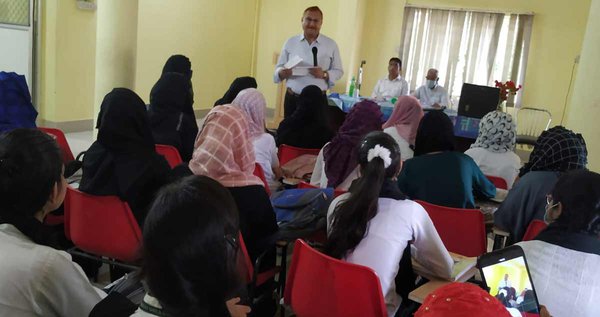
M.W. Ansari, former Director General of Police, Chhattisgarh speaking

Patna:

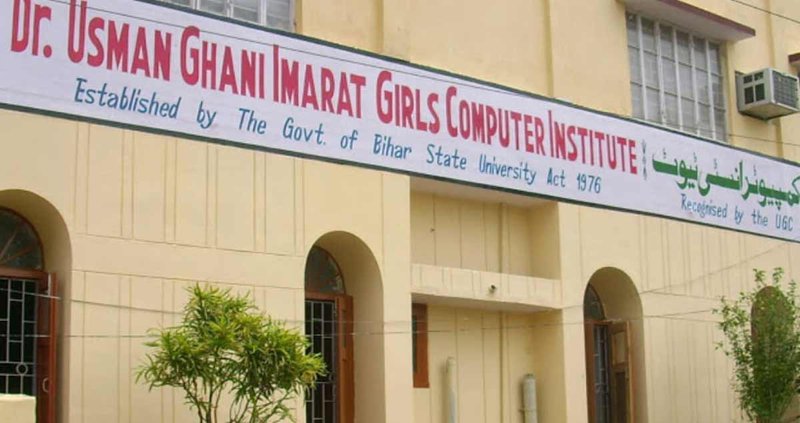
A career awareness program on civil services was held at Dr. Usman Ghani Imarat Girls’ Institute in Patna on 26 September 2021.

The program started with recitation of the Holy Quran.

While talking on ‘What is Civil Services’, Mohammad Naushad Ansari, Hon’y vice chairman of the Institute, through a power-point presentation, elaborated details on the profession of civil services, the rewards and challenges of being in civil services. He emphasised that all graduates are eligible to appear in this exam. They can definitely crack and get a good rank provided they plan their preparation under good guidance and work very hard. It is seen that a good number of candidates qualifying in civil services exams come from lower strata of the society. “Civil Servants of different services are the officers behind implementation of government development plans. They are the people who keep law and order, and work as a link between the public and the government”, he stated.

The chief guest, Mr. M W Ansari, former Director General of Police, Chhattisgarh spoke on the topic ‘Career in Civil Services: Criteria, roles and opportunities’. He stated that the prestige, power and the status that one acquires after entering civil services is immense and unparalleled. Besides, this service provides opportunity to serve the society and the nation at a larger scale. More than 10 lakh students apply for this exam each year. The number of aspirants is increasing every year. This year 761 students have cracked this prestigious exam, out of which only 31 students are from the Muslim community. It is too low considering their population. We require good number of quality institutions, proper guidance and good mentors so that chances of success brighten considerably. In particular, he pointed out that the proportion of Muslim women in these services is negligible. The community cannot prosper without bringing quality education among their women. He also appreciated the contribution of Dr. Usman Ghani Imarat Girls’ Institute in imparting education to the weaker sections of the society with limited resources. In the question and answer session he advised the students that the preparation for Civil Services exam should start from tenth class itself. Bihar had been contributing a good number of Civil Servants every year and this year’s topper in the exam is from Bihar only.

Mr. Khurshid Anwar Arfi, Senior journalist, renowned author of many books and Hon’y chairman of the institute, in his presidential address, emphasised that the community must focus on quality education which should enable new generation to successfully face the modern challenges. The other area of attention should be job-oriented courses and professional educational.

This institute offers various courses viz., BCA, BBA, B Lib. Sc, DCA, Diploma in Dress Designing etc which gives immense opportunity to girls to gain access into good professions and earnings.

He informed that the institute has a plan to organise similar career guidance programs and will be providing all the assistance needed to the Civil Services aspirants for state as well as for UPSC exams.

He thanked all the honorary members of the institute including Mr. Enam Khan, Secretary of the institute, for dedicating his time and energy for the institution’s development.

He also thanked all the teachers and, in particular, Mrs. Ruby Nishat, for offering her services to the institute voluntarily for over two years.

He acknowledged and offered dua for Late Maulana Wali Rahmani who worked hard for development of Institute’s building and infrastructure.

The program was attended by a large number of students, teachers and others. The welcome address was delivered by Mrs. Rupa Sharma, Principal of the Institute and vote of thanks was given by Mrs. Nuzhat Ghousiya . The girls put forward various questions and got enlightened. They noted down details of study plan for the exam and also felt ignited to write this exam.

Dr. Usman Ghani Imarat Girls’ Institute, Patna was established and run by Imarat-e-Shariah Educational & Welfare Trust, Bihar. It is one of the Knowledge Resource Centre of Maulana Mazharul Haque Arabic & Persian University, Bihar.

Union Public Service Commission (UPSC) is India’s premier central recruiting agency for central government public servants.

source: http://www.milligazette.com / The Milli Gazette / Home> News> Education & Careers / TheMilli Gazette Online / September 27th, 2021

Minority welfare: Bihar govt-run coaching centres help minority students clear exams, get jobs

Patna, BIHAR :

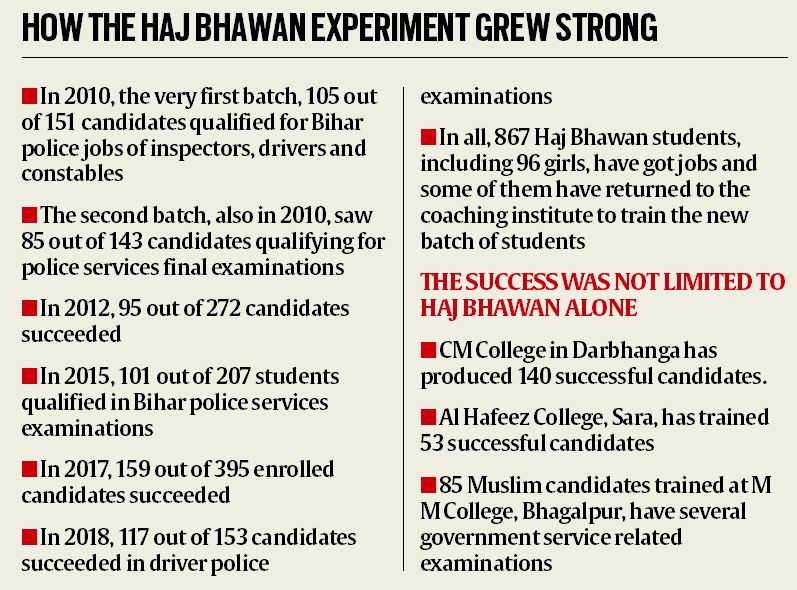
Since 2010, 867 candidates, including 96 girls, have joined the police; 46, including 12 girls, cleared BPSC.

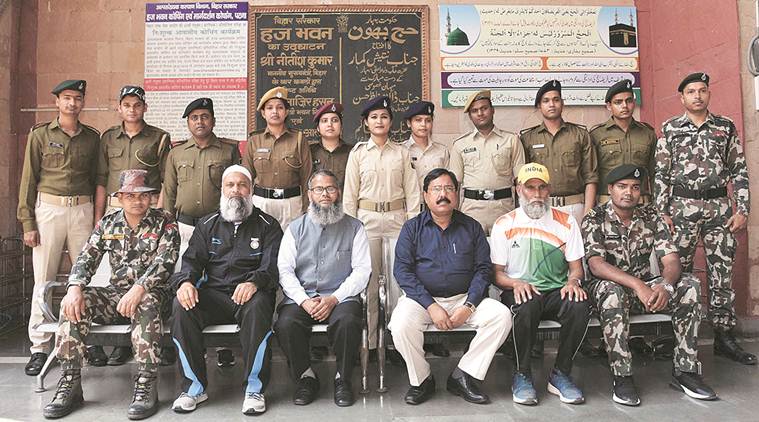
Trainers and successful students at Haj Bhawan coaching centre in Patna. (Express Photo)

Even though Muslims account for 17 per cent of Bihar’s population, according to a senior official, they make up only 2.5 per cent of the state’s police and less than 4 per cent of the other services. A decade ago, these numbers were even lower. And it was to remedy this lack of representation that Bihar’s Minority Welfare Department started a pilot programme to train Muslim students and help them clear different types of public services examinations.

Amir Subhani, Additional Chief Secretary of the Minority Welfare Department, said “As Haj Bhawan had been lying largely unused after pilgrimage season, we came up with the idea of utilising the vast space with a devoted coaching centre for minority boys and girls who needed some kind of motivation to do well in life. Chief Minister Nitish Kumar promptly approved the idea. It is very good to see girls not just coming out of their homes but also showing their increasing preferences for uniformed services. It is a success story under construction. We are trying to replicate it in maximum possible places”.

Since 2010, the Haj Bhawan Coaching and Guidance Cell has been providing almost free coaching to Muslim boys and girls in preparing for prelims, mains and interview stages of competitive examinations in Bihar.

Bihar, Bihar Muslim population, Bihar Minority Welfare schemes, Muslim students, muslims Bihar public services examinations, Nitish Kumar, indian express

 For the first four years, until 2013, it provided coaching only for police services test. Later, it included coaching for BPSC examinations as well. Haj Bhawan Guidance and Coaching Cell, under the nodal agency of Maulana Mazharul Haque Arabic and Persian University, selects Muslims students for training and coaching them in two different ways. One, it screens students that seek its help. Two, it calls deserving students that have cleared one stage or the other in an examination and helps them realise their dream.

Over the past decade, the Haj Bhawan experiment has gone from strength to strength (see box). What’s more, over the last couple of years, the Minority Welfare Department has been replicating the Haj Bhawan coaching model in other districts such as Darbhanga, Bhagalpur  and Ara. Further, it plans to expand this initiative to at least 10 more districts in the coming 3-4 years to attract Muslims girls and boys from rural areas.

“While a candidate coming for physical training is given free residential, fully centralised air-conditioner set-up, a student coming for mains coaching, has to pay Rs 3,500 per month. The centre has a rich library, two big classrooms and separate prayer halls for boys and girls,” said Mohammed Rashid Hussain, coordinator of Haj Bhawan Coaching and Guidance Cell. He said that Bihar’s Minority Welfare Minister Mohammed Khursheed (also known as Firoz Ahmad) contributes in his personal capacity as well by organising a lunch for students on special occasions.

EXPLAINED

Why was special training needed

Muslims, who account for 17% of Bihar’s population, are grossly under-represented in police and administrative services. Since 2010, the state government has been trying to remedy this by providing coaching facilities to the poor yet deserving students and helping them achieve their dream of serving in the government

The public area of the entire Haj Bhawan centre is under CCTV surveillance. Estimated per capita government cost on a student in one season is about Rs 20,000. But there is no fixed cap on the expenditure as it is a demand-driven scheme.

Most of the students in Haj Bhawan come from economically weak backgrounds. Boys and girls coming to study here have similar tales of poverty, struggle and lack of opportunities. Take, for instance, Akbar Ali who hails from Ara where his father runs a small bicycle repair shop. “I am the first boy from my village to come to Patna,” said Ali.

Students who have benefitted describe the initiative as a slow but silent revolution. Shabana Aazmi from East Champaran, who qualified as a constable in 2016 after receiving coaching, said that since becoming the first policewoman from her village, she is regarded as a role model and, in the last four years, many more girls have started preparing for competitive examinations.

source: http://www.indianexpress.com / The Indian Express / Home> Governance / by Santosh Singh / Patna, March 09th, 2020